Sotah 37a: Talmud study for Daf Yomi
Daf Yomi is the daily study of one Talmud folio. Explore 37 tractates with scans, Hebrew text, Sefaria English and AI-generated French translations where annotated.
Passage selection and English or AI-generated French translation are available where the scan has annotations. Daf Study is independent of Torah-Box and Sefaria.
Browse Sotah · סוטה · All tractatesSotah 37a text and translations
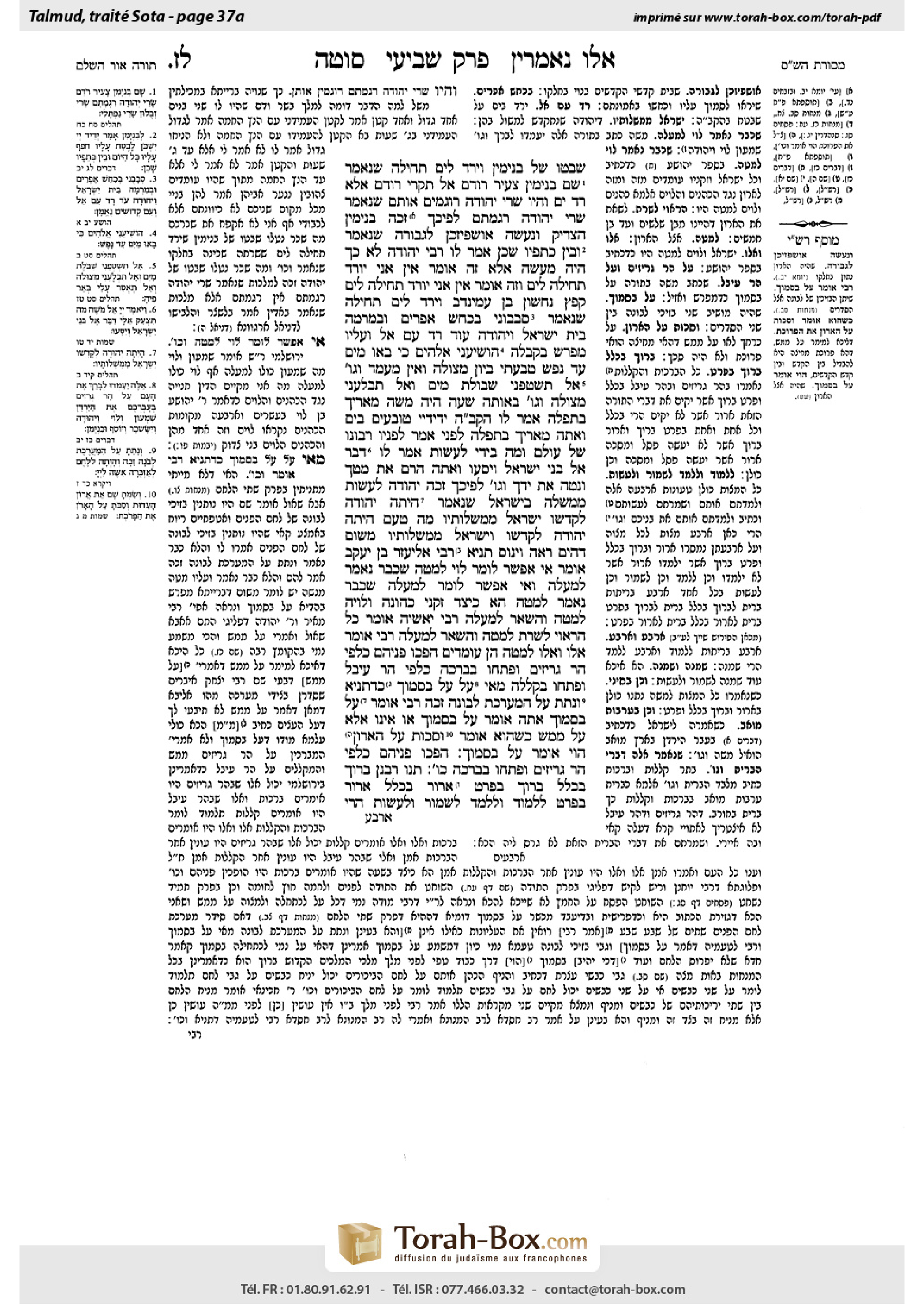
This page of Sotah includes the Aramaic text, an English translation and an AI-generated French translation, alongside the scan above.
סוטה ל״ז א · Aramaic and Hebrew text
שִׁבְטוֹ שֶׁל בִּנְיָמִין וְיָרַד לַיָּם תְּחִילָּה, שֶׁנֶּאֱמַר: ״שָׁם בִּנְיָמִין צָעִיר רֹדֵם״, אַל תִּקְרֵי ״רֹדֵם״ אֶלָּא ״רָד יָם״. וְהָיוּ שָׂרֵי יְהוּדָה רוֹגְמִים אוֹתָם, שֶׁנֶּאֱמַר: ״שָׂרֵי יְהוּדָה רִגְמָתָם״.
לְפִיכָךְ זָכָה בִּנְיָמִין הַצַּדִּיק וְנַעֲשָׂה אוּשְׁפִּיזְכָן לַגְּבוּרָה, שֶׁנֶּאֱמַר: ״וּבֵין כְּתֵפָיו שָׁכֵן״.
אָמַר לוֹ רַבִּי יְהוּדָה: לֹא כָּךְ הָיָה מַעֲשֶׂה, אֶלָּא זֶה אוֹמֵר: אֵין אֲנִי יוֹרֵד תְּחִילָּה לַיָּם, וְזֶה אוֹמֵר: אֵין אֲנִי יוֹרֵד תְּחִילָּה לַיָּם, קָפַץ נַחְשׁוֹן בֶּן עַמִּינָדָב וְיָרַד לַיָּם תְּחִילָּה, שֶׁנֶּאֱמַר: ״סְבָבֻנִי בְכַחַשׁ אֶפְרַיִם וּבְמִרְמָה בֵּית יִשְׂרָאֵל וִיהוּדָה עֹד רָד עִם אֵל״.
וְעָלָיו מְפֹרָשׁ בַּקַּבָּלָה: ״הוֹשִׁיעֵנִי אֱלֹהִים כִּי בָאוּ מַיִם עַד נָפֶשׁ ... טָבַעְתִּי בִּיוֵן מְצוּלָה וְאֵין מׇעֳמָד וְגוֹ׳״, ״אַל תִּשְׁטְפֵנִי שִׁבֹּלֶת מַיִם וְאַל תִּבְלָעֵנִי מְצוּלָה וְגוֹ׳״.
בְּאוֹתָהּ שָׁעָה הָיָה מֹשֶׁה מַאֲרִיךְ בִּתְפִלָּה, אָמַר לוֹ הַקָּדוֹשׁ בָּרוּךְ הוּא: יְדִידַיי טוֹבְעִים בַּיָּם וְאַתָּה מַאֲרִיךְ בִּתְפִלָּה לְפָנַי?! אָמַר לְפָנָיו: רִבּוֹנוֹ שֶׁל עוֹלָם! וּמָה בְּיָדִי לַעֲשׂוֹת? אָמַר לוֹ: ״דַּבֵּר אֶל בְּנֵי יִשְׂרָאֵל וְיִסָּעוּ. וְאַתָּה הָרֵם אֶת מַטְּךָ וּנְטֵה אֶת יָדְךָ וְגוֹ׳״.
לְפִיכָךְ, זָכָה יְהוּדָה לַעֲשׂוֹת מֶמְשָׁלָה בְּיִשְׂרָאֵל, שֶׁנֶּאֱמַר: ״הָיְתָה יְהוּדָה לְקׇדְשׁוֹ יִשְׂרָאֵל מַמְשְׁלוֹתָיו״, מָה טַעַם ״הָיְתָה יְהוּדָה לְקׇדְשׁוֹ וְיִשְׂרָאֵל מַמְשְׁלוֹתָיו״ — מִשּׁוּם דְּ״הַיָּם רָאָה וַיָּנֹס״.
תַּנְיָא, רַבִּי אֱלִיעֶזֶר בֶּן יַעֲקֹב אוֹמֵר: אִי אֶפְשָׁר לוֹמַר לֵוִי לְמַטָּה, שֶׁכְּבָר נֶאֱמַר לְמַעְלָה. וְאִי אֶפְשָׁר לוֹמַר לְמַעְלָה, שֶׁכְּבָר נֶאֱמַר לְמַטָּה.
הָא כֵּיצַד? זִקְנֵי כְּהוּנָּה וּלְוִיָּה לְמַטָּה, וְהַשְּׁאָר לְמַעְלָה. רַבִּי יֹאשִׁיָּה אוֹמֵר: כׇּל הָרָאוּי לְשָׁרֵת לְמַטָּה, וְהַשְּׁאָר לְמַעְלָה.
רַבִּי אוֹמֵר: אֵלּוּ וְאֵלּוּ לְמַטָּה הֵן עוֹמְדִים, הָפְכוּ פְּנֵיהֶם כְּלַפֵּי הַר גְּרִיזִים וּפָתְחוּ בִּבְרָכָה, כְּלַפֵּי הַר עֵיבָל וּפָתְחוּ בִּקְלָלָה. מַאי ״עַל״ — עַל בְּסָמוּךְ.
כִּדְתַנְיָא: ״וְנָתַתָּ עַל הַמַּעֲרֶכֶת לְבוֹנָה זַכָּה״, רַבִּי אוֹמֵר: ״עַל״ — בְּסָמוּךְ. אַתָּה אוֹמֵר ״עַל״ בְּסָמוּךְ, אוֹ אֵינוֹ אֶלָּא עַל מַמָּשׁ? כְּשֶׁהוּא אוֹמֵר ״וְסַכֹּתָ עַל הָאָרֹן״, הֱוֵי אוֹמֵר ״עַל״ בְּסָמוּךְ.
הָפְכוּ פְּנֵיהֶם כְּלַפֵּי הַר גְּרִיזִים וּפָתְחוּ בִּבְרָכָה כּוּ׳, תָּנוּ רַבָּנַן: ״בָּרוּךְ״ בִּכְלָל, ״בָּרוּךְ״ בִּפְרָט. ״אָרוּר״ בִּכְלָל, ״אָרוּר״ בִּפְרָט, לִלְמוֹד וּלְלַמֵּד לִשְׁמוֹר וְלַעֲשׂוֹת, הֲרֵי
Sotah 37a · English translation
the tribe of Benjamin and descended into the sea first, as it is stated: “There is Benjamin, the youngest, ruling them [rodem]” (Psalms 68:28). Do not read it as: “Ruling them [rodem]”; rather, read it as: Descending [red] into the sea [yam]. And the princes of the tribe of Judah were stoning them [rogmim otam] for plunging in first and not in the proper order, as it is stated in the continuation of the verse: “The princes of Judah, their council [rigmatam]” (Psalms 68:28).
Therefore, Benjamin the righteous was privileged to serve as host to the Divine Presence of the Almighty, as the Temple was built in the territory of Benjamin, as it is stated in Moses’ blessing for the tribe of Benjamin: “The beloved of the Lord shall dwell in safety by Him; He covers him all the day, and He rests between his shoulders” (Deuteronomy 33:12).
Rabbi Yehuda said to Rabbi Meir: That is not how the incident took place. Rather, this tribe said: I am not going into the sea first, and that tribe said: I am not going into the sea first. Then, in jumped the prince of Judah, Nahshon ben Amminadab, and descended into the sea first, accompanied by his entire tribe, as it is stated: “Ephraim surrounds Me with lies and the house of Israel with deceit, and Judah is yet wayward toward God [rad im El]” (Hosea 12:1), which is interpreted homiletically as: And Judah descended [rad] with God [im El].
And in this regard, the tradition, i.e., the Writings, explicates Nahshon’s prayer at that moment: “Save me, God; for the waters are come in even unto the soul. I am sunk in deep mire, where there is no standing…let not the water flood overwhelm me, neither let the deep swallow me up” (Psalms 69:2–3, 16).
At that time, Moses was prolonging his prayer. The Holy One, Blessed be He, said to him: My beloved ones are drowning in the sea and you prolong your prayer to me? Moses said before Him: Master of the Universe, but what can I do? God said to him: “Speak to the children of Israel that they go forward. And you, lift up your rod and stretch out your hand” (Exodus 14:15–16).
For this reason, because Nahshon and the tribe of Judah went into the sea first, the tribe of Judah merited to govern Israel, as it is stated: “Judah became His sanctuary, Israel His dominion. The sea saw it and fled” (Psalms 114:2–3). The baraita interprets the verses in this manner: What is the reason that Judah became His sanctuary and Israel came under His dominion? It is because “the sea saw it and fled.”
§ The Gemara returns to discussing the blessing and curses. It is taught in a baraita (Tosefta 8:9) that Rabbi Eliezer ben Ya’akov says: It is impossible to say that the tribe of Levi stood below, between the two mountains, as it is already stated that they were above, in the verse: “These shall stand on Mount Gerizim to bless the people when you have passed over the Jordan: Simeon and Levi and Judah” (Deuteronomy 27:12). And it is impossible to say that they stood above on the mountain because it is already stated: “And all of Israel, and their elders and officers, and their judges, stood on this side of the Ark and on that side before the priests the Levites” (Joshua 8:33). This shows that the Levites stood below, between the mountains, with the Ark.
How is this possible? Only the Elders of the priesthood and the Levites stood below, and the rest of the Levites stood above on the mountain. Rabbi Yoshiya says: Any Levite who was fit to serve in the Temple stood below, between the mountains, and the rest of the tribe, who were too young or too old to serve in the Temple, stood above on the mountain.
Rabbi Yehuda HaNasi says: Both the Levites and the Israelites were standing below. They turned to face Mount Gerizim and opened with a blessing, and then they turned toward Mount Ebal and opened with a curse. Therefore, what is the meaning of the verse: “These shall stand on [al] Mount Gerizim to bless the people” (Deuteronomy 27:12)? “Al” means adjacent to the mountain but not actually on the mountain itself.
As it is taught in a baraita that discusses the shewbread: “And you shall put pure frankincense on [al] each row” (Leviticus 24:7). Rabbi Yehuda HaNasi says: “Al” in this instance means adjacent to. Do you say that “al” means adjacent to, or perhaps it carries only its literal meaning of “on”? When it says in the verse: “And you shall screen the Ark [al haAron] with the curtain” (Exodus 40:3), the word “al” cannot mean on, as the curtain that separated the Sanctuary and the Holy of Holies was not placed on top of the Ark, but near it. Therefore, you must say that “al” means adjacent to.
§ It is stated in the mishna: They turned to face Mount Gerizim and opened with a blessing: Blessed be the man who does not make a graven or molten image (see Deuteronomy 27:15), and these people and those people, i.e., the two groups standing on either mountain, answered: Amen. Then they turned to face Mount Ebal and opened with the curse: “Cursed be the man who makes a graven or molten image” (Deuteronomy 27:15), and these people and those people answered: Amen. The Sages taught (Tosefta 8:10): The blessings and curses include a general blessing for one who fulfills the entire Torah, and a particular blessing for each individual statement mentioned in the blessings and curses. Likewise, there is a general curse for one who does not fulfill the entire Torah and a particular curse for each individual statement. And for each of the blessings and curses there is a mitzva to learn and to teach, and to keep and to perform. Consequently,
Sotah 37a · Traduction française (IA)
la tribu de Benjamin, et descendit la première dans la mer, comme il est dit : « Voici Benjamin, le plus jeune, qui les gouverne [rodem] » (Psaumes 68:28). Ne lis pas : « qui les gouverne [rodem] », mais plutôt : « qui descend [red] dans la mer [yam] ». Les princes de la tribu de Juda leur jetaient des pierres [rogmim otam] parce qu’ils s’étaient élancés les premiers, sans respecter l’ordre approprié, comme il est dit dans la suite du verset : « Les princes de Juda, leur conseil [rigmatam] » (Psaumes 68:28).
C’est pourquoi Benjamin le juste eut le mérite d’accueillir la Présence divine du Tout-Puissant, car le Temple fut construit sur le territoire de Benjamin, comme il est dit dans la bénédiction de Moïse pour la tribu de Benjamin : « Le bien-aimé du Seigneur demeurera en sécurité auprès de Lui ; Il le protège tout le jour, et Il réside entre ses épaules » (Deutéronome 33:12).
Rabbi Yehuda dit à Rabbi Meïr : L’événement ne s’est pas déroulé ainsi. Cette tribu disait : « Je ne vais pas entrer la première dans la mer », et cette autre tribu disait : « Je ne vais pas entrer la première dans la mer. » Alors le prince de Juda, Nahshon ben Amminadab, se jeta à l’eau et descendit le premier dans la mer, accompagné de toute sa tribu, comme il est dit : « Éphraïm M’entoure de mensonges et la maison d’Israël de tromperie, et Juda reste rebelle envers Dieu [rad im El] » (Osée 12:1), ce qui est interprété par homélie ainsi : Juda descendit [rad] avec Dieu [im El].
À ce propos, la tradition, c’est-à-dire les Écrits, explicite la prière de Nahshon à ce moment-là : « Sauve-moi, ô Dieu, car les eaux ont pénétré jusqu’à mon âme. Je m’enfonce dans une fange profonde, où l’on ne peut se tenir… Que le courant des eaux ne m’engloutisse pas, que l’abîme ne m’engloutisse pas » (Psaumes 69:2–3, 16).
À ce moment-là, Moïse prolongeait sa prière. Le Saint, béni soit-Il, lui dit : « Mes bien-aimés se noient dans la mer, et toi, tu prolonges ta prière devant Moi ? » Moïse lui dit : « Maître de l’univers, que puis-je faire ? » Dieu lui dit : « Dis aux enfants d’Israël d’avancer. Et toi, lève ton bâton et étends ta main » (Exode 14:15–16).
C’est parce que Nahshon et la tribu de Juda entrèrent les premiers dans la mer que la tribu de Juda eut le mérite de gouverner Israël, comme il est dit : « Juda devint Son sanctuaire, Israël Son domaine. La mer le vit et s’enfuit » (Psaumes 114:2–3). La baraïta interprète ainsi ces versets : Pourquoi Juda devint-il Son sanctuaire et Israël passa-t-il sous Son autorité ? Parce que « la mer le vit et s’enfuit ».
§ La Guemara revient à la discussion sur la bénédiction et les malédictions. Il est enseigné dans une baraïta (Tosefta 8:9) que Rabbi Eliezer ben Ya’akov dit : Il est impossible de dire que la tribu de Lévi se tenait en contrebas, entre les deux montagnes, puisqu’il est déjà dit qu’elle se tenait en haut, dans le verset : « Ceux-ci se tiendront sur le mont Garizim pour bénir le peuple, lorsque vous aurez traversé le Jourdain : Siméon, Lévi et Juda » (Deutéronome 27:12). Et il est impossible de dire qu’ils se tenaient en haut de la montagne, puisqu’il est déjà dit : « Tout Israël, ses anciens, ses officiers et ses juges se tenaient de part et d’autre de l’Arche, devant les prêtres lévites » (Josué 8:33). Cela montre que les Lévites se tenaient en contrebas, entre les montagnes, avec l’Arche.
Comment cela est-il possible ? Seuls les anciens parmi les prêtres et les Lévites se tenaient en contrebas ; le reste des Lévites se tenait en haut de la montagne. Rabbi Yoshiya dit : Tout Lévite apte à servir dans le Temple se tenait en contrebas, entre les montagnes, tandis que le reste de la tribu, trop jeune ou trop âgé pour servir dans le Temple, se tenait en haut de la montagne.
Rabbi Yehuda HaNasi dit : Les Lévites et les Israélites se tenaient tous en contrebas. Ils se tournèrent vers le mont Garizim et commencèrent par une bénédiction, puis ils se tournèrent vers le mont Ébal et commencèrent par une malédiction. Quel est donc le sens du verset : « Ceux-ci se tiendront sur [al] le mont Garizim pour bénir le peuple » (Deutéronome 27:12) ? « Al » signifie à proximité de la montagne, mais pas sur la montagne elle-même.
Comme il est enseigné dans une baraïta qui traite des pains de proposition : « Tu mettras de l’encens pur sur [al] chaque rangée » (Lévitique 24:7). Rabbi Yehuda HaNasi dit : Ici, « al » signifie « à proximité de ». Dirais-tu que « al » signifie « à proximité de », ou peut-être a-t-il uniquement son sens littéral de « sur » ? Dans le verset : « Tu placeras le voile devant l’Arche [al haAron] » (Exode 40:3), le mot « al » ne peut pas signifier « sur », car le voile qui séparait le Sanctuaire du Saint des Saints n’était pas placé au-dessus de l’Arche, mais à proximité. Il faut donc dire que « al » signifie « à proximité de ».
§ Il est dit dans la Michna : Ils se tournèrent vers le mont Garizim et commencèrent par une bénédiction : « Béni soit l’homme qui ne fabrique pas d’idole sculptée ou fondue » (voir Deutéronome 27:15), et ceux-ci et ceux-là, c’est-à-dire les deux groupes se tenant sur chacune des montagnes, répondirent : Amen. Puis ils se tournèrent vers le mont Ébal et commencèrent par la malédiction : « Maudit soit l’homme qui fabrique une idole sculptée ou fondue » (Deutéronome 27:15), et ceux-ci et ceux-là répondirent : Amen. Les Sages ont enseigné (Tosefta 8:10) : Les bénédictions et les malédictions comprennent une bénédiction générale pour celui qui accomplit toute la Torah, ainsi qu’une bénédiction particulière pour chacune des déclarations mentionnées dans les bénédictions et les malédictions. De même, il y a une malédiction générale pour celui qui n’accomplit pas toute la Torah, ainsi qu’une malédiction particulière pour chacune des déclarations. Pour chacune des bénédictions et des malédictions, il y a une mitsva d’étudier et d’enseigner, de garder et d’accomplir. Par conséquent,
Traduction française générée par IA à partir de l’édition anglaise de Sefaria. Vérifie toujours un passage avec le texte source.
Text from Sefaria: William Davidson Edition - Vocalized Aramaic (CC BY NC); William Davidson Edition - English (CC BY NC).