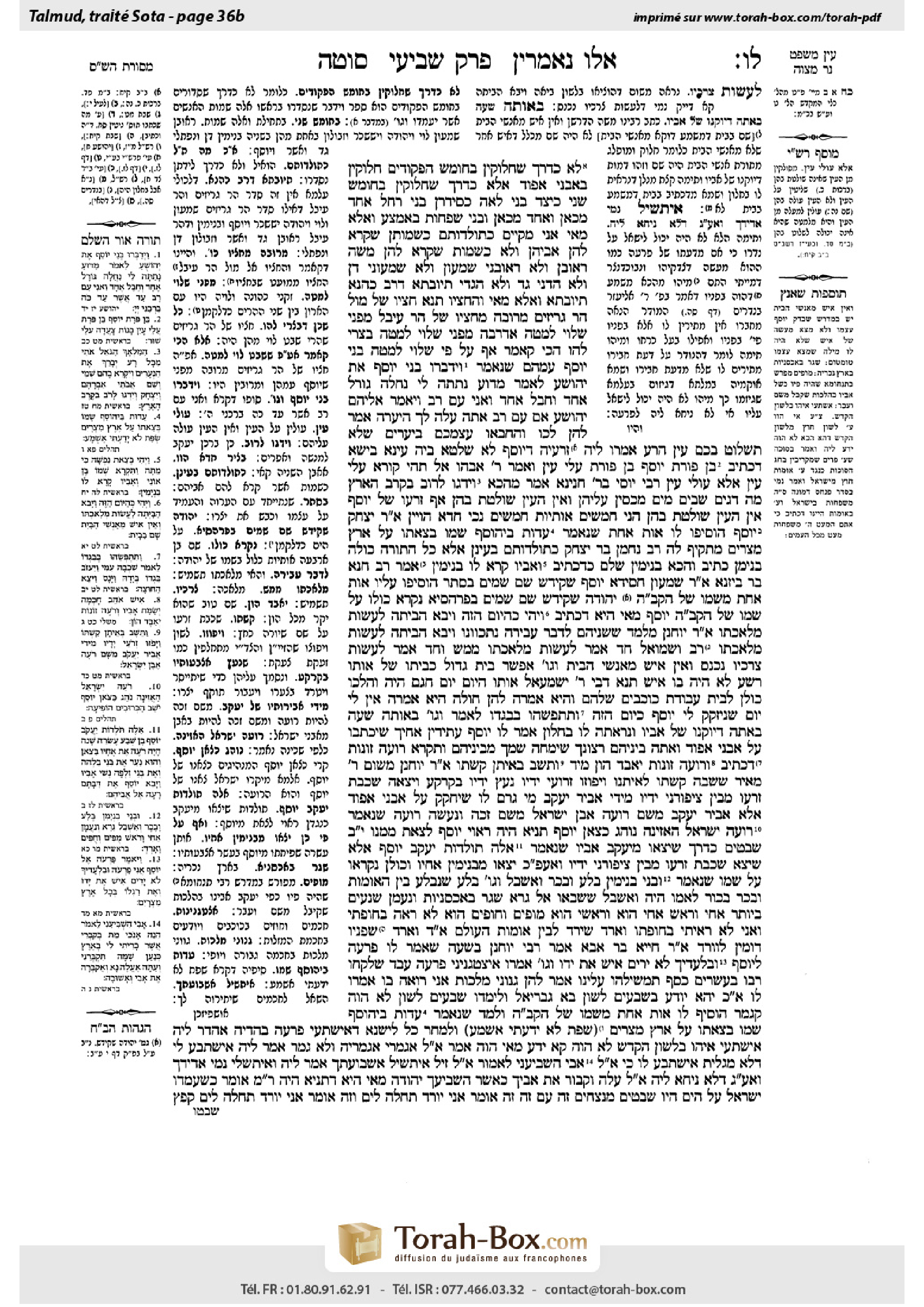
Sotah 36b: Talmud study for Daf Yomi
Daf Yomi is the daily study of one Talmud folio. Explore 37 tractates with scans, Hebrew text, Sefaria English and AI-generated French translations where annotated.
Passage selection and English or AI-generated French translation are available where the scan has annotations. Daf Study is independent of Torah-Box and Sefaria.
Browse Sotah · סוטה · All tractatesSotah 36b text and translations
This page of Sotah includes the Aramaic text, an English translation and an AI-generated French translation, alongside the scan above.
סוטה ל״ו ב · Aramaic and Hebrew text
לֹא כְּדֶרֶךְ שֶׁחֲלוּקִין בְּחוֹמֶשׁ הַפְּקוּדִים, חֲלוּקִין בְּאַבְנֵי אֵפוֹד, אֶלָּא כְּדֶרֶךְ שֶׁחֲלוּקִין בְּחוֹמֶשׁ שֵׁנִי.
כֵּיצַד? בְּנֵי לֵאָה כְּסִידְרָן, בְּנֵי רָחֵל אֶחָד מִכָּאן וְאֶחָד מִכָּאן, וּבְנֵי שְׁפָחוֹת בָּאֶמְצַע.
וְאֶלָּא מַאי אֲנִי מְקַיֵּים ״כְּתוֹלְדֹתָם״ — כִּשְׁמוֹתָן שֶׁקָּרָא לָהֶן אֲבִיהֶן, וְלֹא כְּשֵׁמוֹת שֶׁקָּרָא לָהֶן מֹשֶׁה. ״רְאוּבֵן״, וְלֹא ״רְאוּבֵנִי״, ״שִׁמְעוֹן״, וְלֹא ״שִׁמְעוֹנִי״, ״דָּן״ וְלֹא ״הַדָּנִי״, ״גָּד״ וְלֹא ״הַגָּדִי״. תְּיוּבְתָּא דְּרַב כָּהֲנָא! תְּיוּבְתָּא.
וְאֶלָּא מַאי ״וְהַחֶצְיוֹ״? תָּנָא: — חֶצְיוֹ שֶׁל מוּל הַר גְּרִיזִים מְרוּבֶּה מֵחֶצְיוֹ שֶׁל הַר עֵיבָל, מִפְּנֵי שֶׁלֵּוִי לְמַטָּה.
אַדְּרַבָּה, מִפְּנֵי שֶׁלֵּוִי לְמַטָּה בָּצְרִי לְהוּ! הָכִי קָאָמַר: אַף עַל פִּי שֶׁלֵּוִי לְמַטָּה — בְּנֵי יוֹסֵף עִמָּהֶם. שֶׁנֶּאֱמַר: ״וַיְדַבְּרוּ בְּנֵי יוֹסֵף אֶת יְהוֹשֻׁעַ לֵאמֹר מַדּוּעַ נָתַתָּה לִּי נַחֲלָה גּוֹרָל אֶחָד וְחֶבֶל אֶחָד וַאֲנִי עַם רָב ... וַיֹּאמֶר אֲלֵיהֶם יְהוֹשֻׁעַ אִם עַם רַב אַתָּה עֲלֵה לְךָ הַיַּעְרָה״.
אָמַר לָהֶן: לְכוּ וְהַחְבִּיאוּ עַצְמְכֶם בַּיְּעָרִים, שֶׁלֹּא תִּשְׁלוֹט בָּכֶם עַיִן הָרָע. אֲמַרוּ לֵיהּ: זַרְעֵיהּ דְּיוֹסֵף לָא שָׁלְטָא בֵּיהּ עֵינָא בִּישָׁא, דִּכְתִיב: ״בֵּן פֹּרָת יוֹסֵף בֵּן פֹּרָת עֲלֵי עָיִן״, וְאָמַר רַבִּי אֲבָהוּ: אַל תְּהִי קוֹרֵא ״עֲלֵי עָיִן״, אֶלָּא ״עוֹלֵי עָיִן״.
רַבִּי יוֹסֵי בְּרַבִּי חֲנִינָא אֲמַר, מֵהָכָא: ״וְיִדְגּוּ לָרֹב בְּקֶרֶב הָאָרֶץ״, מָה דָּגִים שֶׁבַּיָּם — מַיִם מְכַסִּין עֲלֵיהֶן וְאֵין הָעַיִן שׁוֹלֶטֶת בָּהֶן, אַף זַרְעוֹ שֶׁל יוֹסֵף — אֵין הָעַיִן שׁוֹלֶטֶת בָּהֶן.
הָנֵי חֲמִשִּׁים אוֹתִיּוֹת? חֲמִשִּׁים נְכֵי חֲדָא הָוְיָין! אָמַר רַבִּי יִצְחָק: יוֹסֵף הוֹסִיפוּ לוֹ אוֹת אַחַת, שֶׁנֶּאֱמַר: ״עֵדוּת בִּיהוֹסֵף שָׂמוֹ בְּצֵאתוֹ עַל אֶרֶץ מִצְרָיִם״.
מַתְקֵיף לַהּ רַב נַחְמָן בַּר יִצְחָק: ״כְּתוֹלְדֹתָם״ בָּעֵינַן! אֶלָּא: כׇּל הַתּוֹרָה כּוּלָּהּ ״בִּנְיָמִן״ כְּתִיב, וְהָכָא ״בִּנְיָמִין״ שָׁלֵם, כְּדִכְתִיב: ״וְאָבִיו קָרָא לוֹ בִנְיָמִין״.
אָמַר רַב חָנָא בַּר בִּיזְנָא אָמַר רַבִּי שִׁמְעוֹן חֲסִידָא: יוֹסֵף שֶׁקִּידֵּשׁ שֵׁם שָׁמַיִם בַּסֵּתֶר — הוֹסִיפוּ עָלָיו אוֹת אַחַת מִשְּׁמוֹ שֶׁל הַקָּדוֹשׁ בָּרוּךְ הוּא, יְהוּדָה שֶׁקִּידֵּשׁ שֵׁם שָׁמַיִם בְּפַרְהֶסְיָא — נִקְרָא כּוּלּוֹ עַל שְׁמוֹ שֶׁל הַקָּדוֹשׁ בָּרוּךְ הוּא.
יוֹסֵף מַאי הִיא — דִּכְתִיב: ״וַיְהִי כְּהַיּוֹם הַזֶּה וַיָּבֹא הַבַּיְתָה לַעֲשׂוֹת מְלַאכְתּוֹ״, אָמַר רַבִּי יוֹחָנָן: מְלַמֵּד שֶׁשְּׁנֵיהֶם לִדְבַר עֲבֵירָה נִתְכַּוְּונוּ. ״וַיָּבֹא הַבַּיְתָה לַעֲשׂוֹת מְלַאכְתּוֹ״. רַב וּשְׁמוּאֵל, חַד אָמַר: לַעֲשׂוֹת מְלַאכְתּוֹ מַמָּשׁ, וְחַד אָמַר: לַעֲשׂוֹת צְרָכָיו נִכְנַס.
״וְאֵין אִישׁ מֵאַנְשֵׁי הַבַּיִת וְגוֹ׳״, אֶפְשָׁר בַּיִת גָּדוֹל כְּבֵיתוֹ שֶׁל אוֹתוֹ רָשָׁע לֹא הָיָה בּוֹ אִישׁ?! תָּנָא דְּבֵי רַבִּי יִשְׁמָעֵאל: אוֹתוֹ הַיּוֹם יוֹם חַגָּם הָיָה, וְהָלְכוּ כּוּלָּן לְבֵית עֲבוֹדָה זָרָה שֶׁלָּהֶם, וְהִיא אָמְרָה לָהֶן חוֹלָה הִיא, אָמְרָה: אֵין לִי יוֹם שֶׁנִּיזְקָק לִי יוֹסֵף כַּיּוֹם הַזֶּה.
״וַתִּתְפְּשֵׂהוּ בְּבִגְדוֹ לֵאמֹר וְגוֹ׳״, בְּאוֹתָהּ שָׁעָה בָּאתָה דְּיוֹקְנוֹ שֶׁל אָבִיו וְנִרְאֲתָה לוֹ בַּחַלּוֹן, אָמַר לוֹ יוֹסֵף! עֲתִידִין אַחֶיךָ שֶׁיִּכָּתְבוּ עַל אַבְנֵי אֵפוֹד וְאַתָּה בֵּינֵיהֶם, רְצוֹנְךָ שֶׁיִּמָּחֶה שִׁמְךָ מִבֵּינֵיהֶם, וְתִקָּרֵא רוֹעֶה זוֹנוֹת? דִּכְתִיב: ״וְרֹעֶה זוֹנוֹת יְאַבֶּד הוֹן״.
מִיָּד — ״וַתֵּשֶׁב בְּאֵיתָן קַשְׁתּוֹ״, אָמַר רַבִּי יוֹחָנָן מִשּׁוּם רַבִּי מֵאִיר: שֶׁשָּׁבָה קַשְׁתּוֹ לְאֵיתָנָהּ. ״וַיָּפֹזּוּ זְרוֹעֵי יָדָיו״ — נָעַץ יָדָיו בַּקַּרְקַע וְיָצְאָה שִׁכְבַת זַרְעוֹ מִבֵּין צִיפּוֹרְנֵי יָדָיו.
״מִידֵּי אֲבִיר יַעֲקֹב״, מִי גָּרַם לוֹ שֶׁיֵּחָקֵק עַל אַבְנֵי אֵפוֹד — אֶלָּא אֲבִיר יַעֲקֹב. ״מִשָּׁם רֹעֶה אֶבֶן יִשְׂרָאֵל״, מִשָּׁם זָכָה וְנַעֲשָׂה רוֹעֶה, שֶׁנֶּאֱמַר: ״רוֹעֵה יִשְׂרָאֵל הַאֲזִינָה נֹהֵג כַּצֹּאן יוֹסֵף״.
תַּנְיָא: הָיָה רָאוּי יוֹסֵף לָצֵאת מִמֶּנּוּ שְׁנֵים עָשָׂר שְׁבָטִים כְּדֶרֶךְ שֶׁיָּצְאוּ מִיַּעֲקֹב אָבִיו, שֶׁנֶּאֱמַר: ״אֵלֶּה תֹּלְדוֹת יַעֲקֹב יוֹסֵף״, אֶלָּא שֶׁיָּצָא שִׁכְבַת זַרְעוֹ מִבֵּין צִיפּוֹרְנֵי יָדָיו. וְאַף עַל פִּי כֵן, יָצְאוּ מִבִּנְיָמִין אָחִיו, וְכוּלָּן נִקְרְאוּ עַל שְׁמוֹ, שֶׁנֶּאֱמַר: ״וּבְנֵי בִנְיָמִן בֶּלַע וָבֶכֶר וְאַשְׁבֵּל וְגוֹ׳״.
״בֶּלַע״ — שֶׁנִּבְלַע בֵּין הָאוּמּוֹת, ״וּבֶכֶר״ — בְּכוֹר לְאִמּוֹ הָיָה, ״וְאַשְׁבֵּל״ — שֶׁשְּׁבָאוֹ אֵל, ״גֵּרָא״ — שֶׁגָּר בְּאַכְסַנְיוֹת,
״וְנַעֲמָן״ — שֶׁנָּעִים בְּיוֹתֵר, ״אֵחִי וָרֹאשׁ״ — אָחִי הוּא וְרֹאשִׁי הוּא, ״מֻפִּים וְחֻפִּים״ — הוּא לֹא רָאָה בְּחוּפָּתִי וַאֲנִי לֹא רָאִיתִי בְּחוּפָּתוֹ, ״וָאָרְדְּ״ — שֶׁיָּרַד לְבֵין אוּמּוֹת הָעוֹלָם. אִיכָּא דְּאָמְרִי: ״וָאָרְדְּ״ — שֶׁפָּנָיו דּוֹמִין לְוֶורֶד.
אָמַר רַבִּי חִיָּיא בַּר אַבָּא אָמַר רַבִּי יוֹחָנָן: בְּשָׁעָה שֶׁאָמַר לוֹ פַּרְעֹה לְיוֹסֵף ״וּבִלְעָדֶיךָ לֹא יָרִים אִישׁ אֶת יָדוֹ וְגוֹ׳״, אָמְרוּ אִיצְטַגְנִינֵי פַרְעֹה: עֶבֶד שֶׁלְּקָחוֹ רַבּוֹ בְּעֶשְׂרִים כֶּסֶף תַּמְשִׁילֵהוּ עָלֵינוּ? אָמַר לָהֶן: גִּנּוּנֵי מַלְכוּת אֲנִי רוֹאֶה בּוֹ.
אָמְרוּ לוֹ: אִם כֵּן, יְהֵא יוֹדֵעַ בְּשִׁבְעִים לָשׁוֹן! בָּא גַּבְרִיאֵל וְלִימְּדוֹ שִׁבְעִים לָשׁוֹן. לָא הֲוָה קָגָמַר. הוֹסִיף לוֹ אוֹת אַחַת מִשְּׁמוֹ שֶׁל הַקָּדוֹשׁ בָּרוּךְ הוּא וְלָמַד, שֶׁנֶּאֱמַר: ״עֵדוּת בִּיהוֹסֵף שָׂמוֹ בְּצֵאתוֹ עַל אֶרֶץ מִצְרָיִם שְׂפַת לֹא יָדַעְתִּי אֶשְׁמָע״. וּלְמָחָר, כֹּל לִישָּׁנָא דְּאִישְׁתַּעִי פַּרְעֹה בַּהֲדֵיהּ, אַהְדַּר לֵיהּ.
אִישְׁתַּעִי אִיהוּ בִּלְשׁוֹן הַקֹּדֶשׁ, לָא הֲוָה קָא יָדַע מַאי הֲוָה אָמַר. אֲמַר לֵיהּ: אַגְמַרִי. אַגְמְרֵיהּ וְלָא גְּמַר. אֲמַר לֵיהּ: אִישְׁתְּבַע לִי דְּלָא מְגַלֵּית. אִישְׁתְּבַע לוֹ.
כִּי אֲמַר לֵיהּ ״אָבִי הִשְׁבִּיעַנִי לֵאמֹר״, אֲמַר לֵיהּ: זִיל אִיתְּשִׁיל אַשְּׁבוּעֲתָךְ. אֲמַר לֵיהּ: וְאִיתְּשִׁיל נָמֵי אַדִּידָךְ. וְאַף עַל גַּב דְּלָא נִיחָא לֵיהּ, אֲמַר לֵיהּ: ״עֲלֵה וּקְבֹר אֶת אָבִיךָ כַּאֲשֶׁר הִשְׁבִּיעֶךָ״.
יְהוּדָה מַאי הִיא? דְּתַנְיָא, הָיָה רַבִּי מֵאִיר אוֹמֵר: כְּשֶׁעָמְדוּ יִשְׂרָאֵל עַל הַיָּם הָיוּ שְׁבָטִים מְנַצְּחִים זֶה עִם זֶה, זֶה אוֹמֵר: אֲנִי יוֹרֵד תְּחִלָּה לַיָּם, וְזֶה אוֹמֵר: אֲנִי יוֹרֵד תְּחִלָּה לַיָּם, קָפַץ
Sotah 36b · English translation
The names of the tribes were not divided on the stones of the ephod the same way that they were divided in the list found at the beginning of the book of Numbers (Numbers 1:1–15). Rather they were divided the way that they were divided in the second book, i.e., Exodus (Exodus 1:2–4).
How were they written? On one stone, the names of the sons of Leah were written in the order of their birth: Reuben, Simeon, Levi, Judah, Issachar, and Zebulun. On the other stone the sons of Rachel were written. One, Benjamin, was written on this side, i.e., at the bottom of the list, and one, Joseph, was written on that side, i.e., at the top of the list. And the children of the handmaids, i.e., Bilhah and Zilpah, who were Dan, Naphtali, Gad, and Asher, were written on the second stone in the middle.
But rather, if their names were not written in the order of their births, then how do I establish the meaning of the phrase: “According to their birth” (Exodus 28:10)? It means that their names were written according to the names that their father, Jacob, called them, and not according to the names that Moses called them. On the stones it said Reuben, and not Reubenites; Simeon, and not Simeonites; Dan, and not Danites; Gad, and not Gadites. This baraita contradicts Rav Kahana’s opinion, as according to all of the opinions in the baraita, the division of the names on the ephod is not identical to the division of the tribes on Mount Gerizim and Mount Ebal. The Gemara confirms: The refutation of the opinion of Rav Kahana is in fact a conclusive refutation.
The Gemara asks: Rather, what is meant by the phrase: “And the half of them facing Mount Ebal” (Joshua 8:33)? It is taught in a baraita: The use of the definitive article in the verse indicates that the smaller half of the Jewish people was on Mount Ebal. The half that was facing Mount Gerizim was larger than the half on Mount Ebal, because the tribe of Levi was included in the group that was facing Mount Gerizim, and they remained on the bottom between the two mountains.
The Gemara is puzzled by this statement: On the contrary, because the tribe of Levi remained on the bottom they were fewer in number. The Gemara answers: This is what the baraita is saying: Although the tribe of Levi was on the bottom, the descendants of Joseph were among them, and the tribe of Joseph was numerous, as it is stated: “And the children of Joseph spoke to Joshua, saying: Why did you give me a single lot and one part for an inheritance, seeing I am a great people, forasmuch as the Lord has blessed me thus, and Joshua said to them: If you are a great people, you should go up to the forest” (Joshua 17:14–15).
The Gemara explains that Joshua said to them: Go and hide yourselves in the forests, so that the evil eye will not have dominion over you, as you are such a large number of people. The tribe of Joseph said to him: The evil eye does not have dominion over the offspring of Joseph, as it is written: “Joseph is a fruitful vine, a fruitful vine by a fountain” (Genesis 49:22), and Rabbi Abbahu says: Do not read the verse as saying: “By a fountain [alei ayin]”; rather, read it as: Those who rise above the evil eye [olei ayin], teaching that Joseph and his descendants are not susceptible to the evil eye.
The Gemara cites an alternative source for the assertion that the evil eye holds no sway over Joseph and his descendants: Rabbi Yosei, son of Rabbi Ḥanina, said that it is derived from here: Jacob blessed Joseph’s children and said: “And let them grow [veyidgu] into a multitude in the midst of the earth” (Genesis 48:16). Just as with regard to fish [dagim] in the sea, waters cover them and the evil eye therefore has no dominion over them, so too, with regard to Joseph’s descendants, the evil eye has no dominion over them.
The Gemara asks with regard to the baraita that contradicts Rav Kahana’s opinion: Are these names of the tribes, which were written on the ephod, composed of a total of fifty letters? There are only forty-nine. Rabbi Yitzḥak says: They added one letter to the name of Joseph [Yosef] when it was written on the ephod, as it is stated: “He appointed it in Joseph [Yehosef] for a testimony when He went forth against the land of Egypt” (Psalms 81:6).
Rav Naḥman bar Yitzḥak objects to this: We require the names to be written “according to their birth,” and Joseph was not called Yehosef from birth. Rather, the explanation is as follows: Throughout the entire Torah, the name of Benjamin is written without a second letter yod between the letters mem and nun, and here, where he is born, Benjamin is written in full, spelled with a second yod. As it is written: “But his father called him Benjamin” (Genesis 35:18). Therefore, his name was written on the ephod with a second yod, “according to his birth.”
§ Rav Ḥana bar Bizna says that Rabbi Shimon Ḥasida says: Joseph, who sanctified the name of Heaven in private, had one letter of the name of the Holy One, Blessed be He, the letter heh, added to his name. Whereas in the case of Judah, who sanctified the name of Heaven in public [befarhesya] at the Red Sea during the exodus from Egypt, merited that his entire name is called by the name of the Holy One, Blessed be He, as the entire four-letter name of God can be found within Judah’s name.
The Gemara explains: What is the situation where Joseph sanctified God’s name in private? As it is written: “And it came to pass on a certain day, when he went into the house to do his work” (Genesis 39:11). Rabbi Yoḥanan says: This teaches that both Joseph and Potiphar’s wife stayed in the house, as they intended to perform a matter of sin. With regard to the phrase “when he went into the house to do his work,” Rav and Shmuel engage in a dispute with regard to its meaning. One says: It means that he went into the house to do his work, literally. And one says: He entered the house in order to fulfill his sexual needs with her.
The verse continues: “And there was none of the men of the house there within” (Genesis 39:11). The Gemara asks: Is it possible that in such a large and important house like the house of that wicked man that no one was in there? The school of Rabbi Yishmael taught: That day was their festival day and they all went to their house of idol worship; and she told them that she was sick and could not go, as she said to herself: I have no day on which Joseph will attend to me like this day.
The verse states: “And she caught him by his garment, saying: Lie with me” (Genesis 39:12). At that moment his father’s image [deyokeno] came and appeared to him in the window. The image said to him: Joseph, the names of your brothers are destined to be written on the stones of the ephod, and you are to be included among them. Do you desire your name to be erased from among them, and to be called an associate [ro’eh] of promiscuous women? As it is written: “But he who keeps company with harlots wastes his riches” (Proverbs 29:3), as he loses his honor, which is more valuable than wealth.
Immediately: “And his bow abode [teishev] firm” (Genesis 49:24). Rabbi Yoḥanan says in the name of Rabbi Meir: This means that his bow, i.e., his penis, returned [shava] to its strength, as he overcame his desire. The verse about Joseph continues: “And the arms of his hands were made supple” (Genesis 49:24), meaning that he dug his hands into the ground and his semen was emitted between his fingernails.
“By the hands of the Mighty One of Jacob” (Genesis 49:24): Who caused his name to be etched onto the stones of the ephod? It was only the might of Jacob. “From there, from the Shepherd, the Stone of Israel” (Genesis 49:24) means: From there, because of Joseph’s ability to withstand this trial, he merited to become a shepherd [ro’eh] of the Jewish people, as it is stated: “Listen, O Shepherd of Israel, who leads like the flock of Joseph” (Psalms 80:2).
It is taught in a baraita: Joseph was deserving of having twelve tribes descend from him, the same as twelve tribes descended from his father Jacob, as it is stated: “These are the generations of Jacob, Joseph” (Genesis 37:2). This implies that everything that happened to Jacob was destined to happen to Joseph. However, he did not merit this because his semen was emitted from between his fingernails. And even so, the offspring that were meant to descend from him descended from his brother Benjamin, who had ten sons. And they were all named after Joseph, as it is stated: “And the sons of Benjamin: Bela, and Becher, and Ashbel, Gera, and Naaman, Ehi, and Rosh, Muppim, and Huppim, and Ard” (Genesis 46:21).
The Gemara explains how each name relates to Joseph: Bela was named after Joseph, who was swallowed [nivla] among the nations. And Becher received that name because Joseph was the firstborn [bekhor] of his mother, Rachel. And Ashbel received his name because God sent Joseph into captivity [shevao El] in Egypt. Gera was named after Joseph, who dwelled [gar] in a foreign land [akhsaneyut].
And Naaman was called that because Joseph was extremely pleasing [na’im]. Ehi and Rosh received these names, as Benjamin said: Joseph is my brother [aḥi] and my leader [roshi]. Benjamin named his sons Muppim and Huppim, as Benjamin said: Joseph did not see my wedding canopy [ḥuppa] and I did not see his wedding canopy. And Ard was named after Joseph, who descended [yarad] to the lands of the nations of the world. Some say that the name Ard means that Joseph’s face was similar in its beauty to a rose [vered].
Rabbi Ḥiyya bar Abba says that Rabbi Yoḥanan says: When Pharaoh said to Joseph: “And without you no man shall lift up his hand or his foot in all the land of Egypt” (Genesis 41:44), Pharaoh’s astrologers said: You will appoint a slave whose master bought him for twenty silver coins to rule over us? He said to them: I perceive royal characteristics [ginnunei malkhut] in him and see that he was not initially a slave.
They said to him: If that is so and he is a child of royalty, he should know the seventy languages that all kings’ children learn. The angel Gabriel then came and taught him the seventy languages, but he could not learn all of them. Gabriel then added one letter, the letter heh, to Joseph’s name from the name of the Holy One, Blessed be He, and then he was able to learn the languages, as it is stated: “He appointed it in Joseph [Yehosef] for a testimony, when he went forth against the land of Egypt, the speech of one that I did not know I heard” (Psalms 81:6). And the next day, when he appeared before Pharaoh, in every language that Pharaoh spoke with him, he answered him.
Joseph then spoke in the sacred tongue, Hebrew, and Pharaoh did not know what he was saying. Pharaoh said to him: Teach me that language. He taught him, but he could not learn it. Pharaoh said to him: Take an oath for my benefit that you will not reveal that I do not know this language. He took an oath for his benefit.
Years later, when Joseph said to Pharaoh: “My father made me swear, saying” (Genesis 50:5) that I would bury him in Eretz Yisrael, Pharaoh said to him: Go request the dissolution of your oath. Joseph said to him: And should I also request dissolution for the oath that I took for your benefit? And consequently, even though Pharaoh was not amenable to letting Joseph go, he worried that Joseph would then request dissolution for the oath that he had taken for his benefit, and Pharaoh therefore said to him: “Go up and bury your father according to what he made you swear” (Genesis 50:6).
§ What was the incident where Judah sanctified God’s name in public? As it is taught in a baraita that Rabbi Meir would say: When the Jewish people stood at the Red Sea, the tribes were arguing with one other. This one was saying: I am going into the sea first, and that one was saying: I am going into the sea first. Then, in jumped
Sotah 36b · Traduction française (IA)
Les noms des tribus n’étaient pas répartis sur les pierres de l’éphod comme dans la liste figurant au début du livre des Nombres (Nombres 1:1–15). Ils étaient plutôt répartis comme dans le deuxième livre, c’est-à-dire l’Exode (Exode 1:2–4).
Comment étaient-ils inscrits ? Sur une pierre figuraient les noms des fils de Léa, dans l’ordre de leur naissance : Ruben, Siméon, Lévi, Juda, Issachar et Zabulon. Sur l’autre pierre figuraient les fils de Rachel : l’un, Benjamin, était inscrit de ce côté, c’est-à-dire en bas de la liste, et l’autre, Joseph, de l’autre côté, c’est-à-dire en haut de la liste. Les enfants des servantes, c’est-à-dire Bilha et Zilpa — Dan, Nephtali, Gad et Aser — étaient inscrits au milieu de la seconde pierre.
Mais alors, si leurs noms n’étaient pas inscrits dans l’ordre de leur naissance, comment comprendre l’expression « selon leur naissance » (Exode 28:10) ? Elle signifie que leurs noms étaient inscrits selon les noms que leur père Jacob leur avait donnés, et non selon ceux que Moïse leur avait donnés. Sur les pierres, il était écrit Ruben, et non Rubénites ; Siméon, et non Siméonites ; Dan, et non Danites ; Gad, et non Gadites. Cette baraïta contredit l’opinion de Rav Kahana, car, selon toutes les opinions exprimées dans la baraïta, la répartition des noms sur l’éphod ne correspond pas à celle des tribus sur le mont Garizim et le mont Ébal. La Guemara confirme : la réfutation de l’opinion de Rav Kahana est bel et bien concluante.
La Guemara demande : Que signifie donc l’expression « et la moitié d’entre eux, face au mont Ébal » (Josué 8:33) ? Une baraïta enseigne que l’emploi de l’article défini dans le verset indique que la moitié la moins nombreuse du peuple juif se trouvait sur le mont Ébal. La moitié qui faisait face au mont Garizim était plus nombreuse que celle du mont Ébal, car la tribu de Lévi était incluse dans le groupe qui faisait face au mont Garizim, tandis que ses membres restaient en bas, entre les deux montagnes.
La Guemara s’étonne de cette affirmation : Au contraire, puisque la tribu de Lévi était restée en bas, ils étaient moins nombreux. La Guemara répond : Voici ce que dit la baraïta : bien que la tribu de Lévi se trouvât en bas, les descendants de Joseph étaient parmi eux, et la tribu de Joseph était nombreuse, comme il est dit : « Les fils de Joseph parlèrent à Josué et dirent : Pourquoi m’as-tu donné un seul lot et une seule part en héritage, alors que je suis un peuple nombreux, puisque le Seigneur m’a ainsi béni ? Et Josué leur dit : Si tu es un peuple nombreux, monte dans la forêt » (Josué 17:14–15).
La Guemara explique que Josué leur dit : « Allez vous cacher dans les forêts, afin que le mauvais œil n’ait pas de prise sur vous, puisque vous êtes si nombreux. » La tribu de Joseph lui dit : « Le mauvais œil n’a pas de prise sur les descendants de Joseph », comme il est écrit : « Joseph est une vigne féconde, une vigne féconde près d’une source » (Genèse 49:22). Rabbi Abbahou dit : « Ne lis pas le verset comme disant “près d’une source [alei ayin]” ; lis plutôt “ceux qui s’élèvent au-dessus du mauvais œil [olei ayin]” », ce qui enseigne que Joseph et ses descendants ne sont pas vulnérables au mauvais œil.
La Guemara cite une autre source à l’appui de l’affirmation selon laquelle le mauvais œil n’a pas de prise sur Joseph et ses descendants. Rabbi Yossei, fils de Rabbi Ḥanina, dit que cela se déduit d’ici : Jacob bénit les enfants de Joseph en disant : « Qu’ils croissent [veyidgu] en multitude au milieu de la terre » (Genèse 48:16). De même que les eaux recouvrent les poissons [dagim] de la mer, de sorte que le mauvais œil n’a pas de prise sur eux, de même, le mauvais œil n’a pas de prise sur les descendants de Joseph.
La Guemara demande, au sujet de la baraïta qui contredit l’opinion de Rav Kahana : les noms des tribus inscrits sur l’éphod comptaient-ils au total cinquante lettres ? Il n’y en a que quarante-neuf. Rabbi Yitzḥak dit : On ajouta une lettre au nom de Joseph [Yosef] lorsqu’il fut inscrit sur l’éphod, comme il est dit : « Il l’établit en Joseph [Yehosef] comme témoignage lorsqu’il sortit contre le pays d’Égypte » (Psaumes 81:6).
Rav Naḥman bar Yitzḥak objecte : Nous exigeons que les noms soient inscrits « selon leur naissance », or Joseph ne s’appelait pas Yehosef à sa naissance. L’explication est plutôt la suivante : dans toute la Torah, le nom de Benjamin est écrit sans deuxième lettre yod entre les lettres mem et noun ; ici, au moment de sa naissance, Benjamin est écrit intégralement, avec un deuxième yod. Car il est écrit : « Mais son père l’appela Benjamin » (Genèse 35:18). Son nom fut donc inscrit sur l’éphod avec un deuxième yod, « selon sa naissance ».
§ Rav Ḥana bar Bizna dit au nom de Rabbi Shimon Ḥasida : Joseph, qui sanctifia le nom du Ciel en privé, reçut dans son nom une lettre du nom du Saint, béni soit-Il : la lettre hé. Quant à Juda, qui sanctifia le nom du Ciel en public [befarhesya], à la mer Rouge, lors de la sortie d’Égypte, il mérita que son nom entier soit désigné par le nom du Saint, béni soit-Il, car le nom divin de quatre lettres se trouve intégralement dans le nom de Juda.
La Guemara explique : Dans quelle circonstance Joseph sanctifia-t-il le nom de Dieu en privé ? Comme il est écrit : « Il arriva un jour qu’il entra dans la maison pour faire son travail » (Genèse 39:11). Rabbi Yoḥanan dit : Cela enseigne que Joseph et la femme de Potiphar se trouvaient tous deux dans la maison, car ils avaient l’intention de commettre une faute. À propos de l’expression « lorsqu’il entra dans la maison pour faire son travail », Rav et Shmuel sont en désaccord sur son sens. Selon l’un, il entra dans la maison pour faire son travail, au sens littéral. Selon l’autre, il entra dans la maison afin de satisfaire avec elle ses désirs sexuels.
Le verset poursuit : « Et aucun des hommes de la maison ne se trouvait là, à l’intérieur » (Genèse 39:11). La Guemara demande : Est-il possible que personne ne se soit trouvé dans une maison aussi grande et importante que celle de cet homme mauvais ? L’école de Rabbi Yishmaël enseignait : Ce jour-là était leur jour de fête, et ils étaient tous allés dans leur lieu de culte idolâtre. Elle leur avait dit qu’elle était malade et ne pouvait pas y aller, car elle se disait : « Je n’aurai aucun jour où Joseph s’occupera de moi comme en ce jour. »
Le verset dit : « Elle le saisit par son vêtement, en disant : Couche avec moi » (Genèse 39:12). À cet instant, l’image [deyokeno] de son père lui apparut à la fenêtre. L’image lui dit : « Joseph, les noms de tes frères doivent être inscrits sur les pierres de l’éphod, et le tien doit figurer parmi eux. Veux-tu que ton nom soit effacé du milieu des leurs et que l’on t’appelle le compagnon [ro’eh] de femmes débauchées ? » Comme il est écrit : « Celui qui fréquente les prostituées dilapide ses biens » (Proverbes 29:3), car il perd son honneur, qui vaut plus que la richesse.
Aussitôt : « Son arc resta [teishev] ferme » (Genèse 49:24). Rabbi Yoḥanan dit au nom de Rabbi Meïr : Cela signifie que son arc, c’est-à-dire son pénis, retrouva [shava] sa vigueur, car il maîtrisa son désir. Le verset concernant Joseph poursuit : « Et les bras de ses mains furent rendus souples » (Genèse 49:24), ce qui signifie qu’il enfonça ses mains dans le sol et que son sperme s’écoula entre ses ongles.
« Par les mains du Puissant de Jacob » (Genèse 49:24) : qui fit graver son nom sur les pierres de l’éphod ? Seule la puissance de Jacob. « De là, du Berger, la Pierre d’Israël » (Genèse 49:24) signifie : de là, grâce à sa capacité à résister à cette épreuve, Joseph mérita de devenir un berger [ro’eh] du peuple juif, comme il est dit : « Écoute, Berger d’Israël, toi qui conduis Joseph comme un troupeau » (Psaumes 80:2).
Une baraïta enseigne : Joseph méritait que douze tribus descendent de lui, comme douze tribus étaient descendues de son père Jacob, ainsi qu’il est dit : « Voici les générations de Jacob : Joseph » (Genèse 37:2). Cela implique que tout ce qui arriva à Jacob devait arriver à Joseph. Cependant, il ne le mérita pas, car son sperme s’écoula d’entre ses ongles. Malgré cela, les descendants qui auraient dû descendre de lui descendirent de son frère Benjamin, qui eut dix fils. Ils furent tous nommés d’après Joseph, comme il est dit : « Et les fils de Benjamin : Bela, Béker, Ashbel, Guéra, Naaman, Ehi, Rosh, Mouppim, Houppim et Ard » (Genèse 46:21).
La Guemara explique en quoi chaque nom se rapporte à Joseph : Bela fut nommé d’après Joseph, qui fut englouti [nivla] parmi les nations. Béker reçut ce nom parce que Joseph était le premier-né [bekhor] de sa mère Rachel. Ashbel reçut son nom parce que Dieu envoya Joseph en captivité [shevao El] en Égypte. Guéra fut nommé d’après Joseph, qui séjourna [gar] dans un pays étranger [akhsaneyut].
Naaman fut ainsi nommé parce que Joseph était extrêmement agréable [na’im]. Ehi et Rosh reçurent ces noms parce que Benjamin disait : « Joseph est mon frère [aḥi] et mon chef [roshi]. » Benjamin nomma ses fils Mouppim et Houppim, car il disait : « Joseph n’a pas vu mon dais nuptial [ḥuppa] et je n’ai pas vu le sien. » Ard fut nommé d’après Joseph, qui descendit [yarad] dans les pays des nations du monde. Certains disent que le nom Ard signifie que le visage de Joseph était d’une beauté semblable à celle d’une rose [vered].
Rabbi Ḥiyya bar Abba dit au nom de Rabbi Yoḥanan : Lorsque Pharaon dit à Joseph : « Sans toi, aucun homme ne lèvera la main ni le pied dans tout le pays d’Égypte » (Genèse 41:44), les astrologues de Pharaon dirent : « Tu vas nommer pour nous gouverner un esclave que son maître a acheté pour vingt pièces d’argent ? » Il leur dit : « Je perçois en lui des traits [ginnunei malkhut] de royauté et vois qu’il n’était pas esclave à l’origine. »
Ils lui dirent : « Si c’est le cas et qu’il est de sang royal, il doit connaître les soixante-dix langues que tous les enfants de rois apprennent. » L’ange Gabriel vint alors les lui enseigner, mais il ne parvint pas à toutes les apprendre. Gabriel ajouta alors à son nom une lettre, la lettre hé, tirée du nom du Saint, béni soit-Il, et il put alors apprendre les langues, comme il est dit : « Il l’établit en Joseph [Yehosef] comme témoignage, lorsqu’il sortit contre le pays d’Égypte ; j’entendis une langue que je ne connaissais pas » (Psaumes 81:6). Le lendemain, lorsqu’il se présenta devant Pharaon, il lui répondit dans chacune des langues que Pharaon employait pour lui parler.
Joseph parla alors dans la langue sacrée, l’hébreu, et Pharaon ne comprit pas ce qu’il disait. Pharaon lui dit : « Enseigne-moi cette langue. » Joseph la lui enseigna, mais Pharaon ne parvint pas à l’apprendre. Pharaon lui dit : « Prête serment pour moi que tu ne révéleras pas que je ne connais pas cette langue. » Joseph prêta serment en sa faveur.
Des années plus tard, lorsque Joseph dit à Pharaon : « Mon père m’a fait jurer, en disant » (Genèse 50:5), qu’il l’ensevelirait en Eretz Yisrael, Pharaon lui dit : « Va demander la levée de ton serment. » Joseph lui dit : « Devrais-je aussi demander la levée du serment que j’ai prêté en ta faveur ? » Par conséquent, bien que Pharaon ne fût pas disposé à laisser partir Joseph, il craignit que celui-ci ne demande alors la levée du serment qu’il avait prêté en sa faveur. Pharaon lui dit donc : « Va, ensevelis ton père comme il t’a fait jurer » (Genèse 50:6).
§ Quel fut l’événement au cours duquel Juda sanctifia le nom de Dieu en public ? Une baraïta enseigne que Rabbi Meïr disait : Lorsque le peuple juif se tenait devant la mer Rouge, les tribus se disputaient entre elles. L’une disait : « C’est moi qui entrerai la première dans la mer », et l’autre disait : « C’est moi qui entrerai la première dans la mer. » Alors, s’élança
Traduction française générée par IA à partir de l’édition anglaise de Sefaria. Vérifie toujours un passage avec le texte source.
Text from Sefaria: William Davidson Edition - Vocalized Aramaic (CC BY NC); William Davidson Edition - English (CC BY NC).