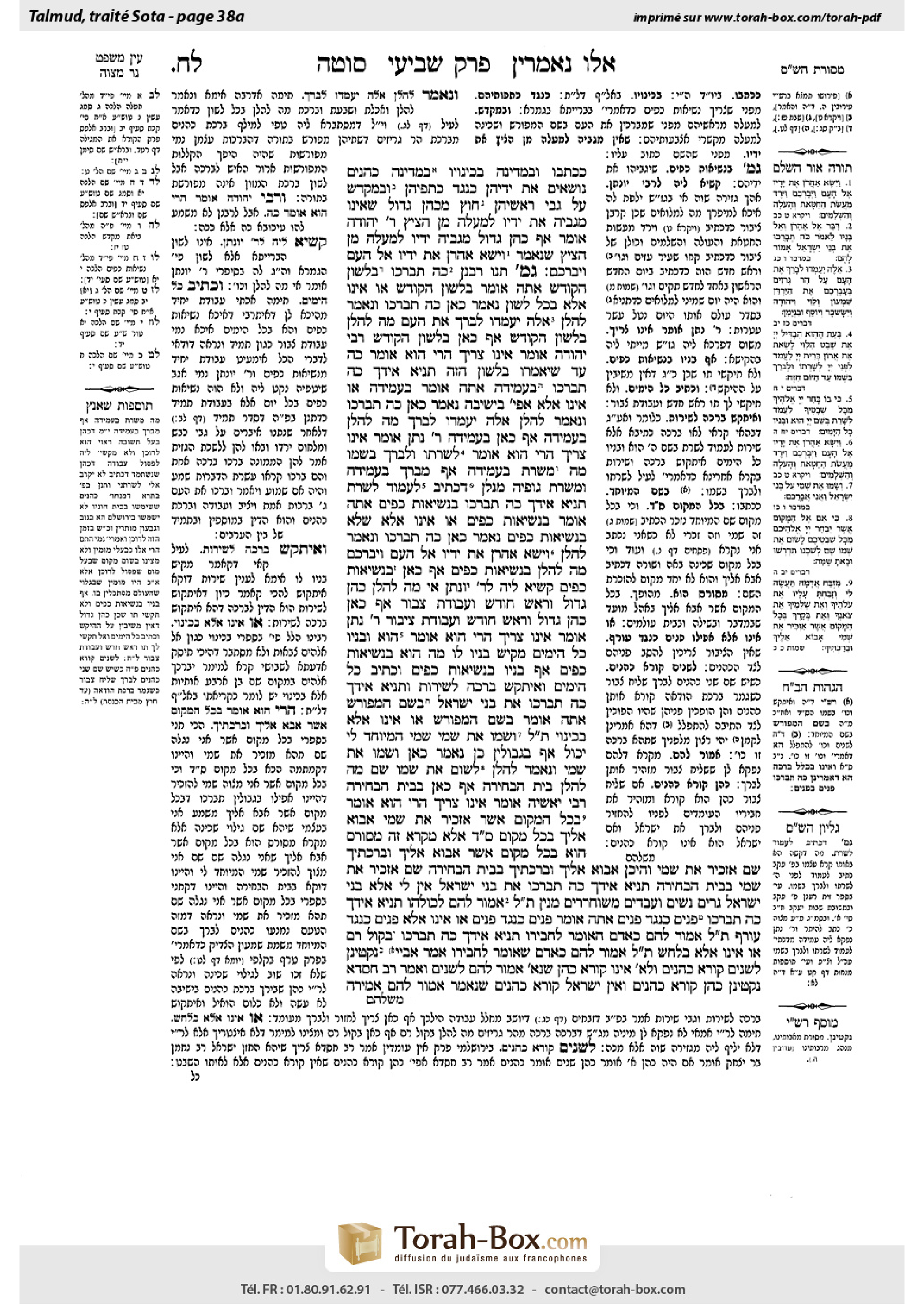
Sotah 38a: Talmud study for Daf Yomi
Daf Yomi is the daily study of one Talmud folio. Explore 37 tractates with scans, Hebrew text, Sefaria English and AI-generated French translations where annotated.
Passage selection and English or AI-generated French translation are available where the scan has annotations. Daf Study is independent of Torah-Box and Sefaria.
Browse Sotah · סוטה · All tractatesSotah 38a text and translations
This page of Sotah includes the Aramaic text, an English translation and an AI-generated French translation, alongside the scan above.
סוטה ל״ח א · Aramaic and Hebrew text
כִּכְתָבוֹ, וּבַמְּדִינָה בְּכִינּוּיוֹ. בַּמְּדִינָה כֹּהֲנִים נוֹשְׂאִים אֶת יְדֵיהֶן כְּנֶגֶד כִּתְפֵיהֶן, וּבַמִּקְדָּשׁ עַל גַּבֵּי רָאשֵׁיהֶן. חוּץ מִכֹּהֵן גָּדוֹל, שֶׁאֵינוֹ מַגְבִּיהַּ אֶת יָדָיו לְמַעְלָה מִן הַצִּיץ. רַבִּי יְהוּדָה אוֹמֵר: אַף כֹּהֵן גָּדוֹל מַגְבִּיהַּ יָדָיו לְמַעְלָה מִן הַצִּיץ, שֶׁנֶּאֱמַר: ״וַיִּשָּׂא אַהֲרֹן אֶת יָדָיו אֶל הָעָם וַיְבָרְכֵם״.
גְּמָ׳ תָּנוּ רַבָּנַן: ״כֹּה תְבָרְכוּ״ — בִּלְשׁוֹן הַקּוֹדֶשׁ. אַתָּה אוֹמֵר בִּלְשׁוֹן הַקּוֹדֶשׁ, אוֹ אֵינוֹ אֶלָּא בְּכׇל לָשׁוֹן? נֶאֱמַר כָּאן ״כֹּה תְבָרְכוּ״, וְנֶאֱמַר לְהַלָּן ״אֵלֶּה יַעַמְדוּ לְבָרֵךְ אֶת הָעָם״. מָה לְהַלָּן בִּלְשׁוֹן הַקּוֹדֶשׁ, אַף כָּאן בִּלְשׁוֹן הַקּוֹדֶשׁ.
רַבִּי יְהוּדָה אוֹמֵר: אֵינוֹ צָרִיךְ, הֲרֵי הוּא אוֹמֵר ״כֹּה״ — עַד שֶׁיֹּאמְרוּ בַּלָּשׁוֹן הַזֶּה.
תַּנְיָא אִידַּךְ: ״כֹּה תְבָרְכוּ״ — בַּעֲמִידָה. אַתָּה אוֹמֵר בַּעֲמִידָה, אוֹ אֵינוֹ אֶלָּא אֲפִילּוּ בִּישִׁיבָה? נֶאֱמַר כָּאן ״כֹּה תְבָרְכוּ״, וְנֶאֱמַר לְהַלָּן ״אֵלֶּה יַעַמְדוּ לְבָרֵךְ״. מָה לְהַלָּן בַּעֲמִידָה — אַף כָּאן בַּעֲמִידָה.
רַבִּי נָתָן אוֹמֵר: אֵינוֹ צָרִיךְ, הֲרֵי הוּא אוֹמֵר ״לְשָׁרְתוֹ וּלְבָרֵךְ בִּשְׁמוֹ״. מָה מְשָׁרֵת בַּעֲמִידָה, אַף מְבָרֵךְ בַּעֲמִידָה. וּמְשָׁרֵת גּוּפֵיהּ מְנָלַן — דִּכְתִיב: ״לַעֲמֹד לְשָׁרֵת״.
תַּנְיָא אִידַּךְ: ״כֹּה תְבָרְכוּ״ — בִּנְשִׂיאוּת כַּפַּיִם. אַתָּה אוֹמֵר בִּנְשִׂיאוּת כַּפַּיִם, אוֹ אֵינוֹ אֶלָּא שֶׁלֹּא בִּנְשִׂיאוּת כַּפַּיִם? נֶאֱמַר כָּאן ״כֹּה תְבָרְכוּ״, וְנֶאֱמַר לְהַלָּן ״וַיִּשָּׂא אַהֲרֹן אֶת יָדָיו אֶל הָעָם וַיְבָרְכֵם״. מָה לְהַלָּן בִּנְשִׂיאוּת כַּפַּיִם — אַף כָּאן בִּנְשִׂיאוּת כַּפַּיִם.
קַשְׁיָא לֵיהּ לְרַבִּי יוֹנָתָן: אִי מָה לְהַלָּן כֹּהֵן גָּדוֹל וְרֹאשׁ חוֹדֶשׁ וַעֲבוֹדַת צִבּוּר, אַף כָּאן כֹּהֵן גָּדוֹל וְרֹאשׁ חוֹדֶשׁ וַעֲבוֹדַת צִיבּוּר?
רַבִּי נָתָן אוֹמֵר: אֵינוֹ צָרִיךְ, הֲרֵי הוּא אוֹמֵר ״הוּא וּבָנָיו כׇּל הַיָּמִים״, מַקִּישׁ בָּנָיו לוֹ: מָה הוּא בִּנְשִׂיאוּת כַּפַּיִם — אַף בָּנָיו בִּנְשִׂיאוּת כַּפַּיִם. וּכְתִיב: ״כׇּל הַיָּמִים״. וְאִיתַּקַּשׁ בְּרָכָה לְשֵׁירוּת.
וְתַנְיָא אִידַּךְ: ״כֹּה תְבָרְכוּ אֶת בְּנֵי יִשְׂרָאֵל״ — בַּשֵּׁם הַמְפוֹרָשׁ. אַתָּה אוֹמֵר בַּשֵּׁם הַמְפוֹרָשׁ, אוֹ אֵינוֹ אֶלָּא בְּכִינּוּי? תַּלְמוּד לוֹמַר: ״וְשָׂמוּ אֶת שְׁמִי״ — שְׁמִי הַמְיוּחָד לִי.
יָכוֹל אַף בַּגְּבוּלִין כֵּן — נֶאֱמַר כָּאן ״וְשָׂמוּ אֶת שְׁמִי״, וְנֶאֱמַר לְהַלָּן ״לָשׂוּם אֶת שְׁמוֹ שָׁם״. מָה לְהַלָּן — בֵּית הַבְּחִירָה, אַף כָּאן בְּבֵית הַבְּחִירָה.
רַבִּי יֹאשִׁיָּה אוֹמֵר: אֵינוֹ צָרִיךְ, הֲרֵי הוּא אוֹמֵר ״בְּכׇל הַמָּקוֹם אֲשֶׁר אַזְכִּיר אֶת שְׁמִי אָבוֹא אֵלֶיךָ״. בְּכׇל מָקוֹם סָלְקָא דַּעְתָּךְ? אֶלָּא מִקְרָא זֶה מְסוֹרָס הוּא: בְּכׇל מָקוֹם אֲשֶׁר אָבוֹא אֵלֶיךָ וּבֵרַכְתִּיךָ — שָׁם אַזְכִּיר אֶת שְׁמִי. וְהֵיכָן אָבוֹא אֵלֶיךָ וּבֵרַכְתִּיךָ — בְּבֵית הַבְּחִירָה, שָׁם אַזְכִּיר אֶת שְׁמִי — בְּבֵית הַבְּחִירָה.
תַּנְיָא אִידַּךְ: ״כֹּה תְבָרְכוּ אֶת בְּנֵי יִשְׂרָאֵל״, אֵין לִי אֶלָּא בְּנֵי יִשְׂרָאֵל. גֵּרִים, נָשִׁים, וַעֲבָדִים מְשׁוּחְרָרִים, מִנַּיִן? תַּלְמוּד לוֹמַר: ״אָמוֹר לָהֶם״, לְכוּלְּהוּ.
תַּנְיָא אִידַּךְ: ״כֹּה תְבָרְכוּ״ — פָּנִים כְּנֶגֶד פָּנִים. אַתָּה אוֹמֵר פָּנִים כְּנֶגֶד פָּנִים, אוֹ אֵינוֹ אֶלָּא פָּנִים כְּנֶגֶד עוֹרֶף? תַּלְמוּד לוֹמַר: ״אָמוֹר לָהֶם״, כְּאָדָם הָאוֹמֵר לַחֲבֵירוֹ.
תַּנְיָא אִידַּךְ: ״כֹּה תְבָרְכוּ״ — בְּקוֹל רָם. אוֹ אֵינוֹ אֶלָּא בְּלַחַשׁ? תַּלְמוּד לוֹמַר: ״אָמוֹר לָהֶם״ — כְּאָדָם שֶׁאוֹמֵר לַחֲבֵירוֹ.
אָמַר אַבָּיֵי: נָקְטִינַן, לִשְׁנַיִם קוֹרֵא ״כֹּהֲנִים״, וּלְאֶחָד אֵינוֹ קוֹרֵא ״כֹּהֵן״, שֶׁנֶּאֱמַר: ״אָמוֹר לָהֶם״ — לִשְׁנַיִם. וְאָמַר רַב חִסְדָּא: נָקְטִינַן, כֹּהֵן קוֹרֵא ״כֹּהֲנִים״, וְאֵין יִשְׂרָאֵל קוֹרֵא ״כֹּהֲנִים״, שֶׁנֶּאֱמַר: ״אָמוֹר לָהֶם״, אֲמִירָה
Sotah 38a · English translation
as it is written in the Torah, i.e., the Tetragrammaton, and in the country they use its substitute name of Lordship. In the country, the priests lift their hands so they are aligned with their shoulders during the benediction. And in the Temple they lift them above their heads, except for the High Priest, who does not lift his hands above the frontplate. Since the Tetragrammaton is inscribed on it, it is inappropriate for him to lift his hands above it. Rabbi Yehuda says: Even the High Priest lifts his hands above the frontplate, as it is stated: “And Aaron lifted up his hands toward the people and blessed them” (Leviticus 9:22).
GEMARA: The Sages taught: The mitzva given to the priests: “So you shall bless the children of Israel” (Numbers 6:23), is that they bless them in the sacred tongue, Hebrew. Do you say that the benediction must be recited in the sacred tongue, or perhaps it may be recited in any language? The baraita answers: It is stated here, with regard to the Priestly Benediction: “So you shall bless,” and it is stated there, with regard to the blessings and curses: “These shall stand on Mount Gerizim to bless the people” (Deuteronomy 27:12). There is a verbal analogy between these two usages of the word “bless”: Just as there, the blessings and curses were recited in the sacred tongue, as stated above (33a), so too here, the Priestly Benediction is recited in the sacred tongue.
Rabbi Yehuda says: It is not necessary to derive this from a verbal analogy, as it says with regard to the Priestly Benediction: “Thus,” which means that it is not recited correctly unless they recite it in this exact language, as it is written in the Torah.
It is taught in another baraita: “So you shall bless,” means while standing. Do you say that the benediction must be recited while standing, or perhaps it may even be recited while sitting? It is stated here: “So you shall bless,” and it is stated there, with regard to the blessings and curses: “These shall stand on Mount Gerizim to bless.” Just as there, the blessing was recited while standing, so too here, the priests must recite the Priestly Benediction while standing.
Rabbi Natan says: It is not necessary to derive this from a verbal analogy, as it says in the verse: “At that time the Lord separated the tribe of Levi to bear the Ark of the Covenant of the Lord, to stand before the Lord to minister to Him and to bless in His name” (Deuteronomy 10:8). Just as a priest performs the Temple service while standing, so too, he blesses while standing. The Gemara asks: And from where do we derive that he performs the service itself while standing? As it is written: “To stand to minister in the name of the Lord” (Deuteronomy 18:5).
It is taught in another baraita: “So you shall bless” means with lifted hands. Do you say that the priests must recite the benediction with lifted hands, or perhaps they may recite it without lifted hands? It is stated here: “So you shall bless,” and it is stated there, with regard to the dedication of the Tabernacle: “And Aaron lifted up his hands toward the people and blessed them” (Leviticus 9:22). Just as there, Aaron blessed the nation with lifted hands, so too here, the Priestly Benediction is recited with lifted hands.
This halakha was difficult for Rabbi Yonatan to understand: If this halakha is derived from the dedication of the Tabernacle, then why not also say: Just as there, the High Priest was the one who recited the blessing, and it was the New Moon, and the offerings that were brought were a communal service, so too here, the Priestly Benediction must be recited only by the High Priest, and on the New Moon, and when performing a communal service?
Rabbi Natan says: It is not necessary to derive from a verbal analogy that the Priestly Benediction is recited with lifted hands, as it says with regard to Aaron: “To stand to minister in the name of the Lord, him and his sons forever” (Deuteronomy 18:5). In this verse, his sons are juxtaposed with him. Just as Aaron recited the Priestly Benediction with lifted hands, so too, his sons recite the benediction with lifted hands. And furthermore, it is written “forever,” which indicates that it is referring not only to special occasions. And although the verse is not referring to the Priestly Benediction, the benediction is juxtaposed to the Temple service in another verse: “To minister to Him and to bless in His name” (Deuteronomy 10:8).
And it is taught in another baraita: “So you shall bless the children of Israel” means the blessing should be recited with the ineffable name. Do you say that the Priestly Benediction must be recited with the ineffable name, or perhaps it is recited with only the substitute name, Adonai? The verse states: “So shall they put My name” (Numbers 6:27), which means My name that is unique to Me.
One might have thought that even in the outlying areas, outside the Temple, this ineffable name is used. It is stated here, with regard to the Priestly Benediction: “So shall they put My name,” and it is stated there, with regard to the place one must sacrifice offerings: “The place that the Lord your God has chosen out of all your tribes to put His name there” (Deuteronomy 12:5). The verbal analogy teaches that just as there, the expression “to put His name there” is referring to the Temple, so too here, the mitzva of “so shall they put My name” applies in the Temple and not anywhere else.
Rabbi Yoshiya says: It is not necessary to derive this halakha from the verbal analogy, as it can be derived from a verse. It says in the verse: “In every place where I cause My name to be mentioned I will come to you and bless you” (Exodus 20:20). Does it enter your mind that this verse literally means that the Divine Presence will be revealed everywhere? Rather, this verse must be interpreted by transposition. It must be reordered and read as follows: In every place where I will come to you and bless you, there I will cause My name to be mentioned. Rabbi Yoshiya explains that God is stating: And where will I come to you and bless you? In the Temple. Therefore, he derives: There, in the Temple, I will cause My name to be mentioned, but the ineffable name is not mentioned elsewhere.
It is taught in another baraita: “So you shall bless the sons of Israel” (Numbers 6:23). I have derived only the halakha to bless the sons of Israel. From where do I derive the halakha of blessing converts, women, and emancipated slaves? The verse states immediately afterward: “You shall say to them,” meaning to all of the Jewish people.
It is taught in another baraita: “So you shall bless,” means that the priests must recite the Priestly Benediction face-to-face with the congregation. Do you say that the Benediction must be recited face-to-face, or perhaps it is only recited with the faces of the priests facing the back of the necks of the congregation? The verse states: “You shall say to them,” face-to-face, like a person who is talking to another.
It is taught in another baraita: “So you shall bless” means that the benediction must be recited out loud. Or, perhaps, is it recited only in a whisper? The verse states: “You shall say to them,” like a person who is talking to another.
Abaye said: We have a tradition with regard to the prayer leader calling the priests to recite the Priestly Benediction: When there are two priests, he calls: Priests, but when there is one priest he does not call: Priest, as it is stated: “You shall say to them,” in plural, meaning to a minimum of two priests. And Rav Ḥisda said: We have a tradition that a priest calls: Priests, but an Israelite does not call: Priests, as it is stated: “You shall say to them,” which means that the saying
Sotah 38a · Traduction française (IA)
comme il est écrit dans la Torah, c’est-à-dire le Tétragramme, tandis qu’en province, on emploie son nom de substitution, le nom de Seigneur. En province, les prêtres lèvent les mains à hauteur des épaules pendant la bénédiction. Dans le Temple, ils les lèvent au-dessus de leur tête, à l’exception du grand prêtre, qui ne lève pas les mains au-dessus du tsits. Puisque le Tétragramme y est gravé, il ne convient pas qu’il lève les mains au-dessus. Rabbi Yehouda dit : « Même le grand prêtre lève les mains au-dessus du tsits », comme il est dit : « Aaron leva les mains vers le peuple et le bénit » (Lévitique 9:22).
GUEMARA : Les Sages ont enseigné : La mitsva prescrite aux prêtres — « Ainsi vous bénirez les enfants d’Israël » (Nombres 6:23) — consiste à les bénir dans la langue sacrée, l’hébreu. Doit-on en conclure que la bénédiction doit être prononcée dans la langue sacrée, ou peut-être peut-elle l’être dans n’importe quelle langue ? La baraïta répond : Ici, à propos de la bénédiction sacerdotale, il est dit : « Ainsi vous bénirez », et là, à propos des bénédictions et des malédictions, il est dit : « Ceux-ci se tiendront sur le mont Guerizim pour bénir le peuple » (Deutéronome 27:12). Il y a une analogie verbale entre ces deux occurrences du mot « bénir » : de même que là, les bénédictions et les malédictions furent prononcées dans la langue sacrée, comme indiqué plus haut (33a), de même ici, la bénédiction sacerdotale est prononcée dans la langue sacrée.
Rabbi Yehouda dit : Il n’est pas nécessaire de déduire cela par analogie verbale, car le verset dit, à propos de la bénédiction sacerdotale : « Ainsi », ce qui signifie qu’elle n’est prononcée correctement que si les prêtres la récitent exactement dans cette langue, telle qu’elle est écrite dans la Torah.
Il est enseigné dans une autre baraïta : « Ainsi vous bénirez » signifie que la bénédiction doit être prononcée debout. Doit-on en conclure qu’elle doit être prononcée debout, ou peut-être peut-elle aussi être prononcée assis ? Ici, il est dit : « Ainsi vous bénirez », et là, à propos des bénédictions et des malédictions, il est dit : « Ceux-ci se tiendront sur le mont Guerizim pour bénir ». De même que là, la bénédiction fut prononcée debout, de même ici, les prêtres doivent prononcer la bénédiction sacerdotale debout.
Rabbi Natan dit : Il n’est pas nécessaire de déduire cela par analogie verbale, car le verset dit : « En ce temps-là, l’Éternel sépara la tribu de Lévi pour porter l’Arche de l’Alliance de l’Éternel, pour se tenir devant l’Éternel afin de Le servir et de bénir en Son nom » (Deutéronome 10:8). De même qu’un prêtre accomplit le service du Temple debout, de même il bénit debout. La Guemara demande : Et d’où déduisons-nous qu’il accomplit le service lui-même debout ? Car il est écrit : « Pour se tenir afin de servir au nom de l’Éternel » (Deutéronome 18:5).
Il est enseigné dans une autre baraïta : « Ainsi vous bénirez » signifie les mains levées. Doit-on en conclure que les prêtres doivent prononcer la bénédiction les mains levées, ou peut-être peuvent-ils la prononcer sans lever les mains ? Ici, il est dit : « Ainsi vous bénirez », et là, à propos de l’inauguration du Tabernacle, il est dit : « Aaron leva les mains vers le peuple et le bénit » (Lévitique 9:22). De même que là, Aaron bénit le peuple les mains levées, de même ici, la bénédiction sacerdotale est prononcée les mains levées.
Cette halakha était difficile à comprendre pour Rabbi Yonatan : si cette halakha est déduite de l’inauguration du Tabernacle, pourquoi ne pas dire également que, de même que là, c’est le grand prêtre qui prononça la bénédiction, que c’était à la nouvelle lune et que les sacrifices offerts relevaient d’un service communautaire, de même ici, la bénédiction sacerdotale ne doit être prononcée que par le grand prêtre, à la nouvelle lune et lors d’un service communautaire ?
Rabbi Natan dit : Il n’est pas nécessaire de déduire par analogie verbale que la bénédiction sacerdotale est prononcée les mains levées, car il est dit à propos d’Aaron : « Pour se tenir afin de servir au nom de l’Éternel, lui et ses fils, à jamais » (Deutéronome 18:5). Dans ce verset, ses fils sont associés à lui. De même qu’Aaron prononça la bénédiction sacerdotale les mains levées, de même ses fils prononcent la bénédiction les mains levées. De plus, le mot « à jamais » est écrit, ce qui indique qu’il ne s’agit pas seulement d’occasions particulières. Et bien que le verset ne parle pas de la bénédiction sacerdotale, celle-ci est associée au service du Temple dans un autre verset : « Pour Le servir et bénir en Son nom » (Deutéronome 10:8).
Et il est enseigné dans une autre baraïta : « Ainsi vous bénirez les enfants d’Israël » signifie que la bénédiction doit être prononcée avec le Nom ineffable. Doit-on en conclure que la bénédiction sacerdotale doit être prononcée avec le Nom ineffable, ou peut-être est-elle prononcée uniquement avec le nom de substitution, Adonaï ? Le verset dit : « Ainsi ils mettront Mon nom » (Nombres 6:27), c’est-à-dire le nom qui M’est propre.
On aurait pu penser que le Nom ineffable est également employé dans les régions éloignées, en dehors du Temple. Ici, à propos de la bénédiction sacerdotale, il est dit : « Ainsi ils mettront Mon nom », et là, à propos du lieu où l’on doit offrir les sacrifices, il est dit : « Le lieu que l’Éternel, votre Dieu, aura choisi parmi toutes vos tribus pour y placer Son nom » (Deutéronome 12:5). L’analogie verbale enseigne que, de même que là, l’expression « pour y placer Son nom » désigne le Temple, de même ici, la mitsva « ainsi ils mettront Mon nom » s’applique dans le Temple et nulle part ailleurs.
Rabbi Yoshiya dit : Il n’est pas nécessaire de déduire cette halakha de l’analogie verbale, car elle peut être déduite d’un verset. Le verset dit : « En tout lieu où Je ferai mentionner Mon nom, Je viendrai à toi et te bénirai » (Exode 20:20). Vous vient-il à l’esprit que ce verset signifie littéralement que la Présence divine se révélera partout ? Il faut plutôt interpréter ce verset par transposition et le réordonner ainsi : « En tout lieu où Je viendrai à toi et te bénirai, là Je ferai mentionner Mon nom. » Rabbi Yoshiya explique que Dieu déclare : « Où viendrai-Je à toi et te bénirai ? Dans le Temple. » Il en déduit donc que c’est là, dans le Temple, que Je ferai mentionner Mon nom, mais que le Nom ineffable n’est pas prononcé ailleurs.
Il est enseigné dans une autre baraïta : « Ainsi vous bénirez les fils d’Israël » (Nombres 6:23). Je n’ai déduit que l’obligation de bénir les fils d’Israël. D’où déduis-je l’obligation de bénir les convertis, les femmes et les esclaves affranchis ? Le verset dit immédiatement après : « Vous leur direz », c’est-à-dire à tout le peuple juif.
Il est enseigné dans une autre baraïta : « Ainsi vous bénirez » signifie que les prêtres doivent prononcer la bénédiction sacerdotale face à face avec l’assemblée. Doit-on en conclure que la bénédiction doit être prononcée face à face, ou peut-être les prêtres doivent-ils seulement tourner le visage vers la nuque des membres de l’assemblée ? Le verset dit : « Vous leur direz », face à face, comme une personne qui parle à une autre.
Il est enseigné dans une autre baraïta : « Ainsi vous bénirez » signifie que la bénédiction doit être prononcée à voix haute. Ou peut-être est-elle prononcée seulement à voix basse ? Le verset dit : « Vous leur direz », comme une personne qui parle à une autre.
Abayé dit : Nous avons une tradition concernant l’officiant qui appelle les prêtres à prononcer la bénédiction sacerdotale : lorsqu’il y a deux prêtres, il appelle : « Prêtres ! », mais lorsqu’il n’y en a qu’un, il ne l’appelle pas : « Prêtre ! », comme il est dit : « Vous leur direz », au pluriel, ce qui signifie au moins deux prêtres. Et Rav Ḥisda dit : Nous avons une tradition selon laquelle un prêtre appelle : « Prêtres ! », mais un Israélite n’appelle pas : « Prêtres ! », comme il est dit : « Vous leur direz », ce qui signifie que l’énonciation
Traduction française générée par IA à partir de l’édition anglaise de Sefaria. Vérifie toujours un passage avec le texte source.
Text from Sefaria: William Davidson Edition - Vocalized Aramaic (CC BY NC); William Davidson Edition - English (CC BY NC).