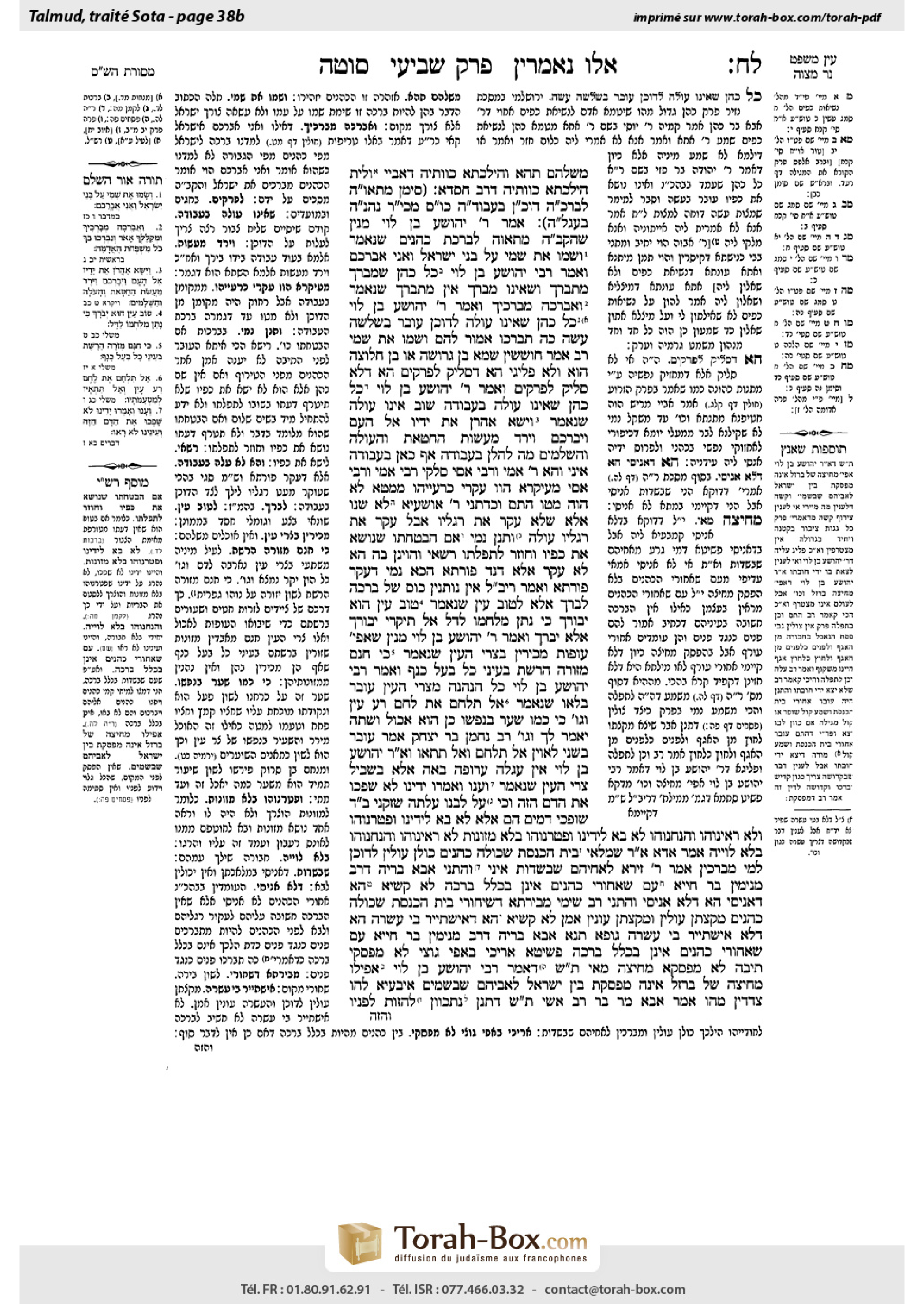
Sotah 38b: Talmud study for Daf Yomi
Daf Yomi is the daily study of one Talmud folio. Explore 37 tractates with scans, Hebrew text, Sefaria English and AI-generated French translations where annotated.
Passage selection and English or AI-generated French translation are available where the scan has annotations. Daf Study is independent of Torah-Box and Sefaria.
Browse Sotah · סוטה · All tractatesSotah 38b text and translations
This page of Sotah includes the Aramaic text, an English translation and an AI-generated French translation, alongside the scan above.
סוטה ל״ח ב · Aramaic and Hebrew text
מִשֶּׁלָּהֶם תְּהֵא. וְהִילְכְתָא כְּווֹתֵיהּ דְּאַבָּיֵי, וְלֵית הִילְכְתָא כְּווֹתֵיהּ דְּרַב חִסְדָּא.
(סִימַן: מִתְאַוֶּה לִבְרָכָה דּוּכָן בַּעֲבוֹדָה כּוֹס מַכִּיר נֶהֱנֶה בְּעֶגְלָה).
אָמַר רַבִּי יְהוֹשֻׁעַ בֶּן לֵוִי: מִנַּיִן שֶׁהַקָּדוֹשׁ בָּרוּךְ הוּא מִתְאַוֶּה לְבִרְכַּת כֹּהֲנִים — שֶׁנֶּאֱמַר: ״וְשָׂמוּ אֶת שְׁמִי עַל בְּנֵי יִשְׂרָאֵל וַאֲנִי אֲבָרְכֵם״. וְאָמַר רַבִּי יְהוֹשֻׁעַ בֶּן לֵוִי: כׇּל כֹּהֵן שֶׁמְּבָרֵךְ — מִתְבָּרֵךְ, וְשֶׁאֵינוֹ מְבָרֵךְ — אֵין מִתְבָּרֵךְ, שֶׁנֶּאֱמַר: ״וַאֲבָרְכָה מְבָרְכֶיךָ״.
וְאָמַר רַבִּי יְהוֹשֻׁעַ בֶּן לֵוִי: כׇּל כֹּהֵן שֶׁאֵינוֹ עוֹלֶה לַדּוּכָן — עוֹבֵר בִּשְׁלֹשָׁה עֲשֵׂה: ״כֹּה תְבָרְכוּ״, ״אָמוֹר לָהֶם״, ״וְשָׂמוּ אֶת שְׁמִי״.
רַב אָמַר: חוֹשְׁשִׁין שֶׁמָּא בֶּן גְּרוּשָׁה אוֹ בֶּן חֲלוּצָה הוּא.
וְלָא פְּלִיגִי, הָא — דְּסָלֵיק לִפְרָקִים, הָא — דְּלָא סָלֵיק לִפְרָקִים.
וְאָמַר רַבִּי יְהוֹשֻׁעַ בֶּן לֵוִי: כׇּל כֹּהֵן שֶׁאֵינוֹ עוֹלֶה בָּעֲבוֹדָה, שׁוּב אֵינוֹ עוֹלֶה, שֶׁנֶּאֱמַר: ״וַיִּשָּׂא אַהֲרֹן אֶת יָדָיו אֶל הָעָם וַיְבָרְכֵם וַיֵּרֶד מֵעֲשֹׂת הַחַטָּאת וְהָעוֹלָה וְהַשְּׁלָמִים״, מָה לְהַלָּן — בַּעֲבוֹדָה, אַף כָּאן — בַּעֲבוֹדָה.
אִינִי? וְהָא רַבִּי אַמֵּי וְרַבִּי אַסִּי סָלְקִי! רַבִּי אַמֵּי וְרַבִּי אַסִּי מֵעִיקָּרָא הֲווֹ עָקְרִי כַּרְעַיְיהוּ, מִמְטָא לָא הֲוָה מָטוּ הָתָם. וְכִדְתָנֵי רַבִּי אוֹשַׁעְיָא: לֹא שָׁנוּ, אֶלָּא שֶׁלֹּא עָקַר אֶת רַגְלָיו, אֲבָל עָקַר אֶת רַגְלָיו — עוֹלֶה.
וּתְנַן נָמֵי — אִם הַבְטָחָתוֹ שֶׁנּוֹשֵׂא אֶת כַּפָּיו וְחוֹזֵר לִתְפִלָּתוֹ — רַשַּׁאי. וְהָוֵינַן בַּהּ: הָא לָא עֲקַר? אֶלָּא דְּנָד פּוּרְתָּא, הָכָא נָמֵי דְּעָקַר פּוּרְתָּא.
וְאָמַר רַבִּי יְהוֹשֻׁעַ בֶּן לֵוִי: אֵין נוֹתְנִין כּוֹס שֶׁל בְּרָכָה לְבָרֵךְ אֶלָּא לְטוֹב עַיִן, שֶׁנֶּאֱמַר: ״טוֹב עַיִן הוּא יְבֹרָךְ כִּי נָתַן מִלַּחְמוֹ לַדָּל״, אַל תִּיקְרֵי ״יְבֹרָךְ״ אֶלָּא ״יְבָרֵךְ״.
וְאָמַר רַבִּי יְהוֹשֻׁעַ בֶּן לֵוִי: מִנַּיִן שֶׁאֲפִילּוּ עוֹפוֹת מַכִּירִין בְּצָרֵי הָעַיִן — שֶׁנֶּאֱמַר: ״כִּי חִנָּם מְזֹרָה הָרָשֶׁת בְּעֵינֵי כׇּל בַּעַל כָּנָף״.
וְאָמַר רַבִּי יְהוֹשֻׁעַ בֶּן לֵוִי: כׇּל הַנֶּהֱנֶה מִצָּרֵי הָעַיִן עוֹבֵר בְּלָאו — שֶׁנֶּאֱמַר: ״אַל תִּלְחַם אֶת לֶחֶם רַע עָיִן וְגוֹ׳ כִּי כְּמוֹ שָׁעַר בְּנַפְשׁוֹ כֶּן הוּא אֱכוֹל וּשְׁתֵה יֹאמַר לָךְ וְגוֹ׳״. רַב נַחְמָן בַּר יִצְחָק אָמַר: עוֹבֵר בִּשְׁנֵי לָאוִין, ״אַל תִּלְחַם״, ״וְאַל תִּתְאָו״.
וְאָמַר רַבִּי יְהוֹשֻׁעַ בֶּן לֵוִי: אֵין עֶגְלָה עֲרוּפָה בָּאָה אֶלָּא בִּשְׁבִיל צָרֵי הָעַיִן,
שֶׁנֶּאֱמַר: ״וְעָנוּ וְאָמְרוּ יָדֵינוּ לֹא שָׁפְכוּ אֶת הַדָּם הַזֶּה״. וְכִי עַל לִבֵּנוּ עָלְתָה שֶׁזִּקְנֵי בֵּית דִּין שׁוֹפְכֵי דָמִים הֵם? אֶלָּא, לֹא בָּא לְיָדֵינוּ וּפְטַרְנוּהוּ, וְלֹא רְאִינוּהוּ וְהִנַּחְנוּהוּ. לֹא בָּא לְיָדֵינוּ וּפְטַרְנוּהוּ בְּלֹא מְזוֹנוֹת, לֹא רְאִינוּהוּ וְהִנַּחְנוּהוּ בְּלֹא לְוָיָיה.
אָמַר אַדָּא אָמַר רַבִּי שִׂמְלַאי: בֵּית הַכְּנֶסֶת שֶׁכּוּלָּהּ כֹּהֲנִים — כּוּלָּן עוֹלִין לַדּוּכָן. לְמִי מְבָרְכִין? אָמַר רַבִּי זֵירָא: לַאֲחֵיהֶם שֶׁבַּשָּׂדוֹת.
אִינִי? וְהָתָנֵי אַבָּא בְּרֵיהּ דְּרַב מִנְיָמִין בַּר חִיָּיא: עַם שֶׁאֲחוֹרֵי כֹּהֲנִים אֵינָן בִּכְלַל בְּרָכָה! לָא קַשְׁיָא, הָא — דַּאֲנִיסִי, הָא — דְּלָא אֲנִיסִי.
וְהָתָנֵי רַב שִׁימִי מִבִּירְתָא דְשִׁיחוֹרִי: בֵּית הַכְּנֶסֶת שֶׁכּוּלָּהּ כֹּהֲנִים — מִקְצָתָן עוֹלִין, וּמִקְצָתָן עוֹנִין ״אָמֵן״!
לָא קַשְׁיָא: הָא — דְּאִישְׁתְּיֻיר בֵּי עֲשָׂרָה, הָא — דְּלָא אִישְׁתְּיֻיר בֵּי עַשְׂרָה.
גּוּפָא, תָּנָא אַבָּא בְּרֵיהּ דְּרַב מִנְיָמִין בַּר חִיָּיא: עַם שֶׁאֲחוֹרֵי כֹּהֲנִים אֵינָן בִּכְלַל בְּרָכָה.
פְּשִׁיטָא, אֲרִיכֵי בְּאַפֵּי גוּצֵי לָא מַפְסְקִי. תֵּיבָה — לָא מַפְסְקָא. מְחִיצָה מַאי? תָּא שְׁמַע, דְּאָמַר רַבִּי יְהוֹשֻׁעַ בֶּן לֵוִי: אֲפִילּוּ מְחִיצָה שֶׁל בַּרְזֶל אֵינָהּ מַפְסֶקֶת בֵּין יִשְׂרָאֵל לַאֲבִיהֶם שֶׁבַּשָּׁמַיִם.
אִיבַּעְיָא לְהוּ: צְדָדִין מַהוּ? אָמַר אַבָּא מָר בַּר רַב אָשֵׁי: תָּא שְׁמַע, דִּתְנַן: נִתְכַּוֵּון לְהַזּוֹת לְפָנָיו
Sotah 38b · English translation
should be from them; one of the priests themselves should call: Priests. The Gemara concludes: And the halakha is in accordance with the opinion of Abaye, that when only one priest is present, the prayer leader does not call: Priest. And the halakha is not in accordance with the opinion of Rav Ḥisda, as an Israelite may also call: Priests.
§ The Gemara cites a mnemonic device for the statements of Rabbi Yehoshua ben Levi: Desires the benediction, platform, during the service, cup, recognize, derives benefit, from a heifer.
Rabbi Yehoshua ben Levi says: From where is it derived that the Holy One, Blessed be He, desires the Priestly Benediction? As it is stated: “So shall they put My name upon the children of Israel, and I will bless them” (Numbers 6:27). This shows that God waits for the priests to bless the people, and only then He Himself blesses them. And Rabbi Yehoshua ben Levi says: Any priest who blesses the people is blessed from Heaven, and one who does not bless the people is not blessed, as it is stated: “And I will bless those who bless you” (Genesis 12:3).
And Rabbi Yehoshua ben Levi says: Any priest who does not ascend the platform to recite the Priestly Benediction violates three positive mitzvot: “So you shall bless,” “And you shall say to them” (Numbers 6:23), and “So shall they put My name” (Numbers 6:27).
Rav says: One need be concerned that a priest who does not ascend to recite the Priestly Benediction is perhaps the son of a priest and a divorced woman, or the son of a priest and a yevama who has performed ḥalitza [ḥalutza]. Perhaps he does not ascend to recite the Priestly Benediction because he is disqualified from the priesthood.
The Gemara comments: And they do not disagree. This statement of Rabbi Yehoshua ben Levi is referring to a case where he ascends periodically. Therefore, there is no reason to believe that he is disqualified from the priesthood, and the assumption is that he violates three positive mitzvot. Whereas that statement of Rav is referring to a case where one does not ascend to recite the Priestly Benediction even periodically, and therefore there is reason to suspect that he is disqualified from the priesthood.
And Rabbi Yehoshua ben Levi says: Any priest who does not ascend the platform during the blessing of the Temple service recited in the Amida prayer may no longer ascend to recite the benediction, as it is stated: “And Aaron lifted up his hands toward the people and blessed them; and he came down from offering the sin-offering, and the burnt-offering, and the peace-offerings” (Leviticus 9:22). Just as there, in the Tabernacle, Aaron lifted up his hands during the service, as evident from the fact that only after he blessed them does it say that he came down from sacrificing the offerings, so too here, in the Amida prayer, the Priestly Benediction is recited during the blessing of Temple service.
The Gemara asks: Is that so? But didn’t the priests Rabbi Ami and Rabbi Asi ascend after the blessing of the service? The Gemara answers: Rabbi Ami and Rabbi Asi would begin walking to the platform during the blessing of the service, but they would not arrive there until after the conclusion of this blessing. And this is sufficient in accordance with what Rabbi Oshaya taught: They taught that a priest may not recite the benediction if he did not ascend the platform during the blessing of Temple service only in a case where he did not begin walking. But if he began walking before the prayer leader finished the blessing, he may ascend the platform even after he has finished the blessing.
And concerning this issue, we also learned in a mishna (Berakhot 34a): A priest who serves as prayer leader does not recite the Priestly Benediction, but if he is certain that he can lift his hands and recite the benediction, and then resume his prayer without becoming confused, he is permitted to do so. And we discussed it and raised the following difficulty: If he did not begin walking to ascend the platform during the blessing of the service, how is it permitted for him to recite the benediction? Rather, it must be explained that he moved slightly to show that he also wanted to ascend the platform. Here too, the statement of Rabbi Oshaya is referring even to a case where the priest uprooted himself slightly from his place during the blessing of the service.
And Rabbi Yehoshua ben Levi says: One may give a cup of blessing to recite the blessing of Grace after Meals only to someone with a good eye, i.e., a generous person, as it is stated: “One who has a good eye will be blessed [yevorakh], for he gives of his bread to the poor” (Proverbs 22:9). Do not read it: “Will be blessed.” Rather, read it: Will bless [yevarekh].
And Rabbi Yehoshua ben Levi says: From where is it derived that even birds recognize miserly people and do not eat the food they have set in bird traps? As it is stated: “For in vain the net is spread in the eyes of any bird” (Proverbs 1:17).
And Rabbi Yehoshua ben Levi says: Anyone who derives benefit from miserly people transgresses a prohibition, as it is stated: “Do not eat the bread of one who has an evil eye, and do not desire his delicacies, for as one that has reckoned within himself, so he is. He says to you: Eat and drink, but his heart is not with you” (Proverbs 23:6–7). Rav Naḥman bar Yitzḥak says: He transgresses two prohibitions, as it says “do not eat” and also “do not desire.”
And Rabbi Yehoshua ben Levi says: When a person is found slain between two cities and it is not known who killed him, a heifer whose neck is broken is brought. This occurs only because of miserly people.
As it is stated: “And they shall speak and say: Our hands have not shed this blood” (Deuteronomy 21:7). But did it enter our hearts to think that the Elders of the court are murderers? Why it is necessary for them to publicize that they did not kill him? Rather, they must declare: It is not so that this victim came to us and we dismissed him, and it is not so that we saw him and left him. In other words, he did not come to us and we in turn dismissed him without food, and we did not see him and then leave him without an escort. It is miserly people who do not provide others with food and cause them to travel to places where they might be murdered.
§ Adda said that Rabbi Samlai says: In a synagogue that is made up entirely of priests, everyone ascends the platform to recite the Priestly Benediction. The Gemara asks: If the entire congregation is composed of priests, for whom do they utter the blessing? Rabbi Zeira says: They say the blessing for their brethren who are in the fields.
The Gemara asks: Is that so? But didn’t Abba, son of Rav Minyamin bar Ḥiyya, teach that the people who are standing behind the backs of the priests are not included in the Priestly Benediction? The Gemara answers: That is not difficult. This is a case where the people are compelled to be in the fields because of their work, and they are therefore included in the benediction. Whereas that statement is referring to people who are not compelled to be away but still do not stand face-to-face with the priests. Consequently, they are not included in the benediction.
The Gemara asks: But didn’t Rav Shimi of Birte deShiḥorei teach the following baraita: In a synagogue that is made up entirely of priests, some of them ascend to recite the benediction and some of them answer amen?
The Gemara answers: That is not difficult. That is a case where, if some of the priests recite the benediction, a quorum of ten priests still remains to receive the benediction and answer amen. Therefore, only some of the priests ascend to recite the benediction. By contrast, this case, which Rabbi Simlai was referring to, is a case where a quorum of ten does not remain to answer amen, so it is better for all of the priests to ascend and bless the people working in the fields.
The Gemara returns to the matter itself cited above: Abba, son of Rav Minyamin bar Ḥiyya, taught: The people who are standing behind the priests are not included in the benediction.
The Gemara raises several questions with regard to this statement: It is obvious that tall people standing in front of short people do not interpose between the priests and the shorter people with regard to the Priestly Benediction. Similarly, a chest or ark containing a Torah scroll does not interpose between the priests and the people. However, what is the halakha with regard to a partition? Come and hear an answer from what Rabbi Yehoshua ben Levi said: Even an iron partition does not interpose between the Jewish people and their Father in Heaven; the people are included in the benediction.
A dilemma was raised before the Sages: What is the halakha in the case of people who are standing to the sides of the priests? Are they included in the blessing? Abba Mar bar Rav Ashi said: Come and hear an answer, as we learned in a mishna (Para 12:2) with regard to the halakha of sprinkling the waters of purification on vessels that contracted ritual impurity imparted by a corpse: If one intended to sprinkle the water forward
Sotah 38b · Traduction française (IA)
devait venir d’eux ; l’un des prêtres eux-mêmes devait appeler : « Prêtres ! » La Guemara conclut : La halakha suit l’opinion d’Abaye : lorsqu’un seul prêtre est présent, l’officiant n’appelle pas : « Prêtre ! » La halakha ne suit pas l’opinion de Rav Ḥisda, car un Israélite peut lui aussi appeler : « Prêtres ! »
§ La Guemara cite un moyen mnémotechnique pour les enseignements de Rabbi Yehoshua ben Levi : désirer la bénédiction, l’estrade, pendant l’office, la coupe, reconnaître, tirer profit, la génisse.
Rabbi Yehoshua ben Levi dit : D’où apprend-on que le Saint, béni soit-Il, désire la bénédiction sacerdotale ? Comme il est dit : « Ils mettront ainsi Mon nom sur les enfants d’Israël, et Moi, Je les bénirai » (Nombres 6, 27). Cela montre que Dieu attend que les prêtres bénissent le peuple et qu’ensuite seulement Lui-même le bénisse. Rabbi Yehoshua ben Levi dit également : Tout prêtre qui bénit le peuple est béni du Ciel, et celui qui ne bénit pas le peuple n’est pas béni, comme il est dit : « Je bénirai ceux qui te bénissent » (Genèse 12, 3).
Rabbi Yehoshua ben Levi dit également : Tout prêtre qui ne monte pas sur l’estrade pour réciter la bénédiction sacerdotale transgresse trois mitsvot positives : « Ainsi vous bénirez », « Vous leur direz » (Nombres 6, 23) et « Ils mettront ainsi Mon nom » (Nombres 6, 27).
Rav dit : Il faut craindre qu’un prêtre qui ne monte pas réciter la bénédiction sacerdotale soit le fils d’un prêtre et d’une femme divorcée, ou le fils d’un prêtre et d’une yevama ayant subi la ḥalitsa [ḥalutza]. Peut-être ne monte-t-il pas réciter la bénédiction sacerdotale parce qu’il est disqualifié de la prêtrise.
La Guemara commente : Ils ne sont pas en désaccord. L’enseignement de Rabbi Yehoshua ben Levi concerne un cas où le prêtre monte de temps à autre. Il n’y a donc aucune raison de penser qu’il est disqualifié de la prêtrise, et l’on suppose qu’il transgresse trois mitsvot positives. L’enseignement de Rav, quant à lui, concerne un cas où le prêtre ne monte jamais réciter la bénédiction sacerdotale, même de temps à autre ; il y a donc lieu de soupçonner qu’il est disqualifié de la prêtrise.
Rabbi Yehoshua ben Levi dit également : Tout prêtre qui ne monte pas sur l’estrade pendant la bénédiction du service du Temple, récitée dans la Amida, ne peut plus monter réciter la bénédiction sacerdotale, comme il est dit : « Aaron leva les mains vers le peuple et le bénit ; puis il descendit après avoir offert le sacrifice expiatoire, l’holocauste et les sacrifices de paix » (Lévitique 9, 22). De même qu’au Tabernacle Aaron leva les mains pendant le service, comme le montre le fait qu’il est dit qu’il descendit après avoir offert les sacrifices seulement après les avoir bénis, de même ici, dans la Amida, la bénédiction sacerdotale est récitée pendant la bénédiction du service du Temple.
La Guemara demande : Est-ce vraiment le cas ? Pourtant, les prêtres Rabbi Ami et Rabbi Asi montaient après la bénédiction du service. La Guemara répond : Rabbi Ami et Rabbi Asi commençaient à se diriger vers l’estrade pendant la bénédiction du service, mais n’y arrivaient qu’après la fin de cette bénédiction. Cela suffit, conformément à ce que Rabbi Oshaya a enseigné : Ils ont enseigné qu’un prêtre ne peut pas réciter la bénédiction s’il n’est pas monté sur l’estrade pendant la bénédiction du service du Temple uniquement dans le cas où il n’a pas commencé à s’y diriger. Mais s’il s’est mis en marche avant que l’officiant ait terminé la bénédiction, il peut monter sur l’estrade même après la fin de celle-ci.
À ce sujet, nous avons également appris dans une Michna (Berakhot 34a) : Un prêtre qui officie comme officiant ne récite pas la bénédiction sacerdotale ; mais s’il est certain de pouvoir lever les mains et réciter la bénédiction, puis reprendre sa prière sans se troubler, cela lui est permis. Nous en avons discuté et soulevé la difficulté suivante : s’il n’a pas commencé à se diriger vers l’estrade pendant la bénédiction du service, comment peut-il lui être permis de réciter la bénédiction ? Il faut plutôt expliquer qu’il s’est légèrement déplacé pour montrer qu’il voulait, lui aussi, monter sur l’estrade. Ici également, l’enseignement de Rabbi Oshaya concerne même le cas où le prêtre s’est légèrement déplacé de sa place pendant la bénédiction du service.
Rabbi Yehoshua ben Levi dit également : On ne peut confier la coupe de bénédiction, pour réciter la bénédiction de Grâce après le repas, qu’à une personne généreuse, comme il est dit : « Celui qui a bon œil sera béni [yevorakh], car il donne de son pain au pauvre » (Proverbes 22, 9). Ne lis pas : « sera béni », mais lis : « bénira » [yevarekh].
Rabbi Yehoshua ben Levi dit également : D’où apprend-on que même les oiseaux reconnaissent les avares et ne mangent pas la nourriture qu’ils ont placée dans des pièges à oiseaux ? Comme il est dit : « Car c’est en vain que le filet est tendu sous les yeux de tout oiseau » (Proverbes 1, 17).
Rabbi Yehoshua ben Levi dit également : Quiconque tire profit de personnes avares transgresse une interdiction, comme il est dit : « Ne mange pas le pain de celui qui a mauvais œil, et ne convoite pas ses mets délicats, car tel qu’il calcule en lui-même, tel il est. Il te dit : “Mange et bois”, mais son cœur n’est pas avec toi » (Proverbes 23, 6-7). Rav Naḥman bar Yitzḥak dit : Il transgresse deux interdictions, car il est dit à la fois « ne mange pas » et « ne convoite pas ».
Rabbi Yehoshua ben Levi dit également : Lorsqu’une personne est retrouvée assassinée entre deux villes et que l’on ignore qui l’a tuée, on apporte une génisse dont on brise la nuque. Cela n’arrive qu’à cause de personnes avares.
Comme il est dit : « Ils diront : Nos mains n’ont pas versé ce sang » (Deutéronome 21, 7). Mais nous serait-il venu à l’esprit de penser que les anciens du tribunal sont des meurtriers ? Pourquoi leur faut-il proclamer publiquement qu’ils ne l’ont pas tué ? Ils doivent plutôt déclarer : « Il n’est pas vrai que cette victime soit venue chez nous et que nous l’ayons renvoyée, ni que nous l’ayons vue et laissée partir. » Autrement dit, il n’est pas venu chez nous pour que nous le renvoyions sans nourriture, et nous ne l’avons pas vu pour le laisser partir sans escorte. Ce sont les personnes avares qui ne fournissent pas de nourriture aux autres et les contraignent à se rendre dans des endroits où elles risquent d’être assassinées.
§ Adda dit au nom de Rabbi Simlai : Dans une synagogue composée exclusivement de prêtres, tous montent sur l’estrade pour réciter la bénédiction sacerdotale. La Guemara demande : Si toute l’assemblée est composée de prêtres, qui bénissent-ils ? Rabbi Zeira dit : Ils récitent la bénédiction pour leurs frères qui se trouvent dans les champs.
La Guemara demande : Est-ce vraiment le cas ? Abba, fils de Rav Minyamin bar Ḥiyya, n’a-t-il pas enseigné que les personnes qui se tiennent derrière les prêtres ne sont pas incluses dans la bénédiction sacerdotale ? La Guemara répond : Il n’y a pas de contradiction. Ici, les personnes sont obligées de se trouver dans les champs pour leur travail ; elles sont donc incluses dans la bénédiction. L’autre enseignement, en revanche, concerne des personnes qui ne sont pas obligées de s’absenter, mais qui ne se tiennent pourtant pas face aux prêtres. Par conséquent, elles ne sont pas incluses dans la bénédiction.
La Guemara demande : Mais Rav Shimi de Birte deShiḥorei n’a-t-il pas enseigné la baraïta suivante : Dans une synagogue composée exclusivement de prêtres, certains montent réciter la bénédiction, et les autres répondent amen ?
La Guemara répond : Il n’y a pas de contradiction. Il s’agit là d’un cas où, même si certains prêtres récitent la bénédiction, il reste encore un quorum de dix prêtres pour la recevoir et répondre amen. C’est pourquoi seuls certains prêtres montent réciter la bénédiction. Le cas dont parlait Rabbi Simlai, en revanche, est celui où il ne reste pas un quorum de dix pour répondre amen ; il vaut donc mieux que tous les prêtres montent bénir les personnes qui travaillent dans les champs.
La Guemara revient à l’enseignement lui-même, cité précédemment : Abba, fils de Rav Minyamin bar Ḥiyya, a enseigné que les personnes qui se tiennent derrière les prêtres ne sont pas incluses dans la bénédiction.
La Guemara soulève plusieurs questions au sujet de cet enseignement : Il est évident que des personnes de grande taille se tenant devant des personnes de petite taille ne s’interposent pas entre les prêtres et ces dernières en ce qui concerne la bénédiction sacerdotale. De même, un coffre ou une arche contenant un rouleau de la Torah ne s’interpose pas entre les prêtres et le peuple. Mais qu’en est-il d’une cloison ? Rabbi Yehoshua ben Levi a dit : Même une cloison de fer ne s’interpose pas entre le peuple juif et son Père dans les Cieux ; les personnes sont incluses dans la bénédiction.
Les Sages soulevèrent une question : Quelle est la halakha concernant les personnes qui se tiennent sur les côtés des prêtres ? Sont-elles incluses dans la bénédiction ? Abba Mar bar Rav Ashi dit : Venez et écoutez la réponse, car nous avons appris dans une Michna (Para 12, 2), au sujet de la halakha de l’aspersion des eaux de purification sur des récipients devenus impurs par l’impureté transmise par un cadavre : Si quelqu’un avait l’intention d’asperger l’eau vers l’avant
Traduction française générée par IA à partir de l’édition anglaise de Sefaria. Vérifie toujours un passage avec le texte source.
Text from Sefaria: William Davidson Edition - Vocalized Aramaic (CC BY NC); William Davidson Edition - English (CC BY NC).