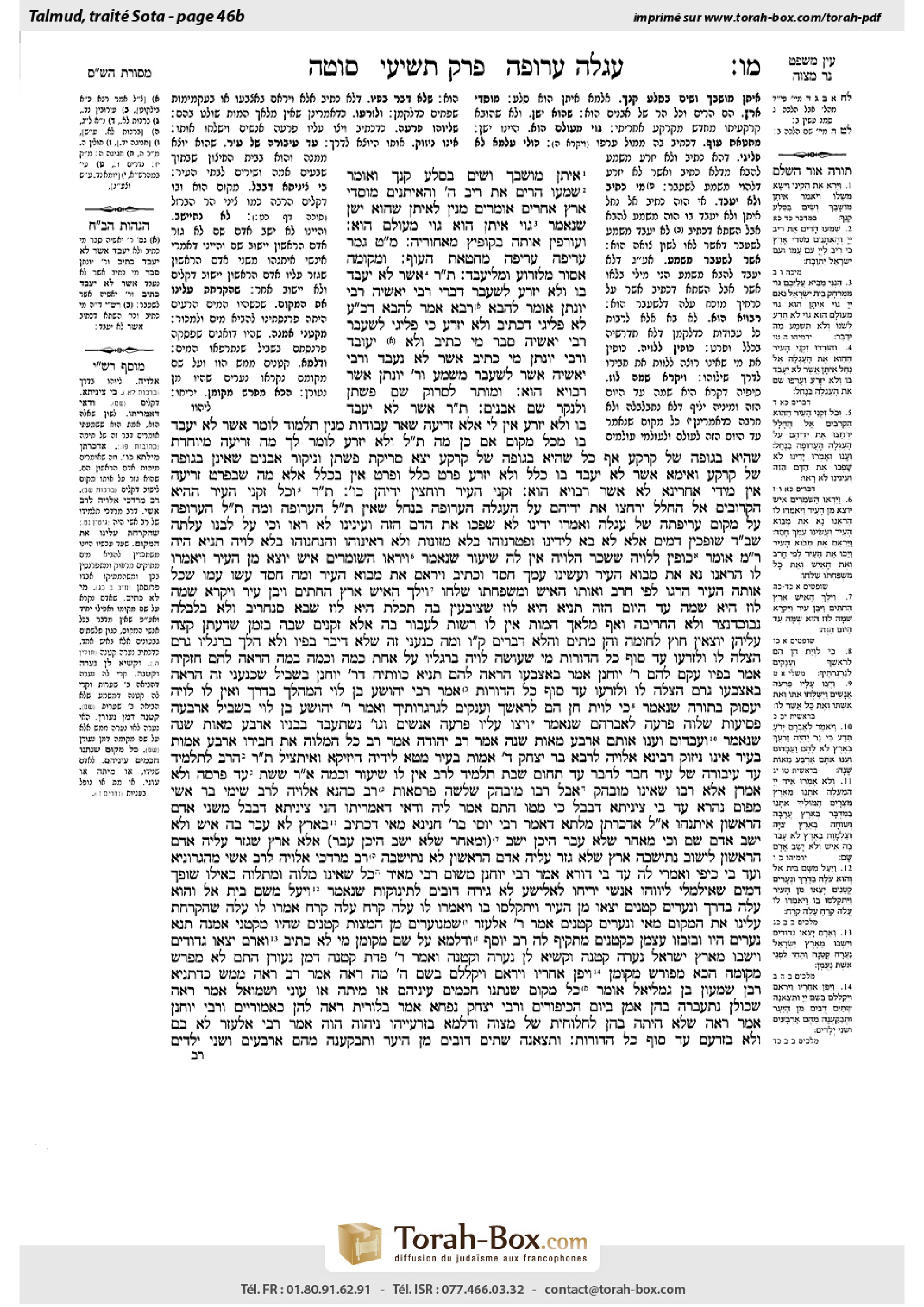
Sotah 46b: Talmud study for Daf Yomi
Daf Yomi is the daily study of one Talmud folio. Explore 37 tractates with scans, Hebrew text, Sefaria English and AI-generated French translations where annotated.
Passage selection and English or AI-generated French translation are available where the scan has annotations. Daf Study is independent of Torah-Box and Sefaria.
Browse Sotah · סוטה · All tractatesSotah 46b text and translations
This page of Sotah includes the Aramaic text, an English translation and an AI-generated French translation, alongside the scan above.
סוטה מ״ו ב · Aramaic and Hebrew text
״אֵיתָן מוֹשָׁבֶךָ וְשִׂים בַּסֶּלַע קִנֶּךָ״, וְאוֹמֵר: ״שִׁמְעוּ הָרִים אֶת רִיב ה׳ וְהָאֵיתָנִים מֹסְדֵי אָרֶץ״. אֲחֵרִים אוֹמְרִים: מִנַּיִן לְ״אֵיתָן״ שֶׁהוּא יָשָׁן — שֶׁנֶּאֱמַר: ״גּוֹי אֵיתָן הוּא, גּוֹי מֵעוֹלָם הוּא״.
״וְעוֹרְפִין אוֹתָהּ בְּקוֹפִיץ מֵאֲחוֹרֶיהָ״. מַאי טַעְמָא — גָּמַר עֲרִיפָה עֲרִיפָה מֵחַטַּאת הָעוֹף.
״וּמְקוֹמָהּ, אָסוּר מִלִּזְרוֹעַ וּמִלֵּיעָבֵד״. תָּנוּ רַבָּנַן: ״אֲשֶׁר לֹא יֵעָבֵד בּוֹ וְלֹא יִזָּרֵעַ״ — לְשֶׁעָבַר, דִּבְרֵי רַבִּי יֹאשִׁיָּה. רַבִּי יוֹנָתָן אוֹמֵר: לְהַבָּא.
רָבָא אָמַר: לְהַבָּא — דְּכוּלֵּי עָלְמָא לָא פְּלִיגִי, דִּכְתִיב: ״וְלֹא יִזָּרֵעַ״, כִּי פְּלִיגִי לְשֶׁעָבַר. רַבִּי יֹאשִׁיָּה סָבַר: מִי כְּתִיב ״וְלֹא יְעוּבַּד״? וְרַבִּי יוֹנָתָן: מִי כְּתִיב ״אֲשֶׁר לֹא נֶעֱבַד״? וְרַבִּי יֹאשִׁיָּה: ״אֲשֶׁר״ — לְשֶׁעָבַר מַשְׁמַע, וְרַבִּי יוֹנָתָן: ״אֲשֶׁר״ — רִבּוּיָא הוּא.
וּמוּתָּר לִסְרוֹק שָׁם פִּשְׁתָּן וּלְנַקֵּר שָׁם אֲבָנִים. תָּנוּ רַבָּנַן: ״אֲשֶׁר לֹא יֵעָבֵד בּוֹ וְלֹא יִזָּרֵעַ״ — אֵין לִי אֶלָּא זְרִיעָה, שְׁאָר עֲבוֹדוֹת מִנַּיִן? תַּלְמוּד לוֹמַר: ״אֲשֶׁר לֹא יֵעָבֵד בּוֹ״ — מִכׇּל מָקוֹם.
אִם כֵּן מָה תַּלְמוּד לוֹמַר ״וְלֹא יִזָּרֵעַ״? לוֹמַר לְךָ: מָה זְרִיעָה מְיוּחֶדֶת שֶׁהִיא בְּגוּפָהּ שֶׁל קַרְקַע, אַף כֹּל שֶׁהוּא בְּגוּפָהּ שֶׁל קַרְקַע. יָצָא סְרִיקַת פִּשְׁתָּן וְנִיקּוּר אֲבָנִים, שֶׁאֵינָן בְּגוּפָהּ שֶׁל קַרְקַע.
וְאֵימָא: ״אֲשֶׁר לֹא יֵעָבֵד בּוֹ״ — כָּלַל, ״וְלֹא יִזָּרֵעַ״ — פָּרַט. כְּלָל וּפְרָט, אֵין בַּכְּלָל אֶלָּא מָה שֶׁבַּפְּרָט: זְרִיעָה — אִין, מִידֵּי אַחֲרִינָא — לָא! ״אֲשֶׁר״ — רִבּוּיָא הוּא.
זִקְנֵי הָעִיר רוֹחֲצִין יְדֵיהֶן כּוּ׳. תָּנוּ רַבָּנַן: ״וְכׇל זִקְנֵי הָעִיר הָהִיא הַקְּרֹבִים אֶל הֶחָלָל יִרְחֲצוּ אֶת יְדֵיהֶם עַל הָעֶגְלָה הָעֲרוּפָה בַנָּחַל״. שֶׁאֵין תַּלְמוּד לוֹמַר ״הָעֲרוּפָה״, וּמָה תַּלְמוּד לוֹמַר ״הָעֲרוּפָה״ — עַל מְקוֹם עֲרִיפָתָהּ שֶׁל עֶגְלָה.
״וְאָמְרוּ יָדֵינוּ לֹא שָׁפְכוּ אֶת הַדָּם הַזֶּה וְעֵינֵינוּ לֹא רָאוּ״, וְכִי עַל לִבֵּנוּ עָלְתָה שֶׁבֵּית דִּין שׁוֹפְכִין דָּמִים?! אֶלָּא: לֹא בָּא לְיָדֵינוּ וּפְטַרְנוּהוּ בְּלֹא מְזוֹנוֹת, וְלֹא רְאִינוּהוּ וְהִנַּחְנוּהוּ בְּלֹא לְוָיָה.
תַּנְיָא, הָיָה רַבִּי מֵאִיר אוֹמֵר: כּוֹפִין לִלְוָיָה, שֶׁשְּׂכַר הַלְוָיָה אֵין לָהּ שִׁיעוּר, שֶׁנֶּאֱמַר: ״וַיִּרְאוּ הַשֹּׁמְרִים אִישׁ יוֹצֵא מִן הָעִיר וַיֹּאמְרוּ לוֹ הַרְאֵנוּ נָא אֶת מְבוֹא הָעִיר וְעָשִׂינוּ עִמְּךָ חָסֶד״, וּכְתִיב: ״וַיַּרְאֵם אֶת מְבוֹא הָעִיר״, וּמָה חֶסֶד עָשׂוּ עִמּוֹ — שֶׁכׇּל אוֹתָהּ הָעִיר הָרְגוּ לְפִי חֶרֶב, וְאוֹתוֹ הָאִישׁ וּמִשְׁפַּחְתּוֹ שָׁלְחוּ.
״וַיֵּלֶךְ הָאִישׁ אֶרֶץ הַחִתִּים וַיִּבֶן עִיר וַיִּקְרָא שְׁמָהּ לוּז הוּא שְׁמָהּ עַד הַיּוֹם הַזֶּה״, תַּנְיָא: הִיא לוּז שֶׁצּוֹבְעִין בָּהּ תְּכֵלֶת, הִיא לוּז שֶׁבָּא סַנְחֵרִיב וְלֹא בִּלְבְּלָהּ, נְבוּכַדְנֶצַּר וְלֹא הֶחְרִיבָהּ, וְאַף מַלְאַךְ הַמָּוֶת אֵין לוֹ רְשׁוּת לַעֲבוֹר בָּהּ. אֶלָּא זְקֵנִים שֶׁבָּהּ, בִּזְמַן שֶׁדַּעְתָּן קָצָה עֲלֵיהֶן יוֹצְאִין חוּץ לַחוֹמָה, וְהֵן מֵתִים.
וַהֲלֹא דְּבָרִים קַל וָחוֹמֶר: וּמָה כְּנַעֲנִי זֶה שֶׁלֹּא דִּיבֵּר בְּפִיו, וְלֹא הָלַךְ בְּרַגְלָיו — גָּרַם הַצָּלָה לוֹ וּלְזַרְעוֹ עַד סוֹף כׇּל הַדּוֹרוֹת, מִי שֶׁעוֹשֶׂה לְוָיָה בְּרַגְלָיו — עַל אַחַת כַּמָּה וְכַמָּה.
בַּמָּה הֶרְאָה לָהֶם? חִזְקִיָּה אָמַר: בְּפִיו עִקֵּם לָהֶם, רַבִּי יוֹחָנָן אָמַר: בְּאֶצְבָּעוֹ הֶרְאָה לָהֶם. תַּנְיָא כְּווֹתֵיהּ דְּרַבִּי יוֹחָנָן: בִּשְׁבִיל שֶׁכְּנַעֲנִי זֶה הֶרְאָה בְּאֶצְבָּעוֹ, גָּרַם הַצָּלָה לוֹ וּלְזַרְעוֹ עַד סוֹף כׇּל הַדּוֹרוֹת.
אָמַר רַבִּי יְהוֹשֻׁעַ בֶּן לֵוִי: הַמְהַלֵּךְ בַּדֶּרֶךְ וְאֵין לוֹ לְוָיָה — יַעֲסוֹק בַּתּוֹרָה, שֶׁנֶּאֱמַר: ״כִּי לִוְיַת חֵן הֵם לְרֹאשֶׁךָ וַעֲנָקִים לְגַרְגְּרֹתֶיךָ״. וְאָמַר רַבִּי יְהוֹשֻׁעַ בֶּן לֵוִי: בִּשְׁבִיל אַרְבָּעָה פְּסִיעוֹת שֶׁלִּוָּה פַּרְעֹה לְאַבְרָהָם, שֶׁנֶּאֱמַר: ״וַיְצַו עָלָיו פַּרְעֹה אֲנָשִׁים וְגוֹ׳״, נִשְׁתַּעְבֵּד בְּבָנָיו אַרְבַּע מֵאוֹת שָׁנָה — שֶׁנֶּאֱמַר: ״וַעֲבָדוּם וְעִנּוּ אֹתָם אַרְבַּע מֵאוֹת שָׁנָה״. אָמַר רַב יְהוּדָה אָמַר רַב: כׇּל הַמְלַוֶּה אֶת חֲבֵירוֹ אַרְבַּע אַמּוֹת בָּעִיר — אֵינוֹ נִיזּוֹק. רָבִינָא אַלְוְיֵהּ לְרָבָא בַּר יִצְחָק אַרְבַּע אַמּוֹת בָּעִיר, מְטָא לִידֵיהּ הֶיזֵּיקָא וְאִיתַּצִּיל.
תָּנוּ רַבָּנַן: הָרַב לְתַלְמִיד — עַד עִיבּוּרָהּ שֶׁל עִיר, חָבֵר לְחָבֵר — עַד תְּחוּם שַׁבָּת, תַּלְמִיד לְרַב — אֵין לוֹ שִׁיעוּר. וְכַמָּה? אָמַר רַב שֵׁשֶׁת: עַד פַּרְסָה. וְלָא אֲמַרַן אֶלָּא רַבּוֹ שֶׁאֵינוֹ מוּבְהָק, אֲבָל רַבּוֹ מוּבְהָק — שְׁלֹשָׁה פַּרְסָאוֹת.
רַב כָּהֲנָא אַלְוְיֵהּ לְרַב שִׁימִי בַּר אָשֵׁי מִפּוּם נַהֲרָא עַד בֵּי צִינְיָתָא דְּבָבֶל. כִּי מְטוֹ הָתָם אֲמַר לֵיהּ: וַדַּאי דְּאָמְרִיתוּ הָנֵי צִינְיָתָא דְּבָבֶל מִשְּׁנֵי אָדָם הָרִאשׁוֹן אִיתַנְהוּ?
אֲמַר לֵיהּ: אַדְכַּרְתַּן מִלְּתָא דְּאָמַר רַבִּי יוֹסֵי בְּרַבִּי חֲנִינָא: מַאי דִּכְתִיב ״בְּאֶרֶץ לֹא עָבַר בָּהּ אִישׁ וְלֹא יָשַׁב אָדָם שָׁם״? וְכִי מֵאַחַר שֶׁלֹּא עָבַר — הֵיכָן יָשַׁב (וּמֵאַחַר שֶׁלֹּא יָשַׁב — הֵיכָן עָבַר)? אֶלָּא: אֶרֶץ שֶׁגָּזַר עָלֶיהָ אָדָם הָרִאשׁוֹן לְיִשּׁוּב — נִתְיַשְּׁבָה, אֶרֶץ שֶׁלֹּא גָּזַר עָלֶיהָ אָדָם הָרִאשׁוֹן — לֹא נִתְיַשְּׁבָה.
רַב מָרְדֳּכַי אַלְוְיֵהּ לְרַב אָשֵׁי מֵהַגְרוֹנְיָא וְעַד בֵּי כֵיפֵי, וְאָמְרִי לַהּ: עַד בֵּי דוּרָא.
אָמַר רַבִּי יוֹחָנָן מִשּׁוּם רַבִּי מֵאִיר: כָּל שֶׁאֵינוֹ מְלַוֶּה וּמִתְלַוֶּה — כְּאִילּוּ שׁוֹפֵךְ דָּמִים, שֶׁאִילְמָלֵי לִיוּוּהוּ אַנְשֵׁי יְרִיחוֹ לֶאֱלִישָׁע לֹא גֵּירָה דּוּבִּים לַתִּינוֹקוֹת, שֶׁנֶּאֱמַר: ״וַיַּעַל מִשָּׁם בֵּית אֵל וְהוּא עֹלֶה בַדֶּרֶךְ וּנְעָרִים קְטַנִּים יָצְאוּ מִן הָעִיר וַיִּתְקַלְּסוּ בוֹ וַיֹּאמְרוּ לוֹ עֲלֵה קֵרֵחַ עֲלֵה קֵרֵחַ״.
אָמְרוּ לוֹ: עֲלֵה, שֶׁהִקְרַחְתָּ עָלֵינוּ אֶת הַמָּקוֹם. מַאי ״וּנְעָרִים קְטַנִּים״? אָמַר רַבִּי אֶלְעָזָר: שֶׁמְּנוֹעָרִים מִן הַמִּצְוֹת, ״קְטַנִּים״ — שֶׁהָיוּ מִקְּטַנֵּי אֲמָנָה. תָּנָא: נְעָרִים הָיוּ, וּבִזְבְּזוּ עַצְמָן כִּקְטַנִּים.
מַתְקֵיף לַהּ רַב יוֹסֵף: וְדִלְמָא עַל שֵׁם מְקוֹמָן? מִי לָא כְּתִיב ״וַאֲרָם יָצְאוּ גְדוּדִים וַיִּשְׁבּוּ מֵאֶרֶץ יִשְׂרָאֵל נַעֲרָה קְטַנָּה״, וְקַשְׁיָא לַן: ״נַעֲרָה״ וּ״קְטַנָּה״? וְאָמַר רַבִּי פְּדָת: קְטַנָּה דְּמִן נְעוֹרָן! הָתָם לָא מְפָרַשׁ מְקוֹמָהּ, הָכָא מְפוֹרָשׁ מְקוֹמָן.
״וַיִּפֶן אַחֲרָיו וַיִּרְאֵם וַיְקַלְלֵם בְּשֵׁם ה׳״. מָה רָאָה? אָמַר רַב: רָאָה מַמָּשׁ. כִּדְתַנְיָא, רַבָּן שִׁמְעוֹן בֶּן גַּמְלִיאֵל אוֹמֵר: כׇּל מָקוֹם שֶׁנָּתְנוּ חֲכָמִים עֵינֵיהֶם — אוֹ מִיתָה, אוֹ עוֹנִי. וּשְׁמוּאֵל אָמַר: רָאָה שֶׁכּוּלָּן נִתְעַבְּרָה בָּהֶן אִמָּן בְּיוֹם הַכִּיפּוּרִים.
וְרַבִּי יִצְחָק נַפָּחָא אָמַר: בְּלוֹרִית רָאָה לָהֶן, כְּגוֹיִים. וְרַבִּי יוֹחָנָן אָמַר: רָאָה שֶׁלֹּא הָיְתָה בָּהֶן לַחְלוּחִית שֶׁל מִצְוָה. וְדִלְמָא בְּזַרְעַיְיהוּ נִיהְוָה הֲוָה? אָמַר רַבִּי אֶלְעָזָר: לֹא בָּם וְלֹא בְּזַרְעָם עַד סוֹף כׇּל הַדּוֹרוֹת.
״וַתֵּצֶאנָה שְׁתַּיִם דֻּבִּים מִן הַיַּעַר וַתְּבַקַּעְנָה מֵהֶם אַרְבָּעִים וּשְׁנֵי יְלָדִים״,
Sotah 46b · English translation
“Firm [eitan] is your dwelling-place, and your nest is set in the rock” (Numbers 24:21), and it states: “Hear, O you mountains, the Lord’s controversy, and the enduring rocks [eitanim], the foundations of the earth” (Micah 6:2). The use of the word in these verses indicates that “eitan” means something hard, like a rock or a mountain. Others say a different explanation of the word eitan: From where is it derived that eitan means old? As it is stated: “It is an ancient [eitan] nation, a nation from of old” (Jeremiah 5:15).
§ The mishna taught: And they break the neck [orfin] of the heifer from behind with a cleaver. The Gemara explains: What is the reason that the Sages understood that the heifer is killed in this manner? They derive that the term arifa, which describes what is done to the heifer, refers to breaking the back of the neck, from the term arifa stated with regard to the bird brought as a sin-offering (see Leviticus 5:8).
§ The mishna taught further: And with regard to its place, it is prohibited for that ground to be sown or to be worked. The Sages taught: The verse: “Which may be neither worked nor sown” (Deuteronomy 21:4) is referring to the past, that is, a place which has not previously been worked or sown. This is the statement of Rabbi Yoshiya. Rabbi Yonatan says: It speaks of the future, meaning it is prohibited to sow or work the land from that point onward.
Rava said: As for the future, everyone agrees that it is prohibited to sow or work the land, as it is written “neither worked nor sown” in the future tense. When they disagree is with regard to the past. Rabbi Yoshiya, who disqualifies a place that was sown beforehand, holds: Does it state: And shall not be worked, in the form of a future command? And Rabbi Yonatan responds: Does it state: And was not worked, in the past tense? And Rabbi Yoshiya answers: The term “which” indicates the past. And as for Rabbi Yonatan, in his opinion the term “which” is a term of amplification, as will be explained later in the Gemara, and it is not referring to the past.
§ The mishna taught: But it is permitted to comb flax there or to cut stones there. The Sages taught: From the phrase “which may be neither worked nor sown,” I have derived only sowing; from where do I derive that other types of labor are also prohibited? The verse states: “Which may be neither worked,” indicating that it may not be worked in any manner.
The baraita continues: If so, why does the verse also need to state “nor sown”? It is in order to say to you: Just as sowing is unique in that it is labor performed on the land itself, so too, all labor that is performed on the land itself is prohibited. This excludes combing flax and cutting stones, which are not done on the land itself.
The Gemara raises an objection: And perhaps one can say a different exposition: “Which may be neither worked” is a generalization, and “nor sown” a detail. When the Torah writes a generalization and a detail, there is nothing in the generalization other than what is in the detail, i.e., the detail serves to impose a limit on the generalization. Consequently, the verse is teaching that with regard to sowing, yes, it is prohibited, but with regard to anything else, no, it is not prohibited. The Gemara again answers: The term “which” is an amplification, and the addition of this term results in this verse not belonging to the category of generalizations and details.
§ The mishna taught that the Elders of the city would then wash their hands. The Sages taught: With regard to the verse: “And all the Elders of that city, who are nearest to the slain man, shall wash their hands over the heifer whose neck was broken in the valley” (Deuteronomy 21:6), one might have thought that there is no need for the verse to state: “Whose neck was broken,” because there is no heifer mentioned other than the one whose neck was broken. And what is the meaning when the verse states: “Whose neck was broken”? It serves to teach us that they wash their hands over the place where the heifer’s neck was broken.
The verse further states: “And they shall say: Our hands did not spill this blood, nor did our eyes see” (Deuteronomy 21:7). The mishna explains: But did it enter our minds that the Elders of the court are spillers of blood, that they must make such a declaration? Rather, they mean to declare: The victim did not come to us and then we let him take his leave without food, and we did not see him and then leave him alone to depart without accompaniment. They therefore attest that they took care of all his needs and are not responsible for his death even indirectly.
It is taught in a baraita: Rabbi Meir would say: There is coercion with regard to accompaniment, i.e., one who does not want to accompany another is nevertheless required to do so, as the reward for accompaniment is without measure. The proof of the importance of accompaniment is from a verse, as it is stated with regard to when the Jewish people laid siege to the city of Bethel: “And the watchers saw a man come out of the city, and they said to him: Show us, please, the entrance into the city, and we will deal kindly with you” (Judges 1:24), and it is written: “And he showed them the entrance to the city” (Judges 1:25). And what kindness did they perform with him? It is that they killed the entire city by the sword, but that man and his family they sent free.
The Gemara elaborates on the reward received in that story. The next verse states: “And the man went to the land of the Hittites, and he built a city, and he called its name Luz; that is its name to this day” (Judges 1:26). It is taught in a baraita: This is the city Luz where sky blue wool is dyed. It is the same city Luz where, although Sennacherib came and exiled many nations from place to place, he did not disarrange and exile its inhabitants; Nebuchadnezzar, who conquered many lands, did not destroy it; and even the angel of death has no permission to pass through it. Rather, its Elders, when they have decided that they have reached the end of life, go outside the city wall and die.
Are these matters not inferred a fortiori: And if this Canaanite, who did not speak with his mouth and explicitly tell them where the city entrance was, and did not walk with them by foot, but merely indicated the correct path to them, nevertheless caused himself to be rescued and also had the merit to provide rescue for his descendants until the end of all generations, then with regard to one who accompanies another by foot, all the more so will his reward be great.
After stating that the man did not openly guide those watching the city, the Gemara asks: How did that Canaanite show them the entrance to the city? Ḥizkiyya says: He twisted his mouth for them, i.e., he showed them the path to the city by moving his lips. Rabbi Yoḥanan says: He showed them with his finger alone. It is taught in a baraita in accordance with the opinion of Rabbi Yoḥanan: Because this Canaanite showed them with his finger, he caused himself to be rescued and merited rescue for his descendants as well, until the end of all generations.
Rabbi Yehoshua ben Levi says: One who walks along the way without having someone to accompany him should occupy himself with words of Torah, as it is stated with regard to words of Torah: “For they shall be a chaplet of grace to your head, and chains around your neck” (Proverbs 1:9). And Rabbi Yehoshua ben Levi further says: Due to four steps that Pharaoh accompanied Abraham, as it is stated: “And Pharaoh gave men charge concerning him, and they brought him on the way, and his wife, and all that he had” (Genesis 12:20), Pharaoh enslaved Abraham’s descendants for four hundred years, as it is stated: “And shall serve them, and they shall afflict them four hundred years” (Genesis 15:13). Rav Yehuda says that Rav says: Anyone who accompanies his friend four cubits in a city will come to no harm by accompanying him. The Gemara relates: Ravina accompanied Rava bar Yitzḥak four cubits in a city. He came close to harm, but he was saved.
The Sages taught: A teacher accompanies a student until the outskirts of the city; a friend accompanies a friend until the Shabbat boundary of that city, which is two thousand cubits; and for a student who accompanies his teacher, there is no measure to the distance he accompanies him. The Gemara asks: And how far? The student is certainly not required to walk with him the entire way. Rav Sheshet says: Up to a parasang [parsa], which is four mil. The Gemara comments: And we said this amount only with regard to one who is not his most significant teacher, but he accompanies his most significant teacher, who taught him most of his knowledge, three parasangs.
The Gemara relates a story about accompaniment: Rav Kahana accompanied Rav Shimi bar Ashi from the town of Pum Nahara to the palm grove in Babylonia. When they arrived there, Rav Kahana said to Rav Shimi bar Ashi: Is it true that you say that these palm trees of Babylonia have been in this place since the years of Adam the first man?
Rav Shimi bar Ashi said to him: By mentioning Adam the first man you reminded me of something that Rabbi Yosei, son of Rabbi Ḥanina, says: What is the meaning of that which is written: “Through a land that no man passed through, and where no person [adam] dwelt”? (Jeremiah 2:6). This verse is difficult: Since it is a land through which no man has passed, where would he dwell? And if he did not dwell, where did he pass? Why does the verse add that no person has dwelled there? Rather, this is the meaning: Any land concerning which Adam the first man decreed that it would be a settled area, was settled; but a land concerning which Adam the first man did not decree that it should be settled, was not settled.
The Gemara also relates that Rav Mordekhai accompanied Rav Ashi from the town of Hagronya until Bei Keifei, and some say that he accompanied him until Bei Dura.
The Gemara continues to discuss the importance of accompaniment. Rabbi Yoḥanan says in the name of Rabbi Meir: Whoever does not accompany another or will not allow himself to be accompanied is like a spiller of blood and is held responsible for any deaths that occur as a result of his inaction. The proof for this is that had the inhabitants of Jericho accompanied Elisha, he would not have incited the bears to attack the children, as it is stated: “And he went up from there to Bethel, and as he was going up by the way, there came forth young lads out of the city and mocked him, and said to him: Go up, baldhead; go up, baldhead” (II Kings 2:23). Had the residents of Jericho accompanied him, they would have sent away those youths and prevented what occurred next.
The Gemara proceeds to discuss this episode in detail, beginning with the meaning of the youths’ taunt. They said to him: Go up, away from here, for you have made the place bald, i.e., bare, for us. They had previously earned their living by providing the city of Jericho with water. Elisha sweetened the city’s own water, rendering their services unnecessary. The Gemara asks: What is the meaning of: “Young lads [ne’arim ketannim]”? One would have expected the verse to state either “young” or “lads,” but not both. Rabbi Elazar says: The word “lads [ne’arim]” means that they were shaken empty [meno’arim] of the mitzvot; the word “young [ketannim]” means that they were of little faith [ketannei amana], as they had no trust that they would be able to earn their livelihood by any other means. The Sages taught: They were lads, that is, already of age, but they disgraced themselves like young children.
Rav Yosef objects to this interpretation: And perhaps they were called ne’arim after their place of origin? Isn’t it written: “And the Arameans had gone out in bands, and had brought away captive from Eretz Yisrael a minor young woman [na’ara ketana]” (II Kings 5:2), and this verse raised a difficulty to us: A minor and a young woman; how could she be both of these? And Rabbi Pedat says it means a minor girl from the town of Ne’oran. This verse concerning the lads can be explained in a similar manner: They were young children from Ne’oran. The Gemara answers: These two cases are not comparable. There the verse does not specify her place of origin, so “na’ara” could mean from the town of Ne’oran; but here the verse specifies their place of origin, namely Jericho.
The verse further states with regard to the same incident: “And he turned behind him and saw them, and he cursed them in the name of the Lord” (II Kings 2:24). The Gemara asks: What did he see? There are four explanations offered. Rav says: He literally saw, i.e., he stared and bored his eyes into them, as it is taught in a baraita: Rabban Shimon ben Gamliel says: Wherever it states that the Sages placed their eyes upon a certain person, they brought upon that person either death or poverty. And Shmuel says: He saw their essential nature, that all their mothers became pregnant with them on Yom Kippur, when conjugal relations are forbidden.
And Rabbi Yitzḥak Nappaḥa says: He saw that they had plaited locks grown on the back of their heads like the gentiles. And Rabbi Yoḥanan says: He saw that they did not contain even a smidgen of a mitzva. The Gemara raises an objection to this last interpretation of Rabbi Yoḥanan: But how could he curse them just because they did not have any mitzvot? Perhaps their descendants would have many mitzvot. Rabbi Elazar says: He saw that mitzvot would be found neither in them nor in their descendants, through all generations.
The verse states: “And two she-bears came out of the forest and tore forty-two children from them” (II Kings 2:24).
Sotah 46b · Traduction française (IA)
« Solide [eitan] est ton séjour, et ton nid est établi sur le roc » (Nombres 24:21), et il est dit : « Écoutez, montagnes, la querelle de l’Éternel, et vous, rochers éternels [eitanim], fondements de la terre » (Michée 6:2). L’emploi de ce mot dans ces versets indique que « eitan » désigne quelque chose de dur, comme un rocher ou une montagne. D’autres proposent une autre explication du mot eitan : d’où sait-on que eitan signifie « ancien » ? Comme il est dit : « C’est une nation ancienne [eitan], une nation d’autrefois » (Jérémie 5:15).
§ La Michna enseigne : « Et ils brisent la nuque [orfin] de la génisse par-derrière, au moyen d’un couperet. » La Guemara explique : Pourquoi les Sages ont-ils compris que la génisse est mise à mort de cette manière ? Ils déduisent que le terme arifa, qui décrit ce qui est fait à la génisse, désigne le fait de briser la nuque à partir du terme arifa employé à propos de l’oiseau apporté comme sacrifice expiatoire (voir Lévitique 5:8).
§ La Michna enseigne encore : Quant à l’endroit où cela a lieu, il est interdit d’ensemencer ce terrain ou de le travailler. Les Sages ont enseigné : Le verset « qui ne sera ni travaillé ni ensemencé » (Deutéronome 21:4) fait référence au passé, c’est-à-dire à un endroit qui n’a pas été travaillé ni ensemencé auparavant. Telle est la déclaration de Rabbi Yoshiya. Rabbi Yonatan dit : Le verset parle de l’avenir, ce qui signifie qu’il est interdit d’ensemencer ou de travailler le terrain à partir de ce moment.
Rava dit : Pour ce qui est de l’avenir, tous sont d’accord qu’il est interdit d’ensemencer ou de travailler le terrain, puisque le verset emploie les termes « ni travaillé ni ensemencé » au futur. Leur désaccord porte sur le passé. Rabbi Yoshiya, qui invalide un endroit préalablement ensemencé, soutient : Le verset dit-il : « et ne sera pas travaillé », sous la forme d’un ordre au futur ? Rabbi Yonatan répond : Le verset dit-il : « et n’a pas été travaillé », au passé ? Rabbi Yoshiya répond : Le terme « qui » indique le passé. Quant à Rabbi Yonatan, selon lui, le terme « qui » est une amplification, comme la Guemara l’expliquera plus loin, et il ne fait pas référence au passé.
§ La Michna enseigne : « Mais il est permis d’y peigner du lin ou d’y tailler des pierres. » Les Sages ont enseigné : De l’expression « qui ne sera ni travaillé ni ensemencé », j’ai seulement déduit qu’il est interdit d’ensemencer ; d’où déduis-je que les autres types de travail sont également interdits ? Le verset dit : « qui ne sera pas travaillé », ce qui indique que le terrain ne peut être travaillé d’aucune manière.
La baraïta poursuit : Si tel est le cas, pourquoi le verset doit-il également dire « ni ensemencé » ? C’est pour t’enseigner ceci : de même que l’ensemencement se distingue en ce qu’il s’agit d’un travail effectué sur le terrain lui-même, de même tout travail effectué sur le terrain lui-même est interdit. Cela exclut le peignage du lin et la taille des pierres, qui ne s’effectuent pas sur le terrain lui-même.
La Guemara soulève une objection : Peut-être peut-on proposer une autre interprétation : « qui ne sera pas travaillé » est une généralité, et « ni ensemencé » une précision. Lorsque la Torah énonce une généralité suivie d’une précision, la généralité ne comprend rien d’autre que ce qui figure dans la précision, c’est-à-dire que la précision vient limiter la généralité. Par conséquent, le verset enseigne que l’ensemencement est interdit, mais que toute autre chose ne l’est pas. La Guemara répond de nouveau : Le terme « qui » est une amplification, et l’ajout de ce terme fait que ce verset ne relève pas de la catégorie des généralités et des précisions.
§ La Michna enseigne que les anciens de la ville se lavent alors les mains. Les Sages ont enseigné : À propos du verset « Tous les anciens de cette ville, ceux qui sont les plus proches de l’homme tué, se laveront les mains au-dessus de la génisse dont la nuque a été brisée dans la vallée » (Deutéronome 21:6), on aurait pu penser qu’il n’était pas nécessaire que le verset dise : « dont la nuque a été brisée », puisqu’il n’est question d’aucune autre génisse que celle dont la nuque a été brisée. Que signifie donc l’expression « dont la nuque a été brisée » ? Elle nous enseigne qu’ils se lavent les mains au-dessus de l’endroit où la nuque de la génisse a été brisée.
Le verset dit ensuite : « Et ils diront : Nos mains n’ont pas versé ce sang, et nos yeux ne l’ont pas vu » (Deutéronome 21:7). La Michna explique : Mais nous est-il venu à l’esprit que les anciens du tribunal étaient des meurtriers, au point qu’ils doivent faire une telle déclaration ? Ils entendent plutôt déclarer : La victime n’est pas venue chez nous sans que nous la laissions repartir sans nourriture ; nous ne l’avons pas vue sans la laisser partir seule, sans escorte. Ils attestent ainsi avoir veillé à tous ses besoins et n’être pas responsables de sa mort, même indirectement.
Il est enseigné dans une baraïta : Rabbi Meïr disait : On peut contraindre quelqu’un à accompagner autrui, c’est-à-dire que celui qui ne veut pas accompagner quelqu’un est néanmoins tenu de le faire, car la récompense de l’accompagnement est sans mesure. L’importance de l’accompagnement est attestée par un verset : au sujet du siège de la ville de Béthel par le peuple juif, il est dit : « Les guetteurs virent un homme sortir de la ville et lui dirent : Indique-nous, s’il te plaît, l’entrée de la ville, et nous te traiterons avec bonté » (Juges 1:24), puis il est écrit : « Il leur indiqua l’entrée de la ville » (Juges 1:25). Quelle bonté lui témoignèrent-ils ? Ils tuèrent toute la ville par l’épée, mais laissèrent partir librement cet homme et sa famille.
La Guemara développe la récompense reçue dans cette histoire. Le verset suivant dit : « L’homme se rendit au pays des Hittites, bâtit une ville et l’appela Louz ; c’est son nom jusqu’à ce jour » (Juges 1:26). Il est enseigné dans une baraïta : Il s’agit de la ville de Louz, où l’on teint la laine en bleu azur. C’est la même ville de Louz où, bien que Sennachérib soit venu et ait exilé de nombreuses nations d’un endroit à l’autre, il ne déplaça pas ses habitants et ne les exila pas ; Nabuchodonosor, qui conquit de nombreux pays, ne la détruisit pas ; et même l’ange de la mort n’a pas la permission d’y passer. Ses anciens, lorsqu’ils décident que leur vie touche à sa fin, sortent plutôt des murs de la ville et meurent à l’extérieur.
Ces choses ne se déduisent-elles pas a fortiori ? Si ce Cananéen, qui ne leur a pas parlé de vive voix pour leur indiquer explicitement où se trouvait l’entrée de la ville et n’a pas marché à leurs côtés, mais s’est contenté de leur montrer le bon chemin, a néanmoins fait en sorte d’être sauvé et a aussi mérité que ses descendants soient sauvés jusqu’à la fin de toutes les générations, à combien plus forte raison la récompense de celui qui accompagne autrui à pied sera-t-elle grande.
Après avoir affirmé que l’homme n’avait pas guidé ouvertement ceux qui surveillaient la ville, la Guemara demande : Comment ce Cananéen leur a-t-il indiqué l’entrée de la ville ? Ḥizkiyya dit : Il remua les lèvres pour eux, c’est-à-dire qu’il leur montra le chemin de la ville en bougeant les lèvres. Rabbi Yoḥanan dit : Il le leur montra du seul doigt. Une baraïta est enseignée conformément à l’avis de Rabbi Yoḥanan : Parce que ce Cananéen le leur montra du doigt, il fit en sorte d’être sauvé et mérita également que ses descendants soient sauvés jusqu’à la fin de toutes les générations.
Rabbi Yehoshua ben Levi dit : Celui qui marche en chemin sans personne pour l’accompagner devrait s’occuper de paroles de Torah, comme il est dit à propos des paroles de Torah : « Elles seront une couronne de grâce pour ta tête et un collier pour ton cou » (Proverbes 1:9). Rabbi Yehoshua ben Levi dit également : À cause des quatre pas que Pharaon fit en accompagnant Abraham, comme il est dit : « Pharaon donna des hommes chargés de s’occuper de lui, et ils le conduisirent en chemin, lui, sa femme et tout ce qu’il possédait » (Genèse 12:20), Pharaon réduisit en esclavage les descendants d’Abraham pendant quatre cents ans, comme il est dit : « Ils les serviront, et ils les opprimeront pendant quatre cents ans » (Genèse 15:13). Rav Yehuda dit au nom de Rav : Quiconque accompagne son ami sur une distance de quatre coudées dans une ville ne subira aucun mal du fait de l’avoir accompagné. La Guemara rapporte : Ravina accompagna Rava bar Yitzḥak sur quatre coudées dans une ville. Il faillit subir un mal, mais fut sauvé.
Les Sages ont enseigné : Un maître accompagne un élève jusqu’aux faubourgs de la ville ; un ami accompagne son ami jusqu’à la limite du Chabbat de cette ville, soit deux mille coudées ; et, pour un élève qui accompagne son maître, la distance qu’il l’accompagne n’a pas de limite. La Guemara demande : Jusqu’où ? L’élève n’est certainement pas tenu de marcher avec lui tout le trajet. Rav Sheshet dit : Jusqu’à une parasange [parsa], soit quatre milles. La Guemara précise : Cette mesure ne s’applique qu’à celui qui n’est pas le maître principal de l’élève ; si celui-ci accompagne son maître principal, qui lui a enseigné la majeure partie de ses connaissances, il l’accompagne sur trois parasanges.
La Guemara rapporte un récit au sujet de l’accompagnement : Rav Kahana accompagna Rav Shimi bar Ashi depuis la ville de Pum Nahara jusqu’à la palmeraie de Babylonie. Lorsqu’ils y arrivèrent, Rav Kahana dit à Rav Shimi bar Ashi : Est-il vrai que tu dis que ces palmiers de Babylonie se trouvent en cet endroit depuis l’époque d’Adam, le premier homme ?
Rav Shimi bar Ashi lui dit : En mentionnant Adam, le premier homme, tu m’as rappelé une chose que Rabbi Yosei, fils de Rabbi Ḥanina, enseigne : Que signifie ce qui est écrit : « À travers un pays que nul homme n’avait traversé et où nul être humain [adam] n’avait habité » (Jérémie 2:6) ? Ce verset est difficile : puisqu’il s’agit d’un pays que nul homme n’a traversé, où aurait-il habité ? Et s’il n’y a pas habité, par où est-il passé ? Pourquoi le verset ajoute-t-il que nul être humain n’y a habité ? Voici plutôt le sens : Toute terre qu’Adam, le premier homme, avait décrété devoir être habitée fut habitée ; mais une terre qu’Adam, le premier homme, n’avait pas décrété devoir être habitée ne le fut pas.
La Guemara rapporte également que Rav Mordekhaï accompagna Rav Ashi depuis la ville de Hagronya jusqu’à Bei Keifei ; certains disent qu’il l’accompagna jusqu’à Bei Dura.
La Guemara poursuit la discussion sur l’importance de l’accompagnement. Rabbi Yoḥanan dit au nom de Rabbi Meïr : Quiconque n’accompagne pas autrui ou ne se laisse pas accompagner est semblable à un meurtrier et est tenu responsable des décès qui surviennent du fait de son inaction. La preuve en est que si les habitants de Jéricho avaient accompagné Élisée, il n’aurait pas incité les ours à attaquer les enfants, comme il est dit : « De là, il monta à Béthel ; tandis qu’il montait sur le chemin, de jeunes garçons sortirent de la ville et se moquèrent de lui en disant : Monte, chauve ! Monte, chauve ! » (II Rois 2:23). Si les habitants de Jéricho l’avaient accompagné, ils auraient éloigné ces jeunes gens et empêché ce qui se produisit ensuite.
La Guemara examine cet épisode en détail, en commençant par le sens de la raillerie des jeunes gens. Ils lui dirent : « Monte, éloigne-toi d’ici, car tu as rendu l’endroit chauve, c’est-à-dire désert, pour nous. » Auparavant, ils gagnaient leur vie en approvisionnant la ville de Jéricho en eau. Élisée adoucit l’eau de la ville elle-même, rendant leurs services inutiles. La Guemara demande : Que signifie « jeunes garçons [ne’arim ketannim] » ? On aurait pu s’attendre à ce que le verset dise soit « jeunes », soit « garçons », mais pas les deux. Rabbi Elazar dit : Le mot « garçons [ne’arim] » signifie qu’ils avaient été dépouillés [meno’arim] des mitsvot ; le mot « jeunes [ketannim] » signifie qu’ils avaient peu de foi [ketannei amana], car ils ne croyaient pas pouvoir gagner leur vie par d’autres moyens. Les Sages ont enseigné : C’étaient des garçons, c’est-à-dire qu’ils avaient déjà atteint l’âge adulte, mais ils se comportaient de façon honteuse comme de jeunes enfants.
Rav Yosef objecte à cette interprétation : Peut-être étaient-ils appelés ne’arim d’après leur lieu d’origine ? N’est-il pas écrit : « Les Araméens étaient sortis en bandes et avaient emmené captive du pays d’Israël une jeune fille mineure [na’ara ketana] » (II Rois 5:2) ? Ce verset nous avait posé une difficulté : une mineure et une jeune fille, comment pouvait-elle être les deux à la fois ? Rabbi Pedat dit que cela signifie une jeune fille mineure de la ville de Ne’oran. Le verset concernant les garçons peut être expliqué de la même manière : c’étaient de jeunes enfants de Ne’oran. La Guemara répond : Ces deux cas ne sont pas comparables. Dans le premier, le verset ne précise pas son lieu d’origine ; « na’ara » pourrait donc désigner une personne de la ville de Ne’oran. Mais ici, le verset précise leur lieu d’origine, à savoir Jéricho.
Le verset dit encore, au sujet du même épisode : « Il se retourna, les regarda et les maudit au nom de l’Éternel » (II Rois 2:24). La Guemara demande : Qu’a-t-il vu ? Quatre explications sont proposées. Rav dit : Il les a vus au sens littéral, c’est-à-dire qu’il les a fixés du regard et les a transpercés de ses yeux, comme il est enseigné dans une baraïta : Rabban Shimon ben Gamliel dit : Chaque fois qu’il est dit que les Sages ont posé leurs yeux sur quelqu’un, ils ont entraîné pour cette personne soit la mort, soit la pauvreté. Et Shmuel dit : Il a vu leur nature profonde : toutes leurs mères étaient tombées enceintes d’eux à Yom Kippour, alors que les relations conjugales sont interdites.
Et Rabbi Yitzḥak Nappaḥa dit : Il vit qu’ils avaient tressé des mèches qui poussaient à l’arrière de leur tête, comme les non-Juifs. Rabbi Yoḥanan dit : Il vit qu’ils ne possédaient même pas une parcelle de mitsva. La Guemara soulève une objection à cette dernière interprétation de Rabbi Yoḥanan : Comment a-t-il pu les maudire simplement parce qu’ils n’avaient aucune mitsva ? Peut-être leurs descendants en auraient-ils beaucoup. Rabbi Elazar dit : Il vit que des mitsvot ne se trouveraient ni chez eux ni chez leurs descendants, à travers toutes les générations.
Le verset dit : « Deux ourses sortirent de la forêt et déchirèrent quarante-deux enfants parmi eux » (II Rois 2:24).
Traduction française générée par IA à partir de l’édition anglaise de Sefaria. Vérifie toujours un passage avec le texte source.
Text from Sefaria: William Davidson Edition - Vocalized Aramaic (CC BY NC); William Davidson Edition - English (CC BY NC).