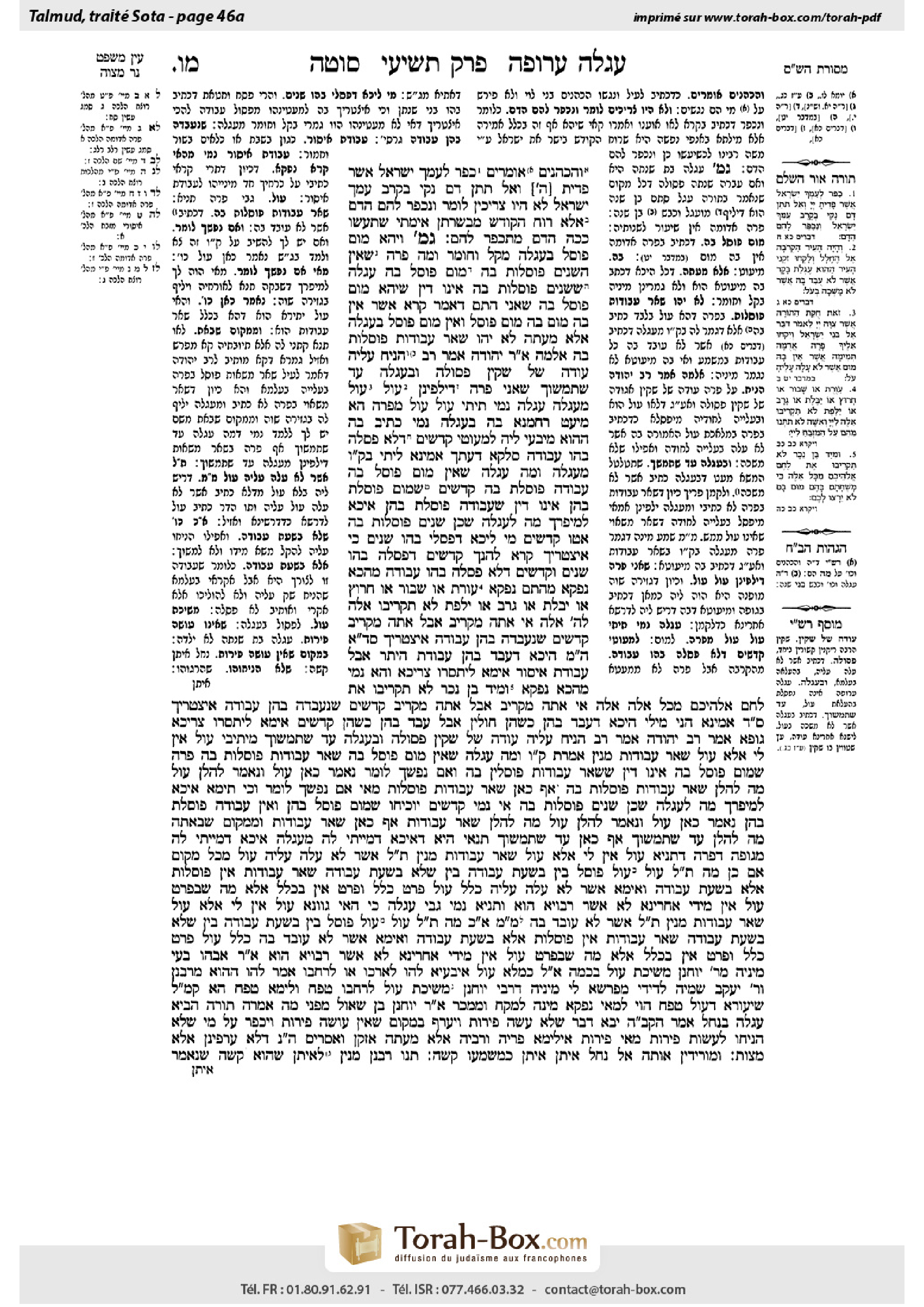
Sotah 46a: Talmud study for Daf Yomi
Daf Yomi is the daily study of one Talmud folio. Explore 37 tractates with scans, Hebrew text, Sefaria English and AI-generated French translations where annotated.
Passage selection and English or AI-generated French translation are available where the scan has annotations. Daf Study is independent of Torah-Box and Sefaria.
Browse Sotah · סוטה · All tractatesSotah 46a text and translations
This page of Sotah includes the Aramaic text, an English translation and an AI-generated French translation, alongside the scan above.
סוטה מ״ו א · Aramaic and Hebrew text
וְהַכֹּהֲנִים אוֹמְרִים: ״כַּפֵּר לְעַמְּךָ יִשְׂרָאֵל אֲשֶׁר פָּדִיתָ ה׳ וְאַל תִּתֵּן דָּם נָקִי בְּקֶרֶב עַמְּךָ יִשְׂרָאֵל״. לֹא הָיוּ צְרִיכִין לוֹמַר ״וְנִכַּפֵּר לָהֶם הַדָּם״, אֶלָּא רוּחַ הַקּוֹדֶשׁ מְבַשַּׂרְתָּן: אֵימָתַי שֶׁתַּעֲשׂוּ כָּכָה — הַדָּם מִתְכַּפֵּר לָהֶם.
גְּמָ׳ וִיהֵא מוּם פּוֹסֵל בְּעֶגְלָה מִקַּל וָחוֹמֶר: וּמָה פָּרָה שֶׁאֵין הַשָּׁנִים פּוֹסְלוֹת בָּהּ, מוּם פּוֹסֵל בָּהּ, עֶגְלָה שֶׁשָּׁנִים פּוֹסְלוֹת בָּהּ — אֵינוֹ דִּין שֶׁיְּהֵא מוּם פּוֹסֵל בָּהּ! שָׁאנֵי הָתָם דְּאָמַר קְרָא: ״אֲשֶׁר אֵין בָּהּ מוּם״ — בָּהּ מוּם פּוֹסֵל, וְאֵין מוּם פּוֹסֵל בְּעֶגְלָה.
אֶלָּא מֵעַתָּה לֹא יְהוּ שְׁאָר עֲבוֹדוֹת פּוֹסְלוֹת בָּהּ.
אַלְּמָה אָמַר רַב יְהוּדָה אָמַר רַב: הִנִּיחַ עָלֶיהָ עוּדָּה שֶׁל שַׂקִּין — פְּסוּלָה, וּבְעֶגְלָה עַד שֶׁתִּמְשׁוֹךְ! שָׁאנֵי פָּרָה, דְּיָלְפִינַן ״עֹל״ ״עֹל״ מֵעֶגְלָה.
עֶגְלָה נָמֵי תֵּיתֵי ״עֹל״ ״עֹל״ מִפָּרָה! הָא מַיעֵט רַחֲמָנָא ״בָּהּ״.
בְּעֶגְלָה נָמֵי כְּתִיב ״בָּהּ״! הָהוּא מִיבְּעֵי לֵיהּ לְמַעוֹטֵי קֳדָשִׁים, דְּלָא פָּסְלָה בְּהוּ עֲבוֹדָה. סָלְקָא דַּעְתָּךְ אָמֵינָא לֵיתֵי בְּקַל וָחוֹמֶר מֵעֶגְלָה: וּמָה עֶגְלָה שֶׁאֵין מוּם פּוֹסֵל בָּהּ — עֲבוֹדָה פּוֹסֶלֶת בָּהּ, קֳדָשִׁים שֶׁמּוּם פּוֹסֵל(ת) בָּהֶן — אֵינוֹ דִּין שֶׁעֲבוֹדָה פּוֹסֶלֶת בָּהֶן?
אִיכָּא לְמִיפְרַךְ: מָה לְעֶגְלָה שֶׁכֵּן שָׁנִים פּוֹסְלוֹת בָּהּ! אַטּוּ קֳדָשִׁים מִי לֵיכָּא דְּפָסְלִי בְּהוּ שָׁנִים? כִּי אִיצְטְרִיךְ קְרָא לְהָנָךְ קֳדָשִׁים דְּפָסְלִי בְּהוּ שָׁנִים.
וְקָדָשִׁים דְּלָא פָּסְלָה בְּהוּ עֲבוֹדָה מֵהָכָא נָפְקָא? מֵהָתָם נָפְקָא: ״עַוֶּרֶת אוֹ שָׁבוּר אוֹ חָרוּץ אוֹ יַבֶּלֶת אוֹ גָרָב אוֹ יַלֶּפֶת לֹא תַקְרִיבוּ אֵלֶּה לַה׳״, אֵלֶּה אִי אַתָּה מַקְרִיב, אֲבָל אַתָּה מַקְרִיב קֳדָשִׁים שֶׁנֶּעֶבְדָה בָּהֶן עֲבוֹדָה! אִיצְטְרִיךְ, סָלְקָא דַּעְתָּךְ אָמֵינָא: הָנֵי מִילֵּי הֵיכָא דְּעָבַד בָּהֶן עֲבוֹדַת הֶיתֵּר, אֲבָל עֲבוֹדַת אִיסּוּר אֵימָא לִיתַּסְרוּ, צְרִיכָא.
וְהָא נָמֵי מֵהָכָא נָפְקָא — ״וּמִיַּד בֶּן נֵכָר לֹא תַקְרִיבוּ אֶת לֶחֶם אֱלֹהֵיכֶם מִכׇּל אֵלֶּה״, אֵלֶּה אִי אַתָּה מַקְרִיב, אֲבָל אַתָּה מַקְרִיב קֳדָשִׁים שֶׁנֶּעֶבְדָה בָּהֶן עֲבוֹדָה!
אִיצְטְרִיךְ, סָלְקָא דַּעְתָּךְ אָמֵינָא: הָנֵי מִילֵּי הֵיכָא דְּעָבַד בָּהֶן כְּשֶׁהֵן חוּלִּין, אֲבָל עָבַד בָּהֶן כְּשֶׁהֵן קֳדָשִׁים — אֵימָא לִיתַּסְרוּ, צְרִיכָא.
גּוּפָא, אָמַר רַב יְהוּדָה אָמַר רַב: הִנִּיחַ עָלֶיהָ עוּדָּה שֶׁל שַׂקִּין פְּסוּלָה, וּבְעֶגְלָה עַד שֶׁתִּמְשׁוֹךְ. מֵיתִיבִי: ״עֹל״, אֵין לִי אֶלָּא עוֹל, שְׁאָר עֲבוֹדוֹת מִנַּיִן? אָמַרְתָּ, קַל וָחוֹמֶר: וּמָה עֶגְלָה שֶׁאֵין מוּם פּוֹסֵל בָּהּ, שְׁאָר עֲבוֹדוֹת פּוֹסְלוֹת בָּהּ, פָּרָה שֶׁמּוּם פּוֹסֵל בָּהּ — אֵינוֹ דִּין שֶׁשְּׁאָר עֲבוֹדוֹת פּוֹסְלִין בָּהּ?
וְאִם נַפְשְׁךָ לוֹמַר: נֶאֱמַר כָּאן ״עֹל״ וְנֶאֱמַר לְהַלָּן ״עֹל״. מָה לְהַלָּן שְׁאָר עֲבוֹדוֹת פּוֹסְלוֹת בָּהּ — אַף כָּאן שְׁאָר עֲבוֹדוֹת פּוֹסְלוֹת.
מַאי ״אִם נַפְשְׁךָ לוֹמַר״? וְכִי תֵּימָא, אִיכָּא לְמִיפְרַךְ: מָה לְעֶגְלָה שֶׁכֵּן שָׁנִים פּוֹסְלוֹת בָּהּ. אִי נָמֵי: קֳדָשִׁים יוֹכִיחוּ, שֶׁמּוּם פּוֹסֵל בָּהֶן, וְאֵין עֲבוֹדָה פּוֹסֶלֶת בָּהֶן.
נֶאֱמַר כָּאן ״עֹל״ וְנֶאֱמַר לְהַלָּן ״עֹל״, מָה לְהַלָּן שְׁאָר עֲבוֹדוֹת — אַף כָּאן שְׁאָר עֲבוֹדוֹת. וּמִמָּקוֹם שֶׁבָּאתָה: מָה לְהַלָּן עַד שֶׁתִּמְשׁוֹךְ, אַף כָּאן עַד שֶׁתִּמְשׁוֹךְ!
תַּנָּאֵי הִיא, דְּאִיכָּא דְּמַיְיתֵי לַהּ מֵעֶגְלָה, אִיכָּא דְּמַיְיתֵי לַהּ מִגּוּפַהּ דְּפָרָה.
דְּתַנְיָא: ״עֹל״, אֵין לִי אֶלָּא עוֹל. שְׁאָר עֲבוֹדוֹת מִנַּיִן — תַּלְמוּד לוֹמַר: ״אֲשֶׁר לֹא עָלָה עָלֶיהָ עֹל״ מִכׇּל מָקוֹם. אִם כֵּן מָה תַּלְמוּד לוֹמַר ״עֹל״ — עוֹל פּוֹסֵל בֵּין בִּשְׁעַת עֲבוֹדָה בֵּין שֶׁלֹּא בִּשְׁעַת עֲבוֹדָה, שְׁאָר עֲבוֹדוֹת אֵין פּוֹסְלוֹת אֶלָּא בִּשְׁעַת עֲבוֹדָה.
וְאֵימָא: ״אֲשֶׁר לֹא עָלָה עָלֶיהָ״ — כָּלַל, ״עֹל״ — פָּרַט, כְּלָל וּפְרָט, אֵין בַּכְּלָל אֶלָּא מָה שֶׁבַּפְּרָט: עוֹל אִין, מִידֵּי אַחֲרִינָא — לָא! ״אֲשֶׁר״ — רִבּוּיָא הוּא.
וְתַנְיָא נָמֵי גַּבֵּי עֶגְלָה כִּי הַאי גַוְונָא: ״עֹל״, אֵין לִי אֶלָּא עוֹל. שְׁאָר עֲבוֹדוֹת מִנַּיִן — תַּלְמוּד לוֹמַר: ״אֲשֶׁר לֹא עֻבַּד בָּהּ״ מִכׇּל מָקוֹם. אִם כֵּן מָה תַּלְמוּד לוֹמַר ״עֹל״ — עוֹל פּוֹסֵל בֵּין בִּשְׁעַת עֲבוֹדָה בֵּין שֶׁלֹּא בִּשְׁעַת עֲבוֹדָה, שְׁאָר עֲבוֹדוֹת אֵין פּוֹסְלוֹת אֶלָּא בִּשְׁעַת עֲבוֹדָה.
וְאֵימָא: ״אֲשֶׁר לֹא עֻבַּד בָּהּ״ — כָּלַל, ״עֹל״ — פָּרַט. כְּלָל וּפְרָט, אֵין בַּכְּלָל אֶלָּא מָה שֶׁבַּפְּרָט: עוֹל — אִין, מִידֵּי אַחֲרִינָא — לָא! ״אֲשֶׁר״ — רִבּוּיָא הוּא.
אָמַר רַבִּי אֲבָהוּ, בְּעַי מִינֵּיהּ מֵרַבִּי יוֹחָנָן: מְשִׁיכַת עוֹל בְּכַמָּה? אָמַר לִי: כִּמְלֹא עוֹל. אִיבַּעְיָא לְהוּ: לְאׇרְכּוֹ אוֹ לְרׇחְבּוֹ? אֲמַר לְהוּ הַהוּא מֵרַבָּנַן וְרַבִּי יַעֲקֹב שְׁמֵיהּ: לְדִידִי מִפָּרְשָׁא לִי מִינֵּיהּ דְּרַבִּי יוֹחָנָן: מְשִׁיכַת עוֹל לְרׇחְבּוֹ טֶפַח.
וְלֵימָא טֶפַח? הָא קָא מַשְׁמַע לַן שִׁיעוּרָא דְּעוֹל — טֶפַח הָוֵי. לְמַאי נָפְקָא מִינַּהּ — לְמִקָּח וּמִמְכָּר.
אָמַר רַבִּי יוֹחָנָן בֶּן שָׁאוּל, מִפְּנֵי מָה אָמְרָה תּוֹרָה: הָבֵיא עֶגְלָה בְּנַחַל? אָמַר הַקָּדוֹשׁ בָּרוּךְ הוּא: יָבֹא דָּבָר שֶׁלֹּא עָשָׂה פֵּירוֹת, וְיֵעָרֵף בִּמְקוֹם שֶׁאֵין עוֹשֶׂה פֵּירוֹת, וִיכַפֵּר עַל מִי שֶׁלֹּא הִנִּיחוּ[הוּ] לַעֲשׂוֹת פֵּירוֹת. מַאי פֵּירוֹת? אִילֵימָא פְּרִיָּה וּרְבִיָּה — אֶלָּא מֵעַתָּה אַזָּקֵן וְאַסָּרִיס הָכִי נָמֵי דְּלָא עָרְפִינַן?! אֶלָּא מִצְוֹת.
וּמוֹרִידִין אוֹתָהּ אֶל נַחַל אֵיתָן. ״אֵיתָן״ כְּמַשְׁמָעוֹ, קָשֶׁה. תָּנוּ רַבָּנַן: מִנַּיִן לְאֵיתָן שֶׁהוּא קָשֶׁה — שֶׁנֶּאֱמַר:
Sotah 46a · English translation
And the priests recite: “Forgive, Lord, Your people Israel, whom You have redeemed, and suffer not innocent blood to remain in the midst of Your people Israel” (Deuteronomy 21:8). They did not have to recite the conclusion of the verse: “And the blood shall be forgiven for them,” as this is not part of the priests’ statement, but rather the Divine Spirit informs them: When you shall do so, the blood is forgiven for you.
GEMARA: With regard to the mishna’s statement that the heifer is not disqualified by a blemish, the Gemara suggests: And a blemish should disqualify in the case of the heifer, by means of an a fortiori inference: And if in the case of the red heifer, which is not disqualified by years, as it may be of any age, and yet a blemish disqualifies it, then a heifer for this ritual, which is disqualified by years, as it is valid only until two years of age, is it not logical that a blemish should disqualify it? The Gemara answers: It is different there, in the case of the red heifer, as the verse states: “Wherein [bah] has no blemish” (Numbers 19:2). This serves as an exclusion and teaches that it is only with regard to it [bah] that a blemish is disqualifying, but a blemish is not disqualifying with regard to the heifer of the ritual of the breaking of the neck.
The Gemara asks: However, if that is so, if the word “bah” precludes a derivation by an a fortiori inference, then any other labor performed with the red heifer, apart from pulling a yoke, should not disqualify it. While the verse disqualifies a red heifer only if it pulled a yoke, as it states: “And upon which never came a yoke” (Numbers 19:2), a similar a fortiori inference could be learned from the heifer whose neck is to be broken to disqualify a red heifer that has performed any labor. However, since the verse states with regard to the heifer whose neck is to be broken: “That has not been worked with [bah]” (Deuteronomy 21:3), this indicates that labor is disqualifying only for “bah,” a heifer whose neck is to be broken, but not for a red heifer.
Why, then, does Rav Yehuda say that Rav says: If he placed a bundle [uda] of sacks on a red heifer, the heifer is immediately disqualified from being used as the red heifer; and as for the heifer whose neck is broken, it is not disqualified by such labor until it pulls and moves the burden, as the verse states: “That has not pulled a yoke” (Deuteronomy 21:3). Why does bearing the weight of the bundle disqualify the red heifer? The Gemara explains: The halakha with regard to the red heifer is different, as we learn by a verbal analogy between the word “yoke” used with regard to the red heifer and the word “yoke” used with regard to the heifer whose neck is broken that any labor disqualifies the former.
The Gemara raises an objection: If there is a verbal analogy between the red heifer and the heifer that will have its neck broken, then the halakha that a blemish should disqualify the heifer whose neck is broken should also be derived from the usage of “yoke” with regard to the heifer whose neck is broken and from the usage of “yoke” with regard to the red heifer. The Gemara answers: The Merciful One has excluded this possibility by placing in the verse the word “bah,” which indicates that disqualification due to blemish applies only to the red heifer and not to the heifer whose neck is broken.
The Gemara counters this claim: In the verse concerning a heifer whose neck is broken, the Torah also writes “bah”; it should be the case that forms of labor other than pulling a yoke are disqualifying only with regard to it and not with regard to the red heifer. The Gemara answers: That word “bah” is required by Rav Yehuda in order to exclude sacred offerings, i.e., which are not disqualified by labor, and one may bring an animal that has been used for labor as an offering. It might enter your mind to say that this should be derived by an a fortiori inference from a heifer whose neck is broken, as follows: And if with regard to a heifer whose neck is broken, which is not disqualified by a blemish, labor nevertheless disqualifies it, then with regard to sacred offerings, which are disqualified by a blemish, is it not right that labor should disqualify them? In order to counter this argument, the word “bah” teaches us that a sacred offering is not disqualified by labor.
With regard to this suggested a fortiori inference, the Gemara observes that it can be refuted in the following manner: What about the fact that a heifer whose neck is broken is disqualified by years, as once it reaches two years of age it is no longer classified as a heifer? As it is clear that the heifer whose neck is to be broken carries some restrictions that do not apply to sacred offerings, perhaps being disqualified by labor is another such restriction. The Gemara refutes this argument: Is that to say that there are no sacred offerings that are disqualified by years? There are several offerings that may be brought only in their first or second year, and where the verse is necessary to teach that sacred offerings are not disqualified by labor, it is with regard to those sacred offerings that are disqualified by years.
The Gemara raises an objection: But is the halakha that sacred offerings are not disqualified by labor derived from this verse? It is derived from elsewhere. The verse states with regard to sacred offerings: “Blind, or broken, or maimed, or having a wart, or scabbed, or scurvy, you shall not offer these to the Lord” (Leviticus 22:22). This verse serves to create an exclusion, teaching that it is these that you may not sacrifice, but you may sacrifice sacred animals that have been used for labor. The Gemara answers: It was necessary to state the halakha twice. It might enter your mind to say that this halakha, that one may sacrifice animals that have been used for labor, applies only in a case where they were used for permitted labor, but if they were used for prohibited labor, e.g., on Shabbat, you might say that it is prohibited to bring them as offerings. In order to refute this argument, it is necessary to state the halakha again.
The Gemara poses another question: But this halakha that prohibited labor does not disqualify offerings is also derived from here, a verse with regard to the sacrifice of blemished animals: “And from the hand of a stranger you shall not offer the bread of your God from any of these, because…there is a blemish in them” (Leviticus 22:25). This verse emphasizes that it is only “these,” i.e., blemished animals, that you may not sacrifice, but you may sacrifice sacred animals that have been used for labor. Since this verse is discussing the possibility of accepting offerings from a gentile, who presumably also performed prohibited labor with the animal, this demonstrates that prohibited labor does not disqualify animals from being sacrificed as offerings.
The Gemara answers: It was necessary to teach this halakha a third time. It might enter your mind to say: This halakha, that labor does not disqualify offerings, applies only where one performed labor with them when they were non-sacred and afterward dedicated them as offerings, but if one performed labor with them when they were already sacred animals, you might say that it is prohibited to bring them as offerings. In order to refute this argument, it is necessary to teach this halakha in three separate places.
§ The Gemara returns to discuss the matter itself: Rav Yehuda says that Rav says: If one placed a bundle of sacks on a red heifer, it is disqualified. And as for a heifer whose neck is broken, it is not disqualified until it pulls a burden. The Gemara raises an objection from a baraita: It states with regard to the red heifer: “That upon which never came a yoke” (Numbers 19:2). I have derived only a yoke; from where do I derive that other types of labor also disqualify the animal? You can say the following a fortiori inference: And if with regard to a heifer whose neck is broken, which is not disqualified by a blemish, other types of labor disqualify it, then with regard to a red heifer, which is disqualified by a blemish, is it not right that other types of labor should disqualify it?
And if it is your wish to say that this a fortiori inference is unsound, you can learn this halakha by a verbal analogy: It is stated here, with regard to the red heifer, “yoke” (Numbers 19:2), and it is stated there, with regard to the heifer whose neck is broken, “yoke” (Deuteronomy 21:3). Just as there, other types of labor disqualify it, so too here, in the case of the red heifer, other types of labor disqualify it.
The Gemara asks: What is the meaning of: If it is your wish to say? What potential problem with the a fortiori inference necessitates the verbal analogy? The Gemara explains: And perhaps you would say that the a fortiori inference can be refuted in the following manner: What is unique about a heifer whose neck is broken is that it is disqualified by years, which is not the case for a red heifer. Alternatively, one could suggest that sacred offerings will prove that this inference should not be made, as a blemish is disqualifying with regard to them, but labor is not disqualifying with regard to them.
As the a fortiori inference can be refuted in either of these ways, there is a need for the verbal analogy: It is stated here “yoke,” and it is stated there “yoke.” Just as there, in the case of a heifer whose neck is broken, other types of labor disqualify it, so too, other types of labor disqualify a red heifer. The Gemara raises an objection to this verbal analogy: And from the place that you came you can offer an alternative exposition: Just as below, in the case of a heifer whose neck is broken, it is not disqualified by carrying a burden until it pulls the yoke, so too here, a red heifer should not be disqualified until it pulls the yoke, contrary to the statement of Rav.
The Gemara answers the objection to the statement of Rav from the baraita: It is a dispute among tanna’im, as there are those who cite the source of this halakha, that labor disqualifies a red heifer, by verbal analogy from a heifer whose neck is broken, and therefore the red heifer is disqualified only if it pulls the burden. There are also those who cite the source of this halakha from a red heifer itself, and consequently they disqualify the red heifer even if it did not pull the yoke.
This is as it is taught in a baraita with regard to a red heifer: From the term “yoke” I have derived only that a yoke disqualifies a red heifer; from where do I derive the other types of labor? The verse states: “That upon which never came a yoke” (Numbers 19:2). The verse could be read with a pause after the word “came,” which would teach that it is disqualified in any case, no matter what labor was performed with it. If so, what is the meaning when the verse states “yoke,” if all forms of labor disqualify it? It teaches us that a yoke placed on the animal disqualifies it whether the yoke was on the animal at the time of performing labor or whether it was on the animal not at the time of performing labor, i.e., it was merely placed on the animal. However, other types of labor actions disqualify animals only at the time of actually performing labor. Rav ruled in accordance with this opinion.
The Gemara raises an objection: And perhaps one can say a different exposition of the verse: “That upon which never came” is a generalization that disqualifies the animal after any type of labor, while “yoke” is a detail. There is a generalization and a detail, and the principle of halakhic exposition in that case is that there is nothing in the generalization other than what is in the detail. Therefore, with regard to a yoke, yes, it will disqualify an animal from being used as a red heifer; but with regard to anything else, no, it will not disqualify the animal. The Gemara answers: “That upon which never came” is an amplification, and the addition of this term results in this verse not belonging to the category of generalizations and details.
The Gemara comments: And a case like this is also taught in a baraita with regard to a heifer whose neck is broken: From the word “yoke” I have derived only that a yoke disqualifies; from where do I derive the other types of labor? The same verse states: “That has not been worked with” (Deuteronomy 21:3), to teach that it is disqualified in any case, no matter what labor was performed with it. If so, what is the meaning when the verse states “yoke”? It serves to teach us that a yoke placed on the animal disqualifies it whether the yoke was on the animal at the time of performing labor or whether it was on the animal not at the time of performing labor, i.e., it was merely placed on the animal, whereas other types of labor actions disqualify animals only at the time of actually performing labor.
The Gemara raises an objection: And perhaps one can say a different exposition of the verse: “That has not been worked with” is a generalization that disqualifies the animal after any type of labor, while “yoke” is a detail. There is a generalization and a detail, and the principle of halakhic exposition in that case is that there is nothing in the generalization other than what is in the detail, which means: With regard to a yoke, yes, it will disqualify an animal, but with regard to anything else, no, it will not disqualify it. The Gemara answers: The phrase “that has not been worked with” is an amplification, and the addition of this term results in this verse not belonging to the category of generalizations and details.
Rabbi Abbahu said: I asked of Rabbi Yoḥanan: This pulling of a yoke that disqualifies a heifer whose neck is broken, with how much, i.e., how far, must the animal pull the yoke for it to be disqualified? He said to me: Like the measure of the size of a full yoke. A dilemma was raised before the Sages: Does this mean according to its length or according to its width? One of the Sages, and Rabbi Ya’akov was his name, said to them: It was explained to me personally by Rabbi Yoḥanan himself: The pulling of a yoke is according to its width, which is a handbreadth.
The Gemara poses a question: And since he stated a fixed measurement, let him merely state: A handbreadth. Why was it necessary to add that this is the width of a yoke? The Gemara answers: This teaches us that the measure of a yoke along its width is a handbreadth. What difference is there in knowing this fact? This teaches that in the case of commercial transactions, a buyer may retract his purchase if the yoke he was given is less than a handbreadth wide.
Rabbi Yoḥanan ben Shaul says: For what reason did the Torah say to bring a heifer whose neck is broken to a stream? The Holy One, Blessed be He, said: Let something that did not produce fruit, i.e., a heifer that has not given birth, come and have its neck be broken at a stream that flows forcefully, which is a place that does not produce fruit, and atone for the murder of one who was not given an opportunity to produce fruit. The Gemara asks: What is this fruit that he was not given an opportunity to produce? If we say it refers to being fruitful and multiplying, i.e., that the killer prevented him from having more children, but if that is so, in the case of an elderly person or a eunuch, so too will you say that we do not break the heifer’s neck because they could not have had any more children even had they lived? Rather, the fruit are mitzvot, as the killer deprived the victim of the opportunity to perform additional mitzvot.
The mishna taught: And they bring it down to a stream that is eitan. Eitan in this context means as the word generally indicates, forceful. The Sages taught: From where is it derived that eitan is forceful? It is as it is stated:
Sotah 46a · Traduction française (IA)
Et les prêtres récitent : « Pardonne, Seigneur, à Ton peuple Israël, que Tu as racheté, et ne laisse pas le sang innocent au milieu de Ton peuple Israël » (Deutéronome 21,8). Ils n’avaient pas à réciter la fin du verset : « Et le sang leur sera pardonné », car cela ne fait pas partie de la déclaration des prêtres ; c’est plutôt l’Esprit divin qui leur annonce : « Lorsque vous agirez ainsi, le sang vous sera pardonné. »
GUEMARA : À propos de l’affirmation de la Michna selon laquelle une infirmité ne rend pas la génisse invalide, la Guemara propose : une infirmité devrait pourtant invalider la génisse, par raisonnement a fortiori. Si une infirmité invalide la vache rousse, alors que celle-ci n’est pas invalidée par l’âge — puisqu’elle peut être de n’importe quel âge —, n’est-il pas logique qu’une infirmité invalide la génisse de ce rite, qui, elle, est invalidée par l’âge, puisqu’elle n’est valable que jusqu’à deux ans ? La Guemara répond : le cas de la vache rousse est différent, car le verset dit : « sur laquelle [bah] il n’y a aucune infirmité » (Nombres 19,2). Cela sert d’exclusion et enseigne que c’est uniquement à son sujet [bah] qu’une infirmité est invalidante, mais qu’une infirmité n’invalide pas la génisse du rite de la nuque brisée.
La Guemara demande : Mais, dans ce cas, si le mot « bah » empêche de tirer une conclusion par raisonnement a fortiori, tout autre travail effectué avec la vache rousse, en dehors du fait de tirer un joug, ne devrait pas l’invalider. Le verset n’invalide une vache rousse que si elle a tiré un joug, comme il est écrit : « sur laquelle aucun joug n’a été posé » (Nombres 19,2). On pourrait toutefois tirer un raisonnement a fortiori de la génisse dont la nuque doit être brisée pour invalider une vache rousse ayant effectué n’importe quel travail. Or, puisque le verset dit au sujet de la génisse dont la nuque doit être brisée : « avec laquelle on n’a pas travaillé [bah] » (Deutéronome 21,3), cela indique que le travail n’est invalidant que pour « bah », la génisse dont la nuque doit être brisée, mais pas pour la vache rousse.
Pourquoi Rav Yehouda dit-il alors que Rav dit : si l’on a posé un ballot [uda] de sacs sur une vache rousse, celle-ci est immédiatement invalidée pour servir de vache rousse ; tandis que la génisse dont la nuque est brisée n’est invalidée par un tel travail que lorsqu’elle tire et déplace la charge, comme le dit le verset : « qui n’a pas tiré de joug » (Deutéronome 21,3) ? Pourquoi le poids du ballot invalide-t-il la vache rousse ? La Guemara explique : la halakha concernant la vache rousse est différente, car nous apprenons, par analogie verbale entre le mot « joug » employé à propos de la vache rousse et le mot « joug » employé à propos de la génisse dont la nuque est brisée, que tout travail invalide la première.
La Guemara soulève une objection : s’il existe une analogie verbale entre la vache rousse et la génisse dont la nuque doit être brisée, il faudrait également déduire que l’infirmité invalide cette dernière, à partir de l’emploi du mot « joug » à son sujet et de l’emploi du mot « joug » à propos de la vache rousse. La Guemara répond : le Miséricordieux a exclu cette possibilité en faisant figurer dans le verset le mot « bah », qui indique que l’invalidité due à une infirmité ne s’applique qu’à la vache rousse et non à la génisse dont la nuque est brisée.
La Guemara oppose à cette affirmation : le verset concernant la génisse dont la nuque est brisée contient lui aussi le mot « bah » ; il devrait donc s’ensuivre que les travaux autres que le fait de tirer un joug ne sont invalidants qu’à son égard, et non à l’égard de la vache rousse. La Guemara répond : ce mot « bah » est nécessaire à Rav Yehouda pour exclure les offrandes consacrées, c’est-à-dire pour enseigner qu’elles ne sont pas invalidées par le travail et que l’on peut offrir un animal qui a été utilisé pour le travail. On pourrait penser qu’il faut déduire cela par raisonnement a fortiori de la génisse dont la nuque est brisée, comme suit : si, pour une génisse dont la nuque est brisée, qui n’est pas invalidée par une infirmité, le travail est néanmoins invalidant, à plus forte raison le travail devrait-il invalider les offrandes consacrées, qui sont invalidées par une infirmité. Afin de réfuter cet argument, le mot « bah » nous enseigne qu’une offrande consacrée n’est pas invalidée par le travail.
À propos de ce raisonnement a fortiori proposé, la Guemara remarque qu’on peut le réfuter ainsi : mais la génisse dont la nuque est brisée est invalidée par l’âge, puisqu’une fois âgée de deux ans, elle n’est plus considérée comme une génisse. Comme il est clair que cette génisse est soumise à certaines restrictions qui ne s’appliquent pas aux offrandes consacrées, peut-être que l’invalidation par le travail est une autre restriction de ce type. La Guemara réfute cet argument : cela signifie-t-il qu’aucune offrande consacrée n’est invalidée par l’âge ? Plusieurs offrandes ne peuvent être apportées que durant leur première ou leur deuxième année ; et lorsque le verset est nécessaire pour enseigner que les offrandes consacrées ne sont pas invalidées par le travail, il s’agit de celles qui sont invalidées par l’âge.
La Guemara soulève une objection : mais la halakha selon laquelle les offrandes consacrées ne sont pas invalidées par le travail est-elle déduite de ce verset ? Elle est déduite d’ailleurs. À propos des offrandes consacrées, le verset dit : « Aveugle, ou brisé, ou mutilé, ou ayant une verrue, ou la gale, ou la teigne, vous ne les offrirez pas au Seigneur » (Lévitique 22,22). Ce verset crée une exclusion et enseigne que ce sont ces animaux-là que vous ne pouvez pas sacrifier, mais que vous pouvez sacrifier des animaux consacrés qui ont été utilisés pour le travail. La Guemara répond : il était nécessaire d’énoncer cette halakha deux fois. On pourrait penser que cette halakha, selon laquelle on peut sacrifier des animaux qui ont été utilisés pour le travail, ne s’applique que lorsqu’ils ont été utilisés pour un travail permis ; mais que, s’ils ont été utilisés pour un travail interdit, par exemple le Chabbat, il serait interdit de les apporter en offrande. Pour réfuter cet argument, il est nécessaire d’énoncer de nouveau cette halakha.
La Guemara pose une autre question : mais la halakha selon laquelle un travail interdit n’invalide pas les offrandes est également déduite d’ici, d’un verset concernant le sacrifice d’animaux atteints d’infirmités : « Et de la main d’un étranger, vous n’offrirez pas le pain de votre Dieu provenant de tout cela, car […] il y a une infirmité en eux » (Lévitique 22,25). Ce verset souligne que seuls « ceux-là », c’est-à-dire les animaux atteints d’infirmités, ne peuvent pas être sacrifiés, mais que l’on peut sacrifier des animaux consacrés qui ont été utilisés pour le travail. Puisque ce verset envisage la possibilité d’accepter des offrandes d’un non-Juif, qui a vraisemblablement également effectué un travail interdit avec l’animal, cela montre qu’un travail interdit n’invalide pas les animaux comme offrandes.
La Guemara répond : il était nécessaire d’enseigner cette halakha une troisième fois. On pourrait penser : cette halakha, selon laquelle le travail n’invalide pas les offrandes, ne s’applique que lorsqu’on a travaillé avec ces animaux alors qu’ils n’étaient pas consacrés, puis qu’on les a consacrés comme offrandes ; mais si on a travaillé avec eux alors qu’ils étaient déjà des animaux consacrés, on pourrait penser qu’il est interdit de les apporter en offrande. Pour réfuter cet argument, il est nécessaire d’enseigner cette halakha dans trois passages distincts.
§ La Guemara revient au sujet lui-même : Rav Yehouda dit que Rav dit : si l’on a posé un ballot de sacs sur une vache rousse, elle est invalidée. Quant à une génisse dont la nuque est brisée, elle n’est invalidée que lorsqu’elle tire une charge. La Guemara soulève une objection tirée d’une baraïta : à propos de la vache rousse, il est écrit : « sur laquelle aucun joug n’a été posé » (Nombres 19,2). Je n’ai déduit que le cas d’un joug ; d’où déduis-je que les autres types de travail invalident également l’animal ? On peut avancer le raisonnement a fortiori suivant : si, pour une génisse dont la nuque est brisée, qui n’est pas invalidée par une infirmité, les autres types de travail sont invalidants, à plus forte raison les autres types de travail devraient-ils invalider une vache rousse, qui est invalidée par une infirmité.
Et si vous voulez dire que ce raisonnement a fortiori n’est pas valable, vous pouvez apprendre cette halakha par analogie verbale : ici, à propos de la vache rousse, il est dit « joug » (Nombres 19,2), et là, à propos de la génisse dont la nuque est brisée, il est dit « joug » (Deutéronome 21,3). De même que là, les autres types de travail l’invalident, de même ici, dans le cas de la vache rousse, les autres types de travail l’invalident.
La Guemara demande : que signifie « si vous voulez dire » ? Quel problème potentiel concernant le raisonnement a fortiori rend nécessaire l’analogie verbale ? La Guemara explique : peut-être diriez-vous que le raisonnement a fortiori peut être réfuté ainsi : ce qui distingue la génisse dont la nuque est brisée, c’est qu’elle est invalidée par l’âge, contrairement à la vache rousse. On pourrait aussi suggérer que les offrandes consacrées prouvent qu’il ne faut pas tirer cette conclusion, car une infirmité les invalide, tandis que le travail ne les invalide pas.
Puisque le raisonnement a fortiori peut être réfuté de l’une ou l’autre de ces façons, l’analogie verbale est nécessaire : ici, il est dit « joug », et là, il est dit « joug ». De même que là, dans le cas de la génisse dont la nuque est brisée, les autres types de travail l’invalident, de même les autres types de travail invalident une vache rousse. La Guemara soulève une objection à cette analogie verbale : mais, à partir du passage dont vous êtes parti, vous pouvez proposer une interprétation différente : de même qu’en bas, dans le cas de la génisse dont la nuque est brisée, le fait de porter une charge ne l’invalide pas tant qu’elle ne tire pas le joug, de même ici, une vache rousse ne devrait pas être invalidée tant qu’elle ne tire pas le joug, contrairement à l’affirmation de Rav.
La Guemara répond à l’objection adressée à l’affirmation de Rav à partir de la baraïta : il existe une controverse entre les tannaïm. Certains citent comme source de cette halakha, selon laquelle le travail invalide une vache rousse, l’analogie verbale avec la génisse dont la nuque est brisée ; la vache rousse n’est donc invalidée que si elle tire la charge. D’autres citent la vache rousse elle-même comme source de cette halakha et invalident donc la vache rousse même si elle n’a pas tiré le joug.
C’est ce qui est enseigné dans une baraïta au sujet de la vache rousse : à partir du terme « joug », je n’ai déduit que le fait qu’un joug invalide une vache rousse ; d’où déduis-je les autres types de travail ? Le verset dit : « sur laquelle aucun joug n’a été posé » (Nombres 19,2). On pourrait lire le verset en marquant une pause après le mot « posé », ce qui enseignerait qu’elle est invalidée dans tous les cas, quel que soit le travail effectué avec elle. Si tel est le cas, que signifie le mot « joug » dans le verset, si toutes les formes de travail l’invalident ? Il nous enseigne qu’un joug posé sur l’animal l’invalide, que le joug ait été sur l’animal au moment où le travail était effectué ou qu’il ait été sur l’animal sans qu’aucun travail ne soit effectué, c’est-à-dire qu’il ait simplement été posé sur l’animal. En revanche, les autres types de travail n’invalident les animaux que pendant l’exécution effective du travail. Rav a statué conformément à cette opinion.
La Guemara soulève une objection : peut-être peut-on proposer une autre interprétation du verset : « sur laquelle aucun joug n’a été posé » est une expression générale qui invalide l’animal après tout type de travail, tandis que « joug » est une précision. Il s’agit d’une expression générale suivie d’une précision ; or, le principe d’interprétation halakhique applicable dans ce cas est que l’expression générale ne comprend rien d’autre que ce qui est inclus dans la précision. Par conséquent, un joug, oui, invalide l’animal destiné à servir de vache rousse ; mais toute autre chose, non, ne l’invalide pas. La Guemara répond : « sur laquelle aucun joug n’a été posé » est une expression amplificatrice ; l’ajout de ce terme fait que ce verset ne relève pas de la catégorie des expressions générales suivies de précisions.
La Guemara fait remarquer qu’un cas analogue est également enseigné dans une baraïta au sujet de la génisse dont la nuque est brisée : du mot « joug », je n’ai déduit que le fait qu’un joug l’invalide ; d’où déduis-je que les autres types de travail l’invalident ? Le même verset dit : « avec laquelle on n’a pas travaillé » (Deutéronome 21,3), pour enseigner qu’elle est invalidée dans tous les cas, quel que soit le travail effectué avec elle. Si tel est le cas, que signifie le mot « joug » dans le verset ? Il nous enseigne qu’un joug posé sur l’animal l’invalide, que le joug ait été sur l’animal au moment où le travail était effectué ou qu’il ait été sur l’animal sans qu’aucun travail ne soit effectué, c’est-à-dire qu’il ait simplement été posé sur l’animal ; en revanche, les autres types de travail n’invalident les animaux que pendant l’exécution effective du travail.
La Guemara soulève une objection : peut-être peut-on proposer une autre interprétation du verset : « avec laquelle on n’a pas travaillé » est une expression générale qui invalide l’animal après tout type de travail, tandis que « joug » est une précision. Il s’agit d’une expression générale suivie d’une précision ; or, le principe d’interprétation halakhique applicable dans ce cas est que l’expression générale ne comprend rien d’autre que ce qui est inclus dans la précision, ce qui signifie : un joug, oui, invalide l’animal, mais toute autre chose, non, ne l’invalide pas. La Guemara répond : l’expression « avec laquelle on n’a pas travaillé » est amplificatrice ; l’ajout de ce terme fait que ce verset ne relève pas de la catégorie des expressions générales suivies de précisions.
Rabbi Abbahou dit : j’ai demandé à Rabbi Yoḥanan : pour qu’une génisse dont la nuque est brisée soit invalidée par le fait de tirer un joug, quelle distance l’animal doit-il le tirer ? Il m’a répondu : une distance égale à la largeur d’un joug entier. Les Sages se sont posé cette question : cela désigne-t-il sa longueur ou sa largeur ? L’un des Sages, nommé Rabbi Ya’akov, leur dit : Rabbi Yoḥanan lui-même me l’a expliqué : il faut que la génisse tire le joug sur une distance égale à sa largeur, soit une palme.
La Guemara demande : puisqu’il a énoncé une mesure fixe, qu’il dise simplement : une palme. Pourquoi était-il nécessaire d’ajouter qu’il s’agit de la largeur d’un joug ? Cela nous enseigne que la largeur d’un joug mesure une palme. Quelle importance y a-t-il à connaître ce fait ? Cela nous enseigne que, dans les transactions commerciales, un acheteur peut annuler son achat si le joug qui lui a été remis mesure moins d’une palme de largeur.
Rabbi Yoḥanan ben Shaoul dit : pourquoi la Torah a-t-elle ordonné d’amener une génisse dont la nuque est brisée auprès d’un torrent ? Le Saint, béni soit-Il, a dit : qu’une chose qui n’a pas produit de fruit — c’est-à-dire une génisse qui n’a pas mis bas — vienne se faire briser la nuque auprès d’un torrent au cours impétueux, un lieu qui ne produit pas de fruit, et expie le meurtre d’un homme à qui l’on n’a pas laissé l’occasion de produire du fruit. La Guemara demande : quel est ce fruit qu’on ne lui a pas laissé l’occasion de produire ? Si nous disons qu’il s’agit de procréer, c’est-à-dire que le meurtrier l’a empêché d’avoir d’autres enfants, diriez-vous également, dans le cas d’un vieillard ou d’un eunuque, que l’on ne brise pas la nuque de la génisse, puisqu’ils n’auraient pu avoir d’autres enfants même s’ils avaient vécu ? Il s’agit plutôt des mitsvot, car le meurtrier a privé la victime de la possibilité d’accomplir d’autres mitsvot.
La Michna a enseigné : on la descend jusqu’à un torrent qui est eitan. Ici, eitan signifie, comme le mot l’indique généralement, impétueux. Les Sages ont enseigné : d’où déduit-on que eitan signifie impétueux ? C’est ce qui est dit :
Traduction française générée par IA à partir de l’édition anglaise de Sefaria. Vérifie toujours un passage avec le texte source.
Text from Sefaria: William Davidson Edition - Vocalized Aramaic (CC BY NC); William Davidson Edition - English (CC BY NC).