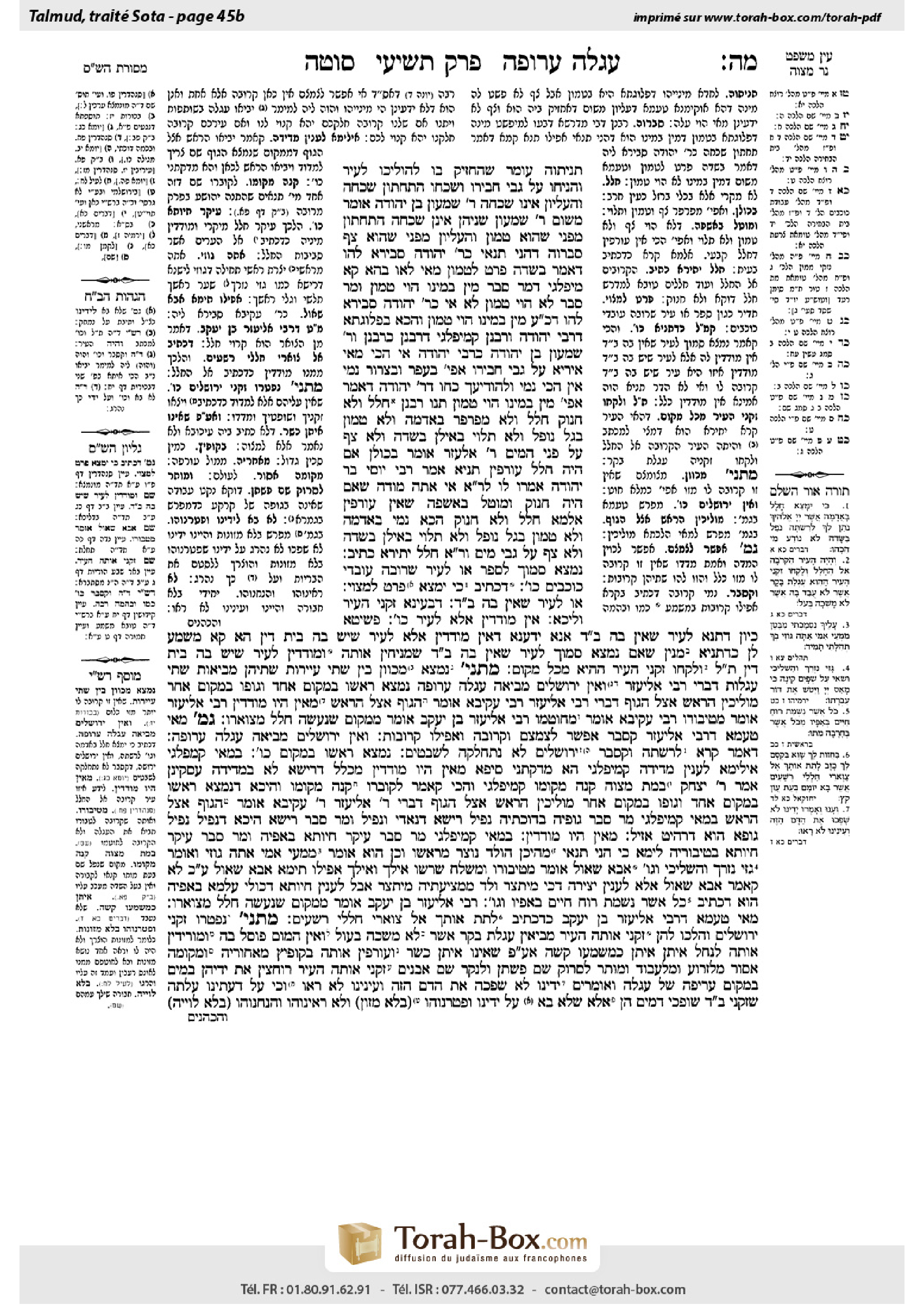
Sotah 45b: Talmud study for Daf Yomi
Daf Yomi is the daily study of one Talmud folio. Explore 37 tractates with scans, Hebrew text, Sefaria English and AI-generated French translations where annotated.
Passage selection and English or AI-generated French translation are available where the scan has annotations. Daf Study is independent of Torah-Box and Sefaria.
Browse Sotah · סוטה · All tractatesSotah 45b text and translations
This page of Sotah includes the Aramaic text, an English translation and an AI-generated French translation, alongside the scan above.
סוטה מ״ה ב · Aramaic and Hebrew text
תְּנֵיתוּהָ: עוֹמֶר שֶׁהֶחְזִיק בּוֹ לְהוֹלִיכוֹ לָעִיר, וְהִנִּיחוֹ עַל גַּבֵּי חֲבֵירוֹ וּשְׁכָחוֹ — הַתַּחְתּוֹן שִׁכְחָה וְהָעֶלְיוֹן אֵינוֹ שִׁכְחָה. רַבִּי שִׁמְעוֹן בֶּן יְהוּדָה אוֹמֵר מִשּׁוּם רַבִּי שִׁמְעוֹן: שְׁנֵיהֶן אֵינָן שִׁכְחָה, הַתַּחְתּוֹן מִפְּנֵי שֶׁהוּא טָמוּן, וְהָעֶלְיוֹן מִפְּנֵי שֶׁהוּא צָף. סַבְרוּהָ דְּהָנֵי תַּנָּאֵי, כְּרַבִּי יְהוּדָה סְבִירָא לְהוּ, דְּאָמַר: ״בַּשָּׂדֶה״ — פְּרָט לְטָמוּן.
מַאי לָאו בְּהָא קָא מִיפַּלְגִי, דְּמָר סָבַר: מִין בְּמִינוֹ הָוֵי טָמוּן, וּמָר סָבַר: לָא הָוֵי טָמוּן.
לָא, אִי כְּרַבִּי יְהוּדָה סְבִירָא לְהוּ, דְּכוּלֵּי עָלְמָא מִין בְּמִינוֹ הָוֵי טָמוּן, וְהָכָא בִּפְלוּגְתָּא דְּרַבִּי יְהוּדָה וְרַבָּנַן קָמִיפַּלְגִי, דְּרַבָּנַן כְּרַבָּנַן. וְרַבִּי שִׁמְעוֹן בֶּן יְהוּדָה כְּרַבִּי יְהוּדָה.
אִי הָכִי, מַאי אִירְיָא עַל גַּבֵּי חֲבֵירוֹ? אֲפִילּוּ בֶּעָפָר וּבִצְרוֹר נָמֵי! אִין הָכִי נָמֵי, וּלְהוֹדִיעֲךָ כֹּחוֹ דְּרַבִּי יְהוּדָה, דְּאָמַר: אֲפִילּוּ מִין בְּמִינוֹ הָוֵי טָמוּן.
תָּנוּ רַבָּנַן: ״חָלָל״ — וְלֹא חָנוּק, ״חָלָל״ — וְלֹא מְפַרְפֵּר, ״בָּאֲדָמָה״ — וְלֹא טָמוּן בַּגַּל, ״נֹפֵל״ — וְלֹא תָּלוּי בָּאִילָן, ״בַּשָּׂדֶה״ — וְלֹא צָף עַל פְּנֵי הַמַּיִם. רַבִּי אֶלְעָזָר אוֹמֵר: בְּכוּלָּן, אִם הָיָה חָלָל — עוֹרְפִין.
תַּנְיָא, אָמַר רַבִּי יוֹסֵי בַּר יְהוּדָה: אָמְרוּ לוֹ לְרַבִּי אֶלְעָזָר, אִי אַתָּה מוֹדֶה שֶׁאִם הָיָה חָנוּק וּמוּטָל בָּאַשְׁפָּה שֶׁאֵין עוֹרְפִין? אַלְמָא: ״חָלָל״ — וְלֹא חָנוּק. הָכָא נָמֵי: ״בָּאֲדָמָה״ — וְלֹא טָמוּן בַּגַּל, ״נֹפֵל״ — וְלֹא תָּלוּי בָּאִילָן, ״בַּשָּׂדֶה״ — וְלֹא צָף עַל גַּבֵּי מַיִם. וְרַבִּי אֶלְעָזָר: ״חָלָל״ יַתִּירָא כְּתִיב.
נִמְצָא סָמוּךְ לַסְּפָר אוֹ לְעִיר שֶׁרוּבָּהּ נׇכְרִים כּוּ׳. דִּכְתִיב: ״כִּי יִמָּצֵא״ — פְּרָט לְמָצוּי.
אוֹ לְעִיר שֶׁאֵין בָּהּ בֵּית דִּין. דְּבָעֵינָא ״זִקְנֵי הָעִיר״, וְלֵיכָּא. אֵין מוֹדְדִין אֶלָּא לְעִיר כּוּ׳. פְּשִׁיטָא! כֵּיוָן דִּתְנָא לְעִיר שֶׁאֵין בָּהּ בֵּית דִּין, אֲנָא יָדַעְנָא דְּאֵין מוֹדְדִין אֶלָּא לְעִיר שֶׁיֵּשׁ בָּהּ בֵּית דִּין!
הָא קָא מַשְׁמַע לַן כִּדְתַנְיָא: מִנַּיִן שֶׁאִם נִמְצָא סָמוּךְ לְעִיר שֶׁאֵין בָּהּ בֵּית דִּין, שֶׁמַּנִּיחִין אוֹתָהּ וּמוֹדְדִין לְעִיר שֶׁיֵּשׁ בָּהּ בֵּית דִּין — תַּלְמוּד לוֹמַר: ״וְלָקְחוּ זִקְנֵי הָעִיר הָהִיא״ — מִכׇּל מָקוֹם.
מַתְנִי׳ נִמְצָא מְכֻוּוֹן בֵּין שְׁתֵּי עֲיָירוֹת — שְׁתֵּיהֶן מְבִיאוֹת שְׁתֵּי עֲגָלוֹת, דִּבְרֵי רַבִּי אֱלִיעֶזֶר. וְאֵין יְרוּשָׁלָיִם מְבִיאָה עֶגְלָה עֲרוּפָה. נִמְצָא רֹאשׁוֹ בְּמָקוֹם אֶחָד וְגוּפוֹ בְּמָקוֹם אַחֵר — מוֹלִיכִין הָרֹאשׁ אֵצֶל הַגּוּף, דִּבְרֵי רַבִּי אֱלִיעֶזֶר. רַבִּי עֲקִיבָא אוֹמֵר: הַגּוּף אֵצֶל הָרֹאשׁ. מֵאַיִן הָיוּ מוֹדְדִין? רַבִּי אֱלִיעֶזֶר אוֹמֵר: מִטִּיבּוּרוֹ, רַבִּי עֲקִיבָא אוֹמֵר: מֵחוֹטְמוֹ, רַבִּי אֱלִיעֶזֶר בֶּן יַעֲקֹב אוֹמֵר: מִמָּקוֹם שֶׁנַּעֲשֶׂה חָלָל, מִצַּוָּארוֹ.
גְּמָ׳ מַאי טַעְמָא דְּרַבִּי אֱלִיעֶזֶר — קָסָבַר אֶפְשָׁר לְצַמְצֵם, וּ״קְרוֹבָה״, וַאֲפִילּוּ קְרוֹבוֹת.
וְאֵין יְרוּשָׁלָיִם מְבִיאָה עֶגְלָה עֲרוּפָה — דְּאָמַר קְרָא ״לְרִשְׁתָּהּ״, וְקָסָבַר: יְרוּשָׁלַיִם לֹא נִתְחַלְּקָה לִשְׁבָטִים.
נִמְצָא רֹאשׁוֹ בְּמָקוֹם כּוּ׳. בְּמַאי קָמִיפַּלְגִי? אִילֵּימָא לְעִנְיַן מְדִידָה קָמִיפַּלְגִי, הָא מִדְּקָתָנֵי סֵיפָא ״מֵאַיִן הָיוּ מוֹדְדִין״, מִכְּלָל דְּרֵישָׁא לָא בִּמְדִידָה עָסְקִינַן! אָמַר רַבִּי יִצְחָק: בְּמֵת מִצְוָה קָנָה מְקוֹמוֹ קָמִיפַּלְגִי,
וְהָכִי קָאָמַר: לְקוֹבְרוֹ קָנָה מְקוֹמוֹ, וְהֵיכָא דְּנִמְצָא רֹאשׁוֹ בְּמָקוֹם אֶחָד וְגוּפוֹ בְּמָקוֹם אַחֵר — מוֹלִיכִין הָרֹאשׁ אֵצֶל הַגּוּף, דִּבְרֵי רַבִּי אֱלִיעֶזֶר. רַבִּי עֲקִיבָא אוֹמֵר: הַגּוּף אֵצֶל הָרֹאשׁ. בְּמַאי קָמִיפַּלְגִי — מָר סָבַר: גּוּפֵיהּ בְּדוּכְתֵּיהּ נָפֵיל, רֵישָׁא דְּנָאדֵי וְנָפֵיל, וּמָר סָבַר: רֵישָׁא הֵיכָא דְּנָפֵיל נָפֵיל, גּוּפָא הוּא דְּרָהֵיט אָזֵיל.
מֵאַיִן הָיוּ מוֹדְדִין. בְּמַאי קָמִיפַּלְגִי? מָר סָבַר: עִיקַּר חִיּוּתָא בְּאַפֵּיהּ, וּמָר סָבַר: עִיקַּר חִיּוּתָא בְּטִיבּוּרֵיהּ.
לֵימָא כִּי הָנֵי תַּנָּאֵי: מֵהֵיכָן הַוָּלָד נוֹצָר — מֵרֹאשׁוֹ, וְכֵן הוּא אוֹמֵר: ״מִמְּעֵי אִמִּי אַתָּה גוֹזִי״, וְאוֹמֵר: ״גׇּזִּי נִזְרֵךְ וְהַשְׁלִיכִי וְגוֹ׳״. אַבָּא שָׁאוּל אוֹמֵר: מִטִּיבּוּרוֹ, וּמְשַׁלֵּחַ שׇׁרְשׁוֹ אֵילָךְ.
אֲפִילּוּ תֵּימָא אַבָּא שָׁאוּל, עַד כָּאן לָא קָאָמַר אַבָּא שָׁאוּל אֶלָּא לְעִנְיַן יְצִירָה, דְּכִי מִיתְּצַר וְלָד מִמְּצִיעֲתֵיהּ מִיתְּצַר, אֲבָל לְעִנְיַן חִיּוּתָא — דְּכוּלֵּי עָלְמָא בְּאַפֵּיהּ הוּא, דִּכְתִיב: ״כׇּל אֲשֶׁר נִשְׁמַת רוּחַ חַיִּים בְּאַפָּיו וְגוֹ׳״.
רַבִּי אֱלִיעֶזֶר בֶּן יַעֲקֹב אוֹמֵר: מִמָּקוֹם שֶׁנַּעֲשֶׂה חָלָל — מִצַּוָּארוֹ. מַאי טַעְמָא דְּרַבִּי אֱלִיעֶזֶר בֶּן יַעֲקֹב? כְּדִכְתִיב: ״לָתֵת אוֹתָךְ אֶל צַוְּארֵי חַלְלֵי רְשָׁעִים״.
מַתְנִי׳ נִפְטְרוּ זִקְנֵי יְרוּשָׁלָיִם וְהָלְכוּ לָהֶן. זִקְנֵי אוֹתָהּ הָעִיר מְבִיאִין עֶגְלַת בָּקָר אֲשֶׁר לֹא מָשְׁכָה בְּעוֹל, וְאֵין הַמּוּם פּוֹסֵל בָּהּ, וּמוֹרִידִין אוֹתָהּ לְנַחַל אֵיתָן. ״אֵיתָן״ כְּמַשְׁמָעוֹ: קָשֶׁה. אַף עַל פִּי שֶׁאֵינוֹ אֵיתָן — כָּשֵׁר. וְעוֹרְפִין אוֹתָהּ בְּקוֹפִיץ מֵאֲחוֹרֶיהָ. וּמְקוֹמָהּ אָסוּר מִלִּזְרוֹעַ וּמִלַּעֲבוֹד, וּמוּתָּר לִסְרוֹק שָׁם פִּשְׁתָּן וּלְנַקֵּר שָׁם אֲבָנִים.
זִקְנֵי אוֹתָהּ הָעִיר רוֹחֲצִין אֶת יְדֵיהֶן בַּמַּיִם בִּמְקוֹם עֲרִיפָה שֶׁל עֶגְלָה, וְאוֹמְרִים ״יָדֵינוּ לֹא שָׁפְכוּ אֶת הַדָּם הַזֶּה וְעֵינֵינוּ לֹא רָאוּ״. וְכִי עַל דַּעְתֵּינוּ עָלְתָה שֶׁזִּקְנֵי בֵּית דִּין שׁוֹפְכֵי דָּמִים הֵן? אֶלָּא שֶׁלֹּא בָּא עַל יָדֵינוּ וּפְטַרְנוּהוּ (בְּלֹא מָזוֹן), וְלֹא רְאִינוּהוּ וְהִנַּחְנוּהוּ (בְּלֹא לְוָיָיה).
Sotah 45b · English translation
You learned it in the baraita (Tosefta, Pe’a 3:7): In the case of a sheaf that had been held by its owner in order to take it to the city, and he placed it on top of another sheaf, and he forgot both sheaves, the lower sheaf is deemed to be a forgotten sheaf, and the upper one is not deemed to be a forgotten sheaf. Rabbi Shimon ben Yehuda says in the name of Rabbi Shimon: Both of them are not deemed to be forgotten sheaves; the lower one because it is concealed and the upper one because it is floating and not directly touching the field. The Sages assumed that these tanna’im in the baraita basically hold in accordance with the opinion of Rabbi Yehuda, who says that the phrase “in the field” serves to exclude a concealed sheaf.
The Gemara continues Abaye’s statement: What, is it not the case that they disagree about this, as one Sage, Rabbi Shimon, holds that a substance in contact with the same type of substance is considered to be concealed, and therefore the lower sheaf is not deemed to be a forgotten sheaf, and one Sage, the Rabbis, holds that it is not considered to be concealed, which means it is deemed to be a forgotten sheaf. The same dispute would apply to the two corpses.
The Gemara refutes this claim: No, if they hold in accordance with the opinion of Rabbi Yehuda, then it could be that everyone agrees that a substance in contact with the same type of substance is considered to be concealed, and they would maintain this with regard to the two corpses as well. And here they disagree with regard to the issue that is the subject of the dispute of Rabbi Yehuda and the Rabbis, in that the opinion of the Rabbis of this baraita is in accordance with the opinion of the Rabbis there, which claims that the halakha of a forgotten sheaf applies even to a concealed sheaf, and Rabbi Shimon ben Yehuda holds in accordance with the opinion of Rabbi Yehuda, who maintains that a concealed sheaf is exempt from the halakha of forgotten sheaves.
The Gemara asks: If that is so, that their dispute is with regard to the halakha of concealed sheaves, why did they specifically disagree in the case of a sheaf that was on top of another sheaf; the same would hold true even in a case where the sheaf was concealed in dirt and pebbles? The Gemara answers: Yes, it is indeed so. They disagree with regard to all concealed sheaves, and their dispute is stated with regard to a case of one sheaf on top of another in order to convey to you the far-reaching nature of the opinion of Rabbi Yehuda, who says that even a substance that is in contact with the same type of substance is considered concealed. Therefore, a substance concealed in a different type of matter is all the more so considered concealed.
§ The Gemara returns to discuss when the ritual of breaking the neck of the heifer is performed. The Sages taught, expounding the verse “If one be found slain in the land which the Lord your God has given you to possess it, lying in the field” (Deuteronomy 21:1): “Slain” indicates one killed by a sword, but not one who was strangled; “slain,” but not one who was found twitching in his death throes; “in the land,” but not concealed in a pile of stones; “lying,” but not hanging on a tree; “in the field,” but not floating on the surface of the water. Rabbi Elazar says: In all these cases, if a person was slain by the sword, the judges break the neck of the heifer, and it does not matter where the corpse was found.
It is taught in a baraita: Rabbi Yosei bar Yehuda says that the Sages said to Rabbi Elazar: Do you not concede that if he was strangled and left in a garbage heap, that they do not break the heifer’s neck? Apparently, “slain” is a precise term that means slain but not strangled. If you accept that, here too the words “in the land” should indicate: In the land, but not concealed in a pile of stones; “fallen” should indicate: Fallen but not hanging on a tree; and “in the field” should indicate in the field but not floating on the surface of the water. And Rabbi Elazar holds that those other situations are not excluded, and that because in that first case the Torah writes “slain” an extra time in the next verse: “About him that is slain” (Deuteronomy 21:2), this repetition teaches that a victim of strangulation is not included in this halakha.
§ The mishna taught: If a corpse was found close to the border of the country or close to a city in which the majority of its inhabitants are gentiles, the judges would not break the heifer’s neck, as it is written: “If one be found slain” (Deuteronomy 21:1). This excludes places where murdered bodies are commonly found, such as the aforementioned locations.
The mishna taught: Or if the victim was discovered close to a city that is without a rabbinical court of twenty-three judges, they would not measure the distance to that city. The Gemara explains: This is because the verse requires “the Elders of that city” (Deuteronomy 21:3), and this is not the case here; therefore the rite was not performed. The mishna also taught that the Elders measure the distance from the corpse only to a city that contains a rabbinical court of twenty-three judges. The Gemara asks: This is obvious. Since the mishna taught that they do not measure the distance to a city that does not have a rabbinical court of twenty-three judges, I know that they measure the distance only to a city that has a rabbinical court of twenty-three judges.
The Gemara answers: This tanna teaches us the halakha as it is taught in a baraita: From where is it derived that if the corpse was found close to a city that does not have a rabbinical court of twenty-three judges, that they leave the city aside and measure the distance from the corpse to a city that has a rabbinical court of twenty-three judges? The verse states: “And the Elders of that city shall take” (Deuteronomy 21:3), which indicates that the Elders of a city are involved in any case, and the measurement is taken even if it is not to the city closest to the body.
MISHNA: If the slain person is found precisely between two cities, the inhabitants of the two of them bring two heifers total; this is the statement of Rabbi Eliezer. And the inhabitants of Jerusalem do not bring a heifer whose neck is broken, even if Jerusalem is the city closest to the slain victim. If the head of the corpse was found in one place and his body was found in a different place, they bring the head next to the body; this is the statement of Rabbi Eliezer. Rabbi Akiva says: They bring the body next to the head. From where on the body would they measure the distance? Rabbi Eliezer says: From his navel. Rabbi Akiva says: From his nose. Rabbi Eliezer ben Ya’akov says: From the place where he became a slain person, which is from the neck.
GEMARA: The Gemara explains: What is the reasoning of Rabbi Eliezer, that when a body is found precisely between two cities, the inhabitants of each city bring a heifer? His ruling is based on two factors. First, he holds that it is possible to measure precisely and that it is a real possibility to determine that both cities are exactly the same distance from the corpse. And second, he interprets the term “That is nearest” (Deuteronomy 21:3), to be referring not only to one city. It can even be understood as: That are nearest, so that the halakhot apply to more than one city.
The mishna taught: And the inhabitants of Jerusalem do not bring a heifer whose neck is broken. The Gemara explains: This is because the verse states: “If one be found slain in the land which the Lord your God has given you to possess it” (Deuteronomy 21:1), and this tanna holds that Jerusalem was not divided among the tribes in the division of Eretz Yisrael. It was not given as a possession to any particular person but belongs to all; therefore the halakha of the heifer whose neck is broken does not apply to it.
§ With regard to the halakha of a corpse whose head was found in one place and its body elsewhere, the Gemara asks: With regard to what halakha do they disagree? If we say they disagree with regard to whether the measurement is taken from the head or the body, from the fact that the latter clause teaches: From where would they measure the distance, it may be inferred that in the first clause we are not dealing with measurement. Rabbi Yitzḥak said: They disagree with regard to a different matter, the question of whether a corpse with no one to bury it [met mitzva] acquires its place, meaning if an unattended corpse must be buried where it is found.
And this is what the mishna is saying: With regard to burying him, the victim acquires his place, and he is buried there. The mishna continues: And in a case where his head is found in one place and his body is found in a different place, they bring the head next to the body and bury him there; this is the statement of Rabbi Eliezer. Rabbi Akiva says: They bring the body next to the head. The Gemara explains: With regard to what do they disagree? They both agree that he should be buried in the place where he was killed, but one Sage, Rabbi Eliezer, holds that his body fell in its place, and it was the head that rolled away and fell. And one Sage, Rabbi Akiva, holds that his head fell where it fell, and it was the body that went and continued onward. Therefore, the body is brought to the head.
§ The mishna taught that there is a dispute concerning the question: From where on the body would they measure the distance? The Gemara asks: With regard to what do they disagree? One Sage, Rabbi Akiva, holds: A person’s life is sustained mainly in his nose, in his respiratory system. And one Sage, Rabbi Eliezer, holds: His life is mainly in the area of his navel, in his digestive system.
The Gemara suggests: Shall we say that these tanna’im are like those tanna’im, who had a dispute as it is taught in a baraita: From where is an embryo formed? From its head, and so the verse states: “Out of my mother’s womb You pulled me [gozi]” (Psalms 71:6). And the proof that “gozi” is referring to the head is from the verse that states: “Cut off [gozi] your hair, and cast it away” (Jeremiah 7:29). In this verse, the term gozi relates to the hair of the head. Abba Shaul says: An embryo is formed from its navel, and it sends its roots forth. This dispute concerning the initial formation of an embryo also appears to depend on where the main source of life in a person is.
The Gemara refutes this comparison: You can even say that both tanna’im of the mishna agree with Abba Shaul, as Abba Shaul says his opinion only with regard to the forming of an embryo, that when an embryo is formed, it is formed from its middle. But with regard to life, everyone, i.e., both tanna’im in the baraita, agree that it is in his nose, as it is written: “All in whose nostrils was the breath of the spirit of life” (Genesis 7:22).
The mishna taught another opinion. Rabbi Eliezer ben Ya’akov says: The distance should be measured from the place where the victim became a slain person, from his neck. The Gemara poses a question: What is the reason of Rabbi Eliezer ben Ya’akov? The Gemara answers: As it is written: “To lay you upon the necks of the wicked who are to be slain” (Ezekiel 21:34), which shows that being slain occurs at the neck.
MISHNA: The mishna continues to describe the ritual. After they would take the measurement, the Elders of Jerusalem took their leave and went away. The Elders of the city that is closest to the corpse bring a heifer from cattle, which has not pulled a yoke. But a blemish does not disqualify it, because, unlike the description of the red heifer, the Torah does not state that it must be without blemish. And they bring it down to a stream that is eitan. Eitan in this context means as the word generally indicates, powerful. The stream must have a forceful flow. The mishna comments: Even if it is not forceful, it is a valid site for the ritual. And they break the neck of the heifer from behind with a cleaver. And with regard to its place, where the heifer was standing when its neck was broken, it is prohibited for that ground to be sown or to be worked, but it is permitted to comb flax there or to cut stones there.
The Elders of that city would then wash their hands in water in the place of the breaking of the neck of the heifer, and they would recite: “Our hands did not spill this blood, nor did our eyes see” (Deuteronomy 21:7). The mishna explains: But did it enter our minds that the Elders of the court are spillers of blood, that they must make such a declaration? Rather, they mean to declare that the victim did not come to us and then we let him take his leave without food, and we did not see him and then leave him alone to depart without accompaniment. They therefore attest that they took care of all his needs and are not responsible for his death even indirectly.
Sotah 45b · Traduction française (IA)
Tu l’as appris dans la baraïta (Tosefta, Pe’a 3:7) : dans le cas d’une gerbe que son propriétaire avait mise de côté pour l’emporter en ville, puis placée sur une autre gerbe, et qu’il a oubliée toutes les deux, la gerbe du dessous est considérée comme une gerbe oubliée, tandis que celle du dessus ne l’est pas. Rabbi Shimon ben Yehuda dit au nom de Rabbi Shimon : aucune des deux n’est considérée comme une gerbe oubliée ; celle du dessous, parce qu’elle est dissimulée, et celle du dessus, parce qu’elle flotte et ne touche pas directement le champ. Les Sages ont supposé que ces tannaïm de la baraïta suivent essentiellement l’opinion de Rabbi Yehuda, selon laquelle l’expression « dans le champ » exclut une gerbe dissimulée.
La Guemara poursuit la déclaration d’Abaye : N’est-ce pas qu’ils sont en désaccord sur ce point, l’un des Sages, Rabbi Shimon, considérant qu’une matière au contact d’une matière de même nature est réputée dissimulée, de sorte que la gerbe du dessous n’est pas considérée comme une gerbe oubliée, tandis que l’autre Sage, les Rabbins, considère qu’elle n’est pas réputée dissimulée, si bien qu’elle est considérée comme une gerbe oubliée ? La même controverse s’appliquerait aux deux cadavres.
La Guemara réfute cette affirmation : Non. S’ils suivent l’opinion de Rabbi Yehuda, il se peut que tous conviennent qu’une matière au contact d’une matière de même nature est réputée dissimulée, et qu’ils soutiennent également cette position à propos des deux cadavres. Ici, leur désaccord porte sur la question qui fait l’objet de la controverse entre Rabbi Yehuda et les Rabbins : les Rabbins de cette baraïta suivent l’opinion des Rabbins de là-bas, selon laquelle la halakha de la gerbe oubliée s’applique même à une gerbe dissimulée, tandis que Rabbi Shimon ben Yehuda suit l’opinion de Rabbi Yehuda, selon laquelle une gerbe dissimulée est exemptée de la halakha des gerbes oubliées.
La Guemara demande : Si c’est ainsi, si leur désaccord porte sur la halakha des gerbes dissimulées, pourquoi se sont-ils précisément opposés dans le cas d’une gerbe posée sur une autre ? La même règle s’appliquerait aussi au cas d’une gerbe dissimulée sous de la terre et des cailloux. La Guemara répond : Oui, c’est bien le cas. Ils sont en désaccord au sujet de toutes les gerbes dissimulées, et leur controverse est formulée à propos d’une gerbe posée sur une autre pour faire ressortir toute la portée de l’opinion de Rabbi Yehuda, qui affirme que même une matière au contact d’une matière de même nature est considérée comme dissimulée. À plus forte raison, une matière dissimulée dans une matière de nature différente est-elle considérée comme dissimulée.
§ La Guemara reprend la discussion sur le moment où a lieu le rite de briser la nuque de la génisse. Les Sages ont enseigné, en interprétant le verset : « Si l’on trouve dans le pays que le Seigneur ton Dieu te donne pour en prendre possession un homme tué, étendu dans les champs » (Deutéronome 21:1) : « tué » indique qu’il a été tué par l’épée, mais non étranglé ; « tué », mais non trouvé en train de tressaillir dans son agonie ; « dans le pays », mais non dissimulé sous un tas de pierres ; « étendu », mais non suspendu à un arbre ; « dans les champs », mais non flottant à la surface de l’eau. Rabbi Elazar dit : Dans tous ces cas, si l’homme a été tué par l’épée, les juges brisent la nuque de la génisse, quel que soit l’endroit où le cadavre a été trouvé.
Il est enseigné dans une baraïta : Rabbi Yosei bar Yehuda rapporte que les Sages ont dit à Rabbi Elazar : Ne reconnais-tu pas que, s’il a été étranglé et laissé dans un tas d’ordures, ils ne brisent pas la nuque de la génisse ? Il apparaît donc que « tué » est un terme précis : tué, mais non étranglé. Si tu l’admets, ici aussi, les mots « dans le pays » devraient indiquer : dans le pays, mais non dissimulé sous un tas de pierres ; « tombé » devrait indiquer : tombé, mais non suspendu à un arbre ; et « dans les champs » devrait indiquer : dans les champs, mais non flottant à la surface de l’eau. Rabbi Elazar, lui, considère que ces autres situations ne sont pas exclues et que, puisque dans le premier cas la Torah écrit une seconde fois « tué » dans le verset suivant — « à propos de celui qui a été tué » (Deutéronome 21:2) —, cette répétition enseigne que la victime étranglée n’est pas comprise dans cette halakha.
§ La Michna enseignait : Si un cadavre était trouvé près de la frontière du pays ou près d’une ville dont la majorité des habitants sont des non-Juifs, les juges ne brisaient pas la nuque de la génisse, comme il est écrit : « Si l’on trouve un homme tué » (Deutéronome 21:1). Cela exclut les lieux où l’on trouve couramment des corps de personnes assassinées, tels que ceux mentionnés plus haut.
La Michna enseignait également : Si la victime était découverte près d’une ville dépourvue d’un tribunal rabbinique de vingt-trois juges, ils ne mesuraient pas la distance jusqu’à cette ville. La Guemara explique : C’est parce que le verset exige « les anciens de cette ville » (Deutéronome 21:3), condition qui n’est pas remplie ici ; le rite n’était donc pas accompli. La Michna enseignait aussi que les anciens mesurent la distance à partir du cadavre uniquement jusqu’à une ville qui possède un tribunal rabbinique de vingt-trois juges. La Guemara demande : Cela va de soi. Puisque la Michna enseigne qu’ils ne mesurent pas la distance jusqu’à une ville qui ne possède pas de tribunal rabbinique de vingt-trois juges, j’en déduis qu’ils ne mesurent que jusqu’à une ville qui en possède un.
La Guemara répond : Ce tanna nous enseigne la halakha telle qu’elle est enseignée dans une baraïta : D’où déduit-on que, si le cadavre a été trouvé près d’une ville qui ne possède pas de tribunal rabbinique de vingt-trois juges, on laisse cette ville de côté et on mesure la distance entre le cadavre et une ville qui possède un tribunal rabbinique de vingt-trois juges ? Le verset dit : « Les anciens de cette ville prendront » (Deutéronome 21:3), ce qui indique que les anciens d’une ville interviennent dans tous les cas ; la mesure est donc effectuée même si elle ne mène pas à la ville la plus proche du corps.
MICHNA : Si l’homme tué est trouvé exactement à égale distance de deux villes, les habitants des deux villes apportent au total deux génisses ; telle est la déclaration de Rabbi Eliezer. Les habitants de Jérusalem n’apportent pas de génisse dont on brise la nuque, même si Jérusalem est la ville la plus proche de la victime. Si la tête du cadavre a été trouvée en un endroit et son corps en un autre, ils apportent la tête auprès du corps ; telle est la déclaration de Rabbi Eliezer. Rabbi Akiva dit : Ils apportent le corps auprès de la tête. À partir de quel endroit du corps mesuraient-ils la distance ? Rabbi Eliezer dit : À partir du nombril. Rabbi Akiva dit : À partir du nez. Rabbi Eliezer ben Ya’akov dit : À partir de l’endroit où il est devenu un homme tué, c’est-à-dire le cou.
GUEMARA : La Guemara explique : Quel est le raisonnement de Rabbi Eliezer, selon lequel, lorsqu’un corps est trouvé exactement à égale distance de deux villes, les habitants de chacune d’elles apportent une génisse ? Sa décision repose sur deux facteurs. Premièrement, il considère qu’il est possible de mesurer avec précision et d’établir que les deux villes sont exactement à la même distance du cadavre. Deuxièmement, il interprète l’expression « celle qui est la plus proche » (Deutéronome 21:3) comme ne désignant pas nécessairement une seule ville. On peut aussi la comprendre comme « celles qui sont les plus proches », de sorte que les halakhot s’appliquent à plusieurs villes.
La Michna enseignait : Les habitants de Jérusalem n’apportent pas de génisse dont on brise la nuque. La Guemara explique : C’est parce que le verset dit : « Si l’on trouve un homme tué dans le pays que le Seigneur ton Dieu te donne pour en prendre possession » (Deutéronome 21:1), et ce tanna considère que Jérusalem n’a pas été répartie entre les tribus lors du partage d’Eretz Israël. Elle n’a pas été donnée en possession à une personne en particulier, mais appartient à tous ; la halakha de la génisse dont on brise la nuque ne s’y applique donc pas.
§ Concernant la halakha du cadavre dont la tête a été trouvée en un endroit et le corps ailleurs, la Guemara demande : Sur quelle halakha sont-ils en désaccord ? Si l’on dit qu’ils sont en désaccord sur la question de savoir si la mesure est prise à partir de la tête ou du corps, le fait que la clause suivante enseigne : « À partir de quel endroit mesuraient-ils la distance ? » permet de déduire que la première clause ne traite pas de la mesure. Rabbi Yitzḥak dit : Leur désaccord porte sur une autre question : celle de savoir si un cadavre sans personne pour l’enterrer [met mitsva] acquiert son emplacement, c’est-à-dire si un cadavre sans personne pour s’occuper de son enterrement doit être enterré là où on le trouve.
Et voici ce que dit la Michna : pour son enterrement, la victime acquiert son emplacement et y est enterrée. La Michna poursuit : si sa tête est trouvée en un endroit et son corps en un autre, ils apportent la tête auprès du corps et l’y enterrent ; telle est la déclaration de Rabbi Eliezer. Rabbi Akiva dit : Ils apportent le corps auprès de la tête. La Guemara explique : Sur quoi sont-ils en désaccord ? Tous deux conviennent qu’il doit être enterré à l’endroit où il a été tué. Mais l’un des Sages, Rabbi Eliezer, considère que son corps est tombé là où il se trouvait et que c’est la tête qui a roulé et est tombée ailleurs. L’autre Sage, Rabbi Akiva, considère que sa tête est tombée là où elle est tombée et que c’est le corps qui a poursuivi sa course. C’est pourquoi on apporte le corps auprès de la tête.
§ La Michna enseignait qu’il existe un désaccord sur la question suivante : à partir de quel endroit du corps mesuraient-ils la distance ? La Guemara demande : Sur quoi sont-ils en désaccord ? L’un des Sages, Rabbi Akiva, considère que la vie d’une personne dépend principalement de son nez, c’est-à-dire de son système respiratoire. L’autre Sage, Rabbi Eliezer, considère que sa vie dépend principalement de la région du nombril, c’est-à-dire de son système digestif.
La Guemara suggère : Faut-il dire que ces tannaïm sont comme les tannaïm qui sont en désaccord, comme il est enseigné dans une baraïta : D’où l’embryon se forme-t-il ? De sa tête, comme le dit le verset : « Tu m’as tiré [gozi] du ventre de ma mère » (Psaumes 71:6). La preuve que « gozi » désigne la tête vient du verset : « Coupe [gozi] tes cheveux et jette-les » (Jérémie 7:29). Dans ce verset, le terme gozi se rapporte aux cheveux de la tête. Abba Shaul dit : L’embryon se forme à partir de son nombril et fait pousser ses racines. Ce désaccord au sujet de la formation initiale de l’embryon semble lui aussi dépendre de l’endroit où se trouve la principale source de vie chez une personne.
La Guemara réfute cette comparaison : On peut même dire que les deux tannaïm de la Michna sont d’accord avec Abba Shaul, car celui-ci n’exprime son opinion qu’au sujet de la formation de l’embryon : lorsque l’embryon se forme, il se forme à partir de son milieu. Mais en ce qui concerne la vie, tous, c’est-à-dire les deux tannaïm de la baraïta, conviennent qu’elle se trouve dans le nez, comme il est écrit : « Tous ceux qui avaient dans leurs narines le souffle de l’esprit de vie » (Genèse 7:22).
La Michna enseignait une autre opinion. Rabbi Eliezer ben Ya’akov dit : La distance doit être mesurée à partir de l’endroit où la victime est devenue un homme tué, c’est-à-dire de son cou. La Guemara demande : Quel est le raisonnement de Rabbi Eliezer ben Ya’akov ? La Guemara répond : Car il est écrit : « Pour te faire coucher sur le cou des méchants qui doivent être tués » (Ézéchiel 21:34), ce qui montre que l’action de tuer a lieu au cou.
MICHNA : La Michna poursuit la description du rite. Après avoir effectué la mesure, les anciens de Jérusalem prenaient congé et s’en allaient. Les anciens de la ville la plus proche du cadavre amènent une génisse provenant du gros bétail, qui n’a pas porté de joug. Un défaut ne la rend toutefois pas impropre, car, contrairement à la description de la vache rousse, la Torah ne précise pas qu’elle doit être sans défaut. Ils la conduisent ensuite jusqu’à un cours d’eau eitan. Dans ce contexte, eitan signifie ce que le mot indique généralement : puissant. Le cours d’eau doit avoir un courant vigoureux. La Michna précise : même si son courant n’est pas vigoureux, le lieu convient pour le rite. Ils brisent la nuque de la génisse par-derrière avec un couperet. Quant à l’endroit où se tenait la génisse au moment où on lui brisait la nuque, il est interdit d’y semer ou d’y travailler la terre, mais il est permis d’y peigner du lin ou d’y tailler des pierres.
Les anciens de cette ville se lavent alors les mains avec de l’eau, à l’endroit où l’on a brisé la nuque de la génisse, et récitent : « Nos mains n’ont pas versé ce sang et nos yeux ne l’ont pas vu » (Deutéronome 21:7). La Michna explique : Mais nous est-il venu à l’esprit que les anciens du tribunal versaient le sang, au point qu’ils doivent faire une telle déclaration ? Ils veulent plutôt déclarer que la victime n’est pas venue chez nous et que nous l’avons laissée repartir sans nourriture, ou que nous l’avons vue sans l’accompagner sur son chemin. Ils attestent ainsi qu’ils ont veillé à satisfaire tous ses besoins et qu’ils ne sont pas responsables de sa mort, même indirectement.
Traduction française générée par IA à partir de l’édition anglaise de Sefaria. Vérifie toujours un passage avec le texte source.
Text from Sefaria: William Davidson Edition - Vocalized Aramaic (CC BY NC); William Davidson Edition - English (CC BY NC).