Sotah 45a: Talmud study for Daf Yomi
Daf Yomi is the daily study of one Talmud folio. Explore 37 tractates with scans, Hebrew text, Sefaria English and AI-generated French translations where annotated.
Passage selection and English or AI-generated French translation are available where the scan has annotations. Daf Study is independent of Torah-Box and Sefaria.
Browse Sotah · סוטה · All tractatesSotah 45a text and translations
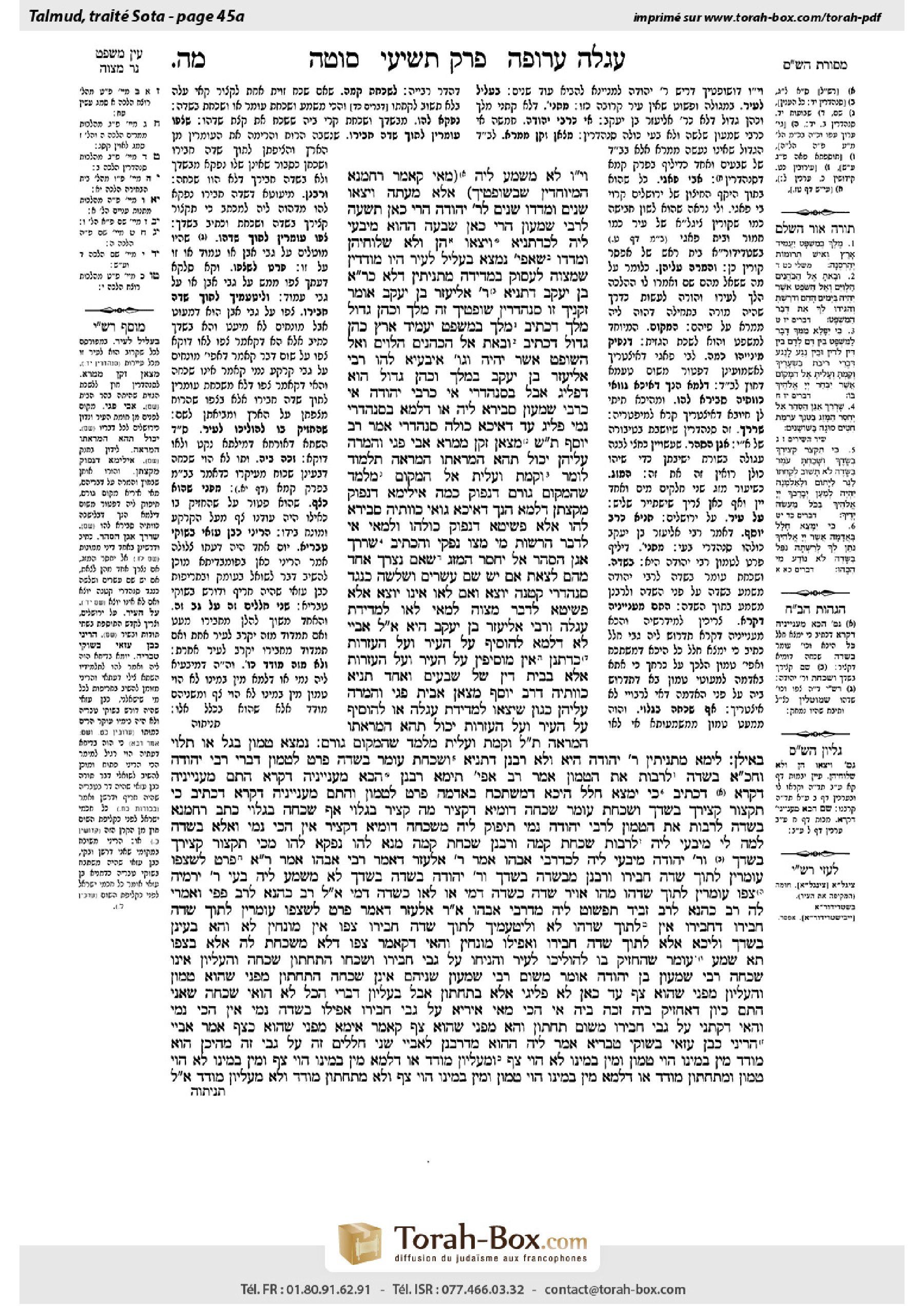
This page of Sotah includes the Aramaic text, an English translation and an AI-generated French translation, alongside the scan above.
סוטה מ״ה א · Aramaic and Hebrew text
וָיו לָא מַשְׁמַע לֵיהּ. (מַאי קָאָמַר רַחֲמָנָא — הַמְיוּחָדִין שֶׁבְּשׁוֹפְטֶיךָ.) אֶלָּא מֵעַתָּה: ״וְיָצְאוּ״ — שְׁנַיִם, ״וּמָדְדוּ״ — שְׁנַיִם, לְרַבִּי יְהוּדָה הֲרֵי כָּאן תִּשְׁעָה, לְרַבִּי שִׁמְעוֹן הֲרֵי כָּאן שִׁבְעָה!
הַהוּא, מִיבְּעֵי לֵיהּ לְכִדְתַנְיָא: ״וְיָצְאוּ״ — הֵן וְלֹא שְׁלוּחֵיהֶן, ״וּמָדְדוּ״ — שֶׁאֲפִילּוּ נִמְצָא בַּעֲלִיל לָעִיר הָיוּ מוֹדְדִין, שֶׁמִּצְוָה לַעֲסוֹק בִּמְדִידָה.
מַתְנִיתִין דְּלָא כְּרַבִּי אֱלִיעֶזֶר בֶּן יַעֲקֹב. דְּתַנְיָא, רַבִּי אֱלִיעֶזֶר בֶּן יַעֲקֹב אוֹמֵר: ״זְקֵנֶיךָ״ — זוֹ סַנְהֶדְרִין, ״שֹׁפְטֶיךָ״ — זֶה מֶלֶךְ וְכֹהֵן גָּדוֹל. מֶלֶךְ — דִּכְתִיב: ״מֶלֶךְ בְּמִשְׁפָּט יַעֲמִיד אָרֶץ״, כֹּהֵן גָּדוֹל — דִּכְתִיב: ״וּבָאתָ אֶל הַכֹּהֲנִים הַלְוִיִּם וְאֶל הַשֹּׁפֵט אֲשֶׁר יִהְיֶה וְגוֹ׳״.
אִיבַּעְיָא לְהוּ: רַבִּי אֱלִיעֶזֶר בֶּן יַעֲקֹב בְּמֶלֶךְ וְכֹהֵן גָּדוֹל הוּא דִּפְלִיג, אֲבָל בְּסַנְהֶדְרִי, אִי כְּרַבִּי יְהוּדָה אִי כְּרַבִּי שִׁמְעוֹן סְבִירָא לֵיהּ, אוֹ דִלְמָא בְּסַנְהֶדְרִי נָמֵי פְּלִיג, עַד דְּאִיכָּא כּוּלַּהּ סַנְהֶדְרִי?
אָמַר רַב יוֹסֵף, תָּא שְׁמַע: מְצָאָן זָקֵן מַמְרֵא אַבֵּי פַגֵּי וְהִמְרָה עֲלֵיהֶן, יָכוֹל תְּהֵא הַמְרָאָתוֹ הַמְרָאָה — תַּלְמוּד לוֹמַר: ״וְקַמְתָּ וְעָלִיתָ אֶל הַמָּקוֹם״, מְלַמֵּד שֶׁהַמָּקוֹם גּוֹרֵם.
דִּנְפוּק כַּמָּה? אִילֵימָא דִּנְפוּק מִקְצָתָן, דִּלְמָא הָנָךְ דְּאִיכָּא גַּוָּאֵי כְּווֹתֵיהּ סְבִירָא לְהוּ! אֶלָּא פְּשִׁיטָא דִּנְפוּק כּוּלְּהוּ.
וּלְמַאי? אִי לִדְבַר הָרְשׁוּת — מִי מָצוּ נָפְקִי? וְהָכְתִיב: ״שׇׁרְרֵךְ אַגַּן הַסַּהַר אַל יֶחְסַר הַמָּזֶג״, שֶׁאִם נִצְרַךְ אֶחָד מֵהֶם לָצֵאת, אִם יֵשׁ שָׁם עֶשְׂרִים וּשְׁלֹשָׁה כְּנֶגֶד סַנְהֶדְרִי קְטַנָּה — יוֹצֵא, וְאִם לָאו — אֵינוֹ יוֹצֵא.
אֶלָּא פְּשִׁיטָא לִדְבַר מִצְוָה. לְמַאי? לָאו לִמְדִידַת עֶגְלָה, וְרַבִּי אֱלִיעֶזֶר בֶּן יַעֲקֹב הִיא? אֲמַר לֵיהּ אַבָּיֵי: לָא, דִּלְמָא לְהוֹסִיף עַל הָעִיר וְעַל הָעֲזָרוֹת. כְּדִתְנַן: אֵין מוֹסִיפִין עַל הָעִיר וְעַל הָעֲזָרוֹת אֶלָּא בְּבֵית דִּין שֶׁל שִׁבְעִים וְאֶחָד.
תַּנְיָא כְּווֹתֵיהּ דְּרַב יוֹסֵף: מְצָאָן אַבֵּית פַּגֵּי וְהִמְרָה עֲלֵיהֶן, כְּגוֹן שֶׁיָּצְאוּ לִמְדִידַת עֶגְלָה אוֹ לְהוֹסִיף עַל הָעִיר וְעַל הָעֲזָרוֹת, יָכוֹל תְּהֵא הַמְרָאָתוֹ הַמְרָאָה — תַּלְמוּד לוֹמַר: ״וְקַמְתָּ וְעָלִיתָ״, מְלַמֵּד שֶׁהַמָּקוֹם גּוֹרֵם.
נִמְצָא טָמוּן בַּגַּל אוֹ תָּלוּי בָּאִילָן. לֵימָא מַתְנִיתִין רַבִּי יְהוּדָה הִיא וְלָא רַבָּנַן. דְּתַנְיָא: ״וְשָׁכַחְתָּ עֹמֶר בַּשָּׂדֶה״ — פְּרָט לְטָמוּן, דִּבְרֵי רַבִּי יְהוּדָה. וַחֲכָמִים אוֹמְרִים: ״בַּשָּׂדֶה״ — לְרַבּוֹת אֶת הַטָּמוּן.
אָמַר רַב: אֲפִילּוּ תֵּימָא רַבָּנַן, הָכָא מֵעִנְיָינֵיהּ דִּקְרָא, הָתָם מֵעִנְיָינֵיהּ דִּקְרָא.
דִּכְתִיב: ״כִּי יִמָּצֵא חָלָל״ — הֵיכָא דְּמִשְׁתְּכַח, ״בָּאֲדָמָה״ — פְּרָט לְטָמוּן. וְהָתָם מֵעִנְיָינֵיהּ דִּקְרָא — דִּכְתִיב: ״כִּי תִקְצֹר קְצִירְךָ בְשָׂדֶךָ וְשָׁכַחְתָּ עֹמֶר״. שִׁכְחָה דּוּמְיָא דְּקָצִיר: מָה קָצִיר בְּגָלוּי — אַף שִׁכְחָה בְּגָלוּי, כְּתַב רַחֲמָנָא ״בַּשָּׂדֶה״ — לְרַבּוֹת אֶת הַטָּמוּן.
לְרַבִּי יְהוּדָה נָמֵי, תִּיפּוֹק לֵיהּ מִשִּׁכְחָה דּוּמְיָא דְּקָצִיר! אִין הָכִי נָמֵי.
וְאֶלָּא ״בַּשָּׂדֶה״, לְמָה לִי? מִיבְּעֵי לֵיהּ לְרַבּוֹת שִׁכְחַת קָמָה. וְרַבָּנַן שִׁכְחַת קָמָה מְנָא לְהוּ? נָפְקָא לְהוּ מִ״כִּי תִקְצֹר קְצִירְךָ בְּשָׂדְךָ״.
וְרַבִּי יְהוּדָה מִיבְּעֵי לֵיהּ לְכִדְרַבִּי אֲבָהוּ אָמַר רַבִּי אֶלְעָזָר. דְּאָמַר רַבִּי אֲבָהוּ אָמַר רַבִּי אֶלְעָזָר: פְּרָט לְשֶׁצָּפוּ עוֹמָרִין לְתוֹךְ שְׂדֵה חֲבֵירוֹ. וְרַבָּנַן: מִ״בַּשָּׂדֶה״ ״בְּשָׂדֶךָ״. וְרַבִּי יְהוּדָה: ״בַּשָּׂדֶה״ ״בְּשָׂדֶךָ״ לָא מַשְׁמַע לֵיהּ.
בָּעֵי רַבִּי יִרְמְיָה: צָפוּ עוֹמָרִין לְתוֹךְ שָׂדֵהוּ, מַהוּ? אֲוִיר שָׂדֶה כְּשָׂדֶה דָּמֵי, אוֹ לָאו כְּשָׂדֶה דָּמֵי?
אֲמַר לֵיהּ רַב כָּהֲנָא לְרַב פַּפֵּי, וְאָמְרִי לָהּ רַב כָּהֲנָא לְרַב זְבִיד: תִּפְשׁוֹט לֵיהּ מִדְּרַבִּי אֲבָהוּ אָמַר רַבִּי אֶלְעָזָר, דְּאָמַר: פְּרָט לְשֶׁצָּפוּ עוֹמָרִין לְתוֹךְ שְׂדֵה חֲבֵירוֹ. דַּחֲבֵירוֹ — אִין, לְתוֹךְ שָׂדֵהוּ — לָא.
וְלִיטַעְמָיךְ: לְתוֹךְ שְׂדֵה חֲבֵירוֹ, צָפוּ — אִין, מוּנָּחִין — לָא? וְהָא בָּעֵינַן ״בְּשָׂדֶךָ״, וְלֵיכָּא!
אֶלָּא: לְתוֹךְ שְׂדֵה חֲבֵירוֹ, וַאֲפִילּוּ מוּנָּחִין. וְהַאי דְּקָאָמַר צָפוּ, דְּלָא מַשְׁכַּחַתְּ לַהּ אֶלָּא בְּצָפוּ.
תָּא שְׁמַע: עוֹמֶר שֶׁהֶחְזִיק בּוֹ לְהוֹלִיכוֹ לָעִיר, וְהִנִּיחוֹ עַל גַּבֵּי חֲבֵירוֹ, וּשְׁכָחוֹ — הַתַּחְתּוֹן שִׁכְחָה, וְהָעֶלְיוֹן אֵינוֹ שִׁכְחָה. רַבִּי שִׁמְעוֹן בֶּן יְהוּדָה אוֹמֵר מִשּׁוּם רַבִּי שִׁמְעוֹן: שְׁנֵיהֶם אֵינָן שִׁכְחָה, הַתַּחְתּוֹן מִפְּנֵי שֶׁהוּא טָמוּן, וְהָעֶלְיוֹן מִפְּנֵי שֶׁהוּא צָף. עַד כָּאן לָא פְּלִיגִי אֶלָּא בְּתַחְתּוֹן, אֲבָל בְּעֶלְיוֹן — דִּבְרֵי הַכֹּל לָא הָוֵאי שִׁכְחָה!
שָׁאנֵי הָתָם, כֵּיוָן דְּאַחְזֵיק בֵּיהּ זְכָה בֵּיהּ. אִי הָכִי, מַאי אִירְיָא עַל גַּבֵּי חֲבֵירוֹ? אֲפִילּוּ בַּשָּׂדֶה נָמֵי! אִין הָכִי נָמֵי, וְהַאי דְּקָתָנֵי ״עַל גַּבֵּי חֲבֵירוֹ״, מִשּׁוּם תַּחְתּוֹן.
וְהָא ״מִפְּנֵי שֶׁהוּא צָף״ קָאָמַר! אֵימָא: ״מִפְּנֵי שֶׁהוּא כְּצָף״.
אָמַר אַבָּיֵי: הֲרֵינִי כְּבֶן עַזַּאי בְּשׁוּקֵי טְבֶרְיָא. אֲמַר לֵיהּ הָהוּא מִדְּרַבָּנַן לְאַבָּיֵי: שְׁנֵי חֲלָלִים זֶה עַל גַּבֵּי זֶה, מֵהֵיכָן הוּא מוֹדֵד?
מִין בְּמִינוֹ הָוֵי טָמוּן, וּמִין בְּמִינוֹ לָא הָוֵי צָף, וּמֵעֶלְיוֹן מוֹדֵד. אוֹ דִּלְמָא: מִין בְּמִינוֹ הָוֵי צָף, וּמִין בְּמִינוֹ לָא הָוֵי טָמוּן, וּמִתַּחְתּוֹן מוֹדֵד.
אוֹ דִּלְמָא: מִין בְּמִינוֹ הָוֵי טָמוּן, וּמִין בְּמִינוֹ הָוֵי צָף, וְלֹא מִתַּחְתּוֹן מוֹדֵד וְלֹא מֵעֶלְיוֹן מוֹדֵד?
אֲמַר לֵיהּ:
Sotah 45a · English translation
because he does not learn anything from the letter vav. Rather, what is the Merciful One saying in the Torah with the phrase “and your judges”? He is referring to the distinguished that are among your judges. The Gemara raises an objection: However, if that is so, if every plural form in the verse adds another two judges, then when it later states: “And they shall go out,” this should indicate another two. And: “And they shall measure” (Deuteronomy 21:2), should indicate yet another two. This means that according to the reasoning of Rabbi Yehuda there are nine judges enumerated here, while according to the reasoning of Rabbi Shimon there are seven judges enumerated here.
The Gemara responds: He requires that verse: “And they shall go out…and they shall measure,” for that which is taught in a baraita: “And they shall go out,” serves to emphasize that they themselves go out, and not their agents, i.e., they may not appoint an agent to measure the distance but must do it themselves. “And they shall measure,” teaches that even if the corpse was found clearly near to a particular city they would nevertheless measure the distance, as it is a mitzva to engage in this act of measurement.
§ The Gemara comments: The mishna is not in accordance with the opinion of Rabbi Eliezer ben Ya’akov, as it is taught in a baraita: Rabbi Eliezer ben Ya’akov says: “Your Elders,” this is the Sanhedrin; “your judges,” this is the king and the High Priest. According to Rabbi Eliezer ben Ya’akov, the king and the High Priest need to participate in the ritual of breaking the neck of the heifer. From where is it learned that they are called judges? A king is called a judge, as it is written: “A king by justice establishes the land” (Proverbs 29:4). A High Priest is called a judge, as it is written: “If there arise a matter too hard for you in judgment…And you shall come to the priests the Levites, and to the judge who shall be in those days” (Deuteronomy 17:8–9).
A dilemma was raised before the Sages: Is it so that Rabbi Eliezer ben Ya’akov disagrees only with regard to a king and a High Priest, contending that they too must be present at the measurement, but that with regard to the Sanhedrin he holds either in accordance with the opinion of Rabbi Yehuda that five Elders are needed or in accordance with the opinion of Rabbi Shimon, that three suffice? Or, perhaps he also disagrees with regard to the Sanhedrin and claims that the ritual is not performed unless there is the entire Sanhedrin participating.
Rav Yosef said: Come and hear a proof from a baraita: If a rebellious Elder found the Sanhedrin not in the Hewn Chamber, which was their usual place, but in Beit Pagei, near Jerusalem, and he rebelled against them there, by teaching in opposition to their ruling, one might have thought his rebellion should be considered a rebellion, rendering him liable to punishment. The verse therefore states: “And you shall arise and go up to the place” (Deuteronomy 17:8), which teaches that it is the place where the Sanhedrin resides that causes the halakha of a rebellious Elder to take effect.
The Gemara analyzes this statement: In this case, how many members of the Sanhedrin were there who went out to Beit Pagei? If we say that only a minority of them went out, why should he be considered a rebellious Elder? Perhaps those judges who are inside the Hewn Chamber hold in accordance with his opinion, which would mean that the Elder in question ruled with the majority. Rather, it is obvious that they all went out.
The assumption that they all went out leads to the following question: And for what purpose did they all leave the Hewn Chamber? If it was for an optional matter, may they leave? But isn’t it written: “Your navel [shorerekh] is like a round goblet, let no mingled wine be wanting” (Song of Songs 7:3). This verse is interpreted as referring to the Sanhedrin, the ministers [sarei] of Israel who sit in a semicircle, like half of a round goblet. The words “let no mingled wine be wanting” teach that if one of the great Sanhedrin needed to leave, then if there are still present in the Hewn Chamber twenty-three members, corresponding to the number of a lesser Sanhedrin, he may leave; and if not, he may not leave. This indicates that it is prohibited for the entire Sanhedrin to leave for an optional matter.
Rather it is obvious that they left for a matter of a mitzva. For what particular mitzva did they venture out? Is it not for the measurement associated with the ritual of the heifer, and it is in accordance with the opinion of Rabbi Eliezer ben Ya’akov? This would prove that Rabbi Eliezer ben Ya’akov holds that the entire Sanhedrin goes out to measure the distance from the corpse to the nearby cities. Abaye said to Rav Yosef: No, this is not a proof, as perhaps they went out for a different mitzva, to expand the city of Jerusalem or the courtyards of the Temple, as we learned in a mishna (Sanhedrin 2a): They may expand the sanctified area of the city of Jerusalem or of the Temple courtyards only with the court of seventy-one.
It is taught in a baraita in accordance with the opinion of Rav Yosef, that Rabbi Eliezer ben Ya’akov disagrees even with regard to the number of judges: If the rebellious Elder found the Sanhedrin in Beit Pagei and rebelled against them, for example, if they went out for the measurement of the ritual of the heifer or to expand the area of the city or that of the courtyards, one might have thought that his rebellion should be a rebellion. Therefore, the verse states with regard to the requirement to follow the rulings of the Sanhedrin: “And you shall arise and go up to the place” (Deuteronomy 17:8). This teaches that the place causes the halakha of a rebellious Elder to take effect, indicating that the entire Sanhedrin participates in the measurement of the distance from the corpse to the cities.
§ The mishna teaches: If the corpse was found concealed in a pile of stones or hanging on a tree, they would not perform the ritual of the heifer. The Gemara suggests: Let us say that the mishna is in accordance with the opinion of Rabbi Yehuda and not in accordance with the opinion of the Rabbis. This is as it is taught in a baraita with regard to the halakha that sheaves of grain forgotten in the fields must be left for the poor: “And you forget a sheaf in the field” (Deuteronomy 24:19). This excludes a concealed sheaf; it is not considered forgotten and it may be collected by the owner, even if he did forget it. This is the statement of Rabbi Yehuda. And the Rabbis say: The phrase “in the field” serves to include the concealed sheaves, and these must be left for the poor. Rabbi Yehuda holds, like the ruling in the mishna here, that when the verse states “in the field” it excludes a concealed corpse.
Rav said: You can even say that the mishna is in accordance with the opinion of the Rabbis, as here they expound the halakha based on the context of the verse, and there too they expound the halakha based on the context of the verse.
In this case, as it is written: “If one be found slain” (Deuteronomy 21:1), the default assumption is that the halakha applies no matter where it is found. When the verse then states: “In the ground,” it must be serving to exclude a matter, i.e., a concealed corpse. And similarly, there, in the case of forgotten sheaves, they also expound based on the context of the verse, as it is written: “When you reap your harvest in your field, and you forget a sheaf” (Deuteronomy 24:19). This indicates that forgotten sheaves are similar to those of the harvest: Just as the harvest is performed with revealed objects, i.e., the growing grain, so too, the halakhot of forgetting pertain to revealed sheaves. Consequently, when the Merciful One writes in the Torah “in the field,” it must be in order to include the concealed sheaves.
In light of this explanation, the Gemara asks: According to Rabbi Yehuda as well, let him derive that covered sheaves are not included from the fact that forgotten sheaves are similar to those of the harvest. Why does he have to derive it from the words “in the field”? The Gemara answers: Yes, it is indeed so, he does not derive that halakha from the phrase “in the field.”
The Gemara therefore inquires: But then why do I need the phrase “in the field,” which indicates either an exclusion or an inclusion? The Gemara answers: He requires it in order to include the forgotten stalks of standing grain. Produce that one forgot to reap is considered forgotten, even if it is still attached to the ground. The Gemara asks: And the Rabbis, from where do they learn the halakha of forgotten stalks of standing grain? The Gemara answers: They derive it from the verse: “When you reap your harvest in your field, and you forget,” which indicates that the halakha includes one who forgot to harvest part of his field.
The Gemara asks: And what does Rabbi Yehuda derive from this verse? The Gemara answers: It is necessary for him in order to learn that which Rabbi Abbahu says that Rabbi Elazar says, as Rabbi Abbahu says that Rabbi Elazar says: This verse excludes sheaves that floated through the air from his field into another’s field. Such sheaves are not classified as forgotten and may be retrieved later by the owner. And the Rabbis, from where do they derive this halakha? They derive it from the fact that the verse could have stated: In the field, but instead states “in your field,” to include sheaves situated only in one’s own field. The Gemara continues to ask: And what does Rabbi Yehuda learn from this phrase? The Gemara answers: He does not learn anything from the difference between: In the field, and “in your field,” as he holds it is not a significant difference.
Rabbi Yirmeya raises a dilemma: If sheaves floated into his field, i.e., if one sheaf landed on another sheaf or on another item, what is the halakha? Is the airspace of a field considered to be like it is the field itself, in which case one sheaf on top of another meets the legal requirements to be deemed forgotten? Or, is it not considered like the field, in which case one sheaf on top of another does not meet the legal requirements to be deemed forgotten?
Rav Kahana said to Rav Pappi, and some say Rav Kahana said it to Rav Zevid: Let him resolve the dilemma from the statement of Rabbi Abbahu, who says that Rabbi Elazar says: This excludes sheaves that floated into another’s field. If they floated into another’s field, yes, Rabbi Elazar said that they are not deemed forgotten, but if they floated into his own field, they are not discussed by Rabbi Elazar, and therefore they are deemed forgotten.
The Gemara refutes this proof: And according to your reasoning that the halakha of the baraita is limited to the case stated, one could infer: In a case where the sheaves drifted into another’s field, then if they were floating, yes, they are not deemed to be forgotten, but if they were resting directly on the ground in another’s field, no, they are deemed to be forgotten. But this cannot be the halakha, as we require the sheaves to be “in your field,” and these sheaves are not in his field.
Rather, you must admit that the words: Into another’s field, include not only those sheaves which are lying on other items, but even those resting directly on the ground. And the reason that Rabbi Abbahu states: Floated, is that you find a situation where sheaves end up in the field of another only in a case where they floated through the air and fell there. Since the term floated was not used to teach a halakha, no inference can be made from this baraita with regard to sheaves that floated in one’s own field.
The Gemara again attempts to resolve the dilemma: Come and hear a proof from a baraita (Tosefta, Pe’a 3:7): In the case of a sheaf that had been held by its owner in order to take it to the city, and he placed it on top of another sheaf, and he forgot both sheaves, the lower sheaf is deemed to be a forgotten sheaf, and the upper one is not deemed to be a forgotten sheaf. Rabbi Shimon ben Yehuda says in the name of Rabbi Shimon: Both of them are not deemed to be forgotten sheaves; the lower one because it is concealed, and the upper one because it is floating and not directly touching the field. The Gemara points out: They disagree only with regard to the lower sheaf, but with regard to the upper one all agree that it is not deemed a forgotten sheaf. This demonstrates that a sheaf located in the airspace of the field is not deemed to be forgotten.
The Gemara rejects this proof: There it is different, as, since the owner had held it to take it to the city, he acquired it. The reason it is not deemed to be a forgotten sheaf is not because it is not touching the field but because the owner had already acquired that particular sheaf before forgetting it. The Gemara raises an objection to this explanation: If so, why specifically state the case of a sheaf that was placed on top of another? The same would hold true in a case where one put the sheaf down directly in the field as well, as he has already acquired it. The Gemara answers: Yes, it is indeed so, and the reason that the baraita teaches: On top of another, is due to the lower sheaf rather than the upper one, in order to teach the dispute concerning the lower sheaf.
The Gemara asks: But Rabbi Shimon said: Because it is floating. How can one then say that the reason for his ruling is because the owner of the field has acquired it? The Gemara answers: Say instead: Because it is like it is floating. In other words, it is as though the upper sheaf had not been put down at all, but remains in the owner’s hands.
The Gemara tells of a related incident. On one occasion Abaye said: I am hereby as sharp and expert as ben Azzai, who taught Torah in the markets of Tiberias, and am ready to answer any question that might be posed to me. One of the Sages said to Abaye, with regard to the ritual of the heifer whose neck is broken: If there were two slain people found one on top of the other not precisely aligned, from where does one measure the distance to the surrounding cities?
The various aspects of the dilemma are as follows: Is a substance in contact with the same type of substance considered to be concealed, and is a substance in contact with the same type of substance not considered to be floating, which would mean that the lower, concealed corpse is ignored because one does not measure the distance from a concealed corpse, as taught in the mishna, and one measures the distance from the upper one? Or perhaps a substance in contact with the same type of substance is considered to be floating, and a substance in contact with the same type of substance is not considered to be concealed, and he measures the distance from the lower one, because it is not considered to be concealed, but not from the upper one, which is considered to be floating.
Or perhaps a substance in contact with the same type of substance is considered to be concealed, and a substance in contact with the same type of substance is considered to be floating, and he therefore does not measure the distance from the lower one nor does he measure the distance from the upper one. According to this last option, in such a situation no measuring is done, and the ritual is not performed.
Abaye said to him:
Sotah 45a · Traduction française (IA)
car il ne tire aucun enseignement de la lettre vav. Que dit donc le Miséricordieux dans la Torah par l’expression « et vos juges » ? Il désigne les notables qui se trouvent parmi vos juges. La Guemara soulève une objection : si tel est le cas, si chaque forme plurielle du verset ajoute deux juges, alors, lorsqu’il est dit ensuite « et ils sortiront », cela devrait en désigner deux autres. Et « et ils mesureront » (Deutéronome 21:2) devrait en désigner encore deux autres. Cela signifie que, selon le raisonnement de Rabbi Yehouda, neuf juges sont énumérés ici, tandis que, selon celui de Rabbi Shimon, sept juges le sont.
La Guemara répond : il a besoin du verset « et ils sortiront… et ils mesureront » pour l’enseignement transmis dans une baraïta : « Et ils sortiront » souligne que ce sont eux-mêmes qui sortent, et non leurs agents ; autrement dit, ils ne peuvent pas désigner un agent pour mesurer la distance, mais doivent le faire eux-mêmes. « Et ils mesureront » enseigne que, même si le cadavre a été trouvé manifestement près d’une ville précise, ils mesurent néanmoins la distance, car effectuer cette mesure est une mitsva.
§ La Guemara fait remarquer que la Michna ne suit pas l’opinion de Rabbi Eliezer ben Ya’akov, comme l’enseigne une baraïta : Rabbi Eliezer ben Ya’akov dit : « Vos anciens », ce sont les membres du Sanhédrin ; « vos juges », ce sont le roi et le Grand Prêtre. Selon Rabbi Eliezer ben Ya’akov, le roi et le Grand Prêtre doivent participer au rite de la nuque brisée de la génisse. D’où apprend-on qu’ils sont appelés juges ? Le roi est appelé juge, comme il est écrit : « Un roi affermit le pays par la justice » (Proverbes 29:4). Le Grand Prêtre est appelé juge, comme il est écrit : « Si une affaire est trop difficile pour toi en matière de jugement… tu iras auprès des prêtres lévites et du juge qui sera en fonction en ces jours-là » (Deutéronome 17:8–9).
Une question fut posée aux Sages : Rabbi Eliezer ben Ya’akov ne diverge-t-il que concernant le roi et le Grand Prêtre, en soutenant qu’eux aussi doivent être présents lors de la mesure, tandis que, concernant le Sanhédrin, il suit soit l’opinion de Rabbi Yehouda, selon laquelle cinq anciens sont nécessaires, soit celle de Rabbi Shimon, selon laquelle trois suffisent ? Ou bien diverge-t-il également concernant le Sanhédrin et soutient-il que le rite ne peut être accompli que si le Sanhédrin tout entier y participe ?
Rav Yossef dit : viens entendre une preuve tirée d’une baraïta : si un Ancien rebelle trouvait le Sanhédrin non pas dans la Salle des pierres taillées, son lieu habituel, mais à Beit Pagei, près de Jérusalem, et se rebellait contre lui à cet endroit en enseignant contrairement à sa décision, on aurait pu penser que sa rébellion serait considérée comme telle, le rendant passible de la peine. Le verset dit donc : « Tu te lèveras et tu monteras vers le lieu » (Deutéronome 17:8), ce qui enseigne que c’est le lieu où siège le Sanhédrin qui fait entrer en vigueur la halakha de l’Ancien rebelle.
La Guemara analyse cette déclaration : dans ce cas, combien de membres du Sanhédrin sont sortis à Beit Pagei ? Si nous disons que seule une minorité d’entre eux est sortie, pourquoi serait-il considéré comme un Ancien rebelle ? Peut-être les juges restés dans la Salle des pierres taillées sont-ils d’accord avec son opinion, ce qui signifierait que l’Ancien en question a statué conformément à la majorité. Il est donc évident qu’ils sont tous sortis.
L’hypothèse selon laquelle ils sont tous sortis soulève la question suivante : dans quel but ont-ils tous quitté la Salle des pierres taillées ? Était-ce pour une affaire facultative ? Pouvaient-ils la quitter ? N’est-il pas écrit : « Ton nombril [shorerekh] est comme une coupe ronde, que le vin mêlé n’y manque pas » (Cantique des Cantiques 7:3) ? Ce verset est interprété comme faisant référence au Sanhédrin, les ministres [sarei] d’Israël, qui siègent en demi-cercle, comme la moitié d’une coupe ronde. Les mots « que le vin mêlé n’y manque pas » enseignent que si l’un des membres du Grand Sanhédrin devait partir, il pouvait le faire s’il restait encore vingt-trois membres dans la Salle des pierres taillées, soit le nombre de membres d’un petit Sanhédrin ; sinon, il ne pouvait pas partir. Cela indique qu’il est interdit à tout le Sanhédrin de partir pour une affaire facultative.
Il est donc évident qu’ils sont sortis pour une mitsva. Quelle mitsva précise les a fait sortir ? N’est-ce pas la mesure liée au rite de la génisse, conformément à l’opinion de Rabbi Eliezer ben Ya’akov ? Cela prouverait que Rabbi Eliezer ben Ya’akov soutient que le Sanhédrin tout entier sort pour mesurer la distance entre le cadavre et les villes voisines. Abayé dit à Rav Yossef : non, ce n’est pas une preuve, car ils sont peut-être sortis pour une autre mitsva : agrandir la ville de Jérusalem ou les parvis du Temple, comme nous l’avons appris dans une Michna (Sanhédrin 2a) : on ne peut agrandir l’espace consacré de la ville de Jérusalem ou des parvis du Temple qu’avec le tribunal de soixante et onze membres.
Une baraïta enseigne conformément à l’opinion de Rav Yossef, selon laquelle Rabbi Eliezer ben Ya’akov diverge également sur le nombre de juges : si l’Ancien rebelle trouvait le Sanhédrin à Beit Pagei et se rebellait contre lui, par exemple si ses membres étaient sortis pour mesurer dans le cadre du rite de la génisse, ou pour agrandir la ville ou les parvis, on aurait pu penser que sa rébellion serait considérée comme telle. Le verset énonce donc, au sujet de l’obligation de suivre les décisions du Sanhédrin : « Tu te lèveras et tu monteras vers le lieu » (Deutéronome 17:8). Cela enseigne que c’est le lieu qui fait entrer en vigueur la halakha de l’Ancien rebelle, ce qui indique que le Sanhédrin tout entier participe à la mesure de la distance entre le cadavre et les villes.
§ La Michna enseigne : si le cadavre était dissimulé sous un amas de pierres ou suspendu à un arbre, on n’accomplissait pas le rite de la génisse. La Guemara suggère : disons que la Michna suit l’opinion de Rabbi Yehouda et non celle des Rabbins. En effet, une baraïta enseigne, à propos de la halakha selon laquelle les gerbes de céréales oubliées dans les champs doivent être laissées aux pauvres : « Et que tu oublies une gerbe dans le champ » (Deutéronome 24:19). Cela exclut une gerbe dissimulée : elle n’est pas considérée comme oubliée et son propriétaire peut la ramasser, même s’il l’a effectivement oubliée. Telle est l’opinion de Rabbi Yehouda. Les Rabbins, eux, disent que l’expression « dans le champ » inclut les gerbes dissimulées, qui doivent être laissées aux pauvres. Rabbi Yehouda soutient, comme la Michna ici, que lorsque le verset dit « dans le champ », il exclut un cadavre dissimulé.
Rav dit : on peut même dire que la Michna suit l’opinion des Rabbins, car ici ils déduisent la halakha du contexte du verset, et là aussi ils la déduisent du contexte du verset.
Dans le cas présent, puisqu’il est écrit : « Si l’on trouve un homme tué » (Deutéronome 21:1), on présume par défaut que la halakha s’applique quel que soit l’endroit où il est trouvé. Lorsque le verset précise ensuite « sur le sol », cela doit nécessairement servir à exclure un cas, celui d’un cadavre dissimulé. De même, dans le cas des gerbes oubliées, ils déduisent aussi la halakha du contexte du verset, car il est écrit : « Lorsque tu moissonneras ta récolte dans ton champ et que tu oublieras une gerbe » (Deutéronome 24:19). Cela indique que les gerbes oubliées sont comparables à la récolte : de même que la récolte concerne des éléments visibles, c’est-à-dire les céréales encore sur pied, de même les halakhot relatives à l’oubli concernent des gerbes visibles. Par conséquent, lorsque le Miséricordieux écrit dans la Torah « dans le champ », c’est nécessairement pour inclure les gerbes dissimulées.
À la lumière de cette explication, la Guemara demande : même selon Rabbi Yehouda, qu’il déduise lui aussi que les gerbes couvertes ne sont pas incluses du fait que les gerbes oubliées sont comparables à la récolte. Pourquoi doit-il le déduire des mots « dans le champ » ? La Guemara répond : oui, c’est bien ainsi ; il ne déduit pas cette halakha de l’expression « dans le champ ».
La Guemara demande donc : mais alors, pourquoi ai-je besoin de l’expression « dans le champ », qui indique soit une exclusion, soit une inclusion ? La Guemara répond : il en a besoin pour inclure les épis de céréales sur pied qui ont été oubliés. Les produits que l’on a oublié de moissonner sont considérés comme oubliés, même s’ils sont encore attachés au sol. La Guemara demande : et les Rabbins, d’où apprennent-ils la halakha relative aux épis de céréales sur pied oubliés ? La Guemara répond : ils la déduisent du verset « Lorsque tu moissonneras ta récolte dans ton champ et que tu oublieras », qui indique que la halakha inclut celui qui a oublié de récolter une partie de son champ.
La Guemara demande : et que déduit Rabbi Yehouda de ce verset ? La Guemara répond : il en a besoin pour enseigner ce que Rabbi Abbahou dit au nom de Rabbi Elazar, car Rabbi Abbahou dit au nom de Rabbi Elazar : ce verset exclut les gerbes qui ont été emportées par le vent de son champ dans le champ d’un autre. De telles gerbes ne sont pas considérées comme oubliées et leur propriétaire peut les récupérer plus tard. Et les Rabbins, d’où déduisent-ils cette halakha ? Ils la déduisent du fait que le verset aurait pu dire « dans le champ », mais qu’il dit « dans ton champ », pour inclure uniquement les gerbes situées dans son propre champ. La Guemara poursuit : et que déduit Rabbi Yehouda de cette expression ? La Guemara répond : il ne tire aucun enseignement de la différence entre « dans le champ » et « dans ton champ », car il estime que cette différence n’est pas significative.
Rabbi Yirmeya soulève une question : si des gerbes ont été emportées dans son champ, c’est-à-dire si une gerbe est tombée sur une autre gerbe ou sur un autre objet, quelle est la halakha ? L’espace aérien d’un champ est-il considéré comme le champ lui-même, auquel cas une gerbe posée sur une autre satisfait aux critères juridiques permettant de la considérer comme oubliée ? Ou bien cet espace n’est-il pas considéré comme le champ, auquel cas une gerbe posée sur une autre ne satisfait pas aux critères juridiques permettant de la considérer comme oubliée ?
Rav Kahana dit à Rav Pappi, et certains disent que Rav Kahana le dit à Rav Zevid : qu’il résolve la question à partir de la déclaration de Rabbi Abbahou, qui rapporte que Rabbi Elazar dit : cela exclut les gerbes qui ont été emportées dans le champ d’un autre. Si elles ont été emportées dans le champ d’un autre, oui, Rabbi Elazar a dit qu’elles ne sont pas considérées comme oubliées ; mais, s’il s’agit de gerbes emportées dans son propre champ, Rabbi Elazar n’en parle pas, et elles sont donc considérées comme oubliées.
La Guemara réfute cette preuve : selon ton raisonnement, qui limite la halakha de la baraïta au cas énoncé, on pourrait déduire ceci : lorsque les gerbes ont dérivé dans le champ d’un autre, si elles y flottent, oui, elles ne sont pas considérées comme oubliées ; mais si elles reposent directement sur le sol du champ d’un autre, alors non, elles sont considérées comme oubliées. Or, cela ne peut pas être la halakha, car il faut que les gerbes se trouvent « dans ton champ », et ces gerbes ne sont pas dans son champ.
Il faut donc admettre que les mots « dans le champ d’un autre » incluent non seulement les gerbes posées sur d’autres objets, mais aussi celles qui reposent directement sur le sol. Si Rabbi Abbahou dit qu’elles ont été « emportées », c’est parce que des gerbes ne peuvent se retrouver dans le champ d’un autre qu’après avoir été emportées par les airs et y être tombées. Puisque le terme « emportées » n’a pas été employé pour enseigner une halakha, on ne peut tirer de cette baraïta aucune conclusion concernant les gerbes emportées dans son propre champ.
La Guemara tente de nouveau de résoudre la question : viens entendre une preuve tirée d’une baraïta (Tossefta, Pe’a 3:7) : dans le cas d’une gerbe que son propriétaire avait prise pour l’emporter en ville, qu’il avait posée sur une autre gerbe, puis avait oublié les deux, la gerbe inférieure est considérée comme oubliée, tandis que la gerbe supérieure ne l’est pas. Rabbi Shimon ben Yehouda dit au nom de Rabbi Shimon : aucune des deux n’est considérée comme oubliée ; l’inférieure, parce qu’elle est dissimulée, et la supérieure, parce qu’elle flotte et ne touche pas directement le champ. La Guemara fait remarquer : ils ne sont en désaccord que sur la gerbe inférieure ; quant à la supérieure, tous conviennent qu’elle n’est pas considérée comme oubliée. Cela démontre qu’une gerbe située dans l’espace aérien du champ n’est pas considérée comme oubliée.
La Guemara rejette cette preuve : là, le cas est différent, car le propriétaire avait pris la gerbe pour l’emporter en ville et se l’était donc acquise. La raison pour laquelle elle n’est pas considérée comme oubliée n’est pas qu’elle ne touche pas le champ, mais que le propriétaire s’était déjà acquis cette gerbe avant de l’oublier. La Guemara soulève une objection à cette explication : si tel est le cas, pourquoi préciser le cas d’une gerbe posée sur une autre ? Il en serait de même si quelqu’un posait la gerbe directement dans le champ, puisqu’il se l’est déjà acquise. La Guemara répond : oui, c’est bien ainsi ; si la baraïta précise « sur une autre », c’est à cause de la gerbe inférieure et non de la supérieure, afin d’enseigner le désaccord concernant la gerbe inférieure.
La Guemara demande : mais Rabbi Shimon a dit : « parce qu’elle flotte ». Comment peut-on alors dire que la raison de sa décision est que le propriétaire du champ se l’est acquise ? La Guemara répond : dis plutôt « parce que c’est comme si elle flottait ». Autrement dit, c’est comme si la gerbe supérieure n’avait pas été déposée du tout et se trouvait encore entre les mains de son propriétaire.
La Guemara rapporte un incident connexe. Un jour, Abayé dit : je suis désormais aussi perspicace et versé que ben Azzai, qui enseignait la Torah sur les marchés de Tibériade, et je suis prêt à répondre à toute question qu’on pourrait me poser. L’un des Sages dit à Abayé, au sujet du rite de la génisse dont on brise la nuque : si deux personnes tuées ont été trouvées l’une sur l’autre, sans être parfaitement alignées, à partir de laquelle mesure-t-on la distance jusqu’aux villes environnantes ?
Les différents aspects de la question sont les suivants : une substance en contact avec une substance du même type est-elle considérée comme dissimulée, et n’est-elle pas considérée comme flottante ? Dans ce cas, le cadavre inférieur, dissimulé, est écarté, car on ne mesure pas la distance à partir d’un cadavre dissimulé, comme l’enseigne la Michna, et l’on mesure la distance à partir du cadavre supérieur. Ou bien une substance en contact avec une substance du même type est-elle considérée comme flottante, et n’est-elle pas considérée comme dissimulée ? Dans ce cas, on mesure la distance à partir du cadavre inférieur, puisqu’il n’est pas considéré comme dissimulé, mais pas à partir du supérieur, qui est considéré comme flottant.
Ou bien une substance en contact avec une substance du même type est-elle considérée comme dissimulée et comme flottante ? Dans ce cas, on ne mesure la distance ni à partir du cadavre inférieur ni à partir du cadavre supérieur. Selon cette dernière possibilité, dans une telle situation, aucune mesure n’est effectuée et le rite n’est pas accompli.
Abayé lui dit :
Traduction française générée par IA à partir de l’édition anglaise de Sefaria. Vérifie toujours un passage avec le texte source.
Text from Sefaria: William Davidson Edition - Vocalized Aramaic (CC BY NC); William Davidson Edition - English (CC BY NC).