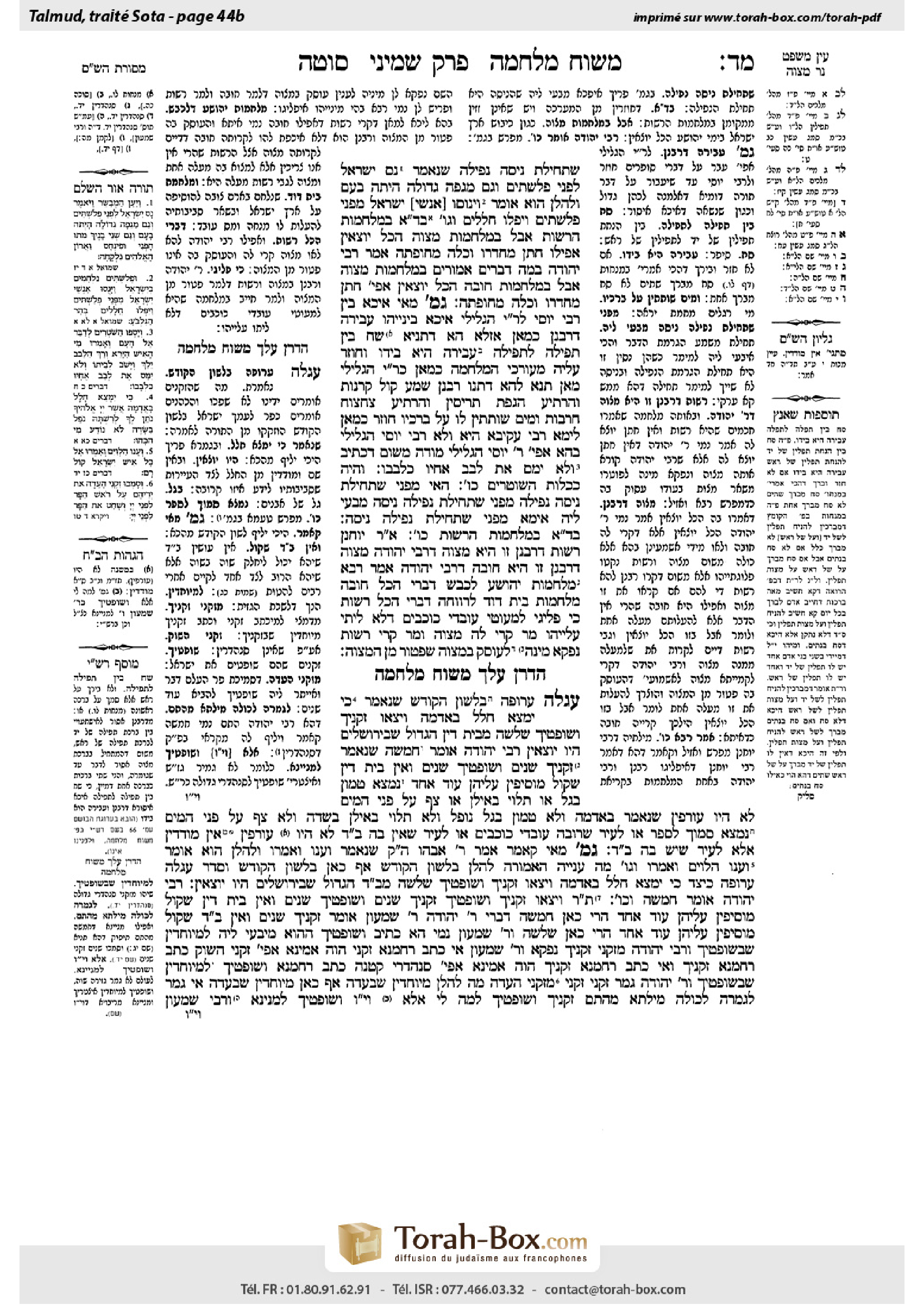
Sotah 44b: Talmud study for Daf Yomi
Daf Yomi is the daily study of one Talmud folio. Explore 37 tractates with scans, Hebrew text, Sefaria English and AI-generated French translations where annotated.
Passage selection and English or AI-generated French translation are available where the scan has annotations. Daf Study is independent of Torah-Box and Sefaria.
Browse Sotah · סוטה · All tractatesSotah 44b text and translations
This page of Sotah includes the Aramaic text, an English translation and an AI-generated French translation, alongside the scan above.
סוטה מ״ד ב · Aramaic and Hebrew text
שֶׁתְּחִילַּת נִיסָה נְפִילָה, שֶׁנֶּאֱמַר: ״נָס יִשְׂרָאֵל לִפְנֵי פְלִשְׁתִּים וְגַם מַגֵּפָה גְדוֹלָה הָיְתָה בָעָם״, וּלְהַלָּן הוּא אוֹמֵר: ״וַיָּנֻסוּ אַנְשֵׁי יִשְׂרָאֵל מִפְּנֵי פְלִשְׁתִּים וַיִּפְּלוּ חֲלָלִים וְגוֹ׳״.
בַּמֶּה דְּבָרִים אֲמוּרִים — בְּמִלְחֲמוֹת הָרְשׁוּת, אֲבָל בְּמִלְחֲמוֹת מִצְוָה — הַכֹּל יוֹצְאִין, אֲפִילּוּ חָתָן מֵחֶדְרוֹ וְכַלָּה מֵחוּפָּתָהּ. אָמַר רַבִּי יְהוּדָה: בַּמֶּה דְּבָרִים אֲמוּרִים — בְּמִלְחֲמוֹת מִצְוָה, אֲבָל בְּמִלְחֲמוֹת חוֹבָה — הַכֹּל יוֹצְאִין, אֲפִילּוּ חָתָן מֵחֶדְרוֹ וְכַלָּה מֵחוּפָּתָהּ.
גְּמָ׳ מַאי אִיכָּא בֵּין רַבִּי יוֹסֵי לְרַבִּי יוֹסֵי הַגְּלִילִי? אִיכָּא בֵּינַיְיהוּ עֲבֵירָה דְּרַבָּנַן.
כְּמַאן אָזְלָא הָא דְּתַנְיָא: שָׂח בֵּין תְּפִילָּה לִתְפִילָּה — עֲבֵירָה הִיא בְּיָדוֹ, וְחוֹזֵר עָלֶיהָ מֵעוֹרְכֵי הַמִּלְחָמָה. כְּמַאן — כְּרַבִּי יוֹסֵי הַגְּלִילִי.
מַאן תְּנָא לְהָא דְּתָנוּ רַבָּנַן: שָׁמַע קוֹל קְרָנוֹת וְהִרְתִּיעַ, הַגָּפַת תְּרִיסִין וְהִרְתִּיעַ, צִחְצוּחַ חֲרָבוֹת וּמַיִם שׁוֹתְתִין לוֹ עַל בִּרְכָּיו — חוֹזֵר. כְּמַאן — לֵימָא רַבִּי עֲקִיבָא הִיא וְלָא רַבִּי יוֹסֵי הַגְּלִילִי? בְּהָא אֲפִילּוּ רַבִּי יוֹסֵי הַגְּלִילִי מוֹדֶה, מִשּׁוּם דִּכְתִיב: ״וְלֹא יִמַּס אֶת לְבַב אֶחָיו כִּלְבָבוֹ״.
״וְהָיָה כְּכַלֹּת הַשֹּׁטְרִים כּוּ׳״. הַאי מִפְּנֵי שֶׁתְּחִילַּת נִיסָה נְפִילָה, מִפְּנֵי שֶׁתְּחִילַּת נְפִילָה נִיסָה מִבְּעֵי לֵיהּ! אֵימָא מִפְּנֵי שֶׁתְּחִילַּת נְפִילָה נִיסָה.
בַּמֶּה דְּבָרִים אֲמוּרִים בְּמִלְחֲמוֹת הָרְשׁוּת כּוּ׳, אָמַר רַבִּי יוֹחָנָן: רְשׁוּת דְּרַבָּנַן זוֹ הִיא מִצְוָה דְּרַבִּי יְהוּדָה, מִצְוָה דְּרַבָּנַן זוֹ הִיא חוֹבָה דְּרַבִּי יְהוּדָה.
אָמַר רָבָא: מִלְחֲמוֹת יְהוֹשֻׁעַ לְכַבֵּשׁ — דִּבְרֵי הַכֹּל חוֹבָה, מִלְחֲמוֹת בֵּית דָּוִד לִרְוָוחָה — דִּבְרֵי הַכֹּל רְשׁוּת. כִּי פְּלִיגִי לְמַעוֹטֵי נׇכְרִים דְּלָא לַיְתֵי עֲלַיְיהוּ. מָר קָרֵי לַהּ מִצְוָה וּמָר קָרֵי רְשׁוּת. נָפְקָא מִינַּהּ לְעוֹסֵק בְּמִצְוָה שֶׁפָּטוּר מִן הַמִּצְוָה.
הֲדַרַן עֲלָךְ מְשׁוּחַ מִלְחָמָה
עֶגְלָה עֲרוּפָה בִּלְשׁוֹן הַקּוֹדֶשׁ, שֶׁנֶּאֱמַר: ״כִּי יִמָּצֵא חָלָל בָּאֲדָמָה ... וְיָצְאוּ זְקֵנֶיךָ וְשֹׁפְטֶיךָ״. שְׁלֹשָׁה מִבֵּית דִּין הַגָּדוֹל שֶׁבִּירוּשָׁלַיִם הָיוּ יוֹצְאִין, רַבִּי יְהוּדָה אוֹמֵר: חֲמִשָּׁה, שֶׁנֶּאֱמַר ״זְקֵנֶיךָ״ — שְׁנַיִם, ״וְשֹׁפְטֶיךָ״ — שְׁנַיִם, וְאֵין בֵּית דִּין שָׁקוּל, מוֹסִיפִין עֲלֵיהֶן עוֹד אֶחָד.
נִמְצָא טָמוּן בַּגַּל אוֹ תָּלוּי בָּאִילָן אוֹ צָף עַל פְּנֵי הַמַּיִם — לֹא הָיוּ עוֹרְפִין, שֶׁנֶּאֱמַר: ״בָּאֲדָמָה״ — וְלֹא טָמוּן בַּגַּל, ״נֹפֵל״ — וְלֹא תָּלוּי בָּאִילָן, ״בַּשָּׂדֶה״ — וְלֹא צָף עַל פְּנֵי הַמַּיִם.
נִמְצָא סָמוּךְ לַסְּפָר אוֹ לְעִיר שֶׁרוּבָּהּ נׇכְרִים אוֹ לְעִיר שֶׁאֵין בָּהּ בֵּית דִּין — לֹא הָיוּ עוֹרְפִין. אֵין מוֹדְדִין אֶלָּא לְעִיר שֶׁיֵּשׁ בָּהּ בֵּית דִּין.
גְּמָ׳ מַאי קָאָמַר? אָמַר רַבִּי אֲבָהוּ, הָכִי קָאָמַר: שֶׁנֶּאֱמַר ״וְעָנוּ וְאָמְרוּ״, וּלְהַלָּן הוּא אוֹמֵר ״וְעָנוּ הַלְוִיִּם וְאָמְרוּ וְגוֹ׳״, מָה עֲנִיָּיה הָאֲמוּרָה לְהַלָּן בִּלְשׁוֹן הַקּוֹדֶשׁ — אַף כָּאן בִּלְשׁוֹן הַקּוֹדֶשׁ.
וְסֵדֶר עֶגְלָה עֲרוּפָה כֵּיצַד — ״כִּי יִמָּצֵא חָלָל בָּאֲדָמָה ... וְיָצְאוּ זְקֵנֶיךָ וְשֹׁפְטֶיךָ״ — שְׁלֹשָׁה מִבֵּית דִּין הַגָּדוֹל שֶׁבִּירוּשָׁלַיִם הָיוּ יוֹצְאִין. רַבִּי יְהוּדָה אוֹמֵר חֲמִשָּׁה וְכוּ׳.
תָּנוּ רַבָּנַן: ״וְיָצְאוּ זְקֵנֶיךָ וְשֹׁפְטֶיךָ״. ״זְקֵנֶיךָ״ — שְׁנַיִם, ״וְשֹׁפְטֶיךָ״ — שְׁנַיִם, וְאֵין בֵּית דִּין שָׁקוּל, מוֹסִיפִין עֲלֵיהֶן עוֹד אֶחָד, הֲרֵי כָּאן חֲמִשָּׁה. דִּבְרֵי רַבִּי יְהוּדָה. רַבִּי שִׁמְעוֹן אוֹמֵר: ״זְקֵנֶיךָ״ — שְׁנַיִם, וְאֵין בֵּית דִּין שָׁקוּל, מוֹסִיפִין עֲלֵיהֶן עוֹד אֶחָד, הֲרֵי כָּאן שְׁלֹשָׁה.
וְרַבִּי שִׁמְעוֹן נָמֵי, הָא כְּתִיב ״וְשֹׁפְטֶיךָ״! הָהוּא מִיבְּעֵי לֵיהּ לִמְיוּחָדִין שֶׁבְּשׁוֹפְטֶיךָ. וְרַבִּי יְהוּדָה: מִ״זִּקְנֵי״ ״זְקֵנֶיךָ״ נָפְקָא.
וְרַבִּי שִׁמְעוֹן: אִי כְּתַב רַחֲמָנָא ״זִקְנֵי״ — הֲוָה אָמֵינָא אֲפִילּוּ זִקְנֵי הַשּׁוּק, כְּתַב רַחֲמָנָא ״זְקֵנֶיךָ״. וְאִי כְּתַב רַחֲמָנָא ״זְקֵנֶיךָ״ — הֲוָה אָמֵינָא אֲפִילּוּ סַנְהֶדְרִי קְטַנָּה, כְּתַב רַחֲמָנָא ״וְשֹׁפְטֶיךָ״ — לִמְיוּחָדִין שֶׁבְּשׁוֹפְטֶיךָ.
וְרַבִּי יְהוּדָה גְּמַר ״זִקְנֵי״ ״זִקְנֵי״ מִ״זִּקְנֵי הָעֵדָה״: מָה לְהַלָּן מְיוּחָדִין שֶׁבָּעֵדָה — אַף כָּאן מְיוּחָדִין שֶׁבָּעֵדָה.
אִי גָּמַר, לִגְמְרַהּ לְכוּלַּהּ מִילְּתָא מֵהָתָם, ״זְקֵנֶיךָ וְשֹׁפְטֶיךָ״ לְמָה לִי? אֶלָּא, וָיו ״וְשֹׁפְטֶיךָ״ לְמִנְיָנָא. וְרַבִּי שִׁמְעוֹן —
Sotah 44b · English translation
because the beginning of fleeing is a downfall on the battlefield, as it is stated: “Israel has fled before the Philistines, and there has been also a great slaughter among the people” (I Samuel 4:17), and likewise it says further on: “And the men of Israel fled from before the Philistines, and fell down slain in Mount Gilboa” (I Samuel 31:1).
The mishna adds: In what case are all of these statements, with regard to the various exemptions from war, said? They are said with regard to elective wars. But in wars whose mandate is a mitzva, everyone goes, even a groom from his room and a bride from her wedding canopy. Rabbi Yehuda said: In what case are all of these statements, with regard to the various exemptions from war, said? They are said with regard to wars whose mandate is a mitzva. But in obligatory wars, everyone goes, even a groom from his room and a bride from her wedding canopy.
GEMARA: The Gemara asks: With regard to their understanding that the “fearful and fainthearted” is referring to one harboring sins, what difference is there between the opinion of Rabbi Yosei and the opinion of Rabbi Yosei HaGelili? The Gemara answers: There is a practical difference between them with regard to a sin which violates a prohibition by rabbinic law. According to Rabbi Yosei HaGelili, one who has violated a rabbinic law returns home, whereas Rabbi Yosei maintains that one returns home only if he has violated a Torah law, as in the case of a priest who has married a divorcée.
The Gemara asks: In accordance with whose opinion is that which is taught in a baraita: If one spoke between donning the phylactery of the arm and the phylactery of the head, he has a sin on his hands, and due to that sin he returns from the ranks of soldiers waging war. In accordance with whose opinion does this man return? It is in accordance with the opinion of Rabbi Yosei HaGelili, who maintains that one returns even due to a minor transgression.
The Gemara asks: Who is the tanna who taught this halakha that the Sages taught in a baraita: If one heard the sound of trumpets and trembled; or he heard the knocking of shields and he trembled; or he heard the sharpening of swords, and urine was trickling down his knees in fear, he returns from the battlefront. In accordance with whose opinion is this? Shall we say that it is the opinion of Rabbi Akiva, who interprets “fearful and fainthearted” literally, and it is not the opinion of Rabbi Yosei HaGelili? The Gemara answers: In this case even Rabbi Yosei HaGelili would concede that he should return, because it is written: “What man is there that is fearful and fainthearted? Let him go and return…lest his brethren’s heart melt as his heart” (Deuteronomy 20:8). Someone so clearly frightened invariably spreads his fear to those around him.
§ The mishna teaches: “And it shall be, when the officers conclude speaking to the people, that captains of legions shall be appointed at the head of the people” (Deuteronomy 20:9), and that the guards have the license to beat the legs of anyone who attempts to turn back and flee from the war, because the beginning of fleeing is a downfall. The Gemara is puzzled by the language of the mishna: This phrase: Because the beginning of fleeing is a downfall, appears to be backward. The mishna should have said the opposite: Because the beginning of the downfall is the act of fleeing. The Gemara concedes: Indeed, say that the mishna means: Because the beginning of the downfall is the act of fleeing.
The mishna teaches: In what case are these statements said? They are said with regard to elective wars, as opposed to obligatory wars or wars whose mandate is a mitzva. Rabbi Yoḥanan says concerning the various categories of war: The elective war referenced by the Rabbis is the same as a war whose mandate is a mitzva referenced by Rabbi Yehuda, and the war that is a mitzva mentioned by the Rabbis is the same as the obligatory war mentioned by Rabbi Yehuda. Therefore, Rabbi Yehuda is merely stating that the wars which the Rabbis call elective are to be seen as mandated by a mitzva.
Rava said: With respect to the wars that Joshua waged to conquer Eretz Yisrael, all agree that they were obligatory. With respect to the wars waged by the House of King David for the sake of territorial expansion, all agree that they were elective wars. When they disagree, it is with regard to preventative wars that are waged to reduce the gentiles so that they will not come and wage war against them. One Sage, Rabbi Yehuda, called this type of war a mitzva, and one Sage, the Rabbis, called it an elective war. There is a practical difference between these opinions with respect to the principle: One who is engaged in a mitzva is exempt from performing another mitzva. According to Rabbi Yehuda, one fighting in this kind of war is exempt from performing another mitzva.
MISHNA: In certain cases of unsolved murder, the Torah prescribes a ritual performed with a heifer whose neck is broken. During the course of this ritual, the judges say a confession in the sacred tongue, Hebrew, as it is stated in the verse: “If one be found slain in the land which the Lord your God has given you to possess it, lying in the field, and it is not known who has smitten him; then your Elders and your judges shall come forth” (Deuteronomy 21:1–2). What is the procedure for this ritual? Three members of the High Court [Sanhedrin] that is in Jerusalem would go out to see the corpse. Rabbi Yehuda says: Five would go out, as it is stated: “Your Elders,” in the plural form, indicating at least two; and it is written: “And your judges,” in the plural form, indicating another two judges; and a court may not be comprised of an even number of judges because they need to be able to issue a majority ruling. Consequently, they add to them one more Elder.
If the corpse was found concealed in a pile of stones, or hanging on a tree, or floating on the surface of the water, then the judges would not break the neck of the heifer, as it is stated: “If one be found slain in the land” (Deuteronomy 21:1), and not concealed in a pile of stones; “lying” on the ground and not hanging on a tree; “in the field,” and not floating on the surface of the water.
If a corpse was found close to the border of the country, or close to a city in which the majority of its inhabitants are gentiles, or close to a city that is without a rabbinical court of twenty-three judges, then the judges would not break the heifer’s neck. Additionally, the Elders measure the distance from the corpse only to a city that has a rabbinical court with twenty-three judges.
GEMARA: The Gemara asks: What is the first sentence in the mishna saying? The mishna is attempting to prove that the verses read during the ritual of breaking a heifer’s neck are to be recited in Hebrew, yet the verse does not offer any proof of this. Rabbi Abbahu said that this is what the mishna is saying: The confession is recited in Hebrew, as it is stated with regard to the ritual of the heifer whose neck is broken: “And they shall speak and say” (Deuteronomy 21:7), and later it is stated with regard to the curses stated on Mount Ebal: “And the Levities shall speak and say” (Deuteronomy 27:14). Just as the word “speak” that is said later with regard to the Levites is referring to a speech that is recited in the sacred tongue, so too here the declaration is recited in the sacred tongue.
The mishna continues to answer the question of: And how is the ritual of the heifer whose neck is broken ordered? The mishna states: It is written in the Torah: “If one be found slain in the land which the Lord your God has given you to possess it, lying in the field, and it is not known who has smitten him; then your Elders and your judges shall come forth, and they shall measure unto the cities which are round about him that is slain” (Deuteronomy 21:1–2). Three members of the High Court that is in Jerusalem would go forth. Rabbi Yehuda says: Five.
The Sages taught: “And your Elders and judges shall come forth.” “Your Elders” indicates two; “and your judges” also indicates two; and a court may not be composed of an even number of judges, so they add to them one more judge. Therefore, there are five judges. This is the statement of Rabbi Yehuda. Rabbi Shimon says: “Your Elders” indicates two, and as a court may not consist of an even number of judges they add to them one more. Therefore, there are three.
The Gemara asks: But according to Rabbi Shimon as well, isn’t it written: “And your judges”; why does he not agree that this indicates a need for two more judges? The Gemara answers: He requires that additional word “Elders” in order to teach that they must be the distinguished among your judges, i.e., judges from the Sanhedrin. And how does Rabbi Yehuda, who derives from the phrase “and your judges” that there is a need for two additional judges, know that they need to be from the Sanhedrin? He derives it from an extra letter. The verse could have simply stated: The Elders. Instead, it adds a letter and states: “Your Elders,” to teach that they must be the distinguished among the Elders of Israel.
And Rabbi Shimon could say: If the Merciful One had written in the Torah: The Elders, I would say that it includes even the Elders of the marketplace, meaning any honorable people. Therefore, the Merciful One writes in the Torah: “Your Elders,” to indicate specifically Torah Sages, who are revered by all. And if the Merciful One had written in the Torah only: “Your Elders,” I would say that it includes even Elders from a lesser Sanhedrin. Therefore, the Merciful One also writes: “And your judges,” to teach that they must be the distinguished among your judges, from the Great Sanhedrin.
And what is the source of Rabbi Yehuda that the judges may not come from a lesser Sanhedrin? He derives this halakha from a verbal analogy between “Elders,” written here, and “Elders,” written with regard to the offering that the Sanhedrin brings when the nation has sinned as a result of a mistaken ruling. This offering is brought by “the Elders of the congregation” (Leviticus 4:15). Just as there, “the Elders of the congregation” are the distinguished among the congregation, from the Great Sanhedrin, so too, here the verse is referring to the distinguished among the congregation.
The Gemara asks: If he derives this halakha from this verbal analogy, then he should derive the entire matter from there, including the requirement for five judges. If so, why do I need the phrase “your Elders and your judges”? Rather, it must be that Rabbi Yehuda does not derive the halakha from this verbal analogy. Instead, he understands that the phrase “your Elders” indicates two, and that “your judges” indicates that they must be the distinguished among your judges, and the letter vav in the phrase “and your judges [veshofetekha]” is to add two more to the count of the judges. And Rabbi Shimon does not accept this derivation
Sotah 44b · Traduction française (IA)
car le début de la fuite annonce la défaite sur le champ de bataille, comme il est dit : « Israël a fui devant les Philistins, et il y eut aussi un grand massacre parmi le peuple » (I Samuel 4,17), et il est également dit plus loin : « Les hommes d’Israël s’enfuirent devant les Philistins et tombèrent, tués, sur le mont Guilboa » (I Samuel 31,1).
La Michna ajoute : Dans quels cas toutes ces dispositions, concernant les différentes exemptions de la guerre, s’appliquent-elles ? Elles s’appliquent aux guerres facultatives. Mais dans les guerres dont le mandat est une mitsva, tous partent, même le marié quitte sa chambre et la mariée son dais nuptial. Rabbi Yehouda dit : Dans quels cas toutes ces dispositions, concernant les différentes exemptions de la guerre, s’appliquent-elles ? Elles s’appliquent aux guerres dont le mandat est une mitsva. Mais dans les guerres obligatoires, tous partent, même le marié quitte sa chambre et la mariée son dais nuptial.
GUEMARA : La Guemara demande : Puisqu’ils comprennent que l’expression « craintif et faible de cœur » désigne celui qui nourrit des péchés, quelle différence y a-t-il entre l’opinion de Rabbi Yossei et celle de Rabbi Yossei HaGelili ? La Guemara répond : La différence pratique entre eux concerne une transgression d’une interdiction rabbinique. Selon Rabbi Yossei HaGelili, celui qui a transgressé une règle rabbinique rentre chez lui, tandis que Rabbi Yossei soutient qu’on ne rentre chez soi que si l’on a transgressé une loi de la Torah, comme dans le cas d’un prêtre qui a épousé une femme divorcée.
La Guemara demande : De l’avis de quel tanna est l’enseignement de cette baraïta : si quelqu’un a parlé entre le moment où il met les téfilines du bras et celui où il met les téfilines de la tête, il a un péché à son compte et, à cause de ce péché, il rentre des rangs des soldats qui font la guerre. De l’avis de qui cet homme rentre-t-il ? De l’avis de Rabbi Yossei HaGelili, qui soutient qu’on rentre même à cause d’une transgression mineure.
La Guemara demande : Quel tanna a enseigné cette halakha que les Sages enseignent dans une baraïta : si quelqu’un entend le son des trompettes et tremble, ou s’il entend le bruit des boucliers qui s’entrechoquent et tremble, ou s’il entend le bruit des épées qu’on aiguise et que l’urine coule le long de ses genoux sous l’effet de la peur, il rentre du front. De l’avis de qui est-ce ? Faut-il dire que c’est l’opinion de Rabbi Akiva, qui interprète au sens littéral l’expression « craintif et faible de cœur », et non celle de Rabbi Yossei HaGelili ? La Guemara répond : Dans ce cas, même Rabbi Yossei HaGelili reconnaîtrait qu’il doit rentrer, car il est écrit : « Quel homme est craintif et faible de cœur ? Qu’il s’en aille et retourne […] de peur que le cœur de ses frères ne se fonde comme le sien » (Deutéronome 20,8). Quelqu’un d’aussi manifestement effrayé répand inévitablement sa peur autour de lui.
§ La Michna enseigne : « Et il arrivera, lorsque les officiers auront fini de parler au peuple, que des chefs de légions seront placés à la tête du peuple » (Deutéronome 20,9), et que les gardes sont autorisés à frapper les jambes de quiconque tente de faire demi-tour et de fuir la guerre, car le début de la fuite annonce la défaite. La Guemara s’étonne de la formulation de la Michna : cette expression, « car le début de la fuite annonce la défaite », semble inversée. La Michna aurait dû dire le contraire : car le début de la défaite est l’acte de fuir. La Guemara reconnaît : En effet, il faut dire que la Michna signifie : car le début de la défaite est l’acte de fuir.
La Michna enseigne : Dans quels cas ces dispositions s’appliquent-elles ? Elles concernent les guerres facultatives, par opposition aux guerres obligatoires ou aux guerres dont le mandat est une mitsva. Rabbi Yoḥanan dit au sujet des différentes catégories de guerre : La guerre facultative mentionnée par les Sages est la même que la guerre dont le mandat est une mitsva mentionnée par Rabbi Yehouda, et la guerre qui constitue une mitsva mentionnée par les Sages est la même que la guerre obligatoire mentionnée par Rabbi Yehouda. Par conséquent, Rabbi Yehouda affirme simplement que les guerres que les Sages qualifient de facultatives doivent être considérées comme ayant pour mandat une mitsva.
Rava dit : En ce qui concerne les guerres que Josué a menées pour conquérir la terre d’Israël, tous s’accordent à dire qu’elles étaient obligatoires. En ce qui concerne les guerres menées par la maison du roi David pour agrandir le territoire, tous s’accordent à dire qu’elles étaient facultatives. Leur désaccord porte sur les guerres préventives, menées pour réduire le nombre des non-Juifs afin qu’ils ne viennent pas leur faire la guerre. Un Sage, Rabbi Yehouda, qualifie ce type de guerre de mitsva, tandis que les Sages la qualifient de guerre facultative. Il y a une différence pratique entre ces opinions concernant le principe suivant : celui qui est occupé à accomplir une mitsva est exempt d’en accomplir une autre. Selon Rabbi Yehouda, celui qui combat dans ce type de guerre est exempt d’accomplir une autre mitsva.
MICHNA : Dans certains cas de meurtre non élucidé, la Torah prescrit un rituel accompli avec une génisse dont on brise la nuque. Au cours de ce rituel, les juges prononcent une déclaration dans la langue sacrée, l’hébreu, comme il est dit dans le verset : « Si l’on trouve, dans le pays que le Seigneur ton Dieu te donne pour en prendre possession, un homme tué, étendu dans les champs, et que l’on ne sait pas qui l’a frappé, alors tes Anciens et tes juges sortiront » (Deutéronome 21,1-2). Quelle est la procédure de ce rituel ? Trois membres du Grand Tribunal [Sanhedrin] de Jérusalem sortaient pour examiner le cadavre. Rabbi Yehouda dit : Cinq sortaient, car il est écrit « tes Anciens », au pluriel, ce qui indique au moins deux ; et il est écrit « et tes juges », au pluriel, ce qui indique deux autres juges. Or, un tribunal ne peut être composé d’un nombre pair de juges, puisqu’il doit pouvoir rendre une décision à la majorité. Par conséquent, ils ajoutent un ancien supplémentaire.
Si le cadavre était retrouvé dissimulé sous un amas de pierres, suspendu à un arbre ou flottant à la surface de l’eau, les juges ne brisaient pas la nuque de la génisse, comme il est dit : « Si l’on trouve un homme tué dans le pays » (Deutéronome 21,1), ce qui exclut un corps dissimulé sous un amas de pierres ; « gisant » à terre, ce qui exclut un corps suspendu à un arbre ; « dans les champs », ce qui exclut un corps flottant à la surface de l’eau.
Si un cadavre était retrouvé près de la frontière du pays, près d’une ville dont la majorité des habitants sont non juifs, ou près d’une ville dépourvue de tribunal rabbinique de vingt-trois juges, les juges ne brisaient pas la nuque de la génisse. De plus, les Anciens ne mesurent la distance entre le cadavre et les villes que jusqu’à une ville dotée d’un tribunal rabbinique de vingt-trois juges.
GUEMARA : La Guemara demande : Que dit la première phrase de la Michna ? La Michna tente de prouver que les versets récités lors du rituel de la génisse dont on brise la nuque doivent l’être en hébreu, mais le verset ne fournit aucune preuve en ce sens. Rabbi Abbahou dit que voici ce que dit la Michna : la confession est récitée en hébreu, comme il est dit à propos du rituel de la génisse dont on brise la nuque : « Ils prendront la parole et diront » (Deutéronome 21,7), et comme il est dit plus loin, à propos des malédictions prononcées sur le mont Ébal : « Les Lévites prendront la parole et diront » (Deutéronome 27,14). De même que le mot « prendre la parole », employé plus loin à propos des Lévites, désigne une déclaration récitée dans la langue sacrée, de même, ici, la déclaration est récitée dans la langue sacrée.
La Michna poursuit en répondant à la question : comment se déroule le rituel de la génisse dont on brise la nuque ? Elle indique que la Torah dit : « Si l’on trouve un homme tué dans le pays que le Seigneur ton Dieu te donne pour en prendre possession, gisant dans les champs, et que l’on ignore qui l’a frappé, tes Anciens et tes juges sortiront et mesureront la distance jusqu’aux villes autour de l’homme tué » (Deutéronome 21,1-2). Trois membres du Grand Tribunal de Jérusalem sortaient. Rabbi Yehouda dit : cinq.
Les Sages ont enseigné : « Tes Anciens et tes juges sortiront. » « Tes Anciens » désigne deux personnes ; « et tes juges » en désigne également deux. Or, un tribunal ne peut être composé d’un nombre pair de juges ; on leur en ajoute donc un. Il y a ainsi cinq juges. Telle est l’opinion de Rabbi Yehouda. Rabbi Shimon dit : « Tes Anciens » désigne deux personnes ; comme un tribunal ne peut être composé d’un nombre pair de juges, on leur en ajoute un. Il y en a donc trois.
La Guemara demande : Mais, pour Rabbi Shimon aussi, n’est-il pas écrit « et tes juges » ? Pourquoi ne considère-t-il pas que cela indique qu’il faut deux juges supplémentaires ? La Guemara répond : Il a besoin de ce mot supplémentaire, « Anciens », pour enseigner qu’ils doivent être les plus éminents parmi tes juges, c’est-à-dire des juges du Sanhédrin. Et comment Rabbi Yehouda, qui déduit de l’expression « et tes juges » qu’il faut deux juges supplémentaires, sait-il qu’ils doivent appartenir au Sanhédrin ? Il le déduit d’une lettre supplémentaire. Le verset aurait pu simplement dire : « Les Anciens ». Au lieu de cela, il ajoute une lettre et dit : « Tes Anciens », pour enseigner qu’ils doivent être les plus éminents parmi les Anciens d’Israël.
Et Rabbi Shimon pourrait répondre : si le Miséricordieux avait écrit dans la Torah « les Anciens », j’aurais dit que cela inclut même les anciens du marché, c’est-à-dire toutes sortes de personnes honorables. C’est pourquoi le Miséricordieux écrit dans la Torah « tes Anciens », pour désigner spécifiquement les Sages de la Torah, que tous révèrent. Et si le Miséricordieux avait écrit dans la Torah uniquement « tes Anciens », j’aurais dit que cela inclut même des anciens issus d’un Sanhédrin inférieur. C’est pourquoi le Miséricordieux écrit également « et tes juges », pour enseigner qu’ils doivent être les plus éminents parmi tes juges, ceux du Grand Sanhédrin.
Et quelle est la source de Rabbi Yehouda pour affirmer que les juges ne peuvent pas provenir d’un Sanhédrin inférieur ? Il déduit cette halakha par une analogie verbale entre « Anciens », écrit ici, et « Anciens », écrit à propos du sacrifice apporté par le Sanhédrin lorsque le peuple a péché à la suite d’une décision erronée. Ce sacrifice est apporté par « les Anciens de l’assemblée » (Lévitique 4,15). De même que là, « les Anciens de l’assemblée » sont les plus éminents de l’assemblée, ceux du Grand Sanhédrin, de même, ici, le verset désigne les plus éminents de l’assemblée.
La Guemara demande : S’il déduit cette halakha de cette analogie verbale, il devrait en déduire toute la question, y compris la nécessité de cinq juges. Dans ce cas, pourquoi a-t-on besoin de l’expression « tes Anciens et tes juges » ? Il faut donc conclure que Rabbi Yehouda ne déduit pas la halakha de cette analogie verbale. Il comprend au contraire que l’expression « tes Anciens » désigne deux personnes, que « tes juges » indique qu’ils doivent être les plus éminents parmi tes juges, et que la lettre vav dans l’expression « et tes juges [veshofetekha] » ajoute deux juges au décompte. Rabbi Shimon, lui, n’accepte pas cette déduction.
Traduction française générée par IA à partir de l’édition anglaise de Sefaria. Vérifie toujours un passage avec le texte source.
Text from Sefaria: William Davidson Edition - Vocalized Aramaic (CC BY NC); William Davidson Edition - English (CC BY NC).