Sotah 44a: Talmud study for Daf Yomi
Daf Yomi is the daily study of one Talmud folio. Explore 37 tractates with scans, Hebrew text, Sefaria English and AI-generated French translations where annotated.
Passage selection and English or AI-generated French translation are available where the scan has annotations. Daf Study is independent of Torah-Box and Sefaria.
Browse Sotah · סוטה · All tractatesSotah 44a text and translations
This page of Sotah includes the Aramaic text, an English translation and an AI-generated French translation, alongside the scan above.
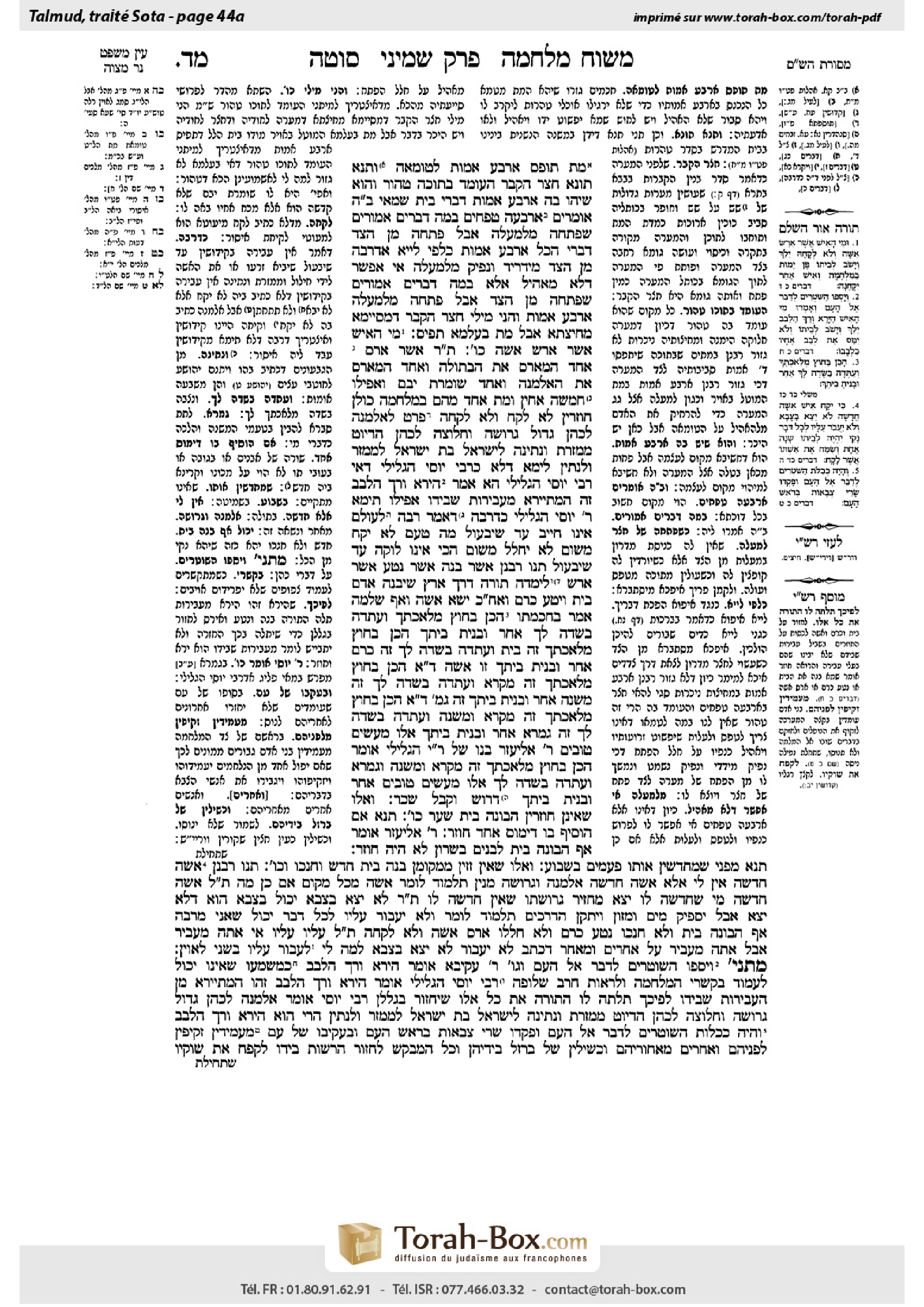
סוטה מ״ד א · Aramaic and Hebrew text
מֵת תּוֹפֵס אַרְבַּע אַמּוֹת לְטוּמְאָה. וְתַנָּא תּוּנָא: חֲצַר הַקֶּבֶר, הָעוֹמֵד בְּתוֹכָהּ — טָהוֹר, וְהוּא שֶׁיְּהוּ בָּהּ אַרְבַּע אַמּוֹת, דִּבְרֵי בֵּית שַׁמַּאי. בֵּית הִלֵּל אוֹמְרִים: אַרְבָּעָה טְפָחִים. בַּמֶּה דְּבָרִים אֲמוּרִים — שֶׁפִּתְחָהּ מִלְּמַעְלָה, אֲבָל פִּתְחָהּ מִן הַצַּד — דִּבְרֵי הַכֹּל אַרְבַּע אַמּוֹת.
כְּלַפֵּי לְיָיא?! אַדְּרַבָּה: מִן הַצַּד — מִידְּרִיד וְנָפֵיק, מִלְּמַעְלָה — אִי אֶפְשָׁר דְּלָא מַאֲהִיל. אֶלָּא: בַּמֶּה דְּבָרִים אֲמוּרִים שֶׁפִּתְחָהּ מִן הַצַּד, אֲבָל פִּתְחָהּ מִלְּמַעְלָה, אַרְבַּע אַמּוֹת. וְהָנֵי מִילֵּי, חֲצַר הַקֶּבֶר דִּמְסַיְּימָא מְחִיצָתַהּ, אֲבָל מֵת בְּעָלְמָא — תָּפֵיס.
״מִי הָאִישׁ אֲשֶׁר אֵרַשׂ אִשָּׁה כּוּ׳״, תָּנוּ רַבָּנַן: ״אֲשֶׁר אֵרַס״, אֶחָד הַמְאָרֵס אֶת הַבְּתוּלָה, וְאֶחָד הַמְאָרֵס אֶת הָאַלְמָנָה, וְאֶחָד שׁוֹמֶרֶת יָבָם. וַאֲפִילּוּ חֲמִשָּׁה אַחִין, וּמֵת אֶחָד מֵהֶם בַּמִּלְחָמָה — כּוּלָּן חוֹזְרִין. ״לֹא לָקַח״, ״וְלֹא לְקָחָהּ״ — פְּרָט לְאַלְמָנָה לַכֹּהֵן גָּדוֹל, גְּרוּשָׁה וַחֲלוּצָה לְכֹהֵן הֶדְיוֹט, מַמְזֶרֶת וּנְתִינָה לְיִשְׂרָאֵל, בַּת יִשְׂרָאֵל לְמַמְזֵר וּלְנָתִין.
לֵימָא דְּלָא כְּרַבִּי יוֹסֵי הַגְּלִילִי, דְּאִי רַבִּי יוֹסֵי הַגְּלִילִי, הָא אָמַר ״הַיָּרֵא וְרַךְ הַלֵּבָב״ — זֶה הַמִּתְיָירֵא מֵעֲבֵירוֹת שֶׁבְּיָדוֹ?
אֲפִילּוּ תֵּימָא רַבִּי יוֹסֵי הַגְּלִילִי, כִּדְרַבָּה. דְּאָמַר רַבָּה: לְעוֹלָם אֵינוֹ חַיָּיב עַד שֶׁיִּבְעוֹל, מָה טַעַם: ״לֹא יִקָּח״ מִשּׁוּם ״לֹא יְחַלֵּל״ — מִשּׁוּם הָכִי אֵינוֹ לוֹקֶה עַד שֶׁיִּבְעוֹל.
תָּנוּ רַבָּנַן: ״אֲשֶׁר בָּנָה״, ״אֲשֶׁר נָטַע״, ״אֲשֶׁר אֵרַשׂ״, לִימְּדָה תּוֹרָה דֶּרֶךְ אֶרֶץ: שֶׁיִּבְנֶה אָדָם בַּיִת, וְיִטַּע כֶּרֶם, וְאַחַר כָּךְ יִשָּׂא אִשָּׁה. וְאַף שְׁלֹמֹה אָמַר בְּחׇכְמָתוֹ: ״הָכֵן בַּחוּץ מְלַאכְתֶּךָ וְעַתְּדָהּ בַּשָּׂדֶה לָךְ אַחַר וּבָנִיתָ בֵיתֶךָ״. ״הָכֵן בַּחוּץ מְלַאכְתֶּךָ״ — זֶה בַּיִת, ״וְעַתְּדָהּ בַּשָּׂדֶה לָךְ״ — זֶה כֶּרֶם, ״אַחַר וּבָנִיתָ בֵיתֶךָ״ — זוֹ אִשָּׁה.
דָּבָר אַחֵר: ״הָכֵן בַּחוּץ מְלַאכְתֶּךָ״ — זֶה מִקְרָא, ״וְעַתְּדָהּ בַּשָּׂדֶה לָךְ״ — זֶה מִשְׁנָה, ״אַחַר וּבָנִיתָ בֵיתֶךָ״ — זֶה גְּמָרָא. דָּבָר אַחֵר: ״הָכֵן בַּחוּץ מְלַאכְתֶּךָ״ — זֶה מִקְרָא וּמִשְׁנָה, ״וְעַתְּדָהּ בַּשָּׂדֶה לָךְ״ — זֶה גְּמָרָא, ״אַחַר וּבָנִית בֵיתֶךָ״ — אֵלּוּ מַעֲשִׂים טוֹבִים. רַבִּי אֱלִיעֶזֶר בְּנוֹ שֶׁל רַבִּי יוֹסֵי הַגְּלִילִי אוֹמֵר: ״הָכֵן בַּחוּץ מְלַאכְתֶּךָ״ — זֶה מִקְרָא וּמִשְׁנָה וּגְמָרָא, ״וְעַתְּדָהּ בַּשָּׂדֶה לָךְ״ — אֵלּוּ מַעֲשִׂים טוֹבִים, ״אַחַר וּבָנִיתָ בֵיתֶךָ״ — דְּרוֹשׁ וְקַבֵּל שָׂכָר.
וְאֵלּוּ שֶׁאֵינָן חוֹזְרִין: הַבּוֹנֶה בֵּית שַׁעַר כּוּ׳. תָּנָא: אִם הוֹסִיף בּוֹ דִּימוֹס אֶחָד — חוֹזֵר. רַבִּי אֱלִיעֶזֶר אוֹמֵר: אַף הַבּוֹנֶה בֵּית לְבֵנִים בַּשָּׁרוֹן — לֹא הָיָה חוֹזֵר. תָּנָא: מִפְּנֵי שֶׁמְּחַדְּשִׁין אוֹתוֹ פַּעֲמַיִם בְּשָׁבוּעַ.
וְאֵלּוּ שֶׁאֵין זָזִין מִמְּקוֹמָן: בָּנָה בַּיִת חָדָשׁ וַחֲנָכוֹ וְכוּ׳. תָּנוּ רַבָּנַן: ״אִשָּׁה חֲדָשָׁה״ — אֵין לִי אֶלָּא אִשָּׁה חֲדָשָׁה, אַלְמָנָה וּגְרוּשָׁה מִנַּיִן — תַּלְמוּד לוֹמַר: ״אִשָּׁה״ מִכׇּל מָקוֹם. אִם כֵּן, מָה תַּלְמוּד לוֹמַר ״אִשָּׁה חֲדָשָׁה״? מִי שֶׁחֲדָשָׁה לוֹ, יָצָא מַחֲזִיר גְּרוּשָׁתוֹ שֶׁאֵין חֲדָשָׁה לוֹ.
תָּנוּ רַבָּנַן: ״לֹא יֵצֵא בַּצָּבָא״. יָכוֹל בַּצָּבָא הוּא דְּלֹא יֵצֵא, אֲבָל יַסְפִּיק מַיִם וּמָזוֹן וִיתַקֵּן הַדְּרָכִים — תַּלְמוּד לוֹמַר: ״וְלֹא יַעֲבֹר עָלָיו לְכׇל דָּבָר״. יָכוֹל שֶׁאֲנִי מְרַבֶּה אַף הַבּוֹנֶה בַּיִת וְלֹא חֲנָכוֹ, נָטַע כֶּרֶם וְלֹא חִלְּלוֹ, אֵרַס אִשָּׁה וְלֹא לְקָחָהּ — תַּלְמוּד לוֹמַר: ״עָלָיו״ — עָלָיו אִי אַתָּה מַעֲבִיר, אֲבָל אַתָּה מַעֲבִיר עַל אֲחֵרִים. וּמֵאַחַר דִּכְתַב ״לֹא יַעֲבֹר״, ״לֹא יֵצֵא בַּצָּבָא״ לְמָה לִי? לַעֲבוֹר עָלָיו בִּשְׁנֵי לָאוִין.
מַתְנִי׳ ״וְיָסְפוּ הַשֹּׁטְרִים לְדַבֵּר אֶל הָעָם וְגוֹ׳״, רַבִּי עֲקִיבָא אוֹמֵר: ״הַיָּרֵא וְרַךְ הַלֵּבָב״ — כְּמַשְׁמָעוֹ, שֶׁאֵינוֹ יָכוֹל לַעֲמוֹד בְּקִשְׁרֵי הַמִּלְחָמָה וְלִרְאוֹת חֶרֶב שְׁלוּפָה. רַבִּי יוֹסֵי הַגְּלִילִי אוֹמֵר: ״הַיָּרֵא וְרַךְ הַלֵּבָב״ — זֶהוּ הַמִּתְיָירֵא מִן הָעֲבֵירוֹת שֶׁבְּיָדוֹ, לְפִיכָךְ תָּלְתָה לוֹ הַתּוֹרָה אֶת כׇּל אֵלּוּ, שֶׁיַּחְזוֹר בִּגְלָלָן.
רַבִּי יוֹסֵי אוֹמֵר: אַלְמָנָה לְכֹהֵן גָּדוֹל, גְּרוּשָׁה וַחֲלוּצָה לְכֹהֵן הֶדְיוֹט, מַמְזֶרֶת וּנְתִינָה לְיִשְׂרָאֵל, בַּת יִשְׂרָאֵל לְמַמְזֵר וּלְנָתִין — הֲרֵי הוּא הַיָּרֵא וְרַךְ הַלֵּבָב.
״וְהָיָה כְּכַלֹּת הַשֹּׁטְרִים לְדַבֵּר אֶל הָעָם וּפָקְדוּ שָׂרֵי צְבָאוֹת בְּרֹאשׁ הָעָם״. וּבַעֲקֵיבוֹ שֶׁל עָם מַעֲמִידִין זְקִיפִין לִפְנֵיהֶם, וַאֲחֵרִים מֵאֲחוֹרֵיהֶם, וְכַשִּׁילִין שֶׁל בַּרְזֶל בִּידֵיהֶן, וְכׇל הַמְבַקֵּשׁ לַחְזוֹר — הָרְשׁוּת בְּיָדוֹ לְקַפֵּחַ אֶת שׁוֹקָיו.
Sotah 44a · English translation
A corpse occupies four cubits with regard to impurity, as the Sages decreed that one becomes impure when he stands within four cubits of a corpse. This measure protects priests and others who are forbidden to contract ritual impurity imparted by a corpse, so that they do not inadvertently become impure. And the tanna of the mishna taught in another mishna as well (Oholot 15:8): With regard to a courtyard adjacent to a grave, one who stands within it is ritually pure, provided that there are four cubits by four cubits within it. A courtyard this size constitutes its own space, according to the statement of Beit Shammai. Beit Hillel say: A space of four handbreadths by four handbreadths is enough. In what case is this statement said? Four handbreadths suffice when the entrance to the courtyard is from above. In such a case there is no concern that one will cover the grave with his body, and thereby become ritually impure, when entering the courtyard. However, if its entrance is from the side, everyone agrees the courtyard must be at least four cubits by four cubits in size.
The Gemara challenges the preceding resolution: In which direction [kelapei layya] is there a distinction between the positions of the entrance? On the contrary, if one enters from the side, he can slip away and exit without becoming impure. However, if one enters from above it is impossible that he will not overlie the grave over the course of climbing in and out of the courtyard. Rather, it should say: In what case is this statement of Beit Hillel, according to which four handbreadths by four handbreadths are enough, said? It is when the entrance is from the side. However, if the entrance is from above, then the courtyard must be at least four cubits by four cubits according to all opinions. The Gemara further qualifies: And this statement applies in a courtyard adjacent to a grave whose partitions are delineated, but if there is only a corpse lying about without any enclosures, it certainly occupies and affects a surrounding area of four cubits.
§ The mishna teaches among the statements that were said before battle: “What man is there that has betrothed a wife and has not taken her? Let him go and return to his house” (Deuteronomy 20:7). The Sages taught: “That has betrothed” is referring to one who betroths a virgin, and to one who betroths a widow, and to one whose yevama is a widow awaiting her yavam, i.e., this man in the military ranks, to perform levirate marriage. And even if there are five brothers, and one of them dies in the war, they all return for the widow. In addition, the verse could have singled out one who has not taken a wife. When the verse specifies: “and has not taken her,” this excludes men in forbidden marriages: A widow who is betrothed to a High Priest; either a divorcée or a yevama who performed ḥalitza [ḥalutza], who is betrothed to a common priest; a mamzeret or a Gibeonite woman who is betrothed to an Israelite; or an Israelite woman who is betrothed to a mamzer or to a Gibeonite.
The Gemara asks: Shall we say that this opinion is not in accordance with the opinion of Rabbi Yosei HaGelili? As, if it were in accordance with the opinion of Rabbi Yosei HaGelili, he says: When the verse singles out “fearful and fainthearted” (Deuteronomy 20:8), this is referring to one who is afraid because of sins that he has. According to this interpretation, one who marries a woman forbidden to him should return home from war because of his guilt, which seems to contradict the opinion mentioned above that such a man does not return from the ranks.
The Gemara answers: Even if you say that the ruling is in accordance with the opinion of Rabbi Yosei HaGelili, such a man does not return, in accordance with the opinion of Rabba. As Rabba said: A man is never liable for a forbidden marriage until he engages in sexual intercourse with his wife. With regard to the forbidden marriages of a High Priest, the Torah states: “A widow, or a divorcée, or a profaned woman, or a harlot, these he shall not take…And he shall not profane his seed among his people” (Leviticus 21:14–15). What is the reason that “he shall not take” one of these women as a wife? It is due to: “He shall not profane his seed” by engaging in sexual intercourse. Due to that reason, he is not flogged until he engages in sexual intercourse with a woman who is forbidden to him. Therefore, even according to Rabbi Yosei HaGelili, one who merely betroths a forbidden wife might not return home from the ranks.
§ The Sages taught (Tosefta 7:20-21): The Torah states: “What man is there that has built” (Deuteronomy 20:5), and then “that has planted” (Deuteronomy 20:6), and finally “that has betrothed” (Deuteronomy 20:7). The Torah has taught a person the desired mode of behavior: A person should build a house, then plant a vineyard, and afterward marry a woman. And even King Solomon said in his wisdom: “Prepare your work outside, and make it fit for yourself in the field; and afterward build your house” (Proverbs 24:27). The Sages explained: “Prepare your work outside”; this is a house. “And make it fit for yourself in the field”; this is a vineyard. “And afterward you shall build your house”; this is a wife.
Alternatively, this verse may be understood as relating to Torah study: “Prepare your work outside”; this is the study of Bible. “And make it fit for yourself in the field”; this is the study of Mishna. “Afterward you shall build your house”; this is the study of Gemara, the analysis of and deliberation over the statements of the Sages. Alternatively: “Prepare your work outside”; this is the study of Bible and Mishna. “And make it fit for yourself in the field”; this is the study of Gemara. “Afterward you shall build your house”; these are good deeds. Rabbi Eliezer, son of Rabbi Yosei HaGelili, says: “Prepare your work outside”; this is the study of Bible, and Mishna, and Gemara. “And make it fit for yourself in the field”; these are good deeds. “Afterward you shall build your house”; expound upon new understandings of Torah and receive reward, which is possible only after the initial steps.
§ The mishna teaches: And these are the men who do not return from the ranks: One who builds a gateway, or an enclosed veranda, or a balcony…Rabbi Yehuda says: Even one who rebuilds a house as it stood originally would not return. A Sage taught (Tosefta 7:18): If one adds one additional row of stones [dimos] to the original structure, he returns from the ranks. That is enough to render it a new building. The mishna further teaches: Rabbi Eliezer says: Even one who builds a new brick house in the Sharon would not return. A Sage taught: This is because the owners renew it twice in a period of seven years, and it is therefore not considered a permanent structure.
§ The mishna teaches: These are the men who do not even move from their places: One who built a house and dedicated it within the year; one who planted a vineyard and used its fruit for less than a year; one who marries his betrothed and one who marries his yevama, as it is stated: “When a man takes a new wife, he shall not go out with the army, neither shall he be charged with any business; he shall be free for his house one year, and shall cheer his wife whom he has taken” (Deuteronomy 24:5). With respect to a new husband’s exemption, the Sages taught a number of halakhot from this verse. From the term: “A new wife” I have derived only that a man returns only for a new virgin wife. From where do I derive that it applies to a widow or a divorcée? The verse states: “A wife,” in any case. If so, what is the meaning when the verse states: “A new wife?” It is referring to one who is new for him, excluding one who remarries his divorcée, who is not new to him.
The Sages taught with regard to the verse: “He shall not go out with the army” (Deuteronomy 24:5); one might have thought it is with the army that he does not go out, but he does go to supply water and food to the army and to repair the roads for them. Therefore, the verse states: “Neither shall he be charged with any business.” One might have thought that I include even one who has built a house and has not dedicated it, or one who has planted a vineyard and has not used its fruit, or one who has betrothed a woman and has not taken her as his wife? The verse states: “Neither shall he be charged with any business”; you do not charge him with any responsibilities, but you do charge others. The Gemara asks: And since the Torah states: “Neither shall he be charged with any business,” why do I need to be taught: “He shall not go out with the army”? The Gemara answers: The Torah adds this clause so that he will violate two prohibitions if he goes out to war: “He shall not go out with the army,” and: “Neither shall he be charged.”
MISHNA: The mishna continues its discussion of the speech given before battle. “And the officers shall speak further to the people, and they shall say: What man is there that is fearful and fainthearted? Let him go and return unto his house” (Deuteronomy 20:8). Rabbi Akiva says: “That is fearful and fainthearted” is to be understood as it indicates, that the man is unable to stand in the battle ranks and to see a drawn sword because it will terrify him. Rabbi Yosei HaGelili says: “That is fearful and fainthearted”; this is one who is afraid because of the sins that he has; he, too, returns. Therefore, the Torah provided him with all these additional reasons for exemption from the army so he can ascribe his leaving to one of them. In this way, the sinner may leave the ranks without having to publicly acknowledge that he is a sinner.
Rabbi Yosei says: With regard to one who has betrothed a woman forbidden to him, including a widow betrothed to a High Priest; a divorcée or a yevama who performed ḥalitza [ḥalutza] betrothed to a common priest; a mamzeret or a Gibeonite woman betrothed to an Israelite; or a daughter of an Israelite betrothed to a mamzer or a Gibeonite; this man is he whom the verse calls “fearful and fainthearted.” He fears that his sin will jeopardize his safety in the war.
The mishna continues its discussion. The verse states: “And it shall be, when the officers conclude speaking to the people, that captains of legions shall be appointed at the head of the people” (Deuteronomy 20:9). The mishna adds: As well as at the rear of the people. The officers station guards [zekifin] in front of them, and other guards behind them, and they have iron rods [kashilin] in their hands. And with regard to anyone who attempts to turn back and flee from the war, the guard has license to beat [lekape’aḥ] his legs
Sotah 44a · Traduction française (IA)
Un cadavre occupe quatre coudées en matière d’impureté, car les Sages ont décrété que l’on devient impur lorsqu’on se tient à moins de quatre coudées d’un cadavre. Cette mesure protège les prêtres et les autres personnes à qui il est interdit de contracter l’impureté rituelle transmise par un cadavre, afin qu’elles ne deviennent pas impures par inadvertance. Le tanna enseigne également dans une autre Michna (Oholot 15:8) : au sujet d’une cour adjacente à une tombe, celui qui se tient à l’intérieur est rituellement pur, à condition qu’elle mesure au moins quatre coudées sur quatre. Selon Beit Shammaï, une cour de cette taille constitue un espace distinct. Beit Hillel disent qu’un espace de quatre palmes sur quatre suffit. Dans quel cas cette affirmation est-elle formulée ? Quatre palmes suffisent lorsque l’entrée de la cour se trouve par le haut. Dans ce cas, il n’y a pas lieu de craindre qu’en entrant dans la cour, on recouvre la tombe avec son corps et devienne ainsi rituellement impur. Toutefois, si l’entrée se trouve sur le côté, tous reconnaissent que la cour doit mesurer au moins quatre coudées sur quatre.
La Guemara conteste la résolution précédente : dans quel sens [kelapei layya] l’emplacement de l’entrée entraîne-t-il une distinction ? Au contraire, si l’on entre par le côté, on peut se faufiler et ressortir sans devenir impur. Mais si l’on entre par le haut, il est impossible de ne pas passer au-dessus de la tombe en entrant dans la cour et en en sortant. Il faut plutôt dire : dans quel cas Beit Hillel affirme-t-il que quatre palmes sur quatre suffisent ? Lorsque l’entrée se trouve sur le côté. En revanche, si l’entrée se trouve par le haut, la cour doit mesurer au moins quatre coudées sur quatre, selon tous les avis. La Guemara précise encore que cette affirmation concerne une cour adjacente à une tombe dont les parois sont délimitées ; mais si un cadavre est simplement étendu à l’air libre, sans aucun enclos, il occupe assurément une zone environnante de quatre coudées.
§ La Michna enseigne parmi les déclarations prononcées avant la bataille : « Quel est l’homme qui a fiancé une femme sans l’avoir prise pour épouse ? Qu’il s’en aille et retourne chez lui » (Deutéronome 20:7). Les Sages ont enseigné que « qui a fiancé » désigne celui qui a fiancé une vierge, celui qui a fiancé une veuve, ainsi que celui dont la yevama est une veuve qui attend que cet homme, qui se trouve dans les rangs de l’armée, contracte avec elle un mariage léviratique. Même s’il y a cinq frères et que l’un d’eux meurt à la guerre, ils retournent tous auprès de la veuve. En outre, le verset aurait pu mentionner simplement celui qui n’a pas pris de femme. En précisant : « sans l’avoir prise pour épouse », il exclut les hommes engagés dans des unions interdites : une veuve fiancée à un grand prêtre ; une divorcée ou une yevama ayant reçu la ḥalitsa [ḥalutza], fiancée à un prêtre ordinaire ; une mamzérète ou une femme guibonite fiancée à un Israélite ; ou une Israélite fiancée à un mamzer ou à un Guibonite.
La Guemara demande : faut-il en conclure que cet avis n’est pas conforme à celui de Rabbi Yosei HaGelili ? En effet, lorsqu’il interprète la mention des « peureux et craintifs » (Deutéronome 20:8), il dit qu’elle désigne celui qui a peur à cause des fautes qu’il a commises. Selon cette interprétation, un homme qui épouse une femme qui lui est interdite devrait retourner chez lui à cause de sa faute, ce qui semble contredire l’avis mentionné plus haut, selon lequel un tel homme ne retourne pas des rangs.
La Guemara répond : même si tu dis que la décision est conforme à l’avis de Rabbi Yosei HaGelili, un tel homme ne retourne pas chez lui, conformément à l’avis de Rabba. Car Rabba a dit : un homme n’est jamais passible de sanction pour une union interdite avant d’avoir eu des rapports sexuels avec sa femme. Au sujet des unions interdites à un grand prêtre, la Torah dit : « Une veuve, une divorcée, une femme profanée ou une prostituée, il ne les prendra pas […] et il ne profanera pas sa descendance au sein de son peuple » (Lévitique 21:14-15). Pourquoi lui est-il interdit de « prendre » l’une de ces femmes pour épouse ? Parce qu’il « ne profanera pas sa descendance » en ayant des rapports sexuels avec elle. C’est pourquoi il ne reçoit pas la flagellation avant d’avoir eu des rapports avec une femme qui lui est interdite. Ainsi, même selon Rabbi Yosei HaGelili, celui qui se contente de fiancer une femme qui lui est interdite n’est pas nécessairement tenu de retourner chez lui depuis les rangs.
§ Les Sages ont enseigné (Tossefta 7:20-21) : la Torah dit d’abord « Quel est l’homme qui a construit » (Deutéronome 20:5), puis « qui a planté » (Deutéronome 20:6), et enfin « qui a fiancé » (Deutéronome 20:7). La Torah enseigne ainsi à l’homme la conduite souhaitable : il doit construire une maison, puis planter une vigne et, ensuite, épouser une femme. Le roi Salomon lui-même a dit dans sa sagesse : « Prépare au-dehors ton ouvrage, aménage-le pour toi dans les champs, puis construis ta maison » (Proverbes 24:27). Les Sages expliquent : « Prépare au-dehors ton ouvrage », c’est une maison ; « aménage-le pour toi dans les champs », c’est une vigne ; « puis construis ta maison », c’est une épouse.
On peut également comprendre que ce verset concerne l’étude de la Torah : « Prépare au-dehors ton ouvrage », c’est l’étude de la Bible ; « aménage-le pour toi dans les champs », c’est l’étude de la Michna ; « puis construis ta maison », c’est l’étude de la Guemara, c’est-à-dire l’analyse et l’examen des paroles des Sages. Autre interprétation : « Prépare au-dehors ton ouvrage », c’est l’étude de la Bible et de la Michna ; « aménage-le pour toi dans les champs », c’est l’étude de la Guemara ; « puis construis ta maison », ce sont les bonnes actions. Rabbi Eliezer, fils de Rabbi Yosei HaGelili, dit : « Prépare au-dehors ton ouvrage », c’est l’étude de la Bible, de la Michna et de la Guemara ; « aménage-le pour toi dans les champs », ce sont les bonnes actions ; « puis construis ta maison », c’est développer de nouvelles interprétations de la Torah et recevoir une récompense, ce qui n’est possible qu’après les étapes initiales.
§ La Michna enseigne : voici les hommes qui ne retournent pas des rangs : celui qui construit un portail, une galerie fermée ou un balcon […] Rabbi Yehuda dit : même celui qui reconstruit une maison telle qu’elle était à l’origine ne retourne pas. Un Sage a enseigné (Tossefta 7:18) : si quelqu’un ajoute une rangée de pierres [dimos] à la structure d’origine, il retourne des rangs. Cela suffit à en faire une construction nouvelle. La Michna enseigne encore : Rabbi Eliezer dit que même celui qui construit une nouvelle maison en briques dans le Sharon ne retourne pas. Un Sage a enseigné que c’est parce que les propriétaires la rénovent deux fois en l’espace de sept ans ; elle n’est donc pas considérée comme une construction permanente.
§ La Michna enseigne : voici les hommes qui ne quittent même pas leur place : celui qui a construit une maison et l’a inaugurée au cours de l’année ; celui qui a planté une vigne et en a consommé les fruits depuis moins d’un an ; celui qui épouse sa fiancée et celui qui épouse sa yevama, comme il est dit : « Lorsqu’un homme prend une nouvelle épouse, il ne partira pas à l’armée et ne sera chargé d’aucune tâche ; il sera libre pour sa maison pendant un an et réjouira la femme qu’il a prise » (Deutéronome 24:5). Les Sages ont déduit de ce verset plusieurs halakhot concernant l’exemption du nouvel époux. Du terme « nouvelle épouse », j’ai seulement appris qu’un homme retourne uniquement pour une nouvelle épouse vierge. D’où apprend-on que cela s’applique aussi à une veuve ou à une divorcée ? Le verset dit « une épouse », sans restriction. Si tel est le cas, pourquoi précise-t-il « nouvelle épouse » ? Il s’agit d’une femme qui est nouvelle pour lui, ce qui exclut celui qui se remarie avec son ancienne femme après l’avoir divorcée, car elle n’est pas nouvelle pour lui.
Les Sages ont enseigné à propos du verset : « Il ne partira pas à l’armée » (Deutéronome 24:5) : on aurait pu penser qu’il ne part pas à l’armée, mais qu’il peut aller apporter de l’eau et de la nourriture à l’armée et réparer les routes pour elle. C’est pourquoi le verset dit : « Il ne sera chargé d’aucune tâche. » On aurait pu penser que cela inclut même celui qui a construit une maison sans l’avoir inaugurée, celui qui a planté une vigne sans en avoir consommé les fruits, ou celui qui a fiancé une femme sans l’avoir prise pour épouse. Le verset dit : « Il ne sera chargé d’aucune tâche » : on ne le charge d’aucune responsabilité, mais on en charge les autres. La Guemara demande : puisque la Torah dit « Il ne sera chargé d’aucune tâche », pourquoi fallait-il enseigner : « Il ne partira pas à l’armée » ? La Guemara répond : la Torah ajoute cette clause afin qu’il enfreigne deux interdictions s’il part à la guerre : « Il ne partira pas à l’armée » et « Il ne sera chargé d’aucune tâche. »
MICHNA : La Michna poursuit son exposé du discours prononcé avant la bataille. « Les officiers parleront encore au peuple et diront : Quel est l’homme qui est peureux et craintif ? Qu’il s’en aille et retourne chez lui » (Deutéronome 20:8). Rabbi Akiva dit : « Peureux et craintif » doit être compris selon son sens apparent : cet homme est incapable de tenir dans les rangs au combat et de voir une épée dégainée, car cela le terrifie. Rabbi Yosei HaGelili dit : « Peureux et craintif » désigne celui qui a peur à cause des fautes qu’il a commises ; lui aussi retourne chez lui. La Torah lui a donc fourni toutes ces raisons supplémentaires d’être dispensé de l’armée, afin qu’il puisse attribuer son départ à l’une d’elles. Ainsi, le pécheur peut quitter les rangs sans avoir à reconnaître publiquement qu’il est pécheur.
Rabbi Yosei dit : celui qui a fiancé une femme qui lui est interdite — notamment une veuve fiancée à un grand prêtre ; une divorcée ou une yevama ayant reçu la ḥalitsa [ḥalutza], fiancée à un prêtre ordinaire ; une mamzérète ou une femme guibonite fiancée à un Israélite ; ou la fille d’un Israélite fiancée à un mamzer ou à un Guibonite — est celui que le verset appelle « peureux et craintif ». Il craint que sa faute ne compromette sa sécurité à la guerre.
La Michna poursuit son exposé. Le verset dit : « Et lorsque les officiers auront fini de parler au peuple, des chefs de légions seront placés à la tête du peuple » (Deutéronome 20:9). La Michna ajoute : ainsi qu’à l’arrière du peuple. Les officiers placent des gardes [zekifin] devant eux et d’autres gardes derrière eux ; ceux-ci tiennent des bâtons de fer [kashilin] à la main. Tout garde a le droit de frapper [lekape’aḥ] aux jambes quiconque tente de faire demi-tour et de fuir la guerre.
Traduction française générée par IA à partir de l’édition anglaise de Sefaria. Vérifie toujours un passage avec le texte source.
Text from Sefaria: William Davidson Edition - Vocalized Aramaic (CC BY NC); William Davidson Edition - English (CC BY NC).