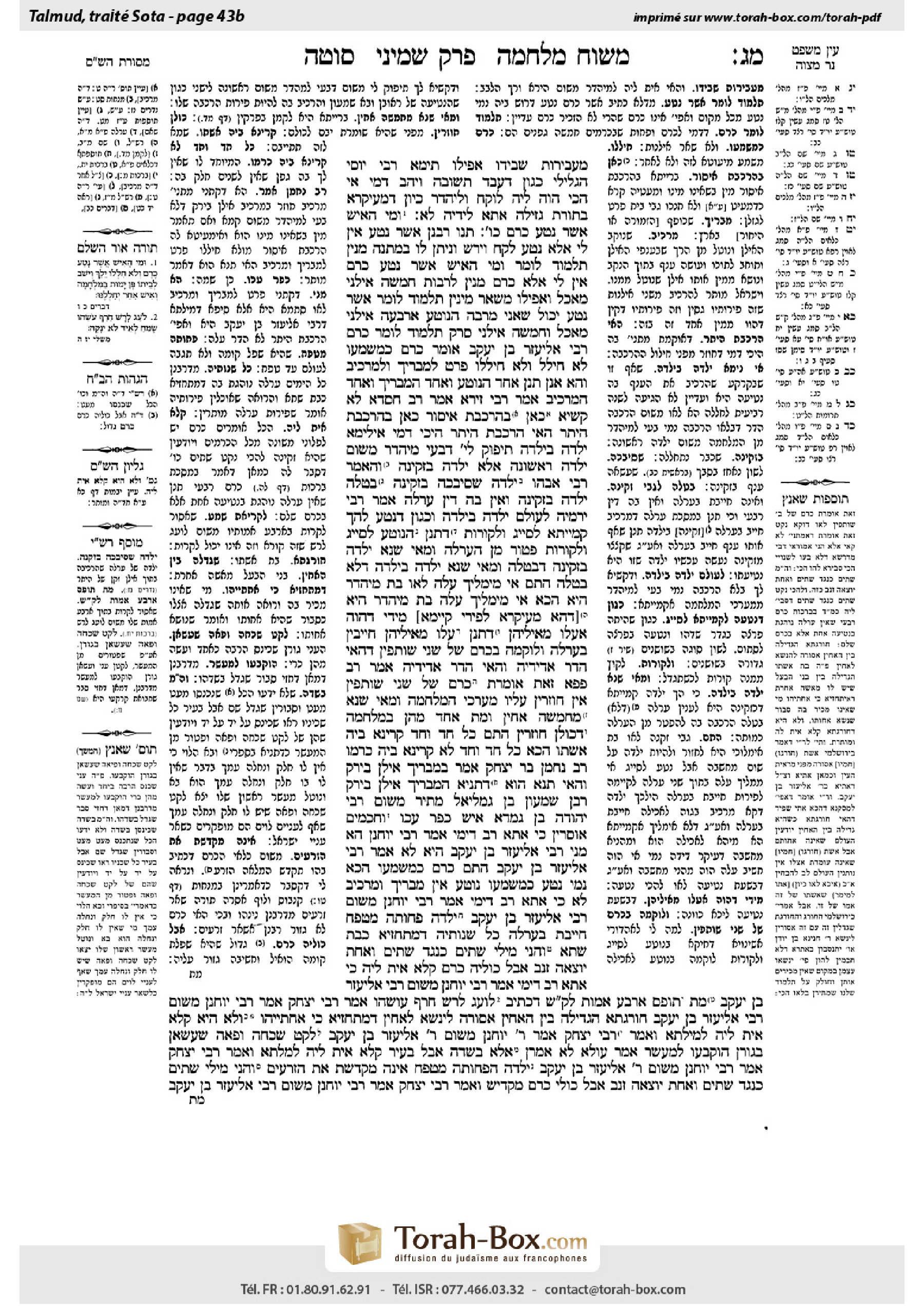
Sotah 43b: Talmud study for Daf Yomi
Daf Yomi is the daily study of one Talmud folio. Explore 37 tractates with scans, Hebrew text, Sefaria English and AI-generated French translations where annotated.
Passage selection and English or AI-generated French translation are available where the scan has annotations. Daf Study is independent of Torah-Box and Sefaria.
Browse Sotah · סוטה · All tractatesSotah 43b text and translations
This page of Sotah includes the Aramaic text, an English translation and an AI-generated French translation, alongside the scan above.
סוטה מ״ג ב · Aramaic and Hebrew text
מֵעֲבֵירוֹת שֶׁבְּיָדוֹ!
אֲפִילּוּ תֵּימָא רַבִּי יוֹסֵי הַגְּלִילִי, כְּגוֹן דַּעֲבַד תְּשׁוּבָה וִיהַב דְּמֵי. אִי הָכִי, הָוֵה לֵיהּ לוֹקֵחַ וְלֶיהְדַּר! כֵּיוָן דְּמֵעִיקָּרָא בְּתוֹרַת גְּזֵילָה אֲתָא לִידֵיהּ — לָא.
״וּמִי הָאִישׁ אֲשֶׁר נָטַע כֶּרֶם כּוּ׳״. תָּנוּ רַבָּנַן: ״אֲשֶׁר נָטַע״ — אֵין לִי אֶלָּא נָטַע. לָקַח וְיָרַשׁ וְנִיתַּן לוֹ בְּמַתָּנָה, מִנַּיִן — תַּלְמוּד לוֹמַר: ״וּמִי הָאִישׁ אֲשֶׁר נָטַע״.
״כֶּרֶם״ — אֵין לִי אֶלָּא כֶּרֶם, מִנַּיִן לְרַבּוֹת חֲמִשָּׁה אִילָנֵי מַאֲכָל וַאֲפִילּוּ מִשְּׁאָר מִינִין — תַּלְמוּד לוֹמַר: ״אֲשֶׁר נָטַע״. יָכוֹל שֶׁאֲנִי מְרַבֶּה הַנּוֹטֵעַ אַרְבָּעָה אִילָנֵי מַאֲכָל וַחֲמִשָּׁה אִילָנֵי סְרָק, תַּלְמוּד לוֹמַר: ״כֶּרֶם״.
רַבִּי אֱלִיעֶזֶר בֶּן יַעֲקֹב אוֹמֵר: ״כֶּרֶם״ כְּמַשְׁמָעוֹ. ״לֹא חִלֵּל״, ״וְלֹא חִלְּלוֹ״ — פְּרָט לְמַבְרִיךְ וּלְמַרְכִּיב. וְהָא אֲנַן תְּנַן: אֶחָד הַנּוֹטֵעַ וְאֶחָד הַמַּבְרִיךְ וְאֶחָד הַמַּרְכִּיב! אָמַר רַבִּי זֵירָא אָמַר רַב חִסְדָּא, לָא קַשְׁיָא: כָּאן בְּהַרְכָּבַת אִיסּוּר, כָּאן בְּהַרְכָּבַת הֶיתֵּר.
הַאי הַרְכָּבַת הֶיתֵּר הֵיכִי דָמֵי? אִילֵּימָא יַלְדָּה בְּיַלְדָּהּ — תִּיפּוֹק לֵיהּ דְּבָעֵי מֶיהְדָּר מִשּׁוּם יַלְדָּה רִאשׁוֹנָה! אֶלָּא יַלְדָּה בִּזְקֵינָה. וְהָאָמַר רַבִּי אֲבָהוּ: יַלְדָּה שֶׁסִּיבְּכָה בִּזְקֵינָה, בָּטְלָה יַלְדָּה בַּזְּקֵינָה, וְאֵין בָּהּ דִּין עׇרְלָה!
אָמַר רַבִּי יִרְמְיָה: לְעוֹלָם יַלְדָּה בְּיַלְדָּה, וּכְגוֹן דִּנְטַע לְהָךְ קַמַּיְיתָא לִסְיָיג וּלְקוֹרוֹת. דִּתְנַן: הַנּוֹטֵעַ לִסְיָיג וּלְקוֹרוֹת — פָּטוּר מִן הָעׇרְלָה.
וּמַאי שְׁנָא יַלְדָּה בִּזְקֵינָה דְּבָטְלָה, וּמַאי שְׁנָא יַלְדָּה בְּיַלְדָּה דְּלָא בָּטְלָה?
הָתָם אִי מִימְּלִיךְ עֲלַהּ — לָאו בַּת מֶיהְדָּר הִיא, הָכָא אִי מִימְּלִיךְ עֲלַהּ — בַּת מֶיהְדָּר הִיא [דְּהָא מֵעִיקָּרָא לְפֵירֵי קָיְימָא]. מִידֵּי דְּהָוֵה אַעָלוּ מֵאֵילֵיהֶן, דִּתְנַן: עָלוּ מֵאֵילֵיהֶן — חַיָּיבִין בְּעׇרְלָה.
וְלוֹקְמַהּ בְּכֶרֶם שֶׁל שְׁנֵי שׁוּתָּפִין, דְּהַאי הָדַר אַדִּידֵיהּ וְהַאי הָדַר אַדִּידֵיהּ? אָמַר רַב פָּפָּא, זֹאת אוֹמֶרֶת: כֶּרֶם שֶׁל שְׁנֵי שׁוּתָּפִין — אֵין חוֹזְרִין עָלָיו מֵעֶרְכֵי הַמִּלְחָמָה.
וּמַאי שְׁנָא מֵחֲמִשָּׁה אַחִין וּמֵת אֶחָד מֵהֶן בַּמִּלְחָמָה, דְּכוּלָּן חוֹזְרִין? הָתָם — כׇּל חַד וְחַד קָרֵינָא בֵּיהּ ״אִשְׁתּוֹ״, הָכָא — כׇּל חַד וְחַד לָא קָרֵינָא בַּיהּ ״כַּרְמוֹ״.
רַב נַחְמָן בַּר יִצְחָק אָמַר: בְּמַבְרִיךְ אִילָן בְּיָרָק, וְהַאי תַּנָּא הוּא דְּתַנְיָא: הַמַּבְרִיךְ אִילָן בְּיָרָק, רַבָּן שִׁמְעוֹן בֶּן גַּמְלִיאֵל מַתִּיר מִשּׁוּם רַבִּי יְהוּדָה בֶּן גַּמְדָּא אִישׁ כְּפַר עַכּוֹ, וַחֲכָמִים אוֹסְרִין.
כִּי אֲתָא רַב דִּימִי, אָמַר רַבִּי יוֹחָנָן: הָא מַנִּי — רַבִּי אֱלִיעֶזֶר בֶּן יַעֲקֹב הִיא. לָא אָמַר רַבִּי אֱלִיעֶזֶר בֶּן יַעֲקֹב הָתָם ״כֶּרֶם״ כְּמַשְׁמָעוֹ? הָכָא נָמֵי ״נָטַע״ כְּמַשְׁמָעוֹ: נוֹטֵעַ אִין, מַבְרִיךְ וּמַרְכִּיב לָא.
כִּי אֲתָא רַב דִּימִי אָמַר רַבִּי יוֹחָנָן מִשּׁוּם רַבִּי אֱלִיעֶזֶר בֶּן יַעֲקֹב: יַלְדָּה פְּחוּתָה מִטֶּפַח — חַיֶּיבֶת בְּעׇרְלָה כׇּל שְׁנוֹתֶיהָ, דְּמִתְחַזְיָא כְּבַת שַׁתָּא. וְהָנֵי מִילֵּי שְׁתַּיִם כְּנֶגֶד שְׁתַּיִם וְאַחַת יוֹצְאָה זָנָב. אֲבָל כּוּלֵּיהּ כֶּרֶם — קָלָא אִית לֵיהּ.
כִּי אֲתָא רַב דִּימִי אָמַר רַבִּי יוֹחָנָן מִשּׁוּם רַבִּי אֱלִיעֶזֶר בֶּן יַעֲקֹב: מֵת תּוֹפֵס אַרְבַּע אַמּוֹת לִקְרִיאַת שְׁמַע, דִּכְתִיב: ״לֹעֵג לָרָשׁ חֵרֵף עֹשֵׂהוּ״.
אָמַר רַבִּי יִצְחָק אָמַר רַבִּי יוֹחָנָן מִשּׁוּם רַבִּי אֱלִיעֶזֶר בֶּן יַעֲקֹב: חוּרְגְּתָא הַגְּדֵילָה בֵּין הָאַחִין — אֲסוּרָה לִינָּשֵׂא לָאַחִין, דְּמִתְחַזְיָא כִּי אֲחָתַיְיהוּ. וְלָא הִיא, קָלָא אִית לַיהּ לְמִילְּתָא.
וְאָמַר רַבִּי יִצְחָק אָמַר רַבִּי יוֹחָנָן מִשּׁוּם רַבִּי אֱלִיעֶזֶר בֶּן יַעֲקֹב: לֶקֶט שִׁכְחָה וּפֵאָה שֶׁעֲשָׂאָן בְּגוֹרֶן — הוּקְבְּעוּ לְמַעֲשֵׂר. אָמַר עוּלָּא: לָא אֲמַרַן אֶלָּא בַּשָּׂדֶה, אֲבָל בָּעִיר — קָלָא אִית לֵיהּ לְמִלְּתָא.
וְאָמַר רַבִּי יִצְחָק אָמַר רַבִּי יוֹחָנָן מִשּׁוּם רַבִּי אֱלִיעֶזֶר בֶּן יַעֲקֹב: יַלְדָּה הַפְּחוּתָה מִטֶּפַח — אֵינָהּ מְקַדֶּשֶׁת אֶת הַזְּרָעִים. וְהָנֵי מִילֵּי שְׁתַּיִם כְּנֶגֶד שְׁתַּיִם וְאַחַת יוֹצְאָה זָנָב, אֲבָל (כולי) [כּוּלֵּיהּ] כֶּרֶם — מְקַדֵּישׁ.
וְאָמַר רַבִּי יִצְחָק אָמַר רַבִּי יוֹחָנָן מִשּׁוּם רַבִּי אֱלִיעֶזֶר בֶּן יַעֲקֹב:
Sotah 43b · English translation
because of sins that he has. According to this interpretation, one who stole another’s real estate should return home from war because of his guilt, which would seem to contradict the opinion of Rabbi Eliezer ben Ya’akov.
The Gemara answers: Even if you say that this ruling is in accordance with the opinion of Rabbi Yosei HaGelili, Rabbi Eliezer ben Ya’akov still needs to exclude one in possession of a stolen house, as in a case where one repented and gave money to the owners of the house that he stole. Although in such a case he is not considered a criminal, the house was originally stolen, and therefore he must remain among the military ranks. The Gemara challenges this: If so, i.e., he repaid the owners, he is now a legal purchaser of the house and he should return from the military ranks. The Gemara answers: Since initially it entered his possession with the status of stolen property, he does not return.
§ The Gemara continues its discussion of those who return from the ranks. “And what man is there that has planted a vineyard, and has not used the fruit thereof” (Deuteronomy 20:6). The Sages taught: From the phrase “that has planted,” I have derived only that it applies to one who actually planted a vineyard. From where is it derived that the military exemption likewise includes one who purchased it, one who inherited it, and one to whom it was given as a gift? The verse states: “And what man is there that has planted.” By not merely stating: One that has planted, but using the expanded “what man is there that has planted,” the verse includes any of these circumstances.
From the specific term “vineyard,” I have derived only a vineyard; from where do I derive that it comes to include five fruit trees even from other species? The verse states: “That has planted,” to include different types of trees. Might I include even one who plants only four fruit trees and one who plants five or more non-fruit bearing trees? The verse states: “Vineyard.” The term excludes a quantity of trees that is too few to qualify as a vineyard, as well as trees that do not yield fruit at all.
Rabbi Eliezer ben Ya’akov says: The word “vineyard” is to be understood as it indicates, and it is referring only to a grape vineyard. And since the verse does not state merely: “And has not used the fruit,” but rather: “And has not used the fruit thereof,” it excludes one who layers the vine or branch and one who grafts different trees onto one another. The Gemara asks: But didn’t we learn in the mishna: He is released if he is one who plants, or if he is one who layers, or if he is one who grafts trees? Rabbi Zeira said that Rav Ḥisda said: This is not difficult. Here, in the case where one does not return from the ranks, the man has performed forbidden grafting; there, in the case where one does return from the ranks, he has performed permitted grafting.
The Gemara asks: With regard to this permitted grafting, what are the circumstances? If we say that it is a young tree grafted together with another young tree, then let him derive the halakha that one must return from the ranks due to the first young tree. One should be exempt because of his first tree, which is young, and the grafted tree is irrelevant. Rather, it is a case in which a young tree is grafted with an old tree. The Gemara objects: But didn’t Rabbi Abbahu say: With regard to a young tree that was entangled, i.e., grafted, with an old tree, the young one is negated by the old one, and the law of orla does not apply to it. Therefore, the grafted tree should likewise lose its status as a young tree, and one in this situation should not return from the ranks.
Rabbi Yirmeya said: Actually, one returns home if he grafts a young tree with another young tree, and it is a case in which he planted this first one for a fence or for beams, so that he is exempt from battle only because of the second tree, which he grafts for fruit. As we learned in a mishna (Orla 1:1): In a case of one who plants a tree for a fence or to yield wood for beams, the tree is exempt from the halakhot of orla.
The Gemara asks: And what is different about the case of a young tree paired with an old tree such that the young tree is negated, and what is different about the case of a young tree being planted for fruit paired with a young tree planted for wood such that the fruit tree is not negated?
The Gemara answers: There, in the case of an older tree, if one changes his mind about it and wants it to be a young tree obligated in orla, it cannot return to its previous state, as he has grafted it. Therefore, it is exempt from the halakhot of orla. Here, when a tree is planted for wood, if he changes his mind and decides to grow it for fruit, it can return to its default state of being planted for fruit, because initially it stands to be used for fruit. Therefore, it is not exempt from the halakhot of orla. This ruling is just as it is concerning trees that grew by themselves, which are subject to orla although they were not consciously planted for their fruit. As we learned in a mishna (Orla 1:2): Fruit trees that grew by themselves are obligated in orla although the landowner did not plant them himself.
The Gemara asks: Why is there a need to establish the mishna as discussing a case where one planted the first tree for a fence or for beams? But let the mishna be established as referring to a vineyard belonging to two partners, where the two trees involved in the grafting were co-owned by partners, and both trees were young. As in this case this one man returns due to his tree and that other man returns due to his tree. Rav Pappa says: Since the Gemara avoids the scenario of the vineyard belonging to partners in favor of discussing a case where one planted the first tree for a fence or for beams, that is to say if there is a vineyard belonging to two partners, evidently they do not return for the vineyard from the ranks of soldiers waging war.
The Gemara asks: And in what way is the case of partners different from the following case: If there are five brothers and one of them dies in the war, the halakha is that they all return. Just as each brother returns because of his shared responsibility to perform levirate marriage or ḥalitza for the widow, each partner should return for his share in the young tree that was grafted. The Gemara answers: There, each and every one is considered one who must return for his wife, as any of them could readily marry her. However, here, each and every one is not considered one who must return for his vineyard because it does not belong exclusively to either of them.
Rav Naḥman bar Yitzḥak said: In accordance with the baraita mentioned above, one does not normally return for a grafted or layered tree. However, the mishna states that one does return for a grafted or layered tree in a case where one layers a tree and grafts it with a vegetable plant. And that ruling is in accordance with this tanna, Rabbi Yehuda ben Gamda, as cited in a baraita. As it is taught in a baraita (Tosefta, Kilayim 1:12): With regard to one who layers a tree and grafts it with a vegetable plant, the tanna’im engaged in a dispute concerning whether this kind of breeding is permitted. Rabban Shimon ben Gamliel, speaking in the name of Rabbi Yehuda ben Gamda of the village of Akko, permits one to do so, and the Rabbis prohibit it. Therefore, one would return from the ranks for a tree grafted to a vegetable plant, in accordance with the opinion of Rabbi Yehuda ben Gamda, although he would not return for the vegetable itself.
The Gemara offers another alternative resolution to the contradiction over whether one returns for a grafted tree. When Rav Dimi came from Eretz Yisrael, he said that Rabbi Yoḥanan said: In accordance with whose opinion is this statement, which says that one does not return for a grafted tree? It is the opinion of Rabbi Eliezer ben Ya’akov. He explains: Didn’t Rabbi Eliezer ben Ya’akov say there in the baraita cited earlier: The word vineyard is to be understood as it indicates, i.e., that the exemption is only for a grape vineyard? Here too, the word planted is to be understood as it indicates; with regard to one who plants, yes, he does return, but one who grafts or layers a tree does not return.
§ After citing Rabbi Yoḥanan’s interpretation of the opinion of Rabbi Eliezer ben Ya’akov, the Gemara cites a string of other rulings that Rabbi Yoḥanan said in the name of Rabbi Eliezer ben Ya’akov. When Rav Dimi came from Eretz Yisrael, he said that Rabbi Yoḥanan said in the name of Rabbi Eliezer ben Ya’akov: The Sages decreed that if there is a young grapevine less than one handbreadth tall, it is obligated in orla all its years, even after the three years mandated by the Torah, because it appears like a vine of one year. The Sages were concerned that if they permitted one to eat from such a vine, people would also eat true orla. And this prohibition applies to a very small section of two grapevines opposite two grapevines and one more vine emerging and growing between them, in the formation of a tail. But if the entire vineyard grows so short, it generates publicity, and people know that the vines are old enough to no longer be subject to orla.
When Rav Dimi came from Eretz Yisrael, he said that Rabbi Yoḥanan said in the name of Rabbi Eliezer ben Ya’akov: A corpse occupies four cubits with regard to the exemption from the recitation of Shema, so that it is prohibited to recite Shema within this space, as it is written in the verse: “Whoever mocks the poor blasphemes his Maker” (Proverbs 17:5). Because the deceased cannot perform mitzvot, one who performs a mitzva in front of them is considered to be mocking them.
Rabbi Yitzḥak says that Rabbi Yoḥanan says in the name of Rabbi Eliezer ben Ya’akov: With regard to a man’s stepdaughter who grows up among the brothers from a different marriage, she is eligible to be married to them in principle, because they are not actually her siblings. Nevertheless, she is prohibited to be married to the brothers, because she appears as though she is their sister. The Gemara comments: And that is not so; such a marriage is not prohibited because the matter generates publicity, and the public knows that they are not truly related.
And Rabbi Yitzḥak says that Rabbi Yoḥanan says in the name of Rabbi Eliezer ben Ya’akov: With regard to gleanings (Leviticus 19:9, 23:22), forgotten sheaves (Deuteronomy 24:19), or produce in the corner of the field which is given to the poor [pe’a] (Leviticus 19:9, 23:22), three obligatory agricultural gifts that must be given to the poor, if one gathered them into the threshing floor, the produce was thereby rendered obligated for tithes. Although one does not take tithes from produce for the poor, onlookers are likely to presume that this is his own produce. Ulla said: We stated this halakha only when the granary is in the field, but in the city, the matter generates publicity. People see that the produce was gathered in small quantities from different places, and they know that this produce is for the poor. In that case, one need not separate tithes.
And Rabbi Yitzḥak says that Rabbi Yoḥanan says in the name of Rabbi Eliezer ben Ya’akov: If there is a young grapevine less than one handbreadth tall, it does not render the seeds that are planted next to it forbidden. Normally, diverse kinds of produce may not be planted in close proximity, but this vine is too small to qualify as a prohibited vineyard. The Gemara limits the scope of this statement: And this statement applies to a very small section of two grapevines opposite two grapevines and one more vine emerging and growing between them, in formation of a tail. But if the entire vineyard grows so short, a vine of this size does render the other seeds planted at its side forbidden.
And Rabbi Yitzḥak says that Rabbi Yoḥanan says in the name of Rabbi Eliezer ben Ya’akov:
Sotah 43b · Traduction française (IA)
en raison des fautes qu’il a commises. Selon cette interprétation, celui qui a volé le bien immobilier d’autrui devrait rentrer de la guerre à cause de sa faute, ce qui semblerait contredire l’opinion de Rabbi Eliezer ben Ya’akov.
La Guemara répond : Même si l’on dit que cette règle est conforme à l’opinion de Rabbi Yosei HaGelili, Rabbi Eliezer ben Ya’akov doit néanmoins exclure celui qui est en possession d’une maison volée, dans le cas où il s’est repenti et a versé de l’argent aux propriétaires de la maison qu’il avait volée. Bien qu’il ne soit alors pas considéré comme un criminel, la maison ayant été volée à l’origine, il doit rester dans les rangs de l’armée. La Guemara objecte : Si tel est le cas, c’est-à-dire s’il a remboursé les propriétaires, il est désormais l’acquéreur légal de la maison et devrait rentrer des rangs de l’armée. La Guemara répond : Puisqu’elle est entrée en sa possession avec le statut de bien volé, il ne rentre pas.
§ La Guemara poursuit son examen de ceux qui rentrent des rangs. « Quel est l’homme qui a planté une vigne et n’a pas joui de ses fruits ? » (Deutéronome 20:6). Les Sages ont enseigné : De l’expression « qui a planté », je déduis seulement que cela s’applique à celui qui a effectivement planté une vigne. D’où déduit-on que l’exemption du service militaire inclut également celui qui l’a achetée, celui qui en a hérité et celui à qui elle a été donnée en cadeau ? Le verset dit : « Quel est l’homme qui a planté ». Au lieu de dire simplement : « Celui qui a planté », il emploie la formule développée « Quel est l’homme qui a planté », ce qui inclut chacune de ces situations.
Du terme précis « vigne », je déduis seulement qu’il s’agit d’une vigne ; d’où déduit-on que cela inclut cinq arbres fruitiers, même d’autres espèces ? Le verset dit : « qui a planté », afin d’inclure différentes sortes d’arbres. Devrais-je peut-être inclure aussi celui qui plante seulement quatre arbres fruitiers, ainsi que celui qui plante cinq arbres ou davantage ne donnant pas de fruits ? Le verset dit : « vigne ». Ce terme exclut un nombre d’arbres trop faible pour constituer une vigne, ainsi que les arbres qui ne produisent aucun fruit.
Rabbi Eliezer ben Ya’akov dit : Le mot « vigne » doit être compris selon son sens et désigne uniquement une vigne à raisin. Et puisque le verset ne dit pas simplement : « et n’a pas joui du fruit », mais plutôt : « et n’a pas joui de ses fruits », cela exclut celui qui marcotte la vigne ou une branche, ainsi que celui qui greffe différentes sortes d’arbres les unes sur les autres. La Guemara demande : Mais n’avons-nous pas appris dans la Michna qu’il est libéré s’il plante, s’il marcotte ou s’il greffe des arbres ? Rabbi Zeira a dit au nom de Rav Ḥisda : Il n’y a pas de difficulté. Ici, dans le cas où l’on ne rentre pas des rangs, l’homme a effectué une greffe interdite ; là, dans le cas où l’on rentre des rangs, il a effectué une greffe permise.
La Guemara demande : Quelles sont les circonstances de cette greffe permise ? Si l’on dit qu’un jeune arbre a été greffé avec un autre jeune arbre, il devrait tirer la halakha de l’obligation de rentrer des rangs du premier jeune arbre. Il devrait être exempté grâce à son premier arbre, qui est jeune, et l’arbre greffé n’a aucune incidence. Il s’agit plutôt du cas où un jeune arbre est greffé avec un vieil arbre. La Guemara objecte : Mais Rabbi Abbahu n’a-t-il pas dit qu’un jeune arbre entremêlé à un vieil arbre, c’est-à-dire greffé sur lui, est annulé par le vieil arbre, et que la loi de l’orla ne s’applique pas à lui ? Par conséquent, l’arbre greffé devrait lui aussi perdre son statut de jeune arbre, et celui qui se trouve dans cette situation ne devrait pas rentrer des rangs.
Rabbi Yirmeya dit : En réalité, on rentre chez soi si l’on greffe un jeune arbre avec un autre jeune arbre. Il s’agit du cas où l’on a planté le premier à titre de clôture ou pour fournir du bois de charpente, de sorte qu’on est exempté du combat uniquement en raison du second arbre, que l’on greffe pour ses fruits. Car nous avons appris dans une Michna (Orla 1:1) : Si quelqu’un plante un arbre pour en faire une clôture ou pour fournir du bois de charpente, l’arbre est exempté des lois de l’orla.
La Guemara demande : En quoi le cas d’un jeune arbre associé à un vieil arbre diffère-t-il, de sorte que le jeune arbre est annulé, du cas d’un jeune arbre planté pour ses fruits associé à un jeune arbre planté pour son bois, où l’arbre fruitier n’est pas annulé ?
La Guemara répond : Là, dans le cas d’un arbre plus ancien, si l’on change d’avis à son sujet et qu’on veut en faire un jeune arbre soumis à l’orla, il ne peut pas retrouver son état antérieur, puisqu’on l’a greffé. Il est donc exempté des lois de l’orla. Ici, lorsqu’un arbre est planté pour son bois, si l’on change d’avis et décide de le cultiver pour ses fruits, il peut retrouver son état initial d’arbre planté pour ses fruits, car, dès le départ, il est destiné à être utilisé pour ses fruits. Il n’est donc pas exempté des lois de l’orla. Cette règle est comparable à celle des arbres qui ont poussé spontanément, lesquels sont soumis à l’orla bien qu’ils n’aient pas été consciemment plantés pour leurs fruits. Car nous avons appris dans une Michna (Orla 1:2) : Les arbres fruitiers qui ont poussé spontanément sont soumis à l’orla, bien que le propriétaire du terrain ne les ait pas plantés lui-même.
La Guemara demande : Pourquoi faut-il établir que la Michna traite du cas où l’on a planté le premier arbre pour en faire une clôture ou pour fournir du bois de charpente ? Qu’on l’établisse plutôt comme traitant d’une vigne appartenant à deux associés, où les deux arbres greffés appartenaient conjointement aux associés et étaient tous deux jeunes. Dans ce cas, cet homme rentre à cause de son arbre et l’autre homme rentre à cause du sien. Rav Pappa dit : Puisque la Guemara écarte le cas d’une vigne appartenant à des associés et préfère examiner celui où l’un a planté le premier arbre pour en faire une clôture ou pour fournir du bois de charpente, cela signifie que, si une vigne appartient à deux associés, ceux-ci ne rentrent pas des rangs des soldats qui font la guerre à cause de cette vigne.
La Guemara demande : Et en quoi le cas des associés diffère-t-il du cas suivant : s’il y a cinq frères et que l’un d’eux meurt à la guerre, la halakha est qu’ils rentrent tous. De même que chaque frère rentre en raison de sa responsabilité commune d’accomplir le mariage léviratique ou la ḥalitsa pour la veuve, chaque associé devrait rentrer à cause de sa part dans le jeune arbre greffé. La Guemara répond : Là, chacun est considéré comme devant rentrer à cause de sa femme, car n’importe lequel pourrait l’épouser. Mais ici, aucun d’eux n’est considéré comme devant rentrer à cause de sa vigne, puisqu’elle n’appartient exclusivement ni à l’un ni à l’autre.
Rav Naḥman bar Yitzḥak dit : Conformément à la baraïta mentionnée plus haut, on ne rentre habituellement pas des rangs pour un arbre greffé ou marcotté. Toutefois, la Michna dit qu’on rentre pour un arbre greffé ou marcotté dans le cas où l’on marcotte un arbre et qu’on le greffe sur une plante potagère. Cette règle est conforme à l’opinion de ce tanna, Rabbi Yehuda ben Gamda, rapportée dans une baraïta. En effet, il est enseigné dans une baraïta (Tosefta, Kilayim 1:12) : À propos de celui qui marcotte un arbre et le greffe sur une plante potagère, les tannaïm sont en désaccord sur la question de savoir si ce type de culture est permis. Rabban Shimon ben Gamliel, au nom de Rabbi Yehuda ben Gamda du village d’Akko, permet de le faire, tandis que les Sages l’interdisent. Par conséquent, on rentrerait des rangs pour un arbre greffé sur une plante potagère, conformément à l’opinion de Rabbi Yehuda ben Gamda, bien qu’on ne rentrerait pas pour la plante potagère elle-même.
La Guemara propose une autre résolution à la contradiction concernant le fait de rentrer ou non des rangs pour un arbre greffé. Lorsque Rav Dimi vint d’Eretz Yisrael, il dit que Rabbi Yoḥanan avait dit : De qui relève l’opinion selon laquelle on ne rentre pas des rangs pour un arbre greffé ? De Rabbi Eliezer ben Ya’akov. Il l’explique ainsi : Rabbi Eliezer ben Ya’akov n’a-t-il pas dit là, dans la baraïta citée précédemment : Le mot « vigne » doit être compris selon son sens, c’est-à-dire que l’exemption concerne uniquement une vigne à raisin ? Ici aussi, le mot « planté » doit être compris selon son sens : celui qui plante, oui, rentre des rangs, mais celui qui greffe ou marcotte un arbre n’y rentre pas.
§ Après avoir rapporté l’interprétation par Rabbi Yoḥanan de l’opinion de Rabbi Eliezer ben Ya’akov, la Guemara cite une série d’autres règles que Rabbi Yoḥanan a énoncées au nom de Rabbi Eliezer ben Ya’akov. Lorsque Rav Dimi vint d’Eretz Yisrael, il dit que Rabbi Yoḥanan avait dit au nom de Rabbi Eliezer ben Ya’akov : Les Sages ont décrété qu’une jeune vigne de moins d’un téfaḥ de hauteur est soumise à l’orla durant toutes ses années, même après les trois années prescrites par la Torah, car elle ressemble à une vigne d’un an. Les Sages craignaient que, s’ils permettaient d’en manger, les gens ne mangent aussi de véritables produits soumis à l’orla. Cette interdiction s’applique à un très petit secteur de deux vignes face à deux vignes, avec une vigne supplémentaire qui émerge et pousse entre elles, en formant une queue. Mais si toute la vigne pousse aussi bas, cela se remarque et les gens savent que les vignes sont assez anciennes pour ne plus être soumises à l’orla.
Lorsque Rav Dimi vint d’Eretz Yisrael, il dit que Rabbi Yoḥanan avait dit au nom de Rabbi Eliezer ben Ya’akov : Un cadavre occupe quatre coudées pour l’exemption de la récitation du Chéma, de sorte qu’il est interdit de réciter le Chéma dans cet espace, ainsi qu’il est écrit : « Celui qui se moque du pauvre outrage son Créateur » (Proverbes 17:5). Puisque le défunt ne peut pas accomplir de mitsvot, celui qui accomplit une mitsva en sa présence est considéré comme se moquant de lui.
Rabbi Yitzḥak dit au nom de Rabbi Yoḥanan, au nom de Rabbi Eliezer ben Ya’akov : La belle-fille d’un homme, qui grandit parmi les frères issus d’un autre mariage, peut en principe les épouser, car ils ne sont pas réellement ses frères. Néanmoins, il lui est interdit d’épouser ces frères, car elle semble être leur sœur. La Guemara commente : Il n’en est rien ; un tel mariage n’est pas interdit, car la situation est connue de tous et les gens savent qu’ils ne sont pas véritablement apparentés.
Et Rabbi Yitzḥak dit au nom de Rabbi Yoḥanan, au nom de Rabbi Eliezer ben Ya’akov : Si l’on a rassemblé dans l’aire de battage des glanures (Lévitique 19:9, 23:22), des gerbes oubliées (Deutéronome 24:19) ou les produits du coin du champ attribués aux pauvres [pe’a] (Lévitique 19:9, 23:22), trois dons agricoles obligatoires destinés aux pauvres, ces produits deviennent alors soumis à la dîme. Bien qu’on ne prélève pas la dîme sur les produits destinés aux pauvres, les observateurs risquent de penser qu’il s’agit de ses propres produits. Ulla dit : Nous n’avons énoncé cette halakha que lorsque l’aire de battage se trouve dans les champs, mais en ville, la situation est connue de tous. Les gens voient que les produits ont été rassemblés en petites quantités en différents endroits et savent qu’ils sont destinés aux pauvres. Dans ce cas, il n’est pas nécessaire de prélever la dîme.
Et Rabbi Yitzḥak dit au nom de Rabbi Yoḥanan, au nom de Rabbi Eliezer ben Ya’akov : Une jeune vigne de moins d’un téfaḥ de hauteur ne rend pas interdits les semis plantés à côté d’elle. En règle générale, il est interdit de planter des espèces végétales différentes à proximité les unes des autres, mais cette vigne est trop petite pour être considérée comme une vigne interdite. La Guemara précise la portée de cette affirmation : elle concerne un très petit secteur de deux vignes face à deux vignes, avec une vigne supplémentaire qui émerge et pousse entre elles, formant une queue. Mais si toute la vigne pousse aussi bas, une vigne de cette taille rend interdits les autres semis plantés à côté d’elle.
Et Rabbi Yitzḥak dit au nom de Rabbi Yoḥanan, au nom de Rabbi Eliezer ben Ya’akov :
Traduction française générée par IA à partir de l’édition anglaise de Sefaria. Vérifie toujours un passage avec le texte source.
Text from Sefaria: William Davidson Edition - Vocalized Aramaic (CC BY NC); William Davidson Edition - English (CC BY NC).