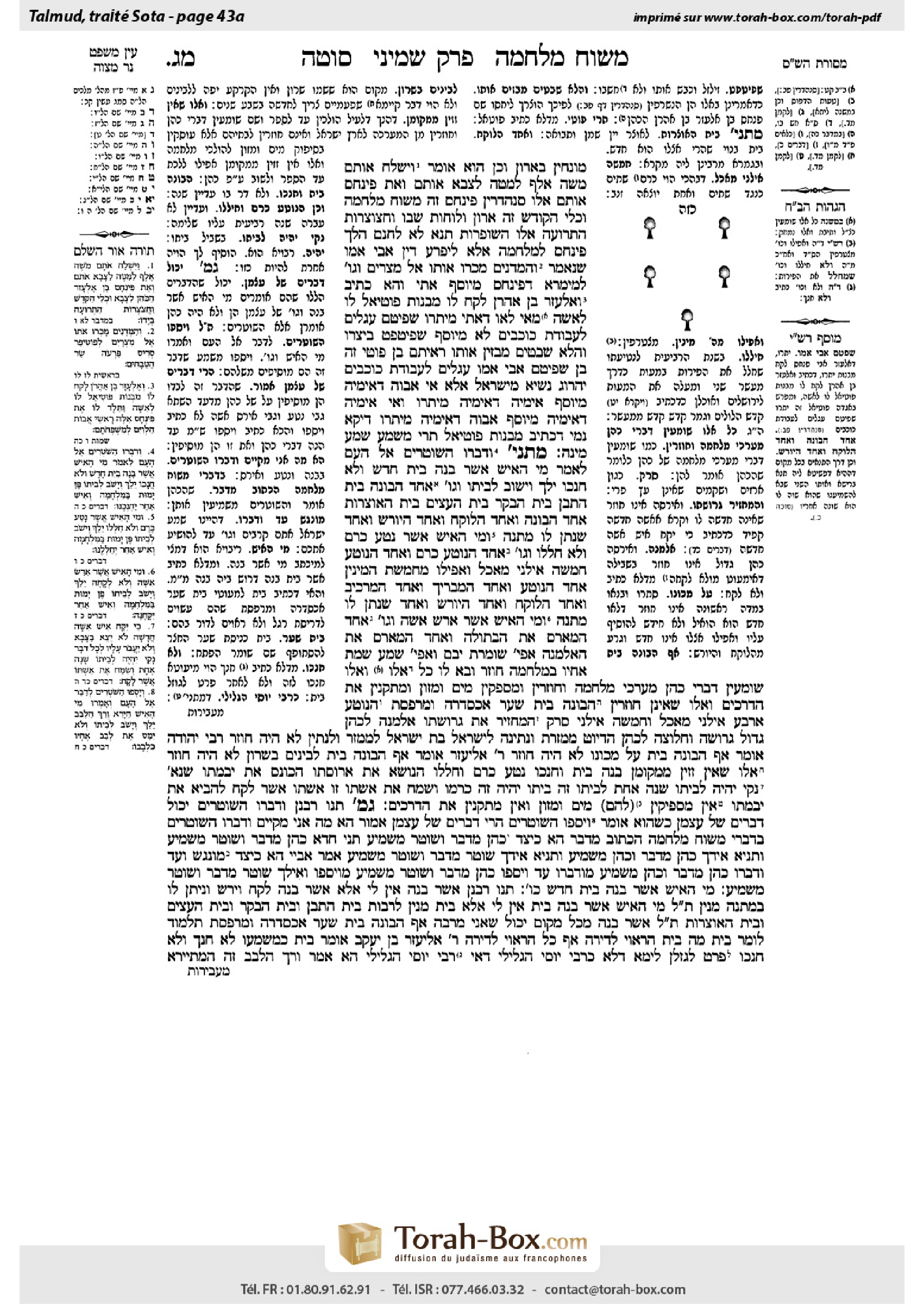
Sotah 43a: Talmud study for Daf Yomi
Daf Yomi is the daily study of one Talmud folio. Explore 37 tractates with scans, Hebrew text, Sefaria English and AI-generated French translations where annotated.
Passage selection and English or AI-generated French translation are available where the scan has annotations. Daf Study is independent of Torah-Box and Sefaria.
Browse Sotah · סוטה · All tractatesSotah 43a text and translations
This page of Sotah includes the Aramaic text, an English translation and an AI-generated French translation, alongside the scan above.
סוטה מ״ג א · Aramaic and Hebrew text
מוּנָּחִין בָּאָרוֹן. וְכֵן הוּא אוֹמֵר: ״וַיִּשְׁלַח אֹתָם מֹשֶׁה אֶלֶף לַמַּטֶּה לַצָּבָא אֹתָם וְאֶת פִּינְחָס״. ״אֹתָם״ — אֵלּוּ סַנְהֶדְרִין, ״פִּינְחָס״ — זֶה מְשׁוּחַ מִלְחָמָה, ״וּכְלֵי הַקֹּדֶשׁ״ — זֶה אָרוֹן וְלוּחוֹת שֶׁבּוֹ, ״וַחֲצֹצְרוֹת הַתְּרוּעָה״ — אֵלּוּ הַשּׁוֹפָרוֹת.
תָּנָא: לֹא לְחִנָּם הָלַךְ פִּינְחָס לַמִּלְחָמָה, אֶלָּא לִיפָּרַע דִּין אֲבִי אִמּוֹ, שֶׁנֶּאֱמַר: ״וְהַמְּדָנִים מָכְרוּ אֹתוֹ אֶל מִצְרַיִם וְגוֹ׳״. לְמֵימְרָא דְּפִינְחָס מִיּוֹסֵף אָתֵי? וְהָא כְּתִיב: ״וְאֶלְעָזָר בֶּן אַהֲרֹן לָקַח לוֹ מִבְּנוֹת פּוּטִיאֵל לוֹ לְאִשָּׁה״. מַאי לָאו, דְּאָתֵי מִיִּתְרוֹ שֶׁפִּיטֵּם עֲגָלִים לַעֲבוֹדָה זָרָה? לָא, מִיּוֹסֵף שֶׁפִּיטְפֵּט בְּיִצְרוֹ.
וַהֲלֹא שְׁבָטִים מְבַזִּין אוֹתוֹ: רְאִיתֶם בֶּן פּוּטִי זֶה, בֵּן שֶׁפִּיטֵּם אֲבִי אִמּוֹ עֲגָלִים לַעֲבוֹדָה זָרָה, יַהֲרוֹג נָשִׂיא מִיִּשְׂרָאֵל! אֶלָּא: אִי אֲבוּהּ דְּאִימֵּיהּ מִיּוֹסֵף — אִימֵּיהּ דְּאִימֵּיהּ מִיִּתְרוֹ, וְאִי אִימֵּיהּ דְּאִימֵּיהּ מִיּוֹסֵף — אֲבוּהּ דְּאִימֵּיהּ מִיִּתְרוֹ. דַּיְקָא נָמֵי, דִּכְתִיב: ״מִבְּנוֹת פּוּטִיאֵל״, תְּרֵי מַשְׁמַע. שְׁמַע מִינַּהּ.
מַתְנִי׳ ״וְדִבְּרוּ הַשֹּׁטְרִים אֶל הָעָם לֵאמֹר מִי הָאִישׁ אֲשֶׁר בָּנָה בַיִת חָדָשׁ וְלֹא חֲנָכוֹ יֵלֵךְ וְיָשֹׁב לְבֵיתוֹ וְגוֹ׳״. אֶחָד הַבּוֹנֶה בֵּית הַתֶּבֶן, בֵּית הַבָּקָר, בֵּית הָעֵצִים, בֵּית הָאוֹצָרוֹת. אֶחָד הַבּוֹנֶה, וְאֶחָד הַלּוֹקֵחַ, וְאֶחָד הַיּוֹרֵשׁ, וְאֶחָד שֶׁנִּתַּן לוֹ מַתָּנָה.
״וּמִי הָאִישׁ אֲשֶׁר נָטַע כֶּרֶם וְלֹא חִלְּלוֹ וְגוֹ׳״ — אֶחָד הַנּוֹטֵעַ כֶּרֶם, וְאֶחָד הַנּוֹטֵעַ חֲמִשָּׁה אִילָנֵי מַאֲכָל, וַאֲפִילּוּ מֵחֲמֵשֶׁת הַמִּינִין. אֶחָד הַנּוֹטֵעַ, וְאֶחָד הַמַּבְרִיךְ וְאֶחָד הַמַּרְכִּיב, וְאֶחָד הַלּוֹקֵחַ, וְאֶחָד הַיּוֹרֵשׁ, וְאֶחָד שֶׁנִּתַּן לוֹ מַתָּנָה.
״וּמִי הָאִישׁ אֲשֶׁר אֵרַשׂ אִשָּׁה וְגוֹ׳״, אֶחָד הַמְאָרֵס אֶת הַבְּתוּלָה, וְאֶחָד הַמְאָרֵס אֶת הָאַלְמָנָה. אֲפִילּוּ שׁוֹמֶרֶת יָבָם, וַאֲפִילּוּ שָׁמַע שֶׁמֵּת אָחִיו בַּמִּלְחָמָה — חוֹזֵר וּבָא לוֹ. כׇּל אֵלּוּ וָאֵלּוּ שׁוֹמְעִין דִּבְרֵי כֹּהֵן מַעַרְכֵי מִלְחָמָה, וְחוֹזְרִין. וּמְסַפְּקִין מַיִם וּמָזוֹן, וּמְתַקְּנִין אֶת הַדְּרָכִים.
וְאֵלּוּ שֶׁאֵינָן חוֹזְרִין: הַבּוֹנֶה בֵּית שַׁעַר, אַכְסַדְרָה וּמִרְפֶּסֶת, הַנּוֹטֵעַ אַרְבָּעָ[ה] אִילָנֵי מַאֲכָל וַחֲמִשָּׁה אִילָנֵי סְרָק, הַמַּחֲזִיר אֶת גְּרוּשָׁתוֹ, אַלְמָנָה לְכֹהֵן גָּדוֹל, גְּרוּשָׁה וַחֲלוּצָה לְכֹהֵן הֶדְיוֹט, מַמְזֶרֶת וּנְתִינָה לְיִשְׂרָאֵל, בַּת יִשְׂרָאֵל לְמַמְזֵר וּלְנָתִין — לֹא הָיָה חוֹזֵר. רַבִּי יְהוּדָה אוֹמֵר: אַף הַבּוֹנֶה בַּיִת עַל מְכוֹנוֹ — לֹא הָיָה חוֹזֵר. רַבִּי אֱלִיעֶזֶר אוֹמֵר: אַף הַבּוֹנֶה בֵּית לְבֵינִים בַּשָּׁרוֹן — לֹא הָיָה חוֹזֵר.
אֵלּוּ שֶׁאֵין זָזִין מִמְּקוֹמָן: בָּנָה בַּיִת וַחֲנָכוֹ, נָטַע כֶּרֶם וְחִלְּלוֹ, הַנּוֹשֵׂא אֶת אֲרוּסָתוֹ, הַכּוֹנֵס אֶת יְבִמְתּוֹ, שֶׁנֶּאֱמַר: ״נָקִי יִהְיֶה לְבֵיתוֹ שָׁנָה אֶחָת״. ״לְבֵיתוֹ״ — זֶה בֵּיתוֹ, ״יִהְיֶה״ — זֶה כַּרְמוֹ, ״וְשִׂמַּח אֶת אִשְׁתּוֹ״ — זוֹ אִשְׁתּוֹ, ״אֲשֶׁר לָקָח״ — לְהָבִיא אֶת יְבִמְתּוֹ. אֵין מַסְפִּיקִין לָהֶם מַיִם וּמָזוֹן, וְאֵין מְתַקְּנִין אֶת הַדְּרָכִים.
גְּמָ׳ תָּנוּ רַבָּנַן: ״וְדִבְּרוּ הַשֹּׁטְרִים״, יָכוֹל דְּבָרִים שֶׁל עַצְמָן? כְּשֶׁהוּא אוֹמֵר ״וְיָסְפוּ הַשֹּׁטְרִים״ — הֲרֵי דְּבָרִים שֶׁל עַצְמָן אָמוּר, הָא מָה אֲנִי מְקַיֵּים ״וְדִבְּרוּ הַשֹּׁטְרִים״ — בְּדִבְרֵי מְשׁוּחַ מִלְחָמָה הַכָּתוּב מְדַבֵּר. הָא כֵּיצַד? — כֹּהֵן מְדַבֵּר וְשׁוֹטֵר מַשְׁמִיעַ.
תָּנֵי חֲדָא: כֹּהֵן מְדַבֵּר וְשׁוֹטֵר מַשְׁמִיעַ, וְתַנְיָא אִידַּךְ: כֹּהֵן מְדַבֵּר וְכֹהֵן מַשְׁמִיעַ, וְתַנְיָא אִידַּךְ: שׁוֹטֵר מְדַבֵּר וְשׁוֹטֵר מַשְׁמִיעַ. אָמַר אַבָּיֵי: הָא כֵּיצַד? מִ״וְּנִגַּשׁ״ וְעַד ״וְדִבְּרוּ״ — כֹּהֵן מְדַבֵּר וְכֹהֵן מַשְׁמִיעַ, מִ״וְּדִבְּרוּ״ עַד ״וְיָסְפוּ״ — כֹּהֵן מְדַבֵּר וְשׁוֹטֵר מַשְׁמִיעַ, מִ״וְּיָסְפוּ״ וְאֵילָךְ — שׁוֹטֵר מְדַבֵּר וְשׁוֹטֵר מַשְׁמִיעַ.
״מִי הָאִישׁ אֲשֶׁר בָּנָה בַיִת חָדָשׁ כּוּ׳״. תָּנוּ רַבָּנַן: ״אֲשֶׁר בָּנָה״, אֵין לִי אֶלָּא אֲשֶׁר בָּנָה. לָקַח וְיָרַשׁ וְנִיתַּן לוֹ בְּמַתָּנָה מִנַּיִן — תַּלְמוּד לוֹמַר: ״מִי הָאִישׁ אֲשֶׁר בָּנָה״.
״בַּיִת״, אֵין לִי אֶלָּא בַּיִת. מִנַּיִן לְרַבּוֹת בֵּית הַתֶּבֶן, וּבֵית הַבָּקָר, וּבֵית הָעֵצִים, וּבֵית הָאוֹצָרוֹת — תַּלְמוּד לוֹמַר: ״אֲשֶׁר בָּנָה״, מִכׇּל מָקוֹם. יָכוֹל שֶׁאֲנִי מְרַבֶּה אַף הַבּוֹנֶה בֵּית שַׁעַר אַכְסַדְרָה וּמִרְפֶּסֶת, תַּלְמוּד לוֹמַר: ״בַּיִת״, מָה בַּיִת הָרָאוּי לְדִירָה — אַף כֹּל הָרָאוּי לְדִירָה.
רַבִּי אֱלִיעֶזֶר בֶּן יַעֲקֹב אוֹמֵר: ״בַּיִת״ כְּמַשְׁמָעוֹ. ״לֹא חָנַךְ״, ״וְלֹא חֲנָכוֹ״ — פְּרָט לְגַזְלָן. לֵימָא דְּלָא כְּרַבִּי יוֹסֵי הַגְּלִילִי, דְּאִי רַבִּי יוֹסֵי הַגְּלִילִי הָא אָמַר: ״וְרַךְ הַלֵּבָב״, זֶה הַמִּתְיָירֵא
Sotah 43a · English translation
were resting in the Ark. And similarly, it says in the verse with regard to the war against Midian: “And Moses sent them, a thousand of every tribe, to the war, them and Pinehas the son of Elazar the priest, to the war, with the holy vessels and the trumpets for the alarm in his hand” (Numbers 31:6). The verse is interpreted as follows: “Them”; these are the Sanhedrin. “Pinehas”; he was the priest anointed for war. “And the holy vessels”; this is the Ark and the tablets that were within it. “And the trumpets for the alarm”; these are the shofarot.
A tanna taught: It was not for nothing that specifically Pinehas went to war with Midian; rather, it was to exact the rightful judgment of his mother’s father, Joseph, as it is stated: “And the Midianites sold him into Egypt to Potiphar, an officer of Pharaoh’s” (Genesis 37:36). The Gemara asks: Is this to say that Pinehas came, on his mother’s side, from the family of Joseph? But it is written: “And Elazar, Aaron’s son, took himself a wife from the daughters of Putiel; and she bore him Pinehas” (Exodus 6:25). What, is it not that Pinehas came from the family of Yitro, who was also called Putiel because he fattened [pittem] calves for idol worship? They answer: No; he was descended from Joseph, who mocked [pitpet] his desire by resisting the advances of Potiphar’s wife.
The Gemara asks: But is it not the case that, according to an oral tradition, the tribes were denigrating Pinehas after he killed Zimri, saying: Did you see this son of Puti, the son whose mother’s father fattened cows for idol worship? Should this man kill a prince of Israel? Evidently, his grandfather Puti was Yitro, not Joseph. The Gemara answers: Rather, Pinehas was descended from both Joseph and Yitro. If his mother’s father descended from Joseph, his mother’s mother descended from Yitro. And if his mother’s mother descended from Joseph, his mother’s father descended from Yitro. The Gemara confirms this resolution: The language is also precise, as it is written: Elazar took a wife “from the daughters of Putiel,” which implies that she came from two daughters of men named Putiel. The Gemara concludes: You may learn from the verse that this is so.
MISHNA: The mishna continues its discussion of the speech given before battle. “And the officers shall speak to the people, saying: What man is there that has built a new house, and has not dedicated it? Let him go and return to his house, lest he die in the battle, and another man dedicate it” (Deuteronomy 20:5). He is sent home if he is one who builds a storehouse for straw, a barn for cattle, a shed for wood, or a warehouse. Similarly, it applies if he is one who builds, or if he is one who purchases, or if he is one who inherits, or if he is one to whom it is given as a gift. In all these instances, the man returns from the war encampment.
The next verse states: “And what man is there that has planted a vineyard, and has not used the fruit thereof? Let him go and return unto his house, lest he die in the battle and another man use the fruit thereof” (Deuteronomy 20:6). He is sent home if he is one who plants a whole vineyard of many vines, or if he is one who plants as few as five fruit trees of another variety, and even if these five are from the five species. The produce need not be all of one species. The same applies if he is one who plants, or if he is one who layers the vine, bending a branch into the ground so that it may take root and grow as a new vine, or if he is one who grafts different trees onto one another. And it applies if he is one who purchases a vineyard, or if he is one who inherits a vineyard, or if he is one to whom the vineyard is given as a gift.
The next verse states: “And what man is there that has betrothed a wife, and has not taken her? Let him go and return to his house, lest he die in the battle, and another man take her” (Deuteronomy 20:7). He is sent home if he is one who betroths a virgin, or if he is one who betroths a widow. This applies even if his yevama, his late brother’s wife, is a widow waiting for him as her yavam to perform levirate marriage; and even if he heard that his brother died in the war and the widow begins to wait for him only then, he returns and goes home. Each of these men, although they are exempt, still hear the address of the priest and the regulations of war at the local camp, and thereafter they return to their respective homes. However, they still support the war effort, and they provide water and food for the soldiers and repair the roads.
And these are the men who do not return to their homes: One who builds a gateway, or an enclosed veranda [akhsadra], or a balcony; or one who plants no more than four fruit trees or even five or more non-fruit bearing trees; or one who remarries his divorced wife. Nor is there an exemption for one who has betrothed a woman whom he is not permitted to marry: With regard to a widow betrothed to a High Priest (see Leviticus 21:7); a divorcée or a yevama who performed ḥalitza [ḥalutza], in lieu of entering into a levirate marriage, betrothed to a common priest (see Leviticus 21:13–15); a mamzeret or a Gibeonite woman betrothed to an Israelite; or an Israelite woman betrothed to a mamzer or a Gibeonite (see Deuteronomy 23:3); such a man does not return to his home. Rabbi Yehuda says: Even one who rebuilds a house as it stood originally would not return. Rabbi Eliezer says: Even one who builds a new brick house in the Sharon would not return because these houses are not stable and are expected to collapse periodically.
These are the men who do not even move from their places because they do not even report to the camp: One who built a house and dedicated it within the year; one who planted a vineyard and used its fruit for less than a year; one who marries his betrothed and one who marries his yevama, his brother’s widow who must enter into a levirate marriage or perform ḥalitza, as it is stated: “When a man takes a new wife, he shall not go out with the army…he shall be free for his house one year, and shall cheer his wife whom he has taken” (Deuteronomy 24:5). The mishna interprets the verse as follows: “For his house”; this means his house that he built. “He shall be”; this term includes his vineyard. “And shall cheer his wife”; this is his wife. “Whom he has taken”; this phrase comes to include his yevama, who is considered his wife with respect to this halakha although he has not yet married her. Those who are exempt for these reasons do not even provide water and food to the soldiers, and they do not repair the roads.
GEMARA: The Sages taught: “And the officers shall speak…What man is there that has built a new house, and has not dedicated it? Let him go and return to his house, lest he die in the battle, and another man dedicate it” (Deuteronomy 20:5). One might have thought that they say their own words and that the priest does not issue these proclamations. However, when it says: “And the officers shall speak further” (Deuteronomy 20:8), their own words are mentioned only in this latter verse. Evidently, then, the priest is the speaker in the earlier verse. How then do I realize the meaning of: “And the officers shall speak” in the first verse? The verse is speaking of the words of the priest anointed for war. How so? The priest speaks in an undertone, and an officer calls out the priest’s words so that they are audible to the assembled.
It is taught in one baraita: A priest speaks, and an officer calls out his words; and it is taught in another baraita: A priest speaks and a priest calls out. And it is taught in yet another baraita: An officer speaks and an officer calls out. Abaye said: How can these texts be reconciled? From the words: “That the priest shall approach” (Deuteronomy 20:2), until the words: “And the officers shall speak” (Deuteronomy 20:5), which consist of words of encouragement and inspiration, a priest speaks and another priest calls out. From the words “and the officers shall speak” until the words: “And the officers shall speak further” (Deuteronomy 20:8), which list various people who are to return home from the battle front because of happy occasions, a priest speaks and an officer calls out. From the words “and the officers shall speak further” and on, which address those who are fearful and fainthearted, an officer speaks and another officer calls out.
§ The mishna teaches that the officers announce: “What man is there that has built a new house, and has not dedicated it? Let him go and return to his house, lest he die in the battle, and another man dedicate it” (Deuteronomy 20:5). The Sages taught: From the phrase “That has built,” I have derived only that this applies to one who has literally built a house. From where do I derive that it includes one who purchased, or inherited, or has been given a house as a gift? The verse states broadly: “What man is there that has built.” By not merely stating: One that has built, but using the expanded “what man is there that has built,” the verse includes any of these circumstances.
From the term “a house” I have derived only a house in which people live. From where is it derived that the exemption is understood to also include one who builds a storehouse for straw, a barn for cattle, a shed for wood, or a warehouse? The verse states: “That has built,” which includes whatever one built, in any case. One might have thought that I should include even one who builds a gateway, or an enclosed veranda, or a balcony; however, the verse states: “A house,” which teaches that just as a house is, by definition, a structure that is fit for living, so too, this halakha applies to every structure that is potentially fit for living, although in practice it may be used for another purpose.
Rabbi Eliezer ben Ya’akov says: The word “house” is to be understood to mean, as it indicates, a building meant for human residence. With regard to the house for which a man may be sent back from the camp, since the verse does not state merely: “And has not dedicated,” but rather: “And has not dedicated it,” specifying the particular house to which the man is connected, the verse therefore excludes a robber who does not own his house. The Gemara asks: Shall we say that this opinion is not in accordance with the opinion of Rabbi Yosei HaGelili? As, if it were in accordance with the opinion of Rabbi Yosei HaGelili, didn’t he say: When the verse singles out the “fearful and fainthearted” (Deuteronomy 20:8), this is referring to one who is afraid
Sotah 43a · Traduction française (IA)
reposaient dans l’Arche. De même, il est dit au sujet de la guerre contre Midian : « Moïse les envoya, mille hommes de chaque tribu, à la guerre, eux et Pin’has, fils d’Elazar le prêtre, à la guerre, avec les ustensiles sacrés et les trompettes d’alarme à la main » (Nombres 31:6). Le verset est interprété ainsi : « Eux » désigne le Sanhédrin. « Pin’has » : il était le prêtre oint pour la guerre. « Les ustensiles sacrés » désignent l’Arche et les Tables qui se trouvaient à l’intérieur. « Les trompettes d’alarme » désignent les chofars.
Un tanna enseigna : Pin’has ne partit pas à la guerre contre Midian sans raison particulière ; il y alla pour faire rendre justice à son grand-père maternel, Joseph, comme il est dit : « Les Midianites le vendirent en Égypte à Potiphar, officier de Pharaon » (Genèse 37:36). La Guemara demande : Cela signifie-t-il que Pin’has descendait, du côté de sa mère, de la famille de Joseph ? Pourtant, il est écrit : « Elazar, fils d’Aaron, prit pour lui une femme parmi les filles de Poutiel ; elle lui enfanta Pin’has » (Exode 6:25). N’est-ce pas à dire que Pin’has descendait de la famille de Yitro, également appelé Poutiel parce qu’il engraissait [pittem] des veaux pour l’idolâtrie ? La Guemara répond : Non ; il descendait de Joseph, qui se moqua [pitpet] de son désir en résistant aux avances de la femme de Potiphar.
La Guemara demande : Pourtant, selon une tradition orale, les tribus dénigraient Pin’has après qu’il eut tué Zimri, en disant : « Avez-vous vu ce fils de Pouti, dont le grand-père maternel engraissait des vaches pour l’idolâtrie ? Cet homme devrait-il tuer un prince d’Israël ? » Il en ressort que son grand-père Pouti était Yitro, et non Joseph. La Guemara répond : Pin’has descendait à la fois de Joseph et de Yitro. Si le père de sa mère descendait de Joseph, la mère de sa mère descendait de Yitro. Et si la mère de sa mère descendait de Joseph, le père de sa mère descendait de Yitro. La Guemara confirme cette résolution : la formulation est également précise, car il est écrit qu’Elazar prit une femme « parmi les filles de Poutiel », ce qui implique qu’elle descendait de deux filles d’hommes appelés Poutiel. La Guemara conclut : On peut tirer du verset que tel est bien le cas.
MICHNA : La Michna poursuit son examen du discours prononcé avant la bataille. « Les officiers parleront au peuple en disant : Quel est l’homme qui a construit une maison neuve sans l’avoir inaugurée ? Qu’il s’en aille et retourne chez lui, de peur qu’il ne meure à la guerre et qu’un autre ne l’inaugure » (Deutéronome 20:5). Il est renvoyé chez lui s’il a construit un grenier à paille, une étable, un abri à bois ou un entrepôt. Il en va de même s’il a construit ou acheté la maison, s’il en a hérité ou si elle lui a été donnée en cadeau. Dans tous ces cas, l’homme quitte le camp de guerre.
Le verset suivant dit : « Quel est l’homme qui a planté une vigne sans en avoir joui ? Qu’il s’en aille et retourne chez lui, de peur qu’il ne meure à la guerre et qu’un autre n’en jouisse » (Deutéronome 20:6). Il est renvoyé chez lui s’il a planté une vigne entière composée de nombreux ceps, ou s’il a planté aussi peu que cinq arbres fruitiers d’une autre variété, même si ces cinq arbres appartiennent aux cinq espèces. Les fruits n’ont pas besoin d’être tous d’une seule espèce. Il en va de même s’il a planté, s’il a marcotté la vigne — en enfouissant une branche dans la terre afin qu’elle prenne racine et pousse pour former un nouveau cep — ou s’il a greffé différents arbres les uns sur les autres. La règle s’applique aussi s’il a acheté une vigne, en a hérité ou si elle lui a été donnée en cadeau.
Le verset suivant dit : « Quel est l’homme qui s’est fiancé à une femme sans l’avoir épousée ? Qu’il s’en aille et retourne chez lui, de peur qu’il ne meure à la guerre et qu’un autre ne l’épouse » (Deutéronome 20:7). Il est renvoyé chez lui s’il s’est fiancé à une vierge ou à une veuve. Cela s’applique même si sa yevama, la veuve de son frère défunt, l’attend en tant que yavam pour contracter le mariage léviratique ; et même s’il apprend que son frère est mort à la guerre, de sorte que la veuve ne commence à l’attendre qu’à ce moment-là, il retourne chez lui. Chacun de ces hommes, bien qu’exempté, entend néanmoins le discours du prêtre et les règles de la guerre au camp local, puis retourne chez lui. Ils continuent toutefois à contribuer à l’effort de guerre : ils fournissent de l’eau et de la nourriture aux soldats et réparent les routes.
Voici les hommes qui ne retournent pas chez eux : celui qui construit une entrée, une véranda fermée [akhsadra] ou un balcon ; celui qui plante au plus quatre arbres fruitiers, ou même cinq arbres ou davantage qui ne donnent pas de fruits ; ou celui qui reprend son épouse divorcée. L’exemption ne s’applique pas non plus à celui qui s’est fiancé à une femme qu’il lui est interdit d’épouser : une veuve fiancée à un grand prêtre (voir Lévitique 21:7) ; une divorcée ou une yevama ayant accompli la ḥalitsa [ḥalutza] au lieu de contracter un mariage léviratique, fiancée à un prêtre ordinaire (voir Lévitique 21:13–15) ; une mamzeret ou une femme guibonite fiancée à un Israélite ; ou une Israélite fiancée à un mamzer ou à un Guibonite (voir Deutéronome 23:3). Un tel homme ne retourne pas chez lui. Rabbi Yehuda dit : Même celui qui reconstruit une maison telle qu’elle était à l’origine ne retournerait pas chez lui. Rabbi Eliezer dit : Même celui qui construit une maison neuve en briques dans le Sharon ne retournerait pas chez lui, car ces maisons sont instables et sont réputées s’effondrer périodiquement.
Voici les hommes qui ne quittent même pas leur place, car ils ne se rendent pas au camp : celui qui a construit une maison et l’a inaugurée au cours de l’année ; celui qui a planté une vigne et en a joui pendant moins d’un an ; celui qui épouse sa fiancée, et celui qui épouse sa yevama, la veuve de son frère qui doit contracter un mariage léviratique ou accomplir la ḥalitsa, comme il est dit : « Lorsqu’un homme prend une nouvelle épouse, il ne partira pas avec l’armée… il sera libre pour sa maison pendant un an et réjouira l’épouse qu’il a prise » (Deutéronome 24:5). La Michna interprète le verset ainsi : « Pour sa maison » désigne la maison qu’il a construite. « Il sera » inclut sa vigne. « Et réjouira son épouse » désigne son épouse. « Qu’il a prise » inclut sa yevama, qui est considérée comme son épouse au regard de cette halakha, bien qu’il ne l’ait pas encore épousée. Ceux qui sont exemptés pour ces raisons ne fournissent même pas d’eau et de nourriture aux soldats et ne réparent pas les routes.
GUEMARA : Les Sages enseignèrent : « Les officiers parleront… Quel est l’homme qui a construit une maison neuve sans l’avoir inaugurée ? Qu’il s’en aille et retourne chez lui, de peur qu’il ne meure à la guerre et qu’un autre ne l’inaugure » (Deutéronome 20:5). On aurait pu penser qu’ils prononcent leurs propres paroles et que le prêtre ne fait pas ces proclamations. Cependant, lorsqu’il est dit : « Les officiers parleront encore » (Deutéronome 20:8), leurs propres paroles ne sont mentionnées que dans ce dernier verset. Il s’ensuit donc que c’est le prêtre qui parle dans le verset précédent. Comment comprendre alors les mots « Les officiers parleront » dans le premier verset ? Le verset fait référence aux paroles du prêtre oint pour la guerre. Comment cela se passe-t-il ? Le prêtre parle à voix basse, et un officier reprend ses paroles à haute voix afin que l’assemblée puisse les entendre.
Il est enseigné dans une baraïta : un prêtre parle et un officier reprend ses paroles ; dans une autre baraïta, il est enseigné : un prêtre parle et un prêtre reprend ses paroles ; et dans une autre baraïta encore, il est enseigné : un officier parle et un officier reprend ses paroles. Abaye dit : Comment concilier ces textes ? Depuis les mots « Le prêtre s’avancera » (Deutéronome 20:2) jusqu’aux mots « Les officiers parleront » (Deutéronome 20:5), qui constituent des paroles d’encouragement et d’inspiration, un prêtre parle et un autre prêtre reprend ses paroles. Depuis les mots « Les officiers parleront » jusqu’aux mots « Les officiers parleront encore » (Deutéronome 20:8), qui énumèrent différentes personnes appelées à rentrer chez elles à l’occasion d’événements heureux, un prêtre parle et un officier reprend ses paroles. À partir des mots « Les officiers parleront encore », qui s’adressent à ceux qui sont craintifs et manquent de courage, un officier parle et un autre officier reprend ses paroles.
§ La Michna enseigne que les officiers proclament : « Quel est l’homme qui a construit une maison neuve sans l’avoir inaugurée ? Qu’il s’en aille et retourne chez lui, de peur qu’il ne meure à la guerre et qu’un autre ne l’inaugure » (Deutéronome 20:5). Les Sages enseignèrent : De l’expression « qui a construit », j’ai seulement déduit que cela s’applique à celui qui a littéralement construit une maison. D’où déduis-je que cela inclut celui qui a acheté ou hérité une maison, ou à qui une maison a été donnée en cadeau ? Le verset dit de manière générale : « Quel est l’homme qui a construit ». En ne disant pas simplement « Celui qui a construit », mais en employant la formulation développée « Quel est l’homme qui a construit », le verset inclut chacune de ces situations.
De l’expression « une maison », j’ai seulement déduit qu’il s’agit d’une maison où des personnes habitent. D’où déduit-on que l’exemption inclut également celui qui construit un grenier à paille, une étable, un abri à bois ou un entrepôt ? Le verset dit : « qui a construit », ce qui inclut toute construction, quel qu’en soit le type. On aurait pu penser que cela inclut aussi celui qui construit une entrée, une véranda fermée ou un balcon. Mais le verset dit « une maison », pour enseigner que, de même qu’une maison est, par définition, une construction habitable, cette halakha s’applique également à toute construction susceptible d’être habitée, même si, en pratique, elle peut être utilisée à une autre fin.
Rabbi Eliezer ben Ya’akov dit : Le mot « maison » doit être compris dans son sens indiqué, celui d’un bâtiment destiné à l’habitation humaine. Quant à la maison pour laquelle un homme peut être renvoyé du camp, comme le verset ne dit pas simplement « sans l’avoir inaugurée », mais « sans l’avoir inaugurée, elle », désignant la maison particulière à laquelle l’homme est lié, le verset exclut donc un voleur qui n’est pas propriétaire de sa maison. La Guemara demande : Faut-il en conclure que cette opinion ne correspond pas à celle de Rabbi Yosei HaGelili ? Car, si elle correspondait à l’opinion de Rabbi Yosei HaGelili, n’a-t-il pas dit que lorsque le verset désigne les « craintifs et ceux qui manquent de courage » (Deutéronome 20:8), il s’agit de quelqu’un qui a peur
Traduction française générée par IA à partir de l’édition anglaise de Sefaria. Vérifie toujours un passage avec le texte source.
Text from Sefaria: William Davidson Edition - Vocalized Aramaic (CC BY NC); William Davidson Edition - English (CC BY NC).