Sotah 42b: Talmud study for Daf Yomi
Daf Yomi is the daily study of one Talmud folio. Explore 37 tractates with scans, Hebrew text, Sefaria English and AI-generated French translations where annotated.
Passage selection and English or AI-generated French translation are available where the scan has annotations. Daf Study is independent of Torah-Box and Sefaria.
Browse Sotah · סוטה · All tractatesSotah 42b text and translations
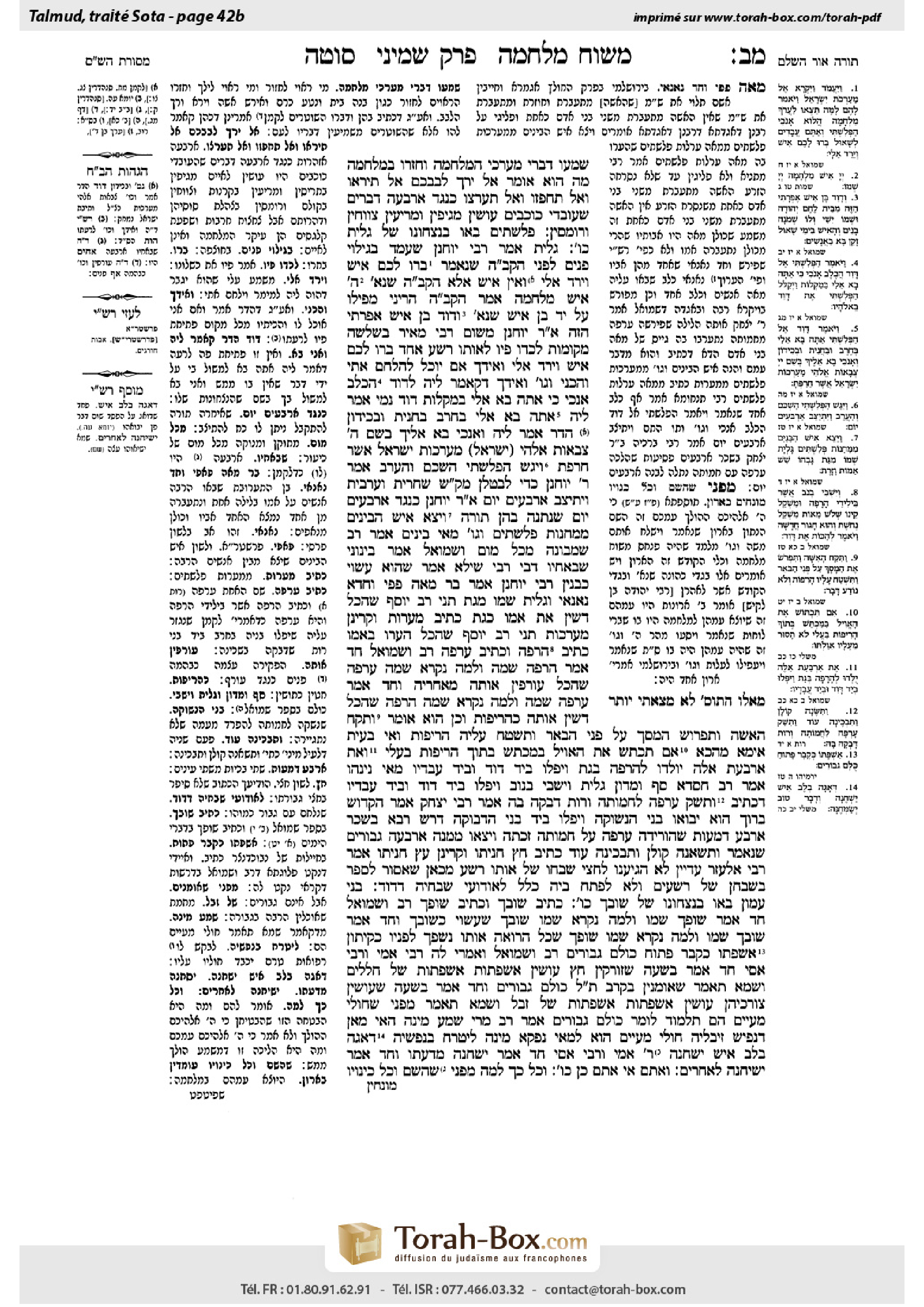
This page of Sotah includes the Aramaic text, an English translation and an AI-generated French translation, alongside the scan above.
סוטה מ״ב ב · Aramaic and Hebrew text
שִׁמְעוּ דִּבְרֵי מַעַרְכֵי הַמִּלְחָמָה, וְחִזְרוּ. בַּמִּלְחָמָה מָה הוּא אוֹמֵר: ״אַל יֵרַךְ לְבַבְכֶם אַל תִּירְאוּ וְאַל תַּחְפְּזוּ וְאַל תַּעַרְצוּ״. כְּנֶגֶד אַרְבָּעָה דְּבָרִים שֶׁאוּמּוֹת הָעוֹלָם עוֹשִׂין: מְגִיפִין, וּמְרִיעִין, צוֹוְחִין, וְרוֹמְסִין.
פְּלִשְׁתִּים בָּאוּ בְּנִצְחוֹנוֹ שֶׁל גׇּלְיָת כּוּ׳. גׇּלְיָת, אָמַר רַבִּי יוֹחָנָן: שֶׁעָמַד בְּגִילּוּי פָּנִים לִפְנֵי הַקָּדוֹשׁ בָּרוּךְ הוּא, שֶׁנֶּאֱמַר: ״בְּרוּ לָכֶם אִישׁ וְיֵרֵד אֵלָי״, וְאֵין ״אִישׁ״ אֶלָּא הַקָּדוֹשׁ בָּרוּךְ הוּא, שֶׁנֶּאֱמַר: ״ה׳ אִישׁ מִלְחָמָה״. אָמַר הַקָּדוֹשׁ בָּרוּךְ הוּא: הֲרֵינִי מַפִּילוֹ עַל יַד בֶּן אִישׁ, שֶׁנֶּאֱמַר: ״וְדָוִד בֶּן אִישׁ אֶפְרָתִי הַזֶּה״.
אָמַר רַבִּי יוֹחָנָן מִשּׁוּם רַבִּי מֵאִיר: בִּשְׁלֹשָׁה מְקוֹמוֹת לְכָדוֹ פִּיו לְאוֹתוֹ רָשָׁע. אֶחָד: ״בְּרוּ לָכֶם אִישׁ וְיֵרֵד אֵלָי״, וְאִידַּךְ: ״אִם יוּכַל לְהִלָּחֵם אִתִּי וְהִכָּנִי וְגוֹ׳״. וְאִידַּךְ, דְּקָאָמַר לֵיהּ לְדָוִד: ״הֲכֶלֶב אָנֹכִי כִּי אַתָּה בָא אֵלַי בַּמַּקְלוֹת״. דָּוִד נָמֵי אֲמַר לֵיהּ ״אַתָּה בָּא אֵלַי בְּחֶרֶב וּבַחֲנִית וּבְכִידוֹן״! הֲדַר אֲמַר לֵיהּ: ״וְאָנֹכִי בָא אֵלֶיךָ בְּשֵׁם ה׳ צְבָאוֹת אֱלֹהֵי (יִשְׂרָאֵל) מַעַרְכוֹת יִשְׂרָאֵל אֲשֶׁר חֵרַפְתָּ״.
״וַיִּגַּשׁ הַפְּלִשְׁתִּי הַשְׁכֵּם וְהַעֲרֵב״, אָמַר רַבִּי יוֹחָנָן: כְּדֵי לְבַטְּלָן מִקְּרִיאַת שְׁמַע שַׁחֲרִית וְעַרְבִית. ״וַיִּתְיַצַּב אַרְבָּעִים יוֹם״, אָמַר רַבִּי יוֹחָנָן: כְּנֶגֶד אַרְבָּעִים יוֹם שֶׁנִּתְּנָה בָּהֶן תּוֹרָה.
״וַיֵּצֵא אִישׁ הַבֵּינַיִם מִמַּחֲנוֹת פְּלִשְׁתִּים וְגוֹ׳״. מַאי ״בֵּינַיִם״? אָמַר רַב: שֶׁמְּבוּנֶּה מִכׇּל מוּם. וּשְׁמוּאֵל אָמַר: בֵּינוֹנִי שֶׁבְּאֶחָיו. דְּבֵי רַבִּי שֵׁילָא אָמַר: שֶׁהוּא עָשׂוּי כְּבִנְיַן. רַבִּי יוֹחָנָן אָמַר: בַּר מְאָה פָּפֵי וַחֲדָא נָאנָאי.
״וְגׇלְיָת שְׁמוֹ מִגַּת״. תָּנֵי רַב יוֹסֵף: שֶׁהַכֹּל דָּשִׁין אֶת אִמּוֹ כְּגַת. כְּתִיב ״מַעֲרוֹת״, וְקָרֵינַן ״מַעַרְכוֹת״. תָּנֵי רַב יוֹסֵף: שֶׁהַכֹּל הֶעֱרוּ בְּאִמּוֹ.
כְּתִיב ״הָרָפָה״, וּכְתִיב ״עׇרְפָּה״, רַב וּשְׁמוּאֵל חַד אָמַר: ״הָרָפָה״ שְׁמָהּ, וְלָמָּה נִקְרָא שְׁמָהּ ״עׇרְפָּה״ — שֶׁהַכֹּל עוֹרְפִין אוֹתָהּ מֵאַחֲרֶיהָ, וְחַד אָמַר: ״עׇרְפָּה״ שְׁמָהּ, וְלָמָּה נִקְרָא שְׁמָהּ ״הָרָפָה״ — שֶׁהַכֹּל דָּשִׁין אוֹתָהּ כְּהָרִיפוֹת, וְכֵן הוּא אוֹמֵר: ״וַתִּקַּח הָאִשָּׁה וְתִפְרֹשׁ הַמָּסָךְ עַל פְּנֵי הַבְּאֵר וַתִּשְׁטַח עָלָיו הָרִפוֹת״. וְאִי בָּעֵית אֵימָא מֵהָכָא: ״אִם תִּכְתּוֹשׁ אֶת הָאֱוִיל בַּמַּכְתֵּשׁ בְּתוֹךְ הָרִיפוֹת בַּעֱלִי״.
״וְאֶת אַרְבַּעַת אֵלֶּה יֻלְּדוּ לְהָרָפָה בְּגַת וַיִּפְּלוּ בְיַד דָּוִד וּבְיַד עֲבָדָיו״. מַאי נִינְהוּ? אָמַר רַב חִסְדָּא: סַף וּמָדוֹן גׇּלְיָת וְיִשְׁבִּי בְּנוֹב.
״וַיִּפְּלוּ בְיַד דָּוִד וּבְיַד עֲבָדָיו״, דִּכְתִיב: ״וַתִּשַּׁק עׇרְפָּה לַחֲמוֹתָהּ וְרוּת דָּבְקָה בָּהּ״. אָמַר רַבִּי יִצְחָק, אָמַר הַקָּדוֹשׁ בָּרוּךְ הוּא: יָבוֹאוּ בְּנֵי הַנְּשׁוּקָה, וְיִפְּלוּ בְּיַד בְּנֵי הַדְּבוּקָה. דָּרֵשׁ רָבָא: בִּשְׂכַר אַרְבַּע דְּמָעוֹת שֶׁהוֹרִידָה עׇרְפָּה עַל חֲמוֹתָהּ — זָכְתָה וְיָצְאוּ מִמֶּנָּה אַרְבָּעָה גִּבּוֹרִים, שֶׁנֶּאֱמַר: ״וַתִּשֶּׂנָה קוֹלָן וַתִּבְכֶּינָה עוֹד״,
כְּתִיב: ״חֵץ חֲנִיתוֹ״, וְקָרֵינַן ״עֵץ חֲנִיתוֹ״. אָמַר רַבִּי אֶלְעָזָר: עֲדַיִין לֹא הִגִּיעָנוּ לַחֲצִי שִׁבְחוֹ שֶׁל אוֹתוֹ רָשָׁע. מִכָּאן שֶׁאָסוּר לְסַפֵּר בְּשִׁבְחָן שֶׁל רְשָׁעִים. וְלָא לִפְתַּח בֵּיהּ כְּלָל! לְאוֹדוֹעֵי שְׁבָחֵיהּ דְּדָוִד.
״בְּנֵי עַמּוֹן בָּאוּ בְּנִצְחוֹנוֹ שֶׁל שׁוֹבַךְ כּוּ׳״. כְּתִיב ״שׁוֹבַךְ״, וּכְתִיב ״שׁוֹפַךְ״. רַב וּשְׁמוּאֵל, חַד אָמַר: ״שׁוֹפַךְ״ שְׁמוֹ, וְלָמָּה נִקְרָא שְׁמוֹ ״שׁוֹבַךְ״ — שֶׁעָשׂוּי כְּשׁוֹבָךְ. וְחַד אָמַר: שׁוֹבַךְ שְׁמוֹ, וְלָמָּה נִקְרָא שְׁמוֹ ״שׁוֹפַךְ״ — שֶׁכׇּל הָרוֹאֶה אוֹתוֹ נִשְׁפָּךְ לְפָנָיו כְּקִיתוֹן.
״אַשְׁפָּתוֹ כְּקֶבֶר פָּתוּחַ כֻּלָּם גִּבּוֹרִים״. רַב וּשְׁמוּאֵל, וְאָמְרִי לַהּ רַבִּי אַמֵּי וְרַבִּי אַסִּי, חַד אָמַר: בְּשָׁעָה שֶׁזּוֹרְקִין חֵץ עוֹשִׂין אַשְׁפַּתּוֹת אַשְׁפַּתּוֹת שֶׁל חֲלָלִים, וְשֶׁמָּא תֹּאמַר שֶׁאוּמָּנִין בַּקְּרָב — תַּלְמוּד לוֹמַר: ״כֻּלָּם גִּבּוֹרִים״. וְחַד אָמַר: בְּשָׁעָה שֶׁעוֹשִׂין צוֹרְכֵיהֶן עוֹשִׂין אַשְׁפַּתּוֹת אַשְׁפַּתּוֹת שֶׁל זֶבֶל, וְשֶׁמָּא תֹּאמַר מִפְּנֵי שֶׁחוֹלֵי מֵעַיִים הֵם — תַּלְמוּד לוֹמַר: ״כֻּלָּם גִּבּוֹרִים״.
אָמַר רַב מָרִי, שְׁמַע מִינַּהּ: הַאי מַאן דִּנְפִישׁ זִיבְלֵיהּ, חוֹלִי מֵעַיִים הוּא. לְמַאי נָפְקָא מִינַּהּ? לִיטְרַח בְּנַפְשֵׁיהּ.
״דְּאָגָה בְלֶב אִישׁ יַשְׁחֶנָּה״, רַבִּי אַמֵּי וְרַבִּי אַסִּי חַד אָמַר: יַשִּׂחֶנָּה מִדַּעְתּוֹ, וְחַד אָמַר: יְשִׂיחֶנָּה לַאֲחֵרִים.
״וְאַתֶּם אִי אַתֶּם כֵּן כּוּ׳״, וְכׇל כָּךְ לָמָּה? מִפְּנֵי שֶׁהַשֵּׁם וְכׇל כִּינּוּיָו
Sotah 42b · English translation
Hear my words, the regulations of war, and consider who is fit to participate in the battle. And return home, all of you who are exempt from combat. What does he say on the battlefield? “Let not your heart faint; fear not, nor be alarmed, and do not be terrified of them” (Deuteronomy 20:3). These four cautions correspond to four actions done by the nations of the world: They clash their weapons, and they blast horns, they shout, and they trample heavily with their horses to frighten their adversaries.
The mishna recorded the particulars of the priest’s address: The Philistines came championed by Goliath. The Gemara describes the battle between David and Goliath. What is implied by the name Goliath? Rabbi Yoḥanan says: The verse indicates that he stood before the Holy One, Blessed be He, with brazenness [gilui panim], as it is stated: “Choose yourselves a man [ish], and let him come down to me” (I Samuel 17:8), and man [ish] is referring to none other than the Holy One, Blessed be He, as it is stated: “The Lord is a man [ish] of war” (Exodus 15:3). The Holy One, Blessed be He, said: I will hereby fell him by the son of a man [ben ish], as it is stated: “Now David was the son of that man [ben ish] of Ephrath” (I Samuel 17:12).
Rabbi Yoḥanan said in the name of Rabbi Meir: In three instances, his own mouth ensnared that wicked one and unwittingly foretold his own downfall. One time he said: “Choose yourselves a man, and let him come down to me,” describing himself at the bottom. And another time, he said: “If he is able to fight with me and kill me then will we be your servants; but if I prevail against him, and kill him, then shall you be our servants, and serve us” (I Samuel 17:9). There, he supposed that his opponent would defeat him, before supposing that he, Goliath, would be victorious. Finally, the other time was when he said to David (I Samuel 17:43): “Am I a dog, that you come to me with staves?” The Gemara asks: But didn’t David also speak in this manner? David also said to him: “You come to me with a sword, and with a spear, and with a javelin” (I Samuel 17:45). The Gemara answers: David then said to him, immediately afterward: “But I come to you in the name of the Lord of hosts, the God of the armies of Israel, whom you have taunted” (I Samuel 17:45).
The verse says: “And the Philistine drew near morning and evening” (I Samuel 17:16). Rabbi Yoḥanan says: He did this specifically in order to prevent them from completing the recitation of Shema in the required times of morning and evening. “And Goliath presented himself forty days” (I Samuel 17:16). Rabbi Yoḥanan says: These days correspond to the forty days over which the Torah was given, as he wanted to do away with it.
The verse introduces Goliath: “And a champion [ish habeinayim] went out from the camp of the Philistines, named Goliath” (I Samuel 17:4). The Gemara asks: What is indicated by the term beinayim? Rav said: The word is related to the root beit, nun, heh, meaning build, and means that he is built [muvneh] perfectly and free of any blemish. And Shmuel said: The word is related to the word bein, meaning between, and means that he was the middle [beinoni] among his brothers. A Sage from the school of Rabbi Sheila said: The word is related to the root beit, nun, heh, meaning build, and means that he was made strong as a building [binyan]. Rabbi Yoḥanan said: The word is related to the word bein, meaning between, and means that he was born from among many, as follows: He was the son of one hundred fathers [pappi] and one dog [nanai], as his mother engaged in sexual intercourse with one hundred men and a dog, and he was fathered from among them.
The verse recounts that he was “named Goliath, of Gath” (I Samuel 17:4). Rav Yosef taught: This is because everyone would thresh his mother by cohabiting with her like people do in a winepress [gat], where everyone tramples. It is written that Goliath came from “the caves [me’arot] of the Philistines” (I Samuel 17:23), but we read, according to the Masoretic text: He came from among “the ranks [ma’arkhot] of the Philistines.” What is meant by the written term me’arot? Rav Yosef taught: The word is related to the word he’era, meaning penetrated, and implies that everyone penetrated [he’eru], i.e., engaged in sexual intercourse with, his mother.
It is written that Goliath’s mother was: “Harafa” (II Samuel 21:16), and in another place it is written: “Orpah” (Ruth 1:4), and the Gemara will soon explain that this was the same woman. Rav and Shmuel engaged in a dispute concerning this matter. One of them said: Her name was Harafa, and why is she called by the name Orpah? It is because everyone came at her from behind [orfin] her, i.e., sodomized her. And one of them said: Her name was Orpah, and why is she called by the name Harafa? It is because everyone threshed her like groats [harifot], i.e., engaged in sexual intercourse with her, and so it says that this word means groats: “And the woman took and spread the covering over the well’s mouth, and strewed groats [harifot] thereon” (II Samuel 17:19). And if you wish, you can say from here: “Though you should crush a fool in a mortar with a pestle among groats [harifot], yet will not his foolishness depart from him” (Proverbs 27:22).
The Gemara continues its discussion of the battle of David and Goliath. “These four were born to Harafa in Gath; and they fell by the hand of David, and by the hand of his servants” (II Samuel 21:22). The Gemara asks: What are the names of the four siblings mentioned here? Rav Ḥisda said: They are Saph, and Madon, Goliath, and Ishbi in Nob (see II Samuel 21:16–20).
It says: “And they fell into the hands of David and his servants.” Why? It is because of the acts of their forebears, as it is written: “And Orpah kissed her mother-in-law, and Ruth cleaved to her” (Ruth 1:14). Rabbi Yitzḥak says: The Holy One, Blessed be He, said: The children of the one who kissed, referring to the four giants descended from Orpah, will come and fall into the hand of the children of the one who cleaved, referring to David, who was descended from Ruth. Rava taught: As a reward for the four tears that Orpah shed in sadness over her mother-in-law, she merited four mighty warriors descended from her, as it is stated: “And they lifted up their voice and wept again” (Ruth 1:14).
It is written about Goliath: “And the half [ḥetz] of his spear was like a weaver’s beam” (I Samuel 17:7), and we read, according to the Masoretic tradition: “And the shaft [etz] of his spear.” Rabbi Elazar says: The written version of the text demonstrates that we have not yet reached half [ḥetzi] of the praise of that wicked man. Only half of his spear was as long as a weaver’s beam, but the Masoretic reading offers a less impressive description. It is learned from here that it is prohibited to relate the praise of wicked people. The Gemara asks: If so, then the verse should not begin by praising him at all. The Gemara answers: It was necessary in this case in order to relate the praise of David, who defeated Goliath.
§ According to the mishna, the priest would say: The Ammonites came championed by Shobach (see II Samuel, chapter 10). In one account, his name is written: “Shobach” (II Samuel 10:18), and in another place it is written: “Shophach” (I Chronicles 19:18). Rav and Shmuel engaged in a dispute concerning this matter. One of them said: His name was Shophach, and why is he called by the name Shobach? It is because he was built like a dovecote [shovakh], as he was exceptionally tall. And one of them said: His name was Shobach, and why is he called by the name Shophach? It is because anyone who would see him would become terrified and his courage would be spilled [nishpakh] before him like water from a jug.
The Gemara records a dispute concerning the enemy forces of Nebuchadnezzar. The prophet states: “Their quiver [ashpato] is an open sepulcher, they are all mighty men” (Jeremiah 5:16). Rav and Shmuel, and some say Rabbi Ami and Rabbi Asi, engaged in a dispute concerning the implication of the verse. One of them said: When they shoot an arrow, they produce heaps and heaps [ashpatot ashpatot] of corpses. And lest you say that they are skilled in the arts of battle but they are not particularly strong, the verse states: “They are all mighty men.” And one of them said: When they perform their needs, i.e., relieve themselves, they produce heaps and heaps [ashpatot ashpatot] of excrement, which indicates they eat heartily, like mighty men. And lest you say it is because they are ill in their intestines, the verse states: “They are all mighty men” and are not ill.
Rav Mari said: Learn from this exchange that if there is one whose excrement is abundant, he is ill in his intestines. The Gemara asks: What difference is there whether or not he is ill in his intestines? The Gemara answers: It is so that one who suffers these symptoms will tend to himself medically.
In a similar vein, one is urged to relieve his distress. The verse states: “If there is a care in the heart of a man, let him bend it [yashḥena]” (Proverbs 12:25). Rabbi Ami and Rabbi Asi dispute the verse’s meaning. One said: He should force it [yasḥena] out of his mind. He should remove his worries from his thoughts. And one said: It means he should tell [yesiḥena] his troubles to others, which will relieve his anxiety.
The mishna recounts the priest’s address: But you are not like them, because, as the verse states: “For the Lord your God is He that goes with you, to fight for you against your enemies, to save you” (Deuteronomy 20:4). And why does the verse elaborate so much in spelling out the nature of God’s attendance in battle? It is because the ineffable name of God and all of His appellations that are written on the tablets
Sotah 42b · Traduction française (IA)
Écoutez mes paroles, les prescriptions de la guerre, et examinez qui est apte à participer au combat. Et rentrez chez vous, vous tous qui êtes exemptés du combat. Que dit-il sur le champ de bataille ? « Que votre cœur ne faiblisse pas ; ne craignez pas, ne soyez pas alarmés, et ne soyez pas terrifiés par eux » (Deutéronome 20:3). Ces quatre mises en garde correspondent à quatre actions réalisées par les nations du monde : Ils font résonner leurs armes, et ils sonnent des cornes, ils crient, et ils piétinent lourdement avec leurs chevaux pour effrayer leurs adversaires.
La Michna a consigné les détails de l'allocution du prêtre : Les Philistins sont venus avec Goliath comme champion. La Guemara décrit la bataille entre David et Goliath. Que sous-entend le nom Goliath ? Rabbi Yoḥanan dit : Le verset indique qu'il se tenait devant le Saint, béni soit-Il, avec une audace [gilui panim], comme il est écrit : « Choisissez-vous un homme [ish], et qu'il descende vers moi » (I Samuel 17:8), et l'homme [ish] ne fait référence à personne d'autre qu'au Saint, béni soit-Il, comme il est écrit : « L'Éternel est un homme [ish] de guerre » (Exode 15:3). Le Saint, béni soit-Il, dit : Je vais le faire tomber par le fils d'un homme [ben ish], comme il est écrit : « Or, David était le fils de cet homme [ben ish] d'Ephrata » (I Samuel 17:12).
Rabbi Yoḥanan a dit au nom de Rabbi Meïr : En trois occasions, sa propre bouche a enserré ce méchant et a prédit inconsciemment sa propre chute. Une fois, il a dit : « Choisissez-vous un homme, et qu'il descende vers moi », se décrivant lui-même comme étant en bas. Et une autre fois, il a dit : « S'il est capable de me combattre et de me tuer, alors nous serons vos serviteurs ; mais si je triomphe de lui, et si je le tue, alors vous serez nos serviteurs, et vous nous servirez » (I Samuel 17:9). Là, il supposait que son adversaire le vaincrait, avant de supposer qu'il, Goliath, serait victorieux. Enfin, l'autre occasion était lorsqu'il a dit à David (I Samuel 17:43) : « Suis-je un chien, pour que tu viennes vers moi avec des bâtons ? » La Guemara demande : Mais David n'a-t-il pas également parlé de cette manière ? David lui a aussi dit : « Tu viens vers moi avec une épée, et avec une lance, et avec une javeline » (I Samuel 17:45). La Guemara répond : David lui a alors dit, immédiatement après : « Mais moi, je viens vers toi au nom de l'Éternel des armées, le Dieu des armées d'Israël, que tu as insulté » (I Samuel 17:45).
Le verset dit : « Et le Philistin s'approchait le matin et le soir » (I Samuel 17:16). Rabbi Yoḥanan dit : Il faisait cela spécifiquement pour les empêcher d'achever la récitation du Chéma aux heures requises du matin et du soir. « Et Goliath se présentait quarante jours » (I Samuel 17:16). Rabbi Yoḥanan dit : Ces jours correspondent aux quarante jours pendant lesquels la Torah a été donnée, car il voulait s'en débarrasser.
Le verset introduit Goliath : « Et un champion [ish habeinayim] sortit du camp des Philistins, nommé Goliath » (I Samuel 17:4). La Guemara demande : Que signifie le terme beinayim ? Rav a dit : Le mot est lié à la racine beit, nun, heh, signifiant construire, et signifie qu'il est bâti [muvneh] parfaitement et exempt de tout défaut. Et Shmuel a dit : Le mot est lié au mot bein, signifiant entre, et signifie qu'il était le milieu [beinoni] parmi ses frères. Un Sage de l'école de Rabbi Sheila a dit : Le mot est lié à la racine beit, nun, heh, signifiant construire, et signifie qu'il était rendu fort comme un bâtiment [binyan]. Rabbi Yoḥanan a dit : Le mot est lié au mot bein, signifiant entre, et signifie qu'il est né parmi beaucoup, comme suit : Il était le fils de cent pères [pappi] et d'un chien [nanai], car sa mère a eu des rapports sexuels avec cent hommes et un chien, et il a été engendré parmi eux.
Le verset rapporte qu'il était « nommé Goliath, de Gath » (I Samuel 17:4). Rav Yosef a enseigné : C'est parce que tout le monde battait sa mère en ayant des rapports avec elle comme on le fait dans un pressoir [gat], où tout le monde piétine. Il est écrit que Goliath venait « des grottes [me'arot] des Philistins » (I Samuel 17:23), mais nous lisons, selon le texte massorétique : Il venait des « rangs [ma'arkhot] des Philistins ». Que signifie le terme écrit me'arot ? Rav Yosef a enseigné : Le mot est lié au mot he'era, signifiant pénétrer, et implique que tout le monde a pénétré [he'eru], c'est-à-dire a eu des rapports sexuels avec, sa mère.
Il est écrit que la mère de Goliath était : « Harafa » (II Samuel 21:16), et en un autre endroit il est écrit : « Orpa » (Ruth 1:4), et la Guemara expliquera bientôt qu'il s'agissait de la même femme. Rav et Shmuel ont eu un différend à ce sujet. L'un d'eux a dit : Son nom était Harafa, et pourquoi est-elle appelée par le nom Orpa ? C'est parce que tout le monde venait à elle par derrière [orfin], c'est-à-dire la sodomisait. Et l'un d'eux a dit : Son nom était Orpa, et pourquoi est-elle appelée par le nom Harafa ? C'est parce que tout le monde la battait comme des sarrasins [harifot], c'est-à-dire avait des rapports sexuels avec elle, et c'est ainsi qu'il est dit que ce mot signifie sarrasins : « Et la femme prit et étendit la couverture sur la bouche du puits, et y répandit des sarrasins [harifot] » (II Samuel 17:19). Et si vous le souhaitez, vous pouvez dire d'ici : « Même si tu pilais un fou dans un mortier avec un pilon parmi les sarrasins [harifot], sa sottise ne s'en irait pas » (Proverbes 27:22).
La Guemara continue sa discussion de la bataille de David et Goliath. « Ces quatre sont nés de Harafa à Gath ; et ils sont tombés par la main de David, et par la main de ses serviteurs » (II Samuel 21:22). La Guemara demande : Quels sont les noms des quatre frères mentionnés ici ? Rav Ḥisda a dit : Ce sont Saph, et Madon, Goliath, et Ishbi en Nob (voir II Samuel 21:16–20).
Il est écrit : « Et ils tombèrent entre les mains de David et de ses serviteurs. » Pourquoi ? C'est à cause des actes de leurs ancêtres, comme il est écrit : « Et Orpa embrassa sa belle-mère, et Ruth s'attacha à elle » (Ruth 1:14). Rabbi Yitzḥak dit : Le Saint, béni soit-Il, a dit : Les enfants de celle qui a embrassé, faisant référence aux quatre géants issus d'Orpa, viendront et tomberont entre les mains des enfants de celle qui s'est attachée, faisant référence à David, qui descendait de Ruth. Rava a enseigné : En récompense des quatre larmes qu'Orpa a versées dans la tristesse pour sa belle-mère, elle a mérité quatre guerriers puissants issus d'elle, comme il est dit : « Et elles élevèrent la voix et pleurèrent encore » (Ruth 1:14).
Il est écrit à propos de Goliath : « Et la moitié [ḥetz] de sa lance était comme une navette de tisserand » (I Samuel 17:7), et nous lisons, selon la tradition massorétique : « Et le fût [etz] de sa lance. » Rabbi Elazar dit : La version écrite du texte démontre que nous n'avons pas encore atteint la moitié [ḥetzi] de l'éloge de cet homme méchant. Seule la moitié de sa lance était aussi longue qu'une navette de tisserand, mais la lecture massorétique offre une description moins impressionnante. On en déduit qu'il est interdit de rapporter l'éloge des méchants. La Guemara demande : Si c'est le cas, alors le verset ne devrait pas commencer par l'éloger du tout. La Guemara répond : Il était nécessaire dans ce cas de le faire afin de rapporter l'éloge de David, qui a vaincu Goliath.
§ Selon la Michna, le prêtre dirait : Les Ammonites sont venus avec Shobach comme champion (voir II Samuel, chapitre 10). Dans un récit, son nom est écrit : « Shobach » (II Samuel 10:18), et dans un autre endroit, il est écrit : « Shophach » (I Chroniques 19:18). Rav et Shmuel ont eu un différend à ce sujet. L'un d'eux a dit : Son nom était Shophach, et pourquoi est-il appelé du nom de Shobach ? C'est parce qu'il était bâti comme un colombier [shovakh], car il était exceptionnellement grand. Et l'un d'eux a dit : Son nom était Shobach, et pourquoi est-il appelé du nom de Shophach ? C'est parce que quiconque le voyait était terrifié et son courage se répandait [nishpakh] devant lui comme de l'eau d'un pichet.
La Guemara rapporte un différend concernant les forces ennemies de Nebucadnetsar. Le prophète déclare : « Leur carquois [ashpato] est un sépulcre ouvert, ils sont tous des hommes vaillants » (Jérémie 5:16). Rav et Shmuel, et certains disent Rabbi Ami et Rabbi Asi, ont eu un différend concernant la portée du verset. L'un d'eux a dit : Quand ils tirent une flèche, ils produisent des tas et des tas [ashpatot ashpatot] de cadavres. Et de peur que vous ne disiez qu'ils sont habiles dans les arts de la guerre mais qu'ils ne sont pas particulièrement forts, le verset déclare : « Ils sont tous des hommes vaillants. » Et l'un d'eux a dit : Quand ils satisfont leurs besoins, c'est-à-dire quand ils se soulagent, ils produisent des tas et des tas [ashpatot ashpatot] d'excréments, ce qui indique qu'ils mangent copieusement, comme des hommes vaillants. Et de peur que vous ne disiez que c'est parce qu'ils sont malades de l'intestin, le verset déclare : « Ils sont tous des hommes vaillants » et ne sont pas malades.
Rav Mari a dit : Apprenez de cet échange que s'il y a quelqu'un dont les excréments sont abondants, il est malade de l'intestin. La Guemara demande : Quelle différence y a-t-il qu'il soit malade de l'intestin ou non ? La Guemara répond : C'est afin que celui qui souffre de ces symptômes prenne soin de lui médicalement.
De même, on est encouragé à soulager sa détresse. Le verset déclare : « S'il y a une inquiétude dans le cœur de l'homme, qu'il la plie [yashḥena] » (Proverbes 12:25). Rabbi Ami et Rabbi Asi débattent du sens du verset. L'un a dit : Il devrait la forcer [yasḥena] à sortir de son esprit. Il devrait chasser ses soucis de ses pensées. Et l'un a dit : Cela signifie qu'il devrait raconter [yesiḥena] ses ennuis aux autres, ce qui soulagera son anxiété.
La Michna rapporte l'allocution du prêtre : Mais vous n'êtes pas comme eux, car, comme le verset le déclare : « Car l'Éternel votre Dieu est Celui qui marche avec vous, pour combattre pour vous contre vos ennemis, pour vous sauver » (Deutéronome 20:4). Et pourquoi le verset s'étend-il tant à décrire la nature de la présence de Dieu dans la bataille ? C'est parce que le nom ineffable de Dieu et toutes Ses appellations qui sont écrites sur les tables
Traduction française générée par IA à partir de l’édition anglaise de Sefaria. Vérifie toujours un passage avec le texte source.
Text from Sefaria: William Davidson Edition - Vocalized Aramaic (CC BY NC); William Davidson Edition - English (CC BY NC).