Sotah 42a: Talmud study for Daf Yomi
Daf Yomi is the daily study of one Talmud folio. Explore 37 tractates with scans, Hebrew text, Sefaria English and AI-generated French translations where annotated.
Passage selection and English or AI-generated French translation are available where the scan has annotations. Daf Study is independent of Torah-Box and Sefaria.
Browse Sotah · סוטה · All tractatesSotah 42a text and translations
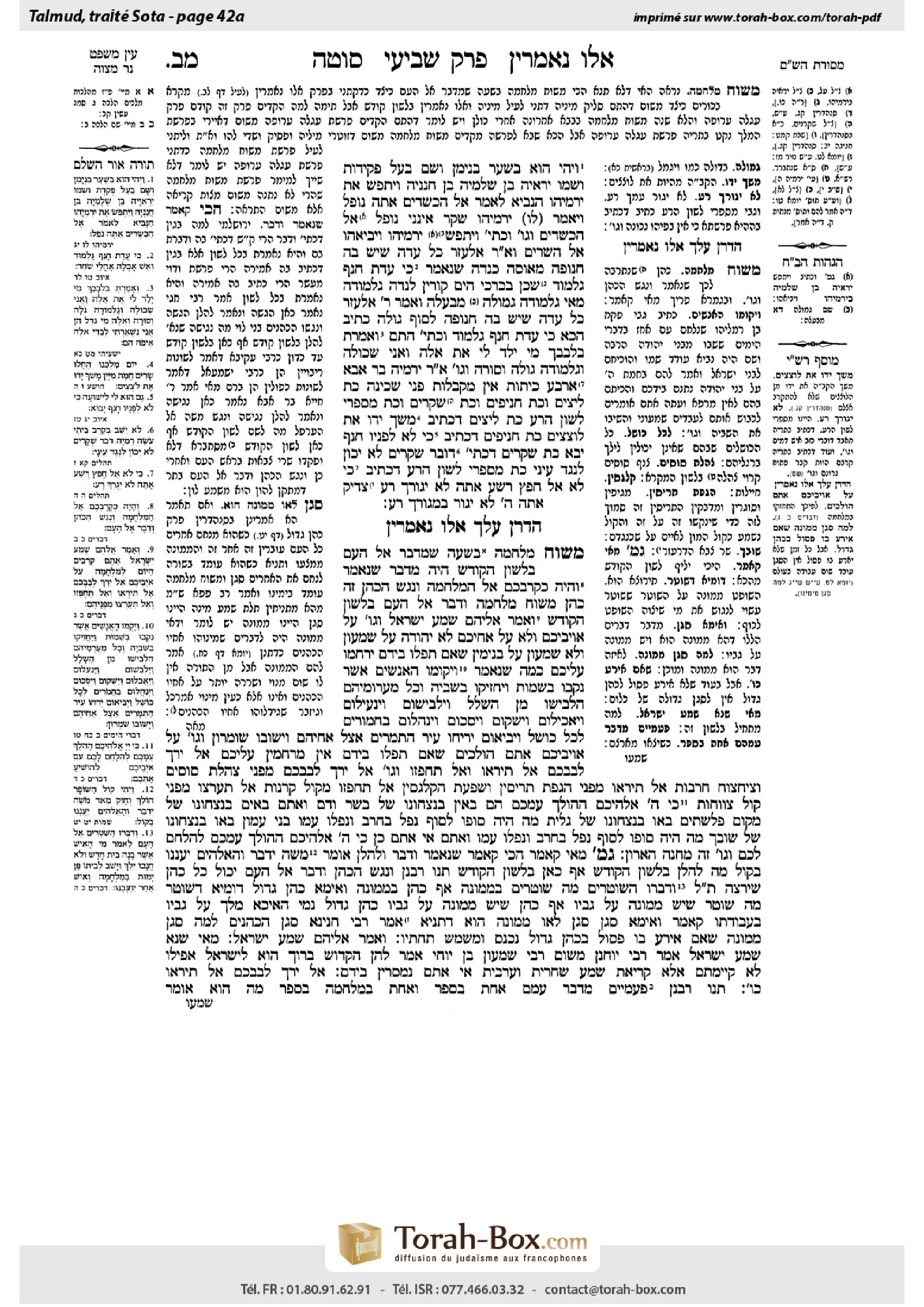
This page of Sotah includes the Aramaic text, an English translation and an AI-generated French translation, alongside the scan above.
סוטה מ״ב א · Aramaic and Hebrew text
״וַיְהִי הוּא בְּשַׁעַר בִּנְיָמִן וְשָׁם בַּעַל פְּקִדֻת וּשְׁמוֹ יִרְאִיָּה בֶּן שֶׁלֶמְיָה בֶּן חֲנַנְיָה וַיִּתְפֹּשׂ אֶת יִרְמְיָהוּ הַנָּבִיא לֵאמֹר אֶל הַכַּשְׂדִּים אַתָּה נֹפֵל. וַיֹּאמֶר לוֹ יִרְמְיָהוּ שֶׁקֶר אֵינֶנִּי נֹפֵל אֶל הַכַּשְׂדִּים וְגוֹ׳״, וּכְתִיב: ״וְיִתְפֹּשׂ יִרְמְיָהוּ וַיְבִאֵהוּ אֶל הַשָּׂרִים״.
וְאָמַר רַבִּי אֶלְעָזָר: כׇּל עֵדָה שֶׁיֵּשׁ בָּהּ חֲנוּפָּה — מְאוּסָה כְּנִדָּה, שֶׁנֶּאֱמַר: ״כִּי עֲדַת חָנֵף גַּלְמוּד״, שֶׁכֵּן בִּכְרַכֵּי הַיָּם קוֹרִין לְנִדָּה גַּלְמוּדָה. מַאי ״גַּלְמוּדָה״ — גְּמוּלָה מִבַּעְלָהּ.
וְאָמַר רַבִּי אֶלְעָזָר: כׇּל עֵדָה שֶׁיֵּשׁ בָּהּ חֲנוּפָּה — לְסוֹף גּוֹלָה, כְּתִיב הָכָא: ״כִּי עֲדַת חָנֵף גַּלְמוּד״, וּכְתִיב הָתָם: ״וְאָמַרְתְּ בִּלְבָבֵךְ מִי יָלַד לִי אֶת אֵלֶּה וַאֲנִי שְׁכוּלָה וְגַלְמוּדָה גֹּלָה וְסוּרָה וְגוֹ׳״.
אָמַר רַבִּי יִרְמְיָה בַּר אַבָּא: אַרְבַּע כִּיתּוֹת אֵין מְקַבְּלוֹת פְּנֵי שְׁכִינָה: כַּת לֵיצִים, וְכַת חֲנֵיפִים, וְכַת שַׁקָּרִים, וְכַת מְסַפְּרֵי לָשׁוֹן הָרָע.
כַּת לֵיצִים — דִּכְתִיב: ״מָשַׁךְ יָדוֹ אֶת לֹצְצִים״. כַּת חֲנֵיפִים — דִּכְתִיב: ״כִּי לֹא לְפָנָיו חָנֵף יָבוֹא״. כַּת שַׁקָּרִים — דִּכְתִיב: ״דֹּבֵר שְׁקָרִים לֹא יִכּוֹן לְנֶגֶד עֵינָי״.
כַּת מְסַפְּרֵי לָשׁוֹן הָרָע — דִּכְתִיב: ״כִּי לֹא אֵל חָפֵץ רֶשַׁע אָתָּה לֹא יְגֻרְךָ רָע״, צַדִּיק אַתָּה ה׳ — לֹא יָגוּר בִּמְגוּרְךָ רָע.
הֲדַרַן עֲלָךְ אֵלּוּ נֶאֱמָרִין
מְשׁוּחַ מִלְחָמָה בְּשָׁעָה שֶׁמְּדַבֵּר אֶל הָעָם — בִּלְשׁוֹן הַקּוֹדֶשׁ הָיָה מְדַבֵּר, שֶׁנֶּאֱמַר: ״וְהָיָה כְּקָרׇבְכֶם אֶל הַמִּלְחָמָה וְנִגַּשׁ הַכֹּהֵן״ — זֶה כֹּהֵן מְשׁוּחַ מִלְחָמָה, ״וְדִבֶּר אֶל הָעָם״ — בִּלְשׁוֹן הַקּוֹדֶשׁ.
״וְאָמַר אֲלֵיהֶם שְׁמַע יִשְׂרָאֵל וְגוֹ׳ עַל אוֹיְבֵיכֶם״ — וְלֹא עַל אֲחֵיכֶם, לֹא יְהוּדָה עַל שִׁמְעוֹן וְלָא שִׁמְעוֹן עַל בִּנְיָמִין. שֶׁאִם תִּפְּלוּ בְּיָדָם יְרַחֲמוּ עֲלֵיכֶם, כְּמָה שֶׁנֶּאֱמַר: ״וַיָּקֻמוּ הָאֲנָשִׁים אֲשֶׁר נִקְּבוּ בְשֵׁמוֹת וַיַּחֲזִיקוּ בַשִּׁבְיָה וְכׇל מַעֲרֻמֵּיהֶם הִלְבִּישׁוּ מִן הַשָּׁלָל וַיַּלְבִּשׁוּם וַיַּנְעִלוּם וַיַּאֲכִלוּם וַיַּשְׁקוּם וַיְסֻכוּם וַיְנַהֲלוּם בַּחֲמֹרִים לְכׇל כּוֹשֵׁל וַיְבִיאוּם יְרֵחוֹ עִיר הַתְּמָרִים אֵצֶל אֲחֵיהֶם וַיָּשׁוּבוּ שֹׁמְרוֹן וְגוֹ׳״. עַל אוֹיְבֵיכֶם אַתֶּם הוֹלְכִים, שֶׁאִם תִּפְּלוּ בְּיָדָם אֵין מְרַחֲמִין עֲלֵיכֶם.
״אַל יֵרַךְ לְבַבְכֶם אַל תִּירְאוּ וְאַל תַּחְפְּזוּ וְגוֹ׳״. ״אַל יֵרַךְ לְבַבְכֶם״ — מִפְּנֵי צׇהֳלַת סוּסִים וְצִחְצוּחַ חֲרָבוֹת, ״אַל תִּירְאוּ״ — מִפְּנֵי הַגָּפַת תְּרִיסִין וְשִׁפְעַת הַקַּלְגַּסִּין, ״אַל תַּחְפְּזוּ״ — מִקּוֹל קְרָנוֹת, ״אַל תַּעַרְצוּ״ — מִפְּנֵי קוֹל צְווֹחוֹת.
״כִּי ה׳ אֱלֹהֵיכֶם הַהֹלֵךְ עִמָּכֶם״. הֵם בָּאִין בְּנִצְחוֹנוֹ שֶׁל בָּשָׂר וָדָם, וְאַתֶּם בָּאִים בְּנִצְחוֹנוֹ שֶׁל מָקוֹם. פְּלִשְׁתִּים בָּאוּ בְּנִצְחוֹנוֹ שֶׁל גׇּלְיָת, מָה הָיָה סוֹפוֹ — לְסוֹף נָפַל בַּחֶרֶב וְנָפְלוּ עִמּוֹ. בְּנֵי עַמּוֹן בָּאוּ בְּנִצְחוֹנוֹ שֶׁל שׁוֹבַךְ, מָה הָיָה סוֹפוֹ — לְסוֹף נָפַל בַּחֶרֶב וְנָפְלוּ עִמּוֹ. וְאַתֶּם אִי אַתֶּם כֵּן, ״כִּי ה׳ אֱלֹהֵיכֶם הַהֹלֵךְ עִמָּכֶם לְהִלָּחֵם לָכֶם וְגוֹ׳״ — זֶה מַחֲנֵה הָאָרוֹן.
גְּמָ׳ מַאי קָאָמַר? הָכִי קָאָמַר: שֶׁנֶּאֱמַר ״וְדִבֶּר״, וּלְהַלָּן אוֹמֵר ״מֹשֶׁה יְדַבֵּר וְהָאֱלֹהִים יַעֲנֶנּוּ בְקוֹל״, מָה לְהַלָּן בִּלְשׁוֹן הַקּוֹדֶשׁ — אַף כָּאן בִּלְשׁוֹן הַקּוֹדֶשׁ.
תָּנוּ רַבָּנַן: ״וְנִגַּשׁ הַכֹּהֵן וְדִבֶּר אֶל הָעָם״. יָכוֹל כׇּל כֹּהֵן שֶׁיִּרְצֶה — תַּלְמוּד לוֹמַר: ״וְדִבְּרוּ הַשֹּׁטְרִים״, מָה שׁוֹטְרִים בִּמְמוּנֶּה, אַף כֹּהֵן בִּמְמוּנֶּה. וְאֵימָא כֹּהֵן גָּדוֹל? דּוּמְיָא דְּשׁוֹטֵר, מָה שׁוֹטֵר שֶׁיֵּשׁ מְמוּנֶּה עַל גַּבָּיו — אַף כֹּהֵן שֶׁיֵּשׁ מְמוּנֶּה עַל גַּבָּיו.
כֹּהֵן גָּדוֹל נָמֵי, הָאִיכָּא מֶלֶךְ עַל גַּבָּיו! בַּעֲבוֹדָתוֹ קָאָמַר. וְאֵימָא סְגָן! סְגָן לָאו מְמוּנֶּה הוּא. דְּתַנְיָא, אָמַר רַבִּי חֲנִינָא סְגַן הַכֹּהֲנִים: לָמָּה סְגָן מְמוּנֶּה — שֶׁאִם אֵירַע בּוֹ פְּסוּל בְּכֹהֵן גָּדוֹל, נִכְנָס וּמְשַׁמֵּשׁ תַּחְתָּיו.
״וְאָמַר אֲלֵיהֶם שְׁמַע יִשְׂרָאֵל״. מַאי שְׁנָא ״שְׁמַע יִשְׂרָאֵל״? אָמַר רַבִּי יוֹחָנָן מִשּׁוּם רַבִּי שִׁמְעוֹן בֶּן יוֹחַי, אָמַר לָהֶן הַקָּדוֹשׁ בָּרוּךְ הוּא לְיִשְׂרָאֵל: אֲפִילּוּ לֹא קִיַּימְתֶּם אֶלָּא קְרִיאַת שְׁמַע שַׁחֲרִית וְעַרְבִית — אִי אַתֶּם נִמְסָרִין בְּיָדָם.
״אַל יֵרַךְ לְבַבְכֶם אַל תִּירְאוּ כּוּ׳״. תָּנוּ רַבָּנַן: פַּעֲמַיִים מְדַבֵּר עִמָּם, אַחַת בַּסְּפָר, וְאַחַת בַּמִּלְחָמָה. בַּסְּפָר מַה הוּא אוֹמֵר —
Sotah 42a · English translation
“And when he was in the gate of Benjamin, a captain of the ward was there, whose name was Irijah, the son of Shelemiah, the son of Hananiah; and he laid hold on Jeremiah the prophet, saying: You shall fall to the Chaldeans. Then Jeremiah said: It is false; I shall not fall to the Chaldeans” (Jeremiah 37:13–14). And it is then written: “So Irijah laid hold on Jeremiah, and brought him to the princes” (Jeremiah 37:14). Irijah was the grandson of Hananiah, and Jeremiah was punished by falling into his hands because he had flattered his grandfather.
And Rabbi Elazar says: Any congregation in which there is flattery is as repulsive as a menstruating woman, as it is stated: “For a flattering congregation shall be desolate [galmud]” (Job 15:34), and in the cities overseas they call a menstruating woman galmuda. What is the meaning of the word galmuda? It means separated [gemula] from her husband [mibbala].
And Rabbi Elazar says: Any congregation in which there is flattery is ultimately exiled. It is written here: “For a flattering congregation shall be desolate [galmud]” (Job 15:34), and it is written there: “Then you will say in your heart: Who has begotten me these, seeing I have been bereaved of my children, and am solitary [galmuda], an exile, and wandering?” (Isaiah 49:21). The verse states: “An exile,” as an appositive to “galmuda,” indicating that they are the same.
Rabbi Yirmeya bar Abba says: Four classes of people will not greet the Divine Presence: The class of cynics, and the class of flatterers, and the class of liars, and the class of slanderers.
The proof for this statement is as follows: The class of cynics, as it is written: “He draws His hand from cynics” (Hosea 7:5), i.e., God does not want to be in their presence; the class of flatterers, as it is written: “That a flatterer cannot come before Him” (Job 13:16); the class of liars, as it is written: “He who speaks falsehood shall not dwell before My eyes” (Psalms 101:7).
The class of slanderers will not greet the Divine Presence, as it is written: “For You are not a god who has pleasure in wickedness, evil shall not sojourn with You” (Psalms 5:5), which means: You, the Lord, are righteous and evil shall not dwell with You in Your dwelling place. “Evil” here is referring to slanderers, as is evident from the continuation of the chapter, which states: “For there is no sincerity in their mouth; their inward part is a yawning gulf, their throat is an open tomb, they make smooth their tongue” (Psalms 5:10).
MISHNA: With regard to the priest who was anointed for war, at the time that he would speak to the nation, he would speak to them in the sacred tongue, Hebrew, as it is stated: “And it shall be, when you draw near to the battle, that the priest shall approach and speak to the people” (Deuteronomy 20:2). This priest identified in the verse is the priest anointed for war, the priest who is inaugurated specifically to serve this function. “And speak to the people”; he addresses them in the sacred tongue, Hebrew.
The Torah dictates the priest’s address: “And he shall say to them: Hear Israel, you draw near today to battle against your enemies; let not your heart faint; fear not, nor be alarmed, and do not be terrified of them” (Deuteronomy 20:3). The priest expounds: “Against your enemies” and not against your brothers. This is not a war of the tribe of Judah against Simon and not Simon against Benjamin, such that if you fall into their hands your brothers will have mercy on you, as it is stated with regard to a war between Judah and Israel: “And the men that have been mentioned by name rose up, and took the captives, and with the spoil clothed all that were naked among them, and arrayed them, and shod them, and gave them to eat and to drink, and anointed them, and carried all the feeble of them upon donkeys, and brought them to Jericho, the city of palm trees, unto their brethren; then they returned to Samaria” (II Chronicles 28:15). Rather, you are marching to war against your enemies, and if you fall into their hands, they will not have mercy on you.
The priest continues: “Let not your heart faint; fear not, nor be alarmed, and do not be terrified of them” (Deuteronomy 20:3). “Let not your heart faint” due to the neighing of horses and the sharpening of the enemy’s swords. “Fear not” due to the knocking of shields [terisin] and the noise of their boots [calgassin]. “Nor be alarmed” by the sound of trumpets. “Do not be terrified” due to the sound of shouts.
The priest explains why the soldiers need not be terrified. “For the Lord your God is He that goes with you, to fight for you against your enemies, to save you” (Deuteronomy 20:4). Remember that they come to war championed by flesh and blood, and you are coming championed by the Omnipresent. The Philistines came championed by Goliath. What was his end? In the end, he fell by the sword, and they fell with him (see I Samuel, chapter 17). The Ammonites came championed by Shobach. What was his end? In the end, he fell by the sword, and they fell with him (see II Samuel, chapter 10). But as for you, you are not so, reliant upon the strength of mortals: “For the Lord your God is He that goes with you, to fight for you against your enemies, to save you”; this verse is referring to the camp of the Ark of the Covenant that accompanies them out to war.
GEMARA: The Gemara clarifies an ambiguous point in the mishna: What is it saying when the mishna derives from the verse that the priest must address the people in Hebrew? The Gemara answers: This is what the mishna is saying: The ruling is derived from a verbal analogy, as it is stated here: “And speak” (Deuteronomy 20:2), and there, concerning the giving of the Torah, it is stated: “Moses spoke and God answered him by a voice” (Exodus 19:19). Just as there, the voice spoke in the sacred tongue, so too here, the priest speaks in the sacred tongue.
The Sages taught: “The priest shall approach and speak to the people” (Deuteronomy 20:2). One might have thought that any priest who would want to address the people may assume this role. To counter this idea, the verse states: “And the officers shall speak” (Deuteronomy 20:5). Just as the officers described are those who have been appointed to discharge their responsibilities, so too, the priest described is one who has been appointed for this role. The Gemara asks: But if so, why not say that the High Priest should deliver this address, as he is also appointed? The Gemara replies: The appointed priest must be similar to an appointed officer. Just as an officer is one who has someone else, i.e., a judge, with greater authority appointed above him, so too, the priest described must be one who has someone else, i.e., the High Priest, appointed above him.
The Gemara rejects this answer: The High Priest also meets this qualification, as there is the king above him, and therefore, the High Priest should deliver the address. The Gemara clarifies: The caveat that one must have someone appointed above him is saying someone above him in his function. That there is a king is irrelevant to the station of the High Priest, who ranks highest in the priesthood. The Gemara suggests: Then say it may be the deputy High Priest, who is second to the High Priest; he should deliver the address. The Gemara answers: The deputy is not an appointed office, as this position has no particular function other than being a ready substitute for the High Priest. As it is taught in a baraita: Rabbi Ḥanina, the deputy High Priest, says: To what end is the deputy appointed? It is merely for the possibility that if some disqualification befalls the High Priest, the deputy steps in and serves in his stead. However, the deputy has no specific role of his own.
§ The Torah says about the priest anointed for war: “And he shall say to them: Hear Israel” (Deuteronomy 20:3). The Gemara asks: What is different in this setting that necessitates the usage of the phrase: “Hear Israel”? Rabbi Yoḥanan said in the name of Rabbi Shimon ben Yoḥai: The Holy One, Blessed be He, said to the Jewish people: Even if you have not fulfilled any mitzva except reciting Shema of the morning and the evening, you will not be delivered into the hands of your enemies. As an allusion to this promise, the priest’s address borrows the phrase “Hear Israel,” a phrase most familiar from the beginning of the recitation of Shema.
With respect to the mishna’s comments about the verse: “Let not your heart faint; fear not, nor be alarmed, and do not be terrified of them” (Deuteronomy 20:3), the Sages taught (Tosefta 7:18): The priest speaks with them twice, one time when they are gathered for war at the border, and one time when they are on the battlefield itself. When they are at the border, what does he say?
Sotah 42a · Traduction française (IA)
« Alors qu’il se trouvait à la porte de Benjamin, un chef de la garde était là, nommé Irijah, fils de Shelemiah, fils de Hananiah. Il saisit le prophète Jérémie en disant : “Tu tomberas aux mains des Chaldéens.” Jérémie répondit alors : “C’est faux ; je ne tomberai pas aux mains des Chaldéens” » (Jérémie 37:13-14). Il est ensuite écrit : « Irijah saisit Jérémie et l’amena devant les princes » (Jérémie 37:14). Irijah était le petit-fils de Hananiah, et Jérémie fut puni en tombant entre ses mains parce qu’il avait flatté son grand-père.
Et Rabbi Elazar dit : toute communauté où règne la flatterie est aussi répugnante qu’une femme menstruée, comme il est dit : « Car une communauté de flatteurs sera désolée [galmud] » (Job 15:34). Dans les villes d’outre-mer, on appelle une femme menstruée galmuda. Que signifie le mot galmuda ? Cela signifie qu’elle est séparée [gemula] de son mari [mibbala].
Et Rabbi Elazar dit : toute communauté où règne la flatterie finira par être exilée. Il est écrit ici : « Car une communauté de flatteurs sera désolée [galmud] » (Job 15:34), et il est écrit là : « Tu diras alors en ton cœur : Qui m’a donné ceux-ci, alors que j’étais privée de mes enfants, solitaire [galmuda], exilée et errante ? » (Isaïe 49:21). Le verset dit « exilée » en apposition à « galmuda », ce qui indique que les deux termes désignent la même chose.
Rabbi Yirmeya bar Abba dit : quatre catégories de personnes ne se tiendront pas devant la Présence divine : les cyniques, les flatteurs, les menteurs et les calomniateurs.
La preuve de cette affirmation est la suivante : pour la catégorie des cyniques, il est écrit : « Il retire Sa main des cyniques » (Osée 7:5), c’est-à-dire que Dieu ne veut pas être en leur présence ; pour la catégorie des flatteurs, il est écrit : « Un flatteur ne peut se présenter devant Lui » (Job 13:16) ; et pour la catégorie des menteurs, il est écrit : « Celui qui profère le mensonge ne demeurera pas sous mes yeux » (Psaumes 101:7).
La catégorie des calomniateurs ne se tiendra pas devant la Présence divine, comme il est écrit : « Car Tu n’es pas un Dieu qui prend plaisir à la méchanceté ; le mal ne séjournera pas auprès de Toi » (Psaumes 5:5). Cela signifie : Toi, le Seigneur, es juste, et le mal ne demeurera pas auprès de Toi, dans Ta demeure. Le « mal » désigne ici les calomniateurs, comme le montre la suite du chapitre : « Leur bouche ne contient aucune sincérité ; leur cœur est un gouffre béant, leur gorge un sépulcre ouvert, leur langue est flatteuse » (Psaumes 5:10).
MICHNA : Au sujet du prêtre oint pour la guerre, lorsqu’il s’adressait au peuple, il lui parlait dans la langue sacrée, l’hébreu, comme il est dit : « Lorsque vous vous approcherez du combat, le prêtre s’avancera et parlera au peuple » (Deutéronome 20:2). Le prêtre désigné par le verset est le prêtre oint pour la guerre, investi spécifiquement de cette fonction. « Et parlera au peuple » : il s’adresse à lui dans la langue sacrée, l’hébreu.
La Torah prescrit le discours du prêtre : « Il leur dira : Écoute, Israël, vous vous approchez aujourd’hui du combat contre vos ennemis ; que votre cœur ne faiblisse pas, ne craignez pas, ne vous alarmez pas et ne soyez pas terrifiés par eux » (Deutéronome 20:3). Le prêtre explique : « Contre vos ennemis », et non contre vos frères. Il ne s’agit pas d’une guerre de la tribu de Juda contre Siméon, ni de Siméon contre Benjamin, où, si vous tombiez entre les mains de vos frères, ils auraient pitié de vous, comme il est dit à propos d’une guerre entre Juda et Israël : « Les hommes désignés par leur nom se levèrent, prirent les captifs et, avec le butin, vêtirent tous ceux qui étaient nus parmi eux, les habillèrent, les chaussèrent, leur donnèrent à manger et à boire, les oignirent, transportèrent tous les faibles sur des ânes et les conduisirent à Jéricho, la ville des palmiers, auprès de leurs frères ; puis ils retournèrent à Samarie » (II Chroniques 28:15). Au contraire, vous partez en guerre contre vos ennemis et, si vous tombez entre leurs mains, ils n’auront pas pitié de vous.
Le prêtre poursuit : « Que votre cœur ne faiblisse pas, ne craignez pas, ne vous alarmez pas et ne soyez pas terrifiés par eux » (Deutéronome 20:3). « Que votre cœur ne faiblisse pas » à cause du hennissement des chevaux et de l’aiguisement des épées de l’ennemi. « Ne craignez pas » à cause du fracas des boucliers [terisin] et du bruit de leurs bottes [calgassin]. « Ne vous alarmez pas » au son des trompettes. « Ne soyez pas terrifiés » par les cris.
Le prêtre explique pourquoi les soldats n’ont pas à être terrifiés : « Car le Seigneur, votre Dieu, marche avec vous pour combattre vos ennemis en votre faveur et vous sauver » (Deutéronome 20:4). Rappelez-vous : eux partent en guerre soutenus par un être de chair et de sang, tandis que vous partez avec le soutien du Tout-Puissant. Les Philistins avaient Goliath pour champion. Quel fut son sort ? Il finit par tomber sous l’épée, et ils tombèrent avec lui (voir I Samuel, chapitre 17). Les Ammonites avaient Shobach pour champion. Quel fut son sort ? Il finit par tomber sous l’épée, et ils tombèrent avec lui (voir II Samuel, chapitre 10). Mais vous, vous ne dépendez pas de la force des mortels : « Car le Seigneur, votre Dieu, marche avec vous pour combattre vos ennemis en votre faveur et vous sauver » ; ce verset désigne le camp de l’Arche d’Alliance qui les accompagne à la guerre.
GUEMARA : La Guemara clarifie un point ambigu de la Michna : que veut-elle dire lorsqu’elle déduit du verset que le prêtre doit s’adresser au peuple en hébreu ? La Guemara répond : voici ce que veut dire la Michna : cette règle est déduite d’une analogie verbale, car il est écrit ici : « et parlera » (Deutéronome 20:2), et il est écrit là, au sujet du don de la Torah : « Moïse parlait et Dieu lui répondait par une voix » (Exode 19:19). De même que là, la voix parlait dans la langue sacrée, de même ici, le prêtre parle dans la langue sacrée.
Les Sages ont enseigné : « Le prêtre s’avancera et parlera au peuple » (Deutéronome 20:2). On aurait pu penser que tout prêtre désireux de s’adresser au peuple pouvait assumer cette fonction. Pour écarter cette idée, le verset dit : « Les officiers parleront » (Deutéronome 20:5). De même que les officiers mentionnés sont ceux qui ont été nommés pour exercer leurs responsabilités, de même, le prêtre mentionné est celui qui a été nommé pour cette fonction. La Guemara demande : mais dans ce cas, pourquoi ne pas dire que le grand prêtre doit prononcer ce discours, puisqu’il a lui aussi été nommé ? La Guemara répond : le prêtre nommé doit être comparable à un officier nommé. De même qu’un officier est quelqu’un au-dessus de qui une autre personne, c’est-à-dire un juge, a été nommée avec une autorité supérieure, de même, le prêtre mentionné doit être quelqu’un au-dessus de qui une autre personne, c’est-à-dire le grand prêtre, a été nommée.
La Guemara rejette cette réponse : le grand prêtre satisfait lui aussi à cette condition, puisqu’il y a le roi au-dessus de lui ; le grand prêtre devrait donc prononcer le discours. La Guemara précise : la condition selon laquelle quelqu’un doit avoir une personne nommée au-dessus de lui signifie qu’il doit y avoir quelqu’un au-dessus de lui dans sa fonction. Le fait qu’il y ait un roi n’a aucune incidence sur le rang du grand prêtre, qui occupe la plus haute position dans la prêtrise. La Guemara suggère : alors, ce pourrait être le grand prêtre adjoint, qui vient au second rang après le grand prêtre ; c’est lui qui devrait prononcer le discours. La Guemara répond : le poste de grand prêtre adjoint n’est pas une fonction dotée d’attributions propres, hormis celle de remplacer le grand prêtre au besoin. En effet, il est enseigné dans une baraïta : Rabbi Ḥanina, le grand prêtre adjoint, dit : à quoi sert la nomination d’un grand prêtre adjoint ? Elle sert uniquement à prévoir le cas où une inaptitude frapperait le grand prêtre : l’adjoint prend alors sa place et officie à sa place. Toutefois, le grand prêtre adjoint n’a pas de fonction propre.
§ La Torah dit au sujet du prêtre oint pour la guerre : « Il leur dira : Écoute, Israël » (Deutéronome 20:3). La Guemara demande : qu’est-ce qui, dans ce contexte, rend nécessaire l’emploi de l’expression « Écoute, Israël » ? Rabbi Yoḥanan dit au nom de Rabbi Shimon ben Yoḥai : le Saint, béni soit-Il, dit au peuple juif : même si vous n’avez accompli aucune mitsva, hormis la récitation du Chéma le matin et le soir, vous ne serez pas livrés aux mains de vos ennemis. En allusion à cette promesse, le discours du prêtre reprend l’expression « Écoute, Israël », surtout connue comme les premiers mots de la récitation du Chéma.
À propos des remarques de la Michna sur le verset : « Que votre cœur ne faiblisse pas, ne craignez pas, ne vous alarmez pas et ne soyez pas terrifiés par eux » (Deutéronome 20:3), les Sages ont enseigné (Tosefta 7:18) : le prêtre leur parle à deux reprises, une fois lorsqu’ils sont rassemblés pour la guerre à la frontière, et une fois lorsqu’ils se trouvent sur le champ de bataille même. Lorsqu’ils sont à la frontière, que leur dit-il ?
Traduction française générée par IA à partir de l’édition anglaise de Sefaria. Vérifie toujours un passage avec le texte source.
Text from Sefaria: William Davidson Edition - Vocalized Aramaic (CC BY NC); William Davidson Edition - English (CC BY NC).