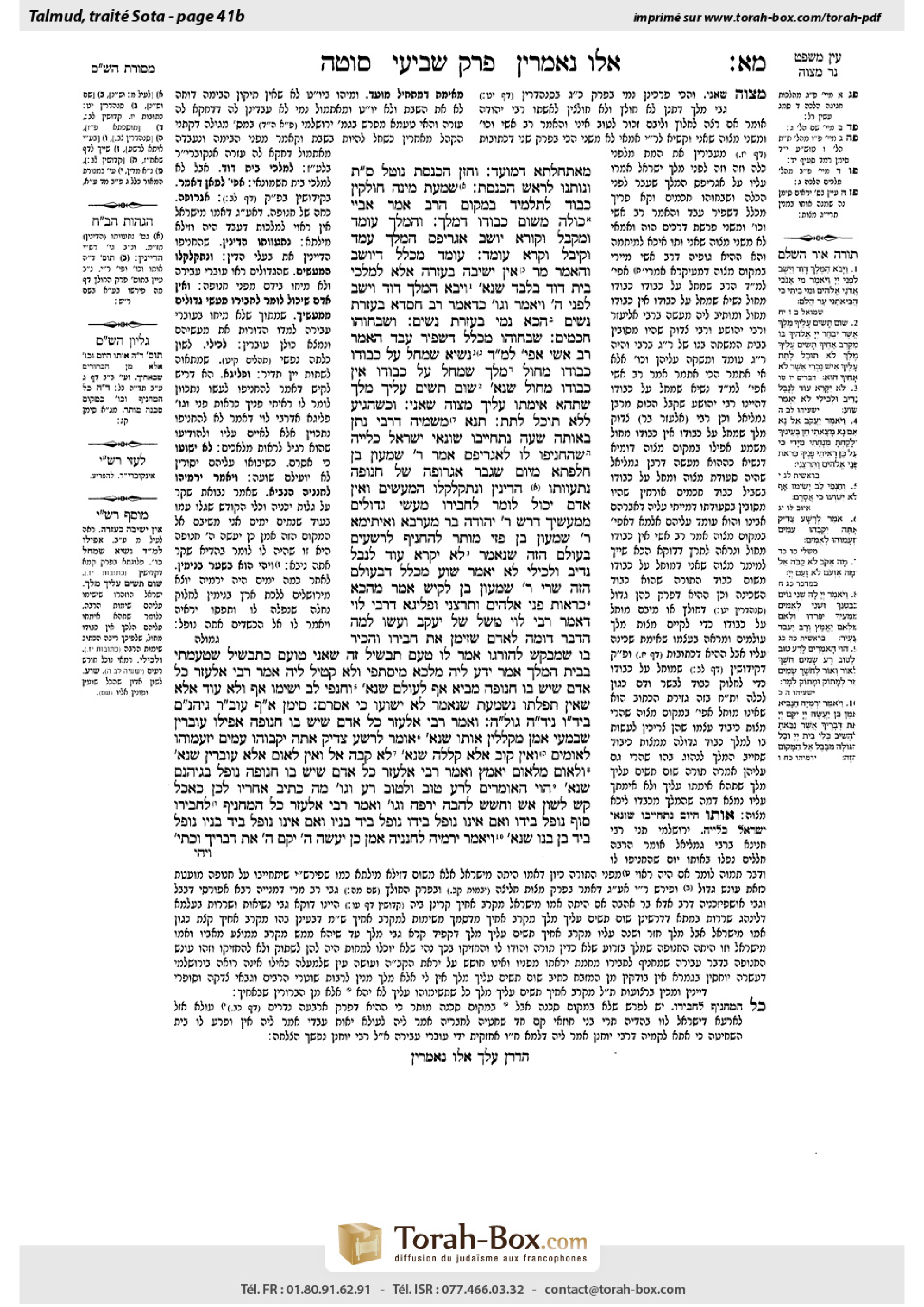
Sotah 41b: Talmud study for Daf Yomi
Daf Yomi is the daily study of one Talmud folio. Explore 37 tractates with scans, Hebrew text, Sefaria English and AI-generated French translations where annotated.
Passage selection and English or AI-generated French translation are available where the scan has annotations. Daf Study is independent of Torah-Box and Sefaria.
Browse Sotah · סוטה · All tractatesSotah 41b text and translations
This page of Sotah includes the Aramaic text, an English translation and an AI-generated French translation, alongside the scan above.
סוטה מ״א ב · Aramaic and Hebrew text
מֵאַתְחַלְתָּא דְּמוֹעֵד.
וְחַזַּן הַכְּנֶסֶת נוֹטֵל סֵפֶר תּוֹרָה וְנוֹתְנוֹ לְרֹאשׁ הַכְּנֶסֶת. שָׁמְעַתְּ מִינַּהּ חוֹלְקִין כָּבוֹד לְתַלְמִיד בִּמְקוֹם הָרַב! אָמַר אַבָּיֵי: כּוּלָּהּ מִשּׁוּם כְּבוֹדוֹ דְּמֶלֶךְ.
וְהַמֶּלֶךְ עוֹמֵד וּמְקַבֵּל וְקוֹרֵא יוֹשֵׁב. אַגְרִיפַּס הַמֶּלֶךְ עָמַד וְקִיבֵּל וְקָרָא עוֹמֵד. עוֹמֵד מִכְּלָל דְּיוֹשֵׁב? וְהָאָמַר מָר: אֵין יְשִׁיבָה בַּעֲזָרָה אֶלָּא לְמַלְכֵי בֵּית דָּוִד בִּלְבַד, שֶׁנֶּאֱמַר: ״וַיָּבֹא הַמֶּלֶךְ דָּוִד וַיֵּשֶׁב לִפְנֵי ה׳ וַיֹּאמֶר וְגוֹ׳״! כִּדְאָמַר רַב חִסְדָּא: בְּעֶזְרַת נָשִׁים, הָכָא נָמֵי בְּעֶזְרַת נָשִׁים.
וְשִׁבְּחוּהוּ חֲכָמִים. שִׁבְּחוּהוּ, מִכְּלָל דְּשַׁפִּיר עֲבַד? הָאָמַר רַב אָשֵׁי: אֲפִילּוּ לְמַאן דְּאָמַר נָשִׂיא שֶׁמָּחַל עַל כְּבוֹדוֹ כְּבוֹדוֹ מָחוּל, מֶלֶךְ שֶׁמָּחַל עַל כְּבוֹדוֹ — אֵין כְּבוֹדוֹ מָחוּל, שֶׁנֶּאֱמַר: ״שׂוֹם תָּשִׂים עָלֶיךָ מֶלֶךְ״, שֶׁתְּהֵא אֵימָתוֹ עָלֶיךָ!
מִצְוָה שָׁאנֵי.
וּכְשֶׁהִגִּיעַ לְ״לֹא תוּכַל לָתֵת״. תָּנָא מִשְּׁמֵיהּ דְּרַבִּי נָתָן: בְּאוֹתָהּ שָׁעָה נִתְחַיְּיבוּ שׂוֹנְאֵי יִשְׂרָאֵל כְּלָיָיה — שֶׁהֶחֱנִיפוּ לוֹ לְאַגְרִיפַּס.
אָמַר רַבִּי שִׁמְעוֹן בֶּן חֲלַפְתָּא: מִיּוֹם שֶׁגָּבַר אֶגְרוֹפָהּ שֶׁל חֲנוּפָּה — נִתְעַוְּותוּ הַדִּינִין, וְנִתְקַלְקְלוּ הַמַּעֲשִׂים, וְאֵין אָדָם יָכוֹל לוֹמַר לַחֲבֵירוֹ ״מַעֲשַׂי גְּדוֹלִים מִמַּעֲשֶׂיךָ״.
דָּרֵשׁ רַבִּי יְהוּדָה בַּר מַעְרְבָא, וְאִיתֵּימָא רַבִּי שִׁמְעוֹן בֶּן פַּזִּי: מוּתָּר לְהַחְנִיף לִרְשָׁעִים בָּעוֹלָם הַזֶּה, שֶׁנֶּאֱמַר: ״לֹא יִקָּרֵא עוֹד לְנָבָל נָדִיב וּלְכִילַי לֹא יֵאָמֵר שׁוֹעַ״, מִכְּלָל דְּבָעוֹלָם הַזֶּה שְׁרֵי.
רַבִּי שִׁמְעוֹן בֶּן לָקִישׁ אָמַר, מֵהָכָא: ״כִּרְאֹת פְּנֵי אֱלֹהִים וַתִּרְצֵנִי״.
וּפְלִיגָא דְּרַבִּי לֵוִי. דְּאָמַר רַבִּי לֵוִי: מָשָׁל שֶׁל יַעֲקֹב וְעֵשָׂו לְמָה הַדָּבָר דּוֹמֶה? לְאָדָם שֶׁזִּימֵּן אֶת חֲבֵירוֹ וְהִכִּיר בּוֹ שֶׁמְבַקֵּשׁ לְהוֹרְגוֹ, אָמַר לוֹ: טְעַם תַּבְשִׁיל זֶה שֶׁאֲנִי טוֹעֵם כְּתַבְשִׁיל שֶׁטָּעַמְתִּי בְּבֵית הַמֶּלֶךְ. אָמַר: יָדַע לֵיהּ מַלְכָּא, מִיסְתְּפֵי וְלָא קָטֵיל לֵיהּ.
אָמַר רַבִּי אֶלְעָזָר: כׇּל אָדָם שֶׁיֵּשׁ בּוֹ חֲנוּפָּה מֵבִיא אַף לָעוֹלָם, שֶׁנֶּאֱמַר: ״וְחַנְפֵי לֵב יָשִׂימוּ אָף״, וְלֹא עוֹד אֶלָּא שֶׁאֵין תְּפִלָּתוֹ נִשְׁמַעַת, שֶׁנֶּאֱמַר: ״לֹא יְשַׁוְּעוּ כִּי אֲסָרָם״.
(סִימַן: אַף עוּבָּר גֵּיהִנָּם בְּיָדוֹ נִידָּה גּוֹלָה).
וְאָמַר רַבִּי אֶלְעָזָר: כׇּל אָדָם שֶׁיֵּשׁ בּוֹ חֲנוּפָּה — אֲפִילּוּ עוּבָּרִין שֶׁבִּמְעֵי אִמָּן מְקַלְּלִין אוֹתוֹ, שֶׁנֶּאֱמַר: ״אֹמֵר לְרָשָׁע צַדִּיק אָתָּה יִקְּבֻהוּ עַמִּים יִזְעָמוּהוּ לְאֻמִּים״, וְאֵין ״קוֹב״ אֶלָּא קְלָלָה, שֶׁנֶּאֱמַר: ״לֹא קַבֹּה אֵל״, וְאֵין ״לְאוֹם״ אֶלָּא עוּבָּרִין, שֶׁנֶּאֱמַר: ״וּלְאֹם מִלְּאֹם יֶאֱמָץ״.
וְאָמַר רַבִּי אֶלְעָזָר: כׇּל אָדָם שֶׁיֵּשׁ בּוֹ חֲנוּפָּה נוֹפֵל בְּגֵיהִנָּם, שֶׁנֶּאֱמַר: ״הוֹי הָאוֹמְרִים לָרַע טוֹב וְלַטּוֹב רָע וְגוֹ׳״, מָה כְּתִיב אַחֲרָיו: ״לָכֵן כֶּאֱכֹל קַשׁ לְשׁוֹן אֵשׁ וַחֲשַׁשׁ לֶהָבָה יִרְפֶּה וְגוֹ׳״.
וְאָמַר רַבִּי אֶלְעָזָר: כׇּל הַמַּחְנִיף לַחֲבֵירוֹ — סוֹף נוֹפֵל בְּיָדוֹ, וְאִם אֵינוֹ נוֹפֵל בְּיָדוֹ — נוֹפֵל בְּיַד בָּנָיו, וְאִם אֵינוֹ נוֹפֵל בְּיַד בָּנָיו — נוֹפֵל בְּיַד בֶּן בְּנוֹ, שֶׁנֶּאֱמַר: ״וַיֹּאמֶר יִרְמְיָה הַנָּבִיא [לַחֲנַנְיָה] אָמֵן כֵּן יַעֲשֶׂה ה׳ יָקֵם ה׳ אֶת דְּבָרֶיךָ״, וּכְתִיב:
Sotah 41b · English translation
implying that the assembly takes place at the beginning of the Festival, when the entire Jewish people comes to Jerusalem.
§ It is taught in the mishna: And the synagogue attendant takes a Torah scroll and gives it to the head of the synagogue, until it is eventually passed to the king. The Gemara suggests: You can learn from the fact that all of these dignitaries receive the Torah scroll before the king that honor may be given to a student in the presence of the teacher. Abaye said: A proof may not be adduced from here, as the entire process is for the honor of the king, to show that he is removed from ordinary people by many ranks.
It is taught in the mishna: And the king stands, and receives the Torah scroll, and reads from it while sitting. King Agrippa arose, and received the Torah scroll, and read from it while standing. The Gemara asks: By inference, until that point he had been sitting. But didn’t the Master say (Tosefta, Sanhedrin 4:4) that sitting in the Temple courtyard is permitted only for kings from the house of David, as it is stated: “Then King David went in, and sat before the Lord; and he said: Who am I?” (II Samuel 7:18). The Gemara answers: As Rav Ḥisda said in a similar context: This took place not in the Israelite courtyard, where the prohibition against sitting applies, but in the women’s courtyard. Here too, the assembly was in the women’s courtyard.
It is stated in the mishna that King Agrippa read from the Torah while standing, and the Sages praised him for this. The Gemara asks: From the fact that they praised him, can it be concluded that he acted appropriately? Didn’t Rav Ashi say: Even according to the one who says with regard to a Nasi who relinquished the honor due him, his honor is relinquished, i.e., he may do so, with regard to a king who relinquished the honor due him, his honor is not relinquished, as it is stated: “You shall place a king over you” (Deuteronomy 17:15). This is interpreted to mean that his awe shall be upon you. The Torah establishes that awe is an essential component of kingship, and it is not the prerogative of the king to relinquish it.
The Gemara answers: Since he relinquished his honor for the sake of a mitzva, this situation is different and does not dishonor him.
The mishna continues: And when Agrippa arrived at the verse: “You may not appoint a foreigner over you” (Deuteronomy 17:15), tears flowed from his eyes because he was a descendant of the house of Herod and was not of Jewish origin. The entire nation said to him: You are our brother. It is taught in the name of Rabbi Natan: At that moment the enemies of the Jewish people, a euphemism for the Jewish people, were sentenced to destruction for flattering Agrippa.
Rabbi Shimon ben Ḥalafta says: From the day that the power of flattery prevailed, the judgment has become corrupted, and people’s deeds have become corrupted, and a person cannot say to another: My deeds are greater than your deeds, as everyone flatters one another and people no longer know the truth.
Rabbi Yehuda of the West, Eretz Yisrael, and some say Rabbi Shimon ben Pazi, taught: It is permitted to flatter wicked people in this world, as it is stated concerning the future: “The vile person shall no longer be called generous, nor shall the churl be said to be noble” (Isaiah 32:5). By inference, this indicates that in this world it is permitted to flatter them.
Rabbi Shimon ben Lakish said that this can be proven from here. Jacob said to Esau: “I have seen your face, as one sees the face of angels, and you were pleased with me” (Genesis 33:10). Jacob flattered him by comparing seeing him to seeing a divine vision.
The Gemara notes: And Rabbi Shimon ben Lakish, in interpreting Jacob’s statement, disagrees with Rabbi Levi, as Rabbi Levi says: With regard to the interaction between Jacob and Esau, to what is this matter comparable? To a person who invited another to his home and the guest realized that he wants to kill him. The guest said to him: The flavor of this dish that I taste is like a dish that I tasted in the king’s house. The host then said to himself: The king must know him. Therefore, he was afraid and did not kill him. Similarly, when Jacob told Esau that his face is like the face of an angel, he intended to let him know that he had seen angels, in order to instill fear in him so that Esau would not seek to harm him.
Rabbi Elazar says: Any person who has flattery in him brings wrath to the world, as it is stated: “But those with flattery in their hearts bring about wrath” (Job 36:13). And moreover, his prayer is not heard, as it is stated in that same verse: “They do not cry for help when He binds them.”
The Gemara cites a mnemonic device for the statements of Rabbi Elazar: Wrath, fetus, Gehenna, in his hands, menstruating woman, exiled.
And Rabbi Elazar says: Any person who has flattery in him, even fetuses in their mothers’ wombs curse him, as it is stated: “He who says to the wicked: You are righteous, peoples shall curse him [yikkevuhu], nations [leummim] shall execrate him” (Proverbs 24:24); and kov, the linguistic root of the word yikkevuhu, means only a curse, as it is stated: Balaam explained that he did not curse the Jewish people, as he said: “How can I curse [ekkov] whom God has not cursed [kabbo]?” (Numbers 23:8). And le’om is homiletically interpreted to mean only fetuses, as it is stated with regard to Jacob and Esau, when they were still in Rebecca’s womb: “And one people [le’om] shall be stronger than the other people [le’om]” (Genesis 25:23).
And Rabbi Elazar says: Any person who has flattery in him falls into Gehenna, as it is stated: “Woe to those who call evil good, and good evil” (Isaiah 5:20). What is written afterward? “Therefore, as the tongue of fire devours straw, and as the chaff is consumed by the flame” (Isaiah 5:24), meaning that the people described in the earlier verse will end up burning like straw in the fires of Gehenna.
And Rabbi Elazar says: Anyone who flatters another ultimately falls into his hands. And if he does not fall into his hands, he falls into his children’s hands. And if he does not fall into his children’s hands, he falls into his grandchild’s hands, as it is stated: “Then the prophet Jeremiah said to Hananiah…Amen, the Lord should do so, the Lord should perform your words” (Jeremiah 28:5–6). This was a form of flattery, as Jeremiah did not explicitly say that Hananiah was a false prophet. And it is written:
Sotah 41b · Traduction française (IA)
ce qui implique que l’assemblée a lieu au début de la fête, lorsque tout le peuple juif vient à Jérusalem.
§ Il est enseigné dans la Michna : Le bedeau de la synagogue prend un rouleau de la Torah et le remet au chef de la synagogue ; le rouleau est ensuite transmis de main en main jusqu’à parvenir au roi. La Guemara suggère : On peut déduire du fait que tous ces dignitaires reçoivent le rouleau de la Torah avant le roi qu’il est permis d’honorer un élève en présence de son maître. Abayé dit : On ne peut pas en tirer de preuve, car toute cette procédure vise à honorer le roi, en montrant que de nombreux rangs le séparent des gens ordinaires.
Il est enseigné dans la Michna : Le roi se lève, reçoit le rouleau de la Torah et en fait la lecture assis. Le roi Agrippa se leva, reçut le rouleau de la Torah et en fit la lecture debout. La Guemara demande : Cela implique que jusque-là, il était assis. Mais le Maître n’a-t-il pas dit (Tossefta, Sanhédrin 4:4) qu’il n’est permis de s’asseoir dans la cour du Temple qu’aux rois de la maison de David, comme il est dit : « Puis le roi David entra et s’assit devant l’Éternel ; et il dit : Qui suis-je ? » (II Samuel 7:18). La Guemara répond : Comme l’a dit Rav Hisda dans un contexte similaire, cela se passa non pas dans la cour des Israélites, où il est interdit de s’asseoir, mais dans la cour des femmes. Ici aussi, l’assemblée se tenait dans la cour des femmes.
La Michna indique que le roi Agrippa lut la Torah debout et que les Sages le louèrent pour cela. La Guemara demande : Peut-on conclure du fait qu’ils le louèrent qu’il a agi comme il convenait ? Rav Ashi n’a-t-il pas dit : Même selon celui qui affirme qu’un nassi peut renoncer aux honneurs qui lui sont dus, et que sa renonciation est valable, si un roi renonce aux honneurs qui lui sont dus, sa renonciation n’est pas valable, comme il est dit : « Tu établiras sur toi un roi » (Deutéronome 17:15). Cela s’interprète ainsi : sa crainte doit être sur toi. La Torah établit que la crainte est un élément essentiel de la royauté, et le roi n’a pas le droit d’y renoncer.
La Guemara répond : Puisqu’il a renoncé à son honneur pour accomplir une mitsva, ce cas est différent et cela ne le déshonore pas.
La Michna poursuit : Lorsqu’Agrippa arriva au verset : « Tu ne pourras pas établir sur toi un étranger » (Deutéronome 17:15), des larmes coulèrent de ses yeux, car il descendait de la maison d’Hérode et n’était pas d’origine juive. Toute la nation lui dit : « Tu es notre frère. » Il est enseigné au nom de Rabbi Natan : À ce moment-là, les ennemis du peuple juif — expression euphémistique désignant le peuple juif — furent condamnés à la destruction pour avoir flatté Agrippa.
Rabbi Shimon ben Halafta dit : Depuis le jour où la flatterie a pris le dessus, le jugement s’est perverti et les actes des gens se sont corrompus ; une personne ne peut plus dire à une autre : « Mes actes sont meilleurs que les tiens », car tous se flattent mutuellement et les gens ne connaissent plus la vérité.
Rabbi Yehouda de l’Ouest, c’est-à-dire d’Eretz Israël — et certains disent Rabbi Shimon ben Pazi — enseigna : Il est permis de flatter les méchants dans ce monde, comme il est dit au sujet de l’avenir : « Le vil ne sera plus appelé généreux, et le fourbe ne sera plus dit noble » (Isaïe 32:5). Cela implique que, dans ce monde, il est permis de les flatter.
Rabbi Shimon ben Lakish dit qu’on peut en apporter la preuve à partir de ce verset. Jacob dit à Ésaü : « J’ai vu ton visage comme on voit le visage d’anges, et tu m’as accueilli favorablement » (Genèse 33:10). Jacob le flatta en comparant le fait de le voir à une vision divine.
La Guemara relève que Rabbi Shimon ben Lakish, dans son interprétation des paroles de Jacob, n’est pas d’accord avec Rabbi Levi, car Rabbi Levi dit : À quoi peut-on comparer l’épisode de Jacob et d’Ésaü ? À un homme qui en invite un autre chez lui, et l’invité se rend compte que son hôte veut le tuer. L’invité lui dit : « La saveur de ce plat que je goûte ressemble à celle d’un plat que j’ai goûté dans la maison du roi. » L’hôte se dit alors : « Le roi doit le connaître. » Il prend donc peur et ne le tue pas. De même, lorsque Jacob dit à Ésaü que son visage ressemblait à celui d’un ange, il voulait lui faire savoir qu’il avait vu des anges, afin de l’effrayer et d’empêcher Ésaü de chercher à lui faire du mal.
Rabbi Elazar dit : Toute personne qui porte en elle de la flatterie attire la colère sur le monde, comme il est dit : « Mais ceux qui ont la flatterie dans le cœur attirent la colère » (Job 36:13). De plus, sa prière n’est pas entendue, comme il est dit dans ce même verset : « Ils ne crient pas au secours lorsqu’Il les enchaîne. »
La Guemara cite un moyen mnémotechnique pour les enseignements de Rabbi Elazar : colère, fœtus, Géhenne, entre ses mains, femme menstruée, exilé.
Et Rabbi Elazar dit : Toute personne qui porte en elle de la flatterie est maudite même par les fœtus dans le ventre de leur mère, comme il est dit : « Celui qui dit au méchant : “Tu es juste”, sera maudit par les peuples [yikkevuhu], les nations [leummim] l’abhorreront » (Proverbes 24:24). Or, kov, la racine linguistique du mot yikkevuhu, signifie uniquement une malédiction, comme il est dit : Balaam expliqua qu’il n’avait pas maudit le peuple juif, en disant : « Comment maudirais-je [ekkov] celui que Dieu n’a pas maudit [kabbo] ? » (Nombres 23:8). Et le’om s’interprète par exégèse comme désignant uniquement les fœtus, comme il est dit au sujet de Jacob et d’Ésaü, alors qu’ils étaient encore dans le ventre de Rebecca : « Un peuple [le’om] sera plus fort que l’autre peuple [le’om] » (Genèse 25:23).
Et Rabbi Elazar dit : Toute personne qui porte en elle de la flatterie tombe dans la Géhenne, comme il est dit : « Malheur à ceux qui appellent le mal bien, et le bien mal » (Isaïe 5:20). Que lit-on ensuite ? « C’est pourquoi, comme la langue de feu dévore le chaume et que la flamme consume la paille » (Isaïe 5:24), ce qui signifie que les personnes décrites dans le verset précédent finiront par brûler comme de la paille dans les feux de la Géhenne.
Et Rabbi Elazar dit : Quiconque flatte autrui finit par tomber entre ses mains. S’il ne tombe pas entre ses mains, il tombe entre les mains de ses enfants. Et s’il ne tombe pas entre les mains de ses enfants, il tombe entre les mains de son petit-fils, comme il est dit : « Alors le prophète Jérémie dit à Hanania… Amen ! Que l’Éternel fasse ainsi, que l’Éternel accomplisse tes paroles » (Jérémie 28:5–6). Il s’agissait d’une forme de flatterie, car Jérémie n’a pas dit explicitement que Hanania était un faux prophète. Et il est écrit :
Traduction française générée par IA à partir de l’édition anglaise de Sefaria. Vérifie toujours un passage avec le texte source.
Text from Sefaria: William Davidson Edition - Vocalized Aramaic (CC BY NC); William Davidson Edition - English (CC BY NC).