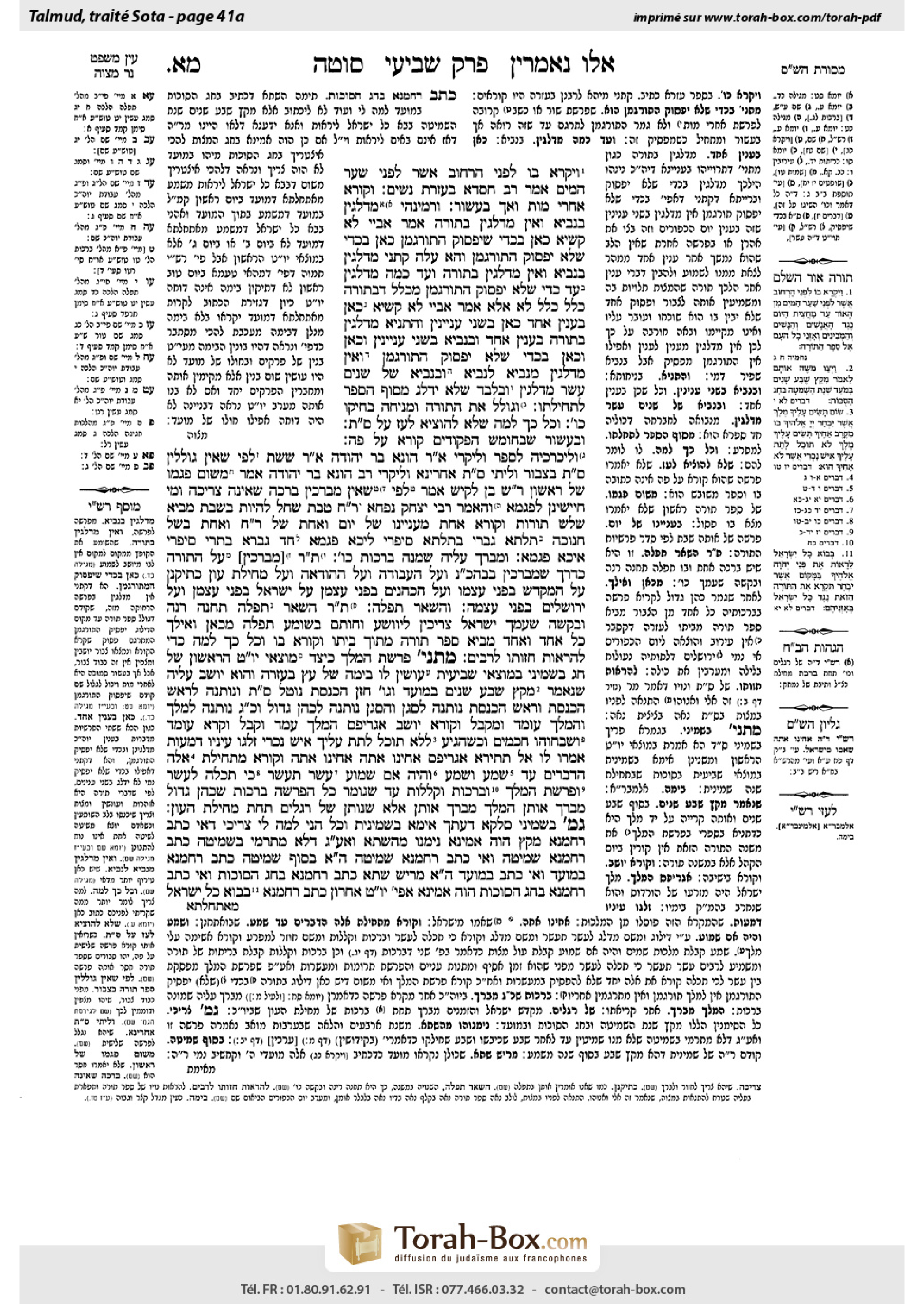
Sotah 41a: Talmud study for Daf Yomi
Daf Yomi is the daily study of one Talmud folio. Explore 37 tractates with scans, Hebrew text, Sefaria English and AI-generated French translations where annotated.
Passage selection and English or AI-generated French translation are available where the scan has annotations. Daf Study is independent of Torah-Box and Sefaria.
Browse Sotah · סוטה · All tractatesSotah 41a text and translations
This page of Sotah includes the Aramaic text, an English translation and an AI-generated French translation, alongside the scan above.
סוטה מ״א א · Aramaic and Hebrew text
״וַיִּקְרָא בוֹ לִפְנֵי הָרְחוֹב אֲשֶׁר לִפְנֵי שַׁעַר הַמַּיִם״! אָמַר רַב חִסְדָּא: בְּעֶזְרַת נָשִׁים.
וְקוֹרֵא ״אַחֲרֵי מוֹת״ וְ״אַךְ בֶּעָשׂוֹר״. ורְמִינְהִי: מְדַלְּגִין בְּנָבִיא וְאֵין מְדַלְּגִין בַּתּוֹרָה!
אָמַר אַבָּיֵי, לָא קַשְׁיָא: כָּאן — בִּכְדֵי שֶׁיִּפְסוֹק הַתּוּרְגְּמָן, כָּאן — בִּכְדֵי שֶׁלֹּא יִפְסוֹק הַתּוּרְגְּמָן.
וְהָא עֲלַהּ קָתָנֵי: מְדַלְּגִין בְּנָבִיא וְאֵין מְדַלְּגִין בַּתּוֹרָה. וְעַד כַּמָּה מְדַלְּגִין — עַד כְּדֵי שֶׁלֹּא יִפְסוֹק הַתּוּרְגְּמָן. מִכְלָל דְּבַתּוֹרָה כְּלָל כְּלָל לָא!
אֶלָּא אָמַר אַבָּיֵי, לָא קַשְׁיָא: כָּאן בְּעִנְיָן אֶחָד, כָּאן בִּשְׁנֵי עִנְיָינִין.
וְהָתַנְיָא: מְדַלְּגִין בַּתּוֹרָה בְּעִנְיָן אֶחָד, וּבְנָבִיא בִּשְׁנֵי עִנְיָינִין. וְכָאן וְכָאן בִּכְדֵי שֶׁלֹּא יִפְסוֹק הַתּוּרְגְּמָן.
וְאֵין מְדַלְּגִין מִנָּבִיא לְנָבִיא. וּבְנָבִיא שֶׁל שְׁנֵים עָשָׂר מְדַלְּגִין, וּבִלְבַד שֶׁלֹּא יְדַלֵּג מִסּוֹף הַסֵּפֶר לִתְחִילָּתוֹ.
וְגוֹלֵל אֶת הַתּוֹרָה וּמַנִּיחָהּ בְּחֵיקוֹ כּוּ׳. וְכׇל כָּךְ לָמָּה — שֶׁלֹּא לְהוֹצִיא לַעַז עַל סֵפֶר תּוֹרָה.
״וּבֶעָשׂוֹר שֶׁבְּחוֹמֶשׁ הַפְּקוּדִים קוֹרֵא עַל פֶּה״. וְלִיכְרְכֵיהּ לְסֵפֶר וְלִיקְרֵי! אָמַר רַב הוּנָא בַּר יְהוּדָה אָמַר רַב שֵׁשֶׁת: לְפִי שֶׁאֵין גּוֹלְלִין סֵפֶר תּוֹרָה בַּצִּבּוּר.
וְלַיְתֵי סֵפֶר תּוֹרָה אַחֲרִינָא וְלִיקְרֵי! רַב הוּנָא בַּר יְהוּדָה אָמַר: מִשּׁוּם פְּגָמוֹ שֶׁל רִאשׁוֹן. רַבִּי שִׁמְעוֹן בֶּן לָקִישׁ אָמַר: לְפִי שֶׁאֵין מְבָרְכִין בְּרָכָה שֶׁאֵינָהּ צְרִיכָה.
וּמִי חָיְישִׁינַן לִפְגָמָא? וְהָאָמַר רַבִּי יִצְחָק נַפָּחָא: רֹאשׁ חֹדֶשׁ טֵבֵת שֶׁחָל לִהְיוֹת בְּשַׁבָּת מֵבִיא שָׁלֹשׁ תּוֹרוֹת וְקוֹרֵא: אַחַת מֵעִנְיָינוֹ שֶׁל יוֹם, וְאַחַת שֶׁל רֹאשׁ חֹדֶשׁ, וְאַחַת בְּשֶׁל חֲנוּכָּה!
תְּלָתָא גַּבְרֵי בִּתְלָתָא סִיפְרֵי — לֵיכָּא פְּגָמָא, חַד גַּבְרָא בִּתְרֵי סִיפְרֵי — אִיכָּא פְּגָמָא.
וּמְבָרֵךְ עָלֶיהָ שְׁמֹנֶה בְּרָכוֹת כּוּ׳. תָּנוּ רַבָּנַן: [מְבָרְכִין] עַל הַתּוֹרָה כְּדֶרֶךְ שֶׁמְּבָרְכִין בְּבֵית הַכְּנֶסֶת, וְעַל הָעֲבוֹדָה, וְעַל הַהוֹדָאָה, וְעַל מְחִילַת עָוֹן — כְּתִיקְנָן. עַל הַמִּקְדָּשׁ בִּפְנֵי עַצְמוֹ, וְעַל הַכֹּהֲנִים בִּפְנֵי עַצְמָן, עַל יִשְׂרָאֵל בִּפְנֵי עַצְמָן, וְעַל יְרוּשָׁלַיִם בִּפְנֵי עַצְמָהּ.
וְהַשְּׁאָר תְּפִלָּה. תָּנוּ רַבָּנַן: הַשְּׁאָר תְּפִלָּה תְּחִנָּה רִנָּה וּבַקָּשָׁה שֶׁעַמְּךָ יִשְׂרָאֵל צְרִיכִין לִיוּוֹשֵׁעַ. וְחוֹתֵם בְּשׁוֹמֵעַ תְּפִלָּה. מִכָּאן וְאֵילָךְ — כׇּל אֶחָד וְאֶחָד מֵבִיא סֵפֶר תּוֹרָה מִתּוֹךְ בֵּיתוֹ וְקוֹרֵא בּוֹ. וְכׇל כָּךְ לָמָּה — כְּדֵי לְהַרְאוֹת חָזוּתוֹ לְרַבִּים.
מַתְנִי׳ פָּרָשַׁת הַמֶּלֶךְ כֵּיצַד? מוֹצָאֵי יוֹם טוֹב הָרִאשׁוֹן שֶׁל חַג, בַּשְּׁמִינִי בְּמוֹצָאֵי שְׁבִיעִית, עוֹשִׂין לוֹ בִּימָה שֶׁל עֵץ בָּעֲזָרָה וְהוּא יוֹשֵׁב עָלֶיהָ, שֶׁנֶּאֱמַר: ״מִקֵּץ שֶׁבַע שָׁנִים בְּמֹעֵד וְגוֹ׳״.
חַזַּן הַכְּנֶסֶת נוֹטֵל סֵפֶר תּוֹרָה וְנוֹתְנָהּ לְרֹאשׁ הַכְּנֶסֶת, וְרֹאשׁ הַכְּנֶסֶת נוֹתְנָהּ לַסְּגָן, וְהַסְּגָן נוֹתְנָהּ לְכֹהֵן גָּדוֹל, וְכֹהֵן גָּדוֹל נוֹתְנָהּ לַמֶּלֶךְ. וְהַמֶּלֶךְ עוֹמֵד וּמְקַבֵּל, וְקוֹרֵא יוֹשֵׁב.
אַגְרִיפַּס הַמֶּלֶךְ עָמַד וְקִבֵּל וְקָרָא עוֹמֵד, וְשִׁבְּחוּהוּ חֲכָמִים. וּכְשֶׁהִגִּיעַ לְ״לֹא תוּכַל לָתֵת עָלֶיךָ אִישׁ נׇכְרִי״, זָלְגוּ עֵינָיו דְּמָעוֹת. אָמְרוּ לוֹ: אַל תִּתְיָרֵא אַגְרִיפַּס, אָחִינוּ אָתָּה, אָחִינוּ אָתָּה!
וְקוֹרֵא מִתְּחִילַּת ״אֵלֶּה הַדְּבָרִים״, עַד ״שְׁמַע״, וּ״שְׁמַע״, ״וְהָיָה אִם שָׁמֹעַ״, ״עַשֵּׂר תְּעַשֵּׂר״, ״כִּי תְכַלֶּה לַעְשֵׂר״, וּפָרָשַׁת הַמֶּלֶךְ, וּבְרָכוֹת וּקְלָלוֹת, עַד שֶׁגּוֹמֵר כׇּל הַפָּרָשָׁה.
בְּרָכוֹת שֶׁכֹּהֵן גָּדוֹל מְבָרֵךְ אוֹתָן — הַמֶּלֶךְ מְבָרֵךְ אוֹתָן, אֶלָּא שֶׁנּוֹתֵן שֶׁל רְגָלִים תַּחַת מְחִילַת הֶעָוֹן.
גְּמָ׳ בַּשְּׁמִינִי סָלְקָא דַּעְתָּךְ? אֵימָא: בַּשְּׁמִינִית.
וְכׇל הָנֵי לְמָה לִי?
צְרִיכִי, דְּאִי כְּתַב רַחֲמָנָא ״מִקֵּץ״ — הֲוָה אָמֵינָא נִימְנוֹ מֵהַשְׁתָּא, וְאַף עַל גַּב דְּלָא מִתְרְמֵי בִּשְׁמִיטָּה, כְּתַב רַחֲמָנָא ״שְׁמִטָּה״.
וְאִי כְּתַב רַחֲמָנָא ״שְׁמִטָּה״ — הֲוָה אָמֵינָא בְּסוֹף שְׁמִיטָּה, כְּתַב רַחֲמָנָא ״בְּמֹעֵד״.
וְאִי כְּתַב ״בְּמֹעֵד״ — הֲוָה אָמֵינָא מֵרֵישׁ שַׁתָּא, כְּתַב רַחֲמָנָא ״בְּחַג הַסֻּכּוֹת״.
וְאִי כְּתַב רַחֲמָנָא ״בְּחַג הַסֻּכּוֹת״ — הֲוָה אָמֵינָא אֲפִילּוּ יוֹם טוֹב אַחֲרוֹן, כְּתַב רַחֲמָנָא ״בְּבוֹא כׇל יִשְׂרָאֵל״.
Sotah 41a · English translation
“And he read there before the broad place that was before the Gate of the Water” (Nehemiah 8:3). According to this opinion, the High Priest would read from the Torah in the Temple courtyard. Rav Ḥisda says in response: The baraita also means that the reading takes place in the women’s courtyard.
§ It is taught in the mishna that the High Priest receives the Torah scroll and reads the Torah portion beginning with the verse: “After the death” (Leviticus 16:1), and the portion beginning with the verse: “But on the tenth” (Leviticus 23:26). Since these two portions are not adjacent to each other, the High Priest skips the section between the two portions. The Gemara raises a contradiction from a mishna (Megilla 24a): One may skip sections when reading the haftara in the Prophets, but one may not skip sections when reading in the Torah.
Abaye said: This is not difficult. There, in the mishna in tractate Megilla that teaches that one may not skip, the intention is that one should not skip if the sections are so far apart from one another that the delay caused by doing so will be of such length that the translator who recites the Aramaic translation will conclude his translation before the next section is reached. However, in the case of the mishna here, it is permitted to skip verses because the two passages are in close proximity to one another. The delay caused is of such short length that the translator will still not conclude his translation.
The Gemara challenges this resolution: But isn’t it taught about this mishna in a baraita: One may skip sections when reading in the Prophets, but one may not skip sections when reading in the Torah. And how much may one skip from one passage to another in the Prophets? One may skip when the section skipped is of such short length that when the furling of the scroll is completed the translator will still not have concluded his translation. By inference, when reading in the Torah one may not skip at all.
Rather, Abaye said another explanation: This is not difficult. In the mishna here, it is permitted to skip because both passages pertain to a single topic. There, in the mishna in tractate Megilla that teaches that one may not skip, the halakha is referring to a case where the passages pertain to two different topics.
And this is as it is taught in a baraita: One may skip sections when reading in the Torah when both sections pertain to a single topic, and in the Prophets one may skip from one section to another even if they pertain to two different topics. And both here and there, one may skip only when the section skipped is of such short length that when the furling of the scroll is completed the translator will still not have concluded his translation.
And one may not skip from one book of the Prophets to another book of the Prophets, even if both pertain to the same topic. But among the books of the Twelve Prophets one may skip, provided that one does not skip from the end of the book to its beginning. Rather, if one wishes to read from several of the Twelve Prophets, he must read the passages in the order that they are written.
§ It is taught in the mishna: And he furls the Torah scroll, and places it on his bosom, and says: More than what I have read before you is written here. The Gemara comments: And why must he say all of this? It is so as to not cast aspersions on the Torah scroll, because people might think the portion that he read by heart is not written there.
It is stated in the mishna that he reads by heart the portion beginning with: “And on the tenth,” from the book of Numbers (29:7–11). The Gemara asks: But let him furl the Torah scroll to that portion and read it from the text. Rav Huna bar Yehuda says that Rav Sheshet says: This is not done because one may not furl a Torah scroll in public, out of respect for the congregation.
The Gemara asks: But why not let them bring another Torah scroll that has previously been furled to that portion and read from it? Rav Huna bar Yehuda says: People might then mistakenly think that the second scroll was brought due to a flaw that was found in the first scroll. Rabbi Shimon ben Lakish says: Another scroll is not brought because then the High Priest will need to recite an additional blessing over it, and one may not recite a blessing that is unnecessary.
The Gemara questions Rav Huna bar Yehuda’s answer: But are we really concerned that people will think that there is a flaw in the first scroll? But didn’t Rabbi Yitzḥak Nappaḥa say: When the New Moon of Tevet, which always occurs during Hanukkah, occurs on Shabbat, one brings three Torah scrolls. And he reads from one scroll the topic of the day, i.e., the weekly portion; and from one scroll the portion of the New Moon; and from one scroll the portion of Hanukkah. It is apparent from the statement of Rabbi Yitzḥak Nappaḥa that many Torah scrolls may be used, and there is no concern that people will mistakenly think that one or more has a flaw.
The Gemara answers: When three men read from three scrolls, there is no concern that people will think that one of the scrolls has a flaw, since people assume that it is befitting for each individual to read from his own scroll. However, when one man reads from two different Torah scrolls, there is a concern that people will think that the first scroll has a flaw, and they will not realize that this was done only to avoid forcing the community to wait while the scroll is furled.
§ It is taught in the mishna: And after the reading the High Priest recites eight blessings. The Sages taught that these are the eight blessings: He recites a blessing concerning the Torah in the usual way one recites a blessing in the synagogue, and he recites the three blessings concerning the Temple service, and concerning thanksgiving, and concerning forgiveness for iniquity, and all are recited in accordance with their established forms in the Amida prayer. He recites the blessing concerning the Temple in and of itself, the blessing concerning the priests in and of itself, the blessing concerning the Jewish people in and of itself, and the blessing concerning Jerusalem in and of itself.
With regard to the end of the mishna, which states: And the rest of the prayer, the Sages taught: The text of the rest of the prayer is as follows: A supplication, a song, and a request that Your people, Israel, are in need of redemption. And he concludes the blessing with: Blessed are You, Lord, the One Who hears prayer. From this point forward, each and every person present brings a Torah scroll from his home and reads from it. And why do all these people bring their personal Torah scrolls? Everyone brings his own in order to show its beautiful appearance to the public, as a way of showing fondness for the mitzva.
MISHNA: How is the portion of the Torah that is read by the king recited at the assembly, when all the Jewish people would assemble? At the conclusion of the first day of the festival of Sukkot, on the eighth, after the conclusion of the Sabbatical Year, they make a wooden platform for the king in the Temple courtyard, and he sits on it, as it is stated: “At the end of every seven years, in the Festival of the Sabbatical Year” (Deuteronomy 31:10).
The synagogue attendant takes a Torah scroll and gives it to the head of the synagogue that stands on the Temple Mount. And the head of the synagogue gives it to the deputy High Priest, and the deputy High Priest gives it to the High Priest, and the High priest gives it to the king. And the king stands, and receives the Torah scroll, and reads from it while sitting.
King Agrippa arose, and received the Torah scroll, and read from it while standing, and the Sages praised him for this. And when Agrippa arrived at the verse in the portion read by the king that states: “You may not appoint a foreigner over you” (Deuteronomy 17:15), tears flowed from his eyes, because he was a descendant of the house of Herod and was not of Jewish origin. The entire nation said to him: Fear not, Agrippa. You are our brother, you are our brother.
And the king reads from the beginning of Deuteronomy, from the verse that states: “And these are the words” (Deuteronomy 1:1), until the words: “Hear, O Israel” (Deuteronomy 6:4). And he then reads the sections beginning with: “Hear, O Israel” (Deuteronomy 6:4–9), “And it shall come to pass, if you shall hearken” (Deuteronomy 11:13–21), “You shall tithe” (Deuteronomy 14:22–29), “When you have made an end of the tithing” (Deuteronomy 26:12–15), and the passage concerning the appointment of a king (Deuteronomy 17:14–20), and the blessings and curses (Deuteronomy 28), until he finishes the entire portion.
The same blessings that the High Priest recites on Yom Kippur, the king recites at this ceremony, but he delivers a blessing concerning the Festivals in place of the blessing concerning forgiveness for iniquity.
GEMARA: The mishna states that the assembly takes place on the eighth. The Gemara asks: Does it enter your mind that the assembly takes place on the eighth day of the festival of Sukkot? The mishna clearly states that the ceremony takes place at the conclusion of the first day of the Festival. Rather, say that it takes place during the eighth year of the Sabbatical cycle.
The verse describes in detail when the assembly takes place: “At the end of every seven years, in the Festival of the Sabbatical Year, in the festival of Sukkot, when all Israel comes to appear before the Lord your God” (Deuteronomy 31:10–11). The Gemara asks: And why do I need all these details?
The Gemara answers: All of these details are necessary, as, if the Merciful One had written only “at the end of every seven years” (Deuteronomy 31:10), I would have said that we count from now, i.e., from when this was said, and that the tally of years begins from the fortieth year in the wilderness, even though by this calculation the assembly would not occur in the Sabbatical Year. Therefore, the Merciful One writes: “The Sabbatical Year.”
And if the Merciful One had written only the phrase: At the end of every seven years of the “Sabbatical Year,” I would have said that it takes place at the end of the Sabbatical Year. Therefore, the Merciful One writes: “In the Festival,” and the first Festival following the Sabbatical Year is in the month of Tishrei.
And if the Torah had written only: “At the end of every seven years in the Festival of the Sabbatical Year,” I would have said that it takes place on the festival of Rosh Hashanah, which is on the first day of Tishrei. Therefore, the Merciful One also writes: “In the festival of Sukkot.”
And if the Merciful One had written only: “In the festival of Sukkot,” I would have said that it could refer even to the last day of the Festival. Therefore, the Merciful One also writes: “When all Israel comes” (Deuteronomy 31:11),
Sotah 41a · Traduction française (IA)
« Et il lut là, devant la grande place qui se trouvait devant la porte de l’Eau » (Néhémie 8:3). Selon cette opinion, le grand prêtre lisait la Torah dans le parvis du Temple. Rav Ḥisda répond : La baraïta signifie également que la lecture a lieu dans le parvis des femmes.
§ Il est enseigné dans la Michna que le grand prêtre reçoit le rouleau de la Torah et lit le passage qui commence par les mots : « Après la mort » (Lévitique 16:1), puis celui qui commence par les mots : « Le dixième jour » (Lévitique 23:26). Ces deux passages n’étant pas contigus, le grand prêtre saute la section qui les sépare. La Guemara soulève une contradiction à partir d’une Michna (Meguila 24a) : on peut sauter des passages lors de la lecture de la haftara dans les Prophètes, mais on ne peut pas en sauter lors de la lecture de la Torah.
Abaye dit : Il n’y a pas de difficulté. Dans la Michna du traité Meguila, où il est enseigné qu’on ne peut pas sauter, il s’agit de passages si éloignés l’un de l’autre que le délai occasionné serait tel que le traducteur, qui récite la traduction araméenne, aurait terminé avant qu’on n’atteigne le passage suivant. En revanche, dans le cas de la Michna ici, il est permis de sauter des versets, car les deux passages sont proches l’un de l’autre. Le délai occasionné est si bref que le traducteur n’aura pas encore terminé sa traduction.
La Guemara conteste cette résolution : Mais n’est-il pas enseigné au sujet de cette Michna dans une baraïta : on peut sauter des passages lors de la lecture des Prophètes, mais on ne peut pas en sauter lors de la lecture de la Torah. De quelle longueur peut être le passage sauté d’un passage à un autre dans les Prophètes ? On peut sauter si le passage omis est si court qu’une fois le rouleau enroulé, le traducteur n’aura pas encore terminé sa traduction. Il en ressort que, lors de la lecture de la Torah, on ne peut rien sauter.
Abaye donne plutôt une autre explication : Il n’y a pas de difficulté. Dans la Michna ici, il est permis de sauter parce que les deux passages traitent d’un seul et même sujet. Dans la Michna du traité Meguila, où il est enseigné qu’on ne peut pas sauter, la halakha concerne un cas où les passages traitent de deux sujets différents.
Et c’est conforme à ce qui est enseigné dans une baraïta : on peut sauter des passages lors de la lecture de la Torah lorsque les deux passages traitent d’un seul et même sujet ; dans les Prophètes, on peut sauter d’un passage à un autre même s’ils traitent de deux sujets différents. Dans les deux cas, on ne peut sauter que si le passage omis est si court qu’une fois le rouleau enroulé, le traducteur n’aura pas encore terminé sa traduction.
On ne peut pas sauter d’un livre des Prophètes à un autre, même si les deux traitent du même sujet. Toutefois, parmi les livres des Douze Prophètes, on peut sauter, à condition de ne pas passer de la fin d’un livre à son début. Si l’on souhaite lire des passages de plusieurs des Douze Prophètes, il faut donc les lire dans l’ordre où ils sont écrits.
§ Il est enseigné dans la Michna : Il enroule le rouleau de la Torah, le pose sur son sein et dit : « Plus que ce que je vous ai lu est écrit ici. » La Guemara commente : Pourquoi doit-il dire tout cela ? Afin de ne pas jeter le discrédit sur le rouleau de la Torah, car les gens pourraient penser que le passage qu’il a récité de mémoire n’y est pas écrit.
La Michna indique qu’il récite de mémoire le passage qui commence par les mots : « Le dixième jour », dans le livre des Nombres (29:7–11). La Guemara demande : Mais pourquoi n’enroule-t-il pas le rouleau de la Torah jusqu’à ce passage pour le lire dans le texte ? Rav Huna bar Yehuda dit au nom de Rav Sheshet : Cela ne se fait pas, car on ne doit pas enrouler un rouleau de la Torah en public, par respect pour l’assemblée.
La Guemara demande : Mais pourquoi ne pas apporter un autre rouleau de la Torah, déjà enroulé jusqu’à ce passage, et le lire ? Rav Huna bar Yehuda répond : Les gens pourraient alors croire à tort que le second rouleau a été apporté parce qu’un défaut a été découvert dans le premier. Rabbi Shimon ben Lakish dit : On n’apporte pas un autre rouleau, car le grand prêtre devrait alors réciter une bénédiction supplémentaire à son sujet, et on ne doit pas réciter de bénédiction qui n’est pas nécessaire.
La Guemara met en doute la réponse de Rav Huna bar Yehuda : Mais craint-on vraiment que les gens pensent qu’il y a un défaut dans le premier rouleau ? Rabbi Yitzḥak Nappaḥa n’a-t-il pas dit : Lorsque la nouvelle lune de Tévet, qui tombe toujours pendant Ḥanoucca, a lieu un Chabbat, on apporte trois rouleaux de la Torah. On lit dans l’un le sujet du jour, c’est-à-dire la paracha hebdomadaire ; dans un autre, le passage de la nouvelle lune ; et dans un troisième, le passage de Ḥanoucca. Il ressort de la déclaration de Rabbi Yitzḥak Nappaḥa qu’on peut utiliser plusieurs rouleaux de la Torah sans craindre que les gens pensent à tort que l’un d’eux, ou plusieurs, présentent un défaut.
La Guemara répond : Lorsque trois hommes lisent dans trois rouleaux, on ne craint pas que les gens pensent que l’un des rouleaux présente un défaut, car ils supposent qu’il convient que chacun lise dans son propre rouleau. En revanche, lorsqu’un seul homme lit dans deux rouleaux différents de la Torah, on craint que les gens pensent que le premier rouleau présente un défaut et ne comprennent pas que cela a été fait uniquement pour éviter de faire attendre l’assemblée pendant qu’on enroule le rouleau.
§ Il est enseigné dans la Michna : Après la lecture, le grand prêtre récite huit bénédictions. Les Sages ont enseigné que voici ces huit bénédictions : il récite une bénédiction relative à la Torah, selon la formule habituelle d’une bénédiction récitée à la synagogue ; puis il récite les trois bénédictions relatives au service du Temple, à l’action de grâce et au pardon des fautes, toutes selon leur formule établie dans la prière de la Amida. Il récite séparément la bénédiction relative au Temple, celle relative aux prêtres, celle relative au peuple juif et celle relative à Jérusalem.
À propos de la fin de la Michna, qui dit : « Et le reste de la prière », les Sages ont enseigné que le texte de cette partie de la prière est le suivant : une supplication, un chant et une requête, car Ton peuple, Israël, a besoin de rédemption. Il conclut la bénédiction ainsi : « Béni sois-Tu, Seigneur, qui entends la prière. » À partir de là, chacune des personnes présentes apporte un rouleau de la Torah de chez elle et y lit. Pourquoi toutes ces personnes apportent-elles leur propre rouleau de la Torah ? Chacun apporte le sien afin d’en montrer la belle apparence au public, manifestant ainsi son attachement à la mitsva.
MICHNA : Comment lit-on, lors de l’assemblée où tout le peuple juif se réunit, le passage de la Torah lu par le roi ? À la fin du premier jour de la fête de Souccot, la huitième année, après la fin de l’année de la Chemita, on construit pour le roi une estrade en bois dans le parvis du Temple, et il s’y assied, comme il est dit : « À la fin de chaque période de sept ans, lors de la fête de l’année de la Chemita » (Deutéronome 31:10).
Le préposé de la synagogue prend un rouleau de la Torah et le remet au chef de la synagogue qui se tient sur le mont du Temple. Le chef de la synagogue le remet au grand prêtre adjoint, le grand prêtre adjoint le remet au grand prêtre, et le grand prêtre le remet au roi. Le roi se lève, reçoit le rouleau de la Torah et en lit le texte assis.
Le roi Agrippa se leva, reçut le rouleau de la Torah et en lut le texte debout ; les Sages le louèrent pour cela. Lorsque Agrippa arriva au verset du passage lu par le roi qui dit : « Tu ne pourras pas mettre à ta tête un étranger » (Deutéronome 17:15), des larmes lui coulèrent des yeux, car il descendait de la maison d’Hérode et n’était pas d’origine juive. Tout le peuple lui dit : « N’aie pas peur, Agrippa. Tu es notre frère, tu es notre frère. »
Le roi lit depuis le début du Deutéronome, à partir du verset qui dit : « Voici les paroles » (Deutéronome 1:1), jusqu’aux mots : « Écoute, Israël » (Deutéronome 6:4). Il lit ensuite les passages qui commencent par : « Écoute, Israël » (Deutéronome 6:4–9), « Et il arrivera, si vous écoutez » (Deutéronome 11:13–21), « Tu prélèveras la dîme » (Deutéronome 14:22–29), « Lorsque tu auras achevé de prélever la dîme » (Deutéronome 26:12–15), puis le passage relatif à l’établissement d’un roi (Deutéronome 17:14–20), ainsi que les bénédictions et les malédictions (Deutéronome 28), jusqu’à ce qu’il termine tout le passage.
Lors de cette cérémonie, le roi récite les mêmes bénédictions que le grand prêtre récite à Yom Kippour, mais il récite une bénédiction relative aux fêtes à la place de celle relative au pardon des fautes.
GUEMARA : La Michna indique que l’assemblée a lieu « la huitième ». La Guemara demande : Peut-on vraiment penser que l’assemblée a lieu le huitième jour de la fête de Souccot ? La Michna dit clairement que la cérémonie a lieu à la fin du premier jour de la fête. Il faut plutôt dire qu’elle a lieu au cours de la huitième année du cycle de la Chemita.
Le verset précise en détail quand a lieu l’assemblée : « À la fin de chaque période de sept ans, lors de la fête de l’année de la Chemita, à la fête de Souccot, lorsque tout Israël vient se présenter devant le Seigneur ton Dieu » (Deutéronome 31:10–11). La Guemara demande : Pourquoi tous ces détails sont-ils nécessaires ?
La Guemara répond : Tous ces détails sont nécessaires. Car si le Miséricordieux avait écrit uniquement « à la fin de chaque période de sept ans » (Deutéronome 31:10), j’aurais dit que nous comptons à partir de maintenant, c’est-à-dire à partir du moment où cela a été dit, et que le décompte des années commence à la quarantième année dans le désert, même si, selon ce calcul, l’assemblée n’aurait pas lieu pendant l’année de la Chemita. Le Miséricordieux écrit donc : « L’année de la Chemita. »
Et si le Miséricordieux avait écrit uniquement la formule « à la fin de chaque période de sept ans de l’année de la Chemita », j’aurais dit que cela a lieu à la fin de l’année de la Chemita. Le Miséricordieux écrit donc : « Lors de la fête », et la première fête qui suit l’année de la Chemita a lieu au mois de Tichri.
Et si la Torah avait écrit uniquement : « À la fin de chaque période de sept ans, lors de la fête de l’année de la Chemita », j’aurais dit que cela a lieu à la fête de Roch Hachana, qui tombe le premier jour de Tichri. Le Miséricordieux écrit donc aussi : « À la fête de Souccot. »
Et si le Miséricordieux avait écrit uniquement : « À la fête de Souccot », j’aurais dit que cela pouvait désigner même le dernier jour de la fête. Le Miséricordieux écrit donc aussi : « Lorsque tout Israël vient » (Deutéronome 31:11),
Traduction française générée par IA à partir de l’édition anglaise de Sefaria. Vérifie toujours un passage avec le texte source.
Text from Sefaria: William Davidson Edition - Vocalized Aramaic (CC BY NC); William Davidson Edition - English (CC BY NC).