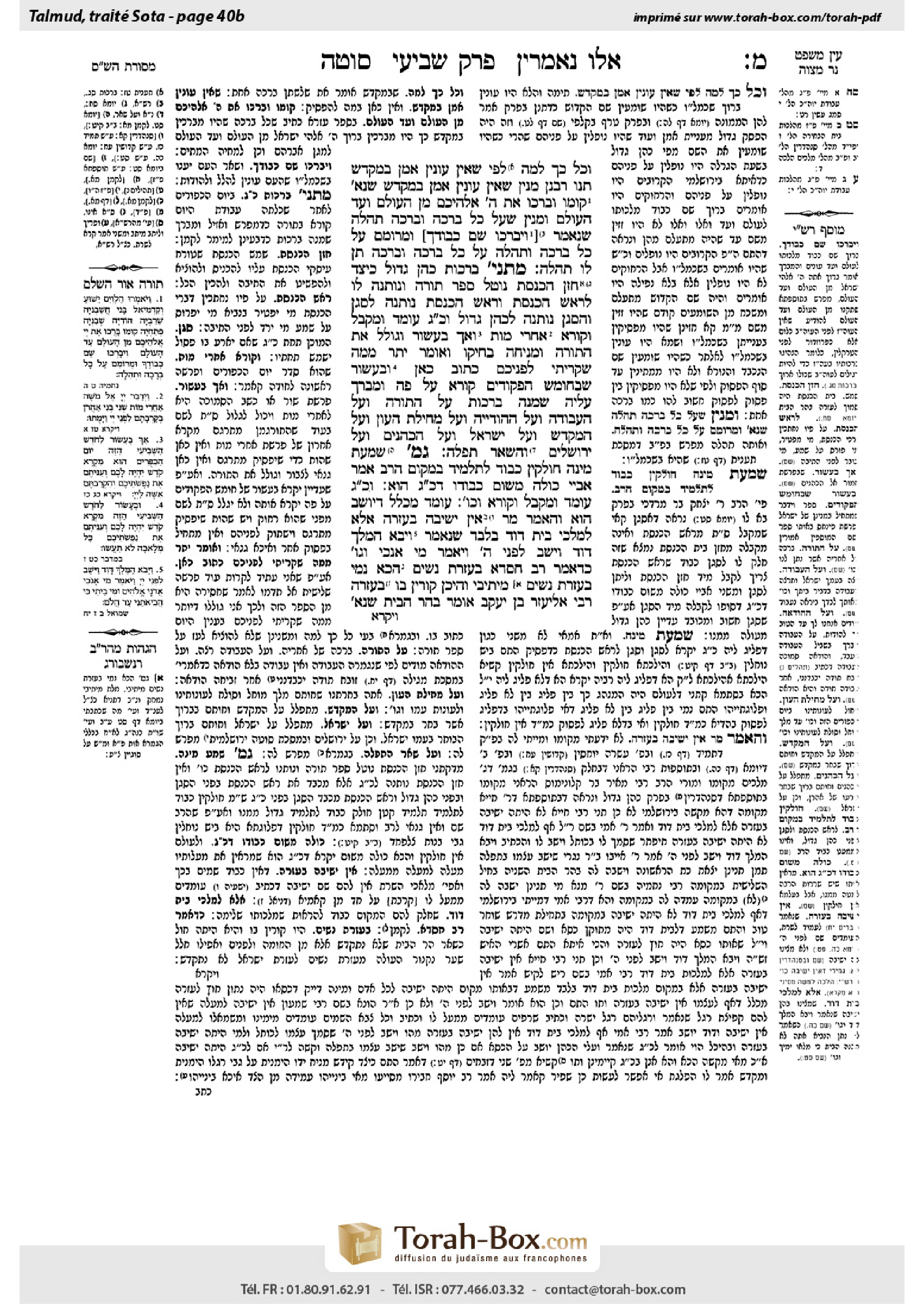
Sotah 40b: Talmud study for Daf Yomi
Daf Yomi is the daily study of one Talmud folio. Explore 37 tractates with scans, Hebrew text, Sefaria English and AI-generated French translations where annotated.
Passage selection and English or AI-generated French translation are available where the scan has annotations. Daf Study is independent of Torah-Box and Sefaria.
Browse Sotah · סוטה · All tractatesSotah 40b text and translations
This page of Sotah includes the Aramaic text, an English translation and an AI-generated French translation, alongside the scan above.
סוטה מ׳ ב · Aramaic and Hebrew text
וְכׇל כָּךְ לָמָּה — לְפִי שֶׁאֵין עוֹנִין ״אָמֵן״ בַּמִּקְדָּשׁ.
תָּנוּ רַבָּנַן: מִנַּיִן שֶׁאֵין עוֹנִין ״אָמֵן״ בַּמִּקְדָּשׁ — שֶׁנֶּאֱמַר: ״קוּמוּ בָּרְכוּ אֶת ה׳ אֱלֹהֵיכֶם מִן הָעוֹלָם עַד הָעוֹלָם״. וּמִנַּיִן שֶׁעַל כׇּל בְּרָכָה וּבְרָכָה תְּהִלָּה — שֶׁנֶּאֱמַר: ״וִיבָרְכוּ שֵׁם כְּבֹדֶךָ וּמְרוֹמַם עַל כׇּל בְּרָכָה וּתְהִלָּה״. עַל כׇּל בְּרָכָה וּבְרָכָה תֵּן לוֹ תְּהִלָּה.
מַתְנִי׳ בִּרְכוֹת כֹּהֵן גָּדוֹל כֵּיצַד? חַזַּן הַכְּנֶסֶת נוֹטֵל סֵפֶר תּוֹרָה וְנוֹתְנָהּ לוֹ לְרֹאשׁ הַכְּנֶסֶת, וְרֹאשׁ הַכְּנֶסֶת נוֹתְנָהּ לַסְּגָן, וְהַסְּגָן נוֹתְנָהּ לְכֹהֵן גָּדוֹל,
וְכֹהֵן גָּדוֹל עוֹמֵד וּמְקַבֵּל, וְקוֹרֵא ״אַחֲרֵי מוֹת״, וְ״אַךְ בֶּעָשׂוֹר״. וְגוֹלֵל אֶת הַתּוֹרָה וּמַנִּיחָהּ בְּחֵיקוֹ, וְאוֹמֵר: יָתֵר מִמַּה שֶּׁקָּרִיתִי לִפְנֵיכֶם כָּתוּב כָּאן. ״וּבֶעָשׂוֹר״ שֶׁבְּחוֹמֶשׁ הַפְּקוּדִים קוֹרֵא עַל פֶּה.
וּמְבָרֵךְ עָלֶיהָ שְׁמֹנֶה בְּרָכוֹת: עַל הַתּוֹרָה, וְעַל הָעֲבוֹדָה, וְעַל הַהוֹדָיָיה, וְעַל מְחִילַת הֶעָוֹן, וְעַל הַמִּקְדָּשׁ, וְעַל יִשְׂרָאֵל, וְעַל הַכֹּהֲנִים, וְעַל יְרוּשָׁלַיִם, וְהַשְּׁאָר תְּפִלָּה.
גְּמָ׳ שָׁמְעַתְּ מִינַּהּ חוֹלְקִין כָּבוֹד לְתַלְמִיד בִּמְקוֹם הָרַב.
אָמַר אַבָּיֵי: כּוּלַּהּ מִשּׁוּם כְּבוֹדוֹ דְּכֹהֵן גָּדוֹל הוּא.
וְכֹהֵן גָּדוֹל עוֹמֵד וּמְקַבֵּל וְקוֹרֵא וְכוּ׳. ״עוֹמֵד״ — מִכְּלָל דְּיוֹשֵׁב הוּא? וְהָאָמַר מָר: אֵין יְשִׁיבָה בַּעֲזָרָה אֶלָּא לְמַלְכֵי בֵּית דָּוִד בִּלְבַד, שֶׁנֶּאֱמַר: ״וַיָּבֹא הַמֶּלֶךְ דָּוִד וַיֵּשֶׁב לִפְנֵי ה׳ וַיֹּאמֶר מִי אָנֹכִי וְגוֹ׳״!
כִּדְאָמַר רַב חִסְדָּא: בְּעֶזְרַת נָשִׁים, הָכָא נָמֵי בְּעֶזְרַת נָשִׁים.
מֵיתִיבִי: וְהֵיכָן קוֹרִין בּוֹ — בָּעֲזָרָה, רַבִּי אֱלִיעֶזֶר בֶּן יַעֲקֹב אוֹמֵר: בְּהַר הַבַּיִת, שֶׁנֶּאֱמַר:
Sotah 40b · English translation
The Gemara asks: And why does the practice in the Temple differ so much from outside the Temple? Because one does not answer amen in the Temple, and therefore there is no pause between the blessings.
The Sages taught: From where is it derived that one does not answer amen in the Temple? As it is stated: “Stand up and bless the Lord, your God, from everlasting to everlasting” (Nehemiah 9:5). This blessing is recited instead of amen in the Temple. And from where is it derived that for each and every blessing in the Temple the people respond with these words of praise? As it is stated: “And let them say: Blessed be Your glorious name, which is exalted above all blessing and praise” (Nehemiah 9:5). This verse indicates that for each and every blessing, you should give Him praise. However, those present do not respond amen.
MISHNA: How are the blessings of the High Priest recited on Yom Kippur? The synagogue attendant takes a Torah scroll and gives it to the head of the synagogue that stands on the Temple Mount, and the head of the synagogue gives it to the deputy High Priest, and the deputy High Priest gives it to the High Priest.
And the High Priest stands; and receives the Torah scroll; and reads the Torah portion beginning with the verse: “After the death” (Leviticus 16:1–34), and the portion beginning with the verse: “But on the tenth” (Leviticus 23:26–32); and furls the Torah scroll; and places it on his bosom; and says: More than what I have read before you is written here. He then reads by heart the portion beginning with: “And on the tenth,” from the book of Numbers (see 29:7–11).
And after the reading the High Priest recites the following eight blessings: A blessing concerning the Torah, and concerning the Temple service, and concerning thanksgiving, and concerning forgiveness for iniquity, and concerning the Temple, and concerning the Jewish people, and concerning the priests, and concerning Jerusalem, and the rest of the prayer.
GEMARA: The Gemara suggests: You can learn from the fact that the head of the synagogue and the deputy High Priest receive the Torah scroll before the High Priest that honor may be given to a student in the presence of the teacher. Although the High Priest is considered everyone’s teacher and master, honor was nevertheless extended to other individuals in his presence without fear of impugning the High Priest’s honor.
Abaye said: A proof may not be adduced from here. Usually one does not show honor for a student in the presence of the teacher, but here the entire process is for the honor of the High Priest. The passing of the Torah scroll to people of increasing importance demonstrates that the High Priest is considered the most important of all those present.
It is stated in the mishna: And the High Priest stands, and receives the Torah scroll, and reads from it. The Gemara asks: From the fact that he stands, it can be understood by inference that until that point he had been sitting. But didn’t the Master say (Tosefta, Sanhedrin 4:4) that sitting in the Temple courtyard is permitted only for kings from the house of David, as it is stated: “Then King David went in, and sat before the Lord; and he said: Who am I, O Lord God, and what is my house, that You have brought me thus far?” (II Samuel 7:18).
The Gemara answers: As Rav Ḥisda said in a similar context: This took place not in the Israelite courtyard, where the prohibition against sitting applies, but in the women’s courtyard. Here, too, the reading was in the women’s courtyard, where it is permitted to sit, as it does not have the sanctified status of the Temple itself.
The Gemara raises an objection from a baraita (Tosefta 7:13): And where does the High Priest read from the Torah scroll? He reads from it in the Temple courtyard. Rabbi Eliezer ben Ya’akov says: He reads from it on the Temple Mount, as it is stated:
Sotah 40b · Traduction française (IA)
La Guemara demande : Pourquoi la pratique dans le Temple diffère-t-elle autant de celle qui a lieu à l’extérieur ? Parce qu’on ne répond pas amen dans le Temple ; il n’y a donc aucune pause entre les bénédictions.
Les Sages ont enseigné : D’où sait-on qu’on ne répond pas amen dans le Temple ? Comme il est dit : « Levez-vous et bénissez le Seigneur, votre Dieu, d’éternité en éternité » (Néhémie 9,5). Dans le Temple, cette bénédiction est récitée à la place de amen. Et d’où sait-on que, pour chacune des bénédictions dans le Temple, le peuple répond par ces paroles de louange ? Comme il est dit : « Et qu’ils disent : Béni soit Ton nom glorieux, qui est exalté au-dessus de toute bénédiction et de toute louange » (Néhémie 9,5). Ce verset indique qu’il faut Lui adresser des louanges après chacune des bénédictions. Toutefois, les personnes présentes ne répondent pas amen.
MICHNA : Comment le grand prêtre récite-t-il les bénédictions à Yom Kippour ? Le préposé de la synagogue prend un rouleau de la Torah et le remet au chef de la synagogue, qui se tient sur le mont du Temple. Le chef de la synagogue le remet au suppléant du grand prêtre, et celui-ci le remet au grand prêtre.
Le grand prêtre se tient alors debout, reçoit le rouleau de la Torah et lit le passage commençant par les mots : « Après la mort » (Lévitique 16,1-34), ainsi que le passage commençant par les mots : « Mais le dixième jour » (Lévitique 23,26-32). Il enroule le rouleau de la Torah, le pose sur son sein et dit : « Il est écrit ici davantage que ce que je vous ai lu. » Puis il lit de mémoire le passage commençant par les mots : « Et le dixième jour », dans le livre des Nombres (voir 29,7-11).
Après la lecture, le grand prêtre récite les huit bénédictions suivantes : une bénédiction concernant la Torah, le service du Temple, les actions de grâce, le pardon de l’iniquité, le Temple, le peuple juif, les prêtres et Jérusalem, puis le reste de la prière.
GUEMARA : La Guemara suggère : On peut déduire du fait que le chef de la synagogue et le suppléant du grand prêtre reçoivent le rouleau de la Torah avant le grand prêtre qu’on peut témoigner de l’honneur à un élève en présence de son maître. Bien que le grand prêtre soit considéré comme le maître de tous, on a néanmoins honoré d’autres personnes en sa présence, sans craindre de porter atteinte à son honneur.
Abayé dit : On ne peut pas en tirer de preuve. En règle générale, on ne témoigne pas de l’honneur à un élève en présence de son maître ; mais ici, toute la procédure vise à honorer le grand prêtre. Le fait que le rouleau de la Torah soit transmis à des personnes de plus en plus importantes montre que le grand prêtre est considéré comme le plus important de tous ceux qui sont présents.
Il est dit dans la Michna : « Le grand prêtre se tient debout, reçoit le rouleau de la Torah et y lit. » La Guemara demande : Du fait qu’il se tient debout, on peut déduire que jusque-là il était assis. Mais le Maître n’a-t-il pas dit (Tossefta, Sanhédrin 4,4) qu’il est permis de s’asseoir dans la cour du Temple uniquement aux rois de la maison de David, comme il est dit : « Le roi David entra et s’assit devant le Seigneur. Il dit : Qui suis-je, Seigneur Dieu, et qu’est ma maison, pour que Tu m’aies conduit jusqu’ici ? » (II Samuel 7,18).
La Guemara répond : Comme Rav Hisda l’a dit dans un contexte similaire, cela s’est passé non dans la cour des Israélites, où l’interdiction de s’asseoir s’applique, mais dans la cour des femmes. Ici aussi, la lecture a eu lieu dans la cour des femmes, où il est permis de s’asseoir, car celle-ci n’a pas le statut de sainteté du Temple lui-même.
La Guemara soulève une objection à partir d’une baraïta (Tossefta 7,13) : Où le grand prêtre lit-il dans le rouleau de la Torah ? Il y lit dans la cour du Temple. Rabbi Eliezer ben Ya’akov dit : Il y lit sur le mont du Temple, comme il est dit :
Traduction française générée par IA à partir de l’édition anglaise de Sefaria. Vérifie toujours un passage avec le texte source.
Text from Sefaria: William Davidson Edition - Vocalized Aramaic (CC BY NC); William Davidson Edition - English (CC BY NC).