Sotah 40a: Talmud study for Daf Yomi
Daf Yomi is the daily study of one Talmud folio. Explore 37 tractates with scans, Hebrew text, Sefaria English and AI-generated French translations where annotated.
Passage selection and English or AI-generated French translation are available where the scan has annotations. Daf Study is independent of Torah-Box and Sefaria.
Browse Sotah · סוטה · All tractatesSotah 40a text and translations
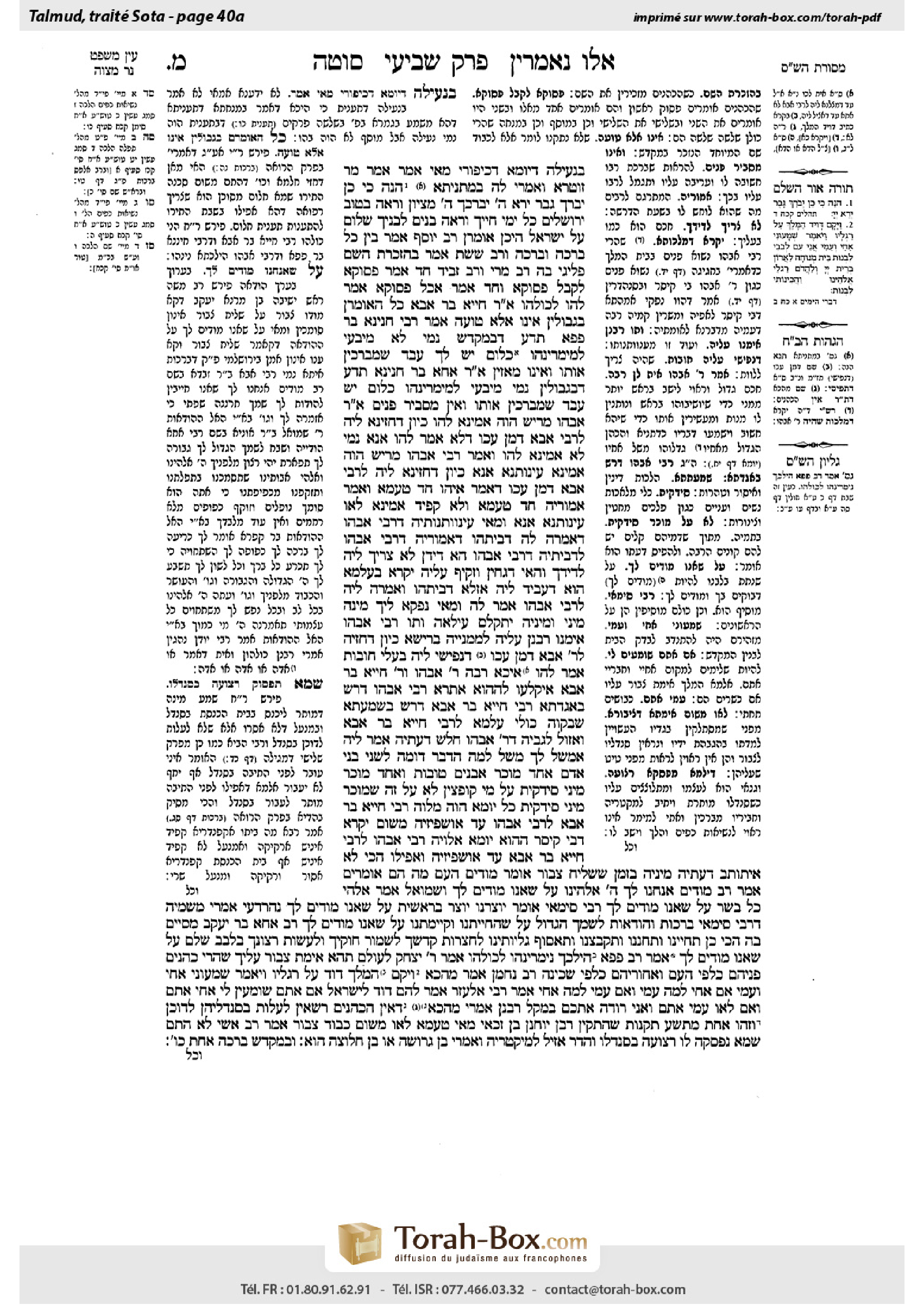
This page of Sotah includes the Aramaic text, an English translation and an AI-generated French translation, alongside the scan above.
סוטה מ׳ א · Aramaic and Hebrew text
בִּנְעִילָה דְּיוֹמָא דְכִיפּוּרֵי מַאי אָמַר? אָמַר מָר זוּטְרָא, וְאָמְרִי לַהּ בְּמַתְנִיתָא: ״הִנֵּה כִי כֵן יְבֹרַךְ גָּבֶר יְרֵא ה׳״. ״יְבָרֶכְךָ ה׳ מִצִּיּוֹן וּרְאֵה בְּטוּב יְרוּשָׁלִָם כֹּל יְמֵי חַיֶּיךָ״. ״וּרְאֵה בָנִים לְבָנֶיךָ שָׁלוֹם עַל יִשְׂרָאֵל״.
הֵיכָן אוֹמְרָן? רַב יוֹסֵף אָמַר: בֵּין כׇּל בְּרָכָה וּבְרָכָה, וְרַב שֵׁשֶׁת אָמַר: בְּהַזְכָּרַת הַשֵּׁם.
פְּלִיגִי בַּהּ רַב מָרִי וְרַב זְבִיד. חַד אָמַר: פְּסוּקָא לָקֳבֵל פְּסוּקָא, וְחַד אָמַר: אַכֹּל פְּסוּקָא אָמַר לְהוּ לְכוּלְּהוּ.
אָמַר רַבִּי חִיָּיא בַּר אַבָּא: כׇּל הָאוֹמְרָן בַּגְּבוּלִין — אֵינוֹ אֶלָּא טוֹעֶה. אָמַר רַבִּי חֲנִינָא בַּר פָּפָּא: תִּדַּע דִּבְמִקְדָּשׁ נָמֵי לָא מִיבְּעֵי לְמֵימְרִינְהוּ, כְּלוּם יֵשׁ לְךָ עֶבֶד שֶׁמְּבָרְכִין אוֹתוֹ וְאֵינוֹ מַאֲזִין?
אָמַר רַבִּי אַחָא בַּר חֲנִינָא: תֵּדַע דְּבִגְבוּלִין נָמֵי מִיבְּעֵי לְמֵימְרִינְהוּ, כְּלוּם יֵשׁ עֶבֶד שֶׁמְּבָרְכִין אוֹתוֹ וְאֵין מַסְבִּיר פָּנִים? אָמַר רַבִּי אֲבָהוּ: מֵרֵישׁ הֲוָה אָמֵינָא לְהוּ, כֵּיוָן דַּחֲזֵינָא לֵיהּ לְרַבִּי אַבָּא דְּמִן עַכּוֹ דְּלָא אֲמַר לְהוּ — אֲנָא נָמֵי לָא אָמֵינָא לְהוּ.
וְאָמַר רַבִּי אֲבָהוּ: מֵרֵישׁ הֲוָה אָמֵינָא עִינְוְתָנָא אֲנָא. כֵּיוָן דַּחֲזֵינָא לֵיהּ לְרַבִּי אַבָּא דְּמִן עַכּוֹ דְּאָמַר אִיהוּ חַד טַעְמָא וְאָמַר אָמוֹרֵיהּ חַד טַעְמָא וְלָא קָפֵיד — אָמֵינָא לָאו עִינְוְתָנָא אֲנָא.
וּמַאי עִינְוְותָנוּתֵיהּ דְּרַבִּי אֲבָהוּ? דַּאֲמַרָה לַהּ דְּבֵיתְהוּ דְּאָמוֹרֵיהּ דְּרַבִּי אֲבָהוּ לִדְבֵיתֵיהּ דְּרַבִּי אֲבָהוּ: הָא דִּידַן לָא צְרִיךְ לֵיהּ לְדִידָךְ, וְהַאי דְּגָחֵין וְזָקֵיף עֲלֵיהּ — יְקָרָא בְּעָלְמָא הוּא דְּעָבֵיד לֵיהּ. אֲזַלָא דְּבֵיתְהוּ וַאֲמַרָה לֵיהּ לְרַבִּי אֲבָהוּ. אֲמַר לַהּ: וּמַאי נָפְקָא לִיךְ מִינַּהּ? מִינִּי וּמִינֵּיהּ יִתְקַלַּס עִילָּאָה.
וְתוּ, רַבִּי אֲבָהוּ אִימְּנוֹ רַבָּנַן עֲלֵיהּ לְמִמְנְיֵיהּ בְּרֵישָׁא, כֵּיוָן דְּחַזְיֵהּ לְרַבִּי אַבָּא דְּמִן עַכּוֹ דִּנְפִישִׁי לֵיהּ בַּעֲלֵי חוֹבוֹת, אֲמַר לְהוּ: אִיכָּא רַבָּה.
רַבִּי אֲבָהוּ וְרַבִּי חִיָּיא בַּר אַבָּא אִיקְּלַעוּ לְהָהוּא אַתְרָא, רַבִּי אֲבָהוּ דְּרַשׁ בְּאַגַּדְתָּא, רַבִּי חִיָּיא בַּר אַבָּא דְּרַשׁ בִּשְׁמַעְתָּא. שַׁבְקוּהּ כּוּלֵּי עָלְמָא לְרַבִּי חִיָּיא בַּר אַבָּא, וַאֲזוּל לְגַבֵּיהּ דְּרַבִּי אֲבָהוּ. חֲלַשׁ דַּעְתֵּיהּ. אֲמַר לֵיהּ: אֶמְשֹׁל לְךָ מָשָׁל לְמָה הַדָּבָר דּוֹמֶה: לִשְׁנֵי בְּנֵי אָדָם, אֶחָד מוֹכֵר אֲבָנִים טוֹבוֹת וְאֶחָד מוֹכֵר מִינֵי סִידְקִית, עַל מִי קוֹפְצִין — לֹא עַל זֶה שֶׁמּוֹכֵר מִינֵי סִידְקִית?
כׇּל יוֹמָא: הֲוָה מַלְוֵה רַבִּי חִיָּיא בַּר אַבָּא לְרַבִּי אֲבָהוּ עַד אוּשְׁפִּיזֵיהּ מִשּׁוּם יְקָרָא דְבֵי קֵיסָר. הָהוּא יוֹמָא אַלְוְיֵהּ רַבִּי אֲבָהוּ לְרַבִּי חִיָּיא בַּר אַבָּא עַד אוּשְׁפִּיזֵיהּ, וַאֲפִילּוּ הָכִי לָא אִיתּוֹתַב דַּעְתֵּיהּ מִינֵּיהּ.
בִּזְמַן שֶׁשְּׁלִיחַ צִבּוּר אוֹמֵר מוֹדִים, הָעָם מָה הֵם אוֹמְרִים? אָמַר רַב: ״מוֹדִים אֲנַחְנוּ לָךְ ה׳ אֱלֹהֵינוּ עַל שֶׁאָנוּ מוֹדִים לָךְ״. וּשְׁמוּאֵל אָמַר: ״אֱלֹהֵי כׇּל בָּשָׂר, עַל שֶׁאָנוּ מוֹדִים לָךְ״. רַבִּי סִימַאי אוֹמֵר: ״יוֹצְרֵנוּ יוֹצֵר בְּרֵאשִׁית עַל שֶׁאָנוּ מוֹדִים לָךְ״. נְהַרְדָּעֵי אָמְרִי מִשְּׁמֵיהּ דְּרַבִּי סִימַאי: ״בְּרָכוֹת וְהוֹדָאוֹת לְשִׁמְךָ הַגָּדוֹל עַל שֶׁהֶחֱיִיתָנוּ וְקִיַּימְתָּנוּ, עַל שֶׁאָנוּ מוֹדִים לָךְ״. רַב אַחָא בַּר יַעֲקֹב מְסַיֵּים בַּהּ הָכִי: ״כֵּן תְּחַיֵּינוּ וּתְחׇנֵּנוּ, וּתְקַבְּצֵנוּ, וְתֶאֱסוֹף גָּלִיּוֹתֵינוּ לְחַצְרוֹת קׇדְשֶׁךָ, לִשְׁמוֹר חוּקֶּיךָ וְלַעֲשׂוֹת רְצוֹנְךָ בְּלֵבָב שָׁלֵם, עַל שֶׁאָנוּ מוֹדִים לָךְ״.
אָמַר רַב פָּפָּא: הִילְכָּךְ נֵימְרִינְהוּ לְכוּלְּהוּ.
אָמַר רַבִּי יִצְחָק: לְעוֹלָם תְּהֵא אֵימַת צִבּוּר עָלֶיךָ, שֶׁהֲרֵי כֹּהֲנִים פְּנֵיהֶם כְּלַפֵּי הָעָם וַאֲחוֹרֵיהֶם כְּלַפֵּי שְׁכִינָה.
רַב נַחְמָן אָמַר: מֵהָכָא: ״וַיָּקׇם דָּוִיד הַמֶּלֶךְ עַל רַגְלָיו וַיֹּאמֶר שְׁמָעוּנִי אַחַי וְעַמִּי״. אִם ״אַחַי״ לָמָּה ״עַמִּי״, וְאִם ״עַמִּי״ לָמָּה ״אַחַי״? אָמַר רַבִּי אֶלְעָזָר: אָמַר לָהֶם דָּוִד לְיִשְׂרָאֵל: אִם אַתֶּם, שׁוֹמְעִין לִי — אַחַי אַתֶּם, וְאִם לָאו — עַמִּי אַתֶּם, וַאֲנִי רוֹדֶה אֶתְכֶם בְּמַקֵּל.
רַבָּנַן אָמְרִי מֵהָכָא: דְּאֵין הַכֹּהֲנִים רַשָּׁאִין לַעֲלוֹת בְּסַנְדְּלֵיהֶן לַדּוּכָן. וְזֶהוּ אַחַת מִתֵּשַׁע תַּקָּנוֹת שֶׁהִתְקִין רַבָּן יוֹחָנָן בֶּן זַכַּאי. מַאי טַעְמָא — לָאו מִשּׁוּם כְּבוֹד צִבּוּר? אָמַר רַב אָשֵׁי: לָא, הָתָם שֶׁמָּא נִפְסְקָה לוֹ רְצוּעָה בְּסַנְדָּלוֹ וַהֲדַר אָזֵיל לְמִיקְטְרֵיהּ, וְאָמְרִי: בֶּן גְּרוּשָׁה אוֹ בֶּן חֲלוּצָה הוּא.
וּבְמִקְדָּשׁ בְּרָכָה אַחַת כּוּ׳.
Sotah 40a · English translation
During the closing prayer [ne’ila] of Yom Kippur, which also includes the Priestly Benediction, what do the people say? Mar Zutra says, and some say that this was taught in a baraita: “Behold, surely thus shall the man who fears the Lord be blessed” (Psalms 128:4), “The Lord shall bless you out of Zion, and you shall see the good of Jerusalem all the days of your life” (Psalms 128:5), and “And see your children’s children. Peace be upon Israel” (Psalms 128:6).
The Gemara asks: Where does the congregation say these verses during the Priestly Benediction? Rav Yosef says: They are said between each and every blessing. And Rav Sheshet says: They are said during the mention of the name of God in each of the three blessings.
Rav Mari and Rav Zevid disagree about this matter. One says: The congregation recites one verse at a time, corresponding to the verse that the priests recite. And one says: For every single verse that the priests recite, the congregation says all three verses.
Rabbi Ḥiyya bar Abba says: Anyone who recites these verses in the outlying areas, i.e., outside the Temple, is nothing other than mistaken in his practice. Rabbi Ḥanina bar Pappa said: You should know that in the Temple also people should not recite these verses. Do you have a servant who is being blessed and does not listen to the blessing, but rather speaks at the same time?
Conversely, Rabbi Aḥa bar Ḥanina says: You should know that in the outlying areas one is also required to say these verses. Is there a servant who is being blessed and his face does not brighten? Therefore, one must recite these verses to give thanks for receiving the Priestly Benediction. Rabbi Abbahu says: At first, I would recite these verses, but since I saw that Rabbi Abba of Akko does not say them, I also do not recite them anymore.
And Rabbi Abbahu says: At first, I would say to myself that I was humble. Since I saw that Rabbi Abba of Akko himself stated one reason for a matter, and his interpreter stated one other reason of his own rather than delivering the reason that Rabbi Abba stated, and yet Rabbi Abba did not mind, I say to myself that I am not humble.
The Gemara asks: And what was the humility of Rabbi Abbahu? The Gemara relates that Rabbi Abbahu’s interpreter’s wife said to Rabbi Abbahu’s wife: This one of ours, i.e., my husband, has no need for your husband Rabbi Abbahu, as he could teach everything on his own. And the fact that he bends over to listen to Rabbi Abbahu, and then stands up above him, and repeats his words to the congregants is merely to show respect for him. Rabbi Abbahu’s wife went and told this to Rabbi Abbahu. He said to her: And what difference does it make to you? Through me and through him the One above will be exalted, and it does not matter which one of us is teaching.
And furthermore, in another example of his humility, the Sages were counted and reached a decision to appoint Rabbi Abbahu to be the head of the yeshiva. Since he saw that Rabbi Abba of Akko had many creditors and was impoverished, he attempted to get him out of debt. He said to them: There is a man who is greater than me, Rabbi Abba.
The Gemara relates another example of his humility: Rabbi Abbahu and Rabbi Ḥiyya bar Abba happened to come to a certain place. Rabbi Abbahu taught matters of aggada, and at the same time Rabbi Ḥiyya bar Abba taught halakha. Everyone left Rabbi Ḥiyya bar Abba and went to Rabbi Abbahu, and Rabbi Ḥiyya was offended. Rabbi Abbahu said to him, to appease him: I will tell you a parable: To what is this matter comparable? It is comparable to two people, one who sells precious stones and one who sells small items [sidkit]. Upon whom do the customers spring? Don’t they spring upon the one who sells small items? Similarly, you teach lofty and important matters that do not attract many people. Everyone comes to me because I teach minor matters.
The Gemara relates that every day Rabbi Ḥiyya bar Abba would escort Rabbi Abbahu to his lodging place [ushpizei] out of respect for the house of the emperor, with which Rabbi Abbahu was associated. On that day, Rabbi Abbahu escorted Rabbi Ḥiyya bar Abba to his lodging place, and even so, Rabbi Ḥiyya bar Abba’s mind was not at ease with Rabbi Abbahu and he felt insulted.
§ The Gemara returns to discuss the response of the congregants to certain parts of the prayer service. While the prayer leader is reciting the blessing of: We give thanks, what do the people say? Rav says that they say: We give thanks to You, Lord our God, for the merit of giving thanks to You. And Shmuel says that one should say: God of all living flesh, for the merit of giving thanks to You. Rabbi Simai says that one should say: Our Creator, Who created everything in the beginning, for the merit of giving thanks to You. The Sages of Neharde’a say in the name of Rabbi Simai that one should say: We offer blessings and praises to Your great name, for You have given us life and sustained us, for giving thanks to You. Rav Aḥa bar Ya’akov would finish the blessing as follows: So may You give us life, and show us favor, and collect us, and gather our exiles into Your sacred courtyards, in order to observe Your laws and to fulfill Your will wholeheartedly, for giving thanks to You.
Rav Pappa said: These Sages each added a different element to the prayer. Therefore, we should combine them together and recite all of them.
§ Rabbi Yitzḥak says: The awe of the public should always be upon you, i.e., one must always treat the public courteously. As when the priests bless the people they face the people and their backs are toward the Divine Presence, out of respect for the congregation.
Rav Naḥman said that this principle is derived from here: “Then King David stood up upon his feet, and said: Hear me, my brethren, and my people” (I Chronicles 28:2). Evidently, King David stood up to address the people rather than remain seated. If he said “my brethren,” why did he say “my people”? And if he said “my people” why did he say “my brethren”? Rabbi Elazar says: David said to the Jewish people: If you listen to me, you are my brethren. And if you do not listen to me willingly, you are my people and I am your king, and I will rule over you by force with a staff. This shows that if the nation acted properly, David would relate to them respectfully.
The Sages say that the importance of showing respect for the congregation is derived from here: The halakha is that the priests are not permitted to ascend the platform to recite the benediction in their sandals, as is taught in a baraita. And this halakha is one of nine ordinances that Rabban Yoḥanan ben Zakkai instituted. What is the reason for this ordinance? Is it not out of respect for the congregation, as it would be disrespectful for the priests to display their dirty sandals in front of the congregants? Rav Ashi said: No, this is not the reason. There, in the baraita, the reason is a concern lest a strap of his sandal break, and he will therefore return to his place to go tie it and not ascend the platform in time for the benediction, and people will say that he was removed from the platform because he is disqualified from the priesthood, as he is the son of a priest and a divorced woman or the son of a priest and a ḥalutza.
§ It is taught in the mishna: And in the Temple, the priests recite the three verses as one blessing.
Sotah 40a · Traduction française (IA)
Pendant la prière de clôture [ne’ila] de Yom Kippour, qui comprend également la bénédiction sacerdotale, que disent les fidèles ? Mar Zutra dit — et certains disent que cela a été enseigné dans une baraïta : « Voici, c’est ainsi que sera béni l’homme qui craint le Seigneur » (Psaumes 128:4), « Que le Seigneur te bénisse depuis Sion, et puisses-tu voir le bonheur de Jérusalem tous les jours de ta vie » (Psaumes 128:5), et « Puisses-tu voir les enfants de tes enfants ! Paix sur Israël » (Psaumes 128:6).
La Guemara demande : À quel moment l’assemblée dit-elle ces versets pendant la bénédiction sacerdotale ? Rav Yosef dit : Ils sont récités entre chacune des bénédictions. Rav Sheshet dit : Ils sont récités pendant la mention du nom de Dieu dans chacune des trois bénédictions.
Rav Mari et Rav Zevid sont en désaccord sur cette question. L’un dit : L’assemblée récite un verset à la fois, correspondant au verset récité par les prêtres. L’autre dit : Pour chacun des versets récités par les prêtres, l’assemblée récite les trois versets.
Rabbi Ḥiyya bar Abba dit : Quiconque récite ces versets dans les localités périphériques, c’est-à-dire hors du Temple, ne fait que se tromper dans sa pratique. Rabbi Ḥanina bar Pappa dit : Sachez que, même dans le Temple, les gens ne devraient pas réciter ces versets. Avez-vous jamais vu un serviteur qui reçoit une bénédiction sans l’écouter, mais qui parle en même temps ?
À l’inverse, Rabbi Aḥa bar Ḥanina dit : Sachez que, dans les localités périphériques également, on doit réciter ces versets. Existe-t-il un serviteur qui reçoit une bénédiction sans que son visage s’illumine ? Il faut donc réciter ces versets pour remercier d’avoir reçu la bénédiction sacerdotale. Rabbi Abbahu dit : Au début, je récitais ces versets, mais depuis que j’ai vu que Rabbi Abba d’Akko ne les récite pas, je ne les récite plus non plus.
Et Rabbi Abbahu dit : Au début, je me disais que j’étais humble. Mais depuis que j’ai vu que Rabbi Abba d’Akko lui-même donnait une raison à une question, tandis que son interprète en donnait une autre, de son propre chef, au lieu de transmettre la raison donnée par Rabbi Abba, et que Rabbi Abba ne s’en formalisait pas, je me dis que je ne suis pas humble.
La Guemara demande : En quoi consistait l’humilité de Rabbi Abbahu ? La Guemara rapporte que la femme de l’interprète de Rabbi Abbahu dit à la femme de Rabbi Abbahu : « Mon mari, lui, n’a pas besoin de ton mari Rabbi Abbahu, car il pourrait tout enseigner lui-même. S’il se penche pour écouter Rabbi Abbahu, puis se redresse au-dessus de lui et répète ses paroles aux fidèles, c’est seulement pour lui témoigner du respect. » La femme de Rabbi Abbahu alla rapporter cela à Rabbi Abbahu. Il lui dit : « Et qu’est-ce que cela peut te faire ? Par moi comme par lui, Celui qui est au-dessus sera glorifié ; peu importe lequel de nous deux enseigne. »
De plus, un autre exemple de son humilité : les Sages se concertèrent et décidèrent de nommer Rabbi Abbahu à la tête de la yeshiva. Voyant que Rabbi Abba d’Akko avait de nombreux créanciers et était dans le dénuement, Rabbi Abbahu chercha à le tirer de ses dettes. Il leur dit : « Il y a un homme plus grand que moi : Rabbi Abba. »
La Guemara rapporte un autre exemple de son humilité : Rabbi Abbahu et Rabbi Ḥiyya bar Abba arrivèrent par hasard dans un certain endroit. Rabbi Abbahu enseignait des sujets d’aggada, tandis que Rabbi Ḥiyya bar Abba enseignait la halakha. Tout le monde quitta Rabbi Ḥiyya bar Abba pour se rendre auprès de Rabbi Abbahu, et Rabbi Ḥiyya en fut vexé. Pour l’apaiser, Rabbi Abbahu lui dit : « Je vais te raconter une parabole : À quoi cette situation ressemble-t-elle ? À deux personnes, l’une qui vend des pierres précieuses et l’autre de petits objets [sidkit]. Vers qui les clients se précipitent-ils ? Ne se précipitent-ils pas vers celui qui vend de petits objets ? De même, tu enseignes des sujets élevés et importants, qui attirent peu de monde. Tout le monde vient à moi parce que j’enseigne des sujets mineurs. »
La Guemara rapporte que chaque jour, Rabbi Ḥiyya bar Abba accompagnait Rabbi Abbahu jusqu’à son lieu d’hébergement [ushpizei], par égard pour la maison de l’empereur, à laquelle Rabbi Abbahu était lié. Ce jour-là, Rabbi Abbahu accompagna Rabbi Ḥiyya bar Abba jusqu’à son lieu d’hébergement ; malgré cela, Rabbi Ḥiyya bar Abba n’était pas apaisé à l’égard de Rabbi Abbahu et se sentait offensé.
§ La Guemara revient sur la réponse des fidèles à certains moments de l’office. Pendant que l’officiant récite la bénédiction « Nous Te rendons grâce », que disent les fidèles ? Rav dit qu’ils disent : « Nous Te rendons grâce, Seigneur notre Dieu, pour le mérite de Te rendre grâce. » Shmuel dit qu’il faut dire : « Dieu de toute chair vivante, pour le mérite de Te rendre grâce. » Rabbi Simai dit qu’il faut dire : « Notre Créateur, qui a tout créé au commencement, pour le mérite de Te rendre grâce. » Les Sages de Neharde’a disent au nom de Rabbi Simai qu’il faut dire : « Nous adressons bénédictions et louanges à Ton grand nom, car Tu nous as donné la vie et nous as soutenus, pour Te rendre grâce. » Rav Aḥa bar Ya’akov concluait la bénédiction ainsi : « Puisses-Tu donc nous donner la vie, nous accorder Ta faveur, nous rassembler et ramener nos exilés dans Tes cours sacrées, afin que nous observions Tes lois et accomplissions Ta volonté de tout notre cœur, pour Te rendre grâce. »
Rav Pappa dit : Chacun de ces Sages a ajouté un élément différent à la prière. Nous devons donc les combiner et réciter toutes ces formulations.
§ Rabbi Yitzḥak dit : Il faut toujours garder à l’esprit le respect dû au public, c’est-à-dire traiter toujours celui-ci avec courtoisie. En effet, lorsque les prêtres bénissent le peuple, ils lui font face et tournent le dos à la Présence divine, par égard pour l’assemblée.
Rav Naḥman dit que ce principe se déduit d’ici : « Alors le roi David se leva et dit : Écoutez-moi, mes frères et mon peuple » (I Chroniques 28:2). De toute évidence, le roi David se leva pour s’adresser au peuple plutôt que de rester assis. S’il a dit « mes frères », pourquoi a-t-il dit « mon peuple » ? Et s’il a dit « mon peuple », pourquoi a-t-il dit « mes frères » ? Rabbi Elazar dit : David dit au peuple juif : « Si vous m’écoutez, vous êtes mes frères. Mais si vous ne m’écoutez pas de bon gré, vous êtes mon peuple et je suis votre roi ; je vous gouvernerai de force, le bâton à la main. » Cela montre que, si le peuple se conduisait correctement, David le traiterait avec respect.
Les Sages disent que l’importance du respect dû à l’assemblée se déduit d’ici : selon la halakha, les prêtres n’ont pas le droit de monter sur l’estrade pour réciter la bénédiction avec leurs sandales, comme l’enseigne une baraïta. Cette halakha est l’une des neuf ordonnances instituées par Rabban Yoḥanan ben Zakkai. Quelle est la raison de cette ordonnance ? N’est-ce pas par égard pour l’assemblée, car il serait irrespectueux que les prêtres montrent leurs sandales sales aux fidèles ? Rav Ashi dit : Non, ce n’est pas la raison. Dans la baraïta, la raison est la crainte qu’une lanière de sa sandale ne se rompe ; il retournerait alors à sa place pour la renouer et ne monterait pas à temps sur l’estrade pour la bénédiction, et les gens diraient qu’il a été écarté de l’estrade parce qu’il est inapte à la prêtrise, étant le fils d’un prêtre et d’une femme divorcée, ou le fils d’un prêtre et d’une ḥalutza.
§ Il est enseigné dans la Michna : Dans le Temple, les prêtres récitent les trois versets comme une seule bénédiction.
Traduction française générée par IA à partir de l’édition anglaise de Sefaria. Vérifie toujours un passage avec le texte source.
Text from Sefaria: William Davidson Edition - Vocalized Aramaic (CC BY NC); William Davidson Edition - English (CC BY NC).