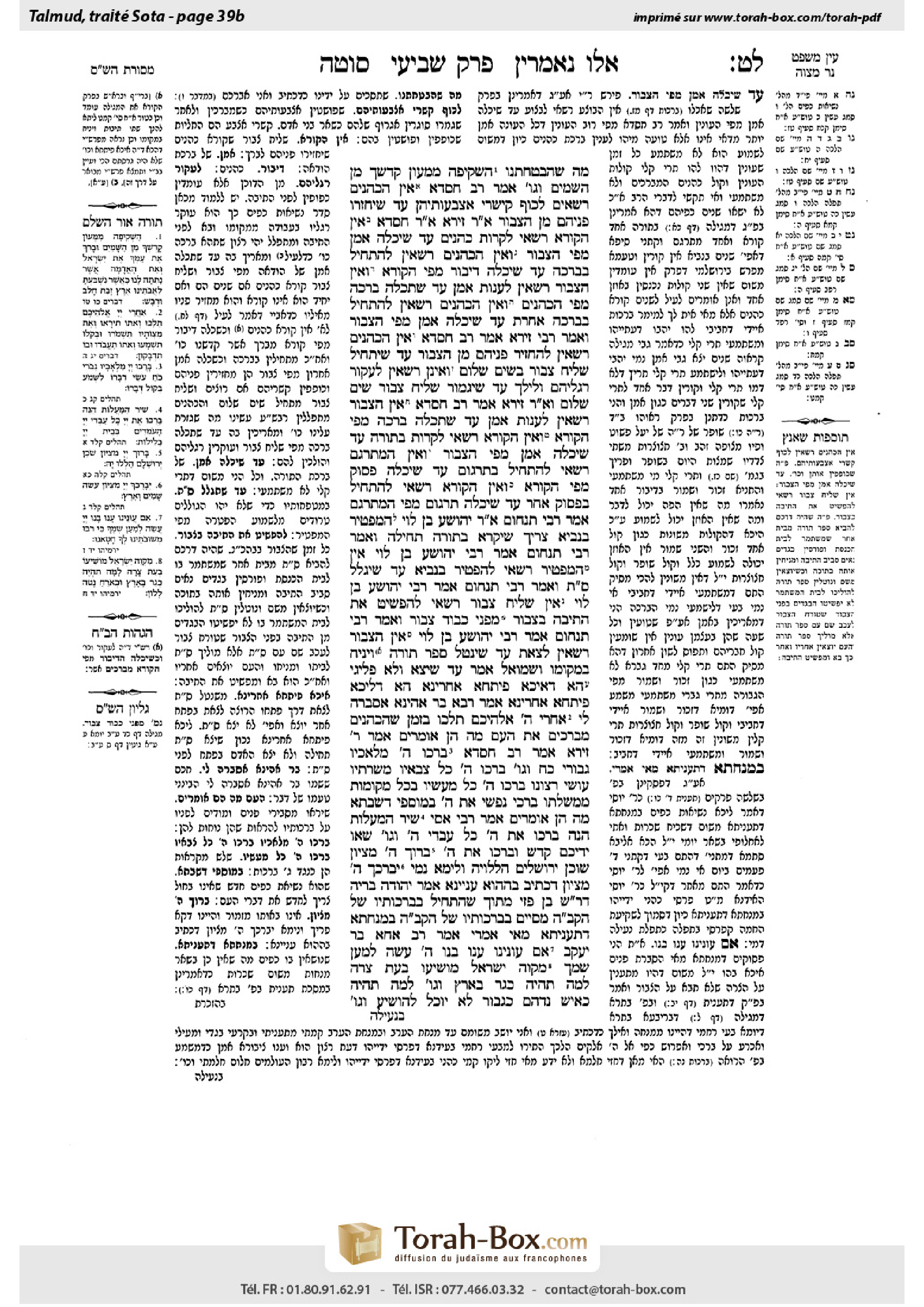
Sotah 39b: Talmud study for Daf Yomi
Daf Yomi is the daily study of one Talmud folio. Explore 37 tractates with scans, Hebrew text, Sefaria English and AI-generated French translations where annotated.
Passage selection and English or AI-generated French translation are available where the scan has annotations. Daf Study is independent of Torah-Box and Sefaria.
Browse Sotah · סוטה · All tractatesSotah 39b text and translations
This page of Sotah includes the Aramaic text, an English translation and an AI-generated French translation, alongside the scan above.
סוטה ל״ט ב · Aramaic and Hebrew text
מַה שֶּׁהִבְטַחְתָּנוּ. הַשְׁקִיפָה מִמְּעוֹן קׇדְשְׁךָ מִן הַשָּׁמַיִם וְגוֹ׳״.
אָמַר רַב חִסְדָּא: אֵין הַכֹּהֲנִים רַשָּׁאִים לָכוֹף קִישְׁרֵי אֶצְבְּעוֹתֵיהֶן עַד שֶׁיַּחְזִרוּ פְּנֵיהֶם מִן הַצִּבּוּר. אָמַר רַבִּי זֵירָא אָמַר רַב חִסְדָּא: אֵין הַקּוֹרֵא רַשַּׁאי לִקְרוֹת ״כֹּהֲנִים״ עַד שֶׁיִּכְלֶה ״אָמֵן״ מִפִּי הַצִּבּוּר,
וְאֵין הַכֹּהֲנִים רַשָּׁאִין לְהַתְחִיל בִּבְרָכָה עַד שֶׁיִּכְלֶה דִּיבּוּר מִפִּי הַקּוֹרֵא, וְאֵין הַצִּבּוּר רַשָּׁאִין לַעֲנוֹת ״אָמֵן״ עַד שֶׁתִּכְלֶה בְּרָכָה מִפִּי הַכֹּהֲנִים, וְאֵין הַכֹּהֲנִים רַשָּׁאִין לְהַתְחִיל בִּבְרָכָה אַחֶרֶת עַד שֶׁיִּכְלֶה ״אָמֵן״ מִפִּי הַצִּבּוּר.
וְאָמַר רַבִּי זֵירָא אָמַר רַב חִסְדָּא: אֵין הַכֹּהֲנִים רַשָּׁאִין לְהַחְזִיר פְּנֵיהֶם מִן הַצִּבּוּר עַד שֶׁיַּתְחִיל שְׁלִיחַ צִבּוּר בְּ״שִׂים שָׁלוֹם״, וְאֵינָן רַשָּׁאִין לַעֲקוֹר רַגְלֵיהֶם וְלֵילֵךְ עַד שֶׁיִּגְמוֹר שְׁלִיחַ צִבּוּר ״שִׂים שָׁלוֹם״.
וְאָמַר רַבִּי זֵירָא אָמַר רַב חִסְדָּא: אֵין הַצִּבּוּר רַשָּׁאִין לַעֲנוֹת ״אָמֵן״ עַד שֶׁתִּכְלֶה בְּרָכָה מִפִּי הַקּוֹרֵא, וְאֵין הַקּוֹרֵא רַשַּׁאי לִקְרוֹת בַּתּוֹרָה עַד שֶׁיִּכְלֶה ״אָמֵן״ מִפִּי הַצִּבּוּר, וְאֵין הַמְתַרְגֵּם רַשַּׁאי לְהַתְחִיל בַּתַּרְגּוּם עַד שֶׁיִּכְלֶה פָּסוּק מִפִּי הַקּוֹרֵא, וְאֵין הַקּוֹרֵא רַשַּׁאי לְהַתְחִיל בְּפָסוּק אַחֵר עַד שֶׁיִּכְלֶה תַּרְגּוּם מִפִּי הַמְתַרְגֵּם.
אָמַר רַבִּי תַּנְחוּם אָמַר רַבִּי יְהוֹשֻׁעַ בֶּן לֵוִי: הַמַּפְטִיר בְּנָבִיא, צָרִיךְ שֶׁיִּקְרָא בַּתּוֹרָה תְּחִילָּה, וְאָמַר רַבִּי תַּנְחוּם אָמַר רַבִּי יְהוֹשֻׁעַ בֶּן לֵוִי: אֵין הַמַּפְטִיר רַשַּׁאי לְהַפְטִיר בַּנָּבִיא עַד שֶׁיִּגָּלֵל סֵפֶר תּוֹרָה.
וְאָמַר רַבִּי תַּנְחוּם אָמַר רַבִּי יְהוֹשֻׁעַ בֶּן לֵוִי: אֵין שְׁלִיחַ צִבּוּר רַשַּׁאי לְהַפְשִׁיט אֶת הַתֵּיבָה בַּצִּבּוּר, מִפְּנֵי כְּבוֹד צִבּוּר.
וְאָמַר רַבִּי תַּנְחוּם אָמַר רַבִּי יְהוֹשֻׁעַ בֶּן לֵוִי: אֵין הַצִּבּוּר רַשָּׁאִין לָצֵאת, עַד שֶׁיִּנָּטֵל סֵפֶר תּוֹרָה וְיָנֻיחַ בִּמְקוֹמוֹ. וּשְׁמוּאֵל אָמַר: עַד שֶׁיֵּצֵא.
וְלָא פְּלִיגִי: הָא — דְּאִיכָּא פִּיתְחָא אַחֲרִינָא. הָא — דְּלֵיכָּא פִּיתְחָא אַחֲרִינָא. אָמַר רָבָא, בַּר אֲהִינָא אַסְבְּרַהּ לִי: ״אַחֲרֵי ה׳ אֱלֹהֵיכֶם תֵּלֵכוּ״.
בִּזְמַן שֶׁהַכֹּהֲנִים מְבָרְכִים אֶת הָעָם, מָה הֵן אוֹמְרִים? אָמַר רַבִּי זֵירָא אָמַר רַב חִסְדָּא: ״בָּרְכוּ ה׳ מַלְאָכָיו גִּבֹּרֵי כֹחַ וְגוֹ׳״, ״בָּרְכוּ ה׳ כׇּל צְבָאָיו מְשָׁרְתָיו עוֹשֵׂי רְצוֹנוֹ״, ״בָּרְכוּ ה׳ כׇּל מַעֲשָׂיו בְּכׇל מְקֹמוֹת מֶמְשַׁלְתּוֹ בָּרְכִי נַפְשִׁי אֶת ה׳״.
בְּמוּסְפֵי דְשַׁבְּתָא, מָה הֵן אוֹמְרִים? אָמַר רַבִּי אַסִּי: ״שִׁיר הַמַּעֲלוֹת הִנֵּה בָּרְכוּ אֶת ה׳ כׇּל עַבְדֵי ה׳ וְגוֹ׳ שְׂאוּ יְדֵיכֶם קֹדֶשׁ וּבָרְכוּ אֶת ה׳״, ״בָּרוּךְ ה׳ מִצִּיּוֹן שׁוֹכֵן יְרוּשָׁלִָם הַלְלוּיָהּ״.
וְלֵימָא נָמֵי ״יְבָרֶכְךָ ה׳ מִצִּיּוֹן״, דִּכְתִיב בְּהָהוּא עִנְיָינָא! אָמַר יְהוּדָה בְּרֵיהּ דְּרַבִּי שִׁמְעוֹן בֶּן פַּזִּי: מִתּוֹךְ שֶׁהִתְחִיל בְּבִרְכוֹתָיו שֶׁל הַקָּדוֹשׁ בָּרוּךְ הוּא מְסַיֵּים בְּבִרְכוֹתָיו שֶׁל הַקָּדוֹשׁ בָּרוּךְ הוּא.
בְּמִנְחֲתָא דְתַעֲנִיתָא מַאי אָמְרִי? אָמַר רַב אַחָא בַּר יַעֲקֹב: ״אִם עֲוֹנֵינוּ עָנוּ בָנוּ ה׳ עֲשֵׂה לְמַעַן שְׁמֶךָ״, ״מִקְוֵה יִשְׂרָאֵל מוֹשִׁיעוֹ בְּעֵת צָרָה לָמָּה תִהְיֶה כְּגֵר בָּאָרֶץ וְגוֹ׳״, ״לָמָּה תִהְיֶה כְּאִישׁ נִדְהָם כְּגִבּוֹר לֹא יוּכַל לְהוֹשִׁיעַ וְגוֹ׳״.
Sotah 39b · English translation
as You have promised us, namely: “So shall they put My name upon the children of Israel, and I will bless them” (Numbers 6:27). “Look forth from your holy habitation, from heaven, and bless Your people, Israel” (Deuteronomy 26:15).
§ Rav Ḥisda says: The priests who spread their hands open during the benediction are not permitted to bend the joints of their fingers until they turn their faces away from the congregation once they have completed the benediction. Rabbi Zeira says that Rav Ḥisda says: The one who calls the priests forward is not permitted to call out: Priests, until the response amen to the blessing of thanksgiving concludes from the mouths of the congregation, in order to ensure that everyone will hear the voices of the priests.
And for the same reason, the priests are not permitted to begin reciting the benediction until the statement of the caller, i.e., his announcement: Priests, concludes from his mouth. And the congregation is not permitted to answer amen until the blessing concludes from the mouths of the priests. And the priests are not permitted to begin reciting another blessing until the response amen to the previous blessing concludes from the mouths of the congregation.
And Rabbi Zeira says that Rav Ḥisda says: The priests are not permitted to turn away from the congregation after they have completed the benediction until the prayer leader begins saying the blessing of: Grant peace. And they are not permitted to uproot their feet and walk away from the platform until the prayer leader finishes saying the blessing of: Grant peace.
And in a similar vein, Rabbi Zeira says that Rav Ḥisda says: The congregation is not permitted to answer amen to the blessing recited over the Torah reading until the blessing of the one reading from the Torah concludes from his mouth. And the reader is not permitted to begin reading from the Torah until the response amen to the preceding blessing concludes from the mouths of the congregation. And the translator is not permitted to begin the translation of the Torah reading until the reading of the verse from the Torah concludes from the mouth of the reader. And the reader is not permitted to begin reading another verse until the translation concludes from the mouth of the translator.
Rabbi Tanḥum says that Rabbi Yehoshua ben Levi says: The one who concludes with a reading from the Prophets [haftara] must first read several verses from the Torah. And Rabbi Tanḥum says that Rabbi Yehoshua ben Levi says: The one who concludes is not permitted to conclude with a reading from the Prophets until the Torah scroll is furled.
And Rabbi Tanḥum says that Rabbi Yehoshua ben Levi says: The prayer leader is not permitted to uncover the decorative covering of the ark in public, out of respect for the congregation. It is inappropriate to have the congregation wait while doing this.
And Rabbi Tanḥum says that Rabbi Yehoshua ben Levi says: The congregation is not permitted to leave the synagogue after the Torah reading until the Torah scroll has been taken and prepared to be returned to its place, as the Torah scroll used to be stored near the synagogue. And Shmuel said: They may not leave until the Torah scroll is actually taken out of the synagogue, out of respect for the Torah scroll.
The Gemara comments: And they do not disagree about the halakha. Rather, they were discussing different situations. This statement of Rabbi Yehoshua ben Levi is referring to a case where there is another exit. When the Torah scroll is being taken out of one exit, people may leave through the other exit. However, that statement of Shmuel is referring to a case where there is no other exit, and therefore the congregation must wait until the Torah is carried out. Rava said: The Sage bar Ahina explained to me that this halakha is derived from the verse: “After the Lord your God you shall walk” (Deuteronomy 13:5), meaning that one must walk after the Torah scroll and not in front of it.
§ The Gemara continues to discuss the Priestly Benediction. When the priests are blessing the people, what do the people say? Rabbi Zeira says that Rav Ḥisda says: For each blessing that the priests recite, they respond with a blessing from the Bible: “Bless the Lord, His angels, mighty in strength that fulfill His word, hearkening unto the voice of His word” (Psalms 103:20), “Bless the Lord, all of His hosts, His ministers that do His pleasure” (Psalms 103:21), and “Bless the Lord, all of His works, in all places of His dominion, bless the Lord, O my soul” (Psalms 103:22).
When the priests ascend a second time to bless the congregation during the additional prayer of Shabbat, what do the people say? It is not appropriate for them to repeat the same verses of praise that they recited previously. Rabbi Asi said: They say: “A song of ascents. Behold, bless you the Lord, all you servants of the Lord, that stand in the house of the Lord in the night seasons” (Psalms 134:1), “Lift up your hands in sanctity and bless the Lord” (Psalms 134:2), and “Blessed be the Lord out of Zion, Who dwells at Jerusalem. Hallelujah” (Psalms 135:21).
The Gemara asks: And let them also say the third verse that appears right after the first two blessings: “The Lord shall bless you out of Zion” (Psalms 134:3), as it is written in that same matter. Yehuda, son of Rabbi Shimon ben Pazi, says: Since they began with blessings of the Holy One, Blessed be He, they must end with a blessing of the Holy One, Blessed be He, rather than reciting this verse, which is a blessing for the Jewish people.
The Gemara asks: When the priests ascend to recite the Priestly Benediction during the afternoon prayer of a fast day, what do the people say? Rav Aḥa bar Ya’akov said: They say: “Though our iniquities testify against us, O Lord, work for Your name’s sake” (Jeremiah 14:7), “The Hope of Israel, its savior in times of trouble, why should You be a stranger in the land and as a wayfaring man that turns aside to tarry for a night?” (Jeremiah 14:8), and “Why should You be like a man overcome, as a mighty man who cannot save? Yet You, O Lord, are in the midst of us, and Your name is called upon us; leave us not” (Jeremiah 14:9).
Sotah 39b · Traduction française (IA)
comme Tu nous l’as promis, à savoir : « Ainsi ils placeront Mon nom sur les enfants d’Israël, et Moi, Je les bénirai » (Nombres 6:27). « Regarde depuis Ta sainte demeure, depuis les cieux, et bénis Ton peuple, Israël » (Deutéronome 26:15).
§ Rav Ḥisda dit : Les prêtres qui écartent les doigts pendant la bénédiction ne sont pas autorisés à fléchir les articulations de leurs doigts avant de se détourner de l’assemblée, une fois la bénédiction achevée. Rabbi Zeira dit au nom de Rav Ḥisda : Celui qui appelle les prêtres à s’avancer n’est pas autorisé à crier : « Prêtres ! » avant que la réponse « amen » à la bénédiction d’action de grâce ait fini d’être prononcée par l’assemblée, afin que tous entendent la voix des prêtres.
Pour la même raison, les prêtres ne sont pas autorisés à commencer à réciter la bénédiction avant que l’appel de celui qui les appelle, c’est-à-dire son annonce : « Prêtres ! », ait fini d’être prononcé. L’assemblée n’est pas autorisée à répondre « amen » avant que les prêtres aient achevé la bénédiction. Et les prêtres ne sont pas autorisés à commencer à réciter une autre bénédiction avant que l’assemblée ait fini de répondre « amen » à la bénédiction précédente.
Rabbi Zeira dit au nom de Rav Ḥisda : Les prêtres ne sont pas autorisés à se détourner de l’assemblée après avoir achevé la bénédiction avant que l’officiant commence à réciter la bénédiction « Accorde la paix ». Ils ne sont pas non plus autorisés à déplacer leurs pieds pour quitter l’estrade avant que l’officiant ait fini de réciter la bénédiction « Accorde la paix ».
Dans le même esprit, Rabbi Zeira dit au nom de Rav Ḥisda : L’assemblée n’est pas autorisée à répondre « amen » à la bénédiction récitée sur la lecture de la Torah avant que celui qui lit la Torah ait achevé cette bénédiction. Le lecteur n’est pas autorisé à commencer la lecture de la Torah avant que l’assemblée ait fini de répondre « amen » à la bénédiction précédente. Le traducteur n’est pas autorisé à commencer la traduction de la lecture de la Torah avant que le lecteur ait achevé la lecture du verset de la Torah. Et le lecteur n’est pas autorisé à commencer à lire un autre verset avant que le traducteur ait achevé la traduction.
Rabbi Tanḥum dit au nom de Rabbi Yehoshua ben Levi : Celui qui conclut par une lecture des Prophètes [haftara] doit d’abord lire plusieurs versets de la Torah. Rabbi Tanḥum dit au nom de Rabbi Yehoshua ben Levi : Celui qui conclut n’est pas autorisé à conclure par une lecture des Prophètes avant que le rouleau de la Torah ait été enroulé.
Rabbi Tanḥum dit au nom de Rabbi Yehoshua ben Levi : L’officiant n’est pas autorisé à découvrir en public le revêtement ornemental de l’arche, par respect pour l’assemblée. Il ne convient pas de faire attendre l’assemblée pendant cette opération.
Rabbi Tanḥum dit au nom de Rabbi Yehoshua ben Levi : L’assemblée n’est pas autorisée à quitter la synagogue après la lecture de la Torah avant que le rouleau de la Torah ait été pris et préparé pour être remis à sa place, car le rouleau de la Torah était autrefois conservé près de la synagogue. Shmuel dit : Ils ne peuvent partir avant que le rouleau de la Torah ait effectivement été sorti de la synagogue, par respect pour le rouleau de la Torah.
La Guemara commente : Ils ne sont pas en désaccord sur la halakha ; ils parlent plutôt de situations différentes. La déclaration de Rabbi Yehoshua ben Levi concerne un cas où il existe une autre sortie. Lorsque le rouleau de la Torah est emporté par une sortie, les gens peuvent partir par l’autre. La déclaration de Shmuel, en revanche, concerne un cas où il n’y a pas d’autre sortie ; l’assemblée doit donc attendre que la Torah soit emportée à l’extérieur. Rava dit : Le Sage bar Ahina m’a expliqué que cette halakha est déduite du verset : « C’est le Seigneur, ton Dieu, que tu suivras » (Deutéronome 13:5), ce qui signifie qu’il faut marcher derrière le rouleau de la Torah, et non devant lui.
§ La Guemara poursuit son examen de la bénédiction sacerdotale. Que dit le peuple lorsque les prêtres le bénissent ? Rabbi Zeira dit au nom de Rav Ḥisda : Pour chacune des bénédictions récitées par les prêtres, les gens répondent par un verset biblique de bénédiction : « Bénissez le Seigneur, vous, Ses anges, puissants en force, qui accomplissez Sa parole, attentifs à la voix de Sa parole » (Psaumes 103:20) ; « Bénissez le Seigneur, toutes Ses armées, vous qui Le servez et faites Sa volonté » (Psaumes 103:21) ; et « Bénissez le Seigneur, toutes Ses œuvres, en tous les lieux de Son empire ; bénis le Seigneur, ô mon âme » (Psaumes 103:22).
Que dit le peuple lorsque les prêtres montent une deuxième fois pour bénir l’assemblée pendant la prière supplémentaire de Chabbat ? Il ne convient pas de répéter les mêmes versets de louange que ceux récités précédemment. Rabbi Asi dit : Ils disent : « Cantique des montées. Voici, bénissez le Seigneur, vous tous, serviteurs du Seigneur, qui vous tenez dans la maison du Seigneur pendant les nuits » (Psaumes 134:1) ; « Élevez vos mains dans la sainteté et bénissez le Seigneur » (Psaumes 134:2) ; et « Que le Seigneur soit béni depuis Sion, Lui qui réside à Jérusalem. Alléluia » (Psaumes 135:21).
La Guemara demande : Qu’ils disent également le troisième verset, qui suit immédiatement les deux premières bénédictions : « Que le Seigneur te bénisse depuis Sion » (Psaumes 134:3), puisqu’il traite du même sujet. Yehuda, fils de Rabbi Shimon ben Pazi, dit : Puisqu’ils ont commencé par des bénédictions adressées au Saint, béni soit-Il, ils doivent terminer par une bénédiction adressée au Saint, béni soit-Il, plutôt que de réciter ce verset, qui est une bénédiction pour le peuple juif.
La Guemara demande : Que dit le peuple lorsque les prêtres montent réciter la bénédiction sacerdotale pendant la prière de l’après-midi d’un jour de jeûne ? Rav Aḥa bar Ya’akov dit : Ils disent : « Bien que nos iniquités témoignent contre nous, Seigneur, agis pour l’honneur de Ton nom » (Jérémie 14:7) ; « Espoir d’Israël, son sauveur au temps de la détresse, pourquoi serais-Tu comme un étranger dans le pays, comme un voyageur qui s’arrête pour passer la nuit ? » (Jérémie 14:8) ; et « Pourquoi serais-Tu comme un homme accablé, comme un guerrier incapable de sauver ? Pourtant, Tu es au milieu de nous, Seigneur, et Ton nom est invoqué sur nous ; ne nous abandonne pas » (Jérémie 14:9).
Traduction française générée par IA à partir de l’édition anglaise de Sefaria. Vérifie toujours un passage avec le texte source.
Text from Sefaria: William Davidson Edition - Vocalized Aramaic (CC BY NC); William Davidson Edition - English (CC BY NC).