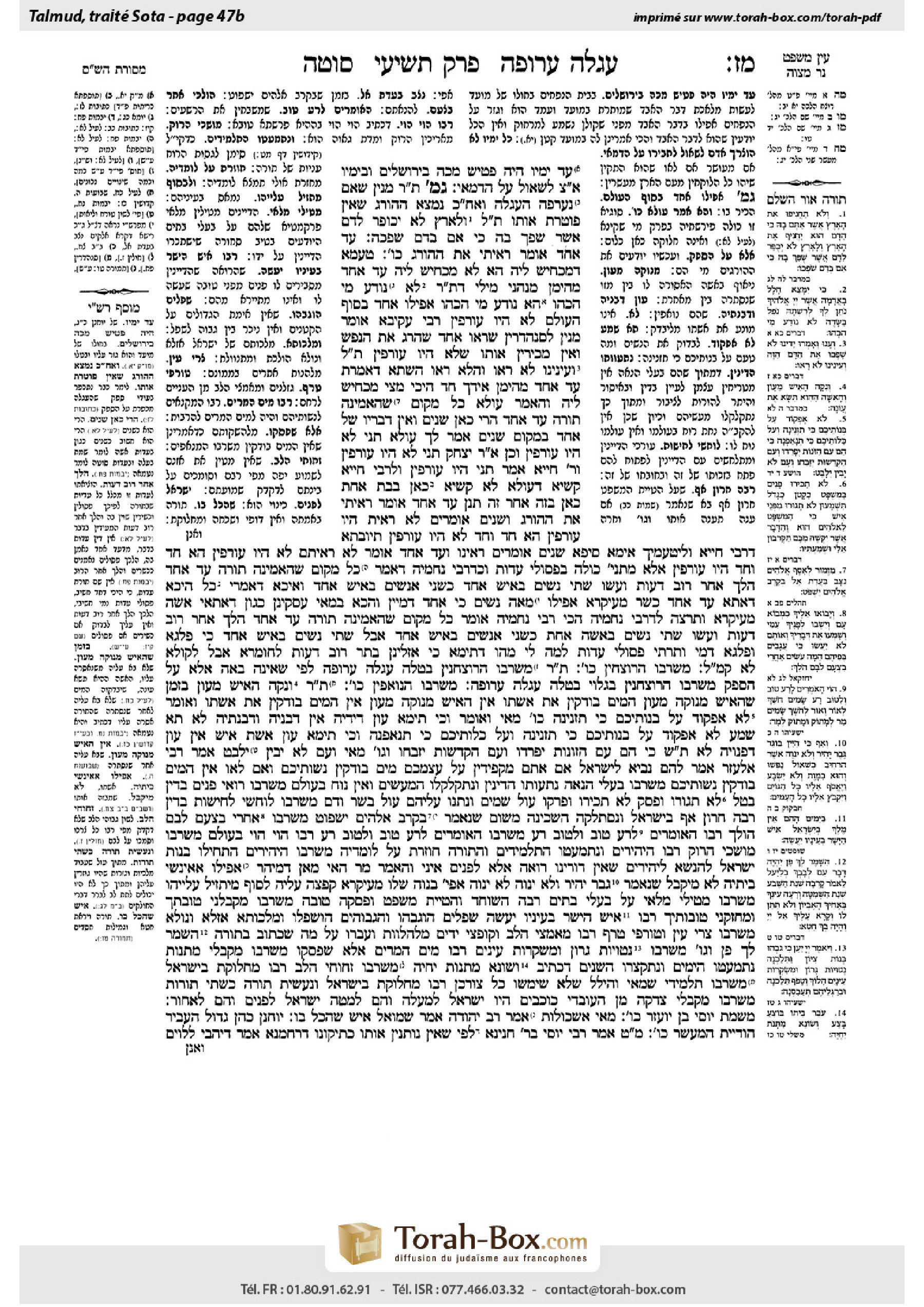
Sotah 47b: Talmud study for Daf Yomi
Daf Yomi is the daily study of one Talmud folio. Explore 37 tractates with scans, Hebrew text, Sefaria English and AI-generated French translations where annotated.
Passage selection and English or AI-generated French translation are available where the scan has annotations. Daf Study is independent of Torah-Box and Sefaria.
Browse Sotah · סוטה · All tractatesSotah 47b text and translations
This page of Sotah includes the Aramaic text, an English translation and an AI-generated French translation, alongside the scan above.
סוטה מ״ז ב · Aramaic and Hebrew text
עַד יָמָיו הָיָה פַּטִּישׁ מַכֶּה בִּירוּשָׁלַיִם. וּבְיָמָיו אֵין צָרִיךְ לִשְׁאוֹל עַל הַדְּמַאי.
גְּמָ׳ תָּנוּ רַבָּנַן: מִנַּיִן שֶׁאִם נֶעֶרְפָה הָעֶגְלָה וְאַחַר כָּךְ נִמְצָא הַהוֹרֵג שֶׁאֵין פּוֹטֶרֶת אוֹתוֹ — תַּלְמוּד לוֹמַר: ״וְלָאָרֶץ לֹא יְכֻפַּר לַדָּם אֲשֶׁר שֻׁפַּךְ בָּהּ כִּי אִם בְּדַם שֹׁפְכוֹ״.
עֵד אֶחָד אוֹמֵר רָאִיתִי אֶת הַהוֹרֵג כּוּ׳. טַעְמָא דְּמַכְחֵישׁ לֵיהּ, הָא לָא מַכְחֵישׁ לֵיהּ — עֵד אֶחָד מְהֵימַן.
מְנָהָנֵי מִילֵּי? דְּתָנוּ רַבָּנַן: ״לֹא נוֹדַע מִי הִכָּהוּ״. הָא נוֹדַע מִי הִכָּהוּ, אֲפִילּוּ אֶחָד בְּסוֹף הָעוֹלָם — לֹא הָיוּ עוֹרְפִין. רַבִּי עֲקִיבָא אוֹמֵר: מִנַּיִן לְסַנְהֶדְרִין שֶׁרָאוּ אֶחָד שֶׁהָרַג אֶת הַנֶּפֶשׁ וְאֵין מַכִּירִין אוֹתוֹ, שֶׁלֹּא הָיוּ עוֹרְפִין — תַּלְמוּד לוֹמַר: ״וְעֵינֵינוּ לֹא רָאוּ״, וַהֲלֹא רָאוּ.
הַשְׁתָּא דְּאָמְרַתְּ עֵד אֶחָד מְהֵימַן, אִידַּךְ חַד הֵיכִי מָצֵי מַכְחֵישׁ לֵיהּ? וְהָאָמַר עוּלָּא: כׇּל מָקוֹם שֶׁהֶאֱמִינָה תּוֹרָה עֵד אֶחָד — הֲרֵי כָּאן שְׁנַיִם, וְאֵין דְּבָרָיו שֶׁל אֶחָד בִּמְקוֹם שְׁנַיִם! אָמַר לָךְ עוּלָּא, תְּנִי: ״לֹא הָיוּ עוֹרְפִין״. וְכֵן אָמַר רַבִּי יִצְחָק, תְּנִי: ״לֹא הָיוּ עוֹרְפִין״.
וְרַבִּי חִיָּיא אָמַר, תְּנִי: ״הָיוּ עוֹרְפִין״. וּלְרַבִּי חִיָּיא קַשְׁיָא דְּעוּלָּא! לָא קַשְׁיָא: כָּאן בְּבַת אַחַת, כָּאן בְּזֶה אַחַר זֶה.
תְּנַן: עֵד אֶחָד אוֹמֵר ״רָאִיתִי אֶת הַהוֹרֵג״, וּשְׁנַיִם אוֹמְרִים ״לֹא רָאִיתָ״ — הָיוּ עוֹרְפִין. הָא חַד וְחַד — לֹא הָיוּ עוֹרְפִין, תְּיוּבְתָּא דְּרַבִּי חִיָּיא!
וְלִיטַעְמָיךְ, אֵימָא סֵיפָא: שְׁנַיִם אוֹמְרִים ״רָאִינוּ״, וְעֵד אֶחָד אוֹמֵר ״לֹא רְאִיתֶם״ — לֹא הָיוּ עוֹרְפִין. הָא חַד וְחַד — הָיוּ עוֹרְפִין.
אֶלָּא: מַתְנִיתִין כּוּלַּהּ בִּפְסוּלֵי עֵדוּת, וְכִדְרַבִּי נְחֶמְיָה, דְּאָמַר: כׇּל מָקוֹם שֶׁהֶאֱמִינָה תּוֹרָה עֵד אֶחָד הַלֵּךְ אַחַר רוֹב דֵּעוֹת, וְעָשׂוּ שְׁתֵּי נָשִׁים בְּאִישׁ אֶחָד כִּשְׁנֵי אֲנָשִׁים בְּאִישׁ אֶחָד.
וְאִיכָּא דְאָמְרִי: כׇּל הֵיכָא דַּאֲתָא עֵד אֶחָד — כָּשֵׁר מֵעִיקָּרָא, אֲפִילּוּ מֵאָה נָשִׁים כִּי אֶחָד דָּמְיָין. וְהָכָא בְּמַאי עָסְקִינַן — כְּגוֹן דַּאֲתַאי אִשָּׁה מֵעִיקָּרָא. וְתָרְצַהּ לִדְרַבִּי נְחֶמְיָה הָכִי: רַבִּי נְחֶמְיָה אוֹמֵר: כׇּל מָקוֹם שֶׁהֶאֱמִינָה תּוֹרָה עֵד אֶחָד — הַלֵּךְ אַחַר רוֹב דֵּעוֹת, וְעָשׂוּ שְׁתֵּי נָשִׁים בְּאִשָּׁה אַחַת כִּשְׁנֵי אֲנָשִׁים בְּאִישׁ אֶחָד, אֲבָל שְׁתֵּי נָשִׁים בְּאִישׁ אֶחָד — כִּי פַּלְגָא וּפַלְגָא דָּמֵי.
וְתַרְתֵּי פְּסוּלֵי עֵדוּת, לְמָה לִי? מַהוּ דְּתֵימָא: כִּי אָזְלִינַן בָּתַר רוֹב דֵּעוֹת — לְחוּמְרָא, אֲבָל לְקוּלָּא — לָא, קָא מַשְׁמַע לַן.
מִשֶּׁרַבּוּ הָרוֹצְחִין כּוּ׳. תָּנוּ רַבָּנַן: מִשֶּׁרַבּוּ הָרוֹצְחָנִין — בָּטְלָה עֶגְלָה עֲרוּפָה, לְפִי שֶׁאֵינָהּ בָּאָה אֶלָּא עַל הַסָּפֵק. מִשֶּׁרַבּוּ הָרוֹצְחָנִין בְּגָלוּי — בָּטְלָה עֶגְלָה עֲרוּפָה.
מִשֶּׁרַבּוּ הַנּוֹאֲפִין כּוּ׳. תָּנוּ רַבָּנַן: ״וְנִקָּה הָאִישׁ מֵעָוֹן״, בִּזְמַן שֶׁהָאִישׁ מְנוּקֶּה מֵעָוֹן — הַמַּיִם בּוֹדְקִין אֶת אִשְׁתּוֹ, אֵין הָאִישׁ מְנוּקֶּה מֵעָוֹן — אֵין הַמַּיִם בּוֹדְקִין אֶת אִשְׁתּוֹ. וְאוֹמֵר: ״לֹא אֶפְקוֹד עַל בְּנוֹתֵיכֶם כִּי תִזְנֶינָה כּוּ׳״.
מַאי ״וְאוֹמֵר״? וְכִי תֵּימָא עָוֹן דִּידֵיהּ — אִין, דִּבְנֵיהּ וְדִבְנָתֵיהּ — לָא, תָּא שְׁמַע: ״לֹא אֶפְקוֹד עַל בְּנוֹתֵיכֶם כִּי תִזְנֶינָה וְעַל כַּלּוֹתֵיכֶם כִּי תְנָאַפְנָה״.
וְכִי תֵּימָא: עֲוֹן אֵשֶׁת אִישׁ — אִין, עָוֹן דִּפְנוּיָה — לָא, תָּא שְׁמַע: ״כִּי הֵם עִם הַזֹּנוֹת יְפָרֵדוּ וְעִם הַקְּדֵשׁוֹת יְזַבֵּחוּ וְגוֹ׳״.
מַאי ״וְעָם לֹא יָבִין יִלָּבֵט״? אָמַר רַבִּי אֶלְעָזָר: אָמַר לָהֶם נָבִיא לְיִשְׂרָאֵל: אִם אַתֶּם מַקְפִּידִין עַל עַצְמְכֶם — מַיִם בּוֹדְקִין נְשׁוֹתֵיכֶם, וְאִם לָאו — אֵין הַמַּיִם בּוֹדְקִין נְשׁוֹתֵיכֶם.
מִשֶּׁרַבּוּ בַּעֲלֵי הֲנָאָה, נִתְעַוְּתוּ הַדִּינִין וְנִתְקַלְקְלוּ הַמַּעֲשִׂים וְאֵין נוֹחַ בָּעוֹלָם. מִשֶּׁרַבּוּ רוֹאֵי פָנִים בַּדִּין, בָּטַל ״לֹא תָגוּרוּ״, וּפָסַק ״לֹא תַכִּירוּ״, וּפָרְקוּ עוֹל שָׁמַיִם וְנָתְנוּ עֲלֵיהֶם עוֹל בָּשָׂר וָדָם.
מִשֶּׁרַבּוּ לוֹחֲשֵׁי לְחִישׁוֹת בַּדִּין — רָבָה חֲרוֹן אַף בְּיִשְׂרָאֵל, וְנִסְתַּלְּקָה הַשְּׁכִינָה, מִשּׁוּם שֶׁנֶּאֱמַר: ״בְּקֶרֶב אֱלֹהִים יִשְׁפֹּט״. מִשֶּׁרַבּוּ ״אַחֲרֵי בִצְעָם לִבָּם הֹלֵךְ״ — רַבּוּ ״הָאוֹמְרִים לָרַע טוֹב וְלַטּוֹב רָע״. מִשֶּׁרַבּוּ ״הָאוֹמְרִים לָרַע טוֹב וְלַטּוֹב רָע״ — רַבּוּ ״הוֹי הוֹי״ בָּעוֹלָם.
מִשֶּׁרַבּוּ מוֹשְׁכֵי הָרוֹק — רַבּוּ הַיְּהִירִים וְנִתְמַעֲטוּ הַתַּלְמִידִים, וְהַתּוֹרָה חוֹזֶרֶת עַל לוֹמְדֶיהָ. מִשֶּׁרַבּוּ הַיְּהִירִים — הִתְחִילוּ בְּנוֹת יִשְׂרָאֵל לְהִנָּשֵׂא לִיהִירִים, שֶׁאֵין דּוֹרֵינוּ רוֹאֶה אֶלָּא לַפָּנִים.
אִינִי?! וְהָאָמַר מָר: הַאי מַאן דְּמִיַּהַר — אֲפִילּוּ אַאִינָשֵׁי בֵּיתֵיהּ לָא מִיקַּבַּל, שֶׁנֶּאֱמַר: ״גֶּבֶר יָהִיר וְלֹא יִנְוֶה״, לֹא יִנְוֶה אֲפִילּוּ בַּנָּוֶה שֶׁלּוֹ! מֵעִיקָּרָא קָפְצָה עֲלֵיהּ, לְסוֹף מִיתְּזִיל עֲלַיְיהוּ.
מִשֶּׁרַבּוּ מַטִּילֵי מְלַאי עַל בַּעֲלֵי בָתִּים — רָבָה הַשּׁוֹחַד וְהַטָּיַית מִשְׁפָּט, וּפָסְקָה טוֹבָה. מִשֶּׁרַבּוּ ״מְקַבְּלֵנִי טוֹבָתְךָ״ וּ״מְחַזְּקֵנִי טוֹבוֹתֶיךָ״ — רַבּוּ ״אִישׁ הַיָּשָׁר בְּעֵינָיו יַעֲשֶׂה״. שְׁפָלִים הוּגְבְּהוּ, וְהַגְּבוֹהִים הוּשְׁפְּלוּ, וּמַלְכוּתָא אָזְלָא וְנָוְלָא. מִשֶּׁרַבּוּ צָרֵי עַיִן וְטוֹרְפֵי טֶרֶף — רַבּוּ מְאַמְּצֵי הַלֵּב וְקוֹפְצֵי יָדַיִם מִלְּהַלְווֹת, וְעָבְרוּ עַל מַה שֶּׁכָּתוּב בַּתּוֹרָה ״הִשָּׁמֶר לְךָ פֶּן וְגוֹ׳״.
מִשֶּׁרַבּוּ ״נְטוּיוֹת גָּרוֹן וּמְשַׂקְּרוֹת עֵינָיִם״ — רַבּוּ מַיִם הַמָּרִים, אֶלָּא שֶׁפָּסְקוּ. מִשֶּׁרַבּוּ מְקַבְּלֵי מַתָּנוֹת — נִתְמַעֲטוּ הַיָּמִים וְנִתְקַצְּרוּ הַשָּׁנִים, דִּכְתִיב: ״וְשׂוֹנֵא מַתָּנֹת יִחְיֶה״. מִשֶּׁרַבּוּ זְחוּחֵי הַלֵּב — רַבּוּ מַחֲלוֹקֹת בְּיִשְׂרָאֵל. מִשֶּׁרַבּוּ תַּלְמִידֵי שַׁמַּאי וְהִילֵּל שֶׁלֹּא שִׁימְּשׁוּ כׇּל צוֹרְכָּן — רַבּוּ מַחְלוֹקוֹת בְּיִשְׂרָאֵל, וְנַעֲשֵׂית תּוֹרָה כִּשְׁתֵּי תוֹרוֹת. מִשֶּׁרַבּוּ מְקַבְּלֵי צְדָקָה מִן הַנׇּכְרִי — הָיוּ יִשְׂרָאֵל לְמַעְלָה וְהֵם לְמַטָּה, יִשְׂרָאֵל לִפְנִים וְהֵם לְאָחוֹר.
מִשֶּׁמֵּת יוֹסֵי בֶּן יוֹעֶזֶר כּוּ׳. מַאי ״אֶשְׁכּוֹלוֹת״? אָמַר רַב יְהוּדָה אָמַר שְׁמוּאֵל, אִישׁ שֶׁהַכֹּל בּוֹ. יוֹחָנָן כֹּהֵן גָּדוֹל הֶעֱבִיר הוֹדָיַית הַמַּעֲשֵׂר כּוּ׳. מַאי טַעְמָא? אָמַר רַבִּי יוֹסֵי בְּרַבִּי חֲנִינָא: לְפִי שֶׁאֵין נוֹתְנִין אוֹתוֹ כְּתִיקּוּנוֹ. דְּרַחֲמָנָא אָמַר דְּיָהֲבִי לִלְוִיִּם,
Sotah 47b · English translation
Until his days the hammer of smiths would strike in Jerusalem on the intermediate days of a Festival, but he banned the practice. And furthermore, in his days there was no need to inquire about doubtfully tithed produce [demai], as everyone was careful to tithe.
GEMARA: The Sages taught: From where is it derived that if the heifer’s neck was broken and afterward the killer was found, then the breaking of the neck does not exempt him from punishment? The verse states: “And the land shall not be atoned, for the blood that was spilled in it, but by the blood of he who spilled it” (Numbers 35:33).
The mishna taught that if one witness says: I saw the killer, and another testifies: You did not see him, they would break the heifer’s neck. The Gemara infers: The reason they break the neck is because the second witness contradicts him, but if no one contradicts him, one witness is relied upon, and they do not break the heifer’s neck.
From where are these matters derived? The Gemara answers that it is as the Sages taught in a baraita: It states with regard to the heifer whose neck is broken: “It is not known who has smitten him” (Deuteronomy 21:1). Consequently, if it was known who smote him, even if it was only one person at the end of the world who knew, they would not break the neck of the heifer. Rabbi Akiva says: From where is it derived that if the members of the Sanhedrin themselves saw one person kill someone, but they do not recognize him, then they would not break the neck of the heifer? The verse states: “Nor did our eyes see” (Deuteronomy 21:7), and did they not see? Seeing the murder alone obviates the need for the performance of the ritual.
The Gemara poses a question: Now that you have said that in this case one witness is relied upon, if so, how is the other one able to contradict him? Didn’t Ulla say: Wherever the Torah relies on one witness, there is the equivalent of the testimony of two witnesses here, and the statement of one witness has no standing in a place where it is contradicted by two witnesses. The Gemara answers: Ulla could have said to you that the text of the mishna should be emended and teach the mishna in this way: They would not break the neck of the heifer. And Rabbi Yitzḥak also said to teach: They would not break the neck.
And Rabbi Ḥiyya said that one should teach: They would break the neck. The Gemara asks: And according to Rabbi Ḥiyya, the above ruling of Ulla is difficult. The Gemara answers: This is not difficult, as here, in the mishna, the case is discussing when two witnesses came simultaneously, and therefore both of their testimonies are rejected; whereas there, with regard to the statement of Ulla, it is referring to a case when they testified one after the other. Ulla rules that once the testimony of the first witness has been accepted the testimony of the second witness cannot nullify it.
We learned in the mishna: If one witness says: I saw the killer, and two say: You did not see, they would break the neck. This cannot be stated just to teach us this halakha, as the fact that two witnesses override one witness is well known. The Gemara assumes that it is stated for the following inference: Therefore, if one testified, and the other one then testified, they would not break the neck. This appears to be a conclusive refutation of Rabbi Ḥiyya, who has the text of: They would break the neck.
The Gemara answers: And according to your reasoning that the mishna states its cases in order to teach an inference, say the latter clause of the mishna: If two witnesses say: We saw, and one witness says: You did not see, they would not break the neck. The Gemara makes an inference from this clause: Therefore, if one came and then the other one came, i.e., they did not come simultaneously, they would break the neck. The two inferences from the different clauses of the mishna consequently contradict one another, and the mishna needs to be explained differently.
Rather, the correct understanding is that the entire mishna is not dealing with valid witnesses and stating an obvious halakha in order to enable an inference, but instead it is dealing with people who are disqualified from bearing witness and is also teaching us a novel ruling. And the mishna is in accordance with the opinion of Rabbi Neḥemya, who says: Wherever the Torah relies on one witness, follow the majority of opinions. In other words, if the testimonies of two disqualified witnesses conflict, the court rules in accordance with the testimony provided by more witnesses, whether or not they are qualified to testify. And they established that with regard to the testimony of two women, who are usually disqualified from testifying, when they testify against one man, it should be like that of two men against one man, and the court will rule in accordance with the testimony of the two women.
And there are those who say a different version of Rabbi Neḥemya’s opinion: Anywhere that one valid witness came at the outset, even one hundred women who later contradict him are considered like one witness, and do not override his testimony. And with what are we dealing here in the mishna? A case where a woman came at the outset, and testified that she saw the killer. Then two other women arrived to contradict her statement. And according to this interpretation you must emend the statement of Rabbi Neḥemya so that it reads like this: Rabbi Neḥemya says: Wherever the Torah relies on one witness, follow the majority of opinions. And they established that two women against one woman are like two men against one man. But two women in opposition to one man who is a valid witness is like half of a pair of witnesses and half of a pair of witnesses, and the mishna did not address that case.
The Gemara poses a question on these two interpretations of the mishna: And why do I need two cases in the mishna to teach the halakha that the majority opinion of those disqualified from bearing witness is followed? The Gemara explains: It is necessary, lest you say that when we follow the majority opinion in the case of invalid witnesses, this is when it results in a decision to be stringent and require the performance of the ritual. But when it results in a decision to be lenient and say that the ritual is not required, we do not follow the majority opinion, and the performance of the ritual is required even if there is one witness saying that the killer was not seen. Therefore, the mishna teaches us that there is no difference in this regard, and the majority opinion is followed in any case.
§ The mishna taught that from the time when murderers proliferated, the ritual of the heifer whose neck is broken was nullified. The Sages taught: From the time when murderers proliferated, the ritual of the heifer whose neck is broken was nullified, because it comes only for a case involving uncertainty with regard to the identity of the murderer. Therefore, when there was an increase of murderers acting openly so that their identities were known, the ritual of the heifer whose neck is broken was nullified.
The mishna also taught that from the time when adulterers proliferated, the performance of the ritual of the bitter water of a sota was nullified. The Sages taught: It states: “And the man shall be cleared of transgression, and that woman shall bear her transgression” (Numbers 5:31), which indicates that when the man is clear of transgression the waters evaluate if his wife was unfaithful, but if the man is not clear of transgression the waters do not evaluate if his wife was unfaithful. And it states: “I will not punish your daughters when they commit harlotry, nor your daughters-in-law when they commit adultery; for they consort with lewd women, and they sacrifice with prostitutes; and the people that is without understanding is distraught” (Hosea 4:14).
The Gemara clarifies: What is the purpose of the addition of: And it states? What is lacking in the exposition from the verse of the Torah? The Gemara explains: And if you would say that based on the verse: “And the man shall be cleared of transgression,” the halakha would be that with regard to his transgression, yes, it will cause the waters to be ineffective, but the transgression of his sons and daughters does not impact the effectiveness, come and hear the verse: “I will not punish your daughters,” i.e., I will not punish your wives, due to your daughters, “when they commit harlotry, nor your daughters-in-law when they commit adultery.”
And if you would say: With regard to the transgression of adultery with a married woman, yes, it will cause the waters to be ineffective, but the transgression of one who engaged in sexual intercourse with an unmarried woman does not impact the effectiveness, come and hear the continuation of the verse: “For they consort with lewd women, and they sacrifice with prostitutes.”
The Gemara turns its attention to the end of the verse. What is the meaning of: “And the people that is without understanding is distraught”? Rabbi Elazar says: The prophet said to the Jewish people: If you are particular about yourselves, the water evaluates your wives; but if not, the water does not evaluate your wives. This would make people distraught, as they would not know how to overcome their suspicion if they are concerned that their wives have been unfaithful.
§ The Gemara cites statements similar to those of the mishna. From the time when those who accept benefit from others proliferated, the laws became twisted and deeds became corrupted, and there was no comfort in the world. From the time when those who look at the faces of the litigants in judgment, in order to rule based on the appearance of the litigants, proliferated, the fulfillment of the verse: “You shall not fear the face of any man” (Deuteronomy 1:17), ceased, and the fulfillment of the verse: “You shall not respect faces in judgment” (Deuteronomy 1:17), halted, and they removed the yoke of Heaven from themselves, and placed upon themselves the yoke of flesh and blood.
From the time when those who whisper whisperings in judgment, advising judges surreptitiously, proliferated, fierce anger proliferated in Israel, and the Divine Presence departed, because it is stated: “God stands in the congregation of God; in the midst of the judges He judges” (Psalms 82:1). The Divine Presence that dwells among judges leaves if they judge improperly. From the time when those who are referred to in the verse: “Their heart goes after their covetousness” (Ezekiel 33:31), proliferated, “Those who say to evil good, and to good evil” (Isaiah 5:20) proliferated, i.e., those who treat wicked people as though they were righteous proliferated as a result. From the time when the fulfillment of the verse: “Those who say to evil good, and to good evil,” proliferated, the cry of: Woe, woe, proliferated in the world. There was an increase in troubles that cause people to cry out.
From the time when those who show their arrogance by drawing out spittle proliferated, the number of haughty people in general proliferated, and the number of students decreased, as they would say haughtily that there was nothing left for them to learn, and the Torah needs to go around to seek those who study it, as people do not learn of their own initiative. Furthermore, from the time when haughty people proliferated, the daughters of Israel began marrying haughty men, as our generation looks only at the face, i.e., the external aspects of a person, and ignores the inner aspects of a person.
The Gemara raises a difficulty: Is that so? Do women wish to marry arrogant men? But didn’t the Master say: One who is haughty is not even accepted by the members of his household, as it is stated: “The haughty man abides not” (Habakkuk 2:5)? “Abides [yinaveh] not” means that even in his abode [naveh], he is not accepted. The Gemara explains: Initially, she jumps at the chance to marry him, because he appears to be a great person to her, but in the end, once she gets to know him, he is demeaned in her eyes.
The baraita continues: From the time when there was an increase in those who placed upon homeowners the obligation to designate the profits from merchandise for the upkeep of judges, bribery and corruption of judgment proliferated and good ceased. From the time when those judges and leaders who say: I accept your favor, and: I hold your favor, proliferated, the fulfillment of the verse: “Every man did that which was right in his eyes” (Judges 17:6), proliferated. Lowly ones were raised and lofty ones were lowered, and the monarchy is increasingly on the decline. From the time when misers and those greedy for profit proliferated, those hardened of heart and who closed their hands from lending proliferated, and they transgressed that which is written in the Torah: “You shall not harden your heart, nor shut your hand from your needy brother…Guard yourself in case there is a base thought in your heart…and you do not give him” (Deuteronomy 15:7, 9).
From the time when women with “stretched-forth necks and wanton eyes” (Isaiah 3:16) proliferated, the bitter waters of a sota proliferated, as more people were suspected of committing adultery; but they eventually ceased when licentiousness became too widespread. From the time when those who accept gifts proliferated, the days decreased and the years shortened, as it is written: “And he who hates gifts lives” (Proverbs 15:27). From the time when those with boastful [zeḥuḥei] hearts proliferated, dispute proliferated in Israel. From the time when the students of Shammai and Hillel who did not serve their Rabbis sufficiently proliferated, dispute proliferated in Israel, and the Torah became like two Torahs. From the time when those who accept charity from gentiles proliferated, the Jewish people were above and they below; the Jewish people ahead and they behind. This last statement is a euphemism; it was the Jewish people that were below and behind, but the Gemara did not want to say so explicitly.
§ The mishna taught that from the time when Yosei ben Yo’ezer died the clusters ceased. The Gemara poses a question: What is the meaning of clusters [eshkolot]? Rav Yehuda says that Shmuel says: It means a man who contains all [ish shehakol bo] elements of Torah and mitzvot. The mishna further taught that Yoḥanan the High Priest took away the declaration of the tithe. The Gemara poses a question: What is the reason he did this? Rabbi Yosei, son of Rabbi Ḥanina, says: Because they did not give the tithe in the proper manner as stated by the Torah. In what way is that? As the Merciful One states in the Torah that they should give the first tithe to the Levites,
Sotah 47b · Traduction française (IA)
Jusqu’à son époque, les marteaux des forgerons résonnaient à Jérusalem pendant les jours intermédiaires d’une fête, mais il interdit cette pratique. De plus, à son époque, il n’était pas nécessaire de s’enquérir au sujet des produits dont le prélèvement des dîmes était douteux [demai], car tout le monde veillait à prélever les dîmes.
GUEMARA : Les Sages ont enseigné : D’où déduit-on que si la nuque de la génisse a été brisée et que, par la suite, le meurtrier a été retrouvé, le fait d’avoir brisé sa nuque ne l’exempte pas de peine ? Le verset dit : « Le pays ne peut être expié du sang qui y a été versé que par le sang de celui qui l’a versé » (Nombres 35:33).
La Michna enseignait que si un témoin dit : « J’ai vu le meurtrier », et qu’un autre témoigne : « Tu ne l’as pas vu », on brisait la nuque de la génisse. La Guemara en déduit que la raison pour laquelle on brise sa nuque est que le second témoin le contredit ; mais si personne ne le contredit, on se fie à un seul témoin et on ne brise pas la nuque de la génisse.
D’où déduit-on ces principes ? La Guemara répond que cela découle de l’enseignement des Sages dans une baraïta : À propos de la génisse dont on brise la nuque, il est écrit : « On ne sait pas qui l’a frappé » (Deutéronome 21:1). Par conséquent, si l’on sait qui l’a frappé, même si une seule personne, à l’autre bout du monde, le sait, on ne brise pas la nuque de la génisse. Rabbi Akiva dit : D’où déduit-on que si les membres du Sanhédrin eux-mêmes ont vu quelqu’un tuer une personne, mais ne reconnaissent pas le meurtrier, on ne brise pas la nuque de la génisse ? Le verset dit : « Nos yeux ne l’ont pas vu » (Deutéronome 21:7). Or, ne l’ont-ils pas vu ? Le fait d’avoir vu le meurtre suffit à rendre le rituel inutile.
La Guemara pose une question : Puisque vous dites à présent que, dans ce cas, on se fie à un seul témoin, comment l’autre peut-il alors le contredire ? Ulla n’a-t-il pas dit : Partout où la Torah s’en remet à un seul témoin, celui-ci a valeur ici de deux témoins ; le témoignage d’un seul témoin n’a donc aucune valeur lorsqu’il est contredit par deux témoins. La Guemara répond : Ulla aurait pu te dire qu’il faut corriger le texte de la Michna et l’enseigner ainsi : On ne briserait pas la nuque de la génisse. Rabbi Yitzḥak a lui aussi dit qu’il faut enseigner : On ne briserait pas la nuque.
Rabbi Ḥiyya a dit, quant à lui, qu’il faut enseigner : On briserait la nuque. La Guemara demande : Selon Rabbi Ḥiyya, la règle énoncée plus haut par Ulla pose une difficulté. La Guemara répond qu’il n’y a pas de difficulté : ici, dans la Michna, le cas concerne deux témoins qui se sont présentés simultanément, et leurs deux témoignages sont donc rejetés ; tandis que là, dans la déclaration d’Ulla, il s’agit d’un cas où ils ont témoigné l’un après l’autre. Selon Ulla, dès que le témoignage du premier témoin a été accepté, celui du second ne peut plus l’annuler.
Nous avons appris dans la Michna : Si un témoin dit : « J’ai vu le meurtrier », et que deux témoins disent : « Tu ne l’as pas vu », on brise la nuque. Cela ne peut pas être énoncé uniquement pour nous enseigner cette halakha, car il est bien connu que deux témoins l’emportent sur un seul. La Guemara suppose que cet enseignement vise l’inférence suivante : par conséquent, si l’un a témoigné, puis que l’autre a témoigné, on ne briserait pas la nuque. Cela semble réfuter définitivement Rabbi Ḥiyya, selon qui il faut enseigner : « On briserait la nuque ».
La Guemara répond : Mais, selon votre raisonnement, si la Michna énonce ses cas afin qu’on en tire une inférence, considérez la clause suivante de la Michna : Si deux témoins disent : « Nous l’avons vu », et qu’un témoin dit : « Vous ne l’avez pas vu », on ne brise pas la nuque. La Guemara tire de cette clause l’inférence suivante : par conséquent, si l’un est venu, puis l’autre, c’est-à-dire s’ils ne sont pas venus simultanément, on briserait la nuque. Les deux inférences tirées des différentes clauses de la Michna se contredisent donc, et il faut expliquer la Michna autrement.
Il faut plutôt comprendre que la Michna, dans son ensemble, ne traite pas de témoins aptes à témoigner et n’énonce pas une halakha évidente afin de permettre d’en tirer une inférence ; elle traite plutôt de personnes inaptes à témoigner et nous enseigne également une règle nouvelle. La Michna suit l’opinion de Rabbi Neḥemya, qui dit : Partout où la Torah s’en remet à un seul témoin, on suit l’avis de la majorité. Autrement dit, lorsque les témoignages de deux témoins inaptes se contredisent, le tribunal tranche selon le témoignage du plus grand nombre, qu’ils soient aptes à témoigner ou non. Et ils ont établi que, lorsque deux femmes, généralement inaptes à témoigner, déposent contre un homme, leur témoignage équivaut à celui de deux hommes contre un homme ; le tribunal tranche donc selon le témoignage des deux femmes.
D’autres rapportent une version différente de l’opinion de Rabbi Neḥemya : Partout où un témoin apte à témoigner s’est présenté en premier, même cent femmes qui viennent ensuite le contredire sont considérées comme un seul témoin et n’annulent pas son témoignage. De quel cas s’agit-il donc ici, dans la Michna ? D’un cas où une femme s’est présentée en premier et a témoigné qu’elle avait vu le meurtrier. Puis deux autres femmes sont arrivées pour contredire sa déclaration. Selon cette interprétation, il faut corriger la formulation de Rabbi Neḥemya pour qu’elle se lise ainsi : Rabbi Neḥemya dit : Partout où la Torah s’en remet à un seul témoin, on suit l’avis de la majorité. Et ils ont établi que deux femmes contre une femme équivalent à deux hommes contre un homme. Mais deux femmes opposées à un homme qui est un témoin apte à témoigner équivalent à la moitié d’une paire de témoins contre l’autre moitié d’une paire de témoins ; la Michna n’a pas abordé ce cas.
La Guemara pose une question sur ces deux interprétations de la Michna : Pourquoi faut-il deux cas dans la Michna pour enseigner la halakha selon laquelle on suit l’avis de la majorité parmi ceux qui sont inaptes à témoigner ? La Guemara explique : C’est nécessaire, de peur que tu dises que, lorsque l’on suit l’avis de la majorité dans le cas de témoins inaptes, c’est seulement lorsque cela conduit à une décision rigoureuse, imposant l’accomplissement du rituel. Mais lorsque cela conduit à une décision indulgente, selon laquelle le rituel n’est pas nécessaire, on ne suit pas l’avis de la majorité, et le rituel doit être accompli même si un témoin affirme que le meurtrier n’a pas été vu. La Michna nous enseigne donc qu’il n’y a pas de différence à cet égard : on suit l’avis de la majorité dans tous les cas.
§ La Michna enseignait qu’à partir du moment où les meurtriers se multiplièrent, le rituel de la génisse dont on brise la nuque fut aboli. Les Sages ont enseigné : À partir du moment où les meurtriers se multiplièrent, le rituel de la génisse dont on brise la nuque fut aboli, car il ne s’applique qu’à un cas où l’identité du meurtrier est incertaine. Ainsi, lorsque les meurtriers se mirent à agir ouvertement, de sorte que leur identité était connue, le rituel de la génisse dont on brise la nuque fut aboli.
La Michna enseignait également qu’à partir du moment où les adultères se multiplièrent, le rituel des eaux amères de la sota fut aboli. Les Sages ont enseigné : Il est écrit : « L’homme sera quitte de faute, mais cette femme portera sa faute » (Nombres 5:31), ce qui indique que, lorsque l’homme est exempt de faute, les eaux vérifient si sa femme lui a été infidèle ; mais si l’homme n’est pas exempt de faute, les eaux ne vérifient pas si sa femme lui a été infidèle. Et il est écrit : « Je ne punirai pas vos filles parce qu’elles se prostituent, ni vos belles-filles parce qu’elles commettent l’adultère ; car eux-mêmes fréquentent les prostituées et offrent des sacrifices avec les courtisanes ; et le peuple dépourvu d’intelligence est bouleversé » (Osée 4:14).
La Guemara précise : À quoi sert l’ajout « et il est écrit » ? Que manque-t-il à l’explication tirée du verset de la Torah ? La Guemara explique : Et si tu disais que, d’après le verset « L’homme sera quitte de faute », seule sa propre faute, oui, rendrait les eaux inopérantes, tandis que la faute de ses fils et de ses filles n’affecterait pas leur efficacité, viens entendre le verset : « Je ne punirai pas vos filles », c’est-à-dire vos épouses, à cause de vos filles « lorsqu’elles se prostituent, ni vos belles-filles lorsqu’elles commettent l’adultère ».
Et si tu disais que la faute d’adultère avec une femme mariée, oui, rendrait les eaux inopérantes, mais que la faute de celui qui a eu des relations sexuelles avec une femme célibataire n’affecterait pas leur efficacité, viens entendre la suite du verset : « Car eux-mêmes fréquentent les prostituées et offrent des sacrifices avec les courtisanes. »
La Guemara s’intéresse à la fin du verset. Que signifie : « Et le peuple dépourvu d’intelligence est bouleversé » ? Rabbi Elazar dit : Le prophète a dit au peuple juif : Si vous êtes rigoureux envers vous-mêmes, les eaux éprouveront vos femmes ; mais sinon, elles ne les éprouveront pas. Cela bouleverserait les gens, car ils ne sauraient comment apaiser leurs soupçons s’ils craignaient que leurs femmes leur aient été infidèles.
§ La Guemara cite des déclarations semblables à celles de la Michna. À partir du moment où se multiplièrent ceux qui acceptent des avantages de la part d’autrui, les lois furent faussées, les actes se corrompirent et le monde ne connut plus de réconfort. À partir du moment où se multiplièrent ceux qui, au tribunal, regardent le visage des plaideurs afin de trancher d’après leur apparence, l’accomplissement du verset « Vous ne craindrez le visage d’aucun homme » (Deutéronome 1:17) prit fin, et celui du verset « Vous ne ferez pas acception des personnes dans le jugement » (Deutéronome 1:17) cessa ; ils rejetèrent le joug du Royaume des Cieux et se placèrent sous le joug des êtres de chair et de sang.
À partir du moment où se multiplièrent ceux qui chuchotent des conseils aux juges pendant les procès, la colère ardente se répandit en Israël et la Présence divine se retira, car il est dit : « Dieu se tient dans l’assemblée de Dieu ; au milieu des juges, Il juge » (Psaumes 82:1). La Présence divine qui réside parmi les juges les quitte s’ils rendent des jugements injustes. À partir du moment où se multiplièrent ceux que désigne le verset « Leur cœur suit leur convoitise » (Ézéchiel 33:31), se multiplièrent « ceux qui appellent le mal bien et le bien mal » (Isaïe 5:20), c’est-à-dire ceux qui traitent les méchants comme s’ils étaient justes. À partir du moment où se multiplia l’accomplissement du verset « ceux qui appellent le mal bien et le bien mal », les cris de « Malheur, malheur » se multiplièrent dans le monde. Les malheurs qui font crier les gens se multiplièrent.
À partir du moment où se multiplièrent ceux qui manifestent leur arrogance en crachant avec ostentation, les arrogants en général se multiplièrent et les élèves diminuèrent, car, avec arrogance, ils disaient qu’il ne leur restait plus rien à apprendre et que la Torah devait aller à la recherche de ceux qui l’étudient, puisque les gens n’apprennent pas de leur propre initiative. De plus, à partir du moment où les arrogants se multiplièrent, les filles d’Israël commencèrent à épouser des hommes arrogants, car notre génération ne regarde que le visage, c’est-à-dire l’apparence extérieure d’une personne, et néglige ses qualités intérieures.
La Guemara soulève une difficulté : Est-ce vraiment le cas ? Les femmes souhaitent-elles épouser des hommes arrogants ? Mais le Maître n’a-t-il pas dit : Celui qui est arrogant n’est même pas accepté par les membres de sa maison, comme il est écrit : « L’homme arrogant ne demeure pas » (Habacuc 2:5) ? « Ne demeure pas » [yinaveh] signifie que même dans sa demeure [naveh], il n’est pas accepté. La Guemara explique : Au début, elle se précipite pour l’épouser, car il lui paraît être un homme remarquable ; mais à la fin, lorsqu’elle apprend à le connaître, il perd de son estime à ses yeux.
La baraïta poursuit : À partir du moment où se multiplièrent ceux qui imposaient aux propriétaires l’obligation de réserver les bénéfices de leurs marchandises à l’entretien des juges, les pots-de-vin et la corruption des jugements se multiplièrent, et le bien cessa. À partir du moment où se multiplièrent ces juges et dirigeants qui disent : « J’accepte votre faveur » et « Je vous suis redevable », l’accomplissement du verset « Chacun faisait ce qui lui semblait juste » (Juges 17:6) se multiplia. Les gens de basse condition furent élevés et les gens éminents abaissés, et la royauté ne cessait de décliner. À partir du moment où se multiplièrent les avares et ceux qui convoitent le profit, se multiplièrent ceux qui avaient le cœur endurci et fermaient leur main pour ne pas prêter ; ils transgressèrent ainsi ce qui est écrit dans la Torah : « Tu n’endurciras pas ton cœur et tu ne fermeras pas ta main à ton frère nécessiteux… Prends garde qu’il ne se trouve dans ton cœur une pensée vile… et que tu ne lui donnes rien » (Deutéronome 15:7, 9).
À partir du moment où se multiplièrent les femmes au « cou tendu et au regard effronté » (Isaïe 3:16), les eaux amères de la sota se multiplièrent, car davantage de personnes étaient soupçonnées d’adultère ; mais elles finirent par cesser lorsque la débauche se répandit trop largement. À partir du moment où se multiplièrent ceux qui acceptent des cadeaux, les jours diminuèrent et les années raccourcirent, comme il est écrit : « Celui qui hait les cadeaux vivra » (Proverbes 15:27). À partir du moment où se multiplièrent ceux dont le cœur était fanfaron [zeḥuḥei], les querelles se multiplièrent en Israël. À partir du moment où se multiplièrent les disciples de Shammaï et de Hillel qui n’avaient pas suffisamment servi leurs maîtres, les querelles se multiplièrent en Israël et la Torah devint comme deux Torah. À partir du moment où se multiplièrent ceux qui acceptent la charité des non-Juifs, le peuple juif fut au-dessus et eux au-dessous ; le peuple juif devant et eux derrière. Cette dernière déclaration est un euphémisme : c’était le peuple juif qui était au-dessous et derrière, mais la Guemara ne voulait pas le dire explicitement.
§ La Michna enseignait qu’à partir de la mort de Yosei ben Yo’ezer, les grappes cessèrent. La Guemara demande : Que signifie « grappes » [eshkolot] ? Rav Yehuda dit au nom de Shmuel : Cela désigne un homme qui possède tout [ish shehakol bo], c’est-à-dire tous les éléments de la Torah et des mitsvot. La Michna enseignait en outre que Yoḥanan le Grand Prêtre supprima la déclaration de la dîme. La Guemara demande : Pourquoi a-t-il fait cela ? Rabbi Yosei, fils de Rabbi Ḥanina, dit : Parce qu’ils ne prélevaient pas la dîme de la manière prescrite par la Torah. En quoi cela consistait-il ? Le Miséricordieux prescrit dans la Torah qu’ils doivent donner la première dîme aux Lévites.
Traduction française générée par IA à partir de l’édition anglaise de Sefaria. Vérifie toujours un passage avec le texte source.
Text from Sefaria: William Davidson Edition - Vocalized Aramaic (CC BY NC); William Davidson Edition - English (CC BY NC).