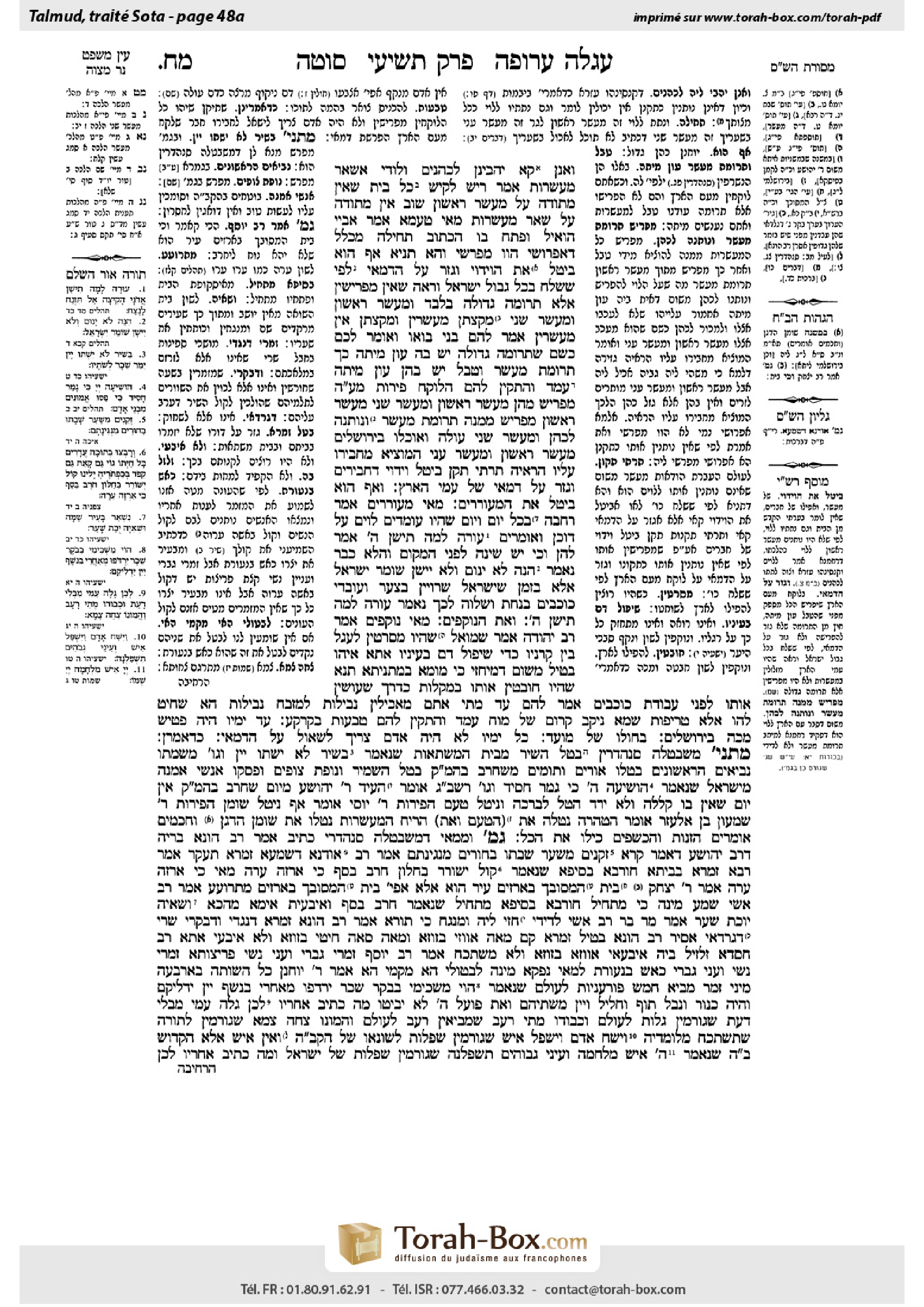
Sotah 48a: Talmud study for Daf Yomi
Daf Yomi is the daily study of one Talmud folio. Explore 37 tractates with scans, Hebrew text, Sefaria English and AI-generated French translations where annotated.
Passage selection and English or AI-generated French translation are available where the scan has annotations. Daf Study is independent of Torah-Box and Sefaria.
Browse Sotah · סוטה · All tractatesSotah 48a text and translations
This page of Sotah includes the Aramaic text, an English translation and an AI-generated French translation, alongside the scan above.
סוטה מ״ח א · Aramaic and Hebrew text
וַאֲנַן קָא יָהֲבִינַן לְכֹהֲנִים.
וְלוֹדֵי אַשְּׁאָר מַעַשְׂרוֹת? אָמַר רֵישׁ לָקִישׁ: כׇּל בַּיִת שֶׁאֵין מִתְוַדֶּה עַל מַעֲשֵׂר רִאשׁוֹן — שׁוּב אֵין מִתְוַדֶּה עַל שְׁאָר מַעַשְׂרוֹת. מַאי טַעְמָא? אָמַר אַבָּיֵי: הוֹאִיל וּפָתַח בּוֹ הַכָּתוּב תְּחִילָּה.
מִכְלָל דְּאַפְרוֹשֵׁי הֲווֹ מַפְרְשִׁי? וְהָא תַּנְיָא: אַף הוּא בִּיטֵּל אֶת הַוִּידּוּי, וְגָזַר עַל הַדְּמַאי. לְפִי שֶׁשָּׁלַח בְּכׇל גְּבוּל יִשְׂרָאֵל וְרָאָה שֶׁאֵין מַפְרִישִׁין אֶלָּא תְּרוּמָה גְּדוֹלָה בִּלְבַד, וּמַעֲשֵׂר רִאשׁוֹן וּמַעֲשֵׂר שֵׁנִי — מִקְצָתָן מְעַשְּׂרִין וּמִקְצָתָן אֵין מְעַשְּׂרִין.
אָמַר לָהֶם: בָּנַי, בּוֹאוּ וְאוֹמַר לָכֶם: כְּשֵׁם שֶׁתְּרוּמָה גְּדוֹלָה יֵשׁ בָּהּ עֲוֹן מִיתָה — כָּךְ תְּרוּמַת מַעֲשֵׂר וְטֶבֶל יֵשׁ בָּהֶן עֲוֹן מִיתָה.
עָמַד וְהִתְקִין לָהֶם: הַלּוֹקֵחַ פֵּירוֹת מֵעַם הָאָרֶץ — מַפְרִישׁ מֵהֶן מַעֲשֵׂר רִאשׁוֹן וּמַעֲשֵׂר שֵׁנִי. מַעֲשֵׂר רִאשׁוֹן — מַפְרִישׁ מִמֶּנָּה תְּרוּמַת מַעֲשֵׂר וְנוֹתְנָהּ לְכֹהֵן, וּמַעֲשֵׂר שֵׁנִי עוֹלֶה וְאוֹכְלוֹ בִּירוּשָׁלַיִם. מַעֲשֵׂר רִאשׁוֹן וּמַעְשַׂר עָנִי — הַמּוֹצִיא מֵחֲבֵירוֹ עָלָיו הָרְאָיָה!
תַּרְתֵּי תַּקֵּן: בִּיטֵּל וִידּוּי דַּחֲבֵירִים, וְגָזַר עַל דְּמַאי שֶׁל עַמֵּי הָאָרֶץ.
וְאַף הוּא בִּיטֵּל אֶת הַמְעוֹרְרִים. מַאי מְעוֹרְרִים? אָמַר רַחֲבָה: בְּכׇל יוֹם וָיוֹם שֶׁהָיוּ עוֹמְדִים לְוִיִּם עַל דּוּכָן וְאוֹמְרִים ״עוּרָה לָמָּה תִישַׁן ה׳״, אָמַר לָהֶן: וְכִי יֵשׁ שֵׁינָה לִפְנֵי הַמָּקוֹם? וַהֲלֹא כְּבָר נֶאֱמַר ״הִנֵּה לֹא יָנוּם וְלֹא יִישָׁן שׁוֹמֵר יִשְׂרָאֵל״! אֶלָּא בִּזְמַן שֶׁיִּשְׂרָאֵל שְׁרוּיִין בְּצַעַר וְאוּמּוֹת הָעוֹלָם בְּנַחַת וְשַׁלְוָה, לְכָךְ נֶאֱמַר ״עוּרָה לָמָּה תִישַׁן ה׳״.
וְאֶת הַנּוֹקְפִים. מַאי ״נוֹקְפִים״? אָמַר רַב יְהוּדָה אָמַר שְׁמוּאֵל: שֶׁהָיוּ מְסָרְטִין לָעֵגֶל בֵּין קַרְנָיו, כְּדֵי שֶׁיִּפּוֹל דָּם בְּעֵינָיו. אֲתָא אִיהוּ בַּטֵּיל, מִשּׁוּם דְּמִיחֲזֵי כִּי מוּמָא.
בְּמַתְנִיתָא תָּנָא: שֶׁהָיוּ חוֹבְטִין אוֹתוֹ בְּמַקְלוֹת כְּדֶרֶךְ שֶׁעוֹשִׂין אוֹתוֹ לִפְנֵי עֲבוֹדָה זָרָה. אָמַר לָהֶם: עַד מָתַי אַתֶּם מַאֲכִילִין נְבֵילוֹת לַמִּזְבֵּחַ! נְבֵילוֹת?! הָא שָׁחֵיט לְהוּ! אֶלָּא טְרֵיפוֹת — שֶׁמָּא נִיקַּב קְרוּם שֶׁל מוֹחַ. עָמַד וְהִתְקִין לָהֶם טַבָּעוֹת בַּקַּרְקַע.
עַד יָמָיו הָיָה פַּטִּישׁ מַכֶּה בִּירוּשָׁלַיִם. בְּחוּלּוֹ שֶׁל מוֹעֵד.
כׇּל יָמָיו לֹא הָיָה אָדָם צָרִיךְ לִשְׁאוֹל עַל הַדְּמַאי. כְּדַאֲמַרַן.
מַתְנִי׳ מִשֶּׁבָּטְלָה סַנְהֶדְרִין — בָּטַל הַשִּׁיר מִבֵּית הַמִּשְׁתָּאוֹת, שֶׁנֶּאֱמַר: ״בַּשִּׁיר לֹא יִשְׁתּוּ יָיִן וְגוֹ׳״.
מִשֶּׁמֵּתוּ נְבִיאִים הָרִאשׁוֹנִים — בָּטְלוּ אוּרִים וְתוּמִּים. מִשֶּׁחָרַב בֵּית הַמִּקְדָּשׁ — בָּטַל הַשָּׁמִיר וְנוֹפֶת צוּפִים, וּפָסְקוּ אַנְשֵׁי אֲמָנָה מִיִּשְׂרָאֵל, שֶׁנֶּאֱמַר: ״הוֹשִׁיעָה ה׳ כִּי גָמַר חָסִיד וְגוֹ׳״.
רַבָּן שִׁמְעוֹן בֶּן גַּמְלִיאֵל אוֹמֵר, הֵעִיד רַבִּי יְהוֹשֻׁעַ: מִיּוֹם שֶׁחָרַב בֵּית הַמִּקְדָּשׁ אֵין יוֹם שֶׁאֵין בּוֹ קְלָלָה, וְלֹא יָרַד הַטַּל לִבְרָכָה, וְנִיטַּל טַעַם הַפֵּירוֹת. רַבִּי יוֹסֵי אוֹמֵר: אַף נִיטַּל שׁוֹמֶן הַפֵּירוֹת. רַבִּי שִׁמְעוֹן בֶּן אֶלְעָזָר אוֹמֵר: הַטׇּהֳרָה נָטְלָה אֶת הַטַּעַם וְאֶת הָרֵיחַ, הַמַּעַשְׂרוֹת נָטְלוּ אֶת שׁוֹמֶן הַדָּגָן. וַחֲכָמִים אוֹמְרִים: הַזְּנוּת וְהַכְּשָׁפִים כִּילוּ אֶת הַכֹּל.
גְּמָ׳ וּמִמַּאי דְּמִשֶּׁבָּטְלָה סַנְהֶדְרִי כְּתִיב? אָמַר רַב הוּנָא בְּרֵיהּ דְּרַב יְהוֹשֻׁעַ, דְּאָמַר קְרָא: ״זְקֵנִים מִשַּׁעַר שָׁבָתוּ בַּחוּרִים מִנְּגִינָתָם״.
אָמַר רַב: אוּדְנָא דְּשָׁמְעָא זִמְרָא — תִּעֲקַר. אָמַר רָבָא: זִמְרָא בְּבֵיתָא — חוּרְבָּא בְּסִיפָּא, שֶׁנֶּאֱמַר: ״קוֹל יְשׁוֹרֵר בַּחַלּוֹן חֹרֶב בַּסַּף כִּי אַרְזָה עֵרָה״.
מַאי ״כִּי אַרְזָה עֵרָה״? אָמַר רַבִּי יִצְחָק: בַּיִת הַמְסוּבָּךְ בַּאֲרָזִים עִיר הוּא! אֶלָּא: אֲפִילּוּ בַּיִת הַמְסוּבָּךְ בַּאֲרָזִים מִתְרוֹעֵעַ. אָמַר רַב אָשֵׁי: שְׁמַע מִינַּהּ כִּי מַתְחֵיל חוּרְבָּא — בְּסִיפָּא מַתְחֵיל, שֶׁנֶּאֱמַר: ״חֹרֶב בַּסַּף״. וְאִיבָּעֵית אֵימָא מֵהָכָא: ״וּשְׁאִיָּה יֻכַּת שָׁעַר״. אָמַר מָר בַּר רַב אָשֵׁי: לְדִידִי חֲזֵי לִי וּמְנַגַּח כִּי תוֹרָא.
אָמַר רַב הוּנָא: זִמְרָא דְּנַגָּדֵי וּדְבַקָּרֵי — שְׁרֵי. דְּגַרְדָּאֵי — אֲסִיר. רַב הוּנָא בַּטֵּיל זִמְרָא, קָם מְאָה אֲווֹזֵי בְּזוּזָא וּמְאָה סָאֵה חִיטֵּי בְּזוּזָא וְלָא אִיבְּעִי. אֲתָא רַב חִסְדָּא זַלְזֵיל בֵּיהּ, אִיבְּעַאי אֲווֹזָא בְּזוּזָא וְלָא אִשְׁתְּכַח.
אָמַר רַב יוֹסֵף: זָמְרִי גַּבְרֵי וְעׇנְיָ[ין] נְשֵׁי — פְּרִיצוּתָא. (זָמְרִי) [זָמְרָן] נְשֵׁי וְעָנַיִ[ין] גַּבְרֵי — כְּאֵשׁ בִּנְעוֹרֶת. לְמַאי נָפְקָא מִינַּהּ — לְבַטּוֹלֵי הָא מִקַּמֵּי הָא.
אָמַר רַבִּי יוֹחָנָן: כׇּל הַשּׁוֹתֶה בְּאַרְבָּעָה מִינֵי זֶמֶר, מֵבִיא חָמֵשׁ פּוּרְעָנִיּוֹת לְעוֹלָם, שֶׁנֶּאֱמַר: ״הוֹי מַשְׁכִּימֵי בַבֹּקֶר שֵׁכָר יִרְדֹּפוּ מְאַחֲרֵי בַנֶּשֶׁף יַיִן יַדְלִיקֵם וְהָיָה כִנּוֹר וָנֶבֶל תֹּף וְחָלִיל וָיַיִן מִשְׁתֵּיהֶם וְאֵת פֹּעַל ה׳ לֹא יַבִּיטוּ״,
מָה כְּתִיב אַחֲרָיו: ״לָכֵן גָּלָה עַמִּי מִבְּלִי דָעַת״ — שֶׁגּוֹרְמִין גָּלוּת לָעוֹלָם, ״וּכְבוֹדוֹ מֵתֵי רָעָב״ — שֶׁמְּבִיאִין רָעָב לְעוֹלָם, ״וַהֲמוֹנוֹ צִחֵה צָמָא״ — שֶׁגּוֹרְמִין לַתּוֹרָה שֶׁתִּשְׁתַּכַּח מִלּוֹמְדֶיהָ, ״וַיִּשַּׁח אָדָם וַיִּשְׁפַּל אִישׁ״ — שֶׁגּוֹרְמִין שִׁפְלוּת לְשׂוֹנְאוֹ שֶׁל הַקָּדוֹשׁ בָּרוּךְ הוּא. וְאֵין ״אִישׁ״ אֶלָּא הַקָּדוֹשׁ בָּרוּךְ הוּא, שֶׁנֶּאֱמַר: ״ה׳ אִישׁ מִלְחָמָה״, ״וְעֵינֵי גְבֹהִים תִּשְׁפַּלְנָה״ — שֶׁגּוֹרְמִין שִׁפְלוּת שֶׁל יִשְׂרָאֵל.
וּמָה כְּתִיב אַחֲרָיו — ״לָכֵן
Sotah 48a · English translation
and we give it to the priests. Ezra penalized the Levites for not ascending with him from Babylonia to Eretz Yisrael by taking away their right to the first tithe. Consequently, the owner of the produce can no longer recite the declaration of tithes, which includes the statement: “I have done according to all that You have commanded me” (Deuteronomy 26:14), as he did not give the tithe to the Levites.
The Gemara asks: And let him at least declare that he donated the other tithes in the proper manner. Reish Lakish said: Any house that does not state the declaration about the first tithe can no longer state the declaration of the other types of tithes. The Gemara asks: What is the reason for this? Abaye said: Because the written verse began the declaration with the tithe given to the Levites: “And I also gave it to the Levite, and to the stranger, to the orphan, and to the widow, in accordance with all Your mitzvot that You commanded me” (Deuteronomy 26:13). If he cannot say the first part of the declaration, he cannot say the rest.
The Gemara poses a question: The fact that Rabbi Yoḥanan canceled the declaration of tithes proves by inference that they would separate tithes in his days. But isn’t it taught (Tosefta 13:10): He, Yoḥanan the High Priest, also canceled the declaration of tithes and decreed with regard to doubtfully tithed produce [demai]? Why did he issue this decree? Because he sent messengers throughout the land, to all the borders of Eretz Yisrael to investigate, and saw that they would separate only teruma gedola, and as for first tithe and second tithe, some people would tithe and some people would not tithe.
He said to them: My sons, come and I will tell you something: Just as the halakhot of teruma gedola include a transgression punishable by death at the hand of God, as one who ate produce from which teruma has not been separated is punished with death from Heaven, so too, the teruma of the tithe, the portion the Levites must separate from their first tithe and give to priests, and untithed produce, these include a transgression punishable by death at the hand of God, if the produce is eaten without the tithes having been taken.
Realizing that it was uncertain with regard to whether or not people were separating tithes, he arose and instituted an ordinance for them with regard to doubtfully tithed produce: One who purchases produce from an am ha’aretz, which may or may not have been tithed, must separate from the produce first tithe and second tithe due to the uncertainty as to whether or not the am ha’aretz separated them. As for first tithe, he then separates teruma of the tithe from it and gives it to a priest, and with regard to second tithe, he goes up and eats it in Jerusalem. However, with regard to the giving of first tithe to the Levite, and the poor man’s tithe, which can be eaten by anyone, as the Levites and the poor only have monetary rights to the produce, the burden of proof rests upon the claimant. Since the Levites and the poor cannot prove that these tithes had not already been set aside by the am ha’aretz, they cannot force the buyer to give them those tithes.
In any case, the Gemara proves from the baraita that not all people would separate tithes in the time of Yoḥanan the High Priest. The Gemara answers: He instituted two ordinances: He canceled the declaration of tithes of those devoted to the meticulous observance of mitzvot [ḥaverim], especially halakhot of teruma and tithes, and he decreed with regard to doubtfully tithed produce purchased from amei ha’aretz, because they may not have separated tithes at all.
§ The mishna further taught: He also nullified the actions of the awakeners. The Gemara poses a question: What are awakeners? Raḥava says: On each and every day when the Levites stood on the platform in the Temple they would say: “Awake, why do you sleep, O Lord?” (Psalms 44:24). Therefore, they were called awakeners. Yoḥanan the High Priest said to them: Does the Omnipresent sleep, that you call upon Him to awaken? But isn’t it already stated: “Behold, He that keeps Israel neither slumbers nor sleeps” (Psalms 121:4)? Rather, when the Jewish people are in a state of suffering, and the nations of the world are in a state of calm and serenity, it is with regard to this that it is stated: “Awake, why do you sleep, O Lord?” If the verse were to be recited every morning it would be interpreted in the wrong way, so Yoḥanan the High Priest therefore canceled the daily recitation of this verse.
The mishna also taught that Yoḥanan the High Priest canceled the strikers. The Gemara asks: What are strikers? Rav Yehuda says that Shmuel says: They are those who would scratch the calf being prepared for slaughter as an offering between its horns, in order that blood should fall in its eyes, so that the animal would not see and resist being slaughtered. He came and nullified this practice, because it looked like they are causing a blemish.
A different explanation of strikers was taught in a baraita (Tosefta 13:9): They are those who would beat the calf with sticks, to stun it before it was slaughtered, in the manner that they do it before idols. Yoḥanan the High Priest said to them: Until when will you feed unslaughtered animal carcasses to the altar? The Gemara asks: Are these animal carcasses actually unslaughtered animal carcasses? They were slaughtered, i.e., they did not die of their own accord. Rather, he said that the beatings would cause them to become like animals with a wound that will cause them to die within twelve months [tereifot], as perhaps these beatings will perforate the membrane surrounding the brain, which would make the calf a tereifa. He therefore arose and instituted an ordinance for them to put rings in the ground with which they could secure the animals, thereby making it easier to slaughter the animals without having to scratch them between the horns or hit them with sticks.
The mishna stated that until the days of Yoḥanan the High Priest the hammer of smiths would strike in Jerusalem. The Gemara explains: This is referring to the intermediate days of a Festival. Though certain types of labor are permitted on those days, the banging of a hammer was outlawed, as the noise it made would detract from the feeling of sanctity of the day.
They further taught that in all of his days a person did not need to inquire with regard to doubtfully tithed produce. The Gemara notes that this is like that which we stated above, that he instituted an ordinance with regard to the tithing of doubtfully tithed produce.
MISHNA: This mishna continues with the list of items that were nullified. From the time when the Sanhedrin ceased song was also nullified from the places of feasts, i.e., it was no longer permitted to sing at a feast where wine was served, as it is stated: “With song they shall not drink wine” (Isaiah 24:9).
From the time when the early prophets died the Urim VeTummim was nullified. From the time when the Second Temple was destroyed the shamir worm ceased to exist and also the sweetness of the honeycomb, as the verse says with regard to the laws of the Torah: “More to be desired are they than gold, indeed, than much fine gold; sweeter also than honey and the honeycomb” (Psalms 19:11). And men of faith ceased from being among the Jewish people, as it is stated: “Help, Lord, for the pious man is finished; for the faithful fail from among the children of men” (Psalms 12:2).
Rabban Shimon ben Gamliel says that Rabbi Yehoshua testified: From the day the Temple was destroyed there is no day that does not include some form of curse. And since then the dew has not descended for blessing, and the taste has been removed from fruit. Rabbi Yosei says: Since then, the fat of fruit has also been removed. Rabbi Shimon ben Elazar says: Since then, the lost purity has removed the taste and the aroma from fruit; the tithes that were not separated have removed the fat of the grain. And the Sages say: Promiscuity and witchcraft have consumed it all.
GEMARA: The Gemara poses a question with regard to the first clause of the mishna: And from where is it derived that the verse: “With song they shall not drink wine” (Isaiah 24:9) is written about the period from the time when the Sanhedrin was nullified? Rav Huna, son of Rav Yehoshua, said: From that which the verse states: “The Elders have ceased from the gate, the young men from their music” (Lamentations 5:14). This indicates that the dissolution of the Sanhedrin, who are the Elders from the gate, is linked to the end of the young men singing.
Rav said: The ear that hears song should be uprooted, as it is prohibited to listen to music after the destruction of the Temple. Rava said: If there is song in a house there will be destruction on the threshold, as it is stated: “Voices shall sing in the windows; desolation shall be in the doorposts; for its cedar work shall be uncovered” (Zephaniah 2:14). The word “uncovered” [era] could be read to mean: Its city [ira].
The Gemara asks: What is the meaning of: For its cedar work shall be its city? Furthermore, Rabbi Yitzḥak wondered when he said: Is a house interlaced with cedars not as strong as a city, and therefore not threatened by desolation? Rather, it means that even a house interlaced with cedars will become unstable [mitroe’a] if song is heard there. Rav Ashi said: Learn from it that when the destruction starts it starts with the threshold, as it is stated: “Desolation shall be in the posts.” And if you wish, say instead that they derive this idea from here: “In the city is left desolation, and the gate is smitten unto ruin [she’iyya]” (Isaiah 24:12). The term “ruin” here is referring to the destructive demon known as She’iyya, who strikes the gate first. Mar bar Rav Ashi said: I saw it, this She’iyya, and it was goring and wreaking havoc like an ox.
Rav Huna said: The song of those who pull ships and lead the herd is permitted, for their singing assists them to establish a rhythm in their work. However, that of weavers is forbidden, as they sing only for their own enjoyment. The Gemara relates that subsequently, Rav Huna nullified all types of song, and this led to a general blessing: The price of one hundred ducks stood at a dinar, and one hundred se’a of wheat at a dinar, and there was no desire for them even at such a cheap price, due to their great abundance. Later, when Rav Ḥisda came and belittled this prohibition, people began to sing again. As a result, prices increased greatly, and this led to a situation whereby one wanted a single duck for one dinar and it could not be found.
Rav Yosef said: If men sing and women respond, this is licentiousness. If women sing and men respond, it causes the evil inclination to burn as if one were setting fire to chips of kindling. The Gemara poses a question: What difference is there? Rav Yosef indicates that in any case both are prohibited. The Gemara answers: To nullify one before the other, i.e., if it is impossible to ban singing entirely, they should at least stop the most problematic form.
Rabbi Yoḥanan says: Anyone who drinks wine with the accompaniment of four types of instruments brings five types of retribution to the world, as it is stated: “Woe to them who rise early in the morning, that they may follow strong drink; who tarry late into the night, until wine inflames them. And the harp and the psaltery, the drum and the pipe and wine, are at their feasts, but they do not regard the work of the Lord” (Isaiah 5:11–12).
After listing the sin of those who drink wine with musical accompaniment, the verse states their punishment: What is written afterward? “Therefore, My people have gone into captivity, for want of knowledge” (Isaiah 5:13), meaning that they cause exile to the world; “and their honorable men are famished” (Isaiah 5:13), as they bring famine to the world; “and their multitude are parched with thirst” (Isaiah 5:13), that they cause the Torah, which is compared to water, to be forgotten by those who learn it. “And mankind is bowed down, and man is humbled” (Isaiah 5:15), that they cause the enemy of the Holy One, Blessed be He, i.e., God Himself, to be brought down, as “man” in the phrase “and man is humbled” means nothing other than the Holy One, Blessed be He, as it is stated: “The Lord is a man of war” (Exodus 15:3). The verse continues: “And the eyes of the lofty are humbled” (Isaiah 5:15), that they cause the Jewish people to be brought down. These are the five retributions.
And what punishment is written afterward for the people who drank wine with musical accompaniment? “Therefore,
Sotah 48a · Traduction française (IA)
et nous la donnons aux prêtres. Ezra pénalisa les Lévites qui n’étaient pas montés avec lui de Babylonie en Eretz Israël en leur retirant leur droit à la première dîme. Par conséquent, le propriétaire des produits ne peut plus réciter la déclaration des dîmes, qui comprend ces mots : « J’ai agi selon tout ce que Tu m’as ordonné » (Deutéronome 26:14), puisqu’il n’a pas donné la dîme aux Lévites.
La Guemara demande : Qu’il déclare au moins qu’il a donné les autres dîmes comme il convenait. Reish Lakish dit : Toute maison qui ne récite pas la déclaration concernant la première dîme ne peut plus réciter celle qui concerne les autres sortes de dîmes. La Guemara demande : Quelle en est la raison ? Abaye dit : Parce que le verset commence la déclaration par la dîme donnée aux Lévites : « Je l’ai aussi donnée au Lévite, à l’étranger, à l’orphelin et à la veuve, conformément à tous Tes commandements que Tu m’as prescrits » (Deutéronome 26:13). S’il ne peut pas prononcer la première partie de la déclaration, il ne peut pas en prononcer la suite.
La Guemara soulève une question : Le fait que Rabbi Yoḥanan ait annulé la déclaration des dîmes implique qu’à son époque, les gens prélevaient les dîmes. Or, n’enseigne-t-on pas (Tosefta 13:10) : Lui aussi, Yoḥanan le Grand Prêtre, annula la déclaration des dîmes et décréta au sujet des produits dont la dîme était incertaine [demai] ? Pourquoi prit-il ce décret ? Parce qu’il envoya des messagers dans tout le pays, jusqu’aux confins d’Eretz Israël, pour enquêter, et constata que les gens ne prélevaient que la grande terouma ; quant à la première dîme et à la seconde dîme, certains les prélevaient et d’autres non.
Il leur dit : Mes fils, venez, je vais vous dire quelque chose : de même que les lois de la grande terouma impliquent une transgression passible de la mort par la main de Dieu, car celui qui consomme des produits dont la terouma n’a pas été prélevée est puni de mort par le Ciel, de même la terouma de la dîme — la part que les Lévites doivent prélever sur leur première dîme et donner aux prêtres — et les produits dont les dîmes n’ont pas été prélevées impliquent une transgression passible de la mort par la main de Dieu si les produits sont consommés sans que les dîmes aient été prélevées.
Comprenant qu’il était incertain que les gens prélèvent ou non les dîmes, il se leva et institua pour eux une ordonnance concernant les produits dont la dîme était incertaine : celui qui achète des produits à un am ha’aretz, qui peuvent ou non avoir été soumis à la dîme, doit en prélever la première dîme et la seconde dîme, puisqu’il est incertain que l’am ha’aretz les ait prélevées ou non. Pour la première dîme, il en prélève ensuite la terouma de la dîme et la donne à un prêtre ; quant à la seconde dîme, il monte à Jérusalem pour la consommer. Toutefois, pour ce qui est de donner la première dîme au Lévite et la dîme du pauvre, qui peuvent être consommées par n’importe qui, puisque les Lévites et les pauvres n’ont qu’un droit pécuniaire sur ces produits, la charge de la preuve incombe au demandeur. Comme les Lévites et les pauvres ne peuvent pas prouver que l’am ha’aretz n’avait pas déjà mis ces dîmes de côté, ils ne peuvent pas contraindre l’acheteur à les leur donner.
Quoi qu’il en soit, la Guemara déduit de la baraïta qu’à l’époque de Yoḥanan le Grand Prêtre, tout le monde ne prélevait pas les dîmes. La Guemara répond : Il institua deux ordonnances : il annula la déclaration des dîmes pour ceux qui observaient scrupuleusement les mitsvot [ḥaverim], en particulier les lois de la terouma et des dîmes, et il décréta au sujet des produits dont la dîme était incertaine, achetés à des amei ha’aretz, car ceux-ci pouvaient ne pas avoir prélevé les dîmes du tout.
§ La Michna enseignait en outre : Il annula également les pratiques des « éveilleurs ». La Guemara demande : Qui étaient les éveilleurs ? Raḥava dit : Chaque jour, lorsque les Lévites se tenaient sur la tribune dans le Temple, ils disaient : « Réveille-toi ! Pourquoi dors-Tu, Seigneur ? » (Psaumes 44:24). C’est pourquoi on les appelait les éveilleurs. Yoḥanan le Grand Prêtre leur dit : Le Tout-Puissant dort-Il, pour que vous L’appeliez à se réveiller ? N’est-il pas déjà écrit : « Voici, Celui qui garde Israël ne sommeille ni ne dort » (Psaumes 121:4) ? Mais lorsque le peuple juif est dans la détresse et que les nations du monde sont dans le calme et la sérénité, c’est à propos de cela qu’il est écrit : « Réveille-toi ! Pourquoi dors-Tu, Seigneur ? » Si le verset était récité chaque matin, il serait interprété de travers ; Yoḥanan le Grand Prêtre annula donc sa récitation quotidienne.
La Michna enseignait également que Yoḥanan le Grand Prêtre annula les « frappeurs ». La Guemara demande : Qui étaient les frappeurs ? Rav Yehuda dit au nom de Shmuel : C’étaient ceux qui égratignaient le veau destiné à être abattu en sacrifice entre ses cornes, afin que du sang lui coule dans les yeux et que l’animal ne voie pas et ne résiste pas à l’abattage. Il vint et annula cette pratique, car cela donnait l’impression qu’ils causaient une infirmité.
Une autre explication des « frappeurs » est enseignée dans une baraïta (Tosefta 13:9) : c’étaient ceux qui frappaient le veau avec des bâtons pour l’assommer avant son abattage, comme on le fait avant les sacrifices aux idoles. Yoḥanan le Grand Prêtre leur dit : Jusqu’à quand apporterez-vous sur l’autel des carcasses d’animaux non abattus rituellement ? La Guemara demande : S’agit-il vraiment de carcasses d’animaux non abattus rituellement ? Ils avaient été abattus, c’est-à-dire qu’ils n’étaient pas morts d’eux-mêmes. Il voulait plutôt dire que les coups pouvaient les rendre semblables à des animaux atteints d’une blessure qui les ferait mourir dans les douze mois [tereifot], car ces coups risquaient de perforer la membrane entourant le cerveau, ce qui ferait du veau un tereifa. Il se leva donc et institua pour eux une ordonnance : placer dans le sol des anneaux auxquels ils pourraient attacher les animaux, afin de faciliter leur abattage sans devoir les égratigner entre les cornes ni les frapper avec des bâtons.
La Michna indiquait que jusqu’à l’époque de Yoḥanan le Grand Prêtre, le marteau des forgerons résonnait à Jérusalem. La Guemara explique : Il s’agit des jours intermédiaires d’une fête. Bien que certains travaux soient permis ces jours-là, le martèlement du marteau fut interdit, car le bruit qu’il produisait diminuait le sentiment de sainteté de la journée.
Ils enseignaient en outre que de son vivant, une personne n’avait pas besoin de s’enquérir au sujet des produits dont la dîme était incertaine. La Guemara remarque que cela correspond à ce que nous avons dit plus haut : il institua une ordonnance concernant le prélèvement des dîmes sur les produits dont la dîme était incertaine.
MICHNA : Cette Michna poursuit la liste des choses qui furent annulées. À partir du moment où le Sanhédrin cessa d’exister, le chant fut également supprimé des lieux de festin, c’est-à-dire qu’il ne fut plus permis de chanter lors d’un festin où l’on servait du vin, comme il est écrit : « On ne boira pas de vin en chantant » (Isaïe 24:9).
À partir du moment où les premiers prophètes moururent, l’Ourim et le Toumim furent supprimés. À partir du moment où le Second Temple fut détruit, le ver shamir cessa d’exister, et la douceur du rayon de miel disparut également, comme le dit le verset à propos des lois de la Torah : « Ils sont plus désirables que l’or, que beaucoup d’or fin ; ils sont aussi plus doux que le miel et que le rayon de miel » (Psaumes 19:11). Les hommes de foi cessèrent aussi de se trouver parmi le peuple juif, comme il est écrit : « Au secours, Seigneur, car le pieux a disparu ; les fidèles ont disparu parmi les fils des hommes » (Psaumes 12:2).
Rabban Shimon ben Gamliel dit que Rabbi Yehoshua témoigna : Depuis le jour où le Temple fut détruit, il n’y a pas de jour qui ne comporte une forme de malédiction. Depuis lors, la rosée ne tombe plus pour être une bénédiction, et la saveur a été retirée aux fruits. Rabbi Yosei dit : Depuis lors, le gras des fruits a également disparu. Rabbi Shimon ben Elazar dit : Depuis lors, la pureté perdue a retiré aux fruits leur saveur et leur arôme ; les dîmes qui n’ont pas été prélevées ont privé le grain de son gras. Et les Sages disent : La débauche et la sorcellerie ont tout consumé.
GUEMARA : La Guemara soulève une question à propos de la première partie de la Michna : D’où déduit-on que le verset « On ne boira pas de vin en chantant » (Isaïe 24:9) se rapporte à la période qui commence avec l’abolition du Sanhédrin ? Rav Huna, fils de Rav Yehoshua, dit : Du verset qui dit : « Les anciens ont cessé de siéger à la porte, les jeunes hommes de jouer de leurs instruments » (Lamentations 5:14). Cela indique que la dissolution du Sanhédrin, dont les membres sont les anciens qui siègent à la porte, est liée à la fin des chants des jeunes hommes.
Rav dit : L’oreille qui entend des chants devrait être arrachée, car il est interdit d’écouter de la musique après la destruction du Temple. Rava dit : S’il y a des chants dans une maison, la destruction se tiendra sur le seuil, comme il est écrit : « Des voix chanteront aux fenêtres ; la désolation sera dans les montants des portes ; son ouvrage de cèdre sera mis à nu » (Sophonie 2:14). Le mot « mis à nu » [era] pourrait se lire comme signifiant : sa ville [ira].
La Guemara demande : Que signifie « son ouvrage de cèdre sera sa ville » ? En outre, Rabbi Yitzḥak s’étonna en disant : Une maison entrelacée de cèdres n’est-elle pas aussi solide qu’une ville, et donc à l’abri de la désolation ? Il faut plutôt comprendre qu’une maison entrelacée de cèdres deviendra elle aussi instable [mitroe’a] si l’on y entend des chants. Rav Ashi dit : On en déduit que lorsque la destruction commence, elle commence par le seuil, comme il est écrit : « La désolation sera dans les montants des portes. » Et si tu préfères, dis plutôt qu’ils tirent cette idée d’ici : « Dans la ville, il ne reste que la désolation, et la porte est frappée de ruine [she’iyya] » (Isaïe 24:12). Le terme « ruine » désigne ici le démon destructeur appelé She’iyya, qui frappe d’abord la porte. Mar bar Rav Ashi dit : Je l’ai vu, ce She’iyya, qui encornait et ravageait tout comme un bœuf.
Rav Huna dit : Le chant de ceux qui tirent les bateaux et guident le troupeau est permis, car leur chant les aide à établir un rythme dans leur travail. En revanche, celui des tisserands est interdit, puisqu’ils ne chantent que pour leur propre plaisir. La Guemara rapporte que, par la suite, Rav Huna annula toutes les formes de chant, ce qui entraîna une bénédiction générale : le prix de cent canards était d’un dinar, et celui de cent séa de blé, d’un dinar ; pourtant, personne ne les désirait, même à un prix aussi bas, tant ils étaient abondants. Plus tard, lorsque Rav Ḥisda vint et minimisa cette interdiction, les gens recommencèrent à chanter. Les prix augmentèrent alors considérablement, au point que l’on voulait acheter un seul canard pour un dinar et qu’on n’en trouvait pas.
Rav Yosef dit : Si les hommes chantent et que les femmes répondent, c’est de la débauche. Si les femmes chantent et que les hommes répondent, cela fait brûler le mauvais penchant comme si l’on mettait le feu à des copeaux. La Guemara soulève une question : Quelle différence cela fait-il ? Rav Yosef indique que, dans les deux cas, c’est interdit. La Guemara répond : Pour en supprimer une avant l’autre, c’est-à-dire que s’il est impossible d’interdire entièrement le chant, il faut au moins mettre fin à sa forme la plus problématique.
Rabbi Yoḥanan dit : Quiconque boit du vin accompagné de quatre sortes d’instruments apporte cinq sortes de châtiments sur le monde, comme il est écrit : « Malheur à ceux qui se lèvent de bon matin pour courir après les boissons fortes, qui s’attardent le soir, échauffés par le vin. La harpe et le luth, le tambourin, la flûte et le vin sont à leurs festins, mais ils ne prennent pas garde à l’œuvre du Seigneur » (Isaïe 5:11–12).
Après avoir énuméré le péché de ceux qui boivent du vin accompagné de musique, le verset énonce leur châtiment. Que lit-on ensuite ? « C’est pourquoi mon peuple est parti en exil, faute de connaissance » (Isaïe 5:13), ce qui signifie qu’ils entraînent le monde en exil ; « ses hommes honorables sont affamés » (Isaïe 5:13), car ils apportent la famine dans le monde ; « sa multitude est desséchée par la soif » (Isaïe 5:13), car ils font oublier la Torah, qui est comparée à l’eau, à ceux qui l’étudient. « L’homme est courbé, et l’homme est humilié » (Isaïe 5:15) : ils font abaisser l’ennemi du Saint, béni soit-Il, c’est-à-dire Dieu Lui-même, car « l’homme » dans l’expression « l’homme est humilié » ne désigne rien d’autre que le Saint, béni soit-Il, comme il est écrit : « Le Seigneur est un homme de guerre » (Exode 15:3). Le verset poursuit : « Et les yeux des arrogants sont humiliés » (Isaïe 5:15) : ils font abaisser le peuple juif. Tels sont les cinq châtiments.
Et quel châtiment est écrit ensuite pour les gens qui buvaient du vin accompagné de musique ? « C’est pourquoi,
Traduction française générée par IA à partir de l’édition anglaise de Sefaria. Vérifie toujours un passage avec le texte source.
Text from Sefaria: William Davidson Edition - Vocalized Aramaic (CC BY NC); William Davidson Edition - English (CC BY NC).