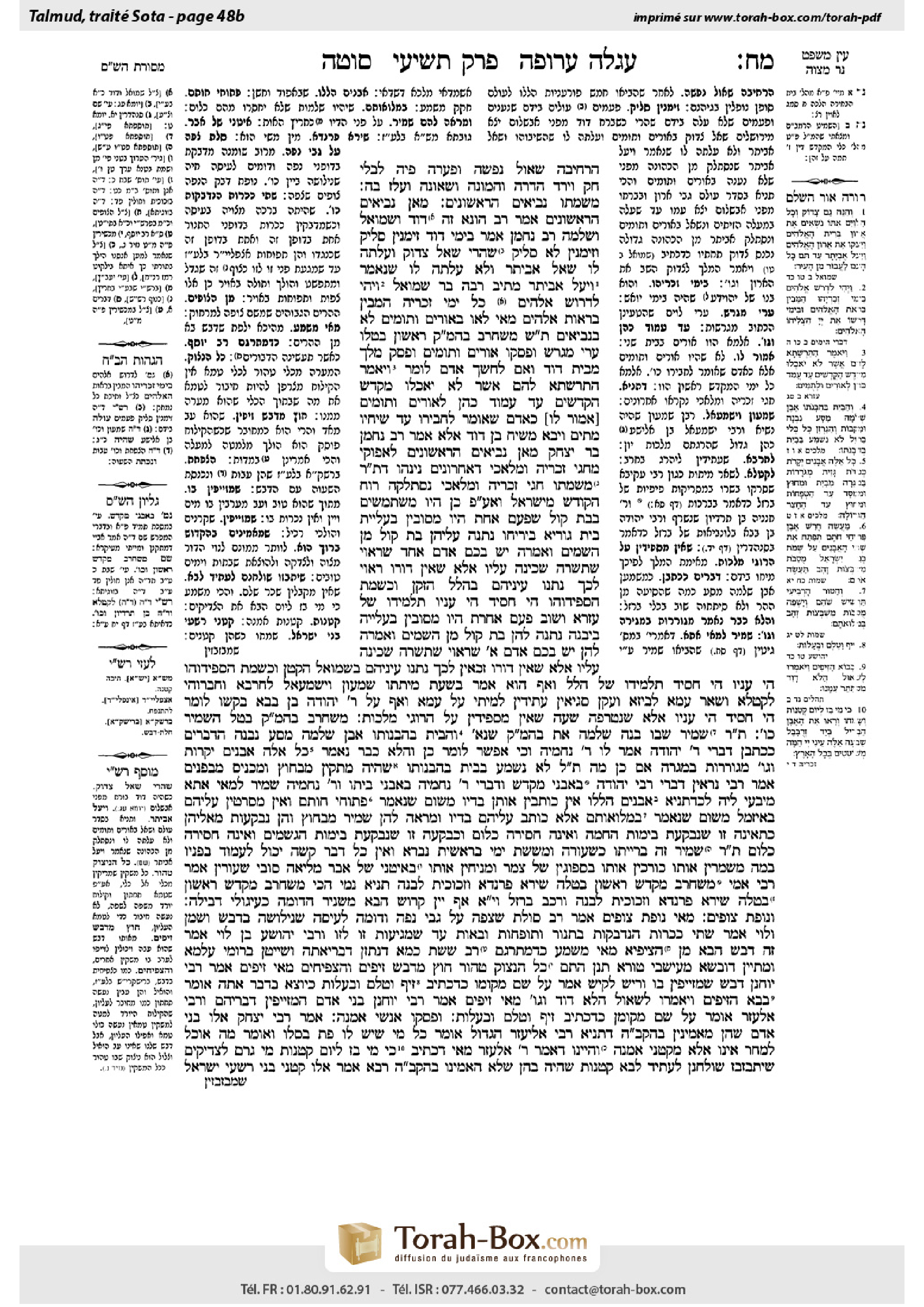
Sotah 48b: Talmud study for Daf Yomi
Daf Yomi is the daily study of one Talmud folio. Explore 37 tractates with scans, Hebrew text, Sefaria English and AI-generated French translations where annotated.
Passage selection and English or AI-generated French translation are available where the scan has annotations. Daf Study is independent of Torah-Box and Sefaria.
Browse Sotah · סוטה · All tractatesSotah 48b text and translations
This page of Sotah includes the Aramaic text, an English translation and an AI-generated French translation, alongside the scan above.
סוטה מ״ח ב · Aramaic and Hebrew text
הִרְחִיבָה שְּׁאוֹל נַפְשָׁהּ וּפָעֲרָה פִיהָ לִבְלִי חֹק וְיָרַד הֲדָרָהּ וַהֲמוֹנָהּ וּשְׁאוֹנָהּ וְעָלֵז בָּהּ״.
מִשֶּׁמֵּתוּ נְבִיאִים הָרִאשׁוֹנִים. מַאן ״נְבִיאִים הָרִאשׁוֹנִים״? אָמַר רַב הוּנָא: זֶה דָּוִד וּשְׁמוּאֵל וּשְׁלֹמֹה. רַב נַחְמָן אָמַר: בִּימֵי דָּוִד, זִימְנִין סְלֵיק, וְזִימְנִין לָא סְלֵיק, שֶׁהֲרֵי שָׁאַל צָדוֹק — וְעָלְתָה לוֹ, שָׁאַל אֶבְיָתָר — וְלֹא עָלְתָה לוֹ, שֶׁנֶּאֱמַר: ״וַיַּעַל אֶבְיָתָר״.
מֵתִיב רַבָּה בַּר שְׁמוּאֵל: ״וַיְהִי לִדְרֹשׁ אֱלֹהִים בִּימֵי זְכַרְיָהוּ הַמֵּבִין בִּרְאֹת הָאֱלֹהִים״, מַאי לָאו, בְּאוּרִים וְתוּמִּים? לֹא, בִּנְבִיאִים.
תָּא שְׁמַע: מִשֶּׁחָרַב בֵּית הַמִּקְדָּשׁ רִאשׁוֹן בָּטְלוּ עָרֵי מִגְרָשׁ, וּפָסְקוּ אוּרִים וְתוּמִּים, וּפָסַק מֶלֶךְ מִבֵּית דָּוִד.
וְאִם לְחָשְׁךָ אָדָם לוֹמַר: ״וַיֹּאמֶר הַתִּרְשָׁתָא לָהֶם אֲשֶׁר לֹא יֹאכְלוּ מִקֹּדֶשׁ הַקֳּדָשִׁים עַד עֲמֹד כֹּהֵן לְאוּרִים וּלְתֻמִּים״, אֱמוֹר לוֹ: כְּאָדָם שֶׁאוֹמֵר לַחֲבֵירוֹ ״עַד שֶׁיִּחְיוּ מֵתִים וְיָבֹא מָשִׁיחַ בֶּן דָּוִד״.
אֶלָּא אָמַר רַב נַחְמָן בַּר יִצְחָק: מַאן ״נְבִיאִים הָרִאשׁוֹנִים״ — לְאַפּוֹקֵי מֵחַגַּי זְכַרְיָה וּמַלְאָכִי, דְּאַחֲרוֹנִים נִינְהוּ. דְּתָנוּ רַבָּנַן: מִשֶּׁמֵּתוּ חַגַּי זְכַרְיָה וּמַלְאָכִי — נִסְתַּלְּקָה רוּחַ הַקּוֹדֶשׁ מִיִּשְׂרָאֵל. וְאַף עַל פִּי כֵן, הָיוּ מִשְׁתַּמְּשִׁים בְּבַת קוֹל,
שֶׁפַּעַם אַחַת הָיוּ מְסוּבִּין בַּעֲלִיַּית בֵּית גּוּרְיָא בִּירִיחוֹ, נִתְּנָה עֲלֵיהֶן בַּת קוֹל מִן הַשָּׁמַיִם וְאָמְרָה: יֵשׁ בָּכֶם אָדָם אֶחָד שֶׁרָאוּי שֶׁתִּשְׁרֶה שְׁכִינָה עָלָיו, אֶלָּא שֶׁאֵין דּוֹרוֹ רָאוּי לְכָךְ. נָתְנוּ עֵינֵיהֶם בְּהִלֵּל הַזָּקֵן, וּכְשֶׁמֵּת הִסְפִּידוּהוּ: הִי חָסִיד, הִי עָנָיו, תַּלְמִידוֹ שֶׁל עֶזְרָא.
וְשׁוּב פַּעַם אַחֶרֶת הָיוּ מְסוּבִּין בַּעֲלִיָּיה בְּיַבְנֶה, נִתְּנָה (לָהֶן) [עֲלֵיהֶן] בַּת קוֹל מִן הַשָּׁמַיִם, וְאָמְרָה לָהֶן: יֵשׁ בָּכֶם אָדָם אֶחָד שֶׁרָאוּי שֶׁתִּשְׁרֶה שְׁכִינָה עָלָיו אֶלָּא שֶׁאֵין דּוֹרוֹ זַכָּאִין לְכָךְ, נָתְנוּ עֵינֵיהֶם בִּשְׁמוּאֵל הַקָּטָן. וּכְשֶׁמֵּת, הִסְפִּידוּהוּ: הִי עָנָיו, הִי חָסִיד, תַּלְמִידוֹ שֶׁל הִלֵּל.
וְאַף הוּא אָמַר בִּשְׁעַת מִיתָתוֹ: שִׁמְעוֹן וְיִשְׁמָעֵאל — לְחַרְבָּא, וְחַבְרוֹהִי — לִקְטָלָא, וּשְׁאָר עַמָּא — לְבִיזָּא, וְעָקָן סַגִּיאִין עֲתִידִין לְמֵיתֵי עַל עַמָּא. וְאַף עַל רַבִּי יְהוּדָה בֶּן בָּבָא בִּקְּשׁוּ לוֹמַר ״הִי חָסִיד הִי עָנָיו״, אֶלָּא שֶׁנִּטְרְפָה שָׁעָה, שֶׁאֵין מַסְפִּידִין עַל הֲרוּגֵי מַלְכוּת.
מִשֶּׁחָרַב בֵּית הַמִּקְדָּשׁ בָּטַל הַשָּׁמִיר כּוּ׳. תָּנוּ רַבָּנַן: שָׁמִיר שֶׁבּוֹ בָּנָה שְׁלֹמֹה אֶת בֵּית הַמִּקְדָּשׁ, שֶׁנֶּאֱמַר: ״וְהַבַּיִת בְּהִבָּנֹתוֹ אֶבֶן שְׁלֵמָה מַסָּע נִבְנָה״ — הַדְּבָרִים כִּכְתָבָן, דִּבְרֵי רַבִּי יְהוּדָה.
אָמַר לוֹ רַבִּי נְחֶמְיָה: וְכִי אֶפְשָׁר לוֹמַר כֵּן? וַהֲלֹא כְּבָר נֶאֱמַר ״כׇּל אֵלֶּה אֲבָנִים יְקָרֹת וְגוֹ׳ מְגֹרָרוֹת בַּמְּגֵרָה״! אִם כֵּן מָה תַּלְמוּד לוֹמַר ״לֹא נִשְׁמַע בַּבַּיִת בְּהִבָּנֹתוֹ״ — שֶׁהָיָה מְתַקֵּין מִבַּחוּץ, וּמַכְנִיס מִבִּפְנִים. אָמַר רַבִּי: נִרְאִין דִּבְרֵי רַבִּי יְהוּדָה בְּאַבְנֵי מִקְדָּשׁ, וְדִבְרֵי רַבִּי נְחֶמְיָה בְּאַבְנֵי בֵיתוֹ.
וְרַבִּי נְחֶמְיָה, שָׁמִיר לְמַאי אֲתָא? מִיבְּעֵי לֵיהּ לְכִדְתַנְיָא: אֲבָנִים הַלָּלוּ אֵין כּוֹתְבִין אוֹתָן בִּדְיוֹ, מִשּׁוּם שֶׁנֶּאֱמַר: ״פִּתּוּחֵי חוֹתָם״, וְאֵין מְסָרְטִין עֲלֵיהֶם בְּאִיזְמֵל, מִשּׁוּם שֶׁנֶּאֱמַר: ״בְּמִלּוּאֹתָם״,
אֶלָּא כּוֹתֵב עֲלֵיהֶם בִּדְיוֹ, וּמַרְאֶה לָהֶן שָׁמִיר מִבַּחוּץ, וְהֵן נִבְקָעוֹת מֵאֲלֵיהֶן, כִּתְאֵינָה זוֹ שֶׁנִּבְקַעַת בִּימוֹת הַחַמָּה וְאֵינָהּ חֲסֵירָה כְּלוּם, וּכְבִקְעָה זוֹ, שֶׁנִּבְקַעַת בִּימוֹת הַגְּשָׁמִים, וְאֵינָהּ חֲסֵירָה כְּלוּם.
תָּנוּ רַבָּנַן: שָׁמִיר זֶה, בְּרִיָּיתוֹ כִּשְׂעוֹרָה, וּמִשֵּׁשֶׁת יְמֵי בְּרֵאשִׁית נִבְרָא, וְאֵין כׇּל דָּבָר קָשֶׁה יָכוֹל לַעֲמוֹד בְּפָנָיו. בַּמֶּה מְשַׁמְּרִין אוֹתוֹ — כּוֹרְכִין אוֹתוֹ בִּסְפוֹגִין שֶׁל צֶמֶר, וּמַנִּיחִין אוֹתוֹ בְּאִיטְנִי שֶׁל אֲבָר מְלֵיאָה סוּבֵּי שְׂעוֹרִין.
אָמַר רַבִּי אַמֵּי: מִשֶּׁחָרַב מִקְדָּשׁ רִאשׁוֹן — בָּטְלָה שִׁירָא פְּרַנְדָּא וּזְכוּכִית לְבָנָה. תַּנְיָא נָמֵי הָכִי: מִשֶּׁחָרַב מִקְדָּשׁ רִאשׁוֹן — בָּטְלָה שִׁירָא פְּרַנְדָּא וּזְכוּכִית לְבָנָה וְרֶכֶב בַּרְזֶל, וְיֵשׁ אוֹמְרִים: אַף יַיִן קָרוּשׁ הַבָּא מִשְּׂנִיר, הַדּוֹמֶה כְּעִיגּוּלֵי דְבֵילָה.
וְנוֹפֶת צוּפִים. מַאי ״נוֹפֶת צוּפִים״? אָמַר רַב: סוֹלֶת שֶׁצָּפָה עַל גַּבֵּי נָפָה, וְדוֹמָה לְעִיסָּה שֶׁנִּילּוֹשָׁה בִּדְבַשׁ וָשֶׁמֶן. וְלֵוִי אָמַר: שְׁתֵּי כִּכָּרוֹת הַנִּדְבָּקוֹת בַּתַּנּוּר וְתוֹפְחוֹת וּבָאוֹת, עַד שֶׁמַּגִּיעוֹת זוֹ לָזוֹ. וְרַבִּי יְהוֹשֻׁעַ בֶּן לֵוִי אָמַר: זֶה דְּבַשׁ הַבָּא מִן הַצִּיפְיָא. מַאי מַשְׁמַע — כְּדִמְתַרְגֵּם רַב שֵׁשֶׁת: ״כְּמָא דְּנָתְזָן דַּבְרָיָאתָה וְשָׁיְיטָן בְּרוּמֵי עָלְמָא וּמַתְיָין דּוּבְשָׁא מֵעִישְׂבֵי טוּרָא״.
תְּנַן הָתָם: כׇּל הַנִּצּוֹק טָהוֹר, חוּץ מִדְּבַשׁ זִיפִים וְהַצַפִּיחִים. מַאי ״זִיפִים״? אָמַר רַבִּי יוֹחָנָן: דְּבַשׁ שֶׁמְּזַיְּיפִין בּוֹ. וְרֵישׁ לָקִישׁ אָמַר: עַל שֵׁם מְקוֹמוֹ, כְּדִכְתִיב: ״זִיף וָטֶלֶם וּבְעָלוֹת״.
כַּיּוֹצֵא בַּדָּבָר אַתָּה אוֹמֵר: ״בְּבוֹא הַזִּיפִים וַיֹּאמְרוּ לְשָׁאוּל הֲלֹא דָוִד וְגוֹ׳״. מַאי ״זִיפִים״? אָמַר רַבִּי יוֹחָנָן: בְּנֵי אָדָם הַמְזַיְּיפִין דִּבְרֵיהֶם. וְרַבִּי אֶלְעָזָר אוֹמֵר: עַל שֵׁם מְקוֹמָן, כְּדִכְתִיב: ״זִיף וָטֶלֶם וּבְעָלוֹת״.
וּפָסְקוּ אַנְשֵׁי אֲמָנָה. אָמַר רַבִּי יִצְחָק: אֵלּוּ בְּנֵי אָדָם שֶׁהֵן מַאֲמִינִין בְּהַקָּדוֹשׁ בָּרוּךְ הוּא. דְּתַנְיָא, רַבִּי אֱלִיעֶזֶר הַגָּדוֹל אוֹמֵר: כָּל מִי שֶׁיֵּשׁ לוֹ פַּת בְּסַלּוֹ וְאוֹמֵר ״מָה אוֹכַל לְמָחָר״ — אֵינוֹ אֶלָּא מִקְּטַנֵּי אֲמָנָה.
וְהַיְינוּ דְּאָמַר רַבִּי אֶלְעָזָר: מַאי דִּכְתִיב ״כִּי מִי בַז לְיוֹם קְטַנּוֹת״ — מִי גָּרַם לַצַּדִּיקִים שֶׁיִּתְבַּזְבֵּז שׁוּלְחָנָן לֶעָתִיד לָבֹא — קַטְנוּת שֶׁהָיָה בָּהֶן, שֶׁלֹּא הֶאֱמִינוּ בְּהַקָּדוֹשׁ בָּרוּךְ הוּא, רָבָא אָמַר: אֵלּוּ קְטַנֵּי בְּנֵי רִשְׁעֵי יִשְׂרָאֵל,
Sotah 48b · English translation
the netherworld has enlarged her desire, and opened her mouth without measure, and down goes their glory and their tumult and their uproar, and he who rejoices among them” (Isaiah 5:14). Their punishment is that they shall descend into the netherworld.
§ The mishna taught: From the time when the early prophets died, the Urim VeTummim was nullified. The Gemara poses a question: Who are the early prophets? Rav Huna says: This is referring to David, and Samuel, and Solomon, and after their death the Urim VeTummim was no longer used. Rav Naḥman said: In the days of David there were times an answer rose up for them from the Urim VeTummim and there were times an answer did not rise up, i.e., they did not receive an answer. The proof for this is that Tzadok, the High Priest in David’s time, asked the Urim VeTummim and an answer rose up for him, whereas Abiathar asked and an answer did not rise up for him, as it is stated: “And Abiathar went up” (II Samuel 15:24), and he was removed from serving as the High Priest as a result.
Rabba bar Shmuel raises an objection: The verse states concerning Uzziah: “And he set himself to seek God in the days of Zechariah, who had an understanding of the vision of God” (II Chronicles 26:5). What, is the verse not stating that Uzziah would seek God by asking questions of the Urim VeTummim, despite the fact that he lived after the time of Solomon? The Gemara rejects this claim: No, he would seek God by asking questions of the prophets, but not of the Urim VeTummim.
The Gemara suggests: Come and hear a proof from a baraita (Tosefta 13:2) with regard to when the Urim VeTummim ceased: From the time when the First Temple was destroyed, the cities with fields that were allocated to the Levites were nullified, and the Urim VeTummim ceased, and the monarchy ceased from the house of David.
And if a person would whisper to you saying that the Urim VeTummim was still extant, as it states with regard to when the Second Temple first stood: “And the Tirshatha said to them that they should not eat of the most sacred things, until there stood a priest with the Urim VeTummim” (Ezra 2:63), which seems to indicate that they merely had to wait until the Second Temple was built for the reappearance of the Urim VeTummim; you should say to him that this is not referring to an expectation of a short-term development, but it is like a person who says to his friend, with regard to something that will occur in the distant future: Until the dead live and the Messiah, the son of David, comes. In any case, the baraita indicates that the Urim VeTummim ceased only from the time when the First Temple was destroyed, and not in the time of Solomon.
Rather, Rav Naḥman bar Yitzḥak said: Who are the early prophets, with regard to whom it states that use of the Urim VeTummim ceased immediately after their death? This term early prophets serves to exclude Haggai, Zechariah, and Malachi, who are the latter prophets. The Urim VeTummim was used throughout the First Temple period, up to, but not including, their time. As the Sages taught in a baraita (Tosefta 13:3): From the time when Haggai, Zechariah, and Malachi died the Divine Spirit departed from the Jewish people, as these three were considered to be the last prophets. And even after the Urim VeTummim ceased to exist, they would nevertheless still make use of a Divine Voice to receive instructions from Above, even after this time.
For on one occasion the Sages were reclining in the upper story of the house of Gurya in Jericho. A Divine Voice from Heaven was issued to them, and it said: There is one person among you for whom it is fitting that the Divine Presence should rest upon him as a prophet, but his generation is not fit for it; they do not deserve to have a prophet among them. The Sages present directed their gaze to Hillel the Elder. And when he died, they eulogized him in the following manner: Alas pious one, alas humble one, student of Ezra.
And again, on another occasion several generations later, the Sages were reclining in an upper story of a house in Yavne, and a Divine Voice from Heaven was issued to them, and said: There is one person among you for whom it is fitting that the Divine Presence should rest upon him, but his generation is not fit for it. The Sages present directed their gaze to Shmuel HaKatan. And when he died, they eulogized him in the following manner: Alas humble one, alas pious one, student of Hillel.
And he too, Shmuel HaKatan, said the following statement of divinely inspired prediction at the time of his death: Shimon, i.e., Rabban Shimon ben Gamliel, and Yishmael, i.e., Rabbi Yishmael ben Elisha the High Priest, are slated for the sword, and their colleagues for killing, and the rest of the people for plunder, and great troubles are destined to befall the people. The Gemara relates: And they also sought to say about Rabbi Yehuda ben Bava, when eulogizing him: Alas pious one, alas humble one, but the moment was disturbed and they could not do so. That is because eulogies are not given for those killed by the monarchy, which was Rabbi Yehuda ben Baba’s fate, in order not to arouse the monarchy’s wrath.
§ The mishna taught: From the time when the First Temple was destroyed the shamir ceased to exist. The Sages taught: This shamir is the creature with which Solomon built the Temple, as it is stated: “For the house, when it was built, was built of whole stone from the quarry” (I Kings 6:7). Now these words should be understood exactly as they are written, that King Solomon took whole stones and shaped them by having the shamir do the cutting. This is the statement of Rabbi Yehuda.
Rabbi Neḥemya said to him: And is it possible to say so? But isn’t it already stated: “All these were costly stones, according to the measures of hewn stones, sawed with saws” (II Kings 7:9), which indicates that saws, which are iron implements, were used to shape the stones? If so, what is the meaning when the verse states: “And hammer, ax, and any tool of iron were not heard in the house when it was being built” (I Kings 6:7)? It means that he would prepare the stones outside the Temple Mount using tools, and bring them inside already cut, so that no iron tools were used inside the Temple itself. Rabbi Yehuda HaNasi said: The statement of Rabbi Yehuda that no iron tools were used appears to be correct with regard to the Temple stones, and the statement of Rabbi Neḥemya that tools were used appears to be correct with regard to the stones of the king’s own house.
The Gemara poses a question: And according to Rabbi Neḥemya, who maintains that they used iron tools even in the cutting of the stones for the Temple, for what purpose did the shamir come? The Gemara answers: It was necessary for that which is taught in a baraita: These stones in the breastplate and ephod, upon which were inscribed the names of the tribes, they may not be written on with ink, because it is stated: “Like the engravings of a signet” (Exodus 28:21), which means the names must be engraved onto the stones. And they may not be scratched on with a scalpel [izemel], because it is stated: “In their full settings” (Exodus 28:20), indicating that the stones must be complete and not missing any of their mass.
The baraita continues: Rather, one writes the letters on them in ink, and shows them, i.e., he places the shamir close to the ink markings from outside, without having it touch the stones, and they split open along the lines of the ink of their own accord, like this fig that splits in the summer without losing anything of its mass, and like this field in a valley that cracks in the rainy season without losing anything of its mass. The shamir was used in this way for these engravings.
The Sages taught: This shamir, its size is that of a barleycorn, and it was created in the six days of creation, and nothing hard can withstand it. In what is it kept, so that it will not break everything in the vicinity? They wrap it in tufts [sefogin] of wool and place it in a leaden vessel [itenei], full of barley bran, which is soft and will not be broken by the shamir.
§ Rabbi Ami says: From the time when the First Temple was destroyed, shiny [peranda] silk [shira] and white glass ceased to exist. This is also taught in a baraita: From the time when the First Temple was destroyed, shiny silk, white glass, and iron chariots ceased; and some say that even congealed wine that comes from Senir, the Hermon, which is similar to round fig cakes after it congeals, ceased to exist as well.
The mishna taught: And the sweetness of the honeycomb [nofet tzufim] also ceased when the First Temple was destroyed. The Gemara asks: What is nofet tzufim? Rav says: Fine flour that floats up and remains on the top of the sieve [nafa], which is similar in taste to dough kneaded with honey and oil. And Levi says that nofet tzufim is the term for two loaves stuck together in an oven, which keep swelling until they reach each other. And Rabbi Yehoshua ben Levi says: This is honey that comes from elevated areas [tzipiyya]. The Gemara explains: From where may it be inferred that this is what nofet tzufim is? As Rav Sheshet would translate the words: “As the bees do” (Deuteronomy 1:44): Like the bees spread out and fly all over the world and bring honey from mountainous plants. Similarly, Rabbi Yehoshua ben Levi states that honey comes from elevated areas.
We learned in a mishna there (Makhshirin 5:9): Anything that is poured remains ritually pure. In other words, even if a liquid is poured into a ritually impure utensil, the stream of the liquid does not defile the contents that remain in the ritually pure utensil from which they were poured, apart from zifim honey and wafer batter. These substances are too viscous to be considered liquids. The Gemara asks: What is the meaning of zifim? Rabbi Yoḥanan says: Honey of such rare quality that they could falsify [mezayyefin] it, by diluting it with other substances, and it would not be noticed. And Reish Lakish says: It is named after its place, as it is written: “Ziph and Telem and Bealoth” (Joshua 15:24).
Similarly, you can say with regard to the verse: “When the zifim came and said to Saul, does not David hide himself with us” (Psalms 54:2). What is the meaning of zifim, mentioned in this verse? Rabbi Yoḥanan says: It means people who would falsify [hamzayyefin] their words. And Rabbi Elazar says: They are called after their place, as it is written: “Ziph and Telem and Bealoth.”
§ The mishna states that from the time when the Second Temple was destroyed men of faith ceased. Rabbi Yitzḥak says: These are people who believe in the Holy One, Blessed be He, and place their trust in Him in all their ways. As it is taught in a baraita: Rabbi Eliezer the Great says that whoever has bread in his basket to eat today and says: What shall I eat tomorrow, meaning he does not know how he will acquire bread for tomorrow, he is nothing other than from those of little faith. One must trust in God to provide him with his sustenance.
And this is what Rabbi Elazar said: What is the meaning of that which is written: “For who plunders the day of small things” (Zechariah 4:10)? What caused the table, i.e., the reward, of the righteous to be plundered, meaning wasted, in the future? It was the small-mindedness they possessed. And what is this small-mindedness? That they did not believe in the Holy One, Blessed be He, with a complete faith. Rava said: Who plunders the day of small things? These are the small children of the wicked ones of the Jewish people, who die young,
Sotah 48b · Traduction française (IA)
« Le monde souterrain a élargi son gosier et ouvert sa bouche sans mesure ; leur gloire, leur tumulte et leur vacarme y descendent, ainsi que celui qui se réjouit parmi eux » (Isaïe 5,14). Leur châtiment est de descendre dans le monde souterrain.
§ La Michna enseignait : Depuis la mort des premiers prophètes, les Ourim et les Toummim furent supprimés. La Guemara demande : Qui sont les premiers prophètes ? Rav Houna dit : Il s’agit de David, Samuel et Salomon ; après leur mort, on n’utilisa plus les Ourim et les Toummim. Rav Naḥman dit : Du vivant de David, il arrivait qu’une réponse leur parvienne des Ourim et des Toummim, et il arrivait qu’ils ne reçoivent aucune réponse. La preuve en est que Tsadoq, le grand prêtre à l’époque de David, consulta les Ourim et les Toummim et reçut une réponse, tandis qu’Eviyatar les consulta sans en recevoir, comme il est dit : « Et Eviyatar monta » (II Samuel 15,24) ; il fut alors écarté de sa fonction de grand prêtre.
Rabba bar Shmuel soulève une objection : Au sujet d’Ozias, le verset dit : « Il s’appliqua à rechercher Dieu aux jours de Zacharie, qui avait l’intelligence des visions de Dieu » (II Chroniques 26,5). Le verset ne signifie-t-il pas qu’Ozias recherchait Dieu en consultant les Ourim et les Toummim, bien qu’il ait vécu après l’époque de Salomon ? La Guemara rejette cette interprétation : Non, il recherchait Dieu en consultant les prophètes, mais pas les Ourim et les Toummim.
La Guemara propose : Viens entendre une preuve tirée d’une baraïta (Tosefta 13,2) concernant le moment où les Ourim et les Toummim cessèrent d’exister : Depuis la destruction du Premier Temple, les villes avec leurs champs attribuées aux Lévites furent supprimées, les Ourim et les Toummim cessèrent d’exister, et la royauté de la maison de David prit fin.
Et si quelqu’un te soufflait que les Ourim et les Toummim existaient encore, comme il est dit au sujet de l’époque où le Second Temple fut érigé pour la première fois : « Le Tirshata leur dit de ne pas manger des choses très saintes, jusqu’à ce qu’un prêtre se présente avec les Ourim et les Toummim » (Esdras 2,63), ce qui semble indiquer qu’il leur suffisait d’attendre la construction du Second Temple pour que les Ourim et les Toummim réapparaissent, tu lui répondras que cela ne désigne pas l’attente d’un événement proche, mais ressemble à quelqu’un qui dit à son ami, à propos d’un événement qui surviendra dans un avenir lointain : « Jusqu’à ce que les morts revivent et que le Messie, fils de David, vienne. » Quoi qu’il en soit, la baraïta indique que les Ourim et les Toummim ne cessèrent qu’à partir de la destruction du Premier Temple, et non à l’époque de Salomon.
Rav Naḥman bar Yitsḥak dit plutôt : Qui sont les premiers prophètes, dont il est dit que l’usage des Ourim et des Toummim cessa immédiatement après leur mort ? L’expression « premiers prophètes » sert à exclure Aggée, Zacharie et Malachie, qui sont les derniers prophètes. Les Ourim et les Toummim furent utilisés pendant toute la période du Premier Temple, jusqu’à leur époque, mais pas au-delà. En effet, les Sages ont enseigné dans une baraïta (Tosefta 13,3) : Depuis la mort d’Aggée, de Zacharie et de Malachie, l’Esprit divin quitta le peuple juif, car ces trois hommes étaient considérés comme les derniers prophètes. Pourtant, même après que les Ourim et les Toummim eurent cessé d’exister, on continua à recourir à une Voix céleste pour recevoir des instructions d’En Haut.
Une fois, les Sages étaient allongés à l’étage supérieur de la maison de Gourya, à Jéricho. Une Voix céleste leur fut adressée et dit : « Il y a parmi vous une personne digne que la Présence divine repose sur elle comme sur un prophète, mais sa génération n’en est pas digne ; elle ne mérite pas d’avoir un prophète parmi elle. » Les Sages présents tournèrent leur regard vers Hillel l’Ancien. À sa mort, ils firent son éloge en ces termes : « Hélas, homme pieux ! Hélas, homme humble ! Disciple d’Ezra ! »
Une autre fois, plusieurs générations plus tard, les Sages étaient allongés à l’étage supérieur d’une maison à Yavné, lorsqu’une Voix céleste leur fut adressée et dit : « Il y a parmi vous une personne digne que la Présence divine repose sur elle, mais sa génération n’en est pas digne. » Les Sages présents tournèrent leur regard vers Shmuel HaKatan. À sa mort, ils firent son éloge en ces termes : « Hélas, homme humble ! Hélas, homme pieux ! Disciple de Hillel ! »
Shmuel HaKatan prononça lui aussi, au moment de sa mort, la prédiction suivante, inspirée par Dieu : « Shimon », c’est-à-dire Rabban Shimon ben Gamliel, « et Yishmaël », c’est-à-dire Rabbi Yishmaël ben Elisha le grand prêtre, « sont promis au glaive ; leurs collègues, au meurtre ; et le reste du peuple, au pillage. De grandes détresses s’abattront sur le peuple. » La Guemara rapporte : On voulut également prononcer au sujet de Rabbi Yehouda ben Bava, en faisant son éloge : « Hélas, homme pieux ! Hélas, homme humble ! », mais l’instant fut troublé et ils ne purent le faire. En effet, on ne fait pas l’éloge de ceux qui sont tués par le pouvoir royal — ce fut le sort de Rabbi Yehouda ben Bava — afin de ne pas provoquer la colère du pouvoir.
§ La Michna enseignait : Depuis la destruction du Premier Temple, le chamir cessa d’exister. Les Sages ont enseigné : Le chamir est la créature dont Salomon se servit pour construire le Temple, comme il est dit : « Lorsque la Maison fut bâtie, elle le fut avec des pierres entières tirées de la carrière » (I Rois 6,7). Il faut comprendre ces mots exactement comme ils sont écrits : le roi Salomon prit des pierres entières et les fit tailler par le chamir. Telle est l’opinion de Rabbi Yehouda.
Rabbi Neḥemya lui dit : Est-il possible de dire cela ? N’est-il pas écrit : « Toutes ces pierres étaient de prix, aux dimensions de pierres taillées, sciées avec des scies » (II Rois 7,9), ce qui indique que des scies, outils de fer, furent utilisées pour tailler les pierres ? Que signifie donc le verset : « Ni marteau, ni hache, ni aucun outil de fer ne furent entendus dans la Maison pendant sa construction » (I Rois 6,7) ? Cela signifie qu’il préparait les pierres à l’extérieur du mont du Temple au moyen d’outils, puis les faisait entrer déjà taillées, de sorte qu’aucun outil de fer ne fût utilisé à l’intérieur même du Temple. Rabbi Yehouda HaNassi dit : L’affirmation de Rabbi Yehouda, selon laquelle aucun outil de fer ne fut utilisé, semble juste pour les pierres du Temple ; celle de Rabbi Neḥemya, selon laquelle des outils furent utilisés, semble juste pour les pierres de la maison du roi lui-même.
La Guemara demande : Et selon Rabbi Neḥemya, qui soutient que des outils de fer furent utilisés même pour tailler les pierres du Temple, à quoi servait le chamir ? La Guemara répond : Il était nécessaire pour ce qui est enseigné dans une baraïta : Il est interdit d’écrire à l’encre les noms des tribus sur les pierres du pectoral et de l’éphod, car il est dit : « Comme les gravures d’un sceau » (Exode 28,21), ce qui signifie que les noms doivent être gravés sur les pierres. Il est également interdit de les graver au scalpel [izemel], car il est dit : « Dans leurs montures, serties » (Exode 28,20), ce qui indique que les pierres doivent être intactes, sans qu’on leur enlève la moindre matière.
La baraïta poursuit : On inscrit plutôt les lettres dessus à l’encre, puis on les montre au chamir, c’est-à-dire qu’on place celui-ci près des marques d’encre, à l’extérieur, sans qu’il touche les pierres. Celles-ci se fendent d’elles-mêmes le long des lignes d’encre, comme une figue qui se fend en été sans perdre la moindre matière, et comme un champ dans une vallée qui se fissure pendant la saison des pluies sans perdre la moindre matière. Le chamir était utilisé de cette manière pour ces gravures.
Les Sages ont enseigné : Ce chamir avait la taille d’un grain d’orge ; il fut créé pendant les six jours de la Création, et rien de dur ne peut lui résister. Dans quoi le conservait-on pour qu’il ne brise pas tout ce qui se trouve à proximité ? On l’enveloppait dans des touffes [sefogin] de laine et on le plaçait dans un récipient de plomb [itenei], rempli de son d’orge, matière tendre que le chamir ne pouvait briser.
§ Rabbi Ami dit : Depuis la destruction du Premier Temple, la soie brillante [peranda] [shira] et le verre blanc cessèrent d’exister. Cela est également enseigné dans une baraïta : Depuis la destruction du Premier Temple, la soie brillante, le verre blanc et les chars de fer cessèrent d’exister ; certains disent que le vin solidifié provenant de Senir, le Hermon, qui ressemble, une fois figé, à des galettes rondes de figues, cessa lui aussi d’exister.
La Michna enseignait : La douceur du miel en rayon [nofet tzufim] cessa elle aussi lorsque le Premier Temple fut détruit. La Guemara demande : Qu’est-ce que le nofet tzufim ? Rav dit : De la farine fine qui remonte et reste à la surface du tamis [nafa], et dont le goût ressemble à celui d’une pâte pétrie avec du miel et de l’huile. Levi dit que le nofet tzufim désigne deux pains collés ensemble dans un four, qui continuent à gonfler jusqu’à se rejoindre. Rabbi Yehoshoua ben Levi dit : Il s’agit du miel provenant des hauteurs [tzipiyya]. La Guemara explique : D’où déduit-on que le nofet tzufim désigne cela ? Rav Sheshet traduisait ainsi les mots : « Comme les abeilles » (Deutéronome 1,44) : « Comme les abeilles se dispersent, volent à travers le monde et rapportent le miel des plantes des montagnes. » De même, Rabbi Yehoshoua ben Levi affirme que le miel provient des hauteurs.
Nous avons appris dans une Michna de là-bas (Makhshirin 5,9) : Tout ce qui est versé reste rituellement pur. Autrement dit, même si un liquide est versé dans un ustensile rituellement impur, le filet de liquide ne rend pas impurs les liquides qui restent dans l’ustensile rituellement pur d’où ils ont été versés, à l’exception du miel zifim et de la pâte à gaufre. Ces substances sont trop visqueuses pour être considérées comme des liquides. La Guemara demande : Que signifie zifim ? Rabbi Yoḥanan dit : Il s’agit d’un miel d’une qualité si rare qu’on pouvait le falsifier [mezayyefin] en le diluant avec d’autres substances sans que cela se remarque. Reish Lakish dit : Il porte le nom de son lieu d’origine, comme il est écrit : « Ziph, Telem et Bealoth » (Josué 15,24).
De même, on peut expliquer le verset : « Les Ziphim vinrent dire à Saül : “David ne se cache-t-il pas parmi nous ?” » (Psaumes 54,2). Que signifie zifim dans ce verset ? Rabbi Yoḥanan dit : Cela désigne des gens qui falsifiaient [hamzayyefin] leurs paroles. Rabbi Elazar dit : Ils sont appelés d’après leur lieu d’origine, comme il est écrit : « Ziph, Telem et Bealoth ».
§ La Michna dit que, depuis la destruction du Second Temple, les hommes de foi ont disparu. Rabbi Yitsḥak dit : Il s’agit de personnes qui croient au Saint, béni soit-Il, et mettent leur confiance en Lui dans toutes leurs voies. En effet, il est enseigné dans une baraïta : Rabbi Eliezer le Grand dit que quiconque a du pain dans son panier pour manger aujourd’hui et dit : « Que mangerai-je demain ? », c’est-à-dire qu’il ne sait pas comment il se procurera du pain pour le lendemain, n’est qu’un homme de peu de foi. Il faut faire confiance à Dieu, qui pourvoira à sa subsistance.
Et voici ce que Rabbi Elazar a dit : Que signifie ce qui est écrit : « Car qui méprise le jour des petites choses ? » (Zacharie 4,10). Qu’est-ce qui a fait que la table, c’est-à-dire la récompense, des justes fut pillée — autrement dit, perdue — dans l’avenir ? La petitesse d’esprit dont ils faisaient preuve. En quoi consistait cette petitesse d’esprit ? Ils ne croyaient pas pleinement au Saint, béni soit-Il. Rava dit : « Qui méprise le jour des petites choses ? » Il s’agit des jeunes enfants des méchants parmi le peuple juif, qui meurent jeunes,
Traduction française générée par IA à partir de l’édition anglaise de Sefaria. Vérifie toujours un passage avec le texte source.
Text from Sefaria: William Davidson Edition - Vocalized Aramaic (CC BY NC); William Davidson Edition - English (CC BY NC).