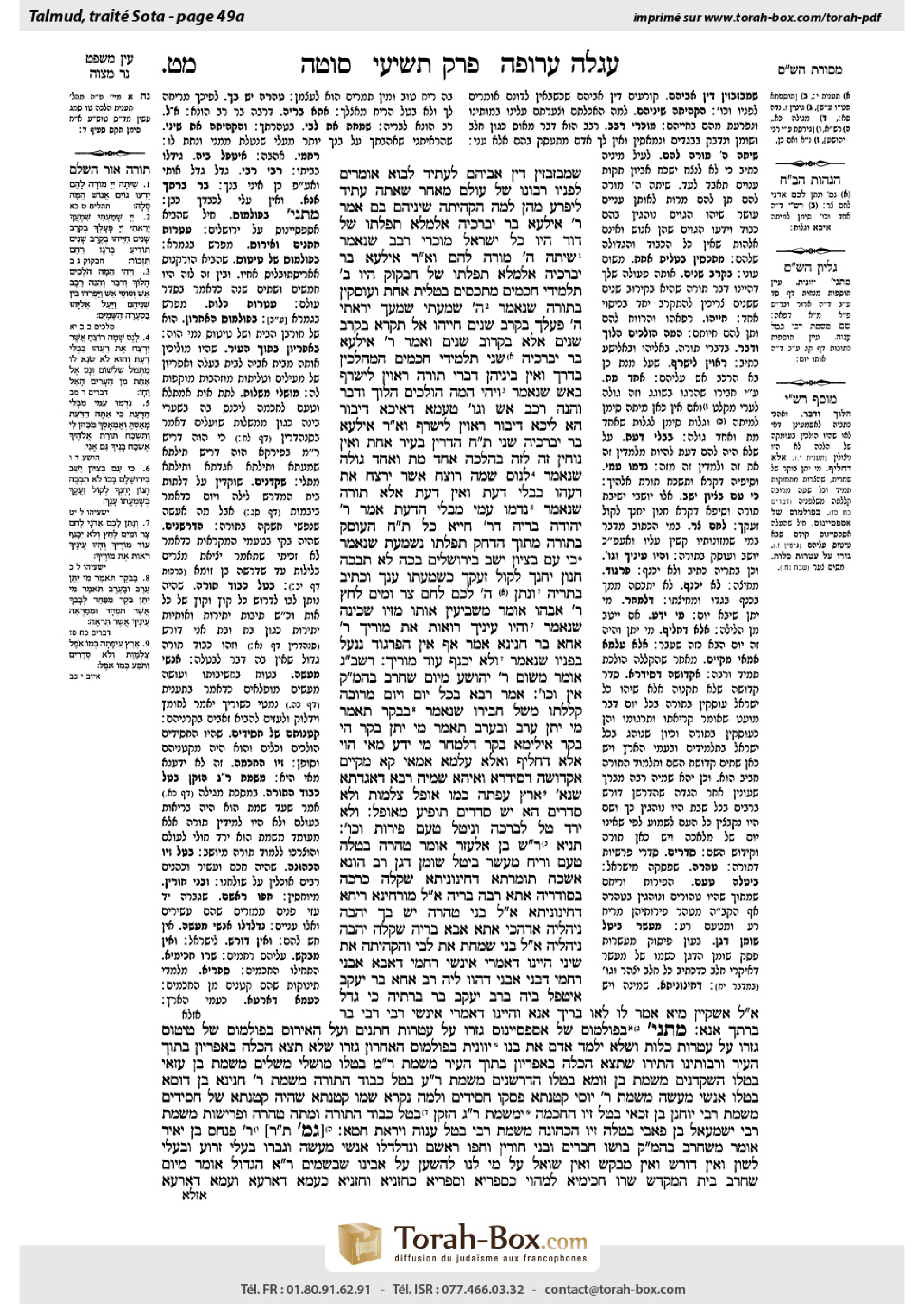
Sotah 49a: Talmud study for Daf Yomi
Daf Yomi is the daily study of one Talmud folio. Explore 37 tractates with scans, Hebrew text, Sefaria English and AI-generated French translations where annotated.
Passage selection and English or AI-generated French translation are available where the scan has annotations. Daf Study is independent of Torah-Box and Sefaria.
Browse Sotah · סוטה · All tractatesSotah 49a text and translations
This page of Sotah includes the Aramaic text, an English translation and an AI-generated French translation, alongside the scan above.
סוטה מ״ט א · Aramaic and Hebrew text
שֶׁמְּבַזְבְּזִין דִּין אֲבִיהֶם לֶעָתִיד לָבוֹא. אוֹמְרִים לְפָנָיו: רִבּוֹנוֹ שֶׁל עוֹלָם, מֵאַחַר שֶׁאַתָּה עָתִיד לִיפָּרַע מֵהֶן, לָמָה הִקְהֵיתָה שִׁינֵּיהֶם בָּם?
אָמַר רַבִּי אִילְעָא בַּר יְבֶרֶכְיָה: אִלְמָלֵא תְּפִלָּתוֹ שֶׁל דָּוִד, הָיוּ כׇּל יִשְׂרָאֵל מוֹכְרֵי רְבָב, שֶׁנֶּאֱמַר: ״שִׁיתָה ה׳ מוֹרָה לָהֶם״. וְאָמַר רַבִּי אִילְעָא בַּר יְבֶרֶכְיָה: אִלְמָלֵא תְּפִלָּתוֹ שֶׁל חֲבַקּוּק, הָיוּ שְׁנֵי תַּלְמִידֵי חֲכָמִים מִתְכַּסִּים בְּטַלִּית אַחַת וְעוֹסְקִין בַּתּוֹרָה, שֶׁנֶּאֱמַר: ״ה׳ שָׁמַעְתִּי שִׁמְעֲךָ יָרֵאתִי ה׳ פׇּעׇלְךָ בְּקֶרֶב שָׁנִים חַיֵּיהוּ״. אַל תִּקְרָא ״בְּקֶרֶב שָׁנִים״, אֶלָּא ״בְּקֵרוּב שְׁנַיִם״.
וְאָמַר רַבִּי אִילְעָא בַּר יְבֶרֶכְיָה: שְׁנֵי תַּלְמִידֵי חֲכָמִים הַמְהַלְּכִין בַּדֶּרֶךְ וְאֵין בֵּינֵיהֶן דִּבְרֵי תוֹרָה — רְאוּיִן לִישָּׂרֵף בָּאֵשׁ, שֶׁנֶּאֱמַר: ״וַיְהִי הֵמָּה הֹלְכִים הָלוֹךְ וְדַבֵּר וְהִנֵּה רֶכֶב אֵשׁ וְגוֹ׳״, טַעְמָא דְּאִיכָּא דִּיבּוּר, הָא לֵיכָּא דִּיבּוּר — רְאוּיִן לִישָּׂרֵף.
וְאָמַר רַבִּי אִילְעָא בַּר יְבֶרֶכְיָה: שְׁנֵי תַּלְמִידֵי חֲכָמִים הַדָּרִין בְּעִיר אַחַת וְאֵין נוֹחִין זֶה לָזֶה בַּהֲלָכָה — אֶחָד מֵת וְאֶחָד גּוֹלֶה, שֶׁנֶּאֱמַר: ״לָנֻס שָׁמָּה רוֹצֵחַ אֲשֶׁר יִרְצַח אֶת רֵעֵהוּ בִּבְלִי דַעַת״, וְאֵין דַּעַת אֶלָּא תּוֹרָה, שֶׁנֶּאֱמַר: ״נִדְמוּ עַמִּי מִבְּלִי הַדָּעַת״.
אָמַר רַבִּי יְהוּדָה בְּרֵיהּ דְּרַבִּי חִיָּיא: כׇּל תַּלְמִיד חָכָם הָעוֹסֵק בַּתּוֹרָה מִתּוֹךְ הַדְּחָק — תְּפִלָּתוֹ נִשְׁמַעַת, שֶׁנֶּאֱמַר: ״כִּי עַם בְּצִיּוֹן יֵשֵׁב בִּירוּשָׁלִָם בָּכוֹ לֹא תִבְכֶּה חָנוֹן יׇחְנְךָ לְקוֹל זַעֲקֶךָ כְּשׇׁמְעָתוֹ עָנָךְ״, וּכְתִיב בָּתְרֵיהּ: ״וְנָתַן ה׳ לָכֶם לֶחֶם צָר וּמַיִם לָחַץ״.
רַבִּי אֲבָהוּ אוֹמֵר: מַשְׂבִּיעִין אוֹתוֹ מִזִּיו שְׁכִינָה, שֶׁנֶּאֱמַר: ״וְהָיוּ עֵינֶיךָ רֹאוֹת אֶת מוֹרֶיךָ״. רַבִּי אַחָא בַּר חֲנִינָא אָמַר: אַף אֵין הַפַּרְגּוֹד נִנְעָל בְּפָנָיו, שֶׁנֶּאֱמַר: ״וְלֹא יִכָּנֵף עוֹד מוֹרֶיךָ״.
רַבָּן שִׁמְעוֹן בֶּן גַּמְלִיאֵל אוֹמֵר מִשּׁוּם רַבִּי יְהוֹשֻׁעַ: מִיּוֹם שֶׁחָרַב בֵּית הַמִּקְדָּשׁ אֵין וְכוּ׳. אָמַר רָבָא: בְּכׇל יוֹם וָיוֹם מְרוּבָּה קִלְלָתוֹ מִשֶּׁל חֲבֵירוֹ, שֶׁנֶּאֱמַר: ״בַּבֹּקֶר תֹּאמַר מִי יִתֵּן עֶרֶב וּבָעֶרֶב תֹּאמַר מִי יִתֵּן בֹּקֶר״, הֵי בֹּקֶר? אִילֵימָא בֹּקֶר דְּלִמְחַר, מִי יָדַע מַאי הָוֵי? אֶלָּא דַּחֲלֵיף.
וְאֶלָּא, עָלְמָא אַמַּאי קָא מִקַּיַּים? אַקְּדוּשָּׁה דְסִידְרָא, וְאַ״יְּהֵא שְׁמֵיהּ רַבָּא״ דְּאַגַּדְתָּא, שֶׁנֶּאֱמַר: ״אֶרֶץ עֵיפָתָה כְּמוֹ אֹפֶל צַלְמָוֶת וְלֹא סְדָרִים״, הָא יֵשׁ סְדָרִים — תּוֹפִיעַ מֵאוֹפֶל.
וְלֹא יָרַד טַל לִבְרָכָה וְנִיטַּל טַעַם פֵּירוֹת וְכוּ׳. תַּנְיָא, רַבִּי שִׁמְעוֹן בֶּן אֶלְעָזָר אוֹמֵר: טׇהֳרָה — בִּטְּלָה טַעַם וָרֵיחַ, מַעֲשֵׂר — בִּיטֵּל שׁוֹמֶן דָּגָן.
רַב הוּנָא אַשְׁכַּח תּוֹמַרְתָּא דְּחִינוּנִיתָא, שַׁקְלַהּ, כַּרְכַהּ בְּסוּדָרֵיהּ. אֲתָא רַבָּה בְּרֵיהּ, אֲמַר לֵיהּ: מוֹרְחִינָא רֵיחָא דְּחִינוּנִיתָא. אֲמַר לֵיהּ: בְּנִי, טׇהֳרָה יֵשׁ בְּךָ. יַהֲבַהּ נִיהֲלֵיהּ. אַדְּהָכִי אֲתָא אַבָּא בְּרֵיהּ, שַׁקְלַהּ, יַהֲבַהּ נִיהֲלֵיהּ. אֲמַר לֵיהּ: בְּנִי, שִׂמַּחְתָּ אֶת לִבִּי, וְהִקְהֵיתָה אֶת שִׁינַּי. הַיְינוּ דְּאָמְרִי אִינָשֵׁי: רַחֲמֵי דְּאַבָּא — אַבְּנֵי, רַחֲמֵי דִּבְנֵי — אַבְּנֵי דְּהָווּ לֵיהּ.
רַב אַחָא בַּר יַעֲקֹב אִיטַּפַּל בֵּיהּ בְּרַב יַעֲקֹב בַּר בְּרַתֵּיה. כִּי גְדַל אֲמַר לֵיהּ: אַשְׁקְיַין מַיָּא. אָמַר לוֹ: לָאו בְּרָיךְ אֲנָא. וְהַיְינוּ דְּאָמְרִי אִינָשֵׁי: רַבִּי רַבִּי, בַּר בְּרַתָּךְ אֲנָא.
מַתְנִי׳ בְּפוּלְמוּס שֶׁל אַסְפַּסְיָינוּס גָּזְרוּ עַל עַטְרוֹת חֲתָנִים וְעַל הָאִירוּס.
בְּפוּלְמוּס שֶׁל טִיטוּס גָּזְרוּ עַל עַטְרוֹת כַּלּוֹת, וְשֶׁלֹּא יְלַמֵּד אָדָם אֶת בְּנוֹ יְווֹנִית.
בְּפוּלְמוּס הָאַחֲרוֹן גָּזְרוּ שֶׁלֹּא תֵּצֵא הַכַּלָּה בְּאַפִּרְיוֹן בְּתוֹךְ הָעִיר, וְרַבּוֹתֵינוּ הִתִּירוּ שֶׁתֵּצֵא הַכַּלָּה בְּאַפִּרְיוֹן בְּתוֹךְ הָעִיר.
מִשֶּׁמֵּת רַבִּי מֵאִיר בָּטְלוּ מוֹשְׁלֵי מְשָׁלִים. מִשֶּׁמֵּת בֶּן עַזַּאי בָּטְלוּ הַשַּׁקְדָנִים. מִשֶּׁמֵּת בֶּן זוֹמָא בָּטְלוּ הַדַּרְשָׁנִים. מִשֶּׁמֵּת רַבִּי עֲקִיבָא בָּטַל כְּבוֹד הַתּוֹרָה. מִשֶּׁמֵּת רַבִּי חֲנִינָא בֶּן דּוֹסָא בָּטְלוּ אַנְשֵׁי מַעֲשֶׂה. מִשֶּׁמֵּת רַבִּי יוֹסֵי קְטֹנְתָּא פָּסְקוּ חֲסִידִים. וְלָמָּה נִקְרָא שְׁמוֹ ״קְטֹנְתָּא״ — שֶׁהָיָה קְטֹנְתָּא שֶׁל חֲסִידִים.
מִשֶּׁמֵּת רַבָּן יוֹחָנָן בֶּן זַכַּאי בָּטַל זִיו הַחׇכְמָה. מִשֶּׁמֵּת רַבָּן גַּמְלִיאֵל הַזָּקֵן בָּטַל כְּבוֹד הַתּוֹרָה, וּמֵתָה טׇהֳרָה וּפְרִישׁוּת. מִשֶּׁמֵּת רַבִּי יִשְׁמָעֵאל בֶּן פִּאָבִי בָּטְלָה זִיו הַכְּהוּנָּה. מִשֶּׁמֵּת רַבִּי בָּטְלָ[ה] עֲנָוָה וְיִרְאַת חֵטְא.
[גְּמָ׳] תָּנוּ רַבָּנַן: רַבִּי פִּנְחָס בֶּן יָאִיר אוֹמֵר: מִשֶּׁחָרַב בֵּית הַמִּקְדָּשׁ בּוֹשׁוּ חֲבֵרִים וּבְנֵי חוֹרִין, וְחָפוּ רֹאשָׁם, וְנִדַּלְדְּלוּ אַנְשֵׁי מַעֲשֶׂה, וְגָבְרוּ בַּעֲלֵי זְרוֹעַ וּבַעֲלֵי לָשׁוֹן, וְאֵין דּוֹרֵשׁ וְאֵין מְבַקֵּשׁ וְאֵין שׁוֹאֵל,
עַל מִי לָנוּ לְהִשָּׁעֵן עַל אָבִינוּ שֶׁבַּשָּׁמַיִם.
רַבִּי אֱלִיעֶזֶר הַגָּדוֹל אוֹמֵר: מִיּוֹם שֶׁחָרַב בֵּית הַמִּקְדָּשׁ שָׁרוֹ חַכִּימַיָּא לְמֶהֱוֵי כְּסָפְרַיָּא, וְסָפְרַיָּא כְּחַזָּנַיָּא, וְחַזָּנַיָּא כְּעַמָּא דְאַרְעָא, וְעַמָּא דְאַרְעָא
Sotah 49a · English translation
who plunder, i.e., destroy, their fathers’ future judgment. When God sits in judgment of their parents, these children say before Him: Master of the Universe, because You were destined to exact punishment from our fathers in the World-to-Come for their wickedness, why did You blunt their teeth with the death of their children in their lifetimes? In this way, the death of their children atones for the fathers.
§ Rabbi Ile’a bar Yeverekhya says: If it were not for the prayer of David for Israel to have sustenance, all Israel would be sellers of fat [revav], i.e., involved in debased occupations, as it is stated: “Place for them mastery, O Lord” (Psalms 9:21), that is, may God grant them dignity. And Rabbi Ile’a bar Yeverekhya also says: If it were not for the prayer of Habakkuk, two Torah scholars would have to cover themselves with a single cloak due to poverty and engage in Torah study dressed that way, as it is stated: “Lord, I heard Your report and was afraid; O Lord, revive Your work in the midst of the years” (Habakkuk 3:2). Do not read: “In the midst [bekerev] of the years [shanim],” but in the closeness [bikrov] of two [shenayim]. In other words, Habakkuk prayed that God would nullify His decree of two Torah scholars having to share a single cloak.
And Rabbi Ile’a bar Yeverekhya says: In the case of two Torah scholars who are walking along the way and there are no words of Torah between them, but they are conversing about other matters, they are deserving of being burned in fire. As it is stated with regard to Elijah and his disciple Elisha: “And it was as they walked along, talking, that behold, there appeared a chariot of fire and horses of fire, which parted them both asunder” (II Kings 2:11). The reason they were not burned by the chariot of fire is that there was speech exchanged between them, which presumably was words of Torah, but if there had been no speech, they would have been deserving of being burned by the chariot.
And Rabbi Ile’a bar Yeverekhya says: If there are two Torah scholars who reside in the same city and they are not pleasant to each other with regard to halakha, but are constantly fighting, one of them will die and the other one will be exiled. As it is stated: “That the manslayer might flee there, who slays his neighbor without knowledge” (Deuteronomy 4:42), and “knowledge” means nothing other than Torah, as it is stated: “My people are destroyed for lack of knowledge” (Hosea 4:6).
Rabbi Yehuda, son of Rabbi Ḥiyya, says: With regard to any Torah scholar who engages in Torah study while experiencing the pressure of poverty, his prayer is listened to, as it is stated: “For, O people that dwells in Zion at Jerusalem, you shall weep no more; He will surely be gracious to you at the voice of your cry. When He shall hear, He will answer you” (Isaiah 30:19), and after it is written: “And the Lord shall give you sparse bread and scant water” (Isaiah 30:20). This verse indicates that those who sit and study Torah, that is, the people who dwell in Zion, and eat bread sparingly, will have their prayers answered by God.
Rabbi Abbahu says: A Torah scholar who engages in Torah study despite economic pressures is satiated with the glory of the Divine Presence, as it is stated in the same verse, above: “And your eyes shall behold your Teacher.” Rabbi Aḥa, son of Ḥanina, said: Even the concealing partition [pargod] before the Divine Presence is not locked before him, as it is stated: “And your Teacher shall not hide Himself anymore” (Isaiah 30:20).
§ The mishna states that Rabban Shimon ben Gamliel says in the name of Rabbi Yehoshua: From the day that the Temple was destroyed, there is no day that does not include some form of curse. Rava says: Each and every day is more cursed than the previous one, as it is stated in the chapter detailing the curses in the book of Deuteronomy: “In the morning you will say, would that it were evening, and in the evening you will say, would that it were morning” (Deuteronomy 28:67). It is unclear which morning the verse means. If we say that in the evening he will wish it would be the following morning, does he know what will be the outcome of the next morning, which would cause him to yearn for its arrival? Rather, it must mean the morning that has passed; that is, in the evening they will pine for the previous morning, because their situation is continuously worsening.
The Gemara poses a question: But if everything is deteriorating, why does the world continue to exist? The Gemara answers: By the sanctification that is said in the order of prayers, after the passage that begins: And a redeemer shall come to Israel, which includes the recitation and translation of the sanctification said by the angels, and by the response: Let His great name be blessed, etc., which is recited after the study of aggada. As it is stated: “A land of thick darkness, as darkness itself; a land of the shadow of death, without any order” (Job 10:22). Therefore, it can be inferred from this verse that if there are orders of prayer and study, the land shall appear from amidst the darkness.
§ The mishna taught that since the destruction of the Temple, dew has not descended for a blessing, and the taste has been removed from fruit. It is taught in a baraita: Rabbi Shimon ben Elazar says: The lost purity has removed the taste and the aroma; the tithes that were not separated have removed the fat of grain.
The Gemara relates that Rav Huna found a fragrant date. He took it and wrapped it in his shawl. Rabba, his son, came and said to him: I smell the aroma of a fragrant date. Rav Huna said to him: My son, there is clearly purity in you, as you were able to notice the fragrance. He gave it to him. Meanwhile, Abba, Rabba’s son, arrived. Rabba took the date and gave it to him. Rav Huna said to Rabba: My son, you have made my heart rejoice with your purity, and you have blunted my teeth, by showing your preference for your own son. The Gemara comments: This explains the folk saying that people say: The love of a father is for the sons; the love of the sons is for their own sons, more than for their father.
The Gemara relates another incident: Rav Aḥa bar Ya’akov took care of Rav Ya’akov, the son of his daughter, who was an orphan. When the grandchild grew up, his grandfather once said to him: Give me water to drink. He said to him: I am not your son, and I am not obligated in your honor as a son must honor his father. The Gemara again comments: And this explains the folk saying that people say: Raise, raise your grandchild, but in the end he will retort: I am the son of your daughter, and I do not have to take care of you.
MISHNA: In the war [pulemus] of Vespasian the Sages decreed upon the crowns of bridegrooms, i.e., that bridegrooms may no longer wear crowns, and upon the drums, meaning they also banned the playing of drums.
In the war of Titus they also decreed upon the crowns of brides, and they decreed that a person should not teach his son Greek.
In the last war, meaning the bar Kokheva revolt, they decreed that a bride may not go out in a palanquin inside the city, but our Sages permitted a bride to go out in a palanquin inside the city, as this helps the bride maintain her modesty.
The mishna lists more things that ceased: From the time when Rabbi Meir died, those who relate parables ceased; from the time when ben Azzai died, the diligent ceased; from the time when ben Zoma died, the exegetists ceased; from the time when Rabbi Akiva died, the honor of the Torah ceased; from the time when Rabbi Ḥanina ben Dosa died, the men of wondrous action ceased; from the time when Rabbi Yosei the Small died, the pious were no more. And why was he called the Small? Because he was the smallest of the pious, meaning he was one of the least important of the pious men.
From the time when Rabban Yoḥanan ben Zakkai died, the glory of wisdom ceased; from the time when Rabban Gamliel the Elder died, the honor of the Torah ceased, and purity and asceticism died. From the time when Rabbi Yishmael ben Pavi died, the glory of the priesthood ceased; from the time when Rabbi Yehuda HaNasi died, humility and fear of sin ceased.
GEMARA: The Sages taught: Rabbi Pineḥas ben Ya’ir says: From the time when the Second Temple was destroyed, the ḥaverim and free men of noble lineage were ashamed, and their heads were covered in shame, and men of action dwindled, and violent and smooth-talking men gained the upper hand, and none seek, and none ask, and none inquire of the fear of Heaven.
Upon whom is there for us to rely? Only upon our Father in Heaven.
Rabbi Eliezer the Great says: From the day the Second Temple was destroyed, the generations have deteriorated: Scholars have begun to become like scribes that teach children, and scribes have become like beadles, and beadles have become like ignoramuses, and ignoramuses
Sotah 49a · Traduction française (IA)
qui pillent, c’est-à-dire détruisent, le jugement futur de leurs pères. Lorsque Dieu juge leurs parents, ces enfants Lui disent : « Maître de l’Univers, puisque Tu devais punir nos pères dans le monde à venir pour leur méchanceté, pourquoi leur as-Tu émoussé les dents en faisant mourir leurs enfants de leur vivant ? » Ainsi, la mort de leurs enfants expie les fautes des pères.
§ Rabbi Ile’a bar Yeverekhya dit : S’il n’y avait pas eu la prière de David pour qu’Israël ait de quoi subsister, tous les Israélites seraient des vendeurs de graisse [revav], c’est-à-dire qu’ils exerceraient des métiers dégradants, comme il est dit : « Impose-leur la domination, Seigneur » (Psaumes 9:21), autrement dit, que Dieu leur accorde la dignité. Rabbi Ile’a bar Yeverekhya dit également : S’il n’y avait pas eu la prière de Habacuc, deux érudits en Torah devraient, par pauvreté, se couvrir d’un seul manteau et étudier la Torah ainsi vêtus, comme il est dit : « Seigneur, j’ai entendu parler de Toi et j’ai été saisi de crainte ; Seigneur, fais revivre Ton œuvre au milieu des années » (Habacuc 3:2). Ne lis pas : « au milieu [bekerev] des années [shanim] », mais « à proximité [bikrov] de deux [shenayim] ». Autrement dit, Habacuc pria pour que Dieu annule Son décret selon lequel deux érudits en Torah devraient partager un seul manteau.
Rabbi Ile’a bar Yeverekhya dit également : Deux érudits en Torah qui cheminent ensemble sans échanger de paroles de Torah, mais conversent d’autres sujets, méritent d’être brûlés par le feu. Car il est dit au sujet d’Élie et de son disciple Élisée : « Tandis qu’ils marchaient en parlant, voici qu’un char de feu et des chevaux de feu apparurent et les séparèrent l’un de l’autre » (II Rois 2:11). S’ils ne furent pas brûlés par le char de feu, c’est parce qu’ils échangèrent des paroles, qui étaient vraisemblablement des paroles de Torah ; mais s’ils n’avaient pas parlé, ils auraient mérité d’être brûlés par le char.
Rabbi Ile’a bar Yeverekhya dit également : Si deux érudits en Torah résident dans la même ville et ne s’entendent pas au sujet de la halakha, mais ne cessent de se quereller, l’un mourra et l’autre sera exilé. Comme il est dit : « Afin que le meurtrier puisse s’y réfugier, celui qui tue son prochain sans le savoir » (Deutéronome 4:42). Or, le « savoir » ne désigne rien d’autre que la Torah, comme il est dit : « Mon peuple est détruit faute de connaissance » (Osée 4:6).
Rabbi Yehuda, fils de Rabbi Ḥiyya, dit : Tout érudit en Torah qui étudie la Torah tout en subissant les difficultés de la pauvreté voit sa prière exaucée, comme il est dit : « Peuple qui habite Sion, à Jérusalem, tu ne pleureras plus ; Il te fera grâce au son de ton cri. Dès qu’Il l’entendra, Il te répondra » (Isaïe 30:19). Et il est écrit ensuite : « Le Seigneur vous donnera un pain mesuré et une eau rationnée » (Isaïe 30:20). Ce verset indique que ceux qui siègent et étudient la Torah, c’est-à-dire les habitants de Sion, et mangent leur pain avec parcimonie verront leurs prières exaucées par Dieu.
Rabbi Abbahu dit : Un érudit en Torah qui étudie la Torah malgré les difficultés économiques est rassasié de la gloire de la Présence divine, comme il est dit dans le même verset, cité plus haut : « Tes yeux verront ton Maître. » Rabbi Aḥa, fils de Ḥanina, dit : Même le voile [pargod] qui dissimule la Présence divine ne lui est pas fermé, comme il est dit : « Ton Maître ne se dérobera plus à toi » (Isaïe 30:20).
§ La Michna enseigne que Rabban Shimon ben Gamliel dit au nom de Rabbi Yehoshua : Depuis le jour où le Temple a été détruit, il n’est pas un jour qui ne comporte quelque forme de malédiction. Rava dit : Chaque jour est plus maudit que le précédent, comme il est dit dans le chapitre des malédictions du Deutéronome : « Le matin, tu diras : “Ah ! si c’était le soir !”, et le soir, tu diras : “Ah ! si c’était le matin !” » (Deutéronome 28:67). On ne sait pas de quel matin parle le verset. Si l’on dit que le soir, il souhaitera que vienne le lendemain matin, sait-il ce que réservera ce lendemain matin, qui lui ferait désirer son arrivée ? Il faut donc comprendre qu’il s’agit du matin déjà passé : le soir, ils regretteront le matin précédent, car leur situation ne cesse d’empirer.
La Guemara pose une question : Mais si tout va de mal en pis, pourquoi le monde continue-t-il d’exister ? La Guemara répond : Grâce à la sanctification récitée dans l’ordre des prières, après le passage qui commence par « Un rédempteur viendra en Israël », passage qui comprend la récitation et la traduction de la sanctification prononcée par les anges, et grâce à la réponse : « Que Son grand nom soit béni », etc., récitée après l’étude de l’aggada. Comme il est dit : « Un pays de ténèbres épaisses, aussi sombre que les ténèbres elles-mêmes, un pays d’ombre de mort, sans aucun ordre » (Job 10:22). On peut donc déduire de ce verset que, s’il y a des ordres de prière et d’étude, le pays émergera des ténèbres.
§ La Michna enseignait que depuis la destruction du Temple, la rosée ne descend plus pour apporter une bénédiction et que la saveur a disparu des fruits. Une baraïta enseigne : Rabbi Shimon ben Elazar dit : La perte de la pureté a fait disparaître la saveur et le parfum ; les dîmes qui n’ont pas été prélevées ont fait disparaître le gras du grain.
La Guemara rapporte que Rav Huna trouva une datte parfumée. Il la prit et l’enveloppa dans son châle. Rabba, son fils, vint lui dire : « Je sens le parfum d’une datte odorante. » Rav Huna lui dit : « Mon fils, il y a manifestement de la pureté en toi, puisque tu as pu en remarquer le parfum. » Il la lui donna. Entre-temps, Abba, le fils de Rabba, arriva. Rabba prit la datte et la lui donna. Rav Huna dit à Rabba : « Mon fils, tu m’as réjoui le cœur par ta pureté, mais tu m’as émoussé les dents en préférant ton propre fils. » La Guemara fait remarquer que cela illustre le dicton populaire : « L’amour d’un père va à ses fils ; celui des fils va à leurs propres fils, plus qu’à leur père. »
La Guemara rapporte un autre épisode : Rav Aḥa bar Ya’akov prit soin de Rav Ya’akov, le fils de sa fille, qui était orphelin. Lorsque son petit-fils eut grandi, son grand-père lui demanda un jour : « Donne-moi de l’eau à boire. » Il lui répondit : « Je ne suis pas ton fils et je ne suis pas tenu de te témoigner le respect qu’un fils doit à son père. » La Guemara fait encore remarquer que cela illustre le dicton populaire : « Élève, élève ton petit-fils, mais à la fin il te répliquera : “Je suis le fils de ta fille et je n’ai pas à prendre soin de toi.” »
MICHNA : Lors de la guerre [pulemus] de Vespasien, les Sages décrétèrent l’interdiction des couronnes des mariés, c’est-à-dire que les mariés ne pouvaient plus porter de couronnes, ainsi que celle des tambours, dont ils interdirent également l’usage.
Lors de la guerre de Titus, ils décrétèrent également l’interdiction des couronnes des mariées et qu’on n’enseigne pas le grec à son fils.
Lors de la dernière guerre, c’est-à-dire la révolte de Bar Kokhba, ils décrétèrent qu’une mariée ne pouvait pas sortir en litière à l’intérieur de la ville. Mais nos Sages autorisèrent une mariée à sortir en litière à l’intérieur de la ville, car cela l’aide à préserver sa modestie.
La Michna énumère d’autres choses qui cessèrent : Depuis la mort de Rabbi Meir, ceux qui racontaient des paraboles cessèrent ; depuis la mort de ben Azzai, les hommes diligents cessèrent ; depuis la mort de ben Zoma, les exégètes cessèrent ; depuis la mort de Rabbi Akiva, l’honneur de la Torah cessa ; depuis la mort de Rabbi Ḥanina ben Dosa, les hommes capables d’accomplir des actes merveilleux cessèrent ; depuis la mort de Rabbi Yosei le Petit, les pieux disparurent. Et pourquoi l’appelait-on le Petit ? Parce qu’il était le plus petit parmi les pieux, c’est-à-dire l’un des moins importants des hommes pieux.
Depuis la mort de Rabban Yoḥanan ben Zakkai, la gloire de la sagesse cessa ; depuis la mort de Rabban Gamliel l’Ancien, l’honneur de la Torah cessa, et la pureté et l’ascétisme disparurent. Depuis la mort de Rabbi Yishmael ben Pavi, la gloire de la prêtrise cessa ; depuis la mort de Rabbi Yehuda HaNasi, l’humilité et la crainte de la faute cessèrent.
GUEMARA : Les Sages enseignèrent : Rabbi Pineḥas ben Ya’ir dit : Depuis la destruction du Second Temple, les ḥaverim et les hommes libres de noble lignée ont eu honte, et leurs têtes se sont couvertes de honte ; les hommes d’action se sont raréfiés, tandis que les hommes violents et ceux qui savent flatter ont pris le dessus. Personne ne cherche, personne ne demande et personne ne s’enquiert de la crainte du Ciel.
Sur qui pouvons-nous nous appuyer ? Uniquement sur notre Père qui est aux Cieux.
Rabbi Eliezer le Grand dit : Depuis le jour où le Second Temple a été détruit, les générations ont décliné : les érudits ont commencé à ressembler à des scribes qui enseignent aux enfants, les scribes sont devenus comme des bedeaux, les bedeaux comme des ignorants, et les ignorants
Traduction française générée par IA à partir de l’édition anglaise de Sefaria. Vérifie toujours un passage avec le texte source.
Text from Sefaria: William Davidson Edition - Vocalized Aramaic (CC BY NC); William Davidson Edition - English (CC BY NC).