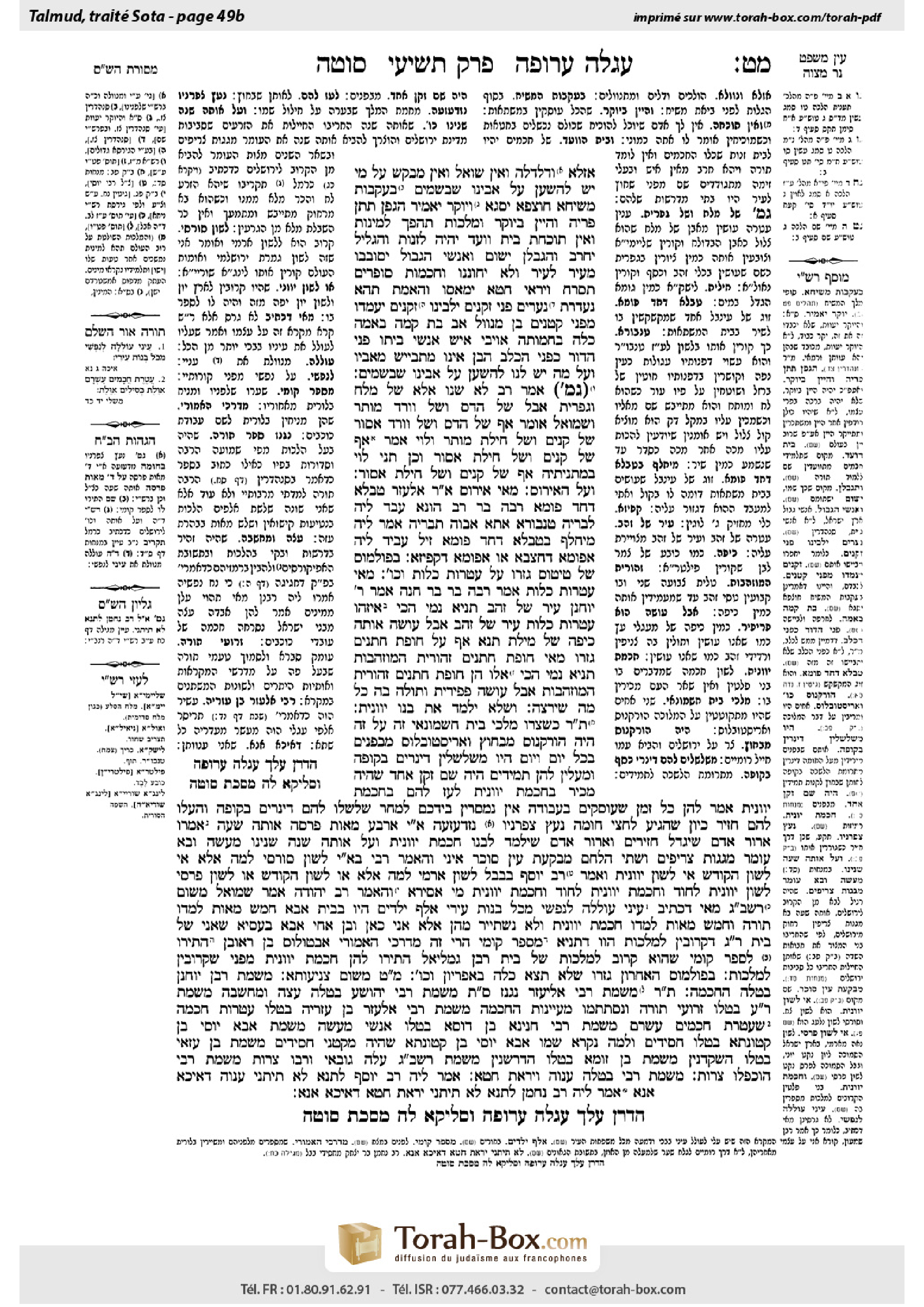
Sotah 49b: Talmud study for Daf Yomi
Daf Yomi is the daily study of one Talmud folio. Explore 37 tractates with scans, Hebrew text, Sefaria English and AI-generated French translations where annotated.
Passage selection and English or AI-generated French translation are available where the scan has annotations. Daf Study is independent of Torah-Box and Sefaria.
Browse Sotah · סוטה · All tractatesSotah 49b text and translations
This page of Sotah includes the Aramaic text, an English translation and an AI-generated French translation, alongside the scan above.
סוטה מ״ט ב · Aramaic and Hebrew text
אָזְלָא (וְדַלְדַּלָהּ) [וְנָוְולָה], וְאֵין שׁוֹאֵל וְאֵין מְבַקֵּשׁ. עַל מִי יֵשׁ לְהִשָּׁעֵן — עַל אָבִינוּ שֶׁבַּשָּׁמַיִם.
בְּעִקְבוֹת מְשִׁיחָא חוּצְפָּא יִסְגֵּא וְיוֹקֶר יַאֲמִיר. הַגֶּפֶן תִּתֵּן פִּרְיָהּ וְהַיַּיִן בְּיוֹקֶר, וּמַלְכוּת תֵּהָפֵךְ לְמִינוּת וְאֵין תּוֹכַחַת. בֵּית וַועַד יִהְיֶה לִזְנוּת וְהַגָּלִיל יֶחֱרַב, וְהַגַּבְלָן יִשּׁוֹם, וְאַנְשֵׁי הַגְּבוּל יְסוֹבְבוּ מֵעִיר לְעִיר וְלֹא יְחוֹנְנוּ,
וְחַכְמוֹת סוֹפְרִים תִּסְרַח, וְיִרְאֵי חֵטְא יִמָּאֵסוּ, וְהָאֱמֶת תְּהֵא נֶעֱדֶרֶת. נְעָרִים פְּנֵי זְקֵנִים יַלְבִּינוּ, זְקֵנִים יַעַמְדוּ מִפְּנֵי קְטַנִּים — בֵּן מְנַוֵּול אָב, בַּת קָמָה בְאִמָּהּ, כַּלָּה בַּחֲמוֹתָהּ, אוֹיְבֵי אִישׁ אַנְשֵׁי בֵיתוֹ, פְּנֵי הַדּוֹר כִּפְנֵי הַכֶּלֶב, הַבֵּן אֵינוֹ מִתְבַּיֵּישׁ מֵאָבִיו, וְעַל מָה יֵשׁ לָנוּ לְהִשָּׁעֵן — עַל אָבִינוּ שֶׁבַּשָּׁמַיִם.
(גְּמָ׳) אָמַר רַב: לֹא שָׁנוּ אֶלָּא שֶׁל מֶלַח וְגׇפְרִית, אֲבָל שֶׁל הֲדַס וְשֶׁל וֶורֶד — מוּתָּר. וּשְׁמוּאֵל אוֹמֵר: אַף שֶׁל הֲדַס וְשֶׁל וֶורֶד אָסוּר, שֶׁל קָנִים וְשֶׁל חִילָת — מוּתָּר. וְלֵוִי אָמַר: אַף שֶׁל קָנִים וְשֶׁל חִילָת אָסוּר. וְכֵן תָּנֵי לֵוִי בְּמַתְנִיתֵיהּ: אַף שֶׁל קָנִים וְשֶׁל חִילָת אָסוּר.
וְעַל הָאִירוּס. מַאי ״אִירוּס״? אָמַר רַבִּי אֶלְעָזָר: טַבְלָא דְּחַד פּוּמָּא. רַבָּה בַּר רַב הוּנָא עֲבַד לֵיהּ לִבְרֵיהּ טַנְבּוּרָא, אֲתָא אֲבוּהּ תַּבְרֵיהּ, אֲמַר לֵיהּ: מִיחַלַּף בְּטַבְלָא דְּחַד פּוּמָּא, זִיל עֲבֵיד לֵיהּ אַפּוּמָּא דְחַצְבָּא אוֹ אַפּוּמָּא דִקְפִיזָא.
בְּפוּלְמוּס שֶׁל טִיטוּס גָּזְרוּ עַל עַטְרוֹת כַּלּוֹת וְכוּ׳. מַאי ״עַטְרוֹת כַּלּוֹת״? אָמַר רַבָּה בַּר בַּר חָנָה אָמַר רַבִּי יוֹחָנָן: עִיר שֶׁל זָהָב. תַּנְיָא נָמֵי הָכִי: אֵיזֶהוּ עַטְרוֹת כַּלּוֹת — עִיר שֶׁל זָהָב, אֲבָל עוֹשֶׂה אוֹתָהּ כִּיפָּה שֶׁל מֵילָת.
תָּנָא: אַף עַל חוּפַּת חֲתָנִים גָּזְרוּ. מַאי ״חוּפַּת חֲתָנִים״? זְהוֹרִיֹּת הַמּוּזְהָבוֹת. תַּנְיָא נָמֵי הָכִי: אֵלּוּ הֵן חוּפַּת חֲתָנִים — זְהוֹרִיֹּת הַמּוּזְהָבוֹת, אֲבָל עוֹשֶׂה פַּפִּירִית וְתוֹלֶה בָּהּ כֹּל מַה שֶּׁיִּרְצֶה.
וְשֶׁלֹּא יְלַמֵּד אֶת בְּנוֹ יְווֹנִית. תָּנוּ רַבָּנַן: כְּשֶׁצָּרוּ מַלְכֵי בֵּית חַשְׁמוֹנַאי זֶה עַל זֶה, הָיָה הוּרְקָנוֹס מִבַּחוּץ, וְאַרִיסְטוֹבֻּלוּס מִבִּפְנִים. בְּכׇל יוֹם וָיוֹם הָיוּ מְשַׁלְשְׁלִין דִּינָרִים בְּקוּפָּה, וּמַעֲלִין לָהֶן תְּמִידִים.
הָיָה שָׁם זָקֵן אֶחָד שֶׁהָיָה מַכִּיר בְּחׇכְמַת יְווֹנִית, לָעַז לָהֶם בְּחׇכְמַת יְווֹנִית, אָמַר לָהֶן: כׇּל זְמַן שֶׁעוֹסְקִים בַּעֲבוֹדָה — אֵין נִמְסָרִין בְּיֶדְכֶם. לְמָחָר שִׁלְשְׁלוּ לָהֶם דִּינָרִים בְּקוּפָּה וְהֶעֱלוּ לָהֶם חֲזִיר. כֵּיוָן שֶׁהִגִּיעַ לַחֲצִי חוֹמָה, נָעַץ צִפׇּרְנָיו, נִזְדַּעְזְעָה אֶרֶץ יִשְׂרָאֵל אַרְבַּע מֵאוֹת פַּרְסָה.
אוֹתָהּ שָׁעָה אָמְרוּ: אָרוּר אָדָם שֶׁיְּגַדֵּל חֲזִירִים, וְאָרוּר אָדָם שֶׁיְּלַמֵּד לִבְנוֹ חׇכְמַת יְווֹנִית. וְעַל אוֹתָהּ שָׁנָה שָׁנִינוּ: מַעֲשֶׂה וּבָא עוֹמֶר מִגַּגּוֹת צְרִיפִים, וּשְׁתֵּי הַלֶּחֶם מִבִּקְעַת עֵין סוֹכֵר.
אִינִי? וְהָאָמַר רַבִּי: בְּאֶרֶץ יִשְׂרָאֵל לָשׁוֹן סוּרְסִי לָמָּה? אֶלָּא אִי לְשׁוֹן הַקּוֹדֶשׁ, אִי לְשׁוֹן יְווֹנִית. וְאָמַר רַב יוֹסֵף: בְּבָבֶל לְשׁוֹן אֲרַמִּי לָמָּה? אֶלָּא אוֹ לְשׁוֹן הַקּוֹדֶשׁ, אוֹ לָשׁוֹן פָּרְסִי!
לְשׁוֹן יְווֹנִית לְחוּד, וְחׇכְמַת יְווֹנִית לְחוּד.
וְחׇכְמַת יְווֹנִית מִי אֲסִירָא? וְהָאָמַר רַב יְהוּדָה אָמַר שְׁמוּאֵל מִשּׁוּם רַבָּן שִׁמְעוֹן בֶּן גַּמְלִיאֵל: מַאי דִּכְתִיב ״עֵינִי עוֹלְלָה לְנַפְשִׁי מִכֹּל בְּנוֹת עִירִי״ — אֶלֶף יְלָדִים הָיוּ בְּבֵית אַבָּא, חֲמֵשׁ מֵאוֹת לָמְדוּ תּוֹרָה, וַחֲמֵשׁ מֵאוֹת לָמְדוּ חׇכְמַת יְווֹנִית, וְלֹא נִשְׁתַּיֵּיר מֵהֶן אֶלָּא אֲנִי כָּאן, וּבֶן אֲחִי אַבָּא בְּעַסְיָא!
שָׁאנֵי שֶׁל בֵּית רַבָּן גַּמְלִיאֵל, דִּקְרוֹבִין לַמַּלְכוּת הֲווֹ. דְּתַנְיָא: מְסַפֵּר קוֹמֵי הֲרֵי זֶה מִדַּרְכֵי הָאֱמוֹרִי. אַבְטוֹלוֹס בֶּן רְאוּבֵן הִתִּירוּ [לוֹ] לְסַפֵּר קוֹמֵי, שֶׁהוּא קָרוֹב לַמַּלְכוּת. שֶׁל בֵּית רַבָּן גַּמְלִיאֵל הִתִּירוּ לָהֶן חׇכְמַת יְווֹנִית, מִפְּנֵי שֶׁקְּרוֹבִין לַמַּלְכוּת.
בְּפוּלְמוּס הָאַחֲרוֹן גָּזְרוּ שֶׁלֹּא תֵּצֵא כַּלָּה בְּאַפִּרְיוֹן וְכוּ׳. מַאי טַעְמָא — מִשּׁוּם צְנִיעוּתָא.
מִשֶּׁמֵּת רַבָּן יוֹחָנָן בָּטְלָה הַחׇכְמָה. תָּנוּ רַבָּנַן: מִשֶּׁמֵּת רַבִּי אֱלִיעֶזֶר נִגְנַז סֵפֶר תּוֹרָה. מִשֶּׁמֵּת רַבִּי יְהוֹשֻׁעַ בָּטְלָה עֵצָה וּמַחְשָׁבָה, מִשֶּׁמֵּת רַבִּי עֲקִיבָא בָּטְלוּ זְרוֹעֵי תוֹרָה וְנִסְתַּתְּמוּ מַעְיְינוֹת הַחׇכְמָה.
מִשֶּׁמֵּת רַבִּי אֶלְעָזָר בֶּן עֲזַרְיָה בָּטְלוּ עַטְרוֹת חׇכְמָה, שֶׁ״עֲטֶרֶת חֲכָמִים עׇשְׁרָם״. מִשֶּׁמֵּת רַבִּי חֲנִינָא בֶּן דּוֹסָא בָּטְלוּ אַנְשֵׁי מַעֲשֶׂה. מִשֶּׁמֵּת אַבָּא יוֹסֵי בֶּן קְטוֹנְתָּא בָּטְלוּ חֲסִידִים, וְלָמָּה נִקְרָא שְׁמוֹ אַבָּא יוֹסֵי בֶּן קְטוֹנְתָּא — שֶׁהָיָה מִקְּטַנֵּי חֲסִידִים.
מִשֶּׁמֵּת בֶּן עַזַּאי בָּטְלוּ הַשַּׁקְדָנִין, מִשֶּׁמֵּת בֶּן זוֹמָא בָּטְלוּ הַדַּרְשָׁנִין, מִשֶּׁמֵּת רַבָּן שִׁמְעוֹן בֶּן גַּמְלִיאֵל עָלָה גּוֹבַאי וְרַבּוּ צָרוֹת. מִשֶּׁמֵּת רַבִּי הוּכְפְּלוּ צָרוֹת.
מִשֶּׁמֵּת רַבִּי בָּטְלָה עֲנָוָה וְיִרְאַת חֵטְא. אֲמַר לֵיהּ רַב יוֹסֵף לְתַנָּא: לָא תִּיתְנֵי עֲנָוָה, דְּאִיכָּא אֲנָא. אֲמַר לֵיהּ רַב נַחְמָן לְתַנָּא: לָא תִּיתְנֵי יִרְאַת חֵטְא, דְּאִיכָּא אֲנָא.
הֲדַרַן עֲלָךְ עֶגְלָה עֲרוּפָה וּסְלִיקָא לַהּ מַסֶּכֶת סוֹטָה
Sotah 49b · English translation
are increasingly diminished, and none ask and none seek. Upon whom is there to rely? Only upon our Father in Heaven.
He also said: In the times of the approach of the Messiah, impudence will increase and high costs will pile up. Although the vine shall bring forth its fruit, wine will nevertheless be expensive. And the monarchy shall turn to heresy, and there will be no one to give reproof about this. The meeting place of the Sages will become a place of promiscuity, and the Galilee shall be destroyed, and the Gavlan will be desolate, and the men of the border shall go round from city to city to seek charity, but they will find no mercy.
And the wisdom of scribes will putrefy, and people who fear sin will be held in disgust, and the truth will be absent. The youth will shame the face of elders, elders will stand before minors. Normal family relations will be ruined: A son will disgrace a father; a daughter will rise up against her mother, a daughter-in-law against her mother-in-law. A man’s enemies will be the members of his household. The face of the generation will be like the face of a dog; a son will no longer be ashamed before his father. And upon what is there for us to rely? Only upon our Father in heaven.
§ Rav says concerning the decree banning the wearing of crowns that they taught this halakha only with regard to crowns of salt and sulfur, but those of myrtle and rose are permitted. And Shmuel says that even crowns of myrtle and rose are prohibited, but those made of reeds and bulrush are permitted. And Levi says: Even crowns of reeds and bulrush are prohibited. And likewise Levi teaches in his baraita: Even those of reeds and bulrush are prohibited.
The mishna taught that the Sages decreed against the wearing of crowns for bridegrooms and upon the drums. The Gemara poses a question: What is this drum [irus]? Rabbi Elazar says: A drum with one mouth. The Gemara relates a story involving this instrument: Rabba bar Rav Huna made a tambourine for his son. His father, Rav Huna, came and broke it. He said to him: This instrument will be confused for a drum with one mouth, and people will assume that a drum with one mouth is permitted. Instead, go and make for him a small drum on the mouth of an earthen jug [ḥatzava], or on the mouth of a container used for measuring a kefiza, a small measurement, which did not pose the concern of being confused with a drum with one mouth.
They further taught that in the war of Titus the Sages decreed upon the crowns of brides. The Gemara clarifies: What are the crowns of brides? Rabba bar bar Ḥana says that Rabbi Yoḥanan says: A city of gold, a gold crown engraved with the design of a city, worn by women as an ornament. This is also taught in a baraita: Which are the crowns of brides that were forbidden? The crown of a bride is a city of gold. However, one may make it as a cap of fine wool [meilat].
The Sage taught: The Sages even decreed upon the canopy of grooms. The Gemara asks: What is the type of canopy of grooms that was prohibited, as they certainly did not ban the marriage canopy. The Gemara answers: It means the golden crimson [zehorit] clothes, dyed red and crimson and decorated with gold, which they would hang on a marriage canopy. This is also taught in a baraita: These are the canopy of grooms the Sages banned: The golden crimson clothes. But he may make a papyrus [papirit] construction and hang upon it whatever he wants, even ornaments made of gold.
§ The mishna taught that during the war of Titus the Sages decreed that a person should not teach his son Greek. The Sages taught that this decree came about as a result of the following incident: When the kings of the Hasmonean monarchy besieged each other in their civil war, Hyrcanus was outside of Jerusalem, besieging it, and Aristoblus was inside. On each and every day they would lower dinars in a box from inside the city, and those on the outside would send up animals for them to bring the daily offerings in the Temple.
A certain Elder was there, in Jerusalem, who was familiar with Greek wisdom. He communicated to those on the outside by means of Greek wisdom, using words understood only by those proficient in Greek wisdom. He said to them: As long as they are engaged in the Temple service, they will not be delivered into your hands. Upon hearing this, on the following day, when they lowered dinars in a box, they sent up a pig to them. Once the pig reached halfway up the wall, it inserted its hooves into the wall and Eretz Yisrael shuddered four hundred parasangs.
When the Sages saw this, they said at that time: Cursed is the person who raises pigs, and cursed is the person who teaches his son Greek wisdom. And with regard to that year of civil war, in which the land was destroyed, we learned (Menaḥot 64b): An incident occurred in which the omer, the measure of barley brought as a communal offering on the sixteenth of Nisan, came from Gaggot Tzerifim, and the two loaves offered on Shavuot came from the valley of Ein Sokher.
It is understood from both the mishna and the baraita that it is prohibited to learn Greek. The Gemara raises a question: Is that so? But didn’t Rabbi Yehuda HaNasi say: In Eretz Yisrael, why should people speak the tongue of Syriac [Sursi], the Aramaic commonly spoken in Eretz Yisrael? Rather, they should speak either in the sacred tongue, Hebrew, or in the beautiful tongue of Greek. And Rav Yosef similarly said: In Babylonia, why should they speak in the vernacular tongue of Aramaic? Rather, they should speak either in the sacred tongue, Hebrew, or in the tongue of Persian, used by the authorities.
The Gemara answers that there is a difference: The Greek tongue is discrete and Greek wisdom is discrete, and the Sages prohibited the latter but not the former.
The Gemara poses a question: And is Greek wisdom prohibited? But didn’t Rav Yehuda say that Shmuel said in the name of Rabban Shimon ben Gamliel: What is the meaning of that which is written: “My eye affected my soul, due to all the daughters of my city” (Lamentations 3:51)? There were a thousand children in my father’s house, the princes’ household. Five hundred of them learned Torah, and the other five hundred learned Greek wisdom, and there only remained of them, after the bar Kokheva revolt, me, here in Eretz Yisrael, and the son of my father’s brother, who lives in Asia Minor [Asya]. The fact that Rabban Gamliel allowed half of his household to study Greek wisdom indicates that it is permitted.
The Gemara answers: The members of the house of Rabban Gamliel are different, as they were close to the monarchy, and therefore had to learn Greek wisdom in order to converse with people of authority. As it is taught in a baraita (Tosefta, Shabbat 7:1): One who cuts his hair in the komi style, which was the gentile fashion of cutting and wearing the hair, is considered to be acting in the ways of the Amorites, and it is prohibited to act in their way. However, they permitted Avtolos ben Reuven to cut his hair in the komi style, as he is close to the monarchy, and similarly they permitted the house of Rabban Gamliel to study Greek wisdom, because they are close to the monarchy.
§ The mishna taught: In the last war the Sages decreed that a bride may not go out in a palanquin inside the city, but the later Sages permitted it. The Gemara explains: What is the reason they permitted this practice? Due to modesty, so that brides should not have to go out into the street and be seen by all.
The mishna taught that from the time when Rabban Yoḥanan ben Zakkai died, wisdom ceased. The Sages taught: From the time when Rabbi Eliezer died, it was as if the Torah scroll had been interred, as he had memorized many secrets of the Torah. From the time when Rabbi Yehoshua died, council and deliberate thought ceased, as he had the sharpest mind in Israel. From the time when Rabbi Akiva died, the powerful arm of Torah, meaning the exposition of all the details of Torah scripture, ceased, and the fountains of wisdom were sealed.
From the time when Rabbi Elazar ben Azarya died, the crowns of wisdom ceased, as “the crown of the wise is their riches” (Proverbs 14:24), and he was both a great Torah scholar and a very wealthy man. From the time when Rabbi Ḥanina ben Dosa died, the men of wondrous deeds ceased. From the time when Abba Yosei ben Katonta died, the pious men ceased. And why was he called Abba Yosei ben Katonta? Because he was among the diminished [miktanei] of the pious people, i.e., he lived in an era when the pious had become few.
From the time when ben Azzai died, the diligent ceased; from the time when ben Zoma died, the exegetists ceased. From the time when Rabban Shimon ben Gamliel died, locusts ascended upon the land and troubles proliferated. From the time when Rabbi Yehuda HaNasi died, the troubles multiplied.
The final line of the mishna states that from the time when Rabbi Yehuda HaNasi died, humility and fear of sin ceased. Rav Yosef said to the tanna who reviewed the mishna: Do not teach that humility ceased, for there is still one who is humble, namely me. Rav Naḥman similarly said to the tanna who reviewed the mishna: Do not teach that fear of sin ceased, for there is still one who fears sin, namely me.
Sotah 49b · Traduction française (IA)
diminuent de plus en plus, et personne ne demande ni ne cherche. Sur qui peut-on s’appuyer ? Uniquement sur notre Père qui est aux Cieux.
Il dit aussi : À l’approche de l’ère messianique, l’impudence augmentera et le coût de la vie s’envolera. Bien que la vigne porte ses fruits, le vin sera néanmoins cher. La monarchie se tournera vers l’hérésie, et personne ne sera là pour la réprimander à ce sujet. Le lieu de rassemblement des Sages deviendra un lieu de débauche, la Galilée sera dévastée et le Gavlan sera désolé. Les habitants des régions frontalières iront de ville en ville chercher la charité, mais ils ne trouveront aucune compassion.
La sagesse des scribes se corrompra, et ceux qui craignent le péché seront tenus en dégoût ; la vérité sera absente. Les jeunes feront honte aux anciens, et les anciens se tiendront devant les mineurs. Les relations familiales normales seront bouleversées : un fils déshonorera son père ; une fille se dressera contre sa mère, et une belle-fille contre sa belle-mère. Les ennemis d’un homme seront les membres de sa maisonnée. Le visage de la génération sera comme celui d’un chien ; un fils n’aura plus honte devant son père. Et sur quoi pouvons-nous nous appuyer ? Uniquement sur notre Père qui est aux Cieux.
§ Rav dit, au sujet du décret interdisant le port de couronnes, que cette halakha ne fut enseignée qu’à propos des couronnes de sel et de soufre, mais que celles de myrte et de rose sont permises. Shmuel dit que même les couronnes de myrte et de rose sont interdites, mais que celles de roseaux et de joncs sont permises. Levi dit : même les couronnes de roseaux et de joncs sont interdites. Levi enseigne de même dans sa baraïta : même celles de roseaux et de joncs sont interdites.
La Michna enseignait que les Sages avaient décrété l’interdiction du port de couronnes par les mariés et de l’usage des tambours. La Guemara demande : qu’est-ce que ce tambour [irus] ? Rabbi Elazar dit : un tambour à une seule ouverture. La Guemara rapporte une histoire liée à cet instrument : Rabba bar Rav Huna fabriqua un tambourin pour son fils. Son père, Rav Huna, vint et le brisa. Il lui dit : « On pourrait confondre cet instrument avec un tambour à une seule ouverture, et les gens penseraient qu’un tel tambour est permis. Va plutôt lui fabriquer un petit tambour sur l’ouverture d’une cruche en terre [ḥatzava], ou sur celle d’un récipient servant à mesurer une kefiza, une petite mesure ; on ne risquera pas de le confondre avec un tambour à une seule ouverture. »
Ils enseignèrent également que, lors de la guerre de Titus, les Sages décrétèrent l’interdiction des couronnes des mariées. La Guemara précise : que désigne-t-on par les couronnes des mariées ? Rabba bar bar Ḥana dit au nom de Rabbi Yoḥanan : une « ville d’or », une couronne d’or gravée d’un motif représentant une ville, que les femmes portaient comme ornement. Cela est également enseigné dans une baraïta : quelles sont les couronnes des mariées qui furent interdites ? La couronne d’une mariée est une ville d’or. Cependant, on peut la confectionner sous la forme d’une coiffe en laine fine [meilat].
Le Sage enseigna : les Sages décrétèrent même l’interdiction du dais des mariés. La Guemara demande : quel type de dais des mariés fut interdit, puisqu’ils n’ont certainement pas interdit le dais nuptial lui-même ? La Guemara répond : il s’agit des étoffes écarlates dorées [zehorit], teintes en rouge et en écarlate et ornées d’or, que l’on suspendait à un dais nuptial. Cela est également enseigné dans une baraïta : voici ce que désigne le dais des mariés interdit par les Sages : les étoffes écarlates dorées. Mais on peut faire une structure en papyrus [papirit] et y suspendre ce que l’on veut, même des ornements en or.
§ La Michna enseignait que, lors de la guerre de Titus, les Sages décrétèrent qu’un homme ne devait pas enseigner le grec à son fils. Les Sages enseignèrent que ce décret résulta de l’incident suivant : lorsque les rois de la dynastie hasmonéenne s’assiégèrent l’un l’autre au cours de leur guerre civile, Hyrcan se trouvait à l’extérieur de Jérusalem et en faisait le siège, tandis qu’Aristobule était à l’intérieur. Chaque jour, ils faisaient descendre des dinars dans une boîte depuis l’intérieur de la ville, et ceux qui se trouvaient à l’extérieur leur faisaient monter des animaux afin qu’ils puissent apporter les offrandes quotidiennes dans le Temple.
Un certain ancien se trouvait là, à Jérusalem, et connaissait la sagesse grecque. Il communiquait avec ceux qui étaient à l’extérieur au moyen de la sagesse grecque, en utilisant des mots que seuls ceux qui la maîtrisaient pouvaient comprendre. Il leur dit : « Tant qu’ils s’occupent du service du Temple, ils ne tomberont pas entre vos mains. » Lorsqu’ils entendirent cela, le lendemain, au lieu de dinars, ils leur firent monter un porc dans une boîte. Lorsque le porc eut atteint le milieu du mur, il y enfonça ses sabots, et la terre d’Israël trembla sur quatre cents parasanges.
Quand les Sages virent cela, ils dirent alors : « Maudit soit celui qui élève des porcs, et maudit soit celui qui enseigne la sagesse grecque à son fils. » Au sujet de cette année de guerre civile, durant laquelle le pays fut dévasté, nous avons appris (Menaḥot 64b) : un incident eut lieu ; l’omer, la mesure d’orge apportée comme offrande communautaire le seize nissan, provenait de Gaggot Tzerifim, et les deux pains offerts à Chavouot provenaient de la vallée d’Ein Sokher.
Il ressort de la Michna comme de la baraïta qu’il est interdit d’apprendre le grec. La Guemara soulève une question : est-ce vraiment le cas ? Rabbi Yehuda HaNasi n’a-t-il pas dit : « En terre d’Israël, pourquoi les gens parleraient-ils la langue syriaque [Sursi], l’araméen couramment parlé en terre d’Israël ? Qu’ils parlent plutôt soit la langue sacrée, l’hébreu, soit la belle langue grecque. » Rav Yosef dit de même : « En Babylonie, pourquoi parleraient-ils la langue vernaculaire, l’araméen ? Qu’ils parlent plutôt soit la langue sacrée, l’hébreu, soit le perse, langue utilisée par les autorités. »
La Guemara répond qu’il y a une différence : la langue grecque est une chose et la sagesse grecque en est une autre ; les Sages ont interdit cette dernière, mais pas la première.
La Guemara pose une question : la sagesse grecque est-elle donc interdite ? Rav Yehuda n’a-t-il pas dit que Shmuel avait rapporté au nom de Rabban Shimon ben Gamliel : « Quel est le sens de ce qui est écrit : “Mon œil a affecté mon âme, à cause de toutes les filles de ma ville” (Lamentations 3:51) ? Il y avait mille enfants dans la maison de mon père, la maison des princes. Cinq cents étudiaient la Torah, et les cinq cents autres la sagesse grecque ; après la révolte de Bar Kokhba, il ne resta parmi eux que moi, ici en terre d’Israël, et le fils du frère de mon père, qui vit en Asie Mineure [Asya]. » Le fait que Rabban Gamliel ait permis à la moitié de sa maisonnée d’étudier la sagesse grecque indique qu’elle est permise.
La Guemara répond : les membres de la maison de Rabban Gamliel font exception, car ils étaient proches de la monarchie et devaient donc apprendre la sagesse grecque pour converser avec les personnes au pouvoir. En effet, il est enseigné dans une baraïta (Tossefta, Chabbat 7:1) : celui qui se fait couper les cheveux à la mode komi, c’est-à-dire selon la manière dont les non-Juifs se coupaient et portaient les cheveux, est considéré comme adoptant les usages des Amoréens ; il est interdit d’agir comme eux. Cependant, on a permis à Avtolos ben Reuven de se couper les cheveux à la mode komi, car il était proche de la monarchie. De même, on a permis à la maison de Rabban Gamliel d’étudier la sagesse grecque, car ses membres étaient proches de la monarchie.
§ La Michna enseignait : lors de la dernière guerre, les Sages décrétèrent qu’une mariée ne devait pas sortir en palanquin à l’intérieur de la ville, mais les Sages ultérieurs le permirent. La Guemara explique : pour quelle raison permirent-ils cette pratique ? Par souci de pudeur, afin que les mariées n’aient pas à sortir dans la rue et à être vues de tous.
La Michna enseignait qu’à partir de la mort de Rabban Yoḥanan ben Zakkai, la sagesse cessa. Les Sages enseignèrent : à partir de la mort de Rabbi Eliezer, ce fut comme si le rouleau de la Torah avait été enseveli, car il avait mémorisé de nombreux secrets de la Torah. À partir de la mort de Rabbi Yehoshua, le conseil et la réflexion approfondie cessèrent, car il avait l’esprit le plus vif d’Israël. À partir de la mort de Rabbi Akiva, le puissant bras de la Torah — c’est-à-dire l’exposition de tous les détails de l’Écriture de la Torah — cessa, et les sources de la sagesse se tarirent.
À partir de la mort de Rabbi Elazar ben Azarya, les couronnes de la sagesse cessèrent, car il est dit : « La couronne des sages, c’est leur richesse » (Proverbes 14:24), et il était à la fois un grand érudit en Torah et un homme très riche. À partir de la mort de Rabbi Ḥanina ben Dosa, les hommes aux actes prodigieux cessèrent. À partir de la mort d’Abba Yosei ben Katonta, les hommes pieux cessèrent. Et pourquoi l’appelait-on Abba Yosei ben Katonta ? Parce qu’il comptait parmi les plus petits [miktanei] des hommes pieux, c’est-à-dire qu’il vivait à une époque où les hommes pieux étaient devenus peu nombreux.
À partir de la mort de ben Azzai, les hommes diligents cessèrent ; à partir de la mort de ben Zoma, les exégètes cessèrent. À partir de la mort de Rabban Shimon ben Gamliel, les sauterelles envahirent le pays et les malheurs se multiplièrent. À partir de la mort de Rabbi Yehuda HaNasi, les malheurs se multiplièrent.
La dernière ligne de la Michna dit qu’à partir de la mort de Rabbi Yehuda HaNasi, l’humilité et la crainte du péché cessèrent. Rav Yosef dit au tanna qui récitait la Michna : « N’enseigne pas que l’humilité a cessé, car il existe encore un homme humble, à savoir moi. » Rav Naḥman dit de même au tanna qui récitait la Michna : « N’enseigne pas que la crainte du péché a cessé, car il existe encore un homme qui craint le péché, à savoir moi. »
Traduction française générée par IA à partir de l’édition anglaise de Sefaria. Vérifie toujours un passage avec le texte source.
Text from Sefaria: William Davidson Edition - Vocalized Aramaic (CC BY NC); William Davidson Edition - English (CC BY NC).