Taanit 26b: Talmud study for Daf Yomi
Daf Yomi is the daily study of one Talmud folio. Explore 37 tractates with scans, Hebrew text, Sefaria English and AI-generated French translations where annotated.
Passage selection and English or AI-generated French translation are available where the scan has annotations. Daf Study is independent of Torah-Box and Sefaria.
Browse Taanit · תענית · All tractatesTaanit 26b text and translations
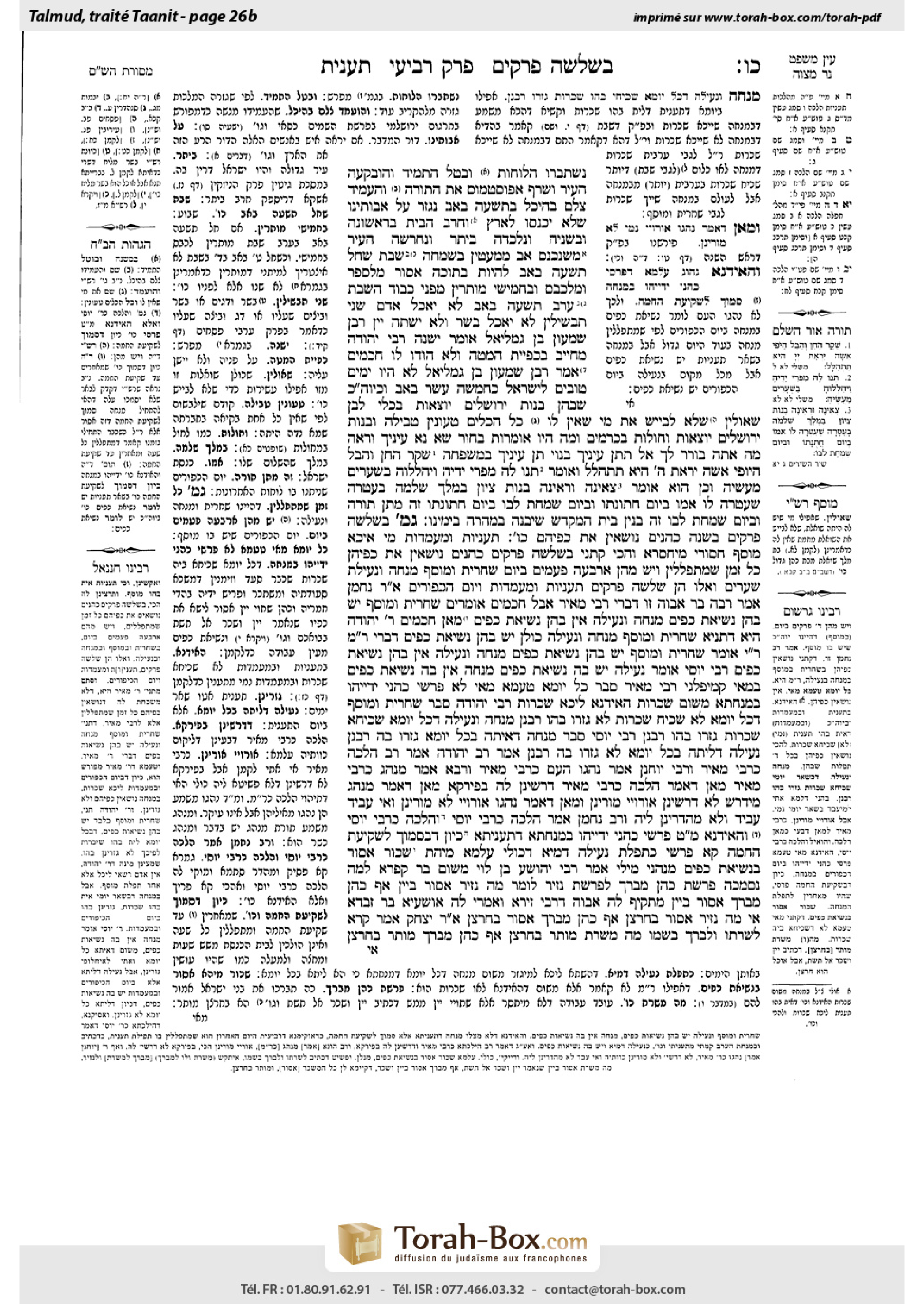
This page of Taanit includes the Aramaic text, an English translation and an AI-generated French translation, alongside the scan above.
תענית כ״ו ב · Aramaic and Hebrew text
נִשְׁתַּבְּרוּ הַלּוּחוֹת, וּבָטַל הַתָּמִיד, וְהוּבְקְעָה הָעִיר, וְשָׂרַף אַפּוֹסְטְמוֹס אֶת הַתּוֹרָה, וְהֶעֱמִיד צֶלֶם בַּהֵיכׇל.
בְּתִשְׁעָה בְּאָב נִגְזַר עַל אֲבוֹתֵינוּ שֶׁלֹּא יִכָּנְסוּ לָאָרֶץ, וְחָרַב הַבַּיִת בָּרִאשׁוֹנָה וּבַשְּׁנִיָּה, וְנִלְכְּדָה בֵּיתֵּר, וְנֶחְרְשָׁה הָעִיר.
מִשֶּׁנִּכְנָס אָב מְמַעֲטִין בְּשִׂמְחָה. שַׁבָּת שֶׁחָל תִּשְׁעָה בְּאָב לִהְיוֹת בְּתוֹכָהּ אָסוּר מִלְּסַפֵּר וּמִלְּכַבֵּס, וּבַחֲמִישִׁי מוּתָּרִין מִפְּנֵי כְּבוֹד הַשַּׁבָּת. עֶרֶב תִּשְׁעָה בְּאָב לֹא יֹאכַל אָדָם שְׁנֵי תַבְשִׁילִין, לֹא יֹאכַל בָּשָׂר וְלֹא יִשְׁתֶּה יַיִן. רַבָּן שִׁמְעוֹן בֶּן גַּמְלִיאֵל אוֹמֵר: יְשַׁנֶּה. רַבִּי יְהוּדָה מְחַיֵּיב בִּכְפִיַּית הַמִּטָּה, וְלֹא הוֹדוּ לוֹ חֲכָמִים.
אָמַר רַבָּן שִׁמְעוֹן בֶּן גַּמְלִיאֵל: לֹא הָיוּ יָמִים טוֹבִים לְיִשְׂרָאֵל כַּחֲמִשָּׁה עָשָׂר בְּאָב וּכְיוֹם הַכִּפּוּרִים, שֶׁבָּהֶן בְּנוֹת יְרוּשָׁלַיִם יוֹצְאוֹת בִּכְלֵי לָבָן שְׁאוּלִין — שֶׁלֹּא לְבַיֵּישׁ אֶת מִי שֶׁאֵין לוֹ. כׇּל הַכֵּלִים טְעוּנִין טְבִילָה.
וּבְנוֹת יְרוּשָׁלַיִם יוֹצְאוֹת וְחוֹלוֹת בַּכְּרָמִים. וּמָה הָיוּ אוֹמְרוֹת: בָּחוּר, שָׂא נָא עֵינֶיךָ וּרְאֵה מָה אַתָּה בּוֹרֵר לָךְ. אַל תִּתֵּן עֵינֶיךָ בַּנּוֹי, תֵּן עֵינֶיךָ בַּמִּשְׁפָּחָה. ״שֶׁקֶר הַחֵן וְהֶבֶל הַיֹּפִי אִשָּׁה יִרְאַת ה׳ הִיא תִתְהַלָּל״, וְאוֹמֵר: ״תְּנוּ לָהּ מִפְּרִי יָדֶיהָ וִיהַלְלוּהָ בַשְּׁעָרִים מַעֲשֶׂיהָ״.
וְכֵן הוּא אוֹמֵר: ״צְאֶינָה וּרְאֶינָה בְּנוֹת צִיּוֹן בַּמֶּלֶךְ שְׁלֹמֹה בָּעֲטָרָה שֶׁעִטְּרָה לּוֹ אִמּוֹ בְּיוֹם חֲתֻנָּתוֹ וּבְיוֹם שִׂמְחַת לִבּוֹ״. ״בְּיוֹם חֲתֻנָּתוֹ״ — זֶה מַתַּן תּוֹרָה, ״וּבְיוֹם שִׂמְחַת לִבּוֹ״ — זֶה בִּנְיַן בֵּית הַמִּקְדָּשׁ, שֶׁיִּבָּנֶה בִּמְהֵרָה בְּיָמֵינוּ.
גְּמָ׳ בִּשְׁלֹשָׁה פְּרָקִים בַּשָּׁנָה כֹּהֲנִים נוֹשְׂאִין אֶת כַּפֵּיהֶם כּוּ׳. תַּעֲנִיּוֹת וּמַעֲמָדוֹת מִי אִיכָּא מוּסָף? חַסּוֹרֵי מִיחַסְּרָא, וְהָכִי קָתָנֵי: בִּשְׁלֹשָׁה פְּרָקִים כֹּהֲנִים נוֹשְׂאִין אֶת כַּפֵּיהֶן כׇּל זְמַן שֶׁמִּתְפַּלְּלִין, וְיֵשׁ מֵהֶן אַרְבָּעָה פְּעָמִים בַּיּוֹם — שַׁחֲרִית וּמוּסָף מִנְחָה וּנְעִילַת שְׁעָרִים, וְאֵלּוּ הֵן שְׁלֹשָׁה פְּרָקִים: תַּעֲנִיּוֹת, וּמַעֲמָדוֹת, וְיוֹם הַכִּפּוּרִים.
אָמַר רַב נַחְמָן אָמַר רַבָּה בַּר אֲבוּהּ: זוֹ דִּבְרֵי רַבִּי מֵאִיר. אֲבָל חֲכָמִים אוֹמְרִים: שַׁחֲרִית וּמוּסָף — יֵשׁ בָּהֶן נְשִׂיאַת כַּפַּיִם, מִנְחָה וּנְעִילָה — אֵין בָּהֶן נְשִׂיאַת כַּפַּיִם.
מַאן חֲכָמִים — רַבִּי יְהוּדָה הִיא. דְּתַנְיָא: שַׁחֲרִית וּמוּסָף מִנְחָה וּנְעִילָה כּוּלָּן יֵשׁ בָּהֶן נְשִׂיאַת כַּפַּיִם, דִּבְרֵי רַבִּי מֵאִיר. רַבִּי יְהוּדָה אוֹמֵר: שַׁחֲרִית וּמוּסָף — יֵשׁ בָּהֶן נְשִׂיאַת כַּפַּיִם, מִנְחָה וּנְעִילָה — אֵין בָּהֶן נְשִׂיאַת כַּפַּיִם. רַבִּי יוֹסֵי אוֹמֵר: נְעִילָה — יֵשׁ בָּהּ נְשִׂיאַת כַּפַּיִם, מִנְחָה — אֵין בָּהּ נְשִׂיאַת כַּפַּיִם.
בְּמַאי קָמִיפַּלְגִי? רַבִּי מֵאִיר סָבַר: כׇּל יוֹמָא טַעְמָא מַאי לָא פָּרְשִׂי כָּהֲנֵי יְדַיְיהוּ בְּמִנְחֲתָא — מִשּׁוּם שִׁכְרוּת, הָאִידָּנָא לֵיכָּא שִׁכְרוּת.
רַבִּי יְהוּדָה סָבַר: שַׁחֲרִית וּמוּסָף דְּכׇל יוֹמָא לָא שְׁכִיחַ שִׁכְרוּת — לָא גְּזַרוּ בְּהוּ רַבָּנַן, מִנְחָה וּנְעִילָה דְּכׇל יוֹמָא שְׁכִיחָא שִׁכְרוּת — גְּזַרוּ בְּהוּ רַבָּנַן.
רַבִּי יוֹסֵי סָבַר: מִנְחָה דְּאִיתַהּ בְּכׇל יוֹמָא — גְּזַרוּ בַּהּ רַבָּנַן, נְעִילָה דְּלֵיתַהּ בְּכׇל יוֹמָא — לָא גְּזַרוּ בַּהּ רַבָּנַן.
אָמַר רַב יְהוּדָה אָמַר רַב: הֲלָכָה כְּרַבִּי מֵאִיר. וְרַבִּי יוֹחָנָן אָמַר: נָהֲגוּ הָעָם כְּרַבִּי מֵאִיר. וְרָבָא אָמַר: מִנְהָג כְּרַבִּי מֵאִיר.
מַאן דְּאָמַר הֲלָכָה כְּרַבִּי מֵאִיר — דָּרְשִׁינַן לַהּ בְּפִירְקָא. מַאן דְּאָמַר מִנְהָג — מִידְרָשׁ לָא דָּרְשִׁינַן, אוֹרוֹיֵי מוֹרֵינַן. וּמַאן דְּאָמַר נָהֲגוּ — אוֹרוֹיֵי לָא מוֹרֵינַן, וְאִי עָבֵיד — עָבֵיד, וְלָא מַהְדְּרִינַן לֵיהּ.
וְרַב נַחְמָן אָמַר: הֲלָכָה כְּרַבִּי יוֹסֵי. וַהֲלָכָה כְּרַבִּי יוֹסֵי. וְהָאִידָּנָא מַאי טַעְמָא פָּרְשִׂי כָּהֲנֵי יְדַיְיהוּ בְּמִנְחֲתָא דְתַעֲנִיתָא? כֵּיוָן דִּבְסָמוּךְ לִשְׁקִיעַת הַחַמָּה קָא פָּרְשִׂי — כִּתְפִילַּת נְעִילָה דָּמְיָא.
דְּכוּלֵּי עָלְמָא מִיהַת שִׁכּוֹר אָסוּר בִּנְשִׂיאַת כַּפַּיִם. מְנָהָנֵי מִילֵּי? אָמַר רַבִּי יְהוֹשֻׁעַ בֶּן לֵוִי מִשּׁוּם בַּר קַפָּרָא: לָמָּה נִסְמְכָה פָּרָשַׁת כֹּהֵן מְבָרֵךְ לְפָרָשַׁת נָזִיר? לוֹמַר: מָה נָזִיר אָסוּר בְּיַיִן, אַף כֹּהֵן מְבָרֵךְ אָסוּר בְּיַיִן.
מַתְקֵיף לַהּ אֲבוּהּ דְּרַבִּי זֵירָא, וְאָמְרִי לַהּ אוֹשַׁעְיָא בַּר זַבְדָּא: אִי מָה נָזִיר אָסוּר בְּחַרְצָן — אַף כֹּהֵן מְבָרֵךְ אָסוּר בְּחַרְצָן! אָמַר רַבִּי יִצְחָק, אָמַר קְרָא: ״לְשָׁרְתוֹ וּלְבָרֵךְ בִּשְׁמוֹ״, מָה מְשָׁרֵת מוּתָּר בְּחַרְצָן — אַף כֹּהֵן מְבָרֵךְ מוּתָּר בְּחַרְצָן.
Taanit 26b · English translation
the tablets were broken by Moses when he saw that the Jews had made the golden calf; the daily offering was nullified by the Roman authorities and was never sacrificed again; the city walls of Jerusalem were breached; the general Apostemos publicly burned a Torah scroll; and Manasseh placed an idol in the Sanctuary.
On the Ninth of Av it was decreed upon our ancestors that they would all die in the wilderness and not enter Eretz Yisrael; and the Temple was destroyed the first time, in the days of Nebuchadnezzar, and the second time, by the Romans; and Beitar was captured; and the city of Jerusalem was plowed, as a sign that it would never be rebuilt.
Not only does one fast on the Ninth of Av, but from when the month of Av begins, one decreases acts of rejoicing. During the week in which the Ninth of Av occurs, it is prohibited to cut one’s hair and to launder clothes, but if the Ninth of Av occurs on a Friday, on Thursday these actions are permitted in deference to Shabbat. On the eve of the Ninth of Av a person may not eat two cooked dishes in one meal. Furthermore, one may neither eat meat nor drink wine. Rabban Shimon ben Gamliel says: One must adjust and decrease the amount he eats. Rabbi Yehuda obligates one to overturn the bed and sleep on the floor like one in a state of mourning, but the Rabbis did not agree with him.
The mishna cites a passage that concludes its discussion of the month of Av, as well as the entire tractate of Ta’anit, on a positive note. Rabban Shimon ben Gamliel said: There were no days as joyous for the Jewish people as the fifteenth of Av and as Yom Kippur, as on them the daughters of Jerusalem would go out in white clothes, which each woman borrowed from another. Why were they borrowed? They did this so as not to embarrass one who did not have her own white garments. All the garments that the women borrowed require immersion, as those who previously wore them might have been ritually impure.
And the daughters of Jerusalem would go out and dance in the vineyards. And what would they say? Young man, please lift up your eyes and see what you choose for yourself for a wife. Do not set your eyes toward beauty, but set your eyes toward a good family, as the verse states: “Grace is deceitful and beauty is vain, but a woman who fears the Lord, she shall be praised” (Proverbs 31:30), and it further says: “Give her the fruit of her hands, and let her works praise her in the gates” (Proverbs 31:31).
And similarly, it says in another verse: “Go forth, daughters of Zion, and gaze upon King Solomon, upon the crown with which his mother crowned him on the day of his wedding, and on the day of the gladness of his heart” (Song of Songs 3:11). This verse is explained as an allusion to special days: “On the day of his wedding”; this is the giving of the Torah through the second set of tablets on Yom Kippur. The name King Solomon in this context, which also means king of peace, is interpreted as a reference to God. “And on the day of the gladness of his heart”; this is the building of the Temple, may it be rebuilt speedily in our days.
GEMARA: The mishna taught: At three times in the year priests raise their hands to recite the Priestly Benediction four times in a single day: On communal fasts, non-priestly watches, and Yom Kippur. The Gemara asks: How do they recite the Priestly Benediction four times on these days? Do fast days and gatherings of non-priestly watches have an additional prayer? The Gemara explains that the mishna is incomplete and is teaching the following: At three times in the year priests raise their hands each time they pray, and on some of these they bless four times a day, in the morning prayer, in the additional prayer, in the afternoon prayer, and in the closing of the gates, i.e., the ne’ila prayer. And these are the three times: Communal fasts, non-priestly watches, and Yom Kippur.
Rav Naḥman said that Rabba bar Avuh said: This mishna is the statement of Rabbi Meir. However, the Rabbis say: The morning prayer and the additional prayer have the Priestly Benediction of the raising of the hands, whereas the afternoon prayer and the closing prayer [ne’ila] do not have the raising of the hands.
The Gemara asks: Who are these Rabbis, who disagree with Rabbi Meir? It is the opinion of Rabbi Yehuda, as it is taught in a baraita: The morning prayer, the additional prayer, the afternoon prayer, and ne’ila all have the Priestly Benediction of the raising of the hands. This is the statement of Rabbi Meir. Rabbi Yehuda says: The morning prayer and the additional prayer have the raising of the hands, whereas the afternoon prayer and ne’ila do not have the raising of the hands. Rabbi Yosei says: Ne’ila has the raising of the hands; the afternoon prayer does not have the raising of the hands.
The Gemara asks: With regard to what principle do they disagree? Rabbi Meir maintains: What is the reason that priests do not spread their hands to bless the people every day in the afternoon prayer? It is due to potential drunkenness, as people occasionally become intoxicated during their lunch, and it is prohibited for an inebriated priest to bless. However, now, on a fast day, there is no concern about drunkenness, and therefore the priests may recite the Priestly Benediction even in the afternoon prayer.
Conversely, Rabbi Yehuda maintains that with regard to the morning prayer and the additional prayer, when drunkenness is not common on every ordinary day, the Sages did not issue a decree that the Priestly Benediction be omitted during them. However, with regard to the afternoon prayer and ne’ila, when drunkenness is common on every day, the Sages issued a decree that the Priestly Benediction should not be recited during them, despite the fact that intoxication is not a concern on a fast day.
Finally, Rabbi Yosei maintains that with regard to the afternoon prayer, which is recited every day, the Sages issued a decree concerning it, whereas with regard to ne’ila, which is not recited every day, the Sages did not issue and apply their decree to it, as there is no concern that people might become confused between ne’ila and an afternoon prayer of a regular weekday.
Rav Yehuda said that Rav said: The halakha is in accordance with the opinion of Rabbi Meir. And Rabbi Yoḥanan said: The people act in accordance with the opinion of Rabbi Meir. And Rava said: The custom is in accordance with the opinion of Rabbi Meir.
The Gemara clarifies these statements. The one who said that the halakha is in accordance with the opinion of Rabbi Meir means that this ruling is taught in the public lectures on Shabbat. The one who said that the custom is in accordance with the opinion of Rabbi Meir means that one does not teach this in public, but if someone comes to ask for a practical ruling, one instructs them in private that this is the halakha. And the one who said that the people act in accordance with the opinion of Rabbi Meir means that one does not even instruct someone that this is the halakha, but if he acts in accordance with Rabbi Meir, he has acted in a valid manner and we do not require him to return and recite the prayer again.
And Rav Naḥman said that the halakha is in accordance with the opinion of Rabbi Yosei. The Gemara concludes: And indeed, the halakha is in accordance with the opinion of Rabbi Yosei. The Gemara asks: And nowadays, what is the reason that priests spread their hands to bless the people in the afternoon prayer of a fast? The Gemara explains: Since they spread their hands near sunset, it is considered like ne’ila, and therefore the decree of the Sages does not apply.
In any event, based on the above, everyone agrees that it is prohibited for a drunken priest to raise his hands and recite the Priestly Benediction. The Gemara asks: From where are these matters derived? Rabbi Yehoshua ben Levi said in the name of bar Kappara: Why is the portion of the priest who recites the benediction (see Numbers 6:22–27) juxtaposed with the portion of the nazirite (see Numbers 6:1–21)? They are juxtaposed to say that just as it is prohibited for a nazirite to drink wine, so too, it is prohibited for a priest who recites the benediction to drink wine.
Rabbi Zeira’s father, and some say it was Oshaya bar Zavda, strongly objects to this explanation. If you wish to compare these two cases, you can argue as follows: Just as it is prohibited for a nazirite to eat grape pits, as he may not partake of any of the products of a grapevine, so too, it should be prohibited for a priest who recites the benediction to eat grape pits. Certainly a priest is not barred from raising his hands after eating a few grape pits. Rather, Rabbi Yitzḥak said that the verse states: “To minister to Him and to bless in His name” (Deuteronomy 10:8). Just as it is permitted for a priest who ministers to God in the Temple to partake of grape pits, so too, it is permitted for a priest who recites the benediction to partake of grape pits.
Taanit 26b · Traduction française (IA)
Les Tables furent brisées par Moïse lorsqu’il vit que les Juifs avaient fabriqué le veau d’or ; l’offrande quotidienne fut supprimée par les autorités romaines et ne fut plus jamais sacrifiée ; les murailles de Jérusalem furent percées ; le général Apostemos brûla publiquement un rouleau de Torah ; et Manassé plaça une idole dans le Sanctuaire.
Le neuf Av, il fut décrété contre nos ancêtres qu’ils mourraient tous dans le désert et n’entreraient pas en Eretz Israël ; le Temple fut détruit une première fois, à l’époque de Nabuchodonosor, puis une seconde fois, par les Romains ; Beitar fut prise ; et la ville de Jérusalem fut labourée, en signe qu’elle ne serait jamais reconstruite.
On ne jeûne pas seulement le neuf Av : dès le début du mois d’Av, on réduit les marques de réjouissance. Durant la semaine où tombe le neuf Av, il est interdit de se couper les cheveux et de laver ses vêtements. Mais si le neuf Av tombe un vendredi, ces actions sont permises le jeudi, par égard pour Chabbat. La veille du neuf Av, on ne peut pas manger deux mets cuits au cours d’un même repas. En outre, on ne peut ni manger de viande ni boire de vin. Rabban Chimon ben Gamliel dit : Il faut modérer et réduire la quantité que l’on mange. Rabbi Yehouda impose de renverser son lit et de dormir à même le sol, comme une personne en deuil, mais les Sages ne furent pas de son avis.
La Michna cite un passage qui conclut la discussion du mois d’Av ainsi que tout le traité de Ta’anit sur une note positive. Rabban Chimon ben Gamliel dit : Il n’y eut pas de jours aussi joyeux pour le peuple juif que le quinze Av et Yom Kippour, car, ces jours-là, les filles de Jérusalem sortaient vêtues de blanc, chacune empruntant sa tenue à une autre. Pourquoi ces vêtements étaient-ils empruntés ? Elles faisaient ainsi pour ne pas faire honte à celle qui ne possédait pas ses propres vêtements blancs. Tous les vêtements empruntés par les femmes devaient être immergés, car celles qui les avaient portés auparavant étaient peut-être en état d’impureté rituelle.
Les filles de Jérusalem sortaient danser dans les vignobles. Et que disaient-elles ? « Jeune homme, lève les yeux et vois celle que tu choisiras pour épouse. Ne porte pas tes regards sur la beauté, mais sur une bonne famille, comme le dit le verset : “Le charme est trompeur et la beauté vaine ; mais la femme qui craint l’Éternel sera louée” (Proverbes 31:30). Et il est dit encore : “Donne-lui le fruit de ses mains, et que ses œuvres la louent aux portes” (Proverbes 31:31). »
De même, un autre verset dit : « Sortez, filles de Sion, et contemplez le roi Salomon, avec la couronne dont sa mère l’a couronné au jour de ses noces et au jour de la joie de son cœur » (Cantique des Cantiques 3:11). Ce verset est interprété comme une allusion à des jours particuliers : « Au jour de ses noces » désigne le don de la Torah, avec les secondes Tables, à Yom Kippour. Le nom « roi Salomon », qui signifie aussi « roi de paix », est ici interprété comme une référence à Dieu. « Et au jour de la joie de son cœur » désigne la construction du Temple. Puisse-t-il être reconstruit rapidement de nos jours.
GUEMARA : La Michna enseigne qu’à trois moments de l’année, les prêtres lèvent les mains pour réciter la Bénédiction sacerdotale quatre fois en une journée : lors des jeûnes communautaires, des gardes non sacerdotales et de Yom Kippour. La Guemara demande : Comment récitent-ils la Bénédiction sacerdotale quatre fois ces jours-là ? Les jours de jeûne et les rassemblements des gardes non sacerdotales comportent-ils une prière supplémentaire ? La Guemara explique que la Michna est incomplète et enseigne ceci : À trois moments de l’année, les prêtres lèvent les mains à chacune des prières, et certains de ces jours, ils bénissent quatre fois par jour : à la prière du matin, à la prière supplémentaire, à la prière de l’après-midi et à la clôture des portes, c’est-à-dire la prière de neïla. Voici ces trois moments : les jeûnes communautaires, les gardes non sacerdotales et Yom Kippour.
Rav Naḥman dit au nom de Rabba bar Avouha : Cette Michna exprime l’opinion de Rabbi Meïr. Les Sages, toutefois, disent que la prière du matin et la prière supplémentaire comportent la Bénédiction sacerdotale avec élévation des mains, tandis que la prière de l’après-midi et la prière de clôture [neïla] ne comportent pas d’élévation des mains.
La Guemara demande : Qui sont ces Sages qui s’opposent à Rabbi Meïr ? C’est l’opinion de Rabbi Yehouda, comme il est enseigné dans une baraïta : La prière du matin, la prière supplémentaire, la prière de l’après-midi et neïla comportent toutes la Bénédiction sacerdotale avec élévation des mains. Telle est l’opinion de Rabbi Meïr. Rabbi Yehouda dit : La prière du matin et la prière supplémentaire comportent l’élévation des mains, tandis que la prière de l’après-midi et neïla ne la comportent pas. Rabbi Yossi dit : Neïla comporte l’élévation des mains ; la prière de l’après-midi ne la comporte pas.
La Guemara demande : Sur quel principe sont-ils en désaccord ? Rabbi Meïr estime que les prêtres n’étendent pas les mains pour bénir le peuple chaque jour à la prière de l’après-midi en raison du risque d’ébriété : il arrive en effet que des gens s’enivrent pendant leur repas de midi, et il est interdit à un prêtre ivre de bénir. Toutefois, un jour de jeûne, il n’y a pas de risque d’ébriété ; les prêtres peuvent donc réciter la Bénédiction sacerdotale même à la prière de l’après-midi.
À l’inverse, Rabbi Yehouda estime que, pour la prière du matin et la prière supplémentaire, où l’ivresse n’est pas fréquente lors des jours ordinaires, les Sages n’ont pas décrété que la Bénédiction sacerdotale devait en être omise. En revanche, pour la prière de l’après-midi et neïla, où l’ivresse est fréquente chaque jour, les Sages ont décrété que la Bénédiction sacerdotale ne devait pas y être récitée, même si le risque d’ivresse n’existe pas un jour de jeûne.
Enfin, Rabbi Yossi estime que les Sages ont décrété cette interdiction pour la prière de l’après-midi, qui est récitée chaque jour, mais qu’ils ne l’ont pas décrétée pour neïla, qui n’est pas récitée chaque jour, car il n’y a pas lieu de craindre que les gens confondent neïla avec la prière de l’après-midi d’un jour de semaine ordinaire.
Rav Yehouda dit au nom de Rav : La halakha suit l’opinion de Rabbi Meïr. Rabbi Yoḥanan dit : Les gens agissent conformément à l’opinion de Rabbi Meïr. Et Rava dit : La coutume suit l’opinion de Rabbi Meïr.
La Guemara précise le sens de ces propos. Celui qui dit que la halakha suit l’opinion de Rabbi Meïr veut dire que cette règle est enseignée publiquement lors des cours du Chabbat. Celui qui dit que la coutume suit l’opinion de Rabbi Meïr veut dire qu’on ne l’enseigne pas publiquement, mais que, si quelqu’un vient demander une décision pratique, on lui indique en privé que telle est la halakha. Et celui qui dit que les gens agissent conformément à l’opinion de Rabbi Meïr veut dire qu’on ne dit même pas à quelqu’un que telle est la halakha ; mais s’il agit conformément à Rabbi Meïr, il agit de manière valable et on ne lui demande pas de recommencer la prière.
Rav Naḥman dit que la halakha suit l’opinion de Rabbi Yossi. La Guemara conclut : Et, de fait, la halakha suit l’opinion de Rabbi Yossi. La Guemara demande : De nos jours, pourquoi les prêtres étendent-ils leurs mains pour bénir le peuple à la prière de l’après-midi d’un jour de jeûne ? La Guemara explique : Puisqu’ils étendent leurs mains près du coucher du soleil, cela est considéré comme neïla ; le décret des Sages ne s’applique donc pas.
Quoi qu’il en soit, d’après ce qui précède, tous s’accordent à dire qu’il est interdit à un prêtre ivre de lever les mains et de réciter la Bénédiction sacerdotale. La Guemara demande : D’où tire-t-on ces règles ? Rabbi Yehoshoua ben Lévi dit au nom de bar Kappara : Pourquoi le passage relatif au prêtre qui récite la bénédiction (voir Nombres 6:22–27) est-il juxtaposé à celui relatif au nazir (voir Nombres 6:1–21) ? Cette juxtaposition enseigne que, de même qu’il est interdit à un nazir de boire du vin, il est également interdit à un prêtre qui récite la bénédiction de boire du vin.
Le père de Rabbi Zeira — et certains disent qu’il s’agissait de Oshaya bar Zavda — conteste vivement cette explication. Si l’on veut comparer ces deux cas, on peut raisonner ainsi : de même qu’il est interdit à un nazir de manger des pépins de raisin, puisqu’il ne peut consommer aucun produit de la vigne, de même il devrait être interdit à un prêtre qui récite la bénédiction de manger des pépins de raisin. Or, il est certain qu’on n’interdit pas à un prêtre de lever les mains après qu’il a mangé quelques pépins de raisin. Rabbi Yitsḥak dit plutôt que le verset déclare : « Pour servir devant Lui et bénir en Son nom » (Deutéronome 10:8). De même qu’il est permis à un prêtre qui sert Dieu dans le Temple de manger des pépins de raisin, de même il est permis à un prêtre qui récite la bénédiction d’en manger.
Traduction française générée par IA à partir de l’édition anglaise de Sefaria. Vérifie toujours un passage avec le texte source.
Text from Sefaria: William Davidson Edition - Vocalized Aramaic (CC BY NC); William Davidson Edition - English (CC BY NC).