Taanit 26a: Talmud study for Daf Yomi
Daf Yomi is the daily study of one Talmud folio. Explore 37 tractates with scans, Hebrew text, Sefaria English and AI-generated French translations where annotated.
Passage selection and English or AI-generated French translation are available where the scan has annotations. Daf Study is independent of Torah-Box and Sefaria.
Browse Taanit · תענית · All tractatesTaanit 26a text and translations
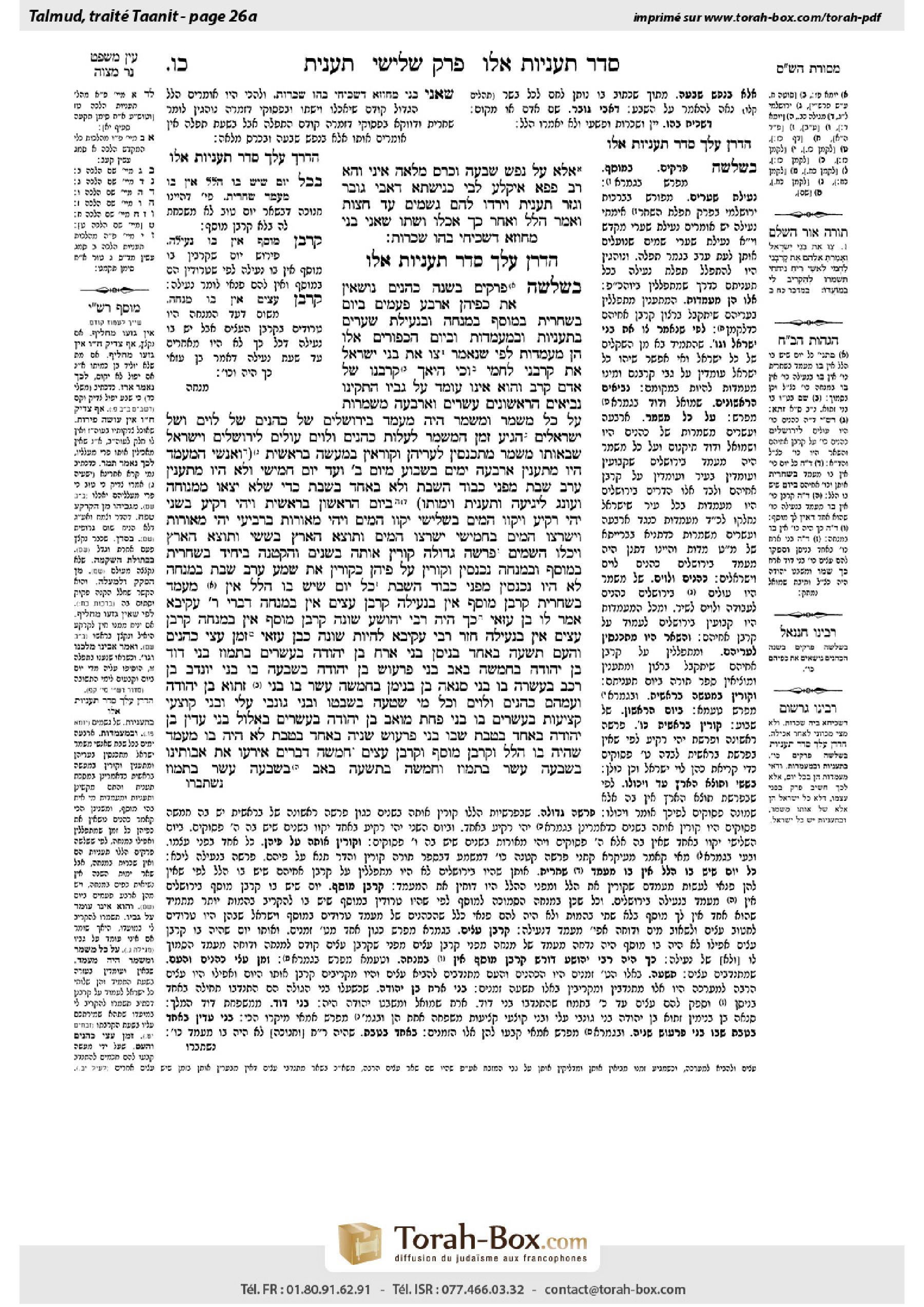
This page of Taanit includes the Aramaic text, an English translation and an AI-generated French translation, alongside the scan above.
תענית כ״ו א · Aramaic and Hebrew text
אֶלָּא עַל נֶפֶשׁ שְׂבֵעָה וְכָרֵס מְלֵאָה. אִינִי? וְהָא רַב פָּפָּא אִיקְּלַע לְבֵי כְּנִישְׁתָּא דַּאֲבִי גוֹבָר וּגְזַר תַּעֲנִית, וְיָרְדוּ לָהֶם גְּשָׁמִים עַד חֲצוֹת, וְאָמַר [לָהֶם: אִמְרוּ] הַלֵּל וְאַחַר כָּךְ אִכְלוּ וּשְׁתוּ! שָׁאנֵי בְּנֵי מָחוֹזָא, דִּשְׁכִיחִי בְּהוּ שִׁכְרוּת.
הֲדַרַן עֲלָךְ סֵדֶר תַּעֲנִיּוֹת אֵלּוּ
בִּשְׁלֹשָׁה פְּרָקִים בְּשָׁנָה כֹּהֲנִים נוֹשְׂאִין אֶת כַּפֵּיהֶן אַרְבַּע פְּעָמִים בַּיּוֹם; בַּשַּׁחֲרִית, בַּמּוּסָף, בַּמִּנְחָה, וּבִנְעִילַת שְׁעָרִים: בְּתַעֲנִיּוֹת, וּבְמַעֲמָדוֹת, וּבְיוֹם הַכִּפּוּרִים.
אֵלּוּ הֵן מַעֲמָדוֹת. לְפִי שֶׁנֶּאֱמַר: ״צַו אֶת בְּנֵי יִשְׂרָאֵל אֶת קׇרְבָּנִי לַחְמִי״, וְכִי הֵיאַךְ קׇרְבָּנוֹ שֶׁל אָדָם קָרֵב וְהוּא אֵינוֹ עוֹמֵד עַל גַּבָּיו?
הִתְקִינוּ נְבִיאִים הָרִאשׁוֹנִים עֶשְׂרִים וְאַרְבָּעָה מִשְׁמָרוֹת, עַל כָּל מִשְׁמָר וּמִשְׁמָר הָיָה מַעֲמָד בִּירוּשָׁלַיִם שֶׁל כֹּהֲנִים שֶׁל לְוִיִּם וְשֶׁל יִשְׂרְאֵלִים.
הִגִּיעַ זְמַן הַמִּשְׁמָר לַעֲלוֹת, כֹּהֲנִים וּלְוִיִּם עוֹלִים לִירוּשָׁלַיִם, וְיִשְׂרָאֵל שֶׁבְּאוֹתוֹ מִשְׁמָר מִתְכַּנְּסִין לְעָרֵיהֶן, וְקוֹרְאִין בְּמַעֲשֵׂה בְרֵאשִׁית. וְאַנְשֵׁי הַמַּעֲמָד הָיוּ מִתְעַנִּין אַרְבָּעָה יָמִים בַּשָּׁבוּעַ מִיּוֹם שֵׁנִי וְעַד יוֹם חֲמִישִׁי. וְלֹא הָיוּ מִתְעַנִּין עֶרֶב שַׁבָּת — מִפְּנֵי כְּבוֹד הַשַּׁבָּת, וְלֹא בְּאֶחָד בְּשַׁבָּת — כְּדֵי שֶׁלֹּא יֵצְאוּ מִמְּנוּחָה וְעוֹנֶג לִיגִיעָה וְתַעֲנִית וְיָמוּתוּ.
בַּיּוֹם הָרִאשׁוֹן: בְּרֵאשִׁית, וִיהִי רָקִיעַ. בַּשֵּׁנִי: יְהִי רָקִיעַ, וְיִקָּווּ הַמַּיִם. בַּשְּׁלִישִׁי: יִקָּווּ הַמַּיִם, וִיהִי מְאֹרֹת. בָּרְבִיעִי: יְהִי מְאֹרֹת, וְיִשְׁרְצוּ הַמַּיִם. בַּחֲמִישִׁי: יִשְׁרְצוּ הַמַּיִם, וְתוֹצֵא הָאָרֶץ. בַּשִּׁשִּׁי: תּוֹצֵא הָאָרֶץ, וַיְכֻלּוּ הַשָּׁמַיִם.
פָּרָשָׁה גְּדוֹלָה קוֹרִין אוֹתָהּ בִּשְׁנַיִם, וְהַקְּטַנָּה בְּיָחִיד. בַּשַּׁחֲרִית וּבַמּוּסָף. וּבַמִּנְחָה נִכְנָסִין וְקוֹרִין עַל פִּיהֶן, כְּקוֹרִין אֶת שְׁמַע. עֶרֶב שַׁבָּת בַּמִּנְחָה לֹא הָיוּ נִכְנָסִין — מִפְּנֵי כְּבוֹד הַשַּׁבָּת.
כׇּל יוֹם שֶׁיֵּשׁ בּוֹ הַלֵּל — אֵין מַעֲמָד בַּשַּׁחֲרִית, קׇרְבַּן מוּסַף — אֵין בַּנְּעִילָה, קׇרְבַּן עֵצִים — אֵין בַּמִּנְחָה. דִּבְרֵי רַבִּי עֲקִיבָא.
אָמַר לוֹ בֶּן עַזַּאי, כָּךְ הָיָה רַבִּי יְהוֹשֻׁעַ שׁוֹנֶה: קׇרְבַּן מוּסַף — אֵין בַּמִּנְחָה, קׇרְבַּן עֵצִים — אֵין בַּנְּעִילָה. חָזַר רַבִּי עֲקִיבָא לִהְיוֹת שׁוֹנֶה כְּבֶן עַזַּאי.
זְמַן עֲצֵי כֹהֲנִים וְהָעָם, תִּשְׁעָה: בְּאֶחָד בְּנִיסָן בְּנֵי אָרַח בֶּן יְהוּדָה, בְּעֶשְׂרִים בְּתַמּוּז בְּנֵי דָוִד בֶּן יְהוּדָה, בַּחֲמִשָּׁה בְּאָב בְּנֵי פַרְעוֹשׁ בֶּן יְהוּדָה, בְּשִׁבְעָה בּוֹ בְּנֵי יוֹנָדָב בֶּן רֵכָב, בַּעֲשָׂרָה בּוֹ בְּנֵי סְנָאָה בֶּן בִּנְיָמִין, בַּחֲמִשָּׁה עָשָׂר בּוֹ בְּנֵי זַתּוּא בֶּן יְהוּדָה.
וְעִמָּהֶם כֹּהֲנִים וּלְוִיִּם, וְכׇל מִי שֶׁטָּעָה בְּשִׁבְטוֹ, וּבְנֵי גּוֹנְבֵי עֱלִי וּבְנֵי קוֹצְעֵי קְצִיעוֹת.
בְּעֶשְׂרִים בּוֹ בְּנֵי פַּחַת מוֹאָב בֶּן יְהוּדָה, בְּעֶשְׂרִים בֶּאֱלוּל בְּנֵי עָדִין בֶּן יְהוּדָה, בְּאֶחָד בְּטֵבֵת שָׁבוּ בְּנֵי פַרְעוֹשׁ שְׁנִיָּה. בְּאֶחָד בְּטֵבֵת לֹא הָיָה בּוֹ מַעֲמָד, שֶׁהָיָה בּוֹ הַלֵּל וְקׇרְבַּן מוּסַף וְקׇרְבַּן עֵצִים.
חֲמִשָּׁה דְּבָרִים אֵירְעוּ אֶת אֲבוֹתֵינוּ בְּשִׁבְעָה עָשָׂר בְּתַמּוּז, וַחֲמִשָּׁה בְּתִשְׁעָה בְּאָב. בְּשִׁבְעָה עָשָׂר בְּתַמּוּז
Taanit 26a · English translation
only on a satisfied soul and a full stomach. Consequently, it is preferable to return home to eat and drink so as to recite hallel in the proper frame of mind. The Gemara asks: Is that so? But Rav Pappa happened to come to the synagogue of Avi Govar in Meḥoza, and he decreed a fast, and rain fell for them before midday, and yet he recited hallel immediately, and only afterward they ate and drank. The Gemara explains: The inhabitants of the city of Meḥoza are different, as drunkenness is common among them. Had Rav Pappa told them to go home to eat and drink, they would have become drunk and been unable to pray.
MISHNA: At three times in the year priests raise their hands to recite the Priestly Benediction four times in a single day, in the morning prayer, in the additional prayer, in the afternoon prayer, and in the evening in the closing of the gates, i.e., the ne’ila prayer. And these are the three times: During communal fasts held due to lack of rain, on which the closing prayer is recited; and during non-priestly watches [ma’amadot], when the Israelite members of the guard parallel to the priestly watch come and read the act of Creation from the Torah, as explained below; and on Yom Kippur.
These are the non-priestly watches: Since it is stated: “Command the children of Israel and say to them: My offering of food, which is presented to Me made by a fire, of a sweet savor to Me, you shall guard the sacrifice to Me in its due season” (Numbers 28:2), this verse teaches that the daily offering was a communal obligation that applied to every member of the Jewish people. The mishna asks: But how can a person’s offering be sacrificed when he is not standing next to it?
The mishna explains: Since it is impossible for the entire nation to be present in Jerusalem when the daily offering is brought, the early prophets, Samuel and David, instituted the division of the priests into twenty-four priestly watches, each of which served for approximately one week, twice per year. For each and every priestly watch there was a corresponding non-priestly watch in Jerusalem of priests, Levites, and Israelites who would stand by the communal offerings for that day to represent the community.
When the time arrived for the members of a certain priestly watch to ascend, the priests and Levites of that watch would ascend to Jerusalem to perform the Temple service. And as for the Israelites assigned to that priestly watch, some of them went up to Jerusalem, while the rest of them assembled in their towns and read the act of Creation. And the members of the non-priestly watch, who represented the entire community that week, would fast four days a week, from Monday until Thursday. And they would not fast on Shabbat eve, in deference to Shabbat, as they did not wish to start Shabbat while fasting. And they did not fast on Sunday, so as not to go from rest and delight immediately to exertion and fasting, and run the risk that they might die as a result of the abrupt change.
Which portions of the Torah would the members of the non-priestly watch read on each day? On Sunday they would read the portions starting with: “In the beginning” and “Let there be a firmament” (Genesis 1:1–8). On Monday they would read: “Let there be a firmament” and “Let the waters be gathered” (Genesis 1:9–13). On Tuesday they would read: “Let the waters be gathered” and “Let there be lights” (Genesis 1:14–19). On Wednesday: “Let there be lights” and “Let the waters swarm” (Genesis 1:20–23). On Thursday: “Let the waters swarm” and “Let the earth bring forth” (Genesis 1:24–31). On Friday: “Let the earth bring forth” and “And the heaven and the earth were finished” (Genesis 2:1–3).
A long passage, consisting of six verses or more, is read by two people, and a short passage is read by one, as one cannot read fewer than three verses from the Torah together. They read from the Torah in the morning prayer and in the additional prayer. In the afternoon prayer the members of the non-priestly watch enter the synagogue and read the daily portion by heart, just as one recites Shema every day. On Shabbat eve at the afternoon prayer, they would not enter the synagogue for the communal Torah readings, in deference to Shabbat.
The mishna states a principle: On any day that has the recitation of hallel, but on which the additional offering was not sacrificed, e.g., Hanukkah, there is no reading of the Torah by the non-priestly watch in the morning prayer. On days that have both hallel and an additional offering, such as Festivals, the non-priestly watch would also not read from the Torah at the closing prayer. When a wood offering was brought, as explained below, there was no non-priestly watch in the afternoon prayer. This is the statement of Rabbi Akiva.
Ben Azzai said to Rabbi Akiva that this is how Rabbi Yehoshua would teach this halakha: On days when an additional offering was sacrificed, there was no non-priestly watch in the afternoon prayer. When a wood offering was brought, there was no non-priestly watch in the closing prayer. Upon hearing this, Rabbi Akiva retracted his ruling and began to teach in accordance with the opinion of ben Azzai.
The mishna details the times for the wood offering of priests and the people. These were private holidays specific to certain families, on which their members would volunteer a wood offering for the altar. There were nine such days and families: On the first of Nisan, the descendants of Araḥ ben Yehuda; on the twentieth of Tammuz, the descendants of David ben Yehuda; on the fifth of Av, the descendants of Parosh ben Yehuda; on the seventh of Av, the descendants of Jonadab ben Rechab; on the tenth of Av, the descendants of Sena’a ben Binyamin; on the fifteenth of Av, the descendants of Zattu ben Yehuda.
And included with this group of Zattu ben Yehuda’s descendants were other priests; and Levites; and anyone who erred with regard to his tribe, i.e., Israelites who did not know which tribe they were from, and the descendants of those who deceived the authorities with a pestle; and the descendants of those who packed dried figs. These last groups and their descriptions are explained in the Gemara.
The mishna resumes its list. On the twentieth of Av, the descendants of Paḥat Moav ben Yehuda; on the twentieth of Elul, the descendants of Adin ben Yehuda; on the first of Tevet, the descendants of Parosh returned to bring wood for a second time; likewise on the first of Tevet, there was no non-priestly watch, as it is Hanukkah, on which hallel is recited, and it is the New Moon, on which an additional offering is sacrificed, and there was also a wood offering.
The mishna discusses the five major communal fast days. Five calamitous matters occurred to our forefathers on the seventeenth of Tammuz, and five other disasters happened on the Ninth of Av. On the seventeenth of Tammuz
Taanit 26a · Traduction française (IA)
uniquement lorsque l’âme est rassasiée et l’estomac plein. Par conséquent, il est préférable de rentrer chez soi pour manger et boire, afin de réciter le hallel dans les dispositions d’esprit qui conviennent. La Guemara demande : Est-ce bien le cas ? Pourtant, Rav Pappa se trouvait par hasard dans la synagogue d’Avi Govar, à Meḥoza, et décréta un jeûne. La pluie tomba pour eux avant midi, et pourtant il récita immédiatement le hallel, après quoi seulement ils mangèrent et burent. La Guemara explique : Les habitants de la ville de Meḥoza sont différents, car l’ivresse est fréquente chez eux. Si Rav Pappa leur avait dit de rentrer chez eux pour manger et boire, ils se seraient enivrés et auraient été incapables de prier.
MICHNA : Trois fois par an, les prêtres lèvent les mains pour réciter la bénédiction sacerdotale quatre fois au cours d’une même journée : à la prière du matin, à la prière supplémentaire, à la prière de l’après-midi et le soir, lors de la clôture des portes, c’est-à-dire à la prière de neïla. Ces trois occasions sont les suivantes : les jeûnes communautaires organisés en raison du manque de pluie, lors desquels on récite la prière de clôture ; les gardes non sacerdotales [ma’amadot], lorsque les membres israélites de la garde correspondant à la garde sacerdotale viennent lire dans la Torah le récit de la Création, comme cela sera expliqué ci-dessous ; et Yom Kippour.
Voici les gardes non sacerdotales : puisqu’il est dit : « Ordonne aux enfants d’Israël et dis-leur : Mon offrande alimentaire, présentée pour Moi par le feu, d’une agréable odeur pour Moi, vous veillerez à Me présenter le sacrifice en son temps fixé » (Nombres 28, 2), ce verset enseigne que le sacrifice quotidien constituait une obligation communautaire qui s’appliquait à chaque membre du peuple juif. La Michna demande : Mais comment le sacrifice d’une personne peut-il être offert si elle ne se tient pas à côté de lui ?
La Michna explique : puisqu’il est impossible que toute la nation soit présente à Jérusalem lorsque le sacrifice quotidien est offert, les premiers prophètes, Samuel et David, instituèrent la répartition des prêtres en vingt-quatre gardes sacerdotales, chacune assurant le service pendant environ une semaine, deux fois par an. À chacune des gardes sacerdotales correspondait une garde non sacerdotale à Jérusalem, composée de prêtres, de Lévites et d’Israélites qui se tenaient auprès des sacrifices communautaires de ce jour-là pour représenter la communauté.
Lorsque venait le moment pour les membres d’une garde sacerdotale donnée de monter à Jérusalem, les prêtres et les Lévites de cette garde s’y rendaient pour assurer le service du Temple. Quant aux Israélites affectés à cette garde sacerdotale, certains montaient à Jérusalem, tandis que les autres se rassemblaient dans leurs villes et lisaient le récit de la Création. Les membres de la garde non sacerdotale, qui représentaient toute la communauté cette semaine-là, jeûnaient quatre jours par semaine, du lundi au jeudi. Ils ne jeûnaient pas la veille de Chabbat, par égard pour Chabbat, car ils ne voulaient pas commencer Chabbat en jeûnant. Ils ne jeûnaient pas non plus le dimanche, afin de ne pas passer directement du repos et des délices à l’effort et au jeûne, au risque de mourir à la suite de ce changement brusque.
Quels passages de la Torah les membres de la garde non sacerdotale lisaient-ils chaque jour ? Le dimanche, ils lisaient les passages commençant par : « Au commencement » et « Qu’il y ait un firmament » (Genèse 1, 1-8). Le lundi, ils lisaient : « Qu’il y ait un firmament » et « Que les eaux se rassemblent » (Genèse 1, 9-13). Le mardi, ils lisaient : « Que les eaux se rassemblent » et « Qu’il y ait des luminaires » (Genèse 1, 14-19). Le mercredi : « Qu’il y ait des luminaires » et « Que les eaux foisonnent » (Genèse 1, 20-23). Le jeudi : « Que les eaux foisonnent » et « Que la terre produise » (Genèse 1, 24-31). Le vendredi : « Que la terre produise » et « Ainsi furent achevés les cieux et la terre » (Genèse 2, 1-3).
Un long passage, comprenant six versets ou davantage, est lu par deux personnes, tandis qu’un passage court est lu par une seule, puisqu’on ne peut lire ensemble moins de trois versets de la Torah. Ils lisaient dans la Torah à la prière du matin et à la prière supplémentaire. À la prière de l’après-midi, les membres de la garde non sacerdotale entraient dans la synagogue et récitaient par cœur la section quotidienne, comme on récite le Chéma chaque jour. La veille de Chabbat, à la prière de l’après-midi, ils n’entraient pas dans la synagogue pour les lectures communautaires de la Torah, par égard pour Chabbat.
La Michna énonce un principe : les jours où l’on récite le hallel, mais où l’offrande supplémentaire n’est pas offerte, par exemple à Hanoucca, la garde non sacerdotale ne lit pas dans la Torah à la prière du matin. Les jours où l’on récite à la fois le hallel et où l’on offre une offrande supplémentaire, comme les jours de fête, la garde non sacerdotale ne lit pas non plus dans la Torah à la prière de clôture. Lorsqu’une offrande de bois était apportée, comme cela sera expliqué ci-dessous, la garde non sacerdotale n’était pas présente à la prière de l’après-midi. Telle est la déclaration de Rabbi Akiva.
Ben Azzai dit à Rabbi Akiva que Rabbi Yehoshua enseignait cette halakha ainsi : les jours où une offrande supplémentaire était offerte, la garde non sacerdotale n’était pas présente à la prière de l’après-midi. Lorsqu’une offrande de bois était apportée, la garde non sacerdotale n’était pas présente à la prière de clôture. En entendant cela, Rabbi Akiva rétracta sa décision et commença à enseigner conformément à l’avis de ben Azzai.
La Michna précise les dates des offrandes de bois des prêtres et du peuple. Il s’agissait de fêtes privées propres à certaines familles, au cours desquelles leurs membres apportaient volontairement une offrande de bois pour l’autel. Il y avait neuf jours et familles de ce type : le premier Nisan, les descendants d’Araḥ ben Yehuda ; le vingt Tammouz, les descendants de David ben Yehuda ; le cinq Av, les descendants de Parosh ben Yehuda ; le sept Av, les descendants de Jonadab ben Rechab ; le dix Av, les descendants de Sena’a ben Binyamin ; le quinze Av, les descendants de Zattu ben Yehuda.
À ce groupe des descendants de Zattu ben Yehuda se joignaient d’autres prêtres, des Lévites, ainsi que toute personne qui s’était trompée au sujet de sa tribu, c’est-à-dire des Israélites qui ne savaient pas de quelle tribu ils étaient issus ; les descendants de ceux qui avaient trompé les autorités au moyen d’un pilon ; et les descendants de ceux qui avaient emballé des figues sèches. Ces derniers groupes et les descriptions qui les concernent sont expliqués dans la Guemara.
La Michna reprend sa liste. Le vingt Av, les descendants de Paḥat Moav ben Yehuda ; le vingt Eloul, les descendants d’Adin ben Yehuda ; le premier Tevet, les descendants de Parosh revinrent apporter du bois une seconde fois. De même, le premier Tevet, il n’y avait pas de garde non sacerdotale, car c’est Hanoucca, où l’on récite le hallel, et la nouvelle lune, où l’on offre une offrande supplémentaire ; il y avait également une offrande de bois.
La Michna traite des cinq grands jours de jeûne communautaire. Cinq événements calamiteux survinrent à nos ancêtres le dix-sept Tammouz, et cinq autres catastrophes eurent lieu le neuf Av. Le dix-sept Tammouz
Traduction française générée par IA à partir de l’édition anglaise de Sefaria. Vérifie toujours un passage avec le texte source.
Text from Sefaria: William Davidson Edition - Vocalized Aramaic (CC BY NC); William Davidson Edition - English (CC BY NC).