Taanit 25b: Talmud study for Daf Yomi
Daf Yomi is the daily study of one Talmud folio. Explore 37 tractates with scans, Hebrew text, Sefaria English and AI-generated French translations where annotated.
Passage selection and English or AI-generated French translation are available where the scan has annotations. Daf Study is independent of Torah-Box and Sefaria.
Browse Taanit · תענית · All tractatesTaanit 25b text and translations
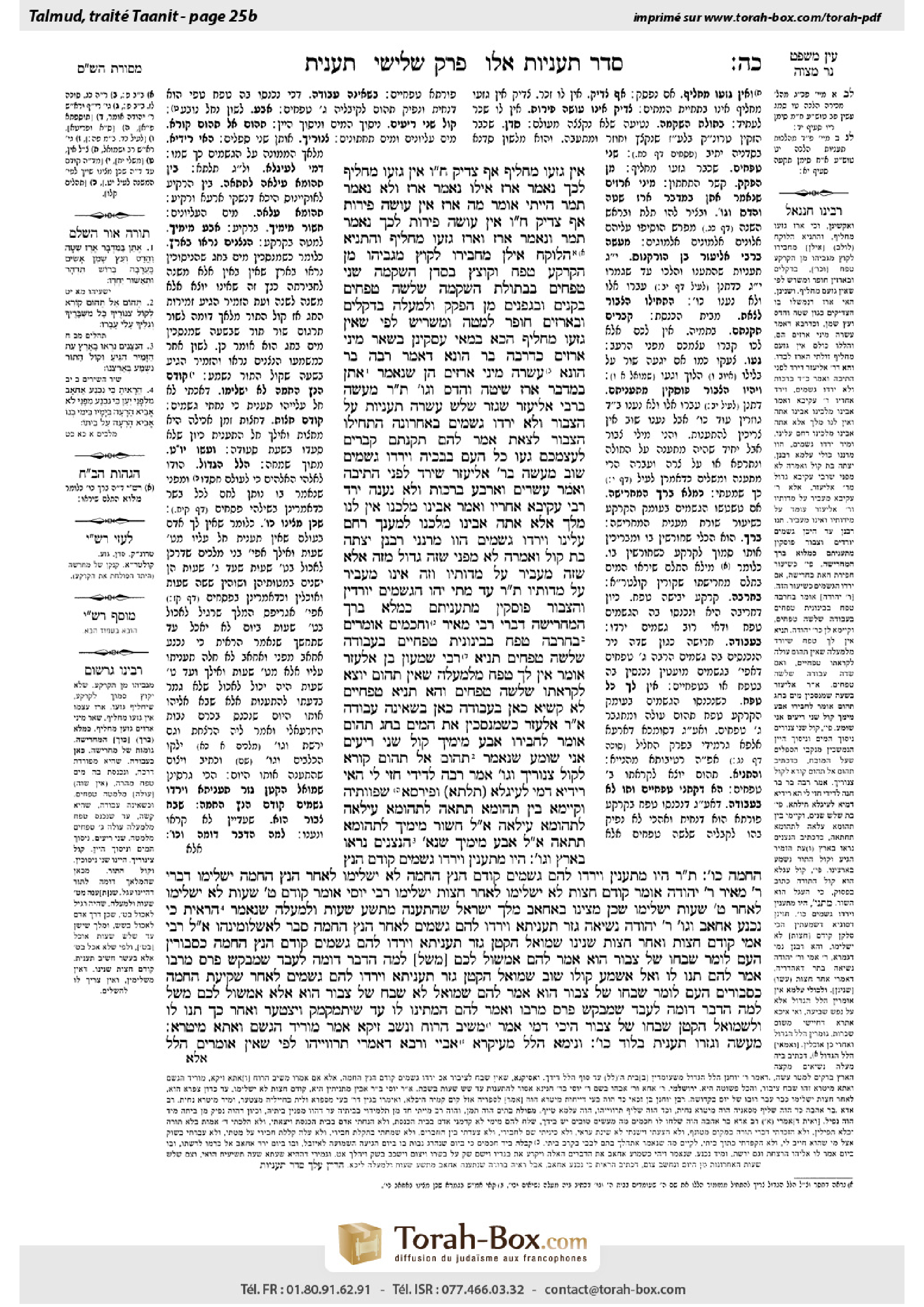
This page of Taanit includes the Aramaic text, an English translation and an AI-generated French translation, alongside the scan above.
תענית כ״ה ב · Aramaic and Hebrew text
אֵין גִּזְעוֹ מַחְלִיף, אַף צַדִּיק חַס וְשָׁלוֹם אֵין גִּזְעוֹ מַחְלִיף — לְכָךְ נֶאֱמַר אֶרֶז. אִילּוּ נֶאֱמַר אֶרֶז וְלֹא נֶאֱמַר תָּמָר, הָיִיתִי אוֹמֵר: מָה אֶרֶז אֵין עוֹשֶׂה פֵּירוֹת אַף צַדִּיק חַס וְשָׁלוֹם אֵין עוֹשֶׂה פֵּירוֹת — לְכָךְ נֶאֱמַר תָּמָר וְנֶאֱמַר אֶרֶז.
וְאֶרֶז גִּזְעוֹ מַחְלִיף? וְהָתַנְיָא: הַלּוֹקֵחַ אִילָן מֵחֲבֵירוֹ לָקוֹץ, מַגְבִּיהוֹ מִן הַקַּרְקַע טֶפַח וְקוֹצֵץ. בְּסַדַּן הַשִּׁקְמָה — שְׁנֵי טְפָחִים. בִּבְתוּלַת הַשִּׁקְמָה — שְׁלֹשָׁה טְפָחִים. בְּקָנִים וּבִגְפָנִים — מִן הַפְּקָק וּלְמַעְלָה. בִּדְקָלִים וּבַאֲרָזִים — חוֹפֵר לְמַטָּה וּמַשְׁרִישׁ, לְפִי שֶׁאֵין גִּזְעוֹ מַחְלִיף.
הָכָא בְּמַאי עָסְקִינַן בִּשְׁאָר מִינֵי אֲרָזִים, כִּדְרַבָּה בַּר הוּנָא. דְּאָמַר רַבָּה בַּר הוּנָא: עֲשָׂרָה מִינֵי אֲרָזִים הֵן, שֶׁנֶּאֱמַר: ״אֶתֵּן בַּמִּדְבָּר אֶרֶז שִׁטָּה וַהֲדַס וְגוֹ׳״.
תָּנוּ רַבָּנַן: מַעֲשֶׂה בְּרַבִּי אֱלִיעֶזֶר שֶׁגָּזַר שְׁלֹשׁ עֶשְׂרֵה תַּעֲנִיּוֹת עַל הַצִּבּוּר וְלֹא יָרְדוּ גְּשָׁמִים, בָּאַחֲרוֹנָה הִתְחִילוּ הַצִּבּוּר לָצֵאת. אָמַר לָהֶם: תִּקַּנְתֶּם קְבָרִים לְעַצְמְכֶם?! גָּעוּ כׇּל הָעָם בִּבְכִיָּה, וְיָרְדוּ גְּשָׁמִים.
שׁוּב מַעֲשֶׂה בְּרַבִּי אֱלִיעֶזֶר שֶׁיָּרַד לִפְנֵי הַתֵּיבָה, וְאָמַר עֶשְׂרִים וְאַרְבַּע בְּרָכוֹת וְלֹא נַעֲנָה. יָרַד רַבִּי עֲקִיבָא אַחֲרָיו וְאָמַר: ״אָבִינוּ מַלְכֵּנוּ אֵין לָנוּ מֶלֶךְ אֶלָּא אָתָּה. אָבִינוּ מַלְכֵּנוּ, לְמַעַנְךָ רַחֵם עָלֵינוּ״, וְיָרְדוּ גְּשָׁמִים. הֲווֹ מְרַנְּנִי רַבָּנַן, יָצְתָה בַּת קוֹל וְאָמְרָה: לֹא מִפְּנֵי שֶׁזֶּה גָּדוֹל מִזֶּה, אֶלָּא שֶׁזֶּה מַעֲבִיר עַל מִידּוֹתָיו, וְזֶה אֵינוֹ מַעֲבִיר עַל מִדּוֹתָיו.
תָּנוּ רַבָּנַן: עַד מָתַי יְהוּ הַגְּשָׁמִים יוֹרְדִין וְהַצִּבּוּר פּוֹסְקִין מִתַּעֲנִיתָם? כִּמְלֹא בֶּרֶךְ הַמַּחֲרֵישָׁה, דִּבְרֵי רַבִּי מֵאִיר. וַחֲכָמִים אוֹמְרִים: בַּחֲרֵבָה טֶפַח, בְּבֵינוֹנִית טִפְחַיִים, בַּעֲבוּדָה שְׁלֹשָׁה טְפָחִים.
תַּנְיָא, רַבִּי שִׁמְעוֹן בֶּן אֶלְעָזָר אוֹמֵר: אֵין לְךָ טֶפַח מִלְּמַעְלָה, שֶׁאֵין תְּהוֹם יוֹצֵא לִקְרָאתוֹ שְׁלֹשָׁה טְפָחִים. וְהָא תַּנְיָא טִפְחַיִים! לָא קַשְׁיָא: כָּאן בַּעֲבוּדָה, כָּאן בְּשֶׁאֵינָהּ עֲבוּדָה.
אָמַר רַבִּי אֶלְעָזָר: כְּשֶׁמְּנַסְּכִין אֶת הַמַּיִם בֶּחָג, תְּהוֹם אוֹמֵר לַחֲבֵירוֹ: אַבַּע מֵימֶיךָ, קוֹל שְׁנֵי רֵיעִים אֲנִי שׁוֹמֵעַ. שֶׁנֶּאֱמַר: ״תְּהוֹם אֶל תְּהוֹם קוֹרֵא לְקוֹל צִנּוֹרֶיךָ וְגוֹ׳״.
אָמַר רַבָּה: לְדִידִי חֲזֵי לִי הַאי רִידְיָא, דָּמֵי לְעִיגְלָא וּפְרִיטָא שִׂפְווֹתֵיהּ וְקָיְימָא בֵּין תְּהוֹמָא תַּתָּאָה לִתְהוֹמָא עִילָּאָה. לִתְהוֹמָא עִילָּאָה אָמַר לֵיהּ: חֲשׁוֹר מֵימֶיךָ. לִתְהוֹמָא תַּתָּאָה אָמַר לֵיהּ: אַבַּע מֵימֶיךָ, שֶׁנֶּאֱמַר: ״הַנִּצָּנִים נִרְאוּ בָּאָרֶץ וְגוֹ׳״.
הָיוּ מִתְעַנִּין וְיָרְדוּ גְּשָׁמִים קוֹדֶם הָנֵץ הַחַמָּה כּוּ׳. תָּנוּ רַבָּנַן: הָיוּ מִתְעַנִּין וְיָרְדוּ לָהֶם גְּשָׁמִים, קוֹדֶם הָנֵץ הַחַמָּה — לֹא יַשְׁלִימוּ. לְאַחַר הָנֵץ הַחַמָּה — יַשְׁלִימוּ, דִּבְרֵי רַבִּי מֵאִיר. רַבִּי יְהוּדָה אוֹמֵר: קוֹדֶם חֲצוֹת — לֹא יַשְׁלִימוּ. לְאַחַר חֲצוֹת — יַשְׁלִימוּ.
רַבִּי יוֹסֵי אוֹמֵר: קוֹדֶם תֵּשַׁע שָׁעוֹת — לֹא יַשְׁלִימוּ, לְאַחַר תֵּשַׁע שָׁעוֹת — יַשְׁלִימוּ, שֶׁכֵּן מָצִינוּ בְּאַחְאָב מֶלֶךְ יִשְׂרָאֵל שֶׁהִתְעַנָּה מִתֵּשַׁע שָׁעוֹת וּלְמַעְלָה, שֶׁנֶּאֱמַר: ״הֲרָאִיתָ כִּי נִכְנַע אַחְאָב וְגוֹ׳״.
רַבִּי יְהוּדָה נְשִׂיאָה גְּזַר תַּעֲנִיתָא וְיָרְדוּ לָהֶם גְּשָׁמִים לְאַחַר הָנֵץ הַחַמָּה. סָבַר לְאַשְׁלוֹמִינְהוּ, אֲמַר לֵיהּ רַבִּי אַמֵּי: קוֹדֶם חֲצוֹת וְאַחַר חֲצוֹת שָׁנִינוּ. שְׁמוּאֵל הַקָּטָן גְּזַר תַּעֲנִיתָא וְיָרְדוּ לָהֶם גְּשָׁמִים קוֹדֶם הָנֵץ הַחַמָּה. כִּסְבוּרִין הָעָם לוֹמַר: שִׁבְחוֹ שֶׁל צִבּוּר הוּא.
אָמַר לָהֶם: אֶמְשׁוֹל לָכֶם מָשָׁל, לְמָה הַדָּבָר דּוֹמֶה — לְעֶבֶד שֶׁמְבַקֵּשׁ פְּרָס מֵרַבּוֹ, אָמַר לָהֶם: תְּנוּ לוֹ וְאַל אֶשְׁמַע קוֹלוֹ.
שׁוּב, שְׁמוּאֵל הַקָּטָן גְּזַר תַּעֲנִיתָא וְיָרְדוּ לָהֶם גְּשָׁמִים לְאַחַר שְׁקִיעַת הַחַמָּה. כִּסְבוּרִים הָעָם לוֹמַר שִׁבְחוֹ שֶׁל צִבּוּר הוּא, אָמַר לָהֶם שְׁמוּאֵל: לֹא שֶׁבַח שֶׁל צִבּוּר הוּא, אֶלָּא אֶמְשׁוֹל לָכֶם מָשָׁל, לְמָה הַדָּבָר דּוֹמֶה — לְעֶבֶד שֶׁמְבַקֵּשׁ פְּרָס מֵרַבּוֹ, וְאָמַר לָהֶם: הַמְתִּינוּ לוֹ עַד שֶׁיִּתְמַקְמֵק וְיִצְטַעֵר, וְאַחַר כָּךְ תְּנוּ לוֹ.
וְלִשְׁמוּאֵל הַקָּטָן שִׁבְחוֹ שֶׁל צִבּוּר הֵיכִי דָּמֵי? אֲמַר ״מַשִּׁיב הָרוּחַ״ וּנְשַׁב זִיקָא, אֲמַר ״מוֹרִיד הַגֶּשֶׁם״ וַאֲתָא מִיטְרָא.
מַעֲשֶׂה וְגָזְרוּ תַּעֲנִית בְּלוֹד כּוּ׳. וְנֵימָא הַלֵּל מֵעִיקָּרָא? אַבָּיֵי וְרָבָא דְּאָמְרִי תַּרְוַויְיהוּ: לְפִי שֶׁאֵין אוֹמְרִים הַלֵּל
Taanit 25b · English translation
its shoots do not replenish themselves when its stump is cut down, so too, Heaven forbid, with regard to a righteous person, his shoots will not replenish themselves, i.e., he will be unable to recover from misfortune. Therefore, it is stated “cedar” in the verse. Just as the cedar grows new shoots after its stump is cut down, so too, a righteous individual will thrive again. Conversely, were it stated “cedar” and were it not stated “palm tree,” I would say that just as in the case of a cedar, it does not produce fruit, so too, a righteous man, God forbid, does not produce fruit, i.e., he will have no reward in the World-to-Come. Therefore, it is stated “palm tree” and it is also stated “cedar.”
§ The Gemara asks: And do a cedar’s shoots really replenish themselves? But isn’t it taught in a baraita: With regard to one who bought a tree from another to chop it down for wood, without acquiring total ownership of the tree, he must lift his ax a handbreadth and chop there, so as to allow the tree to grow back? However, in a case where he purchased a large sycamore, he must leave two handbreadths. In the case of an untrimmed sycamore, he must leave three handbreadths. In a situation where one bought reeds or grapevines, he may chop only from the first knot and above. In the case of palms or cedars, one may dig down and uproot it, as its shoots will not replenish themselves. This baraita indicates that cedars will not grow new shoots after they have been cut down.
The Gemara answers: With what are we dealing here? With other species of cedars. This is in accordance with the opinion of Rabba bar Huna, as Rabba bar Huna said: There are ten species of cedars, as it is stated: “I will plant in the wilderness the cedar, the acacia tree and myrtle and the oil tree; I will set in the desert cypress, the plane tree and the larch together” (Isaiah 41:19). The seven species mentioned in this verse are all called cedars, as are three additional species.
The Sages taught: An incident occurred involving Rabbi Eliezer, who decreed a complete cycle of thirteen fasts upon the congregation, but rain did not fall. At the end of the last fast, the congregation began to exit the synagogue. He said to them: Have you prepared graves for yourselves? If rain does not fall, we will all die of hunger. All the people burst into tears, and rain fell.
There was another incident involving Rabbi Eliezer, who descended to serve as prayer leader before the ark on a fast day. And he recited twenty-four blessings, but he was not answered. Rabbi Akiva descended before the ark after him and said: Our Father, our King, we have no king other than You. Our Father, our King, for Your sake, have mercy on us. And rain immediately fell. The Sages were whispering among themselves that Rabbi Akiva was answered while his teacher, Rabbi Eliezer, was not. A Divine Voice emerged and said: It is not because this Sage, Rabbi Akiva, is greater than that one, Rabbi Eliezer, but that this one is forgiving, and that one is not forgiving. God responded to Rabbi Akiva’s forgiving nature in kind by sending rain.
§ The Sages taught in a baraita: How much rain must fall for the community to cease their fast for rain? If the rain penetrates the soil by the full depth of the blade of a plow until the spot where it bends, they may cease fasting; this is the statement of Rabbi Meir. And the Rabbis say a different measurement: If the earth is completely dry, the soil must become moist to the depth of a single handbreadth. For average soil, they must wait until the moisture reaches a depth of two handbreadths. If it is worked soil, i.e., soil that has been plowed, the moisture must reach to a depth of three handbreadths.
It is taught in a baraita that Rabbi Shimon ben Elazar says: There is no handbreadth of rain from above toward which the water of the deep does not rise three handbreadths. The Gemara raises an objection: But isn’t it taught in another baraita that the water of the deep rises two handbreadths? The Gemara explains: This is not difficult. Here, in first baraita, it is referring to worked land, which water penetrates faster, whereas there, in the second baraita, it is referring to unworked land, which water does not penetrate as easily, and therefore the water of the deep rises only two handbreadths.
Rabbi Elazar said: When the water libation was poured during the festival of Sukkot, these waters of the deep say to the other waters of the deep: Let your water flow, as I hear the voices of two of our friends, the wine libation and the water libation, which are both poured on the altar. As it is stated: “Deep calls to deep at the sound of your channels, all Your waves and Your billows are gone over me” (Psalms 42:8), i.e., the upper waters of the deep call to the lower waters of the deep when they hear the sound of the libations.
Rabba said: I have seen this angel in charge of water, Ridya, in the form of a calf whose lips were parted, standing between the lower waters of the deep and the upper waters of the deep. To the upper waters of the deep, he said: Distill your water and let it rain. To the lower waters of the deep, he said: Let your water flow from below, as it is stated: “The flowers appear on the earth; the time of the singing has come, and the voice of the turtledove [tur] is heard in our land” (Song of Songs 2:12). The appearance of flowers in this verse alludes to the libations, as both the blooming of flowers and pouring of these libations are annual events. The time of the singing is referring to the singing of the Festival. Finally, the term tur in Aramaic can also mean an ox; in this context, it is interpreted as a reference to the angel Ridya.
§ The mishna teaches: If they were fasting for rain and rain fell for them before sunrise, they need not complete their fast until the evening. The Sages taught: If they were fasting for rain and rain fell for them before sunrise, they need not complete their fast, as the obligation to fast does not come into effect until sunrise. However, if rain fell after sunrise, they must complete their fast. This is the statement of Rabbi Meir. Rabbi Yehuda says: If rain fell before midday, they need not complete their fast; however, if it rains after midday, they must complete their fast.
Rabbi Yosei says: If rain falls before the ninth hour, three hours into the afternoon, they need not complete their fast; if it rains after the ninth hour of the day, they must complete their fast, as we found with regard to Ahab, king of Israel, who fasted from the ninth hour and onward, as it is stated: “And it came to pass, when Ahab heard these words, that he rent his clothes, and put sackcloth upon his flesh, and fasted, and lay in sackcloth, and went softly. And the word of the Lord came to Elijah the Tishbite saying: Do you see how Ahab humbles himself before Me?” (I Kings 21:27–29). According to tradition, this occurred in the ninth hour.
Rabbi Yehuda Nesia decreed a fast, and rain fell for them after sunrise. He thought to complete the fast, but Rabbi Ami said to him that we learned: Before noon and after noon, i.e., the halakha is in accordance with the opinion of Rabbi Yehuda. Shmuel HaKatan decreed a fast, and rain fell for them before sunrise. The people thought to say: This is a sign of the praiseworthiness of the community, as we merited rainfall even before we prayed.
He said to them: I will tell you a parable. To what is this matter comparable? To a situation where there is a slave who requests a reward from his master, either food or livelihood, and the master says to his ministers: Give him what he asks for and let me not hear his voice, as I would rather not have to listen to him. Here, too, evidently God has no desire to hear our prayers.
Again, on another occasion, Shmuel HaKatan decreed a fast, and rain fell for them after sunset. Based on his previous response, the people thought to say: This is a sign of the praiseworthiness of the community, as God listened to our prayers all day. Shmuel HaKatan said to them: It is not a sign of the praiseworthiness of the community. Rather, I will tell you a parable. To what is this matter comparable? To a situation where there is a slave who requests a reward from his master, and the master says to his ministers: Wait until he pines away and suffers, and afterward give it to him. Here too, the delay is not to the congregation’s credit.
The Gemara asks: But if so, according to the opinion of Shmuel HaKatan, what is considered the praiseworthiness of the community; what are the circumstances in which approval is shown from Heaven? The Gemara explains: When the prayer leader recites: He Who makes the wind blow, and the wind blows; and when he recites: And the rain fall, and rain falls.
The mishna teaches: An incident occurred in which the court decreed a fast in Lod, and when rain fell they ate and drank, and afterward they recited hallel. The Gemara asks: And let us recite hallel at the outset, without delay. Why did they first go home and eat? Abaye and Rava both said: Because one recites hallel
Taanit 25b · Traduction française (IA)
ses pousses ne repoussent pas lorsque sa souche est coupée. De même, à Dieu ne plaise, les pousses d’un juste ne repousseraient pas, c’est-à-dire qu’il ne pourrait pas se remettre d’un malheur. C’est pourquoi le verset mentionne le « cèdre ». De même que le cèdre produit de nouvelles pousses après que sa souche a été coupée, de même un juste prospérera de nouveau. À l’inverse, si le verset avait mentionné le « cèdre » sans mentionner le « palmier », j’aurais dit que, de même qu’un cèdre ne produit pas de fruits, un juste, à Dieu ne plaise, ne produit pas de fruits, c’est-à-dire qu’il n’aura aucune récompense dans le Monde à venir. C’est pourquoi le verset mentionne à la fois le « palmier » et le « cèdre ».
§ La Guemara demande : Les pousses d’un cèdre repoussent-elles vraiment ? N’est-il pas enseigné dans une baraïta : Celui qui achète à quelqu’un un arbre pour le couper et en faire du bois, sans en acquérir la pleine propriété, doit lever sa hache à une hauteur d’une palme et couper à cet endroit, afin de permettre à l’arbre de repousser. Toutefois, s’il a acheté un grand sycomore, il doit en laisser deux palmes. Dans le cas d’un sycomore non élagué, il doit en laisser trois. Si quelqu’un a acheté des roseaux ou des vignes, il ne peut les couper qu’au-dessus du premier nœud. Pour les palmiers ou les cèdres, on peut creuser et les déraciner, car leurs pousses ne repoussent pas. Cette baraïta indique que les cèdres ne produisent pas de nouvelles pousses après avoir été coupés.
La Guemara répond : De quoi s’agit-il ici ? D’autres espèces de cèdres. Cela correspond à l’opinion de Rabba bar Huna, car Rabba bar Huna a dit : Il existe dix espèces de cèdres, comme il est dit : « Je planterai dans le désert le cèdre, l’acacia, le myrte et l’olivier sauvage ; je mettrai dans la steppe le cyprès, le platane et le mélèze, ensemble » (Isaïe 41,19). Les sept espèces mentionnées dans ce verset sont toutes appelées cèdres, auxquelles s’ajoutent trois autres espèces.
Les Sages ont enseigné : Un incident est arrivé à Rabbi Eliezer, qui décréta un cycle complet de treize jeûnes pour la communauté, mais la pluie ne tomba pas. À la fin du dernier jeûne, la communauté commença à sortir de la synagogue. Il leur dit : Vous êtes-vous préparé des tombes ? Si la pluie ne tombe pas, nous mourrons tous de faim. Tout le peuple éclata en sanglots, et la pluie tomba.
Un autre incident est arrivé à Rabbi Eliezer, qui descendit officier devant l’arche un jour de jeûne. Il récita vingt-quatre bénédictions, mais ne fut pas exaucé. Rabbi Akiva descendit à son tour devant l’arche et dit : « Notre Père, notre Roi, nous n’avons pas d’autre roi que Toi. Notre Père, notre Roi, par égard pour Toi, prends pitié de nous. » La pluie tomba immédiatement. Les Sages se disaient à voix basse que Rabbi Akiva avait été exaucé, contrairement à son maître, Rabbi Eliezer. Une Voix céleste se fit entendre et dit : « Ce n’est pas parce que ce Sage, Rabbi Akiva, est supérieur à cet autre, Rabbi Eliezer, mais parce que celui-ci est indulgent, tandis que celui-là ne l’est pas. » Dieu répondit à l’indulgence de Rabbi Akiva en agissant de même et en envoyant la pluie.
§ Les Sages ont enseigné dans une baraïta : Quelle quantité de pluie doit tomber pour que la communauté cesse son jeûne pour la pluie ? Si la pluie pénètre dans le sol jusqu’à la profondeur complète de la lame de la charrue, jusqu’à l’endroit où elle se courbe, ils peuvent cesser de jeûner ; telle est l’opinion de Rabbi Meïr. Les Sages donnent une autre mesure : si la terre est complètement sèche, elle doit être humidifiée jusqu’à une profondeur d’une palme. Pour un sol ordinaire, il faut attendre que l’humidité atteigne une profondeur de deux palmes. S’il s’agit d’un sol travaillé, c’est-à-dire labouré, l’humidité doit atteindre une profondeur de trois palmes.
Il est enseigné dans une baraïta que Rabbi Shimon ben Elazar dit : Il n’est pas une palme de pluie qui tombe d’en haut sans que l’eau des profondeurs ne remonte de trois palmes. La Guemara soulève une objection : N’est-il pas enseigné dans une autre baraïta que l’eau des profondeurs remonte de deux palmes ? La Guemara explique : Il n’y a pas de difficulté. Ici, dans la première baraïta, il s’agit d’une terre travaillée, que l’eau pénètre plus rapidement ; là, dans la seconde baraïta, il s’agit d’une terre non travaillée, que l’eau pénètre moins facilement, et l’eau des profondeurs ne remonte donc que de deux palmes.
Rabbi Elazar a dit : Lorsque la libation d’eau était versée pendant la fête de Souccot, ces eaux des profondeurs disaient aux autres eaux des profondeurs : « Que votre eau coule, car j’entends les voix de deux de nos amis, la libation de vin et la libation d’eau », qui sont toutes deux versées sur l’autel. Comme il est dit : « L’abîme appelle l’abîme au bruit de tes canaux ; toutes tes vagues et tes flots passent sur moi » (Psaumes 42,8), c’est-à-dire que les eaux supérieures des profondeurs appellent les eaux inférieures des profondeurs lorsqu’elles entendent le bruit des libations.
Rabba a dit : J’ai vu cet ange préposé à l’eau, Ridya, sous la forme d’un veau aux lèvres entrouvertes, debout entre les eaux inférieures des profondeurs et les eaux supérieures des profondeurs. Aux eaux supérieures des profondeurs, il disait : « Laissez votre eau s’égoutter et qu’il pleuve. » Aux eaux inférieures des profondeurs, il disait : « Laissez votre eau couler d’en bas », comme il est dit : « Les fleurs paraissent sur la terre ; le temps du chant est venu, et la voix de la tourterelle [tur] se fait entendre dans notre pays » (Cantique des Cantiques 2,12). L’apparition des fleurs dans ce verset fait allusion aux libations, car la floraison et le versement de ces libations sont tous deux des événements annuels. Le temps du chant désigne le chant de la fête. Enfin, le terme araméen tur peut aussi signifier « bœuf » ; dans ce contexte, il est interprété comme une référence à l’ange Ridya.
§ La Michna enseigne : S’ils jeûnaient pour obtenir la pluie et que la pluie tombait pour eux avant le lever du soleil, ils n’avaient pas besoin de poursuivre leur jeûne jusqu’au soir. Les Sages ont enseigné : S’ils jeûnaient pour obtenir la pluie et que la pluie tombait pour eux avant le lever du soleil, ils n’avaient pas besoin de poursuivre leur jeûne, car l’obligation de jeûner ne prend effet qu’au lever du soleil. Toutefois, si la pluie tombait après le lever du soleil, ils devaient poursuivre leur jeûne. Telle est l’opinion de Rabbi Meïr. Rabbi Yehouda dit : Si la pluie tombait avant midi, ils n’avaient pas besoin de poursuivre leur jeûne ; toutefois, si elle tombait après midi, ils devaient poursuivre leur jeûne.
Rabbi Yossi dit : Si la pluie tombait avant la neuvième heure, c’est-à-dire trois heures après midi, ils n’avaient pas besoin de poursuivre leur jeûne ; si elle tombait après la neuvième heure du jour, ils devaient poursuivre leur jeûne. C’est ce que nous avons constaté à propos d’Achab, roi d’Israël, qui jeûna à partir de la neuvième heure, comme il est dit : « Et il arriva, lorsqu’Achab entendit ces paroles, qu’il déchira ses vêtements, mit un sac sur sa chair, jeûna, coucha dans un sac et marcha lentement. La parole de l’Éternel fut adressée à Élie le Tishbite, en ces termes : “As-tu vu comment Achab s’est humilié devant moi ?” » (I Rois 21,27-29). Selon la tradition, cela se produisit à la neuvième heure.
Rabbi Yehouda Nesia décréta un jeûne, et la pluie tomba pour eux après le lever du soleil. Il envisagea de poursuivre le jeûne, mais Rabbi Ami lui dit que nous avons appris : avant midi et après midi, c’est-à-dire que la halakha suit l’opinion de Rabbi Yehouda. Shmuel HaKatan décréta un jeûne, et la pluie tomba pour eux avant le lever du soleil. Les gens songèrent à dire : « C’est le signe que la communauté est digne d’éloges, puisque nous avons mérité la pluie avant même d’avoir prié. »
Il leur dit : « Je vais vous raconter une parabole. À quoi cette situation est-elle comparable ? À un esclave qui demande à son maître une récompense, sous forme de nourriture ou de quoi subvenir à ses besoins, et à un maître qui dit à ses serviteurs : “Donnez-lui ce qu’il demande et faites en sorte que je n’entende pas sa voix”, car je préfère ne pas avoir à l’écouter. De même ici, manifestement, Dieu ne souhaite pas entendre nos prières. »
Une autre fois, Shmuel HaKatan décréta un jeûne, et la pluie tomba pour eux après le coucher du soleil. Se fondant sur sa réponse précédente, les gens songèrent à dire : « C’est le signe que la communauté est digne d’éloges, puisque Dieu a écouté nos prières toute la journée. » Shmuel HaKatan leur dit : « Ce n’est pas le signe que la communauté est digne d’éloges. Je vais plutôt vous raconter une parabole. À quoi cette situation est-elle comparable ? À un esclave qui demande une récompense à son maître, et à un maître qui dit à ses serviteurs : “Attendez qu’il dépérisse et souffre, puis donnez-la-lui.” De même ici, ce retard ne fait pas honneur à la communauté. »
La Guemara demande : Mais si tel est le cas, selon l’opinion de Shmuel HaKatan, qu’est-ce qui est considéré comme un signe que la communauté est digne d’éloges ? Dans quelles circonstances l’approbation du Ciel se manifeste-t-elle ? La Guemara explique : lorsque le ministre de l’office récite : « Celui qui fait souffler le vent », et que le vent souffle ; et lorsqu’il récite : « Et qui fait tomber la pluie », et que la pluie tombe.
La Michna enseigne : Un incident est arrivé où le tribunal décréta un jeûne à Lod ; lorsque la pluie tomba, ils mangèrent et burent, puis récitèrent le Hallel. La Guemara demande : Pourquoi ne pas réciter le Hallel d’emblée, sans tarder ? Pourquoi sont-ils d’abord rentrés chez eux pour manger ? Abayé et Rava ont tous deux dit : Parce qu’on récite le Hallel
Traduction française générée par IA à partir de l’édition anglaise de Sefaria. Vérifie toujours un passage avec le texte source.
Text from Sefaria: William Davidson Edition - Vocalized Aramaic (CC BY NC); William Davidson Edition - English (CC BY NC).