Taanit 25a: Talmud study for Daf Yomi
Daf Yomi is the daily study of one Talmud folio. Explore 37 tractates with scans, Hebrew text, Sefaria English and AI-generated French translations where annotated.
Passage selection and English or AI-generated French translation are available where the scan has annotations. Daf Study is independent of Torah-Box and Sefaria.
Browse Taanit · תענית · All tractatesTaanit 25a text and translations
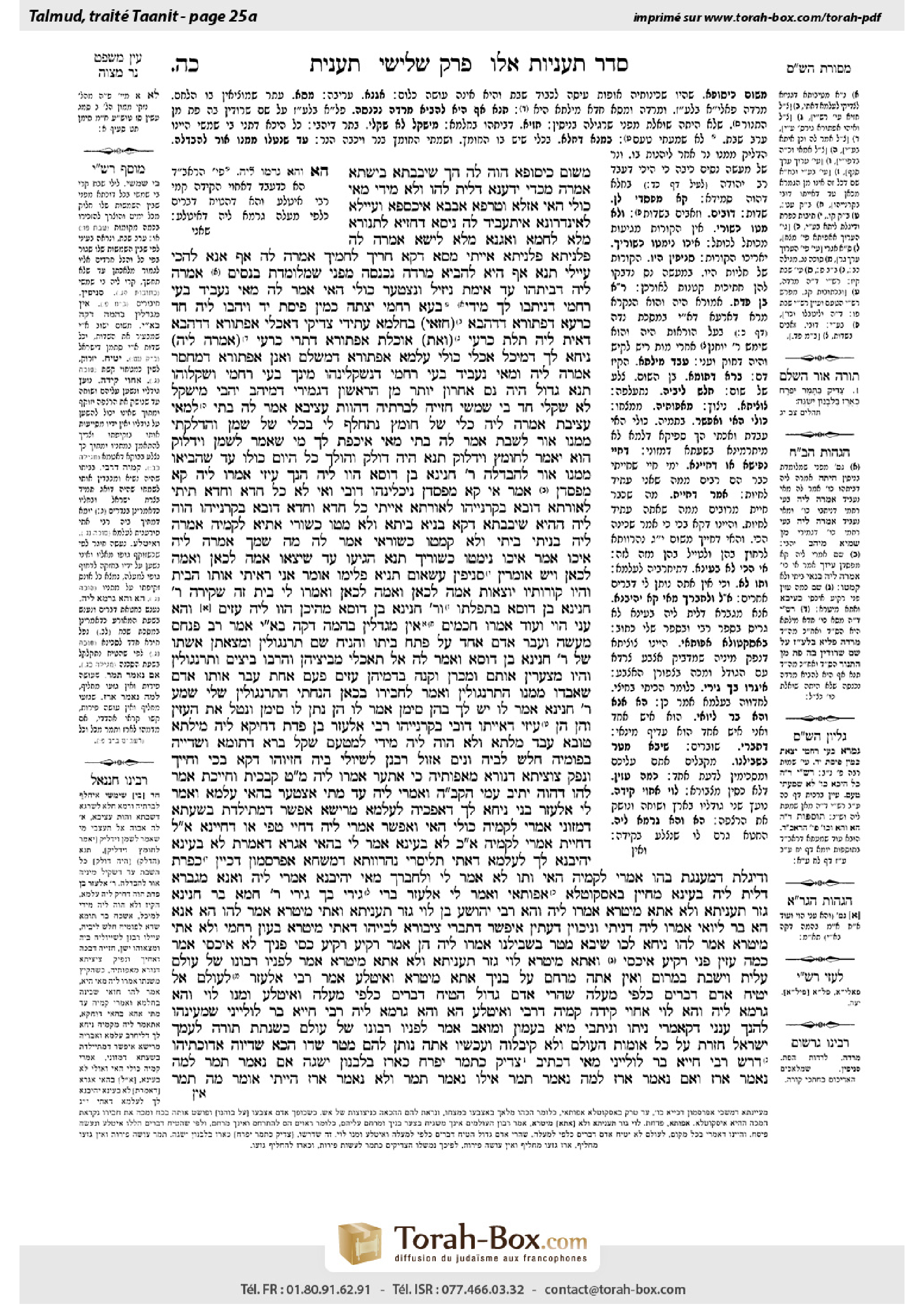
This page of Taanit includes the Aramaic text, an English translation and an AI-generated French translation, alongside the scan above.
תענית כ״ה א · Aramaic and Hebrew text
מִשּׁוּם כִּיסּוּפָא. הֲוָה לַהּ הָךְ שִׁיבָבְתָא בִּישְׁתָּא, אֲמַרָה: מִכְּדֵי יָדַעְנָא דְּלֵית לְהוּ וְלָא מִידֵּי, מַאי כּוּלֵּי הַאי? אֲזַלָא וּטְרַפָא אַבָּבָא, אִיכַּסְפָא וַעֲיַילָא לְאִינְדְּרוֹנָא,
אִיתְעֲבִיד לַהּ נִסָּא דְּחָזְיָא לְתַנּוּרָא מְלֵא לַחְמָא וְאַגָּנָא מְלֵא לֵישָׁא, אֲמַרָה לַהּ: פְּלָנִיתָא, פְּלָנִיתָא! אַיְיתַי מָסָא, דְּקָא חֲרִיךְ לַחְמִיךְ. אֲמַרָה לָהּ: אַף אֲנָא לְהָכִי עֲיַילִי. תָּנָא: אַף הִיא לְהָבִיא מַרְדֶּה נִכְנְסָה, מִפְּנֵי שֶׁמְּלוּמֶּדֶת בְּנִסִּים.
אֲמַרָה לֵיהּ דְּבֵיתְהוּ: עַד אֵימַת נֵיזִיל וְנִצְטַעַר כּוּלֵּי הַאי? אֲמַר לַהּ: מַאי נַעֲבֵיד? בְּעִי רַחֲמֵי דְּנִיתְּבוּ לָךְ מִידֵּי. בְּעָא רַחֲמֵי, יָצְתָה כְּמִין פִּיסַּת יָד וִיהַבוּ לֵיהּ חַד כַּרְעָא דְּפָתוּרָא דְּדַהֲבָא. חָזְיָא בְּחֶלְמָא, עֲתִידִי צַדִּיקֵי דְּאָכְלִי אַפָּתוּרָא דְּדַהֲבָא דְּאִית לֵיהּ תְּלָת כַּרְעֵי, וְאִיהוּ — אַפָּתוּרָא דִּתְרֵי כַּרְעֵי.
אֲמַר לַהּ: נִיחָא לָךְ דְּמֵיכָל אָכְלִי כּוּלֵּי עָלְמָא אַפָּתוּרָא דְּמַשְׁלַם וַאֲנַן אַפָּתוּרָא דִּמְחַסַּר. אֲמַרָה לֵיהּ: וּמַאי נַעֲבֵיד? בְּעִי רַחֲמֵי דְּנִשְׁקְלִינְהוּ מִינָּךְ. בָּעֵי רַחֲמֵי וְשַׁקְלוּהוּ. תָּנָא: גָּדוֹל הָיָה נֵס אַחֲרוֹן יוֹתֵר מִן הָרִאשׁוֹן. דִּגְמִירִי, דְּמֵיהָב יָהֲבִי מִישְׁקָל לָא שָׁקְלִי.
חַד בֵּי שִׁמְשֵׁי חַזְיַיהּ לְבַרְתֵּיהּ דַּהֲווֹת עֲצִיבָא, אֲמַר לַהּ: בִּתִּי אַמַּאי עֲצִיבַתְּ? אֲמַרָה לֵיהּ: כְּלִי שֶׁל חוֹמֶץ נִתְחַלֵּף לִי בִּכְלִי שֶׁל שֶׁמֶן וְהִדְלַקְתִּי מִמֶּנּוּ אוּר לְשַׁבָּת. אֲמַר לַהּ: בִּתִּי, מַאי אִכְפַּת לִךְ? מִי שֶׁאָמַר לַשֶּׁמֶן וְיִדְלוֹק, הוּא יֹאמַר לַחוֹמֶץ וְיִדְלוֹק. תָּנָא: הָיָה דּוֹלֵק וְהוֹלֵךְ כׇּל הַיּוֹם כּוּלּוֹ, עַד שֶׁהֵבִיאוּ מִמֶּנּוּ אוּר לְהַבְדָּלָה.
רַבִּי חֲנִינָא בֶּן דּוֹסָא הֲווֹ לֵיהּ הָנָךְ עִיזֵּי, אֲמַרוּ לֵיהּ: קָא מַפְסְדָן. אֲמַר: אִי קָא מַפְסְדָן — נֵיכְלִינְהוּ דּוּבֵּי, וְאִי לָא — כֹּל חֲדָא וַחֲדָא תַּיְתֵי לְאוּרְתָּא דּוּבָּא בְּקַרְנַיְיהוּ. לְאוּרְתָּא אַיְיתַי כֹּל חֲדָא וַחֲדָא דּוּבָּא בְּקַרְנַיְיהוּ.
הֲוָה לֵיהּ הָהִיא שִׁיבָבְתָא דְּקָא בָנְיָא בֵּיתָא וְלָא מְטוֹ כְּשׁוּרֵי. אָתְיָא לְקַמֵּיהּ, אֲמַרָה לֵיהּ: בְּנֵיתִי בֵּיתִי וְלָא קָמָטוּ כְּשׁוּרַאי. אֲמַר לַהּ: מָה שְׁמִךְ? אֲמַרָה לֵיהּ: אֵיכוּ. אָמַר: אֵיכוּ נִימְטוֹ כְּשׁוּרִיךְ.
תָּנָא: הִגִּיעוּ עַד שֶׁיָּצְאוּ אַמָּה לְכָאן וְאַמָּה לְכָאן. וְיֵשׁ אוֹמְרִין: סְנִיפִין עֲשָׂאוּם. תַּנְיָא, פְּלֵימוֹ אוֹמֵר: אֲנִי רָאִיתִי אוֹתוֹ הַבַּיִת, וְהָיוּ קוֹרוֹתָיו יוֹצְאוֹת אַמָּה לְכָאן וְאַמָּה לְכָאן, וְאָמְרוּ לִי: בַּיִת זֶה שֶׁקֵּירָה רַבִּי חֲנִינָא בֶּן דּוֹסָא בִּתְפִלָּתוֹ.
וְרַבִּי חֲנִינָא בֶּן דּוֹסָא מֵהֵיכָן הֲווֹ לֵיהּ עִזִּים? וְהָא עָנִי הֲוֵי! וְעוֹד, אָמְרוּ חֲכָמִים: אֵין מְגַדְּלִין בְּהֵמָה דַּקָּה בְּאֶרֶץ יִשְׂרָאֵל? אָמַר רַב פִּנְחָס: מַעֲשֶׂה וְעָבַר אָדָם אֶחָד עַל פֶּתַח בֵּיתוֹ וְהִנִּיחַ שָׁם תַּרְנְגוֹלִין, וּמְצָאָתַן אִשְׁתּוֹ שֶׁל רַבִּי חֲנִינָא בֶּן דּוֹסָא,
וְאָמַר לָהּ: אַל תֹּאכְלִי מִבֵּיצֵיהֶן. וְהִרְבּוּ בֵּיצִים וְתַרְנְגוֹלִין וְהָיוּ מְצַעֲרִין אוֹתָם, וּמְכָרָן וְקָנָה בִּדְמֵיהֶן עִזִּים. פַּעַם אַחַת עָבַר אוֹתוֹ אָדָם שֶׁאָבְדוּ מִמֶּנּוּ הַתַּרְנְגוֹלִין וְאָמַר לַחֲבֵירוֹ: בְּכָאן הִנַּחְתִּי הַתַּרְנְגוֹלִין שֶׁלִּי. שָׁמַע רַבִּי חֲנִינָא, אָמַר לוֹ: יֵשׁ לְךָ בָּהֶן סִימָן? אָמַר לוֹ: הֵן. נָתַן לוֹ סִימָן וְנָטַל אֶת הָעִיזִּין, וְהֵן הֵן עִיזֵּי דְּאַיְיתוֹ דּוּבֵּי בְּקַרְנַיְיהוּ.
רַבִּי אֶלְעָזָר בֶּן פְּדָת דְּחִיקָא לֵיהּ מִילְּתָא טוּבָא. עֲבַד מִלְּתָא וְלָא הֲוָה לֵיהּ מִידֵּי לְמִטְעַם, שְׁקַל בְּרָא דְתוּמָא וְשַׁדְיֵיהּ בְּפוּמֵּיהּ, חֲלַשׁ לִבֵּיהּ וְנִים. אֲזוּל רַבָּנַן לְשַׁיּוֹלֵי בֵּיהּ, חַזְיוּהּ דְּקָא בָכֵי וְחָיֵיךְ, וּנְפַק צוּצִיתָא דְנוּרָא מֵאַפּוּתֵיהּ.
כִּי אִתְּעַר, אֲמַרוּ לֵיהּ: מַאי טַעְמָא קָבָכֵית וְחָיְיכַתְּ? אֲמַר לְהוּ: דַּהֲוָה יָתֵיב עִמִּי הַקָּדוֹשׁ בָּרוּךְ הוּא, וַאֲמַרִי לֵיהּ: עַד מָתַי אֶצְטַעַר בְּהַאי עָלְמָא? וַאֲמַר לִי: אֶלְעָזָר בְּנִי, נִיחָא לָךְ דְּאֵפְכֵיהּ לְעָלְמָא מֵרֵישָׁא, אֶפְשָׁר דְּמִתְיַלְּדַתְּ בְּשַׁעְתָּא דִמְזוֹנֵי.
אֲמַרִי לְקַמֵּיהּ: כּוּלֵּי הַאי, וְאֶפְשָׁר? אֲמַרִי לֵיהּ: דַּחֲיַי טְפֵי אוֹ דְחָיֵינָא? אֲמַר לִי: דַּחֲיֵית. אֲמַרִי לְקַמֵּיהּ: אִם כֵּן, לָא בָּעֵינָא.
אֲמַר לִי: בְּהַאי אַגְרָא דַּאֲמַרְתְּ ״לָא בָּעֵינָא״ יָהֵיבְנָא לָךְ לְעָלְמָא דְּאָתֵי תְּלֵיסְרֵי נַהְרָווֹתָא דְמִשְׁחָא אֲפַרְסְמוֹן דָּכַיִין כִּפְרָת וְדִיגְלַת, דְּמִעַנְּגַתְּ בְּהוּ. אֲמַרִי לְקַמֵּיהּ: הַאי וְתוּ לָא? אֲמַר לִי: וּלְחַבְרָךְ מַאי יָהֵיבְנָא? אֲמַרִי לֵיהּ: וַאֲנָא מִגַּבְרָא דְּלֵית לֵיהּ בָּעֵינָא? מַחְיַין בְּאִסְקוּטְלָא אַפּוּתַאי, וַאֲמַר לִי: אֶלְעָזָר בְּרִי, גָּרוֹ בָּךְ גִּירַי.
רַבִּי חָמָא בַּר חֲנִינָא גְּזַר תַּעֲנִיתָא וְלָא אֲתָא מִיטְרָא. אֲמַרוּ לֵיהּ: וְהָא רַבִּי יְהוֹשֻׁעַ בֶּן לֵוִי גָּזַר תַּעֲנִיתָא וְאָתֵי מִיטְרָא! אֲמַר לְהוּ: הָא אֲנָא, הָא בַּר לֵיוַאי. אֲמַרוּ לֵיהּ: דְּנֵיתֵי וְנִיכַוֵּין דַּעְתִּין, אֶפְשָׁר דְּתָבְרִי צִיבּוּרָא לִבַּיְיהוּ דְּאָתֵי מִיטְרָא. בְּעוֹן רַחֲמֵי וְלָא אָתֵי מִיטְרָא.
אֲמַר לְהוּ: נִיחָא לְכוּ שֶׁיָּבֹא מָטָר בִּשְׁבִילֵנוּ? אֲמַרוּ לֵיהּ: הֵן. אָמַר: רָקִיעַ רָקִיעַ כַּסֵּי פָּנֶיךָ! לָא אִיכַּסִּי. אֲמַר: כַּמָּה עַזִּין פְּנֵי רָקִיעַ, אִיכַּסִּי וַאֲתָא מִיטְרָא.
לֵוִי גְּזַר תַּעֲנִיתָא וְלָא אֲתָא מִיטְרָא. אָמַר לְפָנָיו: רִבּוֹנוֹ שֶׁל עוֹלָם! עָלִיתָ וְיָשַׁבְתָּ בַּמָּרוֹם וְאֵין אַתָּה מְרַחֵם עַל בָּנֶיךָ. אֲתָא מִיטְרָא, וְאִיטְּלַע. אָמַר רַבִּי אֶלְעָזָר: לְעוֹלָם אַל יָטִיחַ אָדָם דְּבָרִים כְּלַפֵּי מַעְלָה, שֶׁהֲרֵי אָדָם גָּדוֹל הֵטִיחַ דְּבָרִים כְּלַפֵּי מַעְלָה וְאִיטְּלַע, וּמַנּוּ — לֵוִי.
הָא גְּרַמָא לֵיהּ? וְהָא לֵוִי אַחְוִי קִידָּה קַמֵּיהּ דְּרַבִּי, וְאִיטְּלַע! הָא וְהָא גְּרַמָא לֵיהּ.
רַבִּי חִיָּיא בַּר לוּלְיָינִי שַׁמְעִינְהוּ לְהָנָךְ עֲנָנֵי דְּקָאָמְרִי: נֵיתוֹ וְנִישְׁדֵּי מַיָּא בְּעַמּוֹן וּמוֹאָב. אָמַר לְפָנָיו: רִבּוֹנוֹ שֶׁל עוֹלָם! כְּשֶׁנָּתַתָּ תּוֹרָה לְעַמְּךָ יִשְׂרָאֵל חִזַּרְתָּ עַל כׇּל אוּמּוֹת הָעוֹלָם וְלֹא קִיבְּלוּהָ, וְעַכְשָׁיו אַתָּה נוֹתֵן לָהֶם מָטָר? שְׁדוֹ הָכָא. שַׁדְיוּהּ אַדּוּכְתַּיְהוּ.
דָּרֵשׁ רַבִּי חִיָּיא בַּר לוּלְיָינִי, מַאי דִּכְתִיב: ״צַדִּיק כַּתָּמָר יִפְרָח כְּאֶרֶז בַּלְּבָנוֹן יִשְׂגֶּה״, אִם נֶאֱמַר תָּמָר לָמָּה נֶאֱמַר אֶרֶז, וְאִם נֶאֱמַר אֶרֶז לָמָּה נֶאֱמַר תָּמָר? אִילּוּ נֶאֱמַר תָּמָר וְלֹא נֶאֱמַר אֶרֶז, הָיִיתִי אוֹמֵר: מָה תָּמָר
Taanit 25a · English translation
due to embarrassment, to make it appear that she was baking, despite the fact that there was no bread in her house. She had a certain evil neighbor who said to herself: Now, I know that they have nothing. What, then, is all this smoke? She went and knocked on the door to find out what was in the oven. Rabbi Ḥanina ben Dosa’s wife was embarrassed, and she ascended to an inner room [inderona].
A miracle was performed for Rabbi Ḥanina ben Dosa’s wife, as her neighbor saw the oven filled with bread and the kneading basin filled with dough. She said to Rabbi Ḥanina’s wife, calling her by name: So-and-so, so-and-so, bring a shovel, as your bread is burning. She said to her neighbor: I too went inside for that very purpose. A tanna taught: She too had entered the inner room to bring a shovel, because she was accustomed to miracles and anticipated that one would occur to spare her embarrassment.
The Gemara further relates: Rabbi Ḥanina’s wife said to him: Until when will we continue to suffer this poverty? He said to her: What can we do? She responded: Pray for mercy that something will be given to you from Heaven. He prayed for mercy and something like the palm of a hand emerged and gave him one leg of a golden table. That night, his wife saw in a dream that in the future, i.e., in the World-to-Come, the righteous will eat at a golden table that has three legs, but she will be eating on a table that has two legs.
When she told her husband this story, he said to her: Are you content that everyone will eat at a complete table and we will eat at a defective table? She said to him: But what can we do? Pray for mercy, that the leg of the golden table should be taken from you. He prayed for mercy, and it was taken from him. A tanna taught in a baraita: The last miracle was greater than the first, as it is learned as a tradition that Heaven gives but does not take back.
The Gemara relates that one Shabbat evening, Rabbi Ḥanina ben Dosa saw that his daughter was sad. He said to her: My daughter, why are you sad? She said to him: I confused a vessel of vinegar for a vessel of oil and I lit the Shabbat lamp with vinegar. Soon the lamp will be extinguished and we will be left in the dark. He said to her: My daughter, what are you concerned about? He Who said to the oil that it should burn can say to the vinegar that it should burn. A tanna taught: That lamp burned continuously the entire day, until they brought from it light for havdala.
Rabbi Ḥanina ben Dosa had some goats. His neighbors said to him: Your goats are damaging our property by eating in our fields. He said to them: If they are causing damage, let them be eaten by bears. But if they are not eating your property, let each of them, this evening, bring a bear impaled between its horns. That evening, each one brought in a bear impaled between its horns.
Rabbi Ḥanina ben Dosa had a certain neighbor who was building a house, but the ceiling beams were not long enough to reach from one wall to the other. She came before Rabbi Ḥanina ben Dosa and said to him: I built my house, but my ceiling beams do not reach the walls. He said to her: What is your name? She said to him: My name is Ikku. He said: If so [ikku], may your beams reach your walls.
A tanna taught: The beams were lengthened to such an extent that they not only reached the walls, but they continued until they jutted out a cubit from this side and a cubit from that side. And some say that they extended with segments [senifin], adding new walls at both ends of the beams. It is taught in a baraita that the Sage Palaimo says: I saw that house, and its beams jutted out a cubit on this side and a cubit on that side. And they said to me: This is the house that Rabbi Ḥanina ben Dosa roofed by means of his prayer.
The Gemara asks a question about one of the details of this story. And Rabbi Ḥanina ben Dosa, from where did he have goats? Wasn’t he poor, as stated above? And furthermore, the Sages have said: One may not raise small, domesticated animals in Eretz Yisrael, as they destroy the fields and property of others. How, then, could Rabbi Ḥanina ben Dosa raise goats? Rav Pineḥas said that this is how it came to pass: An incident occurred in which a certain man passed by the entrance of Rabbi Ḥanina’s house and left chickens there. And Rabbi Ḥanina ben Dosa’s wife found them and cared for them.
And Rabbi Ḥanina said her: Do not eat of their eggs, as they are not ours. And the chickens laid many eggs, and chickens hatched from the eggs. And as the noise and mess of the chickens were distressing them, they sold them and bought goats with their proceeds. Once that same man who lost the chickens passed by and said to his companion: Here is where I left my chickens. Rabbi Ḥanina heard this and said to him: Do you have a sign by which to identify them? He said to him: Yes. He gave him the sign and took the goats. The Gemara concludes: And these are the very goats that brought bears impaled between their horns.
§ The Gemara relates more stories of desperately poor righteous individuals. Rabbi Elazar ben Pedat was hard-pressed for money. Once an act of bloodletting was performed on him, but he did not have anything to taste afterward. He took a clove of garlic and put it in his mouth. His heart became weak and he fell asleep. The Sages came to inquire about his welfare. They saw him weeping and laughing, and a ray of light was shining from his forehead.
When he awoke they said to him: What is the reason that you were laughing and crying? He said to them: The reason is that in my dream the Holy One, Blessed be He, was sitting with me, and I said to Him: Until when will I suffer such poverty in this world? And He said to me: Elazar, My son, is it more convenient for you that I return the world to its very beginning? Perhaps you will be born in an hour of sustenance and not be poor.
I said before Him: You suggest doing all this, to return the world to its beginning, and even then is it only a possibility that things will be different, not a certainty? I said to Him: Are the years that I have already lived more numerous, or are that I will live more numerous? He said to me: Those years that you have lived are greater. I said before Him: If so, I do not want You to recreate the world for the sake of a brief few years.
He said to me: As a reward for saying: I do not want, I will give you in the World-to-Come thirteen rivers of pure balsam oil as large as the Euphrates and the Tigris for you to enjoy. I said before Him: This and no more? He said to me: But if I give you more, what will I give to your colleagues? I said to Him: And do I request this from a person, who does not have enough? You are omnipotent. He playfully snapped His finger [askutla] on my forehead and said to me: Elazar, my son, My arrows I cast upon you, My arrows. This touch caused the ray of light to shine from his forehead.
The Gemara returns to the topic of fasting for rain. Rabbi Ḥama bar Ḥanina decreed a fast but rain did not come. They said to him: Didn’t Rabbi Yehoshua ben Levi decree a fast and rain came? He said to them: This is I; this is a son of a Levite, i.e., we are two different people of unequal stature. They said to him: Let us come and focus our minds. Perhaps the hearts of the members of the community will break and rain will come. They prayed for mercy, but rain did not come.
Rabbi Ḥama bar Ḥanina said to them: Are you content that rain should come on our account, and through our merit? They said to him: Yes. He said: Skies, skies, cover your face with clouds. The sky was not covered with clouds. He said in rebuke: How impudent is the face of the sky, to ignore me. The sky became covered with clouds and rain came.
The Gemara relates a similar story. Levi decreed a fast but rain did not come. He said before God: Master of the Universe, You have ascended and sat up high, and You do not have mercy upon Your children. Rain came, but as a punishment for his harsh statement toward God, Levi became lame. Consequently, Rav Elazar said: A person should never cast harsh statements toward God on High, as a great person cast statements toward God on High, and he became lame. And who was this individual? Levi.
The Gemara asks: And did this comment of Levi’s cause him to become lame? But it is stated that Levi demonstrated kidda, a particular type of bowing on one’s face, performed by the High Priest, before Rabbi Yehuda HaNasi, and he became lame as a result (see Megilla 22b). The Gemara explains: Both this and that caused his lameness. As a punishment for acting improperly, he suffered an injury while he was attempting a difficult physical feat and was vulnerable.
The Gemara relates: Rabbi Ḥiyya bar Lulyani heard these clouds saying to one another, let us go and bring water for Ammon and Moab in Transjordan. He said before God: Master of the Universe, when You gave Your Torah to Your nation Israel, You approached all the nations of the world to see if they would accept the Torah, and they did not accept it. And yet now You are giving them rain. Throw the water here. The clouds threw the rain in their place in Eretz Yisrael.
Since the Gemara has mentioned Rabbi Ḥiyya bar Lulyani, it cites a statement in his name. Rabbi Ḥiyya bar Lulyani taught: What is the meaning of that which is written: “The righteous shall flourish like the palm tree; he shall grow like a cedar in Lebanon” (Psalms 92:13)? If it is stated “palm tree” why does it state “cedar,” and if it is stated “cedar” why does it state “palm tree”? What is added by this double comparison? He explains: Were it stated “palm tree” and were it not stated “cedar,” I would say that just as in the case of a palm tree,
Taanit 25a · Traduction française (IA)
par embarras, pour donner l’impression qu’elle faisait cuire du pain, alors qu’il n’y avait pas de pain chez elle. Elle avait une voisine malveillante qui se disait : « À présent, je sais qu’ils n’ont rien. Alors, d’où vient toute cette fumée ? » Elle alla frapper à la porte pour découvrir ce qu’il y avait dans le four. La femme de Rabbi Ḥanina ben Dosa fut embarrassée et se réfugia dans une pièce intérieure [inderona].
Un miracle se produisit pour la femme de Rabbi Ḥanina ben Dosa : sa voisine vit le four rempli de pain et le pétrin rempli de pâte. Elle dit à la femme de Rabbi Ḥanina, en l’appelant par son nom : « Untelle, untelle, apporte une pelle, ton pain est en train de brûler ! » Elle répondit à sa voisine : « Moi aussi, je suis entrée précisément pour cela. » Un tanna enseigna : Elle était elle aussi entrée dans la pièce intérieure pour apporter une pelle, car elle était habituée aux miracles et s’attendait à ce qu’un miracle se produise pour lui épargner cet embarras.
La Guemara rapporte encore : la femme de Rabbi Ḥanina lui dit : « Jusqu’à quand continuerons-nous à souffrir de cette pauvreté ? » Il lui répondit : « Que pouvons-nous faire ? » Elle répliqua : « Prie pour obtenir la miséricorde, afin que quelque chose nous soit accordé du Ciel. » Il pria pour obtenir la miséricorde, et quelque chose ressemblant à la paume d’une main apparut et lui donna un pied d’une table en or. Cette nuit-là, sa femme rêva qu’à l’avenir, c’est-à-dire dans le monde à venir, les justes mangeraient à une table en or à trois pieds, tandis qu’elle mangerait à une table à deux pieds.
Lorsqu’elle raconta cette histoire à son mari, il lui dit : « Es-tu satisfaite que tout le monde mange à une table complète et que nous mangions à une table incomplète ? » Elle lui répondit : « Mais que pouvons-nous faire ? Prie pour que le pied de la table en or te soit retiré. » Il pria pour obtenir la miséricorde, et le pied lui fut retiré. Un tanna enseigna dans une baraïta : le dernier miracle fut plus grand que le premier, car la tradition enseigne que le Ciel donne, mais ne reprend pas.
La Guemara rapporte qu’un soir de Chabbat, Rabbi Ḥanina ben Dosa vit que sa fille était triste. Il lui demanda : « Ma fille, pourquoi es-tu triste ? » Elle lui répondit : « J’ai confondu un récipient de vinaigre avec un récipient d’huile et j’ai allumé la lampe de Chabbat avec du vinaigre. Bientôt, la lampe va s’éteindre et nous serons plongés dans l’obscurité. » Il lui dit : « Ma fille, qu’as-tu à craindre ? Celui qui a dit à l’huile de brûler peut dire au vinaigre de brûler. » Un tanna enseigna : cette lampe brûla sans interruption toute la journée, jusqu’à ce qu’on en tire de la lumière pour la havdala.
Rabbi Ḥanina ben Dosa possédait quelques chèvres. Ses voisins lui dirent : « Tes chèvres causent des dégâts à nos biens en broutant dans nos champs. » Il leur répondit : « Si elles causent des dégâts, que les ours les dévorent. Mais si elles ne s’en prennent pas à vos biens, que chacune d’elles rapporte ce soir un ours empalé entre ses cornes. » Ce soir-là, chacune rapporta un ours empalé entre ses cornes.
Une certaine voisine de Rabbi Ḥanina ben Dosa faisait construire une maison, mais les poutres du plafond n’étaient pas assez longues pour aller d’un mur à l’autre. Elle vint trouver Rabbi Ḥanina ben Dosa et lui dit : « J’ai construit ma maison, mais mes poutres n’atteignent pas les murs. » Il lui demanda : « Quel est ton nom ? » Elle lui répondit : « Je m’appelle Ikku. » Il dit : « Dans ce cas [ikku], que tes poutres atteignent tes murs. »
Un tanna enseigna : les poutres s’allongèrent au point non seulement d’atteindre les murs, mais aussi de dépasser d’une coudée d’un côté et d’une coudée de l’autre. Certains disent qu’elles s’étendirent au moyen de segments [senifin], qui ajoutèrent de nouveaux murs aux deux extrémités des poutres. Une baraïta enseigne que le Sage Palaimo dit : « J’ai vu cette maison, et ses poutres dépassaient d’une coudée d’un côté et d’une coudée de l’autre. On m’a dit : “C’est la maison que Rabbi Ḥanina ben Dosa a couverte d’un toit grâce à sa prière.” »
La Guemara pose une question sur l’un des détails de cette histoire. Et d’où Rabbi Ḥanina ben Dosa tenait-il des chèvres ? N’était-il pas pauvre, comme il a été dit plus haut ? En outre, les Sages ont dit : on ne doit pas élever de petits animaux domestiques en terre d’Israël, car ils ravagent les champs et les biens d’autrui. Comment Rabbi Ḥanina ben Dosa pouvait-il donc élever des chèvres ? Rav Pineḥas dit que voici comment cela arriva : un homme passa un jour devant l’entrée de la maison de Rabbi Ḥanina et y laissa des poules. La femme de Rabbi Ḥanina ben Dosa les trouva et en prit soin.
Et Rabbi Ḥanina lui dit : « Ne mange pas leurs œufs, car ils ne nous appartiennent pas. » Les poules pondirent de nombreux œufs, et des poussins en sortirent. Comme le bruit et le désordre causés par les poules les importunaient, ils les vendirent et achetèrent des chèvres avec l’argent obtenu. Un jour, le même homme qui avait perdu ses poules passa par là et dit à son compagnon : « C’est ici que j’ai laissé mes poules. » Rabbi Ḥanina l’entendit et lui demanda : « As-tu un signe permettant de les reconnaître ? » Il répondit : « Oui. » Il lui donna le signe et reprit les chèvres. La Guemara conclut : ce sont précisément ces chèvres qui rapportèrent des ours empalés entre leurs cornes.
§ La Guemara rapporte d’autres histoires de justes plongés dans une extrême pauvreté. Rabbi Elazar ben Pedat était dans le besoin. Un jour, on lui fit une saignée, mais il n’avait rien à manger ensuite. Il prit une gousse d’ail et la mit dans sa bouche. Son cœur s’affaiblit et il s’endormit. Les Sages vinrent prendre de ses nouvelles. Ils le virent pleurer et rire, tandis qu’un rayon de lumière brillait sur son front.
Lorsqu’il se réveilla, ils lui demandèrent : « Pourquoi pleurais-tu et riais-tu ? » Il leur répondit : « Parce que, dans mon rêve, le Saint, béni soit-Il, était assis avec moi, et je lui ai dit : “Jusqu’à quand souffrirai-je d’une telle pauvreté dans ce monde ?” Il m’a répondu : “Elazar, mon fils, préférerais-tu que je ramène le monde à son tout début ? Peut-être naîtras-tu à une époque d’abondance et ne seras-tu pas pauvre.” »
Je lui ai répondu : « Tu proposes de faire tout cela, de ramener le monde à son commencement, et même alors, il n’est pas certain que les choses soient différentes : ce n’est qu’une possibilité. » Je lui ai demandé : « Les années que j’ai déjà vécues sont-elles plus nombreuses que celles qu’il me reste à vivre ? » Il m’a répondu : « Les années que tu as vécues sont plus nombreuses. » Je lui ai dit : « Dans ce cas, je ne veux pas que Tu recrées le monde pour quelques brèves années. »
Il m’a dit : « En récompense d’avoir dit : “Je ne veux pas”, je te donnerai dans le monde à venir treize fleuves d’huile de baume pure, aussi grands que l’Euphrate et le Tigre, dont tu jouiras. » Je lui ai répondu : « Rien que cela ? » Il m’a dit : « Mais si je t’en donne davantage, que donnerai-je à tes collègues ? » Je lui ai dit : « Est-ce à un homme, qui n’a pas assez, que je demande cela ? Toi, Tu es tout-puissant. » Il claqua en plaisantant des doigts [askutla] sur mon front et me dit : « Elazar, mon fils, mes flèches, ce sont mes flèches que je lance sur toi. » Ce contact fit briller le rayon de lumière sur son front.
La Guemara revient au sujet des jeûnes pour la pluie. Rabbi Ḥama bar Ḥanina décréta un jeûne, mais la pluie ne vint pas. On lui dit : « Rabbi Yehoshua ben Levi n’a-t-il pas décrété un jeûne et obtenu la pluie ? » Il leur répondit : « Moi, c’est moi ; lui, c’est un fils de Lévi », c’est-à-dire que nous sommes deux personnes différentes, de stature inégale. Ils lui dirent : « Venez, concentrons-nous. Peut-être le cœur des membres de la communauté se brisera-t-il et la pluie viendra-t-elle. » Ils prièrent pour obtenir la miséricorde, mais la pluie ne vint pas.
Rabbi Ḥama bar Ḥanina leur dit : « Acceptez-vous que la pluie vienne grâce à nous et à notre mérite ? » Ils lui répondirent : « Oui. » Il dit : « Cieux, cieux, couvrez votre visage de nuages ! » Le ciel ne se couvrit pas de nuages. Il dit sur un ton de reproche : « Comme le ciel a le front insolent, puisqu’il m’ignore ! » Le ciel se couvrit de nuages et la pluie vint.
La Guemara rapporte une histoire semblable. Levi décréta un jeûne, mais la pluie ne vint pas. Il dit devant Dieu : « Maître de l’univers, Tu es monté et Tu sièges dans les hauteurs, et Tu n’as pas pitié de Tes enfants. » La pluie vint, mais, en punition de ses paroles sévères envers Dieu, Levi devint boiteux. Rav Elazar dit donc : « Qu’une personne ne profère jamais de paroles sévères envers Dieu là-haut, car un grand homme a adressé de telles paroles à Dieu là-haut, et il est devenu boiteux. » Et qui était cet homme ? Levi.
La Guemara demande : est-ce cette remarque de Levi qui le rendit boiteux ? Pourtant, il est dit que Levi exécuta la kidda, une forme particulière de prosternation face contre terre, pratiquée par le grand prêtre, devant Rabbi Yehuda HaNasi, et qu’il devint boiteux à la suite de cela (voir Méguila 22b). La Guemara explique : ces deux faits ont contribué à sa boiterie. En punition de s’être mal conduit, il se blessa en tentant un exercice physique difficile, alors qu’il était vulnérable.
La Guemara rapporte : Rabbi Ḥiyya bar Lulyani entendit ces nuages se dire les uns aux autres : « Allons apporter de l’eau à Ammon et à Moab, en Transjordanie. » Il dit devant Dieu : « Maître de l’univers, lorsque Tu as donné Ta Torah à Ton peuple Israël, Tu t’es approché de toutes les nations du monde pour voir si elles l’accepteraient, et elles ne l’ont pas acceptée. Et pourtant, maintenant, Tu leur donnes la pluie. Jette l’eau ici ! » Les nuages déversèrent la pluie à leur place, en terre d’Israël.
Puisque la Guemara a mentionné Rabbi Ḥiyya bar Lulyani, elle cite un enseignement en son nom. Rabbi Ḥiyya bar Lulyani enseigna : que signifie ce qui est écrit : « Le juste fleurira comme le palmier, il croîtra comme le cèdre du Liban » (Psaumes 92, 13) ? S’il est écrit « palmier », pourquoi est-il écrit « cèdre » ? Et s’il est écrit « cèdre », pourquoi est-il écrit « palmier » ? Qu’ajoute cette double comparaison ? Il explique : s’il était écrit « palmier » et qu’il n’était pas écrit « cèdre », je dirais que, de même que dans le cas d’un palmier,
Traduction française générée par IA à partir de l’édition anglaise de Sefaria. Vérifie toujours un passage avec le texte source.
Text from Sefaria: William Davidson Edition - Vocalized Aramaic (CC BY NC); William Davidson Edition - English (CC BY NC).