Taanit 24b: Talmud study for Daf Yomi
Daf Yomi is the daily study of one Talmud folio. Explore 37 tractates with scans, Hebrew text, Sefaria English and AI-generated French translations where annotated.
Passage selection and English or AI-generated French translation are available where the scan has annotations. Daf Study is independent of Torah-Box and Sefaria.
Browse Taanit · תענית · All tractatesTaanit 24b text and translations
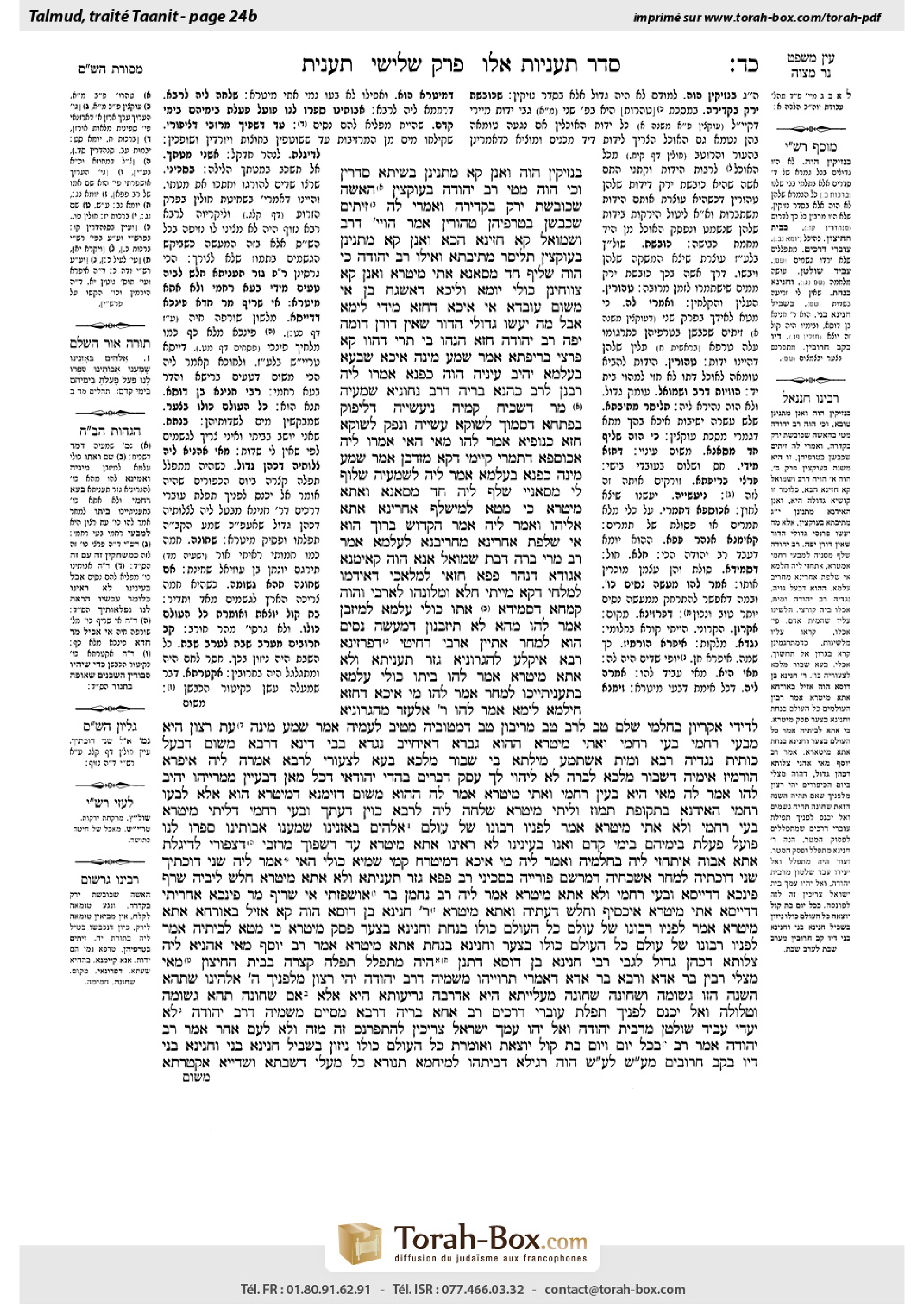
This page of Taanit includes the Aramaic text, an English translation and an AI-generated French translation, alongside the scan above.
תענית כ״ד ב · Aramaic and Hebrew text
בִּנְזִיקִין הֲוָה, וַאֲנַן קָא מַתְנֵינַן בְּשִׁיתָּא סִדְרִין. וְכִי הֲוָה מָטֵי רַב יְהוּדָה בְּעוּקְצִין ״הָאִשָּׁה שֶׁכּוֹבֶשֶׁת יָרָק בִּקְדֵירָה״, וְאָמְרִי לַהּ: ״זֵיתִים שֶׁכְּבָשָׁן בְּטַרְפֵיהֶן טְהוֹרִין״, אֲמַר: הֲוָייוֹת דְּרַב וּשְׁמוּאֵל קָא חָזֵינָא הָכָא,
וַאֲנַן קָא מַתְנֵינַן בְּעוּקְצִין תְּלֵיסַר מְתִיבָתָא. וְאִילּוּ רַב יְהוּדָה, כִּי הֲוָה שָׁלֵיף חַד מְסָאנָא — אָתֵי מִיטְרָא, וַאֲנַן קָא צָוְוחִינַן כּוּלֵּי יוֹמָא וְלֵיכָּא דְּאַשְׁגַּח בַּן. אִי מִשּׁוּם עוֹבָדָא, אִי אִיכָּא דַּחֲזָא מִידֵּי — לֵימָא, אֲבָל מָה יַעֲשׂוּ גְּדוֹלֵי הַדּוֹר שֶׁאֵין דּוֹרָן דּוֹמֶה יָפֶה.
רַב יְהוּדָה חֲזָא הָנְהוּ בֵּי תְרֵי דַּהֲווֹ קָא פָּרְצִי בְּרִיפְתָּא, אֲמַר: שְׁמַע מִינַּהּ אִיכָּא שִׂבְעָא בְּעָלְמָא, יְהֵיב עֵינֵיהּ — הֲוָה כַּפְנָא. אֲמַרוּ לֵיהּ רַבָּנַן לְרַב כָּהֲנָא בְּרֵיהּ דְּרַב נְחוּנְיָא שַׁמָּעֵיהּ: מָר דִּשְׁכִיחַ קַמֵּיהּ, נִיעַשְּׂיֵיהּ דְּלִיפּוֹק בְּפִתְחָא דְּסָמוּךְ לְשׁוּקָא. עַשְּׂיֵיהּ וּנְפַק לְשׁוּקָא, חֲזָא כִּנּוּפְיָא,
אֲמַר לְהוּ: מַאי הַאי? אֲמַרוּ לֵיהּ: אַכּוּסְפָּא דְתַמְרֵי קָיְימִי דְּקָא מִזְדַּבַּן. אֲמַר: שְׁמַע מִינַּהּ כַּפְנָא בְּעָלְמָא, אֲמַר לֵיהּ לְשַׁמָּעֵיהּ: שְׁלוֹף לִי מְסָאנַיי. שְׁלַף לֵיהּ חַד מְסָאנָא וַאֲתָא מִיטְרָא. כִּי מְטָא לְמִישְׁלַף אַחֲרִינָא, אֲתָא אֵלִיָּהוּ וַאֲמַר לֵיהּ: אֲמַר הַקָּדוֹשׁ בָּרוּךְ הוּא: אִי שָׁלְפַתְּ אַחֲרִינָא — מַחְרֵיבְנָא לְעָלְמָא.
אֲמַר רַב מָרִי בְּרַהּ דְּבַת שְׁמוּאֵל: אֲנָא הֲוָה קָאֵימְנָא אַגּוּדָּא דִּנְהַר פָּפָּא, חֲזַאי לְמַלְאֲכֵי דְּאִידְּמוֹ לְמַלָּחֵי דְּקָא מַיְיתִי חָלָא וּמְלוֹנְהוּ לְאַרְבֵּי, וַהֲוָה קִמְחָא דִּסְמִידָא. אֲתוֹ כּוּלֵּי עָלְמָא לְמִיזְבַּן, אָמֵינָא לְהוּ: מֵהָא לָא תִּיזְבְּנוּן דְּמַעֲשֵׂה נִסִּים הוּא, לִמְחַר אָתְיָין אַרְבֵי דְּחִיטֵּי דְּפַרְזִינָא.
רָבָא אִיקְּלַע לְהַגְרוֹנְיָא, גְּזַר תַּעֲנִיתָא וְלָא אֲתָא מִיטְרָא. אֲמַר לְהוּ: בִּיתוּ כּוּלֵּי עָלְמָא בְּתַעֲנִיתַיְיכוּ. לִמְחַר אֲמַר לְהוּ: מִי אִיכָּא דַּחֲזָא חֶילְמָא — לֵימָא. אֲמַר לְהוּ רַבִּי אֶלְעָזָר מֵהַגְרוֹנְיָא, לְדִידִי אַקְרְיוּן בְּחֶלְמַי: שְׁלָם טָב לְרַב טָב מֵרִיבּוֹן טָב, דְּמִטּוּבֵיהּ מֵטֵיב לְעַמֵּיהּ. אֲמַר: שְׁמַע מִינַּהּ עֵת רָצוֹן הִיא (מִבְעֵי רַחֲמֵי). בְּעוֹ רַחֲמֵי וְאָתֵי מִיטְרָא.
הָהוּא גַּבְרָא דְּאִיחַיַּיב נְגָדָא בְּבֵי דִינָא דְּרָבָא מִשּׁוּם דִּבְעַל נׇכְרִית. נַגְּדֵיהּ רָבָא וּמִית. אִשְׁתְּמַע מִילְּתָא בֵּי שַׁבּוּר מַלְכָּא, בְּעָא לְצַעוֹרֵי לְרָבָא. אֲמַרָה לֵיהּ אִיפְרָא הוֹרְמִיז אִימֵּיהּ דְּשַׁבּוּר מַלְכָּא לִבְרַהּ: לָא לֶיהֱוֵי לָךְ עֵסֶק דְּבָרִים בַּהֲדֵי יְהוּדָאֵי, דְּכֹל מָאן דְּבָעַיִין מִמָּרַיְיהוּ יָהֵיב לְהוּ.
אֲמַר לַהּ: מַאי הִיא? בָּעַיִן רַחֲמֵי וְאָתֵי מִיטְרָא. אֲמַר לַהּ: הַהוּא מִשּׁוּם דְּזִימְנָא דְּמִיטְרָא הוּא. אֶלָּא לִבְעוֹ רַחֲמֵי הָאִידָּנָא בִּתְקוּפַת תַּמּוּז, וְלֵיתֵי מִיטְרָא. שְׁלַחָה לֵיהּ לְרָבָא: כַּוֵּין דַּעְתָּךְ וּבְעִי רַחֲמֵי דְּלֵיתֵי מִיטְרָא. בָּעֵי רַחֲמֵי וְלָא אָתֵי מִיטְרָא.
אָמַר לְפָנָיו: רִבּוֹנוֹ שֶׁל עוֹלָם! ״אֱלֹהִים בְּאׇזְנֵינוּ שָׁמַעְנוּ אֲבוֹתֵינוּ סִפְּרוּ לָנוּ פֹּעַל פָּעַלְתָּ בִימֵיהֶם בִּימֵי קֶדֶם״, וְאָנוּ בְּעֵינֵינוּ לֹא רָאִינוּ! אֲתָא מִיטְרָא עַד דִּשְׁפוּךְ מַרְזְבֵי דְמָחוֹזָא לְדִיגְלַת. אֲתָא אֲבוּהּ אִיתְחֲזִי לֵיהּ בְּחֶלְמֵיהּ וַאֲמַר לֵיהּ: מִי אִיכָּא דְּמַיטְרַח קַמֵּי שְׁמַיָּא כּוּלֵּי הַאי? אֲמַר לֵיהּ: שַׁנִּי דּוּכְתָּיךְ. שַׁנִּי דּוּכְתֵּיהּ, לִמְחַר אַשְׁכְּחֵיהּ דְּמִרְשַׁם פּוּרְיֵיהּ בְּסַכִּינֵי.
רַב פָּפָּא גְּזַר תַּעֲנִיתָא וְלָא אֲתָא מִיטְרָא. חֲלַשׁ לִיבֵּיהּ, שְׂרַף פִּינְכָּא דְּדַיְיסָא וּבָעֵי רַחֲמֵי וְלָא אֲתָא מִיטְרָא. אֲמַר לֵיהּ רַב נַחְמָן בַּר אוּשְׁפַּזְתִּי: אִי שָׂרֵיף מָר פִּינְכָּא אַחֲרִיתִי דְּדַיְיסָא אָתֵי מִיטְרָא. אִיכְּסִיף, וַחֲלַשׁ דַּעְתֵּיהּ, וַאֲתָא מִיטְרָא.
רַבִּי חֲנִינָא בֶּן דּוֹסָא הֲוָה קָא אָזֵיל בְּאוֹרְחָא, אֲתָא מִיטְרָא. אָמַר לְפָנָיו: רִבּוֹנוֹ שֶׁל עוֹלָם, כׇּל הָעוֹלָם כּוּלּוֹ בְּנַחַת, וַחֲנִינָא בְּצַעַר! פְּסַק מִיטְרָא. כִּי מְטָא לְבֵיתֵיהּ, אָמַר לְפָנָיו: רִבּוֹנוֹ שֶׁל עוֹלָם, כׇּל הָעוֹלָם כּוּלּוֹ בְּצַעַר וַחֲנִינָא בְּנַחַת? אֲתָא מִיטְרָא.
אָמַר רַב יוֹסֵף: מַאי אַהְנְיָא לֵיהּ צְלוֹתָא דְּכֹהֵן גָּדוֹל לְגַבֵּי רַבִּי חֲנִינָא בֶּן דּוֹסָא. דִּתְנַן: הָיָה מִתְפַּלֵּל תְּפִלָּה קְצָרָה בַּבַּיִת הַחִיצוֹן. מַאי מְצַלֵּי? רָבִין בַּר אַדָּא וְרָבָא בַּר אַדָּא דְּאָמְרִי תַּרְוַיְיהוּ מִשְּׁמֵיהּ דְּרַב יְהוּדָה: יְהִי רָצוֹן מִלְּפָנֶיךָ ה׳ אֱלֹהֵינוּ שֶׁתְּהֵא הַשָּׁנָה הַזּוֹ גְּשׁוּמָה וּשְׁחוּנָה. שְׁחוּנָה מְעַלַּיְיתָא הִיא? אַדְּרַבָּה, גְּרִיעוּתָא הִיא!
אֶלָּא: אִם שְׁחוּנָה — תְּהֵא גְּשׁוּמָה וּטְלוּלָה. וְאַל יִכָּנֵס לְפָנֶיךָ תְּפִילַּת עוֹבְרֵי דְּרָכִים. רַב אַחָא בְּרֵיהּ דְּרָבָא מְסַיֵּים מִשְּׁמֵיהּ דְּרַב יְהוּדָה: לָא יִעְדֵּי עָבֵיד שׁוּלְטָן מִדְּבֵית יְהוּדָה, וְאַל יְהוּ עַמְּךָ יִשְׂרָאֵל צְרִיכִין לְהִתְפַּרְנֵס זֶה מִזֶּה, וְלֹא לְעַם אַחֵר.
אָמַר רַב יְהוּדָה אָמַר רַב: בְּכׇל יוֹם וְיוֹם בַּת קוֹל יוֹצֵאת וְאוֹמֶרֶת: כָּל הָעוֹלָם כּוּלּוֹ נִיזּוֹן בִּשְׁבִיל חֲנִינָא בְּנִי, וַחֲנִינָא בְּנִי דַּיּוֹ בְּקַב חָרוּבִים מֵעֶרֶב שַׁבָּת לְעֶרֶב שַׁבָּת. הֲוָה רְגִילָא דְּבֵיתְהוּ לְמֵיחֲמָא תַּנּוּרָא כׇּל מַעֲלֵי דְשַׁבְּתָא וְשָׁדְיָיא אַקְטַרְתָּא
Taanit 24b · English translation
was connected to the order of Nezikin, while they were largely unfamiliar with the rest of the Mishna, and we learn all six orders of the Mishna. And when Rav Yehuda reached tractate Uktzin, which discusses the extent to which various fruits and vegetables are considered an integral part of the produce in terms of becoming ritually impure, which is the basis for the halakha that a woman who pickles a vegetable in a pot, etc. (Teharot 2:1), and some say that when he reached the halakha that olives that are pickled with their leaves are ritually pure, etc., as they are no longer considered part of the fruit (Uktzin 2:1), he would say: Those are the disputes between Rav and Shmuel that we see here. He felt it was an extremely challenging passage, as difficult as the most complex arguments between Rav and Shmuel.
And we, in contrast, learn tractate Uktzin in thirteen yeshivot, while, with regard to miracles, after declaring a fast to pray for a drought to end, when Rav Yehuda would remove one of his shoes as a sign of distress, the rain would immediately come, before he could remove his second shoe. And yet we cry out all day and no one notices us. Rabba continued: If the difference between the generations is due to inappropriate deeds, if there is anyone who has seen me do anything improper, let him say so. I am not at fault, but what can the great leaders of the generation do when their generation is not worthy, and rain is withheld on account of the people’s transgressions?
The Gemara explains the reference to Rav Yehuda’s shoe. Rav Yehuda saw two people wasting bread, throwing it back and forth. He said: I can learn from the fact that people are acting like this that there is plenty in the world. He cast his eyes angrily upon the world, and there was a famine. The Sages said to Rav Kahana, son of Rav Neḥunya, the attendant of Rav Yehuda: The Master, who is frequently present before Rav Yehuda, should persuade him to leave by way of the door nearest the market, so that he will see the terrible effects of the famine. Rav Kahana persuaded Rav Yehuda, and he went out to the market, where he saw a crowd.
He said to them: What is this gathering? They said to him: We are standing by a container [kuspa] of dates that is for sale. He said: If so many people are crowding around to purchase a single container of dates, I can learn from this that there is a famine in the world. He said to his attendant: I want to fast over this; remove my shoes as a sign of distress. He removed one of his shoes and rain came. When he began to take off the other shoe, Elijah came and said to him: The Holy One, Blessed be He, said: If you remove your other shoe, I will destroy the entire world so that you will not be further distressed.
Rav Mari, son of Shmuel’s daughter, said: At that moment, I was standing on the bank of the Pappa River. I saw angels who appeared as sailors bringing sand and filling ships with it, and it became fine flour. Everyone came to buy this flour, but I said to them: Do not purchase this flour, as it is the product of miracles. Tomorrow, boats filled with wheat will come from Parzina, and you may purchase that produce.
§ The Gemara relates another story. Rava happened to come to the city of Hagrunya. He decreed a fast, but rain did not come. He said to the local residents: Everyone, continue your fast and do not eat tonight. The next morning he said to them: Whoever had a dream last night, let him say it. Rabbi Elazar of Hagronya said to them: The following was recited to me in my dream. Good greetings to a good master from a good Lord, Who in His goodness does good for His people. Rava said: I can learn from this that it is a favorable time to pray for mercy. He prayed for mercy and rain came.
The Gemara relates another story that deals with prayer for rain. There was a certain man who was sentenced to be flogged by Rava’s court because he had relations with a gentile woman. Rava flogged the man and he died as a result. When this matter was heard in the house of the Persian King Shapur, he wanted to punish Rava for imposing the death penalty, as he thought, without the king’s permission. Ifra Hormiz, mother of King Shapur, said to her son: Do not interfere and quarrel with the Jews, as whatever they request from God, their Master, He gives them.
He said to her: What is this that He grants them? She replied: They pray for mercy and rain comes. He said to her: This does not prove that God hears their prayers, as that occurs merely because it is the time for rain, and it just so happens that rain falls after they pray. Rather, if you want to prove that God answers the prayers of the Jews, let them pray for mercy now, in the summer season of Tammuz, and let rain come. Ifra Hormiz sent a message to Rava: Direct your attention and pray for mercy that rain may come. He prayed for mercy, but rain did not come.
He said before God: Master of the Universe, it is written: “O God, we have heard with our ears, our fathers have told us, what work You did in their days, in days of old” (Psalms 44:2), but we have not seen it with our own eyes. As soon as he said this, rain came until the gutters of Meḥoza overflowed and poured into the Tigris River. Rava’s father came and appeared to him in a dream and said to him: Is there anyone who troubles Heaven so much to ask for rain out of its season? In his dream, his father further said to him: Change your place of rest at night. He changed his place, and the next day he found that his bed had been slashed by knives.
The Gemara relates: Rav Pappa decreed a fast, but rain did not come. His heart became weak from hunger, so he swallowed [seraf] a bowl [pinka] of porridge, and prayed for mercy, but rain still did not come. Rav Naḥman bar Ushpazti said to him: If the Master swallows another bowl of porridge, rain will come. He was mocking Rav Pappa for eating while everyone else was fasting. Rav Pappa was embarrassed and grew upset, and rain came.
The Gemara tells another story about prayer for rain. Rabbi Ḥanina ben Dosa was traveling along a road when it began to rain. He said before God: Master of the Universe, the entire world is comfortable, because they needed rain, but Ḥanina is suffering, as he is getting wet. The rain ceased. When he arrived at his home, he said before God: Master of the Universe, the entire world is suffering that the rain stopped, and Ḥanina is comfortable? The rain began to come again.
Rav Yosef said, in reaction to this story: What effect does the prayer of the High Priest have against that of Rabbi Ḥanina ben Dosa? As we learned in a mishna: After leaving the Holy of Holies on Yom Kippur, the High Priest would recite a brief prayer in the outer chamber. The Gemara asks: What would he pray? Ravin bar Adda and Rava bar Adda both say in the name of Rav Yehuda that this was his prayer: May it be Your will, Lord our God, that this year shall be rainy and hot. The Gemara expresses surprise at this request: Is heat a good matter? On the contrary, it is unfavorable. Why should he request that the year be hot?
Rather, say that he recited the following: If the upcoming year is hot, may it also be rainy and moist with dew, lest the heat harm the crops. The High Priest would also pray: And let not the prayer of travelers enter Your presence. Rav Aḥa, son of Rava, in the name of Rav Yehuda, concluded the wording of this prayer: May the rule of power not depart from the house of Judea. And may Your nation Israel not depend upon each other for sustenance, nor upon another nation. Instead, they should be sustained from the produce of their own land. Evidently, the High Priest’s prayer that God should not listen to the prayer of individual travelers was disregarded in the case of Rabbi Ḥanina ben Dosa.
§ The Gemara continues to discuss the righteous Rabbi Ḥanina ben Dosa and the wonders he performed. Rav Yehuda said that Rav said: Each and every day a Divine Voice emerges from Mount Horeb and says: The entire world is sustained by the merit of My son Ḥanina ben Dosa, and yet for Ḥanina, My son, a kav of carobs, a very small amount of inferior food, is sufficient to sustain him for an entire week, from one Shabbat eve to the next Shabbat eve. The Gemara relates: Rabbi Ḥanina ben Dosa’s wife would heat the oven every Shabbat eve and create a great amount of smoke,
Taanit 24b · Traduction française (IA)
était lié à l’ordre de Nezikin, alors qu’ils connaissaient très peu le reste de la Michna, tandis que nous étudions les six ordres de la Michna. Lorsque Rav Yehouda arrivait au traité Ouktsin, qui traite de la mesure dans laquelle divers fruits et légumes sont considérés comme faisant partie intégrante du produit pour ce qui est de contracter l’impureté rituelle — ce qui sert de fondement à la halakha concernant une femme qui fait mariner un légume dans une marmite, etc. (Teharot 2:1) —, ou, selon certains, lorsqu’il arrivait à la halakha selon laquelle les olives marinées avec leurs feuilles sont rituellement pures, etc., car elles ne sont alors plus considérées comme faisant partie du fruit (Ouktsin 2:1), il disait : « Voilà les controverses entre Rav et Chmouel que nous voyons ici. » Il trouvait ce passage extrêmement difficile, aussi ardu que les débats les plus complexes entre Rav et Chmouel.
Nous, en revanche, étudions le traité Ouktsin dans treize yéchivot ; pourtant, en matière de miracles, après avoir décrété un jeûne pour prier afin que la sécheresse prenne fin, lorsque Rav Yehouda retirait une chaussure en signe de détresse, la pluie tombait aussitôt, avant qu’il ait pu retirer la seconde. Et nous, nous implorons toute la journée sans que personne ne nous remarque. Rabba poursuivit : Si la différence entre les générations est due à des actes répréhensibles, que celui qui m’a vu faire quoi que ce soit d’inconvenant le dise. Je ne suis pas en faute ; mais que peuvent faire les grands dirigeants de la génération lorsque celle-ci n’en est pas digne et que la pluie est retenue à cause des transgressions du peuple ?
La Guemara explique la référence à la chaussure de Rav Yehouda. Rav Yehouda vit deux personnes gaspiller du pain en se le lançant. Il dit : « Je peux déduire du fait que les gens agissent ainsi qu’il y a abondance dans le monde. » Il lança au monde un regard courroucé, et la famine survint. Les Sages dirent à Rav Kahana, fils de Rav Neḥounya, l’assistant de Rav Yehouda : « Le Maître, qui se tient souvent auprès de Rav Yehouda, devrait le persuader de sortir par la porte la plus proche du marché, afin qu’il voie les terribles effets de la famine. » Rav Kahana persuada Rav Yehouda, qui sortit au marché et y vit une foule.
Il leur demanda : « Que signifie ce rassemblement ? » Ils lui répondirent : « Nous sommes réunis autour d’un récipient [kuspa] de dattes mis en vente. » Il dit : « Si tant de gens se pressent pour acheter un seul récipient de dattes, je peux en déduire qu’il y a une famine dans le monde. » Il dit à son assistant : « Je veux jeûner à ce sujet ; retire-moi mes chaussures en signe de détresse. » Celui-ci lui enleva une chaussure, et la pluie se mit à tomber. Lorsqu’il commença à retirer l’autre chaussure, Élie vint lui dire : « Le Saint, béni soit-Il, a dit : Si tu retires ton autre chaussure, Je détruirai le monde entier afin que tu ne sois plus affligé. »
Rav Mari, fils de la fille de Chmouel, dit : « À ce moment-là, je me tenais sur la rive du fleuve Pappa. Je vis des anges ayant l’apparence de marins apporter du sable et en remplir des bateaux ; le sable se transforma en farine fine. Tout le monde vint acheter cette farine, mais je leur dis : “N’achetez pas cette farine, car elle est le produit de miracles. Demain, des bateaux chargés de blé arriveront de Parzina, et vous pourrez acheter ces produits.” »
§ La Guemara rapporte une autre histoire. Rava se trouvait par hasard dans la ville de Hagrounya. Il décréta un jeûne, mais la pluie ne vint pas. Il dit aux habitants : « Que chacun poursuive son jeûne et ne mange pas ce soir. » Le lendemain matin, il leur dit : « Que celui qui a rêvé la nuit dernière raconte son rêve. » Rabbi Elazar de Hagronya leur dit : « Voici ce qui m’a été récité dans mon rêve : “Bonnes salutations à un bon maître, de la part d’un bon Seigneur, qui, dans Sa bonté, fait du bien à Son peuple.” » Rava dit : « Je peux en déduire que le moment est propice pour implorer la miséricorde. » Il implora la miséricorde, et la pluie vint.
La Guemara rapporte une autre histoire concernant la prière pour la pluie. Un homme fut condamné à la flagellation par le tribunal de Rava, car il avait eu des relations avec une femme non juive. Rava le fit fouetter, et l’homme mourut des suites de ses blessures. Lorsque cette affaire fut portée à la connaissance de la cour du roi perse Chapour, celui-ci voulut punir Rava pour avoir prononcé, pensait-il, une peine de mort sans l’autorisation du roi. Ifra Hormiz, la mère du roi Chapour, dit à son fils : « Ne te mêle pas des Juifs et ne te querelle pas avec eux, car tout ce qu’ils demandent à Dieu, leur Maître, Il le leur accorde. »
Il lui demanda : « Que leur accorde-t-Il ? » Elle répondit : « Ils implorent la miséricorde, et la pluie vient. » Il lui dit : « Cela ne prouve pas que Dieu entende leurs prières, car cela arrive simplement parce que c’est la saison des pluies ; il se trouve seulement que la pluie tombe après qu’ils ont prié. Si tu veux prouver que Dieu exauce les prières des Juifs, qu’ils implorent la miséricorde maintenant, pendant la saison estivale de Tammouz, et que la pluie vienne. » Ifra Hormiz envoya un message à Rava : « Concentre-toi et implore la miséricorde afin que la pluie vienne. » Il implora la miséricorde, mais la pluie ne vint pas.
Il dit devant Dieu : « Maître de l’Univers, il est écrit : “Ô Dieu, nous avons entendu de nos oreilles, nos pères nous ont raconté ce que Tu as fait en leur temps, aux jours d’autrefois” (Psaumes 44:2), mais nous ne l’avons pas vu de nos propres yeux. » Dès qu’il eut prononcé ces paroles, la pluie tomba jusqu’à ce que les gouttières de Meḥoza débordent et se déversent dans le Tigre. Le père de Rava lui apparut en rêve et lui dit : « Y a-t-il quelqu’un qui importune tant le Ciel en demandant de la pluie hors saison ? » Dans son rêve, son père lui dit encore : « Change d’endroit pour dormir. » Il changea de place et, le lendemain, découvrit que son lit avait été entaillé par des couteaux.
La Guemara rapporte : Rav Pappa décréta un jeûne, mais la pluie ne vint pas. Il se sentit défaillir de faim ; il avala donc [seraf] un bol [pinka] de bouillie et implora la miséricorde, mais la pluie ne vint toujours pas. Rav Naḥman bar Ouchpazti lui dit : « Si le Maître avale un autre bol de bouillie, la pluie viendra. » Il se moquait de Rav Pappa, qui mangeait alors que tous les autres jeûnaient. Rav Pappa fut gêné et contrarié, et la pluie vint.
La Guemara raconte une autre histoire au sujet de la prière pour la pluie. Rabbi Ḥanina ben Dosa cheminait sur une route lorsqu’il se mit à pleuvoir. Il dit devant Dieu : « Maître de l’Univers, le monde entier est à l’aise, puisqu’il avait besoin de pluie, tandis que Ḥanina souffre, car il est trempé. » La pluie cessa. Lorsqu’il arriva chez lui, il dit devant Dieu : « Maître de l’Univers, le monde entier souffre parce que la pluie s’est arrêtée, tandis que Ḥanina est à l’aise ? » La pluie recommença à tomber.
Rav Yossef dit en réaction à cette histoire : « Quel effet la prière du grand prêtre peut-elle avoir face à celle de Rabbi Ḥanina ben Dosa ? » En effet, nous avons appris dans une Michna : Après être sorti du Saint des Saints à Yom Kippour, le grand prêtre récitait une brève prière dans la salle extérieure. La Guemara demande : « Que priait-il ? » Ravin bar Adda et Rava bar Adda disent tous deux au nom de Rav Yehouda qu’il récitait cette prière : « Puisse-t-il être Ta volonté, Seigneur notre Dieu, que cette année soit pluvieuse et chaude. » La Guemara s’étonne de cette demande : « La chaleur est-elle une bonne chose ? » Au contraire, elle est défavorable. Pourquoi demander que l’année soit chaude ?
Il faut plutôt dire qu’il récitait la formule suivante : « Si l’année à venir est chaude, puisse-t-elle aussi être pluvieuse et humide de rosée, de peur que la chaleur n’endommage les récoltes. » Le grand prêtre priait également : « Et que la prière des voyageurs ne parvienne pas devant Toi. » Rav Aḥa, fils de Rava, rapporte au nom de Rav Yehouda la conclusion de cette prière : « Puisse le pouvoir souverain ne pas quitter la maison de Juda. Et que Ton peuple Israël ne dépende ni les uns des autres pour sa subsistance, ni d’une autre nation. Qu’il soit plutôt nourri par les produits de sa propre terre. » Il apparaît donc que la prière du grand prêtre demandant à Dieu de ne pas écouter la prière des voyageurs individuels ne fut pas prise en compte dans le cas de Rabbi Ḥanina ben Dosa.
§ La Guemara poursuit son propos sur le juste Rabbi Ḥanina ben Dosa et les prodiges qu’il accomplissait. Rav Yehouda dit au nom de Rav : « Chaque jour, une Voix céleste sort du mont Horeb et dit : “Le monde entier est entretenu par le mérite de Mon fils Ḥanina ; pourtant, pour Ḥanina, Mon fils, un kav de caroubes, une très petite quantité de nourriture de piètre qualité, suffit à le faire vivre toute une semaine, d’une veille de Chabbat à la suivante.” » La Guemara rapporte : La femme de Rabbi Ḥanina ben Dosa faisait chauffer le four chaque veille de Chabbat et produisait une grande quantité de fumée,
Traduction française générée par IA à partir de l’édition anglaise de Sefaria. Vérifie toujours un passage avec le texte source.
Text from Sefaria: William Davidson Edition - Vocalized Aramaic (CC BY NC); William Davidson Edition - English (CC BY NC).