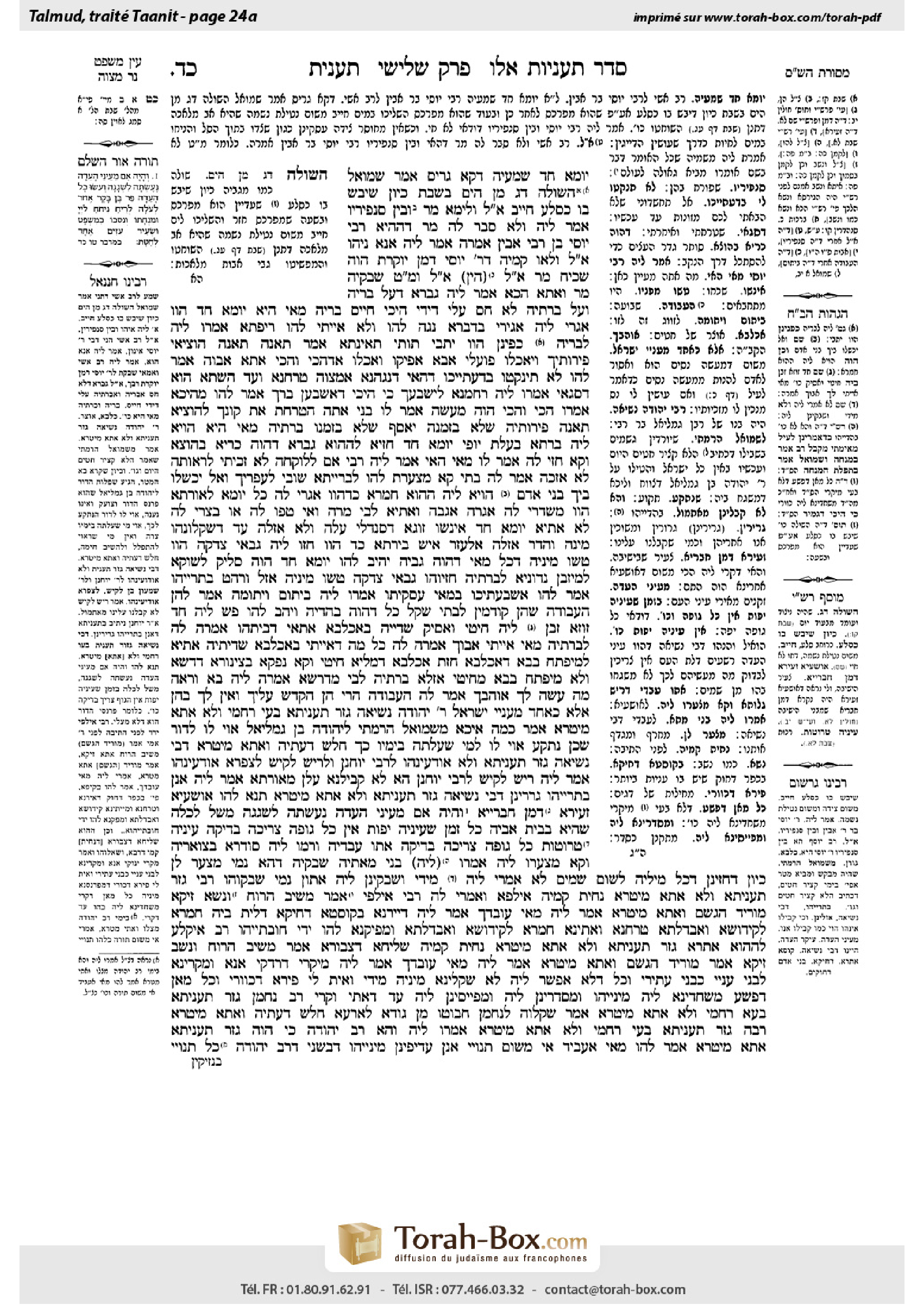
Taanit 24a: Talmud study for Daf Yomi
Daf Yomi is the daily study of one Talmud folio. Explore 37 tractates with scans, Hebrew text, Sefaria English and AI-generated French translations where annotated.
Passage selection and English or AI-generated French translation are available where the scan has annotations. Daf Study is independent of Torah-Box and Sefaria.
Browse Taanit · תענית · All tractatesTaanit 24a text and translations
This page of Taanit includes the Aramaic text, an English translation and an AI-generated French translation, alongside the scan above.
תענית כ״ד א · Aramaic and Hebrew text
יוֹמָא חַד שַׁמְעֵיהּ דְּקָא גָרֵיס, אָמַר שְׁמוּאֵל: הַשּׁוֹלֶה דָּג מִן הַיָּם בְּשַׁבָּת, כֵּיוָן שֶׁיָּבַשׁ בּוֹ כְּסֶלַע — חַיָּיב. אֲמַר לֵיהּ: וְלֵימָא מָר וּבֵין סְנַפִּירָיו! אֲמַר לֵיהּ: וְלָא סָבַר לַהּ מָר דְּהָהִיא רַבִּי יוֹסֵי בֶּן רַבִּי אָבִין אַמְרַהּ? אֲמַר לֵיהּ: אֲנָא נִיהוּ.
אֲמַר לֵיהּ: וְלָאו קַמֵּיהּ דְּרַבִּי יוֹסֵי דְּמִן יוֹקֶרֶת הֲוָה שְׁכִיחַ מָר? אֲמַר לֵיהּ: הִין. אֲמַר לֵיהּ: וּמַאי טַעְמָא שַׁבְקֵיהּ מָר וַאֲתָא הָכָא? אֲמַר לֵיהּ: גַּבְרָא דְּעַל בְּרֵיהּ וְעַל בְּרַתֵּיה לָא חָס, עֲלַי דִּידִי הֵיכִי חָיֵיס?!
בְּרֵיהּ מַאי הִיא? יוֹמָא חַד הֲווֹ אֲגִרִי לֵיהּ אֲגִירֵי בְּדַבְרָא, נְגַהּ לְהוּ וְלָא אַיְיתִי לְהוּ רִיפְתָּא, אֲמַרוּ לֵיהּ לִבְרֵיהּ: כָּפֵינַן! הֲווֹ יָתְבִי תּוּתֵי תְּאֵינְתָּא, אֲמַר: תְּאֵנָה, תְּאֵנָה! הוֹצִיאִי פֵּירוֹתַיִךְ, וְיֹאכְלוּ פּוֹעֲלֵי אַבָּא. אַפִּיקָא וַאֲכַלוּ.
אַדְּהָכִי וְהָכִי אֲתָא אֲבוּהּ אֲמַר לְהוּ: לָא תִּינַּקְטוּ בְּדַעְתַּיְיכוּ, דְּהַאי דִּנְגַהְנָא, אַמִּצְוָה טָרַחְנָא, וְעַד הַשְׁתָּא הוּא דְּסַגַּאי. אֲמַרוּ לֵיהּ: רַחֲמָנָא לַישְׂבְּעָךְ כִּי הֵיכִי דְּאַשְׂבְּעַן בְּרָךְ. אֲמַר לְהוּ: מֵהֵיכָא? אֲמַרוּ: הָכִי וְהָכִי הֲוָה מַעֲשֶׂה. אָמַר לוֹ: בְּנִי, אַתָּה הִטְרַחְתָּ אֶת קוֹנְךָ לְהוֹצִיא תְּאֵנָה פֵּירוֹתֶיהָ שֶׁלֹּא בִּזְמַנָּהּ — יֵאָסֵף שֶׁלֹּא בִּזְמַנּוֹ.
בְּרַתֵּיה מַאי הִיא? הַוְיָא לֵיהּ בְּרַתָּא בַּעֲלַת יוֹפִי, יוֹמָא חַד חַזְיֵאּ לְהָהוּא גַּבְרָא דַּהֲוָה כָּרֵיא בְּהוּצָא וְקָא חָזֵי לַהּ. אָמַר לוֹ: מַאי הַאי? אֲמַר לֵיהּ: רַבִּי, אִם לְלוֹקְחָהּ לֹא זָכִיתִי — לִרְאוֹתָהּ לֹא אֶזְכֶּה? אֲמַר לַהּ: בִּתִּי, קָא מְצַעֲרַתְּ לְהוּ לִבְרִיָּיתָא, שׁוּבִי לְעַפְרִיךְ וְאַל יִכָּשְׁלוּ בִּיךְ בְּנֵי אָדָם.
הַוְיָא לֵיהּ הָהוּא חֲמָרָא, כְּדַהֲווֹ אָגְרִי לַהּ כׇּל יוֹמָא, לְאוּרְתָּא הֲווֹ מְשַׁדְּרִי לֵהּ אַגְרַהּ אַגַּבַּהּ, וְאָתְיָא לְבֵי מָרַהּ, וְאִי טָפוּ לַהּ אוֹ בָּצְרִי לַהּ — לָא אָתְיָא. יוֹמָא חַד אִינְּשׁוֹ זוּגָא דְסַנְדָּלֵי עֲלַהּ, וְלָא אֲזַלָה עַד דְּשַׁקְלוּנְהוּ מִינַּהּ, וַהֲדַר אֲזַלָה.
אֶלְעָזָר אִישׁ בִּירְתָּא, כַּד הֲווֹ חָזוּ לֵיהּ גַּבָּאֵי צְדָקָה הֲווֹ טָשׁוּ מִינֵּיהּ, דְּכׇל מַאי דַּהֲוָה גַּבֵּיהּ יָהֵיב לְהוּ. יוֹמָא חַד הֲוָה סָלֵיק לְשׁוּקָא לְמִיזְבַּן נְדוּנְיָא לִבְרַתֵּיהּ, חַזְיוּהּ גַּבָּאֵי צְדָקָה, טְשׁוֹ מִינֵּיהּ.
אֲזַל וּרְהַט בָּתְרַיְיהוּ, אֲמַר לְהוּ: אַשְׁבַּעְתִּיכוּ בְּמַאי עָסְקִיתוּ? אֲמַרוּ לֵיהּ: בְּיָתוֹם וִיתוֹמָה. אָמַר לָהֶן: הָעֲבוֹדָה שֶׁהֵן קוֹדְמִין לְבִתִּי. שְׁקַל כֹּל דַּהֲוָה בַּהֲדֵיהּ וִיהַב לְהוּ. פָּשׁ לֵיהּ חַד זוּזָא, זְבַן לֵיהּ חִיטֵּי, וְאַסֵּיק שַׁדְיֵיהּ בַּאֲכַלְבָּא.
אֲתַאי דְּבֵיתְהוּ אֲמַרָה לַהּ לִבְרַתֵּיהּ: מַאי אַיְיתִי אֲבוּךְ? אֲמַרָה לָהּ: כׇּל מָה דְּאַיְיתִי, בַּאֲכַלְבָּא שְׁדִיתֵיהּ. אָתְיָא לְמִיפְתַּח בָּבָא דַאֲכַלְבָּא, חֲזָת אֲכַלְבָּא דְּמַלְיָא חִיטֵּי וְקָא נָפְקָא בְּצִינּוֹרָא דְּדַשָּׁא, וְלָא מִיפְּתַח בָּבָא מֵחִיטֵּי. אֲזַלָא בְּרַתֵּיה לְבֵי מִדְרְשָׁא, אֲמַרָה לֵיהּ: בֹּא וּרְאֵה מָה עָשָׂה לְךָ אוֹהַבְךָ! אֲמַר לַהּ: הָעֲבוֹדָה, הֲרֵי הֵן הֶקְדֵּשׁ עָלַיִךְ, וְאֵין לָךְ בָּהֶן אֶלָּא כְּאֶחָד מֵעֲנִיֵּי יִשְׂרָאֵל.
רַבִּי יְהוּדָה נְשִׂיאָה גְּזַר תַּעֲנִיתָא, בְּעָא רַחֲמֵי וְלָא אֲתָא מִיטְרָא. אָמַר: כַּמָּה אִיכָּא מִשְּׁמוּאֵל הָרָמָתִי לִיהוּדָה בֶּן גַּמְלִיאֵל! אוֹי לוֹ לַדּוֹר שֶׁכֵּן נִתְקַע, אוֹי לוֹ לְמִי שֶׁעָלְתָה בְּיָמָיו כָּךְ! חֲלַשׁ דַּעְתֵּיהּ וַאֲתָא מִיטְרָא.
דְּבֵי נְשִׂיאָה גְּזַר תַּעֲנִיתָא, וְלָא אוֹדְעִינְהוּ לְרַבִּי יוֹחָנָן וּלְרֵישׁ לָקִישׁ. לְצַפְרָא אוֹדְעִינְהוּ. אֲמַר לֵיהּ רֵישׁ לָקִישׁ לְרַבִּי יוֹחָנָן: הָא לָא קַבֵּילְנָא עֲלַן מֵאוּרְתָּא! אָמַר לֵיהּ: אֲנַן בָּתְרַיְיהוּ גְּרִרִינַן.
דְּבֵי נְשִׂיאָה גְּזַר תַּעֲנִיתָא וְלָא אֲתָא מִיטְרָא. תְּנָא לְהוּ אוֹשַׁעְיָא זְעֵירָא דְּמִן חַבְרַיָּיא: ״וְהָיָה אִם מֵעֵינֵי הָעֵדָה נֶעֶשְׂתָה לִשְׁגָגָה״.
מָשָׁל לְכַלָּה שֶׁהִיא בְּבֵית אָבִיהָ. כׇּל זְמַן שֶׁעֵינֶיהָ יָפוֹת — אֵין כׇּל גּוּפָהּ צְרִיכָה בְּדִיקָה. עֵינֶיהָ טְרוּטוֹת — כָּל גּוּפָהּ צְרִיכָה בְּדִיקָה.
אֲתוֹ עַבְדֵּיהּ וּרְמוֹ לֵיהּ סוּדָרָא בְּצַוְּארֵיהּ, וְקָא מְצַעֲרוּ לֵיהּ. אֲמַרוּ לְהוּ בְּנֵי מָאתֵיהּ: שִׁבְקֵיהּ, דְּהָא נָמֵי מְצַעַר לַן. כֵּיוָן דַּחֲזֵינַן דְּכׇל מִילֵּיהּ לְשׁוּם שָׁמַיִם, לָא אָמְרִינַן לֵיהּ מִידֵּי וְשָׁבְקִינַן לֵיהּ, אַתּוּן נָמֵי שִׁבְקוּהּ.
רַבִּי גְּזַר תַּעֲנִיתָא וְלָא אֲתָא מִיטְרָא. נְחֵית קַמֵּיהּ אִילְפָא (וְאָמְרִי לַהּ רַבִּי אִילְפֵי), אֲמַר ״מַשִּׁיב הָרוּחַ״ וּנְשַׁב זִיקָא, ״מוֹרִיד הַגֶּשֶׁם״ וַאֲתָא מִיטְרָא. אֲמַר לֵיהּ: מַאי עוֹבָדָךְ? אֲמַר לֵיהּ: דָּיַירְנָא בְּקוּסְטָא דְחִיקָא דְּלֵית בֵּיהּ חַמְרָא לְקִידּוּשָׁא וְאַבְדַּלְתָּא. טָרַחְנָא (וְאָתֵינָא) [וּמַיְיתֵינָא] חַמְרָא לְקִידּוּשָׁא וְאַבְדַּלְתָּא, וּמַפֵּיקְנָא לְהוּ יְדֵי חוֹבְתַיְיהוּ.
רַב אִיקְּלַע לְהָהוּא אַתְרָא, גְּזַר תַּעֲנִיתָא וְלָא אֲתָא מִיטְרָא. נְחֵית קַמֵּיהּ שְׁלִיחָא דְצִבּוּרָא, אֲמַר ״מַשִּׁיב הָרוּחַ״ וּנְשַׁב זִיקָא, אֲמַר ״מוֹרִיד הַגֶּשֶׁם״ וַאֲתָא מִיטְרָא. אֲמַר לֵיהּ: מַאי עוֹבָדָךְ? אֲמַר לֵיהּ: מַיקְרֵי דַרְדְּקֵי אֲנָא, וּמַקְרֵינָא לִבְנֵי עַנְיֵי כִּבְנֵי עַתִּירֵי. וְכֹל דְּלָא אֶפְשָׁר לֵיהּ — לָא שָׁקֵלְינָא מִינֵּיהּ מִידֵּי. וְאִית לִי פִּירָא דִכְווֹרֵי, וְכׇל מַאן דְּפָשַׁע מְשַׁחֵידְנָא לֵיהּ מִינַּיְיהוּ, וּמְסַדְּרִינַן לֵיהּ וּמְפַיְּיסִינַן לֵיהּ עַד דְּאָתֵי וְקָרֵי.
רַב נַחְמָן גְּזַר תַּעֲנִיתָא, בְּעָא רַחֲמֵי וְלָא אֲתָא מִיטְרָא, אֲמַר: שַׁקְלוּהּ לְנַחְמָן, חֲבוּטוּ מִן גּוּדָּא לְאַרְעָא. חֲלַשׁ דַּעְתֵּיהּ וַאֲתָא מִיטְרָא.
רַבָּה גְּזַר תַּעֲנִיתָא, בְּעָא רַחֲמֵי וְלָא אֲתָא מִיטְרָא. אֲמַרוּ לֵיהּ: וְהָא רַב יְהוּדָה כִּי הֲוָה גָּזַר תַּעֲנִיתָא אֲתָא מִיטְרָא. אֲמַר לְהוּ: מַאי אֶעֱבֵיד? אִי מִשּׁוּם תַּנּוֹיֵי — אֲנַן עֲדִיפִינַן מִינַּיְיהוּ, דְּבִשְׁנֵי דְּרַב יְהוּדָה כׇּל תַּנּוֹיֵי
Taanit 24a · English translation
One day Rabbi Yosei bar Avin heard Rav Ashi studying and reciting the following statement. Shmuel said: With regard to one who removes a fish from the sea on Shabbat, when an area on the skin of the fish the size of a sela coin has dried up, he is liable for violating the prohibition against slaughtering an animal on Shabbat. A fish in that condition cannot survive, and therefore one who removed it from the water is liable for killing it. Rabbi Yosei bar Avin said to Rav Ashi: And let the Master say that this is the case provided that the skin that dried is between its fins. Rav Ashi said to him: And doesn’t the Master maintain that Rabbi Yosei ben Rabbi Avin said this ruling? Why didn’t you state it in his name? Rabbi Yosei bar Avin said to him: I am he.
Rav Ashi said to him: And didn’t the Master sit before and frequent the study hall of Rabbi Yosei from Yokrat? Rabbi Yosei bar Avin said to him: Yes. Rav Ashi said to him: And what is the reason that the Master left him and came here? Rabbi Yosei bar Avin said to him: I was concerned and departed because he is so severe and unforgiving. He is a man who has no mercy on his own son, and no mercy on his daughter. How, then, could he have mercy on me?
The Gemara asks: What is the incident involving his son? One day Rabbi Yosei from Yokrat hired day laborers to work his field. It grew late and he did not bring them food. The workers said to the son of Rabbi Yosei from Yokrat: We are starving. They were sitting under a fig tree, so the son said: Fig tree, fig tree. Yield your fruits, so that my father’s workers may eat. The fig tree yielded fruit, and they ate.
In the meantime, his father came and said to the workers: Do not be angry with me for being late, as I was engaged in a mitzva, and until just now I was traveling for that purpose and could not get here any sooner. They said to him: May the Merciful One satisfy you just as your son satisfied us and gave us food. He said to them: From where did he find food to give you? They said: Such-and-such an incident occurred. Rabbi Yosei from Yokrat said to his son: My son, you troubled your Creator to cause the fig to yield its fruit not in its proper time, so too, you will die young. And indeed, his son died before his time.
The Gemara asks: What is the incident involving his daughter? He had a very beautiful daughter. One day Rabbi Yosei from Yokrat saw a certain man piercing a hole in the hedge surrounding his property and looking at his daughter. Rabbi Yosei said to him: What is this? The man said to him: My teacher, if I have not merited taking her in marriage, shall I not at least merit to look at her? Rabbi Yosei said to her: My daughter, you are causing people distress. Return to your dust, and let people no longer stumble into sin due to you.
§ The Gemara relates another story involving Rabbi Yosei from Yokrat. He had a certain donkey that people hired each day for work. In the evening they would send it back with the money for its hire on its back, and the animal would go to its owner’s house. But if they added or subtracted from the appropriate sum, the donkey would not go. One day someone forgot a pair of sandals on the donkey, and it did not move until they removed the sandals from its back, after which it went off.
The Gemara cites more stories about miracles that occurred to righteous individuals. Whenever the charity collectors would see Elazar of the village of Birta, they would hide from him, as any money Elazar had with him he would give them, and they did not want to take all his property. One day, Elazar went to the market to purchase what he needed for his daughter’s dowry. The charity collectors saw him and hid from him.
He went and ran after them, saying to them: I adjure you, tell me, in what mitzva are you engaged? They said to him: We are collecting money for the wedding of an orphan boy and an orphan girl. He said to them: I swear by the Temple service that they take precedence over my daughter. He took everything he had with him and gave it to them. He was left with one single dinar, with which he bought himself wheat, and he then ascended to his house and threw it into the granary.
Elazar’s wife came and said to her daughter: What has your father brought? She said to her mother: Whatever he brought he threw into the granary. She went to open the door of the granary, and saw that the granary was full of wheat, so much so that it was coming out through the doorknob, and the door would not open due to the wheat. The granary had miraculously been completely filled. Elazar’s daughter went to the study hall and said to her father: Come and see what He Who loves You, the Almighty, has performed for you. He said to her: I swear by the Temple service, as far as you are concerned this wheat is consecrated property, and you have a share in it only as one of the poor Jews. He said this because he did not want to benefit from a miracle.
The Gemara returns to the topic of fasting for rain. Rabbi Yehuda Nesia decreed a fast and prayed for mercy, but rain did not come. He said, lamenting: How great is the difference between the prophet Samuel of Rama, for whom rain fell even when he prayed for it in summer, and myself, Yehuda ben Gamliel. Woe to the generation that is stuck with this leadership; woe to him in whose days this has occurred. He grew upset, and rain came.
The Gemara relates another story involving a Nasi’s decree of a fast for rain. In the house of the Nasi a fast was declared, but they didn’t inform Rabbi Yoḥanan and Reish Lakish of the fast the day before. In the morning they informed them. Reish Lakish said to Rabbi Yoḥanan: What are we to do? We did not accept this fast upon ourselves the evening before, and a fast must be accepted in the afternoon service of the day preceding the fast. Rabbi Yoḥanan said to him: We are drawn after the community, and therefore, when the Nasi declares a public fast there is no need for an individual to accept it upon himself the day before.
The Gemara further states that on another occasion, a fast was declared in the house of the Nasi, but rain did not come. Oshaya, the youngest member of the group of Sages, taught them a baraita. It is written: “Then it shall be, if it shall be committed in error by the congregation, it being hidden from their eyes” (Numbers 15:24). This verse indicates that the leaders are considered the eyes of the congregation.
Oshaya continued: There is a parable that illustrates this, involving a bride who is in her father’s home and has not yet been seen by her bridegroom. As long as her eyes are beautiful, her body need not be examined, as certainly she is beautiful. However, if her eyes are bleary [terutot], her entire body requires examination. So too, if the leaders of the generation are flawed, it is a sign that the entire generation is unworthy. By means of this parable, Oshaya was hinting that rain was withheld from the entire nation due to the evil committed by the household of the Nasi.
The servants of the Nasi came and placed a scarf around his neck and tormented him as punishment for insulting the house of the Nasi. His townsmen said to them: Let him be, as he also causes us pain with his harsh reproof, but since we see that all his actions are for the sake of Heaven we do not say anything to him and let him be. You too should let him be.
§ The Gemara relates: Rabbi Yehuda HaNasi declared a fast but rain did not come. Ilfa descended to lead the service before him, and some say it was Rabbi Ilfi. He recited: He Who makes the wind blow, and the wind indeed blew. He continued to recite: And Who makes the rain come, and subsequently, the rain came. Rabbi Yehuda HaNasi said to him: What are your good deeds, in the merit of which your prayers are answered so speedily? He said to him: I live in an impoverished city, in which there is no wine for kiddush or havdala. I go to the effort of bringing the residents wine for kiddush and havdala, and I thereby enable them to fulfill their duty. In reward for this mitzva, my prayers for rain were answered.
The Gemara relates a similar incident. Rav happened to come to a certain place where he decreed a fast but rain did not come. The prayer leader descended to lead the service before him and recited: He Who makes the wind blow, and the wind blew. He continued and said: And Who makes the rain fall, and the rain came. Rav said to him: What are your good deeds? He said to him: I am a teacher of children, and I teach the Bible to the children of the poor as to the children of the rich, and if there is anyone who cannot pay, I do not take anything from him. And I have a fishpond, and any child who neglects his studies, I bribe him with the fish and calm him, and soothe him until he comes and reads.
The Gemara further relates: Rav Naḥman decreed a fast, prayed for mercy, but rain did not come. In his misery, he said: Take Naḥman and throw him from the wall to the ground, as the fast he decreed has evidently had no effect. He grew upset, and rain came.
The Gemara relates: Rabba decreed a fast. He prayed for mercy, but rain did not come. They said to him: But when this Rav Yehuda decreed a fast, rain would come. He said to them: What can I do? If the difference between us is due to Torah study, we are superior to the previous generation, as in the years of Rav Yehuda all of their learning
Taanit 24a · Traduction française (IA)
Un jour, Rabbi Yosei bar Avin entendit Rav Ashi étudier et réciter la déclaration suivante : Shmuel a dit : Celui qui retire un poisson de la mer pendant Chabbat est passible d’avoir violé l’interdiction d’abattre un animal le Chabbat lorsqu’une zone de la peau du poisson, de la taille d’un sela, a séché. Un poisson dans cet état ne peut survivre ; par conséquent, celui qui l’a retiré de l’eau est passible de l’avoir tué. Rabbi Yosei bar Avin dit à Rav Ashi : Que le Maître précise que cela s’applique à condition que la partie de la peau qui a séché se trouve entre ses nageoires. Rav Ashi lui dit : Mais le Maître ne soutient-il pas que Rabbi Yosei ben Rabbi Avin a énoncé cette halakha ? Pourquoi ne l’as-tu pas rapportée en son nom ? Rabbi Yosei bar Avin lui dit : C’est moi.
Rav Ashi lui dit : Le Maître n’a-t-il pas séjourné auprès de Rabbi Yosei de Yokrat et fréquenté son beit midrach ? Rabbi Yosei bar Avin lui répondit : Oui. Rav Ashi lui dit : Pourquoi le Maître l’a-t-il donc quitté pour venir ici ? Rabbi Yosei bar Avin lui répondit : J’ai eu peur et je suis parti, car il est si sévère et impitoyable. C’est un homme qui n’a de compassion ni pour son propre fils ni pour sa fille. Comment aurait-il donc pu avoir de la compassion pour moi ?
La Guemara demande : Quel est l’incident concernant son fils ? Un jour, Rabbi Yosei de Yokrat embaucha des ouvriers à la journée pour travailler dans son champ. Il se fit tard et il ne leur apporta pas de nourriture. Les ouvriers dirent au fils de Rabbi Yosei de Yokrat : Nous mourons de faim. Ils étaient assis sous un figuier ; le fils dit donc : Figuier, figuier, donne tes fruits afin que les ouvriers de mon père puissent manger. Le figuier donna des fruits, et ils en mangèrent.
Entre-temps, son père arriva et dit aux ouvriers : Ne m’en voulez pas d’être en retard ; j’étais occupé à accomplir une mitsva et, jusqu’à présent, je voyageais à cette fin, si bien que je ne pouvais pas arriver plus tôt. Ils lui dirent : Que le Miséricordieux te comble comme ton fils nous a comblés et nous a donné à manger. Il leur demanda : Où a-t-il trouvé de quoi vous nourrir ? Ils répondirent : Voici ce qui s’est passé. Rabbi Yosei de Yokrat dit à son fils : Mon fils, tu as obligé ton Créateur à faire porter ses fruits au figuier hors de la saison appropriée ; de même, tu mourras jeune. Et, de fait, son fils mourut avant l’heure.
La Guemara demande : Quel est l’incident concernant sa fille ? Il avait une fille d’une très grande beauté. Un jour, Rabbi Yosei de Yokrat vit un homme percer un trou dans la haie qui entourait sa propriété et regarder sa fille. Rabbi Yosei lui demanda : Qu’est-ce que cela ? L’homme lui répondit : Mon maître, si je n’ai pas mérité de l’épouser, ne mériterais-je pas au moins de la regarder ? Rabbi Yosei dit à sa fille : Ma fille, tu causes de la peine aux gens. Retourne à la poussière, et que les gens ne trébuchent plus dans le péché à cause de toi.
§ La Guemara rapporte une autre histoire concernant Rabbi Yosei de Yokrat. Il possédait un âne que les gens louaient chaque jour pour travailler. Le soir, ils le renvoyaient chez son propriétaire avec le montant de la location sur le dos, et l’animal se rendait chez lui. Mais si la somme était supérieure ou inférieure au montant exact, l’âne ne bougeait pas. Un jour, quelqu’un oublia une paire de sandales sur l’âne ; celui-ci ne bougea pas avant qu’on les ait retirées de son dos, après quoi il partit.
La Guemara rapporte d’autres récits de miracles survenus à des hommes justes. Chaque fois que les collecteurs de tsedaka apercevaient Elazar du village de Birta, ils se cachaient, car il leur donnait tout l’argent qu’il avait sur lui et ils ne voulaient pas prendre tous ses biens. Un jour, Elazar se rendit au marché pour acheter ce dont il avait besoin pour la dot de sa fille. Les collecteurs de tsedaka le virent et se cachèrent.
Il courut après eux en leur disant : Je vous adjure de me dire pour quelle mitsva vous êtes occupés. Ils lui répondirent : Nous recueillons de l’argent pour le mariage d’un orphelin et d’une orpheline. Il leur dit : Je jure par le service du Temple que leur besoin passe avant celui de ma fille. Il leur donna tout ce qu’il avait sur lui. Il ne lui resta qu’un seul dinar, avec lequel il s’acheta du blé ; puis il monta chez lui et le jeta dans le grenier.
La femme d’Elazar vint demander à sa fille : Qu’a rapporté ton père ? Elle répondit à sa mère : Tout ce qu’il a rapporté, il l’a jeté dans le grenier. Elle alla ouvrir la porte du grenier et vit qu’il était plein de blé, à tel point que celui-ci débordait par le trou de la poignée et empêchait la porte de s’ouvrir. Le grenier avait été miraculeusement rempli. La fille d’Elazar se rendit au beit midrach et dit à son père : Viens voir ce que Celui qui t’aime, le Tout-Puissant, a accompli pour toi. Il lui dit : Je jure par le service du Temple qu’à ton intention, ce blé est une propriété consacrée, et que tu n’y as part qu’en tant que l’une des pauvres d’Israël. Il dit cela parce qu’il ne voulait pas tirer profit d’un miracle.
La Guemara revient au sujet du jeûne pour la pluie. Rabbi Yehuda Nesia décréta un jeûne et implora la miséricorde, mais la pluie ne vint pas. Il dit avec amertume : Quelle différence entre le prophète Shmuel de Rama, pour qui la pluie tombait même lorsqu’il priait pour qu’il pleuve en été, et moi, Yehuda ben Gamliel ! Malheur à la génération qui doit supporter cette direction ; malheur à celui au temps duquel cela s’est produit. Il s’irrita, et la pluie vint.
La Guemara rapporte une autre histoire concernant le décret d’un jeûne pour la pluie par un Nassi. Un jeûne fut décrété dans la maison du Nassi, mais Rabbi Yoḥanan et Reish Lakish n’en furent pas informés la veille. On les en informa le matin. Reish Lakish dit à Rabbi Yoḥanan : Que devons-nous faire ? Nous n’avons pas accepté ce jeûne sur nous-mêmes la veille au soir, et un jeûne doit être accepté pendant l’office de l’après-midi de la veille. Rabbi Yoḥanan lui répondit : Nous suivons la communauté ; par conséquent, lorsqu’un Nassi décrète un jeûne public, un particulier n’a pas besoin de l’accepter sur lui-même la veille.
La Guemara ajoute qu’une autre fois, un jeûne fut décrété dans la maison du Nassi, mais la pluie ne vint pas. Oshaya, le plus jeune des Sages du groupe, leur enseigna une baraïta. Il est écrit : « Alors, si la communauté commet une faute par erreur, sans que cela soit visible à ses yeux » (Nombres 15:24). Ce verset indique que les dirigeants sont considérés comme les yeux de la communauté.
Oshaya poursuivit : Une parabole illustre cela : une jeune mariée se trouve dans la maison de son père et son fiancé ne l’a pas encore vue. Tant que ses yeux sont beaux, il n’est pas nécessaire d’examiner son corps, car elle est certainement belle. Mais si ses yeux sont troubles [terutot], il faut examiner tout son corps. De même, si les dirigeants de la génération sont corrompus, c’est le signe que toute la génération est indigne. Par cette parabole, Oshaya laissait entendre que la pluie était refusée à tout le peuple en raison du mal commis par la maison du Nassi.
Les serviteurs du Nassi vinrent, lui passèrent une écharpe autour du cou et le tourmentèrent pour le punir d’avoir insulté la maison du Nassi. Les gens de sa ville leur dirent : Laissez-le tranquille. Lui aussi nous fait souffrir par ses sévères remontrances, mais nous voyons que toutes ses actions sont accomplies pour la cause du Ciel ; nous ne lui faisons donc aucun reproche et le laissons tranquille. Vous aussi, laissez-le tranquille.
§ La Guemara rapporte : Rabbi Yehuda HaNasi décréta un jeûne, mais la pluie ne vint pas. Ilfa descendit pour diriger l’office devant lui ; selon certains, c’était Rabbi Ilfi. Il récita : « Celui qui fait souffler le vent », et le vent se mit effectivement à souffler. Il poursuivit en récitant : « Et qui fait tomber la pluie », après quoi la pluie vint. Rabbi Yehuda HaNasi lui demanda : Quelles bonnes actions accomplis-tu pour que tes prières soient exaucées si rapidement ? Il lui répondit : Je vis dans une ville pauvre, où il n’y a pas de vin pour le kiddouch ni pour la havdala. Je me donne la peine d’apporter du vin aux habitants pour le kiddouch et la havdala, leur permettant ainsi de s’acquitter de leur obligation. En récompense de cette mitsva, mes prières pour la pluie ont été exaucées.
La Guemara rapporte un incident semblable. Rav se trouvait par hasard dans un certain endroit où il décréta un jeûne, mais la pluie ne vint pas. L’officiant descendit pour diriger l’office devant lui et récita : « Celui qui fait souffler le vent », et le vent se mit à souffler. Il poursuivit en disant : « Et qui fait tomber la pluie », et la pluie vint. Rav lui demanda : Quelles bonnes actions accomplis-tu ? Il lui répondit : Je suis maître d’école et j’enseigne la Bible aux enfants des pauvres comme à ceux des riches ; si quelqu’un ne peut pas payer, je ne lui demande rien. J’ai aussi un vivier à poissons ; lorsqu’un enfant néglige ses études, je l’attire avec du poisson, puis je le calme et le rassure jusqu’à ce qu’il vienne lire.
La Guemara rapporte en outre : Rav Naḥman décréta un jeûne et implora la miséricorde, mais la pluie ne vint pas. Dans sa détresse, il dit : Prenez Naḥman et jetez-le du haut du mur à terre, car le jeûne qu’il a décrété n’a manifestement eu aucun effet. Il s’irrita, et la pluie vint.
La Guemara rapporte : Rabba décréta un jeûne. Il implora la miséricorde, mais la pluie ne vint pas. On lui dit : Pourtant, lorsque ce Rav Yehuda décrétait un jeûne, la pluie venait. Il leur dit : Que puis-je faire ? Si la différence entre nous tient à l’étude de la Torah, nous sommes supérieurs à la génération précédente, car, à l’époque de Rav Yehuda, tout leur apprentissage
Traduction française générée par IA à partir de l’édition anglaise de Sefaria. Vérifie toujours un passage avec le texte source.
Text from Sefaria: William Davidson Edition - Vocalized Aramaic (CC BY NC); William Davidson Edition - English (CC BY NC).