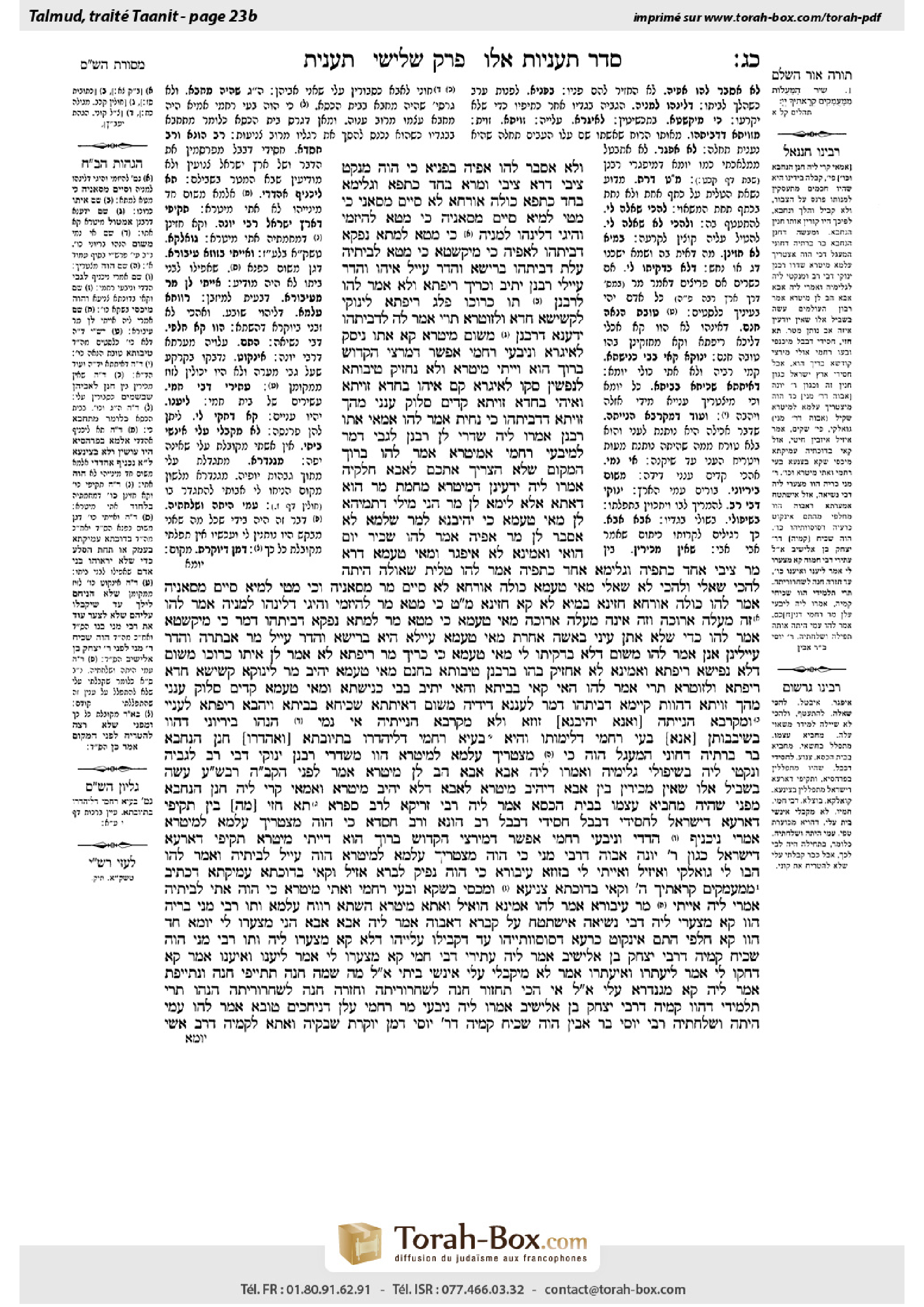
Taanit 23b: Talmud study for Daf Yomi
Daf Yomi is the daily study of one Talmud folio. Explore 37 tractates with scans, Hebrew text, Sefaria English and AI-generated French translations where annotated.
Passage selection and English or AI-generated French translation are available where the scan has annotations. Daf Study is independent of Torah-Box and Sefaria.
Browse Taanit · תענית · All tractatesTaanit 23b text and translations
This page of Taanit includes the Aramaic text, an English translation and an AI-generated French translation, alongside the scan above.
תענית כ״ג ב · Aramaic and Hebrew text
וְלָא אַסְבַּר לְהוּ אַפֵּיהּ. בְּפַנְיָא, כִּי הֲוָה מְנַקֵּט צִיבֵי, דְּרָא צִיבֵי וּמָרָא בְּחַד כַּתְפָּא, וּגְלִימָא בְּחַד כַּתְפָּא. כּוּלַּהּ אוֹרְחָא לָא סָיֵים מְסָאנֵי, כִּי מָטֵי לְמַיָּא סָיֵים מְסָאנֵיהּ. כִּי מְטָא לְהִיזְמֵי וְהִיגֵי דַּלִּינְהוּ לְמָנֵיהּ. כִּי מְטָא לְמָתָא, נָפְקָה דְּבֵיתְהוּ לְאַפֵּיהּ כִּי מִיקַּשְּׁטָא. כִּי מְטָא לְבֵיתֵיהּ, עַלַּת דְּבֵיתְהוּ בְּרֵישָׁא, וַהֲדַר עָיֵיל אִיהוּ, וַהֲדַר עָיְילִי רַבָּנַן. יְתֵיב וּכְרֵיךְ רִיפְתָּא וְלָא אֲמַר לְהוּ לְרַבָּנַן תּוּ כְּרוּכוּ. פְּלַג רִיפְתָּא לְיָנוֹקֵי, לְקַשִּׁישָׁא — חֲדָא, וּלְזוּטְרָא — תְּרֵי.
אֲמַר לַהּ לִדְבֵיתְהוּ: יָדַעְנָא דְּרַבָּנַן מִשּׁוּם מִיטְרָא קָא אָתוּ, נִיסַּק לְאִיגָּרָא וְנִיבְעֵי רַחֲמֵי, אֶפְשָׁר דְּמִרַצֵּי הַקָּדוֹשׁ בָּרוּךְ הוּא וְיֵיתֵי מִיטְרָא וְלָא נַחְזֵיק טֵיבוּתָא לְנַפְשִׁין. סַקוּ לְאִיגָּרָא, קָם אִיהוּ בַּחֲדָא זָוִיתָא, וְאִיהִי בַּחֲדָא זָוִיתָא, קְדוּם סְלוּק עֲנָנֵי מֵהָךְ זָוִיתָא דִּדְבֵיתְהוּ. כִּי נָחֵית אֲמַר לְהוּ: אַמַּאי אֲתוֹ רַבָּנַן? אֲמַרוּ לֵיהּ: שַׁדַּרוּ לַן רַבָּנַן לְגַבֵּי דְּמָר לְמִיבְעֵי רַחֲמֵי אַמִּיטְרָא. אֲמַר לְהוּ: בָּרוּךְ הַמָּקוֹם שֶׁלֹּא הִצְרִיךְ אֶתְכֶם לְאַבָּא חִלְקִיָּה.
אֲמַרוּ לֵיהּ: יָדְעִינַן דְּמִיטְרָא מֵחֲמַת מָר הוּא דַּאֲתָא, אֶלָּא לֵימָא לַן מָר הָנֵי מִילֵּי דִּתְמִיהָא לַן: מַאי טַעְמָא כִּי יָהֵיבְנָא לְמָר שְׁלָמָא לָא אַסְבַּר לַן מָר אַפֵּיהּ? אֲמַר לְהוּ: שְׂכִיר יוֹם הֲוַאי, וְאָמֵינָא: לָא אֶיפַּגַּר. וּמַאי טַעְמָא דְּרָא מָר צִיבֵי אַחַד כַּתְפֵּיהּ וּגְלִימָא אַחַד כַּתְפֵּיהּ? אֲמַר לְהוּ: טַלִּית שְׁאוּלָה הָיְתָה. לְהָכִי שְׁאַלִי, וּלְהָכִי לָא שְׁאַלִי.
מַאי טַעְמָא כּוּלַּהּ אוֹרְחָא לָא סָיֵים מָר מְסָאנֵיהּ וְכִי מָטֵי לְמַיָּא סָיֵים מְסָאנֵיהּ? אֲמַר לְהוּ: כּוּלַּהּ אוֹרְחָא חָזֵינָא, בְּמַיָּא לָא קָא חָזֵינָא. מַאי טַעְמָא כִּי מְטָא מָר לְהִיזְמֵי וְהִיגֵי דַּלִּינְהוּ לְמָנֵיהּ? אֲמַר לְהוּ: זֶה מַעֲלֶה אֲרוּכָה, וְזֶה אֵינוֹ מַעֲלֶה אֲרוּכָה.
מַאי טַעְמָא כִּי מְטָא מָר לְמָתָא נָפְקָא דְּבֵיתְהוּ דְּמָר כִּי מִיקַּשְּׁטָא? אֲמַר לְהוּ: כְּדֵי שֶׁלֹּא אֶתֵּן עֵינַי בְּאִשָּׁה אַחֶרֶת. מַאי טַעְמָא עָיְילָא הִיא בְּרֵישָׁא, וַהֲדַר עָיֵיל מָר אַבָּתְרַהּ, וַהֲדַר עָיְילִינַן אֲנַן? אֲמַר לְהוּ מִשּׁוּם דְּלָא בְּדִיקִיתוּ לִי.
מַאי טַעְמָא כִּי כָּרֵיךְ מָר רִיפְתָּא לָא אֲמַר לַן ״אֵיתוֹ כְּרוּכוּ״? מִשּׁוּם דְּלָא נְפִישָׁא רִיפְתָּא, וְאָמֵינָא: לָא אַחְזֵיק בְּהוּ בְּרַבָּנַן טֵיבוּתָא בְּחִנָּם. מַאי טַעְמָא יְהֵיב מָר לְיָנוֹקָא קַשִּׁישָׁא חֲדָא רִיפְתָּא וּלְזוּטְרָא תְּרֵי? אֲמַר לְהוּ: הַאי — קָאֵי בְּבֵיתָא, וְהַאי — יָתֵיב בְּבֵי כְנִישְׁתָּא.
וּמַאי טַעְמָא קְדֻים סְלוּק עֲנָנֵי מֵהָךְ זָוִיתָא דַּהֲווֹת קָיְימָא דְּבֵיתְהוּ דְּמָר לַעֲנָנָא דִידֵיהּ? מִשּׁוּם דְּאִיתְּתָא שְׁכִיחָא בְּבֵיתָא, וְיָהֲבָא רִיפְתָּא לַעֲנִיֵּי, וּמְקָרְבָא הֲנָיָיתַהּ. וַאֲנָא יָהֵיבְנָא זוּזָא, וְלָא מְקָרְבָא הֲנָיָיתֵיהּ. אִי נָמֵי: הָנְהוּ בִּירְיוֹנֵי דְּהָווּ בְּשִׁיבָבוּתַן, אֲנָא בָּעֵי רַחֲמֵי דְּלֵימוּתוּ, וְהִיא בָּעֲיָא רַחֲמֵי דְּלִיהְדְּרוּ בִּתְיוּבְתָּא [וַהֲדַרוּ].
חָנָן הַנֶּחְבָּא בַּר בְּרַתֵּיה דְּחוֹנִי הַמְעַגֵּל הֲוָה, כִּי מִצְטְרִיךְ עָלְמָא לְמִיטְרָא, הֲווֹ מְשַׁדְּרִי רַבָּנַן יָנוֹקֵי דְּבֵי רַב לְגַבֵּיהּ וְנָקְטִי לֵיהּ בְּשִׁיפּוּלֵי גְלִימֵיהּ, וַאֲמַרוּ לֵיהּ: אַבָּא, אַבָּא, הַב לַן מִיטְרָא! אָמַר לִפְנֵי הַקָּדוֹשׁ בָּרוּךְ הוּא: רִבּוֹנוֹ שֶׁל עוֹלָם! עֲשֵׂה בִּשְׁבִיל אֵלּוּ, שֶׁאֵין מַכִּירִין בֵּין אַבָּא דְּיָהֵיב מִיטְרָא, לְאַבָּא דְּלָא יָהֵיב מִיטְרָא. וְאַמַּאי קָרֵי לֵיהּ ״חָנָן הַנֶּחְבָּא״ — מִפְּנֵי שֶׁהָיָה מַחְבִּיא עַצְמוֹ בְּבֵית הַכִּסֵּא.
אֲמַר לֵיהּ רַבִּי זְרִיקָא לְרַב סָפְרָא: תָּא חֲזִי מָה בֵּין תַּקִּיפֵי דְּאַרְעָא דְיִשְׂרָאֵל לַחֲסִידֵי דְבָבֶל. חֲסִידֵי דְבָבֶל רַב הוּנָא וְרַב חִסְדָּא, כִּי הֲוָה מִצְטְרִיךְ עָלְמָא לְמִיטְרָא אָמְרִי: נִיכַּנֵּיף הֲדָדֵי וְנִיבְעֵי רַחֲמֵי, אֶפְשָׁר דְּמִירַצֵּי הַקָּדוֹשׁ בָּרוּךְ הוּא דְּיֵיתֵי מִיטְרָא.
תַּקִּיפֵי דְּאַרְעָא דְיִשְׂרָאֵל כְּגוֹן רַבִּי יוֹנָה אֲבוּהּ דְּרַבִּי מָנִי, כִּי הֲוָה מִצְטְרִיךְ עָלְמָא לְמִיטְרָא, הֲוָה עָיֵיל לְבֵיתֵיהּ וַאֲמַר לְהוּ: הַבוּ לִי גּוּאַלְקִי, וְאֵיזִיל וְאַיְיתֵי לִי בְּזוּזָא עִיבוּרָא. כִּי הֲוָה נָפֵיק לְבָרָא, אָזֵיל וְקָאֵי בְּדוּכְתָּא עַמִּיקְתָּא, דִּכְתִיב: ״מִמַּעֲמַקִּים קְרָאתִיךָ ה׳״, וְקָאֵי בְּדוּכְתָּא צְנִיעָא, וּמִכַּסֵּי בְּשַׂקָּא, וּבָעֵי רַחֲמֵי, וְאָתֵי מִיטְרָא. כִּי הֲוָה אָתֵי לְבֵיתֵיהּ, אָמְרִי לֵיהּ: אַיְיתִי מָר עִיבוּרָא? אֲמַר לְהוּ: אָמֵינָא, הוֹאִיל וַאֲתָא מִיטְרָא, הַשְׁתָּא רָוַוח עָלְמָא.
וְתוּ, רַבִּי מָנִי בְּרֵיהּ הֲווֹ קָא מְצַעֲרִי לֵיהּ דְּבֵי נְשִׂיאָה. אִישְׁתַּטַּח עַל קִבְרָא דַאֲבוּהּ, אֲמַר לֵיהּ: אַבָּא אַבָּא! הָנֵי מְצַעֲרוּ לִי. יוֹמָא חַד הֲווֹ קָא חָלְפִי הָתָם, אִינְּקוּט כַּרְעָא דְסוּסָווֹתַיְיהוּ עַד דְּקַבִּילוּ עֲלַיְיהוּ דְּלָא קָא מְצַעֲרוּ לֵיהּ.
וְתוּ: רַבִּי מָנִי הֲוָה שְׁכִיחַ קַמֵּיהּ דְּרַבִּי יִצְחָק בֶּן אֶלְיָשִׁיב, אֲמַר לֵיהּ: עַתִּירֵי דְּבֵי חָמִי קָא מְצַעֲרוּ לִי. אֲמַר: לִיעֲנוֹ, וְאִיעֲנוֹ. אֲמַר: קָא דָחֲקוּ לִי. אֲמַר: לִיעַתְּרוּ, וְאִיעַתַּרוּ.
אֲמַר: לָא מִיקַּבְּלִי עֲלַי אִינָשֵׁי בֵּיתִי. אֲמַר לֵיהּ: מָה שְׁמַהּ? חַנָּה. תִּתְיַיפִּי חַנָּה. וְנִתְיַיפֵּת. אֲמַר לֵיהּ: קָא מִגַּנְדְּרָא עֲלַי. אֲמַר לֵיהּ: אִי הָכִי תַּחְזוֹר חַנָּה לְשַׁחְרוּרִיתָהּ, וְחָזְרָה חַנָּה לְשַׁחְרוּרִיתָהּ.
הָנְהוּ תְּרֵי תַלְמִידֵי דַּהֲווֹ קַמֵּיהּ דְּרַבִּי יִצְחָק בֶּן אֶלְיָשִׁיב, אֲמַרוּ לֵיהּ: נִיבְעֵי מָר רַחֲמֵי עֲלַן דְּנִיחֲכֵים טוּבָא. אֲמַר לְהוּ: עִמִּי הָיְתָה, וּשְׁלַחְתִּיהָ.
רַבִּי יוֹסֵי בַּר אָבִין הֲוָה שְׁכִיחַ קַמֵּיהּ דְּרַבִּי יוֹסֵי דְּמִן יוֹקֶרֶת. שִׁבְקֵיהּ, וַאֲתָא לְקַמֵּיהּ דְּרַב אָשֵׁי.
Taanit 23b · English translation
but he did not return their greetings. Toward evening, as he was gathering firewood, he placed the wood and hoe on one shoulder and his cloak on the other shoulder. Along the entire way he did not wear his shoes, but when he reached water he put on his shoes. When he reached an area filled with shrubs and thorns he lifted up his clothes. When he reached the city, his wife came out to greet him, adorned with finery. When he reached his house, his wife entered first, he entered afterward, and afterward the two Sages entered. He sat and ate bread, but he did not say to the Sages: Come and eat, as was customary and polite. He divided bread to his children; to the elder child he gave one piece and to the younger one he gave two.
Abba Ḥilkiyya said to his wife: I know that these Sages have come due to the rain. Let us go up to the roof and pray for mercy. Perhaps the Holy One, Blessed be He, will be appeased, and it will rain, and we will not receive credit ourselves for the rainfall. They went up to the roof. He stood in one corner and she stood in the other corner. Clouds began to form on that side where his wife stood. When he descended, he said to the Sages: Why have the Sages come? They said to him: The other Sages have sent us to the Master, so that you should pray for mercy for rain. He said to them: Blessed is God, Who did not require you to petition Abba Ḥilkiyya, as the sky has filled with clouds and rain is certainly on its way.
They said to him: We know that the rain has come on the Master’s account. However, let the Master please say and explain to us these aspects of your behavior that are puzzling to us: What is the reason that when we greeted the Master, the Master did not return our greeting? He said to them: I am a day laborer, hired for the day, and I said to myself that I may not delay my work to answer you. They further inquired: And what is the reason that the Master carried the firewood on one shoulder and his cloak on the other shoulder? He said to them: It was a borrowed robe. I borrowed it for this purpose, to wear it, and I did not borrow it for that purpose, to place wood on it.
The Sages continued to ask Abba Ḥilkiyya about his unusual behavior. What is the reason that the entire way the Master did not wear his shoes, but when he reached water he put on his shoes? He said to them: The entire way I can see and take care where I walk, and therefore there is no need for me to wear out my shoes, but in the water I cannot see. Therefore, I put on my shoes to avoid hurting myself. They asked: What is the reason that when the Master reached shrubs and thorns, he lifted up his clothes? He said to them: This flesh will heal if it is scratched by thorns, but this garment will not heal if it is torn.
They further inquired: What is the reason that when the Master reached the city, the Master’s wife came out adorned in her finery? He said to them: She dresses that way so that when I walk through the city I will not set my eyes upon another woman. They asked: What is the reason that she entered first, and afterward the Master entered, and only afterward we entered? He said to them: Because you have not been checked by me. I cannot be sure how you will act, and therefore I did not want you to be alone with my wife.
The Sages were not done with their questions. What is the reason that when the Master ate bread, you did not say to us: Come and eat? He replied: Because there is not enough bread for guests, and I said to myself that I should not gain credit from the Sages for nothing, by offering you food I cannot serve you. They asked: What is the reason that the Master gave the older child one piece of bread and the younger child two? He said to them: This older child stays at home, and if he is hungry he can eat at any time, but this younger child sits and studies in the synagogue, and therefore he is hungrier.
The two Sages had one final set of queries for Abba Ḥilkiyya. And what is the reason that the clouds began to form on that side where the Master’s wife stood before your own side? He explained: Because my wife is frequently at home, and she gives bread to the poor, and therefore her provision of benefit to the needy is immediate, i.e., soon after the rains fall she is able to provide the needy with provisions. Accordingly, her prayers are answered without delay. In contrast, I give money to the poor, and consequently, the benefit of my gift is not immediate, i.e., it takes a lot of time before the rainfall results in my ability to give money to the poor. Alternatively, her prayers may have been answered first because when certain hooligans [biryonei] were living in our neighborhood, I prayed that they should die, but she prayed that they should repent. And indeed, they repented.
§ The Gemara relates another story about a descendant of Ḥoni HaMe’aggel. Ḥanan HaNeḥba was the son of Ḥoni HaMe’aggel’s daughter. When the world was in need of rain, the Sages would send schoolchildren to him, and they would grab him by the hem of his cloak and say to him: Father, Father, give us rain. He said before the Holy One, Blessed be He: Master of the Universe, act on behalf of these children, who cannot distinguish between their Father in Heaven, Who can provide rain, and the father who cannot provide rain. The Gemara asks: And why was he called Ḥanan HaNeḥba? Because he would hide [maḥbi] himself in the lavatory so that people would not bestow honor upon him.
The Gemara relates another story about righteous individuals praying for rain. Rabbi Zerika said to Rav Safra: Come and see what the difference is between the powerful men of Eretz Yisrael and the pious men of Babylonia. This comparison serves to highlight the righteousness of the great men of Eretz Yisrael. By the pious men of Babylonia, I mean Rav Huna and Rav Ḥisda. When the world is in need of rain, these Sages say: Let us assemble together and pray for mercy, and perhaps the Holy One, Blessed be He, will be appeased and bring rain. In this manner, the pious men of Babylonia publicized their prayers for rain.
By contrast, the powerful men of Eretz Yisrael, such as Rabbi Yona, the father of Rabbi Mani, acted differently. When the world was in need of rain, he enters his house and say to his household: Give me my sack [gevalki] and I will go and buy myself a dinar of grain. When he went outside, he went and stood in a low place, as it is written: “Out of the depths I have called You, O Lord” (Psalms 130:1). And he would stand in a secluded place, and cover himself with sackcloth, and pray for mercy, and rain would come. When he would come home, they would say to him: Did the Master bring grain? He said to them: I said to myself, since rain has now come, there will be relief in the world and prices will soon go down. In this manner, he hid his greatness even from his own household.
And furthermore, the Gemara relates that Rabbi Mani, Rabbi Yona’s son, was persecuted by members of the house of the Nasi. He prostrated himself upon his father’s grave and said to him: Father, Father, these men are persecuting me. One day, those men were passing there, by the grave, and the legs of their horses became stuck in the ground until they accepted upon themselves not to persecute Rabbi Mani anymore.
And furthermore, the Gemara relates that Rabbi Mani was frequently found before Rabbi Yitzḥak ben Elyashiv, a well-known miracle worker. Once, Rabbi Mani said to him: The wealthy members of my father-in-law’s house are persecuting me. Rabbi Yitzḥak said: May they become poor, so they will no longer lord over you. And indeed, they became poor. Some time later, Rabbi Mani said to his teacher: Now that they are poor they are pressuring me for financial support. Rabbi Yitzḥak said: May they become rich again. And indeed, they became rich.
Rabbi Mani said to his teacher: The members of my household, i.e., my wife, are not acceptable to me, as she is not beautiful. Rabbi Yitzḥak said: What is her name? Rabbi Mana replied: Ḥana. Rabbi Yitzḥak declared: Let Ḥana grow beautiful, and indeed she grew beautiful. After a while, Rabbi Mani said to Rabbi Yitzḥak: She acts haughtily toward me, due to her great beauty. He said to him: If so, let Ḥana return to her homely appearance, and she returned to her homely appearance.
The Gemara relates: These two students, who were sitting before Rabbi Yitzḥak ben Elyashiv, said to him: Let the Master pray for mercy on our behalf, that we should become very wise. He said to them: This power was indeed with me at one stage, as I used to be able to pray for matters of this kind, but I sent it away. I took it upon myself never to pray for changes in the world order.
The Gemara cites another story involving a complaint. Rabbi Yosei bar Avin was frequently found before Rabbi Yosei from Yokrat. At some point he left him and came to study before Rav Ashi, who did not recognize him.
Taanit 23b · Traduction française (IA)
mais il ne leur rendit pas leur salut. Vers le soir, alors qu’il ramassait du bois, il plaça le bois et la houe sur une épaule, et son manteau sur l’autre. Tout au long du trajet, il ne portait pas ses chaussures ; mais lorsqu’il arriva à un point d’eau, il les enfila. Lorsqu’il atteignit un endroit couvert de broussailles et d’épines, il releva ses vêtements. À son arrivée en ville, sa femme vint à sa rencontre, parée de ses atours. Lorsqu’il arriva chez lui, sa femme entra la première, lui entra ensuite, puis les deux Sages entrèrent à leur tour. Il s’assit et mangea du pain, mais ne dit pas aux Sages : « Venez manger », comme il était d’usage et convenable. Il partagea le pain entre ses enfants : il donna un morceau à l’aîné et deux au plus jeune.
Abba Ḥilkiyya dit à sa femme : « Je sais que ces Sages sont venus à cause de la pluie. Montons sur le toit et prions pour obtenir miséricorde. Peut-être le Saint, béni soit-Il, sera-t-Il apaisé et fera-t-Il pleuvoir, sans que nous en tirions nous-mêmes le mérite. » Ils montèrent sur le toit. Il se tint dans un coin et elle dans l’autre. Des nuages commencèrent à se former du côté où se tenait sa femme. Lorsqu’il descendit, il dit aux Sages : « Pourquoi êtes-vous venus ? » Ils lui répondirent : « Les autres Sages nous ont envoyés auprès du Maître, afin que vous priiez pour obtenir miséricorde et faire tomber la pluie. » Il leur dit : « Béni soit Dieu, qui ne vous a pas obligés à solliciter Abba Ḥilkiyya, car le ciel s’est couvert de nuages et la pluie ne saurait tarder. »
Ils lui dirent : « Nous savons que la pluie est venue grâce au Maître. Toutefois, veuillez nous dire et nous expliquer ces comportements du Maître qui nous intriguent : pourquoi, lorsque nous avons salué le Maître, celui-ci ne nous a-t-il pas rendu notre salut ? » Il leur répondit : « Je suis un journalier, engagé pour la journée, et je me suis dit que je ne devais pas retarder mon travail pour vous répondre. » Ils lui demandèrent encore : « Et pourquoi le Maître portait-il le bois sur une épaule et son manteau sur l’autre ? » Il leur répondit : « C’était un vêtement emprunté. Je l’ai emprunté pour le porter, et non pour y poser du bois. »
Les Sages continuèrent à interroger Abba Ḥilkiyya sur son comportement inhabituel. « Pourquoi le Maître ne portait-il pas ses chaussures tout au long du trajet, mais les a-t-il enfilées lorsqu’il est arrivé à un point d’eau ? » Il leur répondit : « Tout au long du trajet, je peux voir où je marche et faire attention ; je n’ai donc pas besoin d’user mes chaussures. Mais dans l’eau, je ne vois pas où je marche. C’est pourquoi j’enfile mes chaussures, afin de ne pas me blesser. » Ils demandèrent : « Pourquoi le Maître a-t-il relevé ses vêtements lorsqu’il est arrivé parmi les broussailles et les épines ? » Il leur répondit : « Cette chair guérira si les épines l’égratignent, mais ce vêtement ne guérira pas s’il se déchire. »
Ils lui demandèrent encore : « Pourquoi, lorsque le Maître est arrivé en ville, sa femme est-elle venue à sa rencontre parée de ses atours ? » Il leur répondit : « Elle s’habille ainsi afin que, lorsque je traverse la ville, je ne pose pas les yeux sur une autre femme. » Ils demandèrent : « Pourquoi est-elle entrée la première, puis le Maître, et seulement ensuite nous ? » Il leur répondit : « Parce que je ne vous ai pas mis à l’épreuve. Je ne peux pas être sûr de la manière dont vous vous comporterez ; je ne voulais donc pas vous laisser seuls avec ma femme. »
Les Sages n’avaient pas fini leurs questions. « Pourquoi, lorsque le Maître a mangé du pain, ne nous a-t-il pas dit : “Venez manger” ? » Il répondit : « Parce qu’il n’y avait pas assez de pain pour des invités, et je me suis dit que je ne devais pas tirer vainement mérite auprès des Sages en vous proposant une nourriture que je ne pouvais pas vous servir. » Ils demandèrent : « Pourquoi le Maître a-t-il donné un morceau de pain à l’aîné et deux au plus jeune ? » Il leur répondit : « L’aîné reste à la maison et, s’il a faim, il peut manger à tout moment. Mais le plus jeune étudie à la synagogue ; il a donc davantage faim. »
Les deux Sages avaient encore une dernière série de questions à poser à Abba Ḥilkiyya. « Pourquoi les nuages ont-ils commencé à se former du côté où se tenait la femme du Maître, avant de se former de votre côté ? » Il expliqua : « Ma femme est souvent à la maison et elle donne du pain aux pauvres ; l’aide qu’elle apporte aux nécessiteux est donc immédiate : peu après les pluies, elle peut leur fournir des provisions. Ses prières sont ainsi exaucées sans délai. Moi, en revanche, je donne de l’argent aux pauvres ; le bénéfice de mon don n’est donc pas immédiat, car il faut beaucoup de temps avant que la pluie me permette de leur donner de l’argent. » Autre explication : ses prières ont peut-être été exaucées en premier parce que, lorsque certains voyous [biryonei] vivaient dans notre quartier, j’ai prié pour qu’ils meurent, tandis qu’elle a prié pour qu’ils se repentent. Et, de fait, ils se sont repentis.
§ La Guemara rapporte une autre histoire au sujet d’un descendant de Ḥoni HaMe’aggel. Ḥanan HaNeḥba était le fils de la fille de Ḥoni HaMe’aggel. Lorsque le monde avait besoin de pluie, les Sages lui envoyaient des écoliers, qui l’attrapaient par le pan de son manteau et lui disaient : « Père, père, donne-nous de la pluie. » Il disait devant le Saint, béni soit-Il : « Maître de l’Univers, agis en faveur de ces enfants, qui ne savent pas distinguer leur Père céleste, capable de faire tomber la pluie, de leur père, qui ne le peut pas. » La Guemara demande : « Pourquoi l’appelait-on Ḥanan HaNeḥba ? » Parce qu’il se cachait [maḥbi] dans les latrines, afin que les gens ne lui rendent pas hommage.
La Guemara rapporte une autre histoire de justes qui prient pour obtenir la pluie. Rabbi Zerika dit à Rav Safra : « Viens voir la différence entre les hommes éminents d’Eretz Israël et les pieux de Babylonie. » Cette comparaison met en évidence la grandeur des hommes éminents d’Eretz Israël. Par les pieux de Babylonie, je désigne Rav Huna et Rav Ḥisda. Lorsque le monde a besoin de pluie, ces Sages disent : « Rassemblons-nous et prions pour obtenir miséricorde ; peut-être le Saint, béni soit-Il, sera-t-Il apaisé et fera-t-Il pleuvoir. » Ainsi, les pieux de Babylonie rendaient publiques leurs prières pour la pluie.
En revanche, les hommes éminents d’Eretz Israël, tels que Rabbi Yona, le père de Rabbi Mani, agissaient autrement. Lorsque le monde avait besoin de pluie, il entrait chez lui et disait aux membres de sa maisonnée : « Donnez-moi mon sac [gevalki] et j’irai m’acheter pour un dinar de céréales. » Lorsqu’il sortait, il allait se tenir dans un endroit bas, comme il est écrit : « Des profondeurs, je T’invoque, ô Seigneur » (Psaumes 130,1). Il se tenait dans un lieu retiré, se couvrait d’un sac et priait pour obtenir miséricorde ; alors la pluie tombait. À son retour, on lui demandait : « Le Maître a-t-il rapporté des céréales ? » Il leur répondait : « Je me suis dit que, puisque la pluie est maintenant tombée, le monde sera soulagé et les prix baisseront bientôt. » Ainsi, il dissimulait sa grandeur même à sa propre maisonnée.
La Guemara rapporte en outre que Rabbi Mani, fils de Rabbi Yona, était persécuté par des membres de la maison du Nassi. Il se prosterna sur la tombe de son père et lui dit : « Père, père, ces hommes me persécutent. » Un jour, ces hommes passaient près de la tombe, et les jambes de leurs chevaux s’enfoncèrent dans le sol, jusqu’à ce qu’ils s’engagent à ne plus persécuter Rabbi Mani.
La Guemara rapporte encore que Rabbi Mani se trouvait fréquemment auprès de Rabbi Yitzḥak ben Elyashiv, un célèbre thaumaturge. Un jour, Rabbi Mani lui dit : « Les membres fortunés de la maison de mon beau-père me persécutent. » Rabbi Yitzḥak répondit : « Qu’ils deviennent pauvres, afin qu’ils ne puissent plus dominer sur toi. » Et, de fait, ils devinrent pauvres. Quelque temps plus tard, Rabbi Mani dit à son maître : « Maintenant qu’ils sont pauvres, ils me pressent de leur apporter un soutien financier. » Rabbi Yitzḥak répondit : « Qu’ils redeviennent riches. » Et, de fait, ils redevinrent riches.
Rabbi Mani dit à son maître : « Ma femme ne me convient pas, car elle n’est pas belle. » Rabbi Yitzḥak demanda : « Quel est son nom ? » Rabbi Mani répondit : « Ḥana. » Rabbi Yitzḥak déclara : « Que Ḥana devienne belle ! » Et, de fait, elle devint belle. Quelque temps après, Rabbi Mani dit à Rabbi Yitzḥak : « À cause de sa grande beauté, elle se montre hautaine envers moi. » Il lui répondit : « Dans ce cas, que Ḥana retrouve son apparence disgracieuse. » Et elle retrouva son apparence disgracieuse.
La Guemara rapporte : ces deux élèves, qui étaient assis devant Rabbi Yitzḥak ben Elyashiv, lui dirent : « Que le Maître prie pour obtenir miséricorde en notre faveur, afin que nous devenions très sages. » Il leur répondit : « J’ai effectivement possédé ce pouvoir à une certaine époque, car je pouvais prier pour obtenir des choses de ce genre, mais je l’ai écarté. J’ai pris sur moi de ne plus jamais prier pour modifier l’ordre du monde. »
La Guemara cite une autre histoire où il est question d’une plainte. Rabbi Yosei bar Avin se trouvait fréquemment auprès de Rabbi Yosei de Yokrat. À un moment donné, il le quitta et vint étudier auprès de Rav Ashi, qui ne le reconnut pas.
Traduction française générée par IA à partir de l’édition anglaise de Sefaria. Vérifie toujours un passage avec le texte source.
Text from Sefaria: William Davidson Edition - Vocalized Aramaic (CC BY NC); William Davidson Edition - English (CC BY NC).