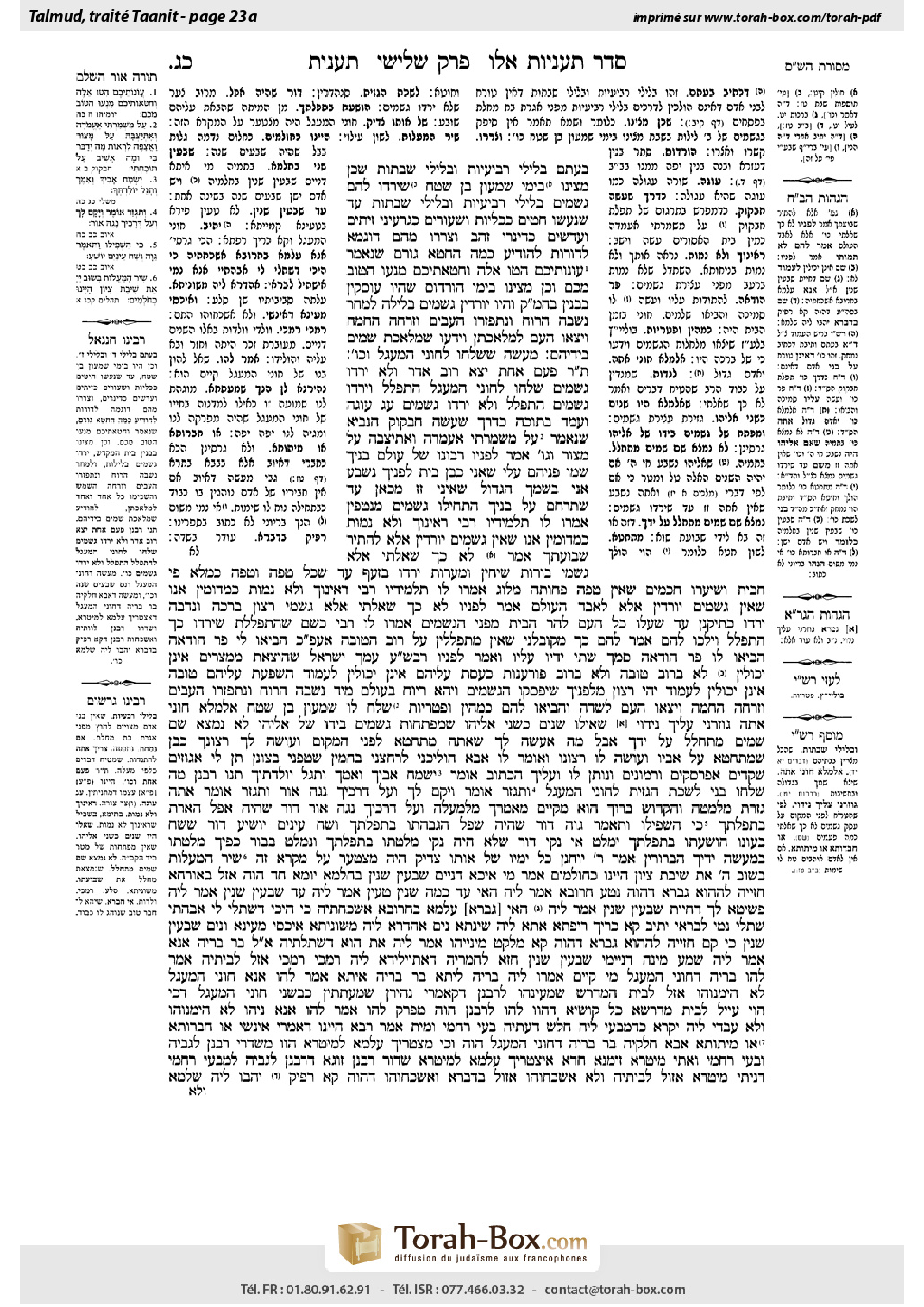
Taanit 23a: Talmud study for Daf Yomi
Daf Yomi is the daily study of one Talmud folio. Explore 37 tractates with scans, Hebrew text, Sefaria English and AI-generated French translations where annotated.
Passage selection and English or AI-generated French translation are available where the scan has annotations. Daf Study is independent of Torah-Box and Sefaria.
Browse Taanit · תענית · All tractatesTaanit 23a text and translations
This page of Taanit includes the Aramaic text, an English translation and an AI-generated French translation, alongside the scan above.
תענית כ״ג א · Aramaic and Hebrew text
״בְּעִתָּם״ — בְּלֵילֵי רְבִיעִיּוֹת וּבְלֵילֵי שַׁבָּתוֹת.
שֶׁכֵּן מָצִינוּ בִּימֵי שִׁמְעוֹן בֶּן שָׁטַח שֶׁיָּרְדוּ לָהֶם גְּשָׁמִים בְּלֵילֵי רְבִיעִיּוֹת וּבְלֵילֵי שַׁבָּתוֹת, עַד שֶׁנַּעֲשׂוּ חִטִּים כִּכְלָיוֹת, וּשְׂעוֹרִים כְּגַרְעִינֵי זֵיתִים, וַעֲדָשִׁים כְּדִינְרֵי זָהָב, וְצָרְרוּ מֵהֶם דּוּגְמָא לַדּוֹרוֹת, לְהוֹדִיעַ כַּמָּה הַחֵטְא גּוֹרֵם, שֶׁנֶּאֱמַר: ״עֲוֹנוֹתֵיכֶם הִטּוּ אֵלֶּה וְחַטֹּאתֵיכֶם מָנְעוּ הַטּוֹב מִכֶּם״.
וְכֵן מָצִינוּ בִּימֵי הוֹרְדוֹס, שֶׁהָיוּ עוֹסְקִין בְּבִנְיַן בֵּית הַמִּקְדָּשׁ, וְהָיוּ יוֹרְדִין גְּשָׁמִים בַּלַּיְלָה, לְמָחָר נָשְׁבָה הָרוּחַ וְנִתְפַּזְּרוּ הֶעָבִים וְזָרְחָה הַחַמָּה, וְיָצְאוּ הָעָם לִמְלַאכְתָּן, וְיָדְעוּ שֶׁמְּלֶאכֶת שָׁמַיִם בִּידֵיהֶם.
מַעֲשֶׂה שֶׁשָּׁלְחוּ לְחוֹנִי הַמְעַגֵּל וְכוּ׳. תָּנוּ רַבָּנַן: פַּעַם אַחַת יָצָא רוֹב אֲדָר וְלֹא יָרְדוּ גְּשָׁמִים, שָׁלְחוּ לְחוֹנִי הַמְעַגֵּל: הִתְפַּלֵּל וְיֵרְדוּ גְּשָׁמִים! הִתְפַּלֵּל, וְלֹא יָרְדוּ גְּשָׁמִים. עָג עוּגָה וְעָמַד בְּתוֹכָהּ, כְּדֶרֶךְ שֶׁעָשָׂה חֲבַקּוּק הַנָּבִיא, שֶׁנֶּאֱמַר: ״עַל מִשְׁמַרְתִּי אֶעֱמֹדָה וְאֶתְיַצְּבָה עַל מָצוֹר וְגוֹ׳״.
אָמַר לְפָנָיו: רִבּוֹנוֹ שֶׁל עוֹלָם! בָּנֶיךָ שָׂמוּ פְּנֵיהֶם עָלַי, שֶׁאֲנִי כְּבֶן בַּיִת לְפָנֶיךָ. נִשְׁבָּע אֲנִי בְּשִׁמְךָ הַגָּדוֹל שֶׁאֵינִי זָז מִכָּאן עַד שֶׁתְּרַחֵם עַל בָּנֶיךָ. הִתְחִילוּ גְּשָׁמִים מְנַטְּפִין. אָמְרוּ לוֹ תַּלְמִידָיו: רַבִּי! רְאִינוּךְ וְלֹא נָמוּת, כִּמְדוּמִּין אָנוּ שֶׁאֵין גְּשָׁמִים יוֹרְדִין אֶלָּא לְהַתִּיר שְׁבוּעָתְךָ.
אָמַר: לֹא כָּךְ שָׁאַלְתִּי, אֶלָּא גִּשְׁמֵי בּוֹרוֹת שִׁיחִין וּמְעָרוֹת. יָרְדוּ בְּזַעַף, עַד שֶׁכׇּל טִפָּה וְטִפָּה כִּמְלֹא פִּי חָבִית. וְשִׁיעֲרוּ חֲכָמִים שֶׁאֵין טִפָּה פְּחוּתָה מִלּוֹג. אָמְרוּ לוֹ תַּלְמִידָיו: רַבִּי, רְאִינוּךְ וְלֹא נָמוּת, כִּמְדוּמִּין אָנוּ שֶׁאֵין גְּשָׁמִים יוֹרְדִין אֶלָּא לְאַבֵּד הָעוֹלָם.
אָמַר לְפָנָיו: לֹא כָּךְ שָׁאַלְתִּי, אֶלָּא גִּשְׁמֵי רָצוֹן בְּרָכָה וּנְדָבָה. יָרְדוּ כְּתִיקְנָן, עַד שֶׁעָלוּ כׇּל הָעָם לְהַר הַבַּיִת, מִפְּנֵי הַגְּשָׁמִים. אָמְרוּ לוֹ: רַבִּי, כְּשֵׁם שֶׁהִתְפַּלַּלְתָּ שֶׁיֵּרְדוּ, כָּךְ הִתְפַּלֵּל וְיֵלְכוּ לָהֶם. אָמַר לָהֶם: כָּךְ מְקוּבְּלַנִי שֶׁאֵין מִתְפַּלְּלִין עַל רוֹב הַטּוֹבָה.
אַף עַל פִּי כֵן, הָבִיאוּ לִי פַּר הוֹדָאָה. הֵבִיאוּ לוֹ פַּר הוֹדָאָה, סָמַךְ שְׁתֵּי יָדָיו עָלָיו, וְאָמַר לְפָנָיו: רִבּוֹנוֹ שֶׁל עוֹלָם! עַמְּךָ יִשְׂרָאֵל שֶׁהוֹצֵאתָ מִמִּצְרַיִם אֵינָן יְכוֹלִין לֹא בְּרוֹב טוֹבָה וְלֹא בְּרוֹב פּוּרְעָנוּת. כָּעַסְתָּ עֲלֵיהֶם — אֵינָן יְכוֹלִין לַעֲמוֹד, הִשְׁפַּעְתָּ עֲלֵיהֶם טוֹבָה — אֵינָן יְכוֹלִין לַעֲמוֹד, יְהִי רָצוֹן מִלְּפָנֶיךָ שֶׁיִּפָּסְקוּ הַגְּשָׁמִים, וִיהֵא רֶיוַח בָּעוֹלָם. מִיָּד נָשְׁבָה הָרוּחַ, וְנִתְפַּזְּרוּ הֶעָבִים, וְזָרְחָה הַחַמָּה, וְיָצְאוּ הָעָם לַשָּׂדֶה וְהֵבִיאוּ לָהֶם כְּמֵהִין וּפִטְרִיּוֹת.
שָׁלַח לוֹ שִׁמְעוֹן בֶּן שָׁטַח: אִלְמָלֵא חוֹנִי אַתָּה, גּוֹזְרַנִי עָלֶיךָ נִידּוּי. שֶׁאִילּוּ שָׁנִים כִּשְׁנֵי אֵלִיָּהוּ שֶׁמַּפְתְּחוֹת גְּשָׁמִים בְּיָדוֹ שֶׁל אֵלִיָּהוּ, לֹא נִמְצָא שֵׁם שָׁמַיִם מִתְחַלֵּל עַל יָדְךָ,
אֲבָל מָה אֶעֱשֶׂה לְךָ, שֶׁאַתָּה מִתְחַטֵּא לִפְנֵי הַמָּקוֹם וְעוֹשֶׂה לְךָ רְצוֹנְךָ, כְּבֵן שֶׁמִּתְחַטֵּא עַל אָבִיו וְעוֹשֶׂה לוֹ רְצוֹנוֹ, וְאוֹמֵר לוֹ: אַבָּא, הוֹלִיכַנִי לְרׇחְצֵנִי בְּחַמִּין. שׇׁטְפֵנִי בְּצוֹנֵן. תֵּן לִי אֱגוֹזִים, שְׁקֵדִים, אֲפַרְסְקִים וְרִמּוֹנִים — וְנוֹתֵן לוֹ. וְעָלֶיךָ הַכָּתוּב אוֹמֵר: ״יִשְׂמַח אָבִיךָ וְאִמֶּךָ וְתָגֵל יוֹלַדְתֶּךָ״.
תָּנוּ רַבָּנַן: מָה שָׁלְחוּ בְּנֵי לִשְׁכַּת הַגָּזִית לְחוֹנִי הַמְעַגֵּל — ״וְתִגְזַר אֹמֶר וְיָקׇם לָךְ וְעַל דְּרָכֶיךָ נָגַהּ אוֹר״.
״וְתִגְזַר אֹמֶר״ — אַתָּה גָּזַרְתָּ מִלְּמַטָּה, וְהַקָּדוֹשׁ בָּרוּךְ הוּא מְקַיֵּים מַאֲמָרְךָ מִלְמַעְלָה. ״וְעַל דְּרָכֶיךָ נָגַהּ אוֹר״ — דּוֹר שֶׁהָיָה אָפֵל הֵאַרְתָּ בִּתְפִלָּתֶךָ.
״כִּי הִשְׁפִּילוּ וַתֹּאמֶר גֵּוָה״ — דּוֹר שֶׁהָיָה שָׁפֵל הִגְבַּהְתּוֹ בִּתְפִלָּתֶךָ. ״וְשַׁח עֵינַיִם יוֹשִׁעַ״ — דּוֹר שֶׁשַּׁח בַּעֲוֹנוֹ הוֹשַׁעְתּוֹ בִּתְפִלָּתֶךָ. ״יְמַלֵּט אִי נָקִי״ — דּוֹר שֶׁלֹּא הָיָה נָקִי מִלַּטְתּוֹ בִּתְפִלָּתֶךָ. ״וְנִמְלַט בְּבֹר כַּפֶּיךָ״ — מִלַּטְתּוֹ בְּמַעֲשֵׂה יָדֶיךָ הַבְּרוּרִין.
אָמַר רַבִּי יוֹחָנָן: כׇּל יָמָיו שֶׁל אוֹתוֹ צַדִּיק, הָיָה מִצְטַעֵר עַל מִקְרָא זֶה: ״שִׁיר הַמַּעֲלוֹת בְּשׁוּב ה׳ אֶת שִׁיבַת צִיּוֹן הָיִינוּ כְּחֹלְמִים״, אָמַר: מִי אִיכָּא דְּנָיֵים שִׁבְעִין שְׁנִין בְּחֶלְמָא?
יוֹמָא חַד הֲוָה אָזֵל בְּאוֹרְחָא, חַזְיֵיהּ לְהָהוּא גַּבְרָא דַּהֲוָה נָטַע חָרוּבָא, אֲמַר לֵיהּ: הַאי, עַד כַּמָּה שְׁנִין טָעֵין? אֲמַר לֵיהּ: עַד שִׁבְעִין שְׁנִין. אֲמַר לֵיהּ: פְּשִׁיטָא לָךְ דְּחָיֵית שִׁבְעִין שְׁנִין? אֲמַר לֵיהּ: אֲנָא חָרוּבָא בְּעָלְמָא אַשְׁכְּחֵיהּ. כִּי הֵיכִי דִּשְׁתַלוּ לִי אֲבָהָתִי — שְׁתַלִי נָמֵי לִבְרָאִי.
יָתֵיב, קָא כָּרֵיךְ רִיפְתָּא, אֲתַאי לֵיהּ שִׁינְתָּא, נִים. אַהְדַּרָא לֵיהּ מְשּׁוּנִּיתָא, אִיכַּסִּי מֵעֵינָא, וְנִים שִׁבְעִין שְׁנִין. כִּי קָם, חַזְיֵיהּ לְהָהוּא גַּבְרָא דְּהוּא קָא מְלַקֵּט מִינַּיְיהוּ, אָמַר לֵיהּ: אַתְּ הוּא דִּשְׁתַלְתֵּיהּ? אֲמַר לֵיהּ: בַּר בְּרֵיהּ אֲנָא. אֲמַר לֵיהּ: שְׁמַע מִינַּהּ דִּנְיַימִי שִׁבְעִין שְׁנִין. חֲזָא לַחֲמָרְ[תֵּ]יהּ דְּאִתְיְילִידָא לַיהּ רַמְכֵי רַמְכֵי.
אֲזַל לְבֵיתֵיהּ אֲמַר לְהוּ: בְּרֵיהּ דְּחוֹנִי הַמְעַגֵּל מִי קַיָּים? אֲמַרוּ לֵיהּ: בְּרֵיהּ לֵיתֵאּ, בַּר בְּרֵיהּ אִיתֵאּ. אֲמַר לְהוּ: אֲנָא חוֹנִי הַמְעַגֵּל. לָא הֵימְנוּהוּ. אֲזַל לְבֵית הַמִּדְרָשׁ, שַׁמְעִינְהוּ לְרַבָּנַן דְּקָאָמְרִי: נְהִירָן שְׁמַעְתָּתִין כְּבִשְׁנֵי חוֹנִי הַמְעַגֵּל, דְּכִי הָוֵי עָיֵיל לְבֵית מִדְרְשָׁא — כֹּל קוּשְׁיָא דַּהֲווֹ לְהוּ לְרַבָּנַן הֲוָה מְפָרֵק לְהוּ. אָמַר לְהוּ: אֲנָא נִיהוּ, וְלָא הֵימְנוּהוּ, וְלָא עָבְדִי לֵיהּ יְקָרָא כִּדְמִבְּעֵי לֵיהּ. חֲלַשׁ דַּעְתֵּיהּ, בְּעָא רַחֲמֵי, וּמִית. אָמַר רָבָא: הַיְינוּ דְּאָמְרִי אִינָשֵׁי: אוֹ חַבְרוּתָא אוֹ מִיתוּתָא.
אַבָּא חִלְקִיָּה בַּר בְּרֵיהּ דְּחוֹנִי הַמְעַגֵּל הֲוָה, וְכִי מִצְטְרִיךְ עָלְמָא לְמִיטְרָא הֲווֹ מְשַׁדְּרִי רַבָּנַן לְגַבֵּיהּ וּבָעֵי רַחֲמֵי, וְאָתֵי מִיטְרָא. זִימְנָא חֲדָא אִיצְטְרִיךְ עָלְמָא לְמִיטְרָא, שַׁדּוּר רַבָּנַן זוּגָא דְּרַבָּנַן לְגַבֵּיהּ לְמִבְעֵי רַחֲמֵי דְּנֵיתֵי מִיטְרָא. אֲזוּל לְבֵיתֵיהּ וְלָא אַשְׁכְּחוּהּו, אֲזוּל בְּדַבְרָא וְאַשְׁכְּחוּהּ דַּהֲוָה קָא רָפֵיק, יְהַבוּ לֵיהּ שְׁלָמָא
Taanit 23a · English translation
“In their season” means on Wednesday eves, i.e., Tuesday nights, and on Shabbat eves, i.e., Friday nights, because at these times people are not out in the streets, either due to fear of demonic forces that were thought to wander on Tuesday nights or due to the sanctity of Shabbat.
As we found in the days of Shimon ben Shetaḥ that rain invariably fell for them on Wednesday eves and on Shabbat eves, until wheat grew as big as kidneys, and barley as big as olive pits, and lentils as golden dinars. And they tied up some of these crops as an example [dugma] for future generations, to convey to them how much damage sin causes, as it is stated: “The Lord our God, Who gives rain, the former rain and the latter rain, in its season that keeps for us the appointed weeks of the harvest. Your iniquities have turned away these things, and your sins have withheld the good from you” (Jeremiah 5:24–25).
And we likewise found that in the days of Herod that they were occupied in the building of the Temple, and rain would fall at night. And the next day the wind would blow, the clouds would disperse, the sun would shine, and the people would go out to their work. And as rain would fall only at a time when it would not interfere with their labor, the nation knew that the work of Heaven was being performed by their hands.
§ The mishna taught: An incident occurred in which the people sent a message to Ḥoni HaMe’aggel. This event is related in greater detail in the following baraita. The Sages taught: Once, most of the month of Adar had passed but rain had still not fallen. They sent this message to Ḥoni HaMe’aggel: Pray, and rain will fall. He prayed, but no rain fell. He drew a circle in the dust and stood inside it, in the manner that the prophet Habakkuk did, as it is stated: “And I will stand upon my watch and set myself upon the tower, and I will look out to see what He will say to me, and what I shall answer when I am reproved” (Habakkuk 2:1). This verse is taken to mean that Habakkuk fashioned a kind of prison for himself where he sat.
Ḥoni said before God: Master of the Universe, Your children have turned their faces toward me, as I am like a member of Your household. Therefore, I take an oath by Your great name that I will not move from here until you have mercy upon Your children and answer their prayers for rain. Rain began to trickle down, but only in small droplets. His students said to him: Rabbi, we have seen that you can perform great wonders, but this quantity of rain is not enough to ensure that we will not die. It appears to us that a small amount of rain is falling only to enable you to dissolve your oath, but it is not nearly enough to save us.
Ḥoni said to God: I did not ask for this, but for rain to fill the cisterns, ditches, and caves. Rain began to fall furiously, until each and every drop was as big as the mouth of a barrel, and the Sages estimated that no drop was less than a log in size. His students said to him: Rabbi, we have seen that you can call on God to perform miracles and we will not die, but now it appears to us that rain is falling only to destroy the world.
Ḥoni again said before God: I did not ask for this harmful rain either, but for rain of benevolence, blessing, and generosity. Subsequently, the rains fell in their standard manner, until all of the people sought higher ground and ascended to the Temple Mount due to the rain. They said to him: Rabbi, just as you prayed that the rains should fall, so too, pray that they should stop. He said to them: This is the tradition that I received, that one does not pray over an excess of good.
Ḥoni continued: Nevertheless, bring me a bull. I will sacrifice it as a thanks-offering and pray at the same time. They brought him a bull for a thanks-offering. He placed his two hands on its head and said before God: Master of the Universe, Your nation Israel, whom You brought out of Egypt, cannot bear either an excess of good or an excess of punishment. You grew angry with them and withheld rain, and they are unable to bear it. You bestowed upon them too much good, and they were also unable to bear it. May it be Your will that the rain stop and that there be relief for the world. Immediately, the wind blew, the clouds dispersed, the sun shone, and everyone went out to the fields and gathered for themselves truffles and mushrooms that had sprouted in the strong rain.
Shimon ben Shetaḥ relayed to Ḥoni HaMe’aggel: If you were not Ḥoni, I would have decreed ostracism upon you. For were these years like the years of Elijah, when the keys of rain were entrusted in Elijah’s hands, and he swore it would not rain, wouldn’t the name of Heaven have been desecrated by your oath not to leave the circle until it rained? Once you have pronounced this oath, either yours or Elijah’s must be falsified.
However, what can I do to you, as you nag God and He does your bidding, like a son who nags his father and his father does his bidding. And the son says to his father: Father, take me to be bathed in hot water; wash me with cold water; give me nuts, almonds, peaches, and pomegranates. And his father gives him. About you, the verse states: “Your father and mother will be glad and she who bore you will rejoice” (Proverbs 23:25).
The Sages taught: What message did the members of the Chamber of the Hewn Stone, the Great Sanhedrin, send to Ḥoni HaMe’aggel? About you, the verse states: “You shall also decree a matter, and it shall be established for you; and the light shall shine upon your ways. When they cast down, you will say: There is lifting up, for He saves the humble person. He will deliver the one who is not innocent and he will be delivered through the cleanness of your hands” (Job 22:28–30).
They interpreted: “You shall also decree a matter”; you, Ḥoni, decree from below, and the Holy One, Blessed be He, fulfills your statement from above. “And the light shall shine upon your ways”; a generation that was in darkness, you have illuminated it with your prayer.
“When they cast down, you will say: There is lifting up”; a generation that was cast down, you lifted it up with your prayer. “For He saves the humble person”; a generation that was humble in its transgression, you saved it through your prayer. “He will deliver the one who is not innocent”; a generation that was not innocent, you have delivered it through your prayer. “And he will be delivered through the cleanness of your hands”; you have delivered an undeserving generation through the clean work of your hands.
§ The Gemara relates another story about Ḥoni HaMe’aggel. Rabbi Yoḥanan said: All the days of the life of that righteous man, Ḥoni, he was distressed over the meaning of this verse: “A song of Ascents: When the Lord brought back those who returned to Zion, we were like those who dream” (Psalms 126:1). He said to himself: Is there really a person who can sleep and dream for seventy years? How is it possible to compare the seventy-year exile in Babylonia to a dream?
One day, he was walking along the road when he saw a certain man planting a carob tree. Ḥoni said to him: This tree, after how many years will it bear fruit? The man said to him: It will not produce fruit until seventy years have passed. Ḥoni said to him: Is it obvious to you that you will live seventy years, that you expect to benefit from this tree? He said to him: That man himself found a world full of carob trees. Just as my ancestors planted for me, I too am planting for my descendants.
Ḥoni sat and ate bread. Sleep overcame him and he slept. A cliff formed around him, and he disappeared from sight and slept for seventy years. When he awoke, he saw a certain man gathering carobs from that tree. Ḥoni said to him: Are you the one who planted this tree? The man said to him: I am his son’s son. Ḥoni said to him: I can learn from this that I have slept for seventy years, and indeed he saw that his donkey had sired several herds during those many years.
Ḥoni went home and said to the members of the household: Is the son of Ḥoni HaMe’aggel alive? They said to him: His son is no longer with us, but his son’s son is alive. He said to them: I am Ḥoni HaMe’aggel. They did not believe him. He went to the study hall, where he heard the Sages say about one scholar: His halakhot are as enlightening and as clear as in the years of Ḥoni HaMe’aggel, for when Ḥoni HaMe’aggel would enter the study hall he would resolve for the Sages any difficulty they had. Ḥoni said to them: I am he, but they did not believe him and did not pay him proper respect. Ḥoni became very upset, prayed for mercy, and died. Rava said: This explains the folk saying that people say: Either friendship or death, as one who has no friends is better off dead.
§ The Gemara relates another story, this time about Ḥoni HaMe’aggel’s descendants, who were also renowned for their righteous deeds. Abba Ḥilkiyya was the son of Ḥoni HaMe’aggel’s son. And when the world was in need of rain they would send Sages to him, and he would pray for mercy, and rain would fall. Once the world was in need of rain, and the Sages sent a pair of Sages to him so that he would pray for mercy and rain would fall. They went to his house but they did not find him there. They went to the field and found him hoeing the ground. They greeted him,
Taanit 23a · Traduction française (IA)
« En leur saison » désigne les veilles du mercredi, c’est-à-dire les nuits du mardi, et les veilles de Chabbat, c’est-à-dire les nuits du vendredi, car à ces moments-là, les gens ne sont pas dans les rues, soit par crainte des forces démoniaques que l’on croyait errer les nuits du mardi, soit en raison de la sainteté du Chabbat.
Car nous avons constaté qu’à l’époque de Shimon ben Shetaḥ, la pluie tombait régulièrement pour eux les veilles du mercredi et les veilles de Chabbat, au point que le blé poussait avec des grains aussi gros que des reins, l’orge avec des grains aussi gros que des noyaux d’olive et les lentilles avec des grains aussi gros que des dinars d’or. Ils lièrent certains de ces produits agricoles en guise d’exemple [dugma] pour les générations futures, afin de leur faire comprendre combien de dommages le péché cause, comme il est dit : « L’Éternel, notre Dieu, qui donne la pluie, la pluie de la première et de l’arrière-saison, en son temps, qui nous réserve les semaines fixées pour la moisson. Vos fautes ont détourné ces choses, et vos péchés vous ont privés du bien » (Jérémie 5:24–25).
De même, nous avons constaté qu’à l’époque d’Hérode, alors qu’ils étaient occupés à la construction du Temple, la pluie tombait la nuit. Le lendemain, le vent soufflait, les nuages se dissipaient, le soleil brillait et les gens sortaient travailler. Comme la pluie ne tombait qu’à un moment où elle ne gênait pas leur travail, le peuple savait que l’œuvre du Ciel s’accomplissait par leurs mains.
§ La Michna enseigne : Un événement se produisit où le peuple envoya un message à Ḥoni HaMe’aggel. La baraïta suivante rapporte cet épisode plus en détail. Les Sages ont enseigné : Une fois, la majeure partie du mois d’Adar s’était écoulée, mais la pluie n’était toujours pas tombée. On envoya ce message à Ḥoni HaMe’aggel : « Prie, et la pluie tombera. » Il pria, mais aucune pluie ne tomba. Il traça un cercle dans la poussière et se tint à l’intérieur, à la manière du prophète Habacuc, comme il est dit : « Je me tiendrai à mon poste de garde et me placerai sur la tour ; je guetterai pour voir ce qu’Il me dira et ce que je répondrai lorsque je serai repris » (Habacuc 2:1). Ce verset est compris comme signifiant qu’Habacuc s’était aménagé une sorte de prison où il s’assit.
Ḥoni dit devant Dieu : « Maître de l’univers, Tes enfants se sont tournés vers moi, car je suis comme un membre de Ta maison. C’est pourquoi je jure par Ton grand Nom que je ne bougerai pas d’ici jusqu’à ce que Tu aies pitié de Tes enfants et exauces leurs prières pour la pluie. » La pluie commença à tomber en bruine, mais seulement en petites gouttes. Ses élèves lui dirent : « Rabbi, nous avons vu que tu peux accomplir de grands prodiges, mais cette quantité de pluie ne suffit pas à nous assurer que nous ne mourrons pas. Il nous semble qu’une faible quantité de pluie tombe uniquement pour te permettre de te délier de ton serment, mais elle est loin de suffire à nous sauver. »
Ḥoni dit à Dieu : « Ce n’est pas cela que j’ai demandé, mais de la pluie qui remplisse les citernes, les fossés et les grottes. » La pluie se mit à tomber avec violence, au point que chaque goutte était aussi grosse que l’ouverture d’un tonneau ; les Sages estimèrent qu’aucune goutte ne faisait moins d’un log. Ses élèves lui dirent : « Rabbi, nous avons vu que tu peux demander à Dieu d’accomplir des miracles pour que nous ne mourions pas, mais maintenant, il nous semble que la pluie ne tombe que pour détruire le monde. »
Ḥoni dit de nouveau devant Dieu : « Je n’ai pas non plus demandé cette pluie nuisible, mais une pluie de bienveillance, de bénédiction et de générosité. » Ensuite, les pluies tombèrent de manière habituelle, jusqu’à ce que tous cherchent un terrain plus élevé et montent sur le mont du Temple à cause de la pluie. Ils lui dirent : « Rabbi, de même que tu as prié pour que les pluies tombent, prie aussi pour qu’elles s’arrêtent. » Il leur dit : « Voici la tradition que j’ai reçue : on ne prie pas au sujet d’un excès de bien. »
Ḥoni poursuivit : « Néanmoins, amenez-moi un taureau. Je l’offrirai en sacrifice d’action de grâce et prierai en même temps. » On lui amena un taureau en sacrifice d’action de grâce. Il posa ses deux mains sur sa tête et dit devant Dieu : « Maître de l’univers, Ton peuple Israël, que Tu as fait sortir d’Égypte, ne peut supporter ni un excès de bien ni un excès de châtiment. Tu T’es irrité contre lui et as retenu la pluie, et il ne peut le supporter. Tu lui as accordé trop de bien, et il n’a pas pu le supporter non plus. Qu’il soit Ta volonté que la pluie cesse et que le monde soit soulagé. » Aussitôt, le vent souffla, les nuages se dissipèrent, le soleil brilla, et tous sortirent dans les champs pour y cueillir des truffes et des champignons qui avaient poussé sous cette pluie abondante.
Shimon ben Shetaḥ fit transmettre à Ḥoni HaMe’aggel : « Si tu n’étais pas Ḥoni, j’aurais prononcé contre toi une sentence d’excommunication. Car si ces années avaient été comme celles d’Élie, lorsque les clés de la pluie avaient été confiées à Élie et qu’il avait juré qu’il ne pleuvrait pas, le Nom du Ciel n’aurait-il pas été profané par ton serment de ne pas quitter le cercle avant qu’il pleuve ? Une fois que tu as prononcé ce serment, soit le tien, soit celui d’Élie doit être démenti. »
« Cependant, que puis-je te faire, puisque tu importunes Dieu et qu’Il exauce tes demandes, comme un fils qui importune son père et dont le père exauce les demandes ? Le fils dit à son père : “Père, emmène-moi prendre un bain chaud ; lave-moi à l’eau froide ; donne-moi des noix, des amandes, des pêches et des grenades.” Et son père les lui donne. À ton sujet, le verset dit : “Que ton père et ta mère se réjouissent, et que celle qui t’a enfanté soit dans l’allégresse” (Proverbes 23:25). »
Les Sages ont enseigné : Quel message les membres de la Chambre de la pierre de taille, le Grand Sanhédrin, ont-ils envoyé à Ḥoni HaMe’aggel ? À ton sujet, le verset dit : « Tu décideras aussi d’une chose, et elle s’accomplira pour toi ; la lumière brillera sur tes chemins. Lorsqu’ils seront abattus, tu diras : “Il y a relèvement”, car Il sauve l’homme humble. Il délivrera celui qui n’est pas innocent, et celui-ci sera délivré grâce à la pureté de tes mains » (Job 22:28–30).
Ils interprétèrent ainsi : « Tu décideras aussi d’une chose » : toi, Ḥoni, tu décides depuis ici-bas, et le Saint, béni soit-Il, accomplit ta parole là-haut. « La lumière brillera sur tes chemins » : tu as éclairé par ta prière une génération qui était dans les ténèbres.
« Lorsqu’ils seront abattus, tu diras : “Il y a relèvement” » : tu as relevé par ta prière une génération qui était abattue. « Car Il sauve l’homme humble » : tu as sauvé par ta prière une génération humble dans sa transgression. « Il délivrera celui qui n’est pas innocent » : tu as délivré par ta prière une génération qui n’était pas innocente. « Et celui-ci sera délivré grâce à la pureté de tes mains » : tu as délivré, par l’œuvre pure de tes mains, une génération qui ne le méritait pas.
§ La Guemara rapporte une autre histoire au sujet de Ḥoni HaMe’aggel. Rabbi Yoḥanan dit : Durant toute la vie de ce juste, Ḥoni, celui-ci fut tourmenté par le sens de ce verset : « Cantique des montées. Quand l’Éternel ramena ceux qui revenaient à Sion, nous étions comme des rêveurs » (Psaumes 126:1). Il se disait : « Existe-t-il vraiment quelqu’un qui puisse dormir et rêver pendant soixante-dix ans ? Comment peut-on comparer les soixante-dix années de l’exil à Babylone à un rêve ? »
Un jour, il marchait sur la route lorsqu’il vit un homme planter un caroubier. Ḥoni lui dit : « Au bout de combien d’années cet arbre donnera-t-il des fruits ? » L’homme lui répondit : « Il ne produira pas de fruits avant que soixante-dix ans ne se soient écoulés. » Ḥoni lui dit : « Es-tu certain de vivre soixante-dix ans, pour espérer profiter de cet arbre ? » L’homme lui répondit : « Cet homme a trouvé un monde rempli de caroubiers. De même que mes ancêtres en ont planté pour moi, moi aussi j’en plante pour mes descendants. »
Ḥoni s’assit et mangea du pain. Le sommeil s’empara de lui et il s’endormit. Une falaise se forma autour de lui ; il disparut de la vue et dormit pendant soixante-dix ans. À son réveil, il vit un homme qui récoltait des caroubes sur cet arbre. Ḥoni lui dit : « Est-ce toi qui as planté cet arbre ? » L’homme lui répondit : « Je suis le petit-fils de son fils. » Ḥoni lui dit : « J’en conclus que j’ai dormi pendant soixante-dix ans. » En effet, il constata que son ânesse avait engendré plusieurs troupeaux au cours de ces longues années.
Ḥoni rentra chez lui et demanda aux membres de la maisonnée : « Le fils de Ḥoni HaMe’aggel est-il en vie ? » Ils lui répondirent : « Son fils n’est plus parmi nous, mais son petit-fils est en vie. » Il leur dit : « Je suis Ḥoni HaMe’aggel. » Ils ne le crurent pas. Il se rendit à la maison d’étude, où il entendit les Sages dire à propos d’un érudit : « Ses halakhot sont aussi lumineuses et aussi claires qu’à l’époque de Ḥoni HaMe’aggel, car lorsque Ḥoni HaMe’aggel entrait à la maison d’étude, il résolvait toutes les difficultés que les Sages rencontraient. » Ḥoni leur dit : « C’est moi. » Mais ils ne le crurent pas et ne lui témoignèrent pas le respect qui lui était dû. Ḥoni en fut très contrarié ; il pria pour obtenir la miséricorde et mourut. Rava dit : Cela explique le dicton populaire : « Ou bien l’amitié, ou bien la mort », car celui qui n’a pas d’amis ferait mieux d’être mort.
§ La Guemara rapporte une autre histoire, cette fois au sujet des descendants de Ḥoni HaMe’aggel, eux aussi réputés pour leurs actes de piété. Abba Ḥilkiyya était le petit-fils de Ḥoni HaMe’aggel. Lorsque le monde avait besoin de pluie, on lui envoyait des Sages ; il priait pour obtenir la miséricorde, et la pluie tombait. Une fois, le monde eut besoin de pluie et les Sages lui envoyèrent deux Sages afin qu’il prie pour obtenir la miséricorde et que la pluie tombe. Ils se rendirent chez lui, mais ne le trouvèrent pas. Ils allèrent dans les champs et le trouvèrent en train de biner la terre. Ils le saluèrent,
Traduction française générée par IA à partir de l’édition anglaise de Sefaria. Vérifie toujours un passage avec le texte source.
Text from Sefaria: William Davidson Edition - Vocalized Aramaic (CC BY NC); William Davidson Edition - English (CC BY NC).