Taanit 22b: Talmud study for Daf Yomi
Daf Yomi is the daily study of one Talmud folio. Explore 37 tractates with scans, Hebrew text, Sefaria English and AI-generated French translations where annotated.
Passage selection and English or AI-generated French translation are available where the scan has annotations. Daf Study is independent of Torah-Box and Sefaria.
Browse Taanit · תענית · All tractatesTaanit 22b text and translations
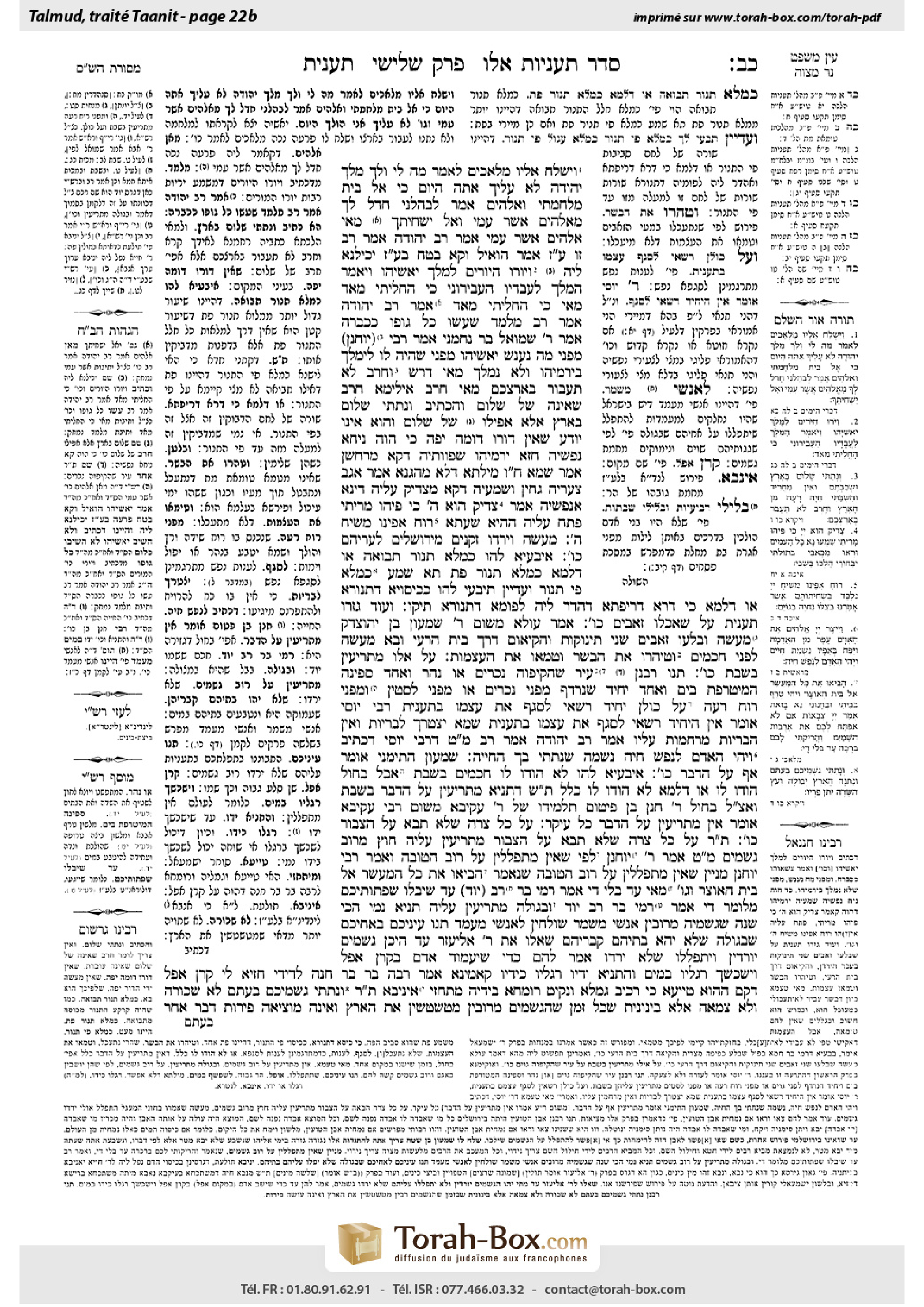
This page of Taanit includes the Aramaic text, an English translation and an AI-generated French translation, alongside the scan above.
תענית כ״ב ב · Aramaic and Hebrew text
״וַיִּשְׁלַח אֵלָיו מַלְאָכִים לֵאמֹר מַה לִּי וָלָךְ מֶלֶךְ יְהוּדָה לֹא עָלֶיךָ אַתָּה הַיּוֹם כִּי אֶל בֵּית מִלְחַמְתִּי וֵאלֹהִים אָמַר לְבַהֲלֵנִי חֲדַל לְךָ מֵאֱלֹהִים אֲשֶׁר עִמִּי וְאַל יַשְׁחִיתֶךָ״.
מַאי: ״אֱלֹהִים אֲשֶׁר עִמִּי״? אָמַר רַב יְהוּדָה אָמַר רַב: זוֹ עֲבוֹדָה זָרָה. אֲמַר: הוֹאִיל וְקָא בָּטַח בַּעֲבוֹדָה זָרָה — יָכֵילְנָא לֵיהּ.
״וַיֹּרוּ הַיֹּרִים לַמֶּלֶךְ יֹאשִׁיָּהוּ וַיֹּאמֶר הַמֶּלֶךְ לַעֲבָדָיו הַעֲבִירוּנִי כִּי הׇחֳלֵיתִי מְאֹד״, מַאי ״כִּי הׇחֳלֵיתִי מְאֹד״? אָמַר רַב יְהוּדָה אָמַר רַב: מְלַמֵּד שֶׁעָשׂוּ כׇּל גּוּפוֹ כִּכְבָרָה.
אָמַר רַבִּי שְׁמוּאֵל בַּר נַחְמָנִי אָמַר רַבִּי יוֹנָתָן: מִפְּנֵי מָה נֶעֱנַשׁ יֹאשִׁיָּהוּ — מִפְּנֵי שֶׁהָיָה לוֹ לִימָּלֵךְ בְּיִרְמְיָהוּ וְלֹא נִמְלַךְ. מַאי דְּרַשׁ: ״וְחֶרֶב לֹא תַעֲבֹר בְּאַרְצְכֶם״,
מַאי ״חֶרֶב״? אִילֵּימָא חֶרֶב שֶׁאֵינָהּ שֶׁל שָׁלוֹם, וְהָכְתִיב: ״וְנָתַתִּי שָׁלוֹם בָּאָרֶץ״! אֶלָּא אֲפִילּוּ שֶׁל שָׁלוֹם. וְהוּא אֵינוֹ יוֹדֵעַ שֶׁאֵין דּוֹרוֹ דּוֹמֶה יָפֶה.
כִּי הֲוָה נִיחָא נַפְשֵׁיהּ, חֲזָא יִרְמְיָהוּ שִׂפְווֹתֵיהּ דְּקָא מְרַחֲשָׁן, אָמַר: שֶׁמָּא חַס וְשָׁלוֹם מִילְּתָא דְּלָא מְהַגְּנָא אֲמַר אַגַּב צַעֲרֵיהּ. גְּחֵין וְשַׁמְעֵיהּ דְּקָא מַצְדֵּיק עֲלֵיהּ דִּינָא אַנַּפְשֵׁיהּ, אֲמַר: ״צַדִּיק הוּא ה׳ כִּי פִיהוּ מָרִיתִי״. פְּתַח עֲלֵיהּ הַהִיא שַׁעְתָּא: ״רוּחַ אַפֵּינוּ מְשִׁיחַ ה׳״.
מַעֲשֶׂה וְיָרְדוּ זְקֵנִים מִירוּשָׁלַיִם לְעָרֵיהֶם כּוּ׳. אִיבַּעְיָא לְהוּ: כִּמְלֹא תַנּוּר תְּבוּאָה, אוֹ דִלְמָא כִּמְלֹא תַנּוּר פַּת.
תָּא שְׁמַע: כִּמְלֹא פִי תַנּוּר. וַעֲדַיִין תִּיבְּעֵי לְהוּ: כְּכִיסּוּיָא דְתַנּוּרָא, אוֹ דִלְמָא כִּי דָרָא דְרִיפְתָּא דְּהָדַר לֵיהּ לְפוּמָּא דְתַנּוּרָא? תֵּיקוּ.
וְעוֹד גָּזְרוּ תַּעֲנִית עַל שֶׁאָכְלוּ זְאֵבִים כּוּ׳. אָמַר עוּלָּא מִשּׁוּם רַבִּי שִׁמְעוֹן בֶּן יְהוֹצָדָק: מַעֲשֶׂה וּבָלְעוּ זְאֵבִים שְׁנֵי תִינוֹקוֹת וֶהֱקִיאוּם דֶּרֶךְ בֵּית הָרְעִי. וּבָא מַעֲשֶׂה לִפְנֵי חֲכָמִים, וְטִיהֲרוּ אֶת הַבָּשָׂר, וְטִמְּאוּ אֶת הָעֲצָמוֹת.
עַל אֵלּוּ מַתְרִיעִין בְּשַׁבָּת כּוּ׳. תָּנוּ רַבָּנַן: עִיר שֶׁהִקִּיפוּהָ נׇכְרִים אוֹ נָהָר, וְאֶחָד סְפִינָה הַמִּיטָּרֶפֶת בַּיָּם, וְאֶחָד יָחִיד שֶׁנִּרְדָּף מִפְּנֵי נׇכְרִים אוֹ מִפְּנֵי לִסְטִין וּמִפְּנֵי רוּחַ רָעָה — מַתְרִיעִין בְּשַׁבָּת. וְעַל כּוּלָּן יָחִיד רַשַּׁאי לְסַגֵּף אֶת עַצְמוֹ בְּתַעֲנִית.
רַבִּי יוֹסֵי אוֹמֵר: אֵין הַיָּחִיד רַשַּׁאי לְסַגֵּף אֶת עַצְמוֹ בְּתַעֲנִית, שֶׁמָּא יִצְטָרֵךְ לַבְּרִיּוֹת וְאֵין הַבְּרִיּוֹת מְרַחֲמוֹת עָלָיו. אָמַר רַב יְהוּדָה אָמַר רַב: מַאי טַעְמָא דְּרַבִּי יוֹסֵי — דִּכְתִיב: ״וַיְהִי הָאָדָם לְנֶפֶשׁ חַיָּה״ — נְשָׁמָה שֶׁנָּתַתִּי בְּךָ הַחְיֵיה.
שִׁמְעוֹן הַתִּימְנִי אוֹמֵר: אַף עַל הַדֶּבֶר כּוּ׳. אִיבַּעְיָא לְהוּ: לֹא הוֹדוּ לוֹ חֲכָמִים בַּשַּׁבָּת, אֲבָל בַּחוֹל — הוֹדוּ לוֹ, אוֹ דִלְמָא: לֹא הוֹדוּ לוֹ כְּלָל?
תָּא שְׁמַע, דְּתַנְיָא: מַתְרִיעִין עַל הַדֶּבֶר בַּשַּׁבָּת, וְאֵין צָרִיךְ לוֹמַר בַּחוֹל. רַבִּי חָנָן בֶּן פִּיטוֹם תַּלְמִידוֹ שֶׁל רַבִּי עֲקִיבָא מִשּׁוּם רַבִּי עֲקִיבָא אוֹמֵר: אֵין מַתְרִיעִין עַל הַדֶּבֶר כׇּל עִיקָּר.
עַל כׇּל צָרָה שֶׁלֹּא תָּבוֹא עַל הַצִּבּוּר כּוּ׳. תָּנוּ רַבָּנַן: עַל כׇּל צָרָה שֶׁלֹּא תָּבוֹא עַל הַצִּבּוּר מַתְרִיעִין עָלֶיהָ, חוּץ מֵרוֹב גְּשָׁמִים. מַאי טַעְמָא? אָמַר רַבִּי יוֹחָנָן: לְפִי שֶׁאֵין מִתְפַּלְּלִין עַל רוֹב הַטּוֹבָה.
וְאָמַר רַבִּי יוֹחָנָן: מִנַּיִין שֶׁאֵין מִתְפַּלְּלִין עַל רוֹב הַטּוֹבָה, שֶׁנֶּאֱמַר: ״הָבִיאוּ אֶת כׇּל הַמַּעֲשֵׂר אֶל בֵּית הָאוֹצָר וְגוֹ׳״. מַאי ״עַד בְּלִי דָּי״? אָמַר רָמֵי בַּר רַב יוֹד: עַד שֶׁיִּבְלוּ שִׂפְתוֹתֵיכֶם מִלּוֹמַר ״דָּי״.
אָמַר רָמֵי בַּר רַב יוֹד: וּבַגּוֹלָה, מַתְרִיעִין עָלֶיהָ. תַּנְיָא נָמֵי הָכִי: שָׁנָה שֶׁגְּשָׁמֶיהָ מְרוּבִּין, אַנְשֵׁי מִשְׁמָר שׁוֹלְחִין לְאַנְשֵׁי מַעֲמָד: תְּנוּ עֵינֵיכֶם בַּאֲחֵיכֶם שֶׁבַּגּוֹלָה, שֶׁלֹּא יְהֵא בָּתֵּיהֶם קִבְרֵיהֶם.
שָׁאֲלוּ אֶת רַבִּי אֱלִיעֶזֶר: עַד הֵיכָן גְּשָׁמִים יוֹרְדִין וְיִתְפַּלְּלוּ שֶׁלֹּא יֵרְדוּ? אָמַר לָהֶם: כְּדֵי שֶׁיַּעֲמוֹד אָדָם בְּקֶרֶן אָפֵל וִישַׁכְשֵׁךְ רַגְלָיו בַּמַּיִם. וְהָתַנְיָא: ״יָדָיו״! רַגְלָיו כְּיָדָיו קָאָמֵינָא.
אָמַר רַבָּה בַּר בַּר חָנָה: לְדִידִי חַזְיָא לִי קֶרֶן אָפֵל, דְּקָם הַהוּא טַיָּיעָא כִּי רְכִיב גַּמְלָא וְנָקֵיט רוּמְחָא בִּידֵיהּ מִיתְחֲזֵי אִינִיבָא.
תָּנוּ רַבָּנַן: ״וְנָתַתִּי גִּשְׁמֵיכֶם בְּעִתָּם״, לֹא שִׁכּוֹרָה, וְלֹא צְמֵאָה, אֶלָּא בֵּינוֹנִית. שֶׁכׇּל זְמַן שֶׁהַגְּשָׁמִים מְרוּבִּין — מְטַשְׁטְשִׁין אֶת הָאָרֶץ וְאֵינָהּ מוֹצִיאָהּ פֵּירוֹת. דָּבָר אַחֵר:
Taanit 22b · English translation
“But he sent ambassadors to him saying: What have I to do with you, king of Judea? I do not come against you this day, but against the house with which I am at war; and God has commanded me to make haste. Forbear from meddling with God, Who is with me, so that He will not destroy you” (II Chronicles 35:21). This clearly shows that Pharaoh Neco had no intention of engaging Josiah in battle.
The Gemara asks: What is the meaning of the phrase “God, Who is with me”? Rav Yehuda said that Rav said: This is referring to Neco’s idolatry, which he brought for assistance. In other words, it is a secular reference and should be read as: The god that is with me, in my possession. Josiah said: Since he trusts in idolatry, I will be able to defeat him.
With regard to Josiah’s battle with Pharaoh Neco, the verse states: “And the archers shot at King Josiah and the king said to his servants: Move me away, for I am seriously wounded” (II Chronicles 35:23). What is the meaning of the phrase: “For I am seriously wounded”? Rav Yehuda said that Rav said: This teaches that the Egyptian archers made his entire body like a sieve from the many arrows they shot at him.
Rabbi Shmuel bar Naḥmani said that Rabbi Yoḥanan said: For what reason was Josiah punished? Because he should have consulted with the prophet Jeremiah to find out if he should go to war, but he did not consult with him. How did Josiah interpret the verses of the Torah? How did they lead him to go to war? The verse states: “Neither shall a sword go through your land” (Leviticus 26:6).
What is the meaning of the term: “Sword”? If we say that it is referring to a sword that is not of peace, but isn’t it written earlier in the same verse: “And I will give peace in the land”? Rather, the verse must mean that even a sword of peace shall not pass through the land, and Josiah sought to prevent this occurrence, in fulfillment of the blessing. But he did not know that his generation did not merit these blessings, and he would therefore not receive divine assistance in this regard.
The Gemara discusses Josiah’s deathbed reflections. When Josiah was dying, Jeremiah saw his lips moving. Jeremiah said: Perhaps, Heaven forbid, he is saying something improper and complaining about God’s judgment on account of his great distress. Jeremiah bent over and heard that he was justifying God’s judgment against himself. Josiah said: “The Lord is righteous, for I have rebelled against His word” (Lamentations 1:18). At that moment, Jeremiah began his eulogy for Josiah: “The breath of our nostrils, the anointed of the Lord, was trapped in their pits” (Lamentations 4:20).
§ The mishna taught: An incident occurred in which Elders descended from Jerusalem to their cities and decreed a fast throughout the land because a small amount of blight was seen in the city of Ashkelon, enough to fill the mouth of an oven. A dilemma was raised before the Sages: Did they mean enough grain to fill an entire oven, or perhaps they meant enough grain to prepare bread to fill an oven? This is far less, as bread is stuck to the walls of the oven and does not fill its inner area.
The Gemara answers: Come and hear the phrase of the mishna: Enough to fill the mouth of an oven. This indicates that the bread referred to does not fill the entire oven, but rather covers the mouth of the oven. The Gemara further asks: And still you can raise this dilemma before them: Is the mishna referring to the bread of the cover of the oven? Perhaps it is referring to a row of bread around the mouth of the oven. No resolution was found, and the Gemara states that the dilemma shall stand unresolved.
§ The mishna taught: And furthermore, they decreed a fast because wolves had eaten two children in Transjordan. Ulla said in the name of Rabbi Shimon ben Yehotzadak: An incident occurred in which wolves swallowed two children and excreted them. And the incident came before the Sages for a ruling. They were asked if the remains were ritually impure even after they had passed through the animal’s digestive tract, and they pronounced the flesh ritually pure, as it had been digested, but they pronounced the intact bones ritually impure.
§ The mishna further taught: For the following calamities they sound the alarm even on Shabbat: For a city that is surrounded by gentile troops, for a place in danger of being flooded by a river that has swelled its banks, or for a ship tossed about at sea. The Sages taught: In the case of a city that is surrounded by gentile troops or a river that has swelled beyond its banks, and this also applies to both a ship tossed about at sea and an individual who is being pursued by gentiles, or by thieves, or by an evil spirit, which may lead him to harm himself, they sound the alarm even on Shabbat. And in all these cases, an individual is permitted to afflict himself by fasting to annul the evil decrees against him.
Rabbi Yosei says: An individual is not permitted to afflict himself by fasting, lest he become too weak to work and be beholden to other beings, and those beings will not have mercy on him. Rav Yehuda said that Rav said: What is the reason of Rabbi Yosei? It is as it is written: “And man became a living soul” (Genesis 2:7). Rabbi Yosei interprets this verse as a command: The soul I placed within you, preserve and sustain it.
§ The mishna taught that Shimon the Timnite says: One may cry out on Shabbat even for pestilence, but the Rabbis did not agree with him. A dilemma was raised before the Sages: Does this mean that the Rabbis did not agree with him with regard to crying out in these cases on Shabbat, but if they occur on a weekday they agreed with him? Or perhaps they did not agree with him at all, as they maintain that one never cries out over pestilence.
The Gemara answers: Come and hear, as it is taught in a baraita: One cries out for a plague of pestilence on Shabbat, and needless to say on weekdays. Rabbi Ḥanan ben Pitom, the student of Rabbi Akiva, says in the name of Rabbi Akiva: One does not cry out for pestilence at all. This opinion attributed to Rabbi Akiva is the ruling of the Rabbis in the mishna.
§ The mishna further states that they sound the alarm on account of any trouble that should not befall the community, a euphemism for trouble that may befall the community, except for an overabundance of rain. The Sages taught in a baraita: For any trouble that should not befall the community, they sound the alarm for it, except for an overabundance of rain. The Gemara asks: What is the reason for this? Rabbi Yoḥanan said: Because one does not pray over an excess of good. Since rain is generally good for the world, it is not appropriate to pray for it to stop, even when it falls in excess.
And Rabbi Yoḥanan said: From where is it derived that one does not pray over an excess of good? It is stated: “Bring the whole tithe into the storeroom, that there may be food in My house, and test Me now by this, said the Lord of hosts, if I will not open for you the windows of heaven, and pour out for you a blessing that there shall be more than sufficiency” (Malachi 3:10). What is the meaning of the phrase: “That there shall be more than sufficiency [ad beli dai]”? Rami bar Ḥama said: It means that the abundance will be so great that your lips will be worn out [yivlu], similar to the word beli, from saying enough [dai]. In other words, even when a blessing is delivered in gross excess, one should not pray for it to cease, as the verse blesses the people with an excess.
Rami bar Rav Yud said: This is true in Eretz Yisrael, but in the Diaspora, i.e., Babylonia, they do sound the alarm over excessive rain. The reason is that Babylonia is in a low-lying region, where excessive rain poses a real danger. That opinion is also taught in a baraita: In a year whose rains are abundant, the members of the priestly watch in the Temple would send a message to the members of the non-priestly watch: Cast your eyes on your brothers in the Diaspora and have them in mind when you pray, so that their houses should not collapse from excessive rain and become their graves.
They asked Rabbi Eliezer: How much rain must fall until they should pray that it should not fall anymore? He said to them by way of exaggeration: Enough rain must fall so that a person stands at the colossal cliff Keren Ophel and dips his feet in water. The Gemara asks: But isn’t it taught in a baraita that Rabbi Eliezer said he must be able to place his hands in water? Rabbi Eliezer could answer: When I said to you that he must be able to place his feet, I meant like his hands, i.e., the water must be high enough that he can dip both his hands and feet into the water with ease.
With regard to the height of this great cliff, Rabba bar bar Ḥana said: I personally saw Keren Ophel, and when I peered down I saw that an Arab was positioned below, and while riding a camel and holding a spear in his hand, he looked like a worm [iniva].
The Sages taught: “Then I will give your rains in their season” (Leviticus 26:4). This means that the earth will be neither drunk nor thirsty; rather, a moderate amount of rain will fall. For as long as the rains are abundant, they muddy the soil of the land, and it does not give out its produce. Alternatively,
Taanit 22b · Traduction française (IA)
« Mais il lui envoya des messagers pour lui dire : “Que me veux-tu, roi de Juda ? Je ne viens pas contre toi aujourd’hui, mais contre la maison avec laquelle je suis en guerre ; Dieu m’a ordonné de me hâter. Garde-toi de t’en prendre à Dieu, qui est avec moi, de peur qu’il ne te détruise” » (II Chroniques 35:21). Cela montre clairement que le pharaon Néko n’avait pas l’intention d’affronter Josias au combat.
La Guemara demande : Que signifie l’expression « Dieu, qui est avec moi » ? Rav Yehouda a dit au nom de Rav : Cela désigne l’idole de Néko, qu’il avait apportée pour qu’elle lui vienne en aide. Autrement dit, il s’agit d’une référence profane, qu’il faut comprendre ainsi : « Le dieu qui est avec moi », c’est-à-dire en ma possession. Josias se dit : Puisqu’il se fie à l’idolâtrie, je pourrai le vaincre.
À propos de la bataille de Josias contre le pharaon Néko, le verset dit : « Les archers tirèrent sur le roi Josias, et le roi dit à ses serviteurs : “Emmenez-moi, car je suis grièvement blessé” » (II Chroniques 35:23). Que signifie l’expression « car je suis grièvement blessé » ? Rav Yehouda a dit au nom de Rav : Cela enseigne que les archers égyptiens avaient criblé tout son corps de flèches, au point de le rendre semblable à un tamis.
Rabbi Shmuel bar Naḥmani a dit au nom de Rabbi Yoḥanan : Pour quelle raison Josias fut-il puni ? Parce qu’il aurait dû consulter le prophète Jérémie pour savoir s’il devait partir en guerre, mais il ne l’a pas consulté. Comment Josias interpréta-t-il les versets de la Torah ? Comment ceux-ci l’amenèrent-ils à partir en guerre ? Le verset dit : « L’épée ne traversera pas votre pays » (Lévitique 26:6).
Que signifie le terme « épée » ? Si l’on dit qu’il s’agit d’une épée qui n’est pas une épée de paix, n’est-il pas écrit plus tôt dans le même verset : « Et je donnerai la paix dans le pays » ? Le verset doit donc signifier que même une épée de paix ne traversera pas le pays. Josias chercha à empêcher qu’une telle chose se produise, afin que la bénédiction s’accomplisse. Mais il ne savait pas que sa génération ne méritait pas ces bénédictions et qu’il ne bénéficierait donc pas, à cet égard, de l’aide divine.
La Guemara évoque les réflexions de Josias sur son lit de mort. Alors que Josias était mourant, Jérémie vit ses lèvres remuer. Jérémie se dit : « Peut-être, à Dieu ne plaise, dit-il quelque chose d’inconvenant et se plaint-il du jugement de Dieu, accablé par sa grande détresse. » Jérémie se pencha et entendit Josias justifier le jugement de Dieu à son propre égard. Josias dit : « L’Éternel est juste, car je me suis rebellé contre sa parole » (Lamentations 1:18). À cet instant, Jérémie prononça l’éloge funèbre de Josias : « Le souffle de nos narines, l’oint de l’Éternel, a été pris dans leurs fosses » (Lamentations 4:20).
§ La Michna enseignait : Un événement se produisit : des Anciens descendirent de Jérusalem dans leurs villes et décrétèrent un jeûne dans tout le pays, car une petite quantité de nielle avait été observée dans la ville d’Ashkelon, suffisante pour remplir la bouche d’un four. Les Sages soulevèrent un dilemme : s’agissait-il d’une quantité de grain suffisante pour remplir un four entier, ou peut-être d’une quantité suffisante pour préparer du pain remplissant un four ? Cette dernière quantité est bien moindre, car le pain adhère aux parois du four et ne remplit pas son espace intérieur.
La Guemara répond : Viens et entends ce que dit la Michna : « Assez pour remplir la bouche d’un four. » Cela indique que le pain en question ne remplit pas tout le four, mais en couvre plutôt l’ouverture. La Guemara demande encore : On peut néanmoins soulever ce dilemme à leur sujet : la Michna parle-t-elle du pain qui couvre l’ouverture du four ? Peut-être parle-t-elle d’une rangée de pains disposée autour de l’ouverture du four. Aucune solution n’est apportée, et la Guemara conclut que le dilemme reste sans réponse.
§ La Michna enseignait : De plus, ils décrétèrent un jeûne parce que des loups avaient dévoré deux enfants en Transjordanie. Oulla a dit au nom de Rabbi Shimon ben Yehotzadak : Un événement se produisit : des loups avalèrent deux enfants, puis les rejetèrent. L’affaire fut soumise aux Sages afin qu’ils statuent. On leur demanda si les restes étaient rituellement impurs même après avoir traversé le tube digestif de l’animal. Ils déclarèrent la chair rituellement pure, puisqu’elle avait été digérée, mais les os intacts rituellement impurs.
§ La Michna enseignait encore : Pour les calamités suivantes, on sonne l’alarme même le Chabbat : lorsqu’une ville est encerclée par des troupes de non-Juifs, lorsqu’un lieu risque d’être inondé par une rivière qui a débordé de son lit, ou lorsqu’un navire est ballotté en mer. Les Sages ont enseigné : lorsqu’une ville est encerclée par des troupes de non-Juifs ou qu’une rivière a débordé de son lit — et cela s’applique également à un navire ballotté en mer et à une personne poursuivie par des non-Juifs, des brigands ou un mauvais esprit susceptible de l’inciter à se faire du mal — on sonne l’alarme même le Chabbat. Dans tous ces cas, une personne est autorisée à s’affliger en jeûnant afin d’annuler les mauvais décrets qui pèsent sur elle.
Rabbi Yossei dit : Une personne n’est pas autorisée à s’affliger en jeûnant, de peur qu’elle ne devienne trop faible pour travailler et qu’elle ne soit à la charge d’autrui, qui n’aura alors pas pitié d’elle. Rav Yehouda a dit au nom de Rav : Quelle est la raison de Rabbi Yossei ? C’est ce qui est écrit : « Et l’homme devint un être vivant » (Genèse 2:7). Rabbi Yossei interprète ce verset comme un commandement : « Préserve et entretiens l’âme que j’ai placée en toi. »
§ La Michna enseignait que Shimon le Timnite dit : On peut crier le Chabbat même en cas de peste, mais les Rabbins ne furent pas d’accord avec lui. Les Sages soulevèrent un dilemme : cela signifie-t-il que les Rabbins n’étaient pas d’accord avec lui quant au fait de crier dans ces cas le Chabbat, mais qu’ils étaient d’accord avec lui si ces événements se produisaient un jour de semaine ? Ou peut-être n’étaient-ils pas du tout d’accord avec lui, car ils soutiennent qu’on ne crie jamais en cas de peste ?
La Guemara répond : Viens et entends, car il est enseigné dans une baraïta : On crie en cas d’épidémie de peste le Chabbat, et à plus forte raison les jours de semaine. Rabbi Ḥanan ben Pitom, le disciple de Rabbi Akiva, dit au nom de Rabbi Akiva : On ne crie jamais en cas de peste. Cette opinion attribuée à Rabbi Akiva correspond à la décision des Rabbins dans la Michna.
§ La Michna indique encore qu’on sonne l’alarme à l’occasion de toute calamité qui ne devrait pas frapper la communauté — formule euphémique désignant une calamité susceptible de la frapper — à l’exception de pluies excessives. Les Sages ont enseigné dans une baraïta : On sonne l’alarme pour toute calamité qui ne devrait pas frapper la communauté, à l’exception de pluies excessives. La Guemara demande : Pourquoi ? Rabbi Yoḥanan a dit : Parce qu’on ne prie pas contre un excès de bien. Puisque la pluie est généralement bénéfique au monde, il ne convient pas de prier pour qu’elle cesse, même lorsqu’elle tombe en excès.
Et Rabbi Yoḥanan a dit : D’où apprend-on qu’on ne prie pas contre un excès de bien ? Il est écrit : « Apportez toute la dîme au grenier, afin qu’il y ait de la nourriture dans Ma maison, et mettez-Moi à l’épreuve en cela, dit l’Éternel des armées : je vous ouvrirai les fenêtres du ciel et répandrai sur vous une bénédiction au-delà de toute mesure » (Malachie 3:10). Que signifie l’expression « au-delà de toute mesure [ad beli dai] » ? Rami bar Ḥama a dit : Cela signifie que l’abondance sera si grande que vos lèvres seront usées [yivlu] — terme apparenté à beli — à force de dire : « Assez [dai] ! » Autrement dit, même lorsqu’une bénédiction est accordée en quantité démesurée, on ne doit pas prier pour qu’elle cesse, puisque le verset bénit le peuple par l’abondance.
Rami bar Rav Yud a dit : Cela est vrai en Eretz Yisrael, mais dans la Diaspora, c’est-à-dire en Babylonie, on sonne l’alarme en cas de pluies excessives. La raison en est que la Babylonie se trouve dans une région basse, où des pluies excessives représentent un réel danger. Cette opinion est également enseignée dans une baraïta : Lors d’une année où les pluies sont abondantes, les membres de la garde sacerdotale au Temple envoyaient un message aux membres de la garde non sacerdotale : « Tournez vos regards vers vos frères de la Diaspora et pensez à eux dans vos prières, afin que leurs maisons ne s’effondrent pas sous les pluies excessives et ne deviennent pas leurs tombeaux. »
On demanda à Rabbi Eliezer : Quelle quantité de pluie doit-il tomber pour qu’ils prient afin qu’elle cesse ? Il leur répondit par une exagération : Il faut qu’il tombe assez de pluie pour qu’un homme, debout sur l’immense falaise Keren Ophel, puisse plonger ses pieds dans l’eau. La Guemara demande : Mais n’est-il pas enseigné dans une baraïta que, selon Rabbi Eliezer, il doit pouvoir y plonger ses mains ? Rabbi Eliezer pourrait répondre : Quand je vous ai dit qu’il devait pouvoir y plonger ses pieds, je voulais dire à une profondeur comparable à celle nécessaire pour y plonger ses mains, c’est-à-dire que l’eau doit être assez haute pour qu’il puisse y plonger facilement les mains comme les pieds.
À propos de la hauteur de cette grande falaise, Rabba bar bar Ḥana a dit : J’ai vu Keren Ophel de mes propres yeux et, en regardant vers le bas, j’ai aperçu un Arabe en contrebas qui, monté sur un chameau et tenant une lance à la main, ressemblait à un ver [iniva].
Les Sages ont enseigné : « Je vous donnerai vos pluies en leur saison » (Lévitique 26:4). Cela signifie que la terre ne sera ni ivre ni assoiffée ; au contraire, il tombera une quantité modérée de pluie. En effet, tant que les pluies sont abondantes, elles détrempent le sol du pays, qui ne produit alors pas ses récoltes. Autre explication,
Traduction française générée par IA à partir de l’édition anglaise de Sefaria. Vérifie toujours un passage avec le texte source.
Text from Sefaria: William Davidson Edition - Vocalized Aramaic (CC BY NC); William Davidson Edition - English (CC BY NC).