Taanit 22a: Talmud study for Daf Yomi
Daf Yomi is the daily study of one Talmud folio. Explore 37 tractates with scans, Hebrew text, Sefaria English and AI-generated French translations where annotated.
Passage selection and English or AI-generated French translation are available where the scan has annotations. Daf Study is independent of Torah-Box and Sefaria.
Browse Taanit · תענית · All tractatesTaanit 22a text and translations
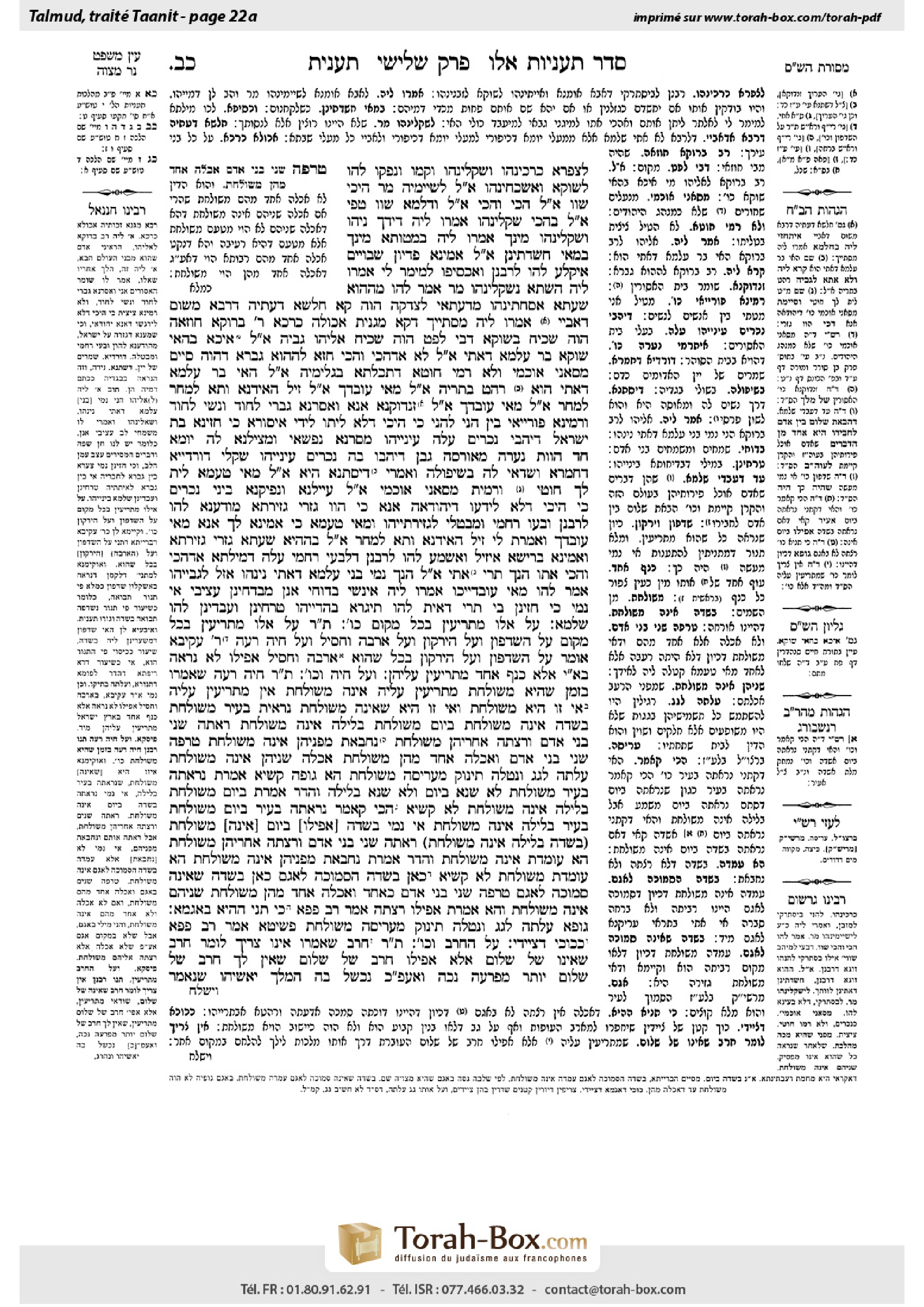
This page of Taanit includes the Aramaic text, an English translation and an AI-generated French translation, alongside the scan above.
תענית כ״ב א · Aramaic and Hebrew text
לְצַפְרָא, כַּרְכִינְהוּ וְשַׁקְלִינְהוּ וְקָמוּ וּנְפַקוּ לְהוּ לְשׁוּקָא וְאַשְׁכְּחִינְהוּ. אֲמַרוּ לֵיהּ: לְשַׁיְּימֵיהּ מָר הֵיכִי שָׁווּ. אֲמַר לְהוּ: הָכִי וְהָכִי. אֲמַרוּ לֵיהּ: וְדִלְמָא שָׁווּ טְפֵי? אֲמַר לְהוּ: בְּהָכִי (שַׁקְלִינְהוּ) [שְׁקַלִי לְהוּ]. אֲמַרוּ לֵיהּ: דִּידָךְ נִיהוּ וְשַׁקְלִינְהוּ מִינָּךְ.
אֲמַרוּ לֵיהּ: בְּמָטוּתָא מִינָּךְ בְּמַאי חֲשַׁדְתִּינַּן? אֲמַר לְהוּ: אָמֵינָא, פִּדְיוֹן שְׁבוּיִים אִיקְּלַע לְהוּ לְרַבָּנַן, וְאִכְּסִיפוּ לְמֵימַר לִי. אֲמַרוּ לֵיהּ: הַשְׁתָּא נִשְׁקְלִינְהוּ מָר! אֲמַר לְהוּ: מֵהָהוּא שַׁעְתָּא אַסַּחְתִּינְהוּ מִדַּעְתַּאי לִצְדָקָה.
הֲוָה קָא חָלְשָׁא דַּעְתֵּיהּ דְּרָבָא מִשּׁוּם דְּאַבָּיֵי, אֲמַרוּ לֵיהּ: מִסָּתְיָיךְ דְּקָא מַגְּנַיתְּ אַכּוּלֵּהּ כַּרְכָא.
רַבִּי בְּרוֹקָא חוֹזָאָה הֲוָה שְׁכִיחַ בְּשׁוּקָא דְּבֵי לָפָט. הֲוָה שְׁכִיחַ אֵלִיָּהוּ גַּבֵּיהּ, אֲמַר לֵיהּ: אִיכָּא בְּהַאי שׁוּקָא בַּר עָלְמָא דְּאָתֵי? אֲמַר לֵיהּ: לָא. אַדְּהָכִי וְהָכִי חֲזָא לְהָהוּא גַּבְרָא דַּהֲוָה סָיֵים מְסָאנֵי אוּכָּמֵי וְלָא רְמֵי חוּטָא דִתְכֵלְתָּא בִּגְלִימֵיהּ. אֲמַר לֵיהּ: הַאי בַּר עָלְמָא דְּאָתֵי הוּא.
רְהַט בָּתְרֵיהּ, אֲמַר לֵיהּ: מַאי עוֹבָדָךְ? אֲמַר לֵיהּ: זִיל הָאִידָּנָא, וְתָא לִמְחַר. לִמְחַר אֲמַר לֵיהּ: מַאי עוֹבָדָךְ? אֲמַר לֵיהּ: זַנְדּוּקְנָא אֲנָא, וְאָסַרְנָא גַּבְרֵי לְחוֹד וְנָשֵׁי לְחוֹד, וְרָמֵינָא פּוּרְיַיאי בֵּין הָנֵי לְהָנֵי כִּי הֵיכִי דְּלָא לֵיתוֹ לִידֵי אִיסּוּרָא. כִּי חָזֵינָא בַּת יִשְׂרָאֵל דְּיָהֲבִי נׇכְרִים עֲלַהּ עֵינַיְיהוּ, מָסַרְנָא נַפְשַׁאי וּמַצֵּילְנָא לַהּ. יוֹמָא חַד הֲווֹת נַעֲרָה מְאוֹרָסָה גַּבַּן דִּיהַבוּ בָּהּ נׇכְרִים עֵינַיְיהוּ, שְׁקַלִי דּוּרְדְּיָיא דְּחַמְרָא וּשְׁדַאי לַהּ בְּשִׁיפּוּלַהּ, וַאֲמַרִי: דַּשְׁתָּנָא הִיא.
אֲמַר לֵיהּ: מַאי טַעְמָא לֵית לָךְ חוּטֵי, וּרְמֵית מְסָאנֵי אוּכָּמֵי? אֲמַר לֵיהּ: עָיֵילְנָא וְנָפֵיקְנָא בֵּינֵי נׇכְרִים, כִּי הֵיכִי דְּלָא לִידְּעוּ דִּיהוּדָאָה אֲנָא. כִּי הָווּ גָּזְרִי גְּזֵירְתָּא, מוֹדַעְנָא לְהוּ לְרַבָּנַן וּבָעוּ רַחֲמֵי וּמְבַטְּלִי לִגְזֵירְתַּיְיהוּ. וּמַאי טַעְמָא כִּי אָמֵינָא לָךְ אֲנָא מַאי עוֹבָדָךְ, וַאֲמַרְתְּ לִי: זִיל הָאִידָּנָא וְתָא לִמְחַר? אֲמַר לֵיהּ: בְּהַהִיא שַׁעְתָּא גָּזְרִי גְּזֵירְתָּא, וְאָמֵינָא: בְּרֵישָׁא אֵיזִיל וְאֶשְׁמְעַ[הּ], וְאֶשְׁלַח לְהוּ לְרַבָּנַן דְּלִבְעוֹ רַחֲמֵי עֲלַהּ דְּמִילְּתָא.
אַדְּהָכִי וְהָכִי אֲתוֹ הָנָךְ תְּרֵי אַחֵי. אֲמַר לֵיהּ: הָנָךְ נָמֵי בְּנֵי עָלְמָא דְּאָתֵי נִינְהוּ. אֲזַל לְגַבַּיְיהוּ, אֲמַר לְהוּ: מַאי עוֹבָדַיְיכוּ? אֲמַרוּ לֵיהּ: אִינָשֵׁי בָּדוֹחֵי אֲנַן, מְבַדְּחִינַן עֲצִיבֵי. אִי נָמֵי, כִּי חָזֵינַן בֵּי תְרֵי דְּאִית לְהוּ תִּיגְרָא בַּהֲדַיְיהוּ, טָרְחִינַן וְעָבְדִינַן לְהוּ שְׁלָמָא.
עַל אֵלּוּ מַתְרִיעִין בְּכׇל מָקוֹם כּוּ׳. תָּנוּ רַבָּנַן, עַל אֵלּוּ מַתְרִיעִין בְּכׇל מָקוֹם: עַל הַשִּׁדָּפוֹן, וְעַל הַיֵּרָקוֹן, וְעַל אַרְבֶּה וְחָסִיל, וְעַל חַיָּה רָעָה. רַבִּי עֲקִיבָא אוֹמֵר: עַל הַשִּׁדָּפוֹן וְעַל הַיֵּרָקוֹן בְּכׇל שֶׁהוּא. אַרְבֶּה וְחָסִיל, אֲפִילּוּ לֹא נִרְאָה בְּאֶרֶץ יִשְׂרָאֵל אֶלָּא כָּנָף אֶחָד — מַתְרִיעִין עֲלֵיהֶן.
וְעַל חַיָּה וְכוּ׳. תָּנוּ רַבָּנַן: חַיָּה רָעָה שֶׁאָמְרוּ, בִּזְמַן שֶׁהִיא מְשׁוּלַּחַת — מַתְרִיעִין עָלֶיהָ, אֵינָהּ מְשׁוּלַּחַת — אֵין מַתְרִיעִין עָלֶיהָ. אֵי זוֹ הִיא מְשׁוּלַּחַת וְאֵי זוֹ הִיא שֶׁאֵינָהּ מְשׁוּלַּחַת? נִרְאֵית בָּעִיר — מְשׁוּלַּחַת, בַּשָּׂדֶה — אֵינָהּ מְשׁוּלַּחַת. בַּיּוֹם — מְשׁוּלַּחַת, בַּלַּיְלָה — אֵינָהּ מְשׁוּלַּחַת.
רָאֲתָה שְׁנֵי בְּנֵי אָדָם וְרָצְתָה אַחֲרֵיהֶן — מְשׁוּלַּחַת. נֶחְבֵּאת מִפְּנֵיהֶן — אֵינָהּ מְשׁוּלַּחַת. טָרְפָה שְׁנֵי בְּנֵי אָדָם וְאָכְלָה אֶחָד מֵהֶן — מְשׁוּלַּחַת. אָכְלָה שְׁנֵיהֶן — אֵינָהּ מְשׁוּלַּחַת. עָלְתָה לַגַּג וְנָטְלָה תִּינוֹק מֵעֲרִיסָה — מְשׁוּלַּחַת.
הָא גּוּפַהּ קַשְׁיָא, אָמְרַתְּ: נִרְאֲתָה בָּעִיר — מְשׁוּלַּחַת; לָא שְׁנָא בַּיּוֹם וְלָא שְׁנָא בַּלַּיְלָה. וַהֲדַר אָמְרַתְּ: בַּיּוֹם — מְשׁוּלַּחַת, בַּלַּיְלָה — אֵינָהּ מְשׁוּלַּחַת!
לָא קַשְׁיָא, הָכִי קָאָמַר: נִרְאֲתָה בָּעִיר בַּיּוֹם — מְשׁוּלַּחַת. בָּעִיר בַּלַּיְלָה — אֵינָהּ מְשׁוּלַּחַת. אִי נָמֵי בַּשָּׂדֶה, אֲפִילּוּ בַּיּוֹם — אֵינָהּ מְשׁוּלַּחַת. (בַּשָּׂדֶה, בַּלַּיְלָה — אֵינָהּ מְשׁוּלַּחַת).
רָאֲתָה שְׁנֵי בְּנֵי אָדָם וְרָצְתָה אַחֲרֵיהֶן — מְשׁוּלַּחַת, הָא עוֹמֶדֶת — אֵינָהּ מְשׁוּלַּחַת. וַהֲדַר אָמְרַתְּ: נֶחְבֵּאת מִפְּנֵיהֶן — אֵינָהּ מְשׁוּלַּחַת, הָא עוֹמֶדֶת — מְשׁוּלַּחַת!
לָא קַשְׁיָא: כָּאן — בְּשָׂדֶה הַסְּמוּכָה לַאֲגַם, כָּאן — בְּשָׂדֶה שֶׁאֵינָהּ סְמוּכָה לַאֲגַם.
טָרְפָה שְׁנֵי בְּנֵי אָדָם כְּאֶחָד וְאָכְלָה אֶחָד מֵהֶן — מְשׁוּלַּחַת, שְׁנֵיהֶם — אֵינָהּ מְשׁוּלַּחַת. וְהָא אָמְרַתְּ אֲפִילּוּ רָצְתָה! אָמַר רַב פָּפָּא: כִּי תָּנֵי הָהִיא, בְּאַגְמָא.
גּוּפָא: עָלְתָה לַגַּג וְנָטְלָה תִּינוֹק מֵעֲרִיסָה — מְשׁוּלַּחַת. פְּשִׁיטָא! אָמַר רַב פָּפָּא: כְּכוּכֵי דְצַיָּידֵי.
עַל הַחֶרֶב וְכוּ׳. תָּנוּ רַבָּנַן: חֶרֶב שֶׁאָמְרוּ, אֵינוֹ צָרִיךְ לוֹמַר חֶרֶב שֶׁאֵינוֹ שֶׁל שָׁלוֹם, אֶלָּא אֲפִילּוּ חֶרֶב שֶׁל שָׁלוֹם. שֶׁאֵין לְךָ חֶרֶב שֶׁל שָׁלוֹם יוֹתֵר מִפַּרְעֹה נְכֹה, וְאַף עַל פִּי כֵן נִכְשַׁל בָּהּ הַמֶּלֶךְ יֹאשִׁיָּהוּ, שֶׁנֶּאֱמַר:
Taanit 22a · English translation
In the morning, the Sages rolled up these rugs and took them, and they arose and went out to the market with them. And when Abba found them, the Sages said to him: Let the Master appraise these rugs, how much they are worth. He said to them: Their value is such and such. They said to him: But perhaps they are worth more. He said to them: This is what I paid for them. They said to him: The rugs are yours and we took them from you.
After explaining the reason for their actions, the Sages said to him: Please tell us, what did you suspect of us? You knew that we had taken your rugs, and yet you did not say anything. He said to them: I said to myself, certainly an unexpected opportunity for a ransom of prisoners became available for the Sages, and they required immediate funds, but they were too embarrassed to say so to me or to ask for money. Instead, they took the rugs. The Sages said to him: Now that we have explained the situation, let the Master take back the rugs. He said to them: From that moment when I realized they were missing, I put them out of my mind and consigned them for charity. As far as I am concerned, they are already designated for that purpose, and I cannot take them back.
Rava was distressed due to the fact that Abaye received greetings from Heaven every Shabbat eve, while Rava received such greetings only once a year, on Yom Kippur eve, as stated above. They said to him: Be content that through your merit you protect your entire city.
§ The Gemara relates another story about the righteousness of common people. Rabbi Beroka Ḥoza’a was often found in the market of Bei Lefet, and Elijah the Prophet would often appear to him. Once Rabbi Beroka said to Elijah: Of all the people who come here, is there anyone in this market worthy of the World-to-Come? He said to him: No. In the meantime, Rabbi Beroka saw a man who was wearing black shoes, contrary to Jewish custom, and who did not place the sky-blue, dyed thread of ritual fringes on his garment. Elijah said to Rabbi Beroka: That man is worthy of the World-to-Come.
Rabbi Beroka ran after the man and said to him: What is your occupation? The man said to him: Go away now, as I have no time, but come back tomorrow and we will talk. The next day, Rabbi Beroka arrived and again said to him: What is your occupation? The man said to him: I am a prison guard [zandukana], and I imprison the men separately and the women separately, and I place my bed between them so that they will not come to transgression. When I see a Jewish woman upon whom gentiles have set their eyes, I risk my life to save her. One day, there was a betrothed young woman among us, upon whom the gentiles had set their eyes. I took dregs [durdayya] of red wine and threw them on the lower part of her dress, and I said: She is menstruating [dastana], so that they would leave her alone.
Rabbi Beroka said to him: What is the reason that you do not have threads of ritual fringes, and why do you wear black shoes? The man said to him: Since I come and go among gentiles, I dress this way so that they will not know that I am a Jew. When they issue a decree, I inform the Sages, and they pray for mercy and annul the decree. Rabbi Beroka further inquired: And what is the reason that when I said to you: What is your occupation, you said to me: Go away now but come tomorrow? The man said to him: At that moment, they had just issued a decree, and I said to myself: First I must go and inform the Sages, so that they will pray for mercy over this matter.
In the meantime, two brothers came to the marketplace. Elijah said to Rabbi Beroka: These two also have a share in the World-to-Come. Rabbi Beroka went over to the men and said to them: What is your occupation? They said to him: We are jesters, and we cheer up the depressed. Alternatively, when we see two people who have a quarrel between them, we strive to make peace. It is said that for this behavior one enjoys the profits of his actions in this world, and yet his reward is not diminished in the World-to-Come.
§ The mishna states: For the following calamities they sound the alarm in every place. The Sages taught: For the following calamities they sound the alarm in every place: For blight, for mildew, for locusts, for caterpillars, a type of locust that comes in large swarms and descends upon a certain place, and for dangerous beasts. Rabbi Akiva says: For blight and mildew they sound the alarm over any amount. For locusts, and for caterpillars, even if only a single wing of one of these pests was seen in all of Eretz Yisrael, they sound the alarm over them, as this is a sign that more are on their way.
The mishna taught that they sound the alarm for dangerous beasts that have invaded a town. The Sages taught in a baraita: The term dangerous beasts that they said is referring to a situation when there is an abnormal outbreak of the animals in a populated area (see Leviticus 26:22). In this case, they sound the alarm over them. However, if it is not an outbreak, they do not sound the alarm over them. The Gemara elaborates: What is considered an outbreak and what is not an outbreak? If a dangerous beast is seen in the city, this is an outbreak. If it is seen in the field, where it is usually found, this is not an outbreak. If it is seen during the day, this is an outbreak. If it is seen at night, this is not an outbreak.
The baraita continues: If the beast saw two people and chased after them, this is an outbreak. If it hid from them, this is not an outbreak. If it tore apart two people and ate one of them, this is an outbreak, as it is clear that the animal did not attack merely due to hunger. If it ate both of them, this is not an outbreak, as the animal was evidently hungry and acted in accordance with its nature. If it climbed to the roof and took a baby from its cradle, this is an outbreak. This concludes the Gemara’s citation of the baraita.
The Gemara asks: This baraita is itself difficult. Initially, you said that if a dangerous beast is seen in the city, this is an outbreak, which indicates that it is no different whether it is seen by day and it is no different if it is seen at night. And then you said: If the animal is seen during the day, this is an outbreak; if it is seen at night, this is not an outbreak.
The Gemara resolves this difficulty: This is not difficult, as this is what the baraita is saying: If it is seen in the city during the day, this is an outbreak; if it is seen in the city at night, this is not an outbreak. Alternatively, if it is seen in the field, even during the day, this is not an outbreak. If it is spotted in the field at night, this is certainly not an outbreak.
The Gemara inquires about another apparent contradiction: The baraita states that if the beast saw two people and chased after them, this is an outbreak. This indicates that if it stands but does not run away, this is not an outbreak. And then you said that if it hid from them, this is not an outbreak, from which it may be inferred that if it stands and does not run away, this is an outbreak.
The Gemara answers: This is not difficult, as the two sections of the baraita describe different situations. Here, where it is an outbreak, the beast is standing in a field near a marsh. It is natural for the animal to stand, for the beast knows that if people attempt to catch it, it can run into the marsh. Conversely, there, where it is not an outbreak, the beast is standing in a field that is not near a marsh. Since it has nowhere to run, standing demonstrates an unnatural lack of fear.
The baraita taught that if the beast tore apart two people and ate one of them, this is an outbreak, but if it ate both of them this is not an outbreak. The Gemara asks: But didn’t you say that even if the animal merely chased after two people, this is an outbreak? Rav Pappa said: When that ruling of a beast that tore apart two people is taught, it is referring to an animal in a marsh. Since it is in its own habitat, it is natural for a territorial beast to attack.
The Gemara returns to the matter of the baraita itself. If a wild animal climbed to the roof and took a baby from its cradle, this is an outbreak. The Gemara asks: It is obvious that this animal is acting unnaturally. Why does the baraita mention this case? Rav Pappa said: The baraita is referring to the roof of a hunter’s hideout. Since this hut is in a wild area, one might have thought that it is natural for the beast to attack. Therefore, the baraita teaches us that this is still considered an outbreak.
§ The mishna taught that they sound the alarm for the sword. The Sages taught: With regard to the sword that they mentioned, it is not necessary to state that this includes a sword that is not of peace, i.e., an enemy army that has come to wage war against the Jews. Rather, even in a case of a sword of peace, when an army passes through with no intention of waging war against the Jews, but is merely on its way to another place, this is enough to obligate the court to sound the alarm, as you do not have a greater example of a sword of peace than Pharaoh Neco. He passed through Eretz Yisrael to wage war with Nebuchadnezzar, and nevertheless King Josiah stumbled in this matter, as it is stated:
Taanit 22a · Traduction française (IA)
Au matin, les Sages enroulèrent ces tapis, les emportèrent, puis se levèrent et les apportèrent au marché. Lorsque Abba les retrouva, les Sages lui dirent : « Que le Maître estime ces tapis : combien valent-ils ? » Il leur répondit : « Ils valent tant. » Ils lui dirent : « Mais peut-être valent-ils davantage. » Il leur répondit : « C’est le prix que je les ai payés. » Ils lui dirent : « Ces tapis sont à toi ; nous te les avons pris. »
Après lui avoir expliqué la raison de leurs actes, les Sages lui dirent : « Dis-nous, s’il te plaît, que soupçonnais-tu à notre sujet ? Tu savais que nous avions pris tes tapis, et pourtant tu n’as rien dit. » Il leur répondit : « Je me suis dit : “Il est certain qu’une occasion imprévue de financer la rançon de prisonniers s’est présentée aux Sages ; ils avaient besoin de fonds immédiatement, mais étaient trop gênés pour me le dire ou me demander de l’argent. Ils ont donc pris les tapis.” » Les Sages lui dirent : « Maintenant que nous t’avons expliqué la situation, que le Maître reprenne les tapis. » Il leur répondit : « Dès que j’ai constaté leur disparition, je les ai sortis de mon esprit et les ai consacrés à la charité. À mes yeux, ils sont déjà destinés à cet usage, et je ne peux pas les reprendre. »
Rava était affligé parce qu’Abayé recevait des salutations célestes chaque veille de Chabbat, tandis que Rava n’en recevait qu’une fois par an, la veille de Yom Kippour, comme indiqué plus haut. On lui dit : « Contente-toi de savoir que, grâce à ton mérite, tu protèges toute ta ville. »
§ La Guemara rapporte une autre histoire au sujet de la droiture des gens du peuple. Rabbi Beroka Ḥoza’a se trouvait souvent au marché de Bei Lefet, et le prophète Élie lui apparaissait fréquemment. Un jour, Rabbi Beroka dit à Élie : « Parmi tous ceux qui viennent ici, y a-t-il quelqu’un sur ce marché qui soit digne du Monde futur ? » Il lui répondit : « Non. » Entre-temps, Rabbi Beroka aperçut un homme chaussé de souliers noirs, contrairement à la coutume juive, et qui ne portait pas sur son vêtement le fil bleu des franges rituelles. Élie dit à Rabbi Beroka : « Cet homme est digne du Monde futur. »
Rabbi Beroka courut après l’homme et lui demanda : « Quelle est ta profession ? » L’homme lui répondit : « Va-t’en pour l’instant, je n’ai pas le temps. Reviens demain et nous parlerons. » Le lendemain, Rabbi Beroka vint et lui demanda de nouveau : « Quelle est ta profession ? » L’homme lui répondit : « Je suis gardien de prison [zandukana] ; je sépare les hommes des femmes dans leurs cellules et je place mon lit entre eux afin qu’ils ne commettent pas de transgression. Lorsque je vois une femme juive sur laquelle des non-Juifs ont jeté leur dévolu, je risque ma vie pour la sauver. Un jour, une jeune femme fiancée se trouvait parmi nous et les non-Juifs avaient jeté leur dévolu sur elle. J’ai pris de la lie [durdayya] de vin rouge et l’ai jetée sur le bas de sa robe, puis j’ai dit : “Elle a ses règles [dastana]”, afin qu’ils la laissent tranquille. »
Rabbi Beroka lui demanda : « Pourquoi ne portes-tu pas de franges rituelles, et pourquoi portes-tu des souliers noirs ? » L’homme lui répondit : « Comme je fréquente les non-Juifs, je m’habille ainsi afin qu’ils ne sachent pas que je suis juif. Lorsqu’ils promulguent un décret, j’en informe les Sages, qui implorent la miséricorde et font annuler le décret. » Rabbi Beroka lui demanda encore : « Et pourquoi, lorsque je t’ai demandé quelle était ta profession, m’as-tu répondu : “Va-t’en pour l’instant, mais reviens demain” ? » L’homme lui répondit : « À ce moment-là, ils venaient de promulguer un décret, et je me suis dit : “Je dois d’abord aller en informer les Sages, afin qu’ils implorent la miséricorde à ce sujet.” »
Entre-temps, deux frères arrivèrent au marché. Élie dit à Rabbi Beroka : « Ces deux-là aussi ont une part dans le Monde futur. » Rabbi Beroka s’approcha d’eux et leur demanda : « Quelle est votre profession ? » Ils lui répondirent : « Nous sommes des bouffons et nous égayons les personnes abattues. Par ailleurs, lorsque nous voyons deux personnes en querelle, nous nous efforçons de rétablir la paix. » Il est dit que, grâce à un tel comportement, on jouit du fruit de ses actes en ce monde, sans que sa récompense soit pour autant diminuée dans le Monde futur.
§ La Michna enseigne : Pour les calamités suivantes, on sonne l’alarme partout. Les Sages ont enseigné : Pour les calamités suivantes, on sonne l’alarme partout : pour la brûlure des récoltes, pour la moisissure, pour les sauterelles, pour les gazam, une espèce de sauterelles qui arrive en grands essaims et s’abat sur un endroit donné, et pour les bêtes dangereuses. Rabbi Akiva dit : pour la brûlure des récoltes et la moisissure, on sonne l’alarme quelle qu’en soit la quantité. Pour les sauterelles et les gazam, même si l’on n’a aperçu qu’une seule aile de l’un de ces ravageurs dans tout le pays d’Israël, on sonne l’alarme à leur sujet, car c’est le signe que d’autres sont en route.
La Michna enseigne qu’on sonne l’alarme pour les bêtes dangereuses qui ont envahi une ville. Les Sages ont enseigné dans une baraïta : l’expression « bêtes dangereuses » qu’ils ont employée désigne une apparition anormale de ces animaux dans une zone habitée (voir Lévitique 26:22). Dans ce cas, on sonne l’alarme à leur sujet. Mais s’il ne s’agit pas d’une apparition anormale, on ne sonne pas l’alarme à leur sujet. La Guemara précise : qu’est-ce qui est considéré comme une apparition anormale et qu’est-ce qui ne l’est pas ? Si une bête dangereuse est aperçue dans la ville, il s’agit d’une apparition anormale. Si elle est aperçue dans les champs, où elle se trouve habituellement, il ne s’agit pas d’une apparition anormale. Si elle est aperçue le jour, il s’agit d’une apparition anormale. Si elle est aperçue la nuit, il ne s’agit pas d’une apparition anormale.
La baraïta poursuit : si la bête aperçoit deux personnes et se lance à leur poursuite, il s’agit d’une apparition anormale. Si elle se cache pour leur échapper, il ne s’agit pas d’une apparition anormale. Si elle met en pièces deux personnes et en mange une, il s’agit d’une apparition anormale, car il est clair que l’animal n’a pas attaqué simplement parce qu’il avait faim. Si elle les mange toutes les deux, il ne s’agit pas d’une apparition anormale, car l’animal avait manifestement faim et a agi conformément à sa nature. Si elle monte sur un toit et enlève un bébé de son berceau, il s’agit d’une apparition anormale. C’est ici que s’achève la citation de la baraïta par la Guemara.
La Guemara demande : cette baraïta présente elle-même une difficulté. Au début, tu as dit que si une bête dangereuse est aperçue dans la ville, il s’agit d’une apparition anormale, ce qui indique que cela ne fait aucune différence qu’elle soit aperçue le jour ou la nuit. Puis tu as dit : si l’animal est aperçu le jour, il s’agit d’une apparition anormale ; s’il est aperçu la nuit, il ne s’agit pas d’une apparition anormale.
La Guemara résout cette difficulté : il n’y a pas de contradiction, car voici ce que dit la baraïta : si la bête est aperçue dans la ville le jour, il s’agit d’une apparition anormale ; si elle est aperçue dans la ville la nuit, il ne s’agit pas d’une apparition anormale. On peut aussi répondre que si elle est aperçue dans les champs, même le jour, il ne s’agit pas d’une apparition anormale. Si elle est aperçue dans les champs la nuit, il est certain qu’il ne s’agit pas d’une apparition anormale.
La Guemara soulève une autre contradiction apparente : la baraïta enseigne que si la bête aperçoit deux personnes et se lance à leur poursuite, il s’agit d’une apparition anormale. Cela indique que si elle reste immobile sans s’enfuir, il ne s’agit pas d’une apparition anormale. Puis tu as dit que si elle se cache pour leur échapper, il ne s’agit pas d’une apparition anormale, d’où l’on peut déduire que si elle reste immobile sans s’enfuir, il s’agit d’une apparition anormale.
La Guemara répond : il n’y a pas de contradiction, car les deux passages de la baraïta décrivent des situations différentes. Ici, dans le cas où il s’agit d’une apparition anormale, la bête se tient dans un champ, près d’un marécage. Il est naturel que l’animal reste là, car il sait que, si des gens tentent de le capturer, il peut s’enfuir dans le marécage. En revanche, là, dans le cas où il ne s’agit pas d’une apparition anormale, la bête se tient dans un champ qui n’est pas près d’un marécage. Comme elle n’a nulle part où s’enfuir, le fait qu’elle reste immobile manifeste une absence de crainte contre nature.
La baraïta enseigne que si la bête met en pièces deux personnes et en mange une, il s’agit d’une apparition anormale, mais que si elle les mange toutes les deux, il ne s’agit pas d’une apparition anormale. La Guemara demande : mais n’as-tu pas dit que même si l’animal se contente de poursuivre deux personnes, il s’agit d’une apparition anormale ? Rav Pappa dit : lorsque cette règle concernant une bête qui a mis en pièces deux personnes est enseignée, elle se rapporte à un animal qui se trouve dans un marécage. Puisqu’il se trouve dans son habitat, il est naturel qu’une bête territoriale attaque.
La Guemara revient au contenu même de la baraïta. Si une bête sauvage monte sur un toit et enlève un bébé de son berceau, il s’agit d’une apparition anormale. La Guemara demande : il est évident que cet animal agit de manière anormale. Pourquoi la baraïta mentionne-t-elle ce cas ? Rav Pappa dit : la baraïta parle du toit d’une cabane servant de repaire à un chasseur. Puisque cette cabane se trouve dans une région sauvage, on aurait pu penser qu’il est naturel que la bête attaque. La baraïta nous enseigne donc que cela est tout de même considéré comme une apparition anormale.
§ La Michna enseigne qu’on sonne l’alarme à cause de l’épée. Les Sages ont enseigné : au sujet de l’épée mentionnée, il n’est pas nécessaire de préciser qu’il s’agit d’une épée qui n’est pas une épée de paix, c’est-à-dire d’une armée ennemie venue faire la guerre aux Juifs. Même dans le cas d’une épée de paix, lorsqu’une armée traverse le pays sans avoir l’intention de faire la guerre aux Juifs, mais se dirige simplement vers un autre endroit, cela suffit à obliger le tribunal à sonner l’alarme, car on ne saurait trouver d’exemple plus éclatant d’épée de paix que le pharaon Neko. Il traversa le pays d’Israël pour faire la guerre à Nabuchodonosor ; pourtant, le roi Josias échoua dans cette affaire, comme il est dit :
Traduction française générée par IA à partir de l’édition anglaise de Sefaria. Vérifie toujours un passage avec le texte source.
Text from Sefaria: William Davidson Edition - Vocalized Aramaic (CC BY NC); William Davidson Edition - English (CC BY NC).