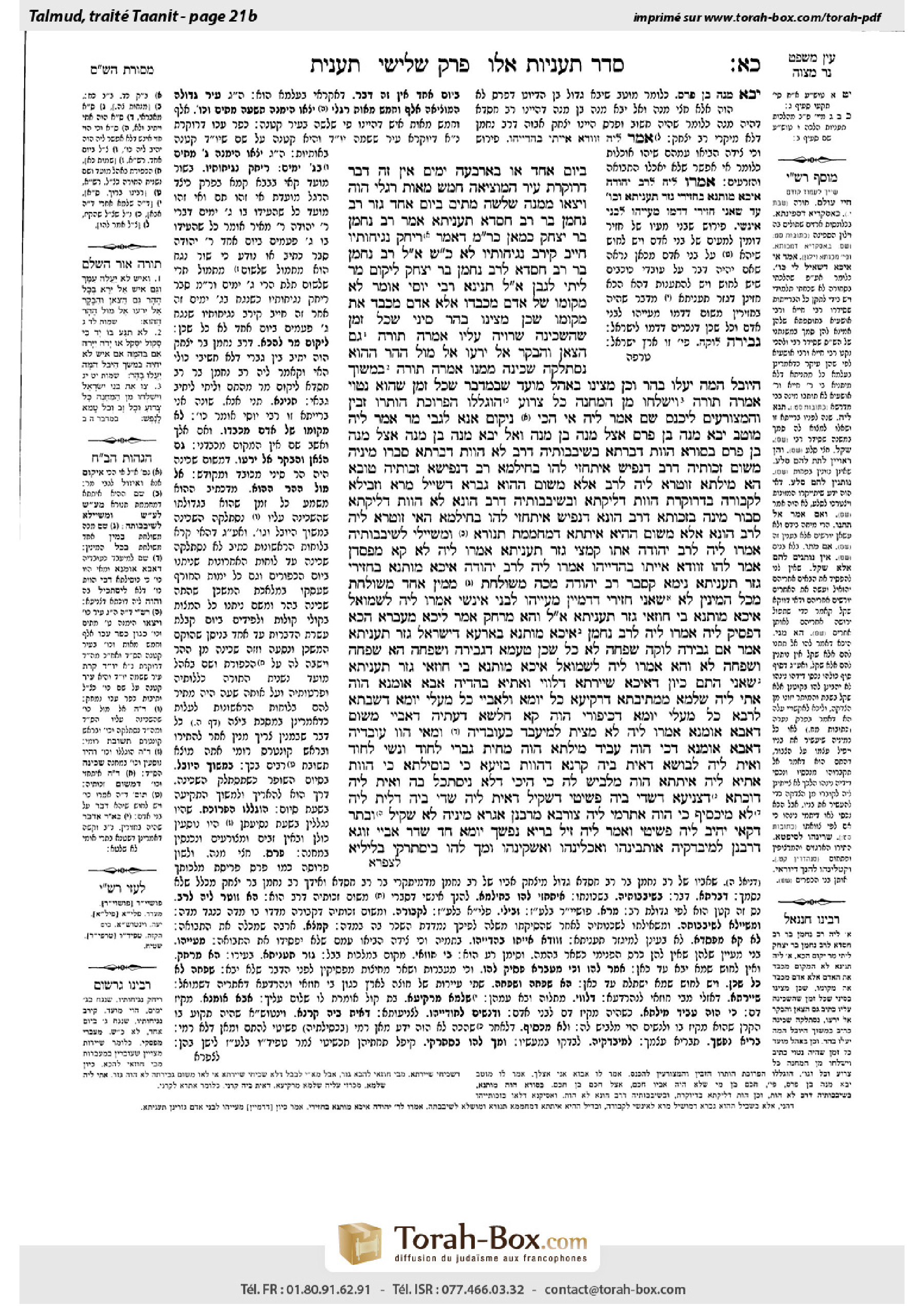
Taanit 21b: Talmud study for Daf Yomi
Daf Yomi is the daily study of one Talmud folio. Explore 37 tractates with scans, Hebrew text, Sefaria English and AI-generated French translations where annotated.
Passage selection and English or AI-generated French translation are available where the scan has annotations. Daf Study is independent of Torah-Box and Sefaria.
Browse Taanit · תענית · All tractatesTaanit 21b text and translations
This page of Taanit includes the Aramaic text, an English translation and an AI-generated French translation, alongside the scan above.
תענית כ״א ב · Aramaic and Hebrew text
בְּיוֹם אֶחָד אוֹ בְּאַרְבָּעָה יָמִים — אֵין זֶה דֶּבֶר.
דְּרוֹקֶרֶת, עִיר הַמּוֹצִיאָה חֲמֵשׁ מֵאוֹת רַגְלִי הֲוַאי, וְיָצְאוּ מִמֶּנָּה שְׁלֹשָׁה מֵתִים בְּיוֹם אֶחָד. גְּזַר רַב נַחְמָן בַּר רַב חִסְדָּא תַּעֲנִיתָא. אֲמַר רַב נַחְמָן בַּר יִצְחָק: כְּמַאן — כְּרַבִּי מֵאִיר,
דְּאָמַר: רִיחֵק נְגִיחוֹתָיו — חַיָּיב, קֵירַב נְגִיחוֹתָיו — לֹא כׇּל שֶׁכֵּן?!
אֲמַר לֵיהּ רַב נַחְמָן בַּר רַב חִסְדָּא לְרַב נַחְמָן בַּר יִצְחָק: לֵיקוּם מָר לֵיתֵי לְגַבַּן. אֲמַר לֵיהּ: תְּנֵינָא, רַבִּי יוֹסֵי אוֹמֵר: לֹא מְקוֹמוֹ שֶׁל אָדָם מְכַבְּדוֹ, אֶלָּא אָדָם מְכַבֵּד אֶת מְקוֹמוֹ. שֶׁכֵּן מָצִינוּ בְּהַר סִינַי, שֶׁכׇּל זְמַן שֶׁהַשְּׁכִינָה שְׁרוּיָה עָלָיו, אָמְרָה תּוֹרָה: ״גַּם הַצֹּאן וְהַבָּקָר אַל יִרְעוּ אֶל מוּל הָהָר הַהוּא״, נִסְתַּלְּקָה שְׁכִינָה מִמֶּנּוּ, אָמְרָה תּוֹרָה: ״בִּמְשֹׁךְ הַיֹּבֵל הֵמָּה יַעֲלוּ בָהָר״.
וְכֵן מָצִינוּ בְּאֹהֶל מוֹעֵד שֶׁבַּמִּדְבָּר, שֶׁכׇּל זְמַן שֶׁהוּא נָטוּי אָמְרָה תּוֹרָה: ״וִישַׁלְּחוּ מִן הַמַּחֲנֶה כׇּל צָרוּעַ״, הוּגְלְלוּ הַפָּרוֹכוֹת — הוּתְּרוּ זָבִין וּמְצוֹרָעִים לִיכָּנֵס שָׁם.
אֲמַר לֵיהּ: אִי הָכִי, נֵיקוּם אֲנָא לְגַבֵּי מָר. אֲמַר לֵיהּ: מוּטָב יָבֹא מָנֶה בֶּן פְּרָס אֵצֶל מָנֶה בֶּן מָנֶה, וְאַל יָבֹא מָנֶה בֶּן מָנֶה אֵצֶל מָנֶה בֶּן פְּרָס.
בְּסוּרָא הֲווֹת דְּבַרְתָּא, בְּשִׁיבָבוּתֵיהּ דְּרַב לָא הֲווֹת דְּבַרְתָּא. סְבוּר מִינַּהּ, מִשּׁוּם זְכוּתֵיהּ דְּרַב דִּנְפִישׁ. אִיתְחֲזִי לְהוּ בְּחֶילְמָא: רַב דִּנְפִישָׁא זְכוּתֵיהּ טוּבָא — הָא מִילְּתָא זוּטְרָא לֵיהּ לְרַב. אֶלָּא, מִשּׁוּם הָהוּא גַּבְרָא דִּמְשַׁיֵּיל מָרָא וּזְבִילָא לִקְבוּרָה.
בִּדְרוֹקֶרֶת הֲווֹת דְּלֵיקְתָּא, וּבְשִׁיבָבוּתֵיהּ דְּרַב הוּנָא לָא הֲווֹת דְּלֵיקְתָּא. סְבוּר מִינַּהּ, בִּזְכוּתָא דְּרַב הוּנָא דִּנְפִישׁ. אִיתְחֲזִי לְהוּ בְּחֶילְמָא: הַאי זוּטְרָא לֵיהּ לְרַב הוּנָא, אֶלָּא מִשּׁוּם הָהִיא אִיתְּתָא דִּמְחַמְּמָא תַּנּוּרָא וּמְשַׁיְּילָא לְשִׁיבָבוּתַיהּ.
אֲמַרוּ לֵיהּ לְרַב יְהוּדָה: אֲתוֹ קַמְצֵי. גְּזַר תַּעֲנִיתָא. אֲמַרוּ לֵיהּ: לָא קָא מַפְסְדָן. אֲמַר לְהוּ: זְווֹדֵא אַיְיתוֹ בַּהֲדַיְיהוּ?
אֲמַרוּ לֵיהּ לְרַב יְהוּדָה: אִיכָּא מוֹתָנָא בַּחֲזִירֵי. גְּזַר תַּעֲנִיתָא. נֵימָא קָסָבַר רַב יְהוּדָה מַכָּה מְשׁוּלַּחַת מִמִּין אֶחָד מְשׁוּלַּחַת מִכׇּל הַמִּינִין? לָא, שָׁאנֵי חֲזִירֵי — דְּדׇמְיָין מְעַיְיהוּ לִבְנֵי אִינָשֵׁי.
אֲמַרוּ לֵיהּ לִשְׁמוּאֵל: אִיכָּא מוֹתָנָא בֵּי חוֹזָאֵי. גְּזַר תַּעֲנִיתָא. אָמְרִי לֵיהּ: וְהָא מְרַחַק! אֲמַר: לֵיכָּא מַעְבָּרָא הָכָא דְּפָסֵיק לֵיהּ.
אֲמַרוּ לֵיהּ לְרַב נַחְמָן: אִיכָּא מוֹתָנָא בְּאַרְעָא דְיִשְׂרָאֵל. גְּזַר תַּעֲנִיתָא אֲמַר: אִם גְּבִירָה לוֹקָה, שִׁפְחָה לֹא כׇּל שֶׁכֵּן!
טַעְמָא דִּגְבִירָה וְשִׁפְחָה, הָא שִׁפְחָה וְשִׁפְחָה — לָא. וְהָא אֲמַרוּ לֵיהּ לִשְׁמוּאֵל: אִיכָּא מוֹתָנָא בֵּי חוֹזָאֵי, גְּזַר תַּעֲנִיתָא! שָׁאנֵי הָתָם, כֵּיוָן דְּאִיכָּא שַׁיָּירָתָא דְּלַוִּוי וְאָתְיָא בַּהֲדֵיהּ.
אַבָּא אוּמָּנָא הֲוָה אָתֵי לֵיהּ שְׁלָמָא מִמְּתִיבְתָּא דִּרְקִיעָא כֹּל יוֹמָא, וּלְאַבָּיֵי כֹּל מַעֲלֵי יוֹמָא דְּשַׁבְּתָא, לְרָבָא כֹּל מַעֲלֵי יוֹמָא דְכִיפּוּרֵי. הֲוָה קָא חָלְשָׁא דַּעְתֵּיהּ דְּאַבָּיֵי מִשּׁוּם דְּאַבָּא אוּמָּנָא. אֲמַרוּ לֵיהּ: לָא מָצֵית לְמִיעְבַּד כְּעוֹבָדֵיהּ.
וּמַאי הֲווֹ עוֹבָדֵיהּ דְּאַבָּא אוּמָּנָא — דְּכִי הֲוָה עָבֵיד מִילְּתָא, הֲוָה מַחֵית גַּבְרֵי לְחוֹד וְנָשֵׁי לְחוֹד, וְאִית לֵיהּ לְבוּשָׁא דְּאִית בֵּיהּ קַרְנָא דַּהֲווֹת בְּזִיעָא כִּי כוּסִילְתָּא. כִּי הֲווֹת אָתְיָא לֵיהּ אִיתְּתָא, הֲוָה מַלְבֵּישׁ לָהּ כִּי הֵיכִי דְּלָא נִיסְתַּכַּל בָּהּ. וְאִית לֵיהּ דּוּכְתָּא דִּצְנִיעָא דְּשָׁדֵי בֵּיהּ פְּשִׁיטֵי דְּשָׁקֵיל, דְּאִית לֵיהּ — שָׁדֵי בֵּיהּ, דְּלֵית לֵיהּ — לָא מִיכְּסִיף.
כִּי הֲוָה אִתְרְמֵי לֵיהּ צוּרְבָּא מֵרַבָּנַן, אַגְרָא מִינֵּיהּ לָא שָׁקֵיל. וּבָתַר דְּקָאֵי, יָהֵיב לֵיהּ פְּשִׁיטֵי וַאֲמַר לֵיהּ: זִיל אַבְרִי נַפְשָׁךְ. יוֹמָא חַד שַׁדַּר אַבָּיֵי זוּגָא דְרַבָּנַן לְמִיבְדְּקֵיהּ. אוֹתְבִינְהוּ וְאֹכְלִינְהוּ וְאַשְׁקִינְהוּ וּמָךְ לְהוּ בִּיסְתַּרְקִי בְּלֵילְיָא.
Taanit 21b · English translation
If all three died on one day or over four days, this is not a plague of pestilence.
In explanation of the counterintuitive ruling that many deaths in one day is not indicative of a plague, the Gemara relates: Drokart was a city that sent out five hundred infantrymen, and three dead were removed from it on one day. Rav Naḥman bar Rav Ḥisda decreed a fast on account of the plague. Rav Naḥman bar Yitzḥak said: In accordance with whose opinion did you declare this fast? It must be in accordance with the opinion of Rabbi Meir.
This is related to the definition of a forewarned ox, an animal that has gored enough times to be considered a dangerous beast that requires careful supervision, as Rabbi Meir said: The owner of an ox is liable to pay full damages if its acts of goring were separated, i.e., if it gored three times on three consecutive days, as claimed by the Rabbis. If its acts of goring were near each other, performed on a single day, is it not all the more so that this animal should be classified as a forewarned ox? However, Rav Naḥman bar Yitzḥak continued, this represents a minority opinion. Just as Rabbi Meir’s reasoning is rejected for halakha in the case of an ox, so too it is rejected with regard to a plague.
Upon hearing this impressive argument, Rav Naḥman bar Rav Ḥisda said to Rav Naḥman bar Yitzḥak: Let the Master arise and come to live with us as our community leader. Rav Naḥman bar Yitzḥak said to him: We already learned in a baraita that Rabbi Yosei says: It is not the place of a person that honors him; rather, the person honors his place, as we found with regard to Mount Sinai, that as long as the Divine Presence rested upon it, the Torah said: “Neither let the flocks nor the herds feed before that mount” (Exodus 34:3). Once the Divine Presence departed from the mountain, the Torah said: “When the shofar sounds long they shall come up to the mount” (Exodus 19:13). This indicates that the sanctity was not inherent to the place but was due to the Divine Presence resting there.
And we likewise found with regard to the Tent of Meeting that was in the wilderness, that whenever it was erected, the Torah said: “That they put out of the camp every leper” (Numbers 5:2). Once the curtain was rolled up and the Tent of Meeting was prepared for travel, zavim and lepers were permitted to enter the place where it had stood. The place itself had no intrinsic sanctity; rather, it was sacred only because the Divine Presence was there. Accordingly, Rav Naḥman bar Yitzḥak maintained that there is no reason for him to move places to receive honor.
Rav Naḥman bar Rav Ḥisda said to Rav Naḥman bar Yitzḥak: If so, let me arise and come to the Master, to learn Torah from you. Rav Naḥman bar Yitzḥak said to him: It is better that one hundred dinars that is the son of a peras, fifty dinars, should come to one hundred dinars that is the son of one hundred dinars; but one hundred dinars that is the son of one hundred dinars, should not come to one hundred dinars that is the son of a peras. In other words, although Rav Naḥman bar Yitzḥak was a learned scholar, comparable to one hundred dinars, it was nevertheless more appropriate for him to come to Rav Naḥman bar Rav Ḥisda. Whereas Rav Naḥman bar Yitzḥak was the son of a peras, an ordinary man, Rav Naḥman bar Rav Ḥisda was the son of a scholar.
The Gemara relates another story involving a plague: Once there was a plague of pestilence in Sura, but in the neighborhood of Rav there was no pestilence. The people therefore thought that this was due to Rav’s great merit. However, it was revealed to them in a dream that Rav’s merit was too great and this matter too small for the merit of Rav to be involved. Rather, his neighborhood was spared due to the acts of kindness of a certain man, who would lend his hoe [mara] and shovel [zevila] to prepare sites for burial.
The Gemara relates a similar incident. In Drokart there was a fire, but in the neighborhood of Rav Huna there was no fire. The people therefore thought that this was due to Rav Huna’s great merit. It was revealed to them in a dream that this matter was too small for the merit of Rav Huna to have played a role. Rather, it was due to a certain woman who heats her oven and lends it, i.e., the use of her oven, to her neighbors.
They said to Rav Yehuda: Locusts have come to our region. Rav Yehuda decreed a fast. They said to him: They are not destroying anything, as they are eating only a little. He said to them: Have they brought provisions with them, that they have something else to eat? Even if they are not damaging your crops now, they will certainly eat them soon.
On another occasion, they said to Rav Yehuda: There is pestilence among the pigs. Rav Yehuda decreed a fast. The Gemara asks: Let us say that Rav Yehuda maintains that a plague affecting one species will come to affect all species, and that is why he decreed a fast. The Gemara answers: No, in other cases there is no cause for concern. However, pigs are different, as their intestines are similar to those of humans. Consequently, their disease might spread to people.
They said to Shmuel: There is pestilence in the region of Bei Ḥozai, which is quite a distance from Babylonia. Shmuel decreed a fast. They said to him: But it is far from here. He said: There is no crossing here that will stop the pestilence, and therefore there is cause for concern that it will reach us.
They said to Rav Naḥman: There is pestilence in Eretz Yisrael. Rav Naḥman decreed a fast in Babylonia, saying: If the lady of the house, i.e., Eretz Yisrael, is afflicted, is it not all the more so that the maidservant, Babylonia, will be afflicted?
The Gemara asks: The reason for this ruling is apparently only because Eretz Yisrael is a lady in comparison to the Diaspora, which is likened to a maidservant. It may be inferred from this that in a case involving a maidservant and a maidservant, i.e., two places in the Diaspora, there is no reason to fast. But in the previous story, when they said to Shmuel: There is pestilence in the region of Bei Ḥozai, he decreed a fast in Neharde’a, despite the fact that Neharde’a is not considered a lady with respect to Bei Ḥozai. The Gemara answers: It is different there. Since there are caravans that regularly travel from Bei Ḥozai to Neharde’a, the pestilence will join and accompany them in the caravans.
§ Apropos the above stories that deal with the merits of ordinary people, the Gemara relates: Abba the Bloodletter would receive greetings from the yeshiva on High every day, and Abaye would receive these greetings every Shabbat eve, and Rava would receive greetings only once a year on Yom Kippur eve. Abaye was distressed due to Abba the Bloodletter, as he did not understand why Abba received greater honor than he did. They said to him: You are unable to perform what he does, and therefore you do not merit the same honor.
The Gemara asks: And what were these righteous deeds of Abba the Bloodletter? The Gemara explains that when he would perform a matter of bloodletting, he would bring in men separately from women, for reasons of modesty. And he had a special garment that had a slit in the place of the incision [kusilta] where the bloodletting instrument was inserted. When a woman came to him, he would have her dress in that garment, so that he would not see her exposed. And furthermore, he had a hidden place where he worked, where customers would place the coins [peshitei] that he would take as his fee. In this manner, one who had money would throw it there, while one who did not have money was not embarrassed.
When a Torah scholar came to him for bloodletting, he would take no pay from him, and after the scholar arose, Abba would give him money and say to him: Go and purchase food with this money to heal yourself, as it is important to eat healthy food after bloodletting. One day, Abaye sent a pair of Sages to investigate the extent of Abba the Bloodletter’s righteousness. Abba the Bloodletter sat them down, and gave them food to eat, and gave them something to drink. And at night he spread out mats [bistarkei] for them to sleep on.
Taanit 21b · Traduction française (IA)
Si tous trois sont morts le même jour ou sur une période de quatre jours, il ne s’agit pas d’une épidémie de peste.
Pour expliquer cette décision contre-intuitive selon laquelle de nombreux décès survenus en un seul jour ne sont pas le signe d’une épidémie, la Guemara rapporte : Drokart était une ville qui avait envoyé cinq cents fantassins, et l’on en retira trois morts en un seul jour. Rav Naḥman bar Rav Ḥisda décréta un jeûne à cause de l’épidémie. Rav Naḥman bar Yitzḥak lui dit : Selon l’opinion de qui as-tu décrété ce jeûne ? Ce doit être selon celle de Rabbi Meïr.
Cela renvoie à la définition d’un bœuf présumé dangereux, un animal qui a encorné suffisamment de fois pour être considéré comme une bête dangereuse nécessitant une surveillance attentive. En effet, Rabbi Meïr a dit : Le propriétaire d’un bœuf est tenu de payer la totalité des dommages si les actes où il a encorné sont espacés, c’est-à-dire s’il a encorné trois fois en trois jours consécutifs, comme le soutiennent les Rabbins. S’il a encorné à intervalles rapprochés, en une seule journée, n’est-il pas d’autant plus évident que cet animal doit être considéré comme un bœuf présumé dangereux ? Cependant, poursuivit Rav Naḥman bar Yitzḥak, cela représente une opinion minoritaire. De même que le raisonnement de Rabbi Meïr est écarté en halakha dans le cas d’un bœuf, il l’est aussi à propos d’une épidémie.
Après avoir entendu cet argument impressionnant, Rav Naḥman bar Rav Ḥisda dit à Rav Naḥman bar Yitzḥak : Que le Maître se lève et vienne vivre parmi nous comme dirigeant de notre communauté. Rav Naḥman bar Yitzḥak lui répondit : Nous avons déjà appris dans une baraïta que Rabbi Yosei dit : Ce n’est pas le lieu qui honore l’homme ; c’est l’homme qui honore son lieu. Nous le constatons à propos du mont Sinaï : tant que la Présence divine y reposait, la Torah disait : « Que ni les troupeaux ni les bœufs ne paissent devant cette montagne » (Exode 34:3). Une fois que la Présence divine eut quitté la montagne, la Torah dit : « Quand le son du chofar se prolongera, ils monteront sur la montagne » (Exode 19:13). Cela indique que la sainteté n’était pas inhérente au lieu, mais qu’elle tenait à la Présence divine qui y reposait.
Nous le constatons également à propos de la Tente d’assignation qui se trouvait dans le désert : chaque fois qu’on la dressait, la Torah disait : « Qu’ils fassent sortir du camp tout lépreux » (Nombres 5:2). Une fois le rideau enroulé et la Tente d’assignation préparée pour le voyage, les zavim et les lépreux étaient autorisés à pénétrer dans l’endroit où elle s’était tenue. Le lieu lui-même n’avait pas de sainteté intrinsèque ; il n’était sacré que parce que la Présence divine s’y trouvait. En conséquence, Rav Naḥman bar Yitzḥak soutenait qu’il n’avait aucune raison de changer de lieu pour recevoir des honneurs.
Rav Naḥman bar Rav Ḥisda dit à Rav Naḥman bar Yitzḥak : Dans ce cas, que je me lève et vienne auprès du Maître pour étudier la Torah avec vous. Rav Naḥman bar Yitzḥak lui répondit : Il vaut mieux que cent dinars, fils d’un peras — c’est-à-dire de cinquante dinars — aillent vers cent dinars, fils de cent dinars ; mais cent dinars, fils de cent dinars, ne devraient pas aller vers cent dinars, fils d’un peras. Autrement dit, bien que Rav Naḥman bar Yitzḥak fût un érudit, comparable à cent dinars, il convenait néanmoins davantage qu’il se rende auprès de Rav Naḥman bar Rav Ḥisda. Rav Naḥman bar Yitzḥak était le fils d’un peras, un homme ordinaire, tandis que Rav Naḥman bar Rav Ḥisda était le fils d’un érudit.
La Guemara rapporte une autre histoire liée à une épidémie : une fois, une épidémie de peste sévit à Sura, mais le quartier de Rav en fut épargné. Les gens pensèrent donc que cela était dû au grand mérite de Rav. Cependant, on leur révéla en rêve que le mérite de Rav était trop grand et cette affaire trop insignifiante pour que le mérite de Rav y soit pour quelque chose. Le quartier avait plutôt été épargné grâce aux actes de bonté d’un certain homme, qui prêtait sa houe [mara] et sa pelle [zevila] pour préparer des lieux d’inhumation.
La Guemara rapporte un incident similaire. Un incendie se déclara à Drokart, mais le quartier de Rav Huna en fut épargné. Les gens pensèrent donc que cela était dû au grand mérite de Rav Huna. On leur révéla en rêve que cette affaire était trop insignifiante pour que le mérite de Rav Huna ait joué un rôle. C’était plutôt grâce à une certaine femme, qui chauffait son four puis le prêtait à ses voisins pour qu’ils s’en servent.
On dit à Rav Yehuda : Des sauterelles sont arrivées dans notre région. Rav Yehuda décréta un jeûne. On lui dit : Elles ne détruisent rien, car elles ne mangent que très peu. Il leur répondit : Ont-elles apporté des provisions pour avoir autre chose à manger ? Même si elles n’abîment pas vos récoltes pour l’instant, elles les mangeront certainement bientôt.
Une autre fois, on dit à Rav Yehuda : Il y a une épidémie parmi les porcs. Rav Yehuda décréta un jeûne. La Guemara demande : Faut-il en conclure que Rav Yehuda estime qu’une épidémie qui touche une espèce finira par toucher toutes les espèces, et qu’il décréta un jeûne pour cette raison ? La Guemara répond : Non, dans les autres cas, il n’y a pas lieu de s’inquiéter. Mais les porcs sont différents, car leurs intestins ressemblent à ceux des humains. Par conséquent, leur maladie pourrait se transmettre aux êtres humains.
On dit à Shmuel : Il y a une épidémie dans la région de Bei Ḥozai, qui se trouve assez loin de Babylonie. Shmuel décréta un jeûne. On lui dit : Mais c’est loin d’ici. Il répondit : Il n’y a ici aucun cours d’eau qui puisse arrêter l’épidémie ; il y a donc lieu de craindre qu’elle ne nous atteigne.
On dit à Rav Naḥman : Il y a une épidémie en Eretz Israël. Rav Naḥman décréta un jeûne en Babylonie, en disant : Si la maîtresse de maison, c’est-à-dire Eretz Israël, est frappée, n’est-il pas d’autant plus évident que la servante, la Babylonie, sera frappée ?
La Guemara demande : La raison de cette décision est apparemment uniquement qu’Eretz Israël est une maîtresse par rapport à la Diaspora, qui est comparée à une servante. Peut-on en déduire que, dans le cas d’une servante et d’une servante, c’est-à-dire de deux endroits de la Diaspora, il n’y a pas lieu de jeûner ? Pourtant, dans l’histoire précédente, lorsque l’on dit à Shmuel : « Il y a une épidémie dans la région de Bei Ḥozai », il décréta un jeûne à Neharde’a, bien que Neharde’a ne soit pas considérée comme une maîtresse par rapport à Bei Ḥozai. La Guemara répond : Le cas est différent. Comme des caravanes voyagent régulièrement de Bei Ḥozai à Neharde’a, l’épidémie les rejoindra et les accompagnera dans les caravanes.
§ À propos des récits ci-dessus qui portent sur le mérite des gens ordinaires, la Guemara rapporte : Abba le saigneur recevait chaque jour des salutations de la yeshiva d’En-Haut ; Abaye les recevait chaque veille de Chabbat, et Rava ne les recevait qu’une fois par an, la veille de Yom Kippour. Abaye était contrarié à cause d’Abba le saigneur, car il ne comprenait pas pourquoi Abba recevait davantage d’honneurs que lui. On lui dit : Tu es incapable de faire ce qu’il fait ; tu ne mérites donc pas les mêmes honneurs.
La Guemara demande : Quels étaient donc les actes de droiture d’Abba le saigneur ? La Guemara explique que, lorsqu’il pratiquait une saignée, il faisait entrer les hommes séparément des femmes, par pudeur. Il avait aussi un vêtement spécial, fendu à l’endroit de l’incision [kusilta] où l’instrument de saignée était inséré. Lorsqu’une femme venait le voir, il lui faisait revêtir ce vêtement afin de ne pas la voir découverte. En outre, il travaillait dans un endroit caché, où ses clients déposaient les pièces [peshitei] qui constituaient ses honoraires. Ainsi, celui qui avait de l’argent en jetait là, tandis que celui qui n’en avait pas n’était pas embarrassé.
Lorsqu’un érudit en Torah venait le voir pour une saignée, il ne lui demandait aucun paiement et, après que l’érudit s’était levé, Abba lui donnait de l’argent en lui disant : « Va acheter de la nourriture avec cet argent pour te rétablir, car il est important de manger des aliments sains après une saignée. » Un jour, Abaye envoya deux Sages pour examiner l’étendue de la droiture d’Abba le saigneur. Abba les fit asseoir, leur donna à manger et leur servit à boire. Le soir, il étendit pour eux des nattes [bistarkei] afin qu’ils puissent dormir.
Traduction française générée par IA à partir de l’édition anglaise de Sefaria. Vérifie toujours un passage avec le texte source.
Text from Sefaria: William Davidson Edition - Vocalized Aramaic (CC BY NC); William Davidson Edition - English (CC BY NC).