Taanit 21a: Talmud study for Daf Yomi
Daf Yomi is the daily study of one Talmud folio. Explore 37 tractates with scans, Hebrew text, Sefaria English and AI-generated French translations where annotated.
Passage selection and English or AI-generated French translation are available where the scan has annotations. Daf Study is independent of Torah-Box and Sefaria.
Browse Taanit · תענית · All tractatesTaanit 21a text and translations
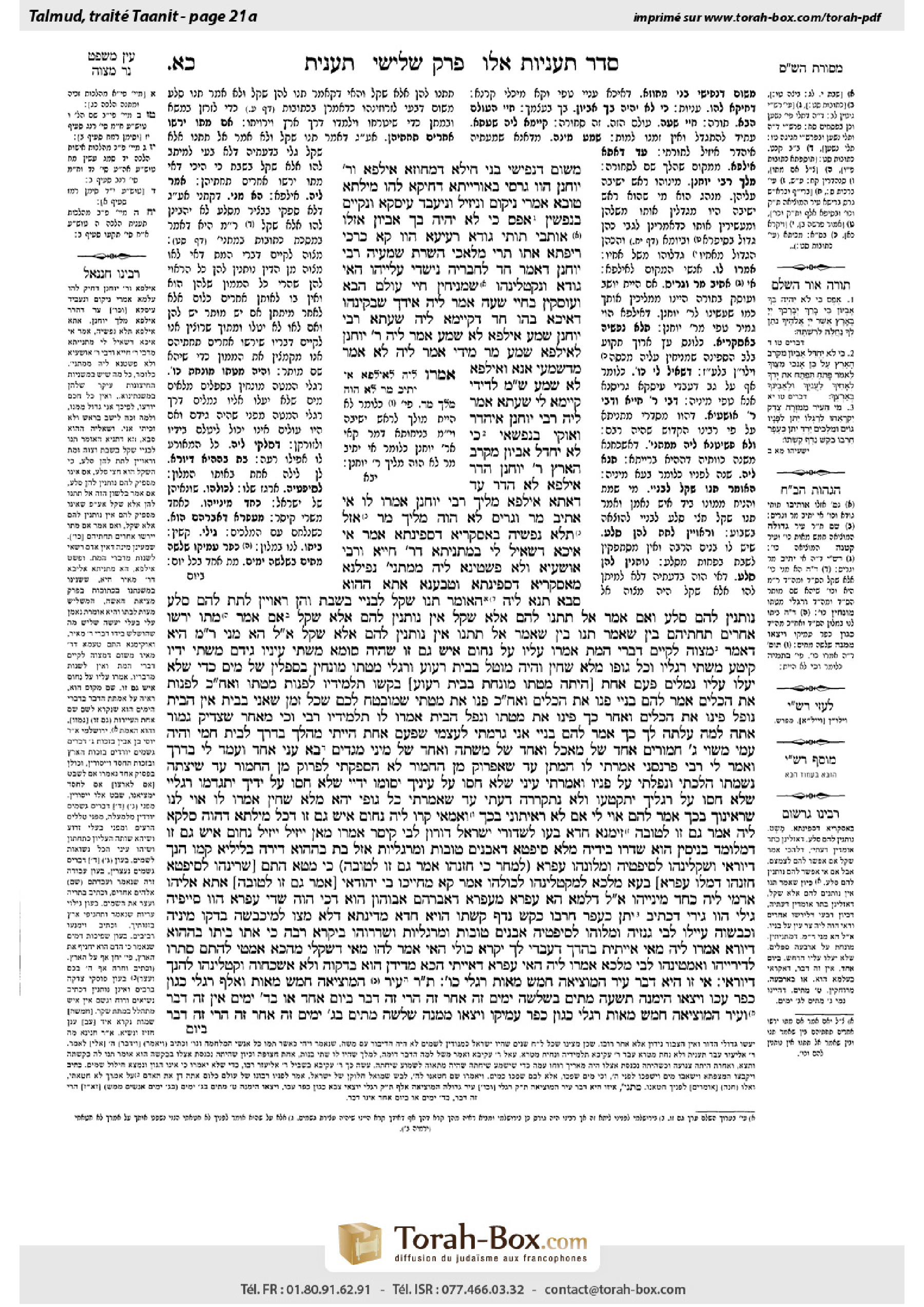
This page of Taanit includes the Aramaic text, an English translation and an AI-generated French translation, alongside the scan above.
תענית כ״א א · Aramaic and Hebrew text
מִשּׁוּם דִּנְפִישִׁי בְּנֵי חֵילָא דְּמָחוֹזָא.
אִילְפָא וְרַבִּי יוֹחָנָן הֲווֹ גָּרְסִי בְּאוֹרָיְיתָא, דְּחִיקָא לְהוּ מִילְּתָא טוּבָא, אָמְרִי: נֵיקוּם וְנֵיזִיל וְנֶיעְבַּד עִיסְקָא וּנְקַיֵּים בְּנַפְשִׁין ״אֶפֶס כִּי לֹא יִהְיֶה בְּךָ אֶבְיוֹן״. אֲזַלוּ, אוֹתִיבוּ תּוּתֵי גּוּדָּא רְעִיעָא, הֲווֹ קָא כָּרְכִי רִיפְתָּא, אֲתוֹ תְּרֵי מַלְאֲכֵי הַשָּׁרֵת.
שַׁמְעֵיהּ רַבִּי יוֹחָנָן דְּאָמַר חַד לְחַבְרֵיהּ: נִישְׁדֵּי עֲלַיְיהוּ הַאי גּוּדָּא וְנִקְטְלִינְהוּ, שֶׁמַּנִּיחִין חַיֵּי עוֹלָם הַבָּא וְעוֹסְקִין בְּחַיֵּי שָׁעָה! אֲמַר לֵיהּ אִידַּךְ: שַׁבְקִינְהוּ, דְּאִיכָּא בְּהוּ חַד דְּקָיְימָא לֵיהּ שַׁעְתָּא. רַבִּי יוֹחָנָן שְׁמַע, אִילְפָא לָא שְׁמַע. אֲמַר לֵיהּ רַבִּי יוֹחָנָן לְאִילְפָא: שָׁמַע מָר מִידֵּי? אֲמַר לֵיהּ: לָא. אֲמַר מִדִּשְׁמַעִי אֲנָא וְאִילְפָא לָא שְׁמַע, שְׁמַע מִינַּהּ לְדִידִי קָיְימָא לִי שַׁעְתָּא.
אֲמַר לֵיהּ רַבִּי יוֹחָנָן: אֶיהֱדַר, וְאוֹקֵי בְּנַפְשַׁאי ״כִּי לֹא יֶחְדַּל אֶבְיוֹן מִקֶּרֶב הָאָרֶץ״. רַבִּי יוֹחָנָן הֲדַר, אִילְפָא לָא הֲדַר. עַד דַּאֲתָא אִילְפָא, מָלֵיךְ רַבִּי יוֹחָנָן.
אָמְרוּ לוֹ: אִי אִתִּיב מָר וְגָרֵיס, לָא הֲוָה מָלֵיךְ מָר. אֲזַל תְּלָא נַפְשֵׁיהּ בְּאַסְקַרְיָא דִסְפִינְתָּא, אֲמַר: אִי אִיכָּא דְּשָׁאֵיל לִי בְּמַתְנִיתָא דְּרַבִּי חִיָּיא וְרַבִּי אוֹשַׁעְיָא וְלָא פָּשֵׁיטְנָא לֵיהּ מִמַּתְנִיתִין, נָפֵילְנָא מֵאַסְקַרְיָא דִסְפִינְתָּא וְטָבַעְנָא.
אֲתָא הָהוּא סָבָא, תְּנָא לֵיהּ: הָאוֹמֵר תְּנוּ שֶׁקֶל לְבָנַיי בְּשַׁבָּת, וְהֵן רְאוּיִין לָתֵת לָהֶם סֶלַע — נוֹתְנִין לָהֶם סֶלַע. וְאִם אָמַר: אַל תִּתְּנוּ לָהֶם אֶלָּא שֶׁקֶל — אֵין נוֹתְנִין לָהֶם אֶלָּא שֶׁקֶל.
אִם אָמַר: אִם מֵתוּ יִרְשׁוּ אֲחֵרִים תַּחְתֵּיהֶם — בֵּין שֶׁאָמַר ״תְּנוּ״ בֵּין שֶׁאָמַר ״אַל תִּתְּנוּ״ — אֵין נוֹתְנִין לָהֶם אֶלָּא שֶׁקֶל. אֲמַר לֵיהּ: הָא מַנִּי — רַבִּי מֵאִיר הִיא, דְּאָמַר: מִצְוָה לְקַיֵּים דִּבְרֵי הַמֵּת.
אָמְרוּ עָלָיו עַל נַחוּם אִישׁ גַּם זוֹ שֶׁהָיָה סוֹמֵא מִשְׁתֵּי עֵינָיו, גִּדֵּם מִשְׁתֵּי יָדָיו, קִיטֵּעַ מִשְׁתֵּי רַגְלָיו, וְכׇל גּוּפוֹ מָלֵא שְׁחִין. וְהָיָה מוּטָּל בְּבַיִת רָעוּעַ, וְרַגְלֵי מִטָּתוֹ מוּנָּחִין בִּסְפָלִין שֶׁל מַיִם כְּדֵי שֶׁלֹּא יַעֲלוּ עָלָיו נְמָלִים. פַּעַם אַחַת בִּקְּשׁוּ תַּלְמִידָיו לְפַנּוֹת מִטָּתוֹ, וְאַחַר כָּךְ לְפַנּוֹת אֶת הַכֵּלִים. אָמַר לָהֶם: בָּנַיי, פַּנּוּ אֶת הַכֵּלִים, וְאַחַר כָּךְ פַּנּוּ אֶת מִטָּתִי, שֶׁמּוּבְטָח לָכֶם שֶׁכׇּל זְמַן שֶׁאֲנִי בַּבַּיִת אֵין הַבַּיִת נוֹפֵל. פִּינּוּ אֶת הַכֵּלִים וְאַחַר כָּךְ פִּינּוּ אֶת מִטָּתוֹ, וְנָפַל הַבַּיִת.
אָמְרוּ לוֹ תַּלְמִידָיו: רַבִּי, וְכִי מֵאַחַר שֶׁצַּדִּיק גָּמוּר אַתָּה, לָמָה עָלְתָה לְךָ כָּךְ? אָמַר לָהֶם: בָּנַיי, אֲנִי גָּרַמְתִּי לְעַצְמִי. שֶׁפַּעַם אַחַת הָיִיתִי מְהַלֵּךְ בַּדֶּרֶךְ לְבֵית חָמִי, וְהָיָה עִמִּי מַשּׂוֹי שְׁלֹשָׁה חֲמוֹרִים, אֶחָד שֶׁל מַאֲכָל, וְאֶחָד שֶׁל מִשְׁתֶּה, וְאֶחָד שֶׁל מִינֵי מְגָדִים. בָּא עָנִי אֶחָד וְעָמַד לִי בַּדֶּרֶךְ, וְאָמַר לִי: רַבִּי, פַּרְנְסֵנִי. אָמַרְתִּי לוֹ: הַמְתֵּן עַד שֶׁאֶפְרוֹק מִן הַחֲמוֹר. לֹא הִסְפַּקְתִּי לִפְרוֹק מִן הַחֲמוֹר עַד שֶׁיָּצְתָה נִשְׁמָתוֹ.
הָלַכְתִּי וְנָפַלְתִּי עַל פָּנָיו, וְאָמַרְתִּי: עֵינַי שֶׁלֹּא חָסוּ עַל עֵינֶיךָ — יִסּוֹמוּ, יָדַיי שֶׁלֹּא חָסוּ עַל יָדֶיךָ — יִתְגַּדְּמוּ, רַגְלַי שֶׁלֹּא חָסוּ עַל רַגְלֶיךָ — יִתְקַטְּעוּ. וְלֹא נִתְקָרְרָה דַּעְתִּי עַד שֶׁאָמַרְתִּי: כׇּל גּוּפִי יְהֵא מָלֵא שְׁחִין. אָמְרוּ לוֹ: אוֹי לָנוּ שֶׁרְאִינוּךָ בְּכָךְ! אָמַר לָהֶם: אוֹי לִי אִם לֹא רְאִיתוּנִי בְּכָךְ.
וְאַמַּאי קָרוּ לֵיהּ נַחוּם אִישׁ גַּם זוֹ — דְּכׇל מִילְּתָא דַּהֲוָה סָלְקָא לֵיהּ, אֲמַר: גַּם זוֹ לְטוֹבָה. זִימְנָא חֲדָא בְּעוֹ לְשַׁדּוֹרֵי יִשְׂרָאֵל דּוֹרוֹן לְבֵי קֵיסָר, אָמְרוּ: מַאן יֵיזִיל — יֵיזִיל נַחוּם אִישׁ גַּם זוֹ, דִּמְלוּמָּד בְּנִיסִּין הוּא. שַׁדַּרוּ בִּידֵיהּ מְלֵא סִיפְטָא דַּאֲבָנִים טוֹבוֹת וּמַרְגָּלִיּוֹת. אֲזַל, בָּת בְּהָהוּא דִּירָא. בְּלֵילְיָא קָמוּ הָנָךְ דָּיוֹרָאֵי וְשַׁקְלִינְהוּ לְסִיפְטֵיהּ וּמְלוֹנְהוּ עַפְרָא.
כִּי מְטָא הָתָם, שְׁרִינְהוּ לְסִיפְטֵי, חֲזָנְהוּ דִּמְלוּ עַפְרָא. בְּעָא מַלְכָּא לְמִקְטְלִינְהוּ לְכוּלְּהוּ, אֲמַר: קָא מְחַיְּיכוּ בִּי יְהוּדָאֵי. אֲמַר: גַּם זוֹ לְטוֹבָה. אֲתָא אֵלִיָּהוּ אִדְּמִי לֵיהּ כְּחַד מִינַּיְיהוּ, אֲמַר לֵיהּ: דִּלְמָא הָא עַפְרָא מֵעַפְרָא דְּאַבְרָהָם אֲבוּהוֹן הוּא, דְּכִי הֲוָה שָׁדֵי עַפְרָא — הָווּ סַיְיפֵי, גִּילֵי — הָווּ גִּירֵי, דִּכְתִיב: ״יִתֵּן כֶּעָפָר חַרְבּוֹ כְּקַשׁ נִדָּף קַשְׁתּוֹ״.
הַוְיָא חֲדָא מְדִינְתָּא דְּלָא מָצוּ לְמִיכְבְּשַׁהּ, בְּדַקוּ מִינֵּיהּ וְכַבְשׁוּהָ. עֲיַילוּ לְבֵי גִנְזֵיה וּמְלוֹהוּ לְסִיפְטֵיהּ אֲבָנִים טוֹבוֹת וּמַרְגָּלִיּוֹת, וְשַׁדְּרוּהוּ בִּיקָרָא רַבָּה.
כִּי אֲתוֹ, בִּיתוּ בְּהָהוּא דִּיּוּרָא, אֲמַרוּ לֵיהּ: מַאי אַיְיתֵית בַּהֲדָךְ דְּעָבְדִי לָךְ יְקָרָא כּוּלֵּי הַאי? אֲמַר לְהוּ: מַאי דִּשְׁקַלִי מֵהָכָא אַמְטִי לְהָתָם. סְתַרוּ לְדִירַיְיהוּ וְאַמְטִינְהוּ לְבֵי מַלְכָּא, אֲמַרוּ לֵיהּ: הַאי עַפְרָא דְּאַיְיתִי הָכָא — מִדִּידַן הוּא. בַּדְקוּהּ וְלָא אַשְׁכְּחוּהּ, וְקַטְלִינְהוּ לְהָנָךְ דָּיוֹרָאֵי.
אִי זוֹ הִיא דֶּבֶר — עִיר הַמּוֹצִיאָה חֲמֵשׁ מֵאוֹת רַגְלִי כּוּ׳. תָּנוּ רַבָּנַן: עִיר הַמּוֹצִיאָה חֲמֵשׁ מֵאוֹת וְאֶלֶף רַגְלִי, כְּגוֹן כְּפַר עַכּוֹ, וְיָצְאוּ הֵימֶנָּה תִּשְׁעָה מֵתִים בִּשְׁלֹשָׁה יָמִים זֶה אַחַר זֶה — הֲרֵי זֶה דֶּבֶר.
בְּיוֹם אֶחָד אוֹ בְּאַרְבָּעָה יָמִים — אֵין זֶה דֶּבֶר. וְעִיר הַמּוֹצִיאָה חֲמֵשׁ מֵאוֹת רַגְלִי, כְּגוֹן כְּפַר עֲמִיקוּ, וְיָצְאוּ הֵימֶנָּה שְׁלֹשָׁה מֵתִים בִּשְׁלֹשָׁה יָמִים זֶה אַחַר זֶה — הֲרֵי זֶה דֶּבֶר.
Taanit 21a · English translation
due to the fact that there are many soldiers in the city of Meḥoza, and if I let them all eat, they will take all the food I own.
§ The Gemara relates another story that involves an unstable wall. Ilfa and Rabbi Yoḥanan studied Torah together, and as a result they became very hard-pressed for money. They said: Let us get up and go and engage in commerce, and we will fulfill, with regard to ourselves, the verse: “Although there should be no needy among you” (Deuteronomy 15:4), as we will no longer be complete paupers. They went and sat under a dilapidated wall and were eating bread, when two ministering angels arrived.
Rabbi Yoḥanan heard that one angel said to the other: Let us knock this wall down upon them and kill them, as they abandon eternal life of Torah study and engage in temporal life for their own sustenance. The other angel said to him: Leave them, as there is one of them whose time of achievement stands before him, i.e., his time has yet to come. Rabbi Yoḥanan heard all this, but Ilfa did not hear the angels’ conversation. Rabbi Yoḥanan said to Ilfa: Did the Master hear anything? Ilfa said to him: No. Rabbi Yoḥanan said to himself: Since I heard the angels and Ilfa did not hear, I can learn from this that it is I whose time of achievement stands before me.
Rabbi Yoḥanan said to Ilfa: I will return home and fulfill with regard to myself the contrary verse: “For the poor shall never cease out of the land” (Deuteronomy 15:11). Rabbi Yoḥanan returned to the study hall, and Ilfa did not return, but went to engage in business instead. By the time that Ilfa came back from his business travels, Rabbi Yoḥanan had been appointed head of the academy, and his financial situation had improved.
His colleagues said to Ilfa: If the Master had sat and studied, instead of going off to his business ventures, wouldn’t the Master have been appointed head of the academy? Ilfa went and suspended himself from the mast [askariya] of a ship, saying: If there is anyone who can ask me a question concerning a baraita of Rabbi Ḥiyya and Rabbi Oshaya, and I do not resolve his problem from a mishna, I will fall from the mast of this ship and be drowned. Ilfa sought to demonstrate that despite the time he had spent in business, he still retained his extensive Torah knowledge.
A certain old man came and taught a baraita before him: If there is a man who, upon his deathbed, says in his will: Give a shekel to my sons every week, but this is a situation where, based on their needs, they are fit for the court to give them a sela, i.e., double the amount, they give them a sela. When the dying man mentioned a shekel, he presumably meant that they should be given a sum in accordance with their actual requirements, not that specific amount. But if he said: Give them only a shekel, the court gives them only a shekel and no more.
The baraita further states that if one said: If my sons die, others should inherit their portion in their stead, regardless of whether he said: Give them a shekel, or whether he said: Give them only a shekel, then the court gives his sons only a shekel per week, as their father clearly stated that he wishes to give his sons only a specific stipend and that he intends to leave the bulk of his property to others. Ilfa said to the old man: In accordance with whose opinion is this ruling? It is in accordance with the opinion of Rabbi Meir, who said: It is a mitzva to fulfill the statement of the dead. This entire baraita can be explained based on a principle that appears in a mishna: In all cases, one should try to execute the wishes of the deceased.
§ The Gemara relates another story about a rundown building. They said about Naḥum of Gam Zu that he was blind in both eyes, both his arms were amputated, both his legs were amputated, and his entire body was covered in boils. And he was lying in a dilapidated house, and legs of his bed were placed in buckets of water so that ants should not climb onto him, as he was unable to keep them off in any other manner. Once his students sought to remove his bed from the house and afterward remove his other vessels. He said to them: My sons, remove the vessels first, and afterward remove my bed, as I can guarantee you that as long as I am in the house, the house will not fall. Indeed they removed the vessels and afterward they removed his bed, and immediately the house collapsed.
His students said to him: Rabbi, since you are evidently a wholly righteous man, as we have just seen that as long as you were in your house it did not fall, why has this suffering befallen you? He said to them: My sons, I brought it upon myself. Naḥum of Gam Zu related to them the following: As once I was traveling along the road to my father-in-law’s house, and I had with me a load distributed among three donkeys, one of food, one of drink, and one of delicacies. A poor person came and stood before me in the road, saying: My rabbi, sustain me. I said to him: Wait until I unload the donkey, after which I will give you something to eat. However, I had not managed to unload the donkey before his soul left his body.
I went and fell upon his face and said: May my eyes, which had no compassion on your eyes, be blinded; may my hands, which had no compassion on your hands, be amputated; may my legs, which had no compassion on your legs, be amputated. And my mind did not rest until I said: May my whole body be covered in boils. Naḥum of Gam Zu prayed that his suffering might atone for his failure. His students said to him: Even so, woe to us that we have seen you in this state. He said to them: Woe is me if you had not seen me in this state, as this suffering atones for me.
The Gemara inquires: And why did they call him Naḥum of Gam Zu? The reason is that with regard to any matter that occurred to him, he would say: This too is for the good [gam zu letova]. Once, the Jews wished to send a gift [doron] to the house of the emperor. They said: Who should go and present this gift? Let Naḥum of Gam Zu go, as he is accustomed to miracles. They sent with him a chest [sifta] full of jewels and pearls, and he went and spent the night in a certain inn. During the night, these residents of the inn arose and took all of the precious jewels and pearls from the chest, and filled it with earth. The next day, when he saw what had happened, Naḥum of Gam Zu said: This too is for the good.
When he arrived there, at the ruler’s palace, they opened the chest and saw that it was filled with earth. The king wished to put all the Jewish emissaries to death. He said: The Jews are mocking me. Naḥum of Gam Zu said: This too is for the good. Elijah the Prophet came and appeared before the ruler as one of his ministers. He said to the ruler: Perhaps this earth is from the earth of their father Abraham. As when he threw earth, it turned into swords, and when he threw stubble, it turned into arrows, as it is written in a prophecy that the Sages interpreted this verse as a reference to Abraham: “His sword makes them as the dust, his bow as the driven stubble” (Isaiah 41:2).
There was one province that the Romans were unable to conquer. They took some of this earth, tested it by throwing it at their enemies, and conquered that province. When the ruler saw that this earth indeed had miraculous powers, his servants entered his treasury and filled Naḥum of Gam Zu’s chest with precious jewels and pearls and sent him off with great honor.
When Naḥum of Gam Zu came to spend the night at that same inn, the residents said to him: What did you bring with you to the emperor that he bestowed upon you such great honor? He said to them: That which I took from here, I brought there. When they heard this, the residents of the inn thought that the soil upon which their house stood had miraculous powers. They tore down their inn and brought the soil underneath to the king’s palace. They said to him: That earth that was brought here was from our property. The miracle had been performed only in the merit of Naḥum of Gam Zu. The emperor tested the inn’s soil in battle, and it was not found to have miraculous powers, and he had these residents of the inn put to death.
§ The mishna taught: What is considered a plague of pestilence? If it is a city that sends out five hundred infantrymen, and three dead are removed from it on three consecutive days, one dead per day, this is a plague of pestilence. The Sages taught: If a city that sends out fifteen hundred infantrymen, i.e., one that has a population of at least fifteen hundred men, e.g., the village of Akko, and nine dead are removed from it on three consecutive days, i.e., three dead per day, this is considered a plague of pestilence.
If all nine died on a single day, while none died on the other days, or if the nine died over a period of four days, this is not a plague of pestilence. And a city that sends out five hundred infantrymen, for example, the village of Amiko, and three dead are removed from it on three consecutive days, this is a plague of pestilence.
Taanit 21a · Traduction française (IA)
parce qu’il y a beaucoup de soldats dans la ville de Meḥoza et que, si je les laissais tous manger, ils prendraient toute la nourriture que je possède.
§ La Guemara rapporte une autre histoire impliquant un mur instable. Ilfa et Rabbi Yoḥanan étudiaient la Torah ensemble et, par conséquent, se trouvaient dans une grande précarité financière. Ils dirent : « Levons-nous, partons faire du commerce et accomplissons à notre égard le verset : “Il n’y aura pas de pauvre parmi vous” (Deutéronome 15:4), car nous ne serons plus complètement démunis. » Ils partirent et s’assirent sous un mur délabré pour manger du pain, quand deux anges se présentèrent.
Rabbi Yoḥanan entendit un ange dire à l’autre : « Abattons ce mur sur eux et tuons-les, car ils abandonnent la vie éternelle de l’étude de la Torah pour s’occuper de leur subsistance, une vie temporaire. » L’autre ange lui répondit : « Laisse-les, car l’un d’eux a encore devant lui le temps de sa réussite », c’est-à-dire que ce temps n’est pas encore venu. Rabbi Yoḥanan entendit tout cela, mais Ilfa n’entendit pas la conversation des anges. Rabbi Yoḥanan dit à Ilfa : « Le Maître a-t-il entendu quelque chose ? » Ilfa lui répondit : « Non. » Rabbi Yoḥanan se dit : « Puisque j’ai entendu les anges et qu’Ilfa ne les a pas entendus, j’en conclus que c’est moi qui ai encore devant moi le temps de ma réussite. »
Rabbi Yoḥanan dit à Ilfa : « Je vais rentrer et accomplir à mon égard le verset contraire : “Car il ne cessera jamais d’y avoir des pauvres dans le pays” (Deutéronome 15:11). » Rabbi Yoḥanan retourna à la maison d’étude, tandis qu’Ilfa n’y retourna pas et partit plutôt faire des affaires. Au retour d’Ilfa de ses voyages d’affaires, Rabbi Yoḥanan avait été nommé à la tête de l’académie et sa situation financière s’était améliorée.
Ses collègues dirent à Ilfa : « Si le Maître était resté étudier au lieu de partir faire des affaires, n’aurait-il pas été nommé à la tête de l’académie ? » Ilfa alla se suspendre au mât [askariya] d’un navire et dit : « Si quelqu’un peut me poser une question sur une baraïta de Rabbi Ḥiyya et de Rabbi Oshaya et que je ne parviens pas à résoudre son problème à partir d’une Michna, je tomberai du mât de ce navire et me noierai. » Ilfa cherchait à démontrer que, malgré le temps consacré aux affaires, il avait conservé son vaste savoir de la Torah.
Un certain vieillard vint enseigner une baraïta devant lui : si un homme, sur son lit de mort, déclare dans son testament : « Donnez chaque semaine un shekel à mes fils », mais que, compte tenu de leurs besoins, le tribunal estime qu’il convient de leur donner un sela, c’est-à-dire le double, on leur donne un sela. Lorsque le mourant a mentionné un shekel, il voulait probablement dire qu’on devait leur donner une somme correspondant à leurs besoins réels, et non ce montant précis. Mais s’il a dit : « Donnez-leur seulement un shekel », le tribunal ne leur donne qu’un shekel, et rien de plus.
La baraïta ajoute que si quelqu’un a dit : « Si mes fils meurent, que d’autres héritent de leur part à leur place », qu’il ait dit « Donnez-leur un shekel » ou « Donnez-leur seulement un shekel », le tribunal ne donne alors à ses fils qu’un shekel par semaine, car leur père a clairement déclaré qu’il souhaitait leur verser une allocation précise et laisser la majeure partie de ses biens à d’autres. Ilfa dit au vieillard : « Selon l’opinion de qui cette décision est-elle rendue ? » Elle est conforme à l’opinion de Rabbi Meïr, qui a dit : « C’est une mitsva d’accomplir la déclaration du défunt. » Toute cette baraïta s’explique par un principe énoncé dans une Michna : dans tous les cas, il faut s’efforcer d’exécuter les volontés du défunt.
§ La Guemara rapporte une autre histoire au sujet d’un bâtiment délabré. On disait de Naḥum de Gam Zu qu’il était aveugle des deux yeux, qu’on lui avait amputé les deux bras et les deux jambes, et que tout son corps était couvert de furoncles. Il était couché dans une maison délabrée, et les pieds de son lit étaient placés dans des seaux d’eau pour empêcher les fourmis de grimper jusqu’à lui, car il était incapable de les en empêcher autrement. Un jour, ses élèves voulurent sortir son lit de la maison, puis en sortir ses autres affaires. Il leur dit : « Mes fils, sortez d’abord les affaires, puis sortez mon lit, car je peux vous garantir que tant que je suis dans la maison, elle ne s’écroulera pas. » Ils sortirent effectivement les affaires, puis son lit, et aussitôt la maison s’effondra.
Ses élèves lui dirent : « Rabbi, puisque tu es manifestement un homme entièrement juste, comme nous venons de voir que tant que tu étais dans ta maison elle ne s’est pas écroulée, pourquoi cette souffrance t’a-t-elle frappé ? » Il leur répondit : « Mes fils, je l’ai provoquée moi-même. » Naḥum de Gam Zu leur raconta ce qui suit : « Un jour, je voyageais sur la route qui menait chez mon beau-père, et j’avais avec moi une cargaison répartie entre trois ânes : l’un portait de la nourriture, l’autre des boissons et le troisième des friandises. Un pauvre vint se placer devant moi sur la route et me dit : “Mon maître, nourris-moi.” Je lui répondis : “Attends que j’aie déchargé l’âne ; ensuite, je te donnerai quelque chose à manger.” Mais je n’avais pas encore réussi à décharger l’âne que son âme le quitta. »
« Je m’approchai de lui, tombai face contre terre et dis : “Que mes yeux, qui n’ont pas eu compassion des tiens, deviennent aveugles ; que mes mains, qui n’ont pas eu compassion des tiennes, soient amputées ; que mes jambes, qui n’ont pas eu compassion des tiennes, soient amputées.” Mais je ne trouvai pas le repos avant d’ajouter : “Que tout mon corps soit couvert de furoncles.” » Naḥum de Gam Zu pria pour que sa souffrance expie sa faute. Ses élèves lui dirent : « Malgré tout, malheur à nous de t’avoir vu dans cet état. » Il leur dit : « Malheur à moi si vous ne m’aviez pas vu dans cet état, car cette souffrance m’apporte l’expiation. »
La Guemara demande : pourquoi l’appelait-on Naḥum de Gam Zu ? Parce que, quelle que soit la chose qui lui arrivait, il disait : « Cela aussi est pour le bien » [gam zu letova]. Un jour, les Juifs voulurent envoyer un cadeau [doron] à la cour de l’empereur. Ils dirent : « Qui ira présenter ce cadeau ? Que Naḥum de Gam Zu y aille, car il est habitué aux miracles. » Ils lui confièrent un coffre [sifta] rempli de pierres précieuses et de perles, et il partit passer la nuit dans une certaine auberge. Pendant la nuit, les aubergistes se levèrent, prirent toutes les pierres précieuses et les perles du coffre et le remplirent de terre. Le lendemain, lorsqu’il vit ce qui s’était passé, Naḥum de Gam Zu dit : « Cela aussi est pour le bien. »
Lorsqu’il arriva là-bas, au palais du souverain, on ouvrit le coffre et l’on vit qu’il était rempli de terre. Le roi voulut mettre à mort tous les émissaires juifs. Il dit : « Les Juifs se moquent de moi. » Naḥum de Gam Zu dit : « Cela aussi est pour le bien. » Le prophète Élie vint et apparut devant le souverain sous les traits de l’un de ses ministres. Il dit au souverain : « Peut-être cette terre provient-elle de celle de leur père Abraham. En effet, lorsqu’il jetait de la terre, celle-ci se transformait en épées, et lorsqu’il jetait du chaume, celui-ci se transformait en flèches, comme il est écrit dans une prophétie que les Sages ont interprétée comme faisant référence à Abraham : “Son épée les réduit en poussière, son arc en chaume emporté par le vent” (Isaïe 41:2). »
Il y avait une province que les Romains ne parvenaient pas à conquérir. Ils prirent un peu de cette terre, la mirent à l’épreuve en la lançant sur leurs ennemis et conquirent cette province. Lorsque le souverain vit que cette terre avait effectivement des pouvoirs miraculeux, ses serviteurs entrèrent dans son trésor, remplirent le coffre de Naḥum de Gam Zu de pierres précieuses et de perles, puis le renvoyèrent avec de grands honneurs.
Lorsque Naḥum de Gam Zu vint passer la nuit dans cette même auberge, ses habitants lui demandèrent : « Qu’as-tu apporté à l’empereur pour qu’il t’ait accordé de si grands honneurs ? » Il leur répondit : « Ce que j’ai pris ici, je l’ai apporté là-bas. » En entendant cela, les aubergistes crurent que le sol sur lequel se dressait leur maison possédait des pouvoirs miraculeux. Ils démolirent leur auberge et apportèrent au palais du roi la terre qui se trouvait en dessous. Ils lui dirent : « Cette terre qui a été apportée ici provenait de notre propriété. » Or le miracle n’avait été accompli que par le mérite de Naḥum de Gam Zu. L’empereur mit la terre de l’auberge à l’épreuve au combat : elle ne se révéla pas dotée de pouvoirs miraculeux, et il fit mettre à mort ces aubergistes.
§ La Michna a enseigné : qu’est-ce qui est considéré comme une épidémie ? Si une ville qui fournit cinq cents fantassins voit trois morts en sortir au cours de trois jours consécutifs, à raison d’un mort par jour, il s’agit d’une épidémie. Les Sages ont enseigné : si une ville qui fournit quinze cents fantassins, c’est-à-dire une ville dont la population compte au moins quinze cents hommes, comme le village d’Akko, voit neuf morts en sortir au cours de trois jours consécutifs, soit trois morts par jour, cela est considéré comme une épidémie.
Si les neuf sont morts le même jour, tandis qu’aucun n’est mort les autres jours, ou si les neuf sont morts sur une période de quatre jours, il ne s’agit pas d’une épidémie. Et si une ville fournit cinq cents fantassins, par exemple le village d’Amiko, et que trois morts en sortent au cours de trois jours consécutifs, il s’agit d’une épidémie.
Traduction française générée par IA à partir de l’édition anglaise de Sefaria. Vérifie toujours un passage avec le texte source.
Text from Sefaria: William Davidson Edition - Vocalized Aramaic (CC BY NC); William Davidson Edition - English (CC BY NC).