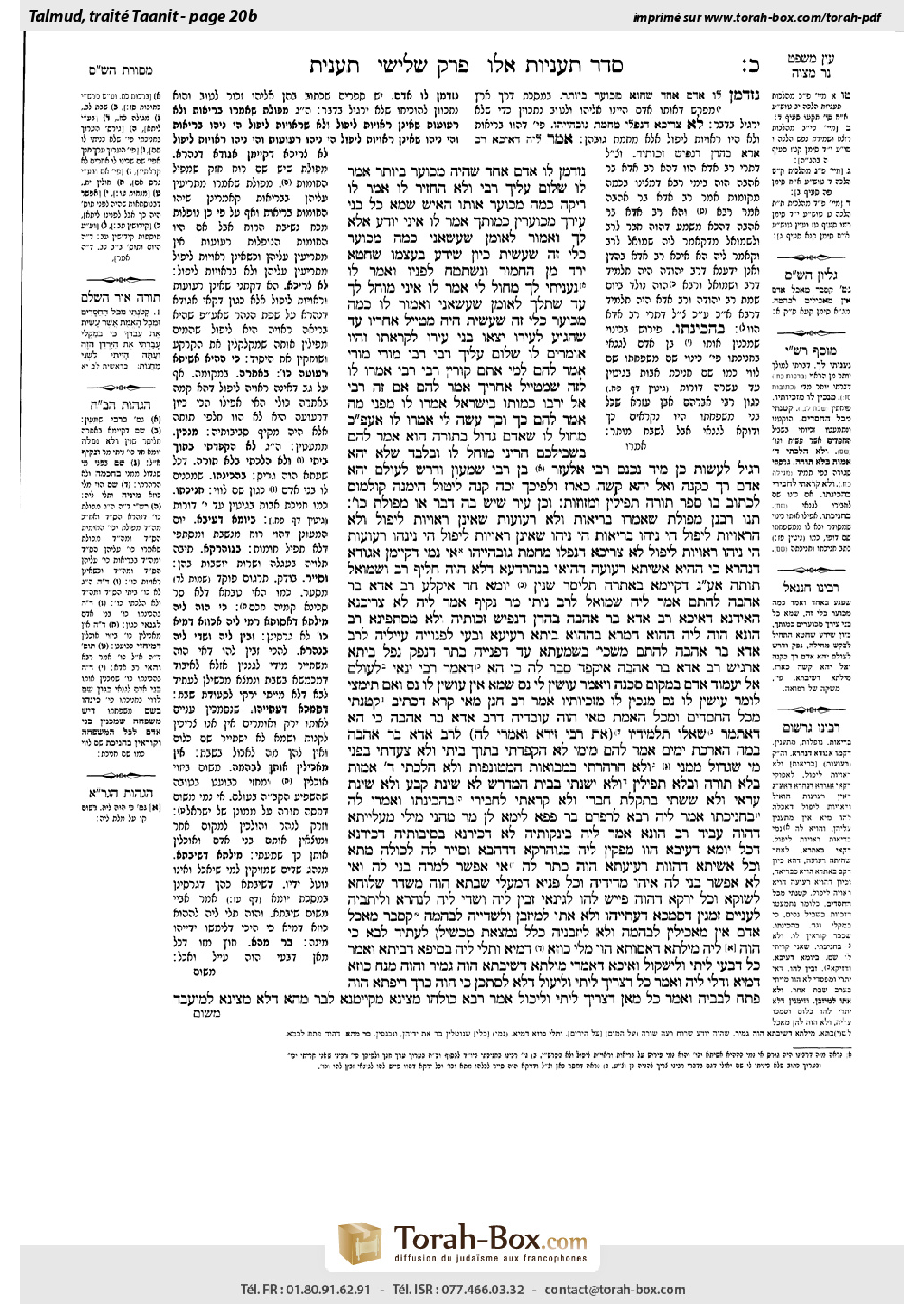
Taanit 20b: Talmud study for Daf Yomi
Daf Yomi is the daily study of one Talmud folio. Explore 37 tractates with scans, Hebrew text, Sefaria English and AI-generated French translations where annotated.
Passage selection and English or AI-generated French translation are available where the scan has annotations. Daf Study is independent of Torah-Box and Sefaria.
Browse Taanit · תענית · All tractatesTaanit 20b text and translations
This page of Taanit includes the Aramaic text, an English translation and an AI-generated French translation, alongside the scan above.
תענית כ׳ ב · Aramaic and Hebrew text
נִזְדַּמֵּן לוֹ אָדָם אֶחָד שֶׁהָיָה מְכוֹעָר בְּיוֹתֵר. אָמַר לוֹ: שָׁלוֹם עָלֶיךָ רַבִּי! וְלֹא הֶחְזִיר לוֹ. אָמַר לוֹ: רֵיקָה, כַּמָּה מְכוֹעָר אוֹתוֹ הָאִישׁ! שֶׁמָּא כׇּל בְּנֵי עִירֶךָ מְכוֹעָרִין כְּמוֹתְךָ? אָמַר לוֹ: אֵינִי יוֹדֵעַ, אֶלָּא לֵךְ וֶאֱמוֹר לָאוּמָּן שֶׁעֲשָׂאַנִי: ״כַּמָּה מְכוֹעָר כְּלִי זֶה שֶׁעָשִׂיתָ״. כֵּיוָן שֶׁיָּדַע בְּעַצְמוֹ שֶׁחָטָא, יָרַד מִן הַחֲמוֹר וְנִשְׁתַּטַּח לְפָנָיו, וְאָמַר לוֹ: נַעֲנֵיתִי לְךָ, מְחוֹל לִי! אָמַר לוֹ: אֵינִי מוֹחֵל לְךָ עַד שֶׁתֵּלֵךְ לָאוּמָּן שֶׁעֲשָׂאַנִי וֶאֱמוֹר לוֹ: כַּמָּה מְכוֹעָר כְּלִי זֶה שֶׁעָשִׂיתָ.
הָיָה מְטַיֵּיל אַחֲרָיו עַד שֶׁהִגִּיעַ לְעִירוֹ. יָצְאוּ בְּנֵי עִירוֹ לִקְרָאתוֹ, וְהָיוּ אוֹמְרִים לוֹ: שָׁלוֹם עָלֶיךָ רַבִּי רַבִּי, מוֹרִי מוֹרִי! אָמַר לָהֶם: לְמִי אַתֶּם קוֹרִין רַבִּי רַבִּי? אָמְרוּ לוֹ: לְזֶה שֶׁמְּטַיֵּיל אַחֲרֶיךָ. אָמַר לָהֶם: אִם זֶה רַבִּי — אַל יִרְבּוּ כְּמוֹתוֹ בְּיִשְׂרָאֵל. אָמְרוּ לוֹ: מִפְּנֵי מָה? אָמַר לָהֶם: כָּךְ וְכָךְ עָשָׂה לִי. אָמְרוּ לוֹ: אַף עַל פִּי כֵּן, מְחוֹל לוֹ, שֶׁאָדָם גָּדוֹל בְּתוֹרָה הוּא.
אָמַר לָהֶם: בִּשְׁבִילְכֶם הֲרֵינִי מוֹחֵל לוֹ, וּבִלְבַד שֶׁלֹּא יְהֵא רָגִיל לַעֲשׂוֹת כֵּן. מִיָּד נִכְנַס רַבִּי אֶלְעָזָר בְּרַבִּי שִׁמְעוֹן, וְדָרַשׁ: לְעוֹלָם יְהֵא אָדָם רַךְ כְּקָנֶה וְאַל יְהֵא קָשֶׁה כְּאֶרֶז. וּלְפִיכָךְ זָכָה קָנֶה לִיטּוֹל הֵימֶנּוּ קוּלְמוֹס לִכְתּוֹב בּוֹ סֵפֶר תּוֹרָה תְּפִילִּין וּמְזוּזוֹת.
וְכֵן עִיר שֶׁיֵּשׁ בָּהּ דֶּבֶר אוֹ מַפּוֹלֶת כּוּ׳. תָּנוּ רַבָּנַן: מַפּוֹלֶת שֶׁאָמְרוּ, בְּרִיאוֹת וְלֹא רְעוּעוֹת. שֶׁאֵינָן רְאוּיוֹת לִיפּוֹל, וְלֹא הָרְאוּיוֹת לִיפּוֹל.
הֵי נִיהוּ בְּרִיאוֹת, הֵי נִיהוּ שֶׁאֵינָן רְאוּיוֹת לִיפּוֹל. הֵי נִיהוּ רְעוּעוֹת, הֵי נִיהוּ רְאוּיוֹת לִיפּוֹל! לָא צְרִיכָא, דִּנְפַלוּ מֵחֲמַת גּוּבְהַיְיהוּ. אִי נָמֵי, דְּקָיְימָן אַגּוּדָּא דְנַהֲרָא.
כִּי הַהִיא אֲשִׁיתָא רְעִיעֲתָא דַּהֲוַאי בִּנְהַרְדְּעָא דְּלָא הֲוָה חָלֵיף רַב וּשְׁמוּאֵל תּוּתַהּ, אַף עַל גַּב דְּקַיְימָא בְּאַתְרַהּ תְּלֵיסַר שְׁנִין. יוֹמָא חַד אִיקְּלַע רַב אַדָּא בַּר אַהֲבָה לְהָתָם, אֲמַר לֵיהּ שְׁמוּאֵל לְרַב: נֵיתֵי מָר נַקֵּיף! אֲמַר לֵיהּ: לָא צְרִיכְנָא הָאִידָּנָא, דְּאִיכָּא רַב אַדָּא בַּר אַהֲבָה בַּהֲדַן דִּנְפִישָׁ[א] זְכוּתֵיהּ, וְלָא מִסְתְּפֵינָא.
רַב הוּנָא הֲוָה לֵיהּ הָהוּא חַמְרָא בְּהָהוּא בֵּיתָא רְעִיעָא, וּבְעָא לְפַנּוֹיֵיהּ. עַיְּילֵיהּ לְרַב אַדָּא בַּר אַהֲבָה לְהָתָם, מַשְׁכֵיהּ בִּשְׁמַעְתָּא עַד דְּפַנְּיֵיהּ. בָּתַר דִּנְפַק נְפַל בֵּיתָא. אַרְגֵּישׁ רַב אַדָּא בַּר אַהֲבָה, אִיקְּפַד.
סָבַר לַהּ כִּי הָא דְּאָמַר רַבִּי יַנַּאי: לְעוֹלָם אַל יַעֲמוֹד אָדָם בְּמָקוֹם סַכָּנָה וְיֹאמַר: עוֹשִׂין לִי נֵס, שֶׁמָּא אֵין עוֹשִׂין לוֹ נֵס. וְאִם תִּימְצֵי לוֹמַר עוֹשִׂין לוֹ נֵס — מְנַכִּין לוֹ מִזְּכִיּוֹתָיו. אָמַר רַב חָנָן: מַאי קְרָא — דִּכְתִיב: ״קָטֹנְתִּי מִכֹּל הַחֲסָדִים וּמִכׇּל הָאֱמֶת״.
מַאי הֲוָה עוֹבָדֵיהּ דְּרַב אַדָּא בַּר אַהֲבָה? כִּי הָא דְּאִתְּמַר, שָׁאֲלוּ תַּלְמִידָיו לְרַב אַדָּא בַּר אַהֲבָה: בַּמָּה הֶאֱרַכְתָּ יָמִים? אָמַר לָהֶם: מִיָּמַי לֹא הִקְפַּדְתִּי בְּתוֹךְ בֵּיתִי, וְלֹא צָעַדְתִּי בִּפְנֵי מִי שֶׁגָּדוֹל מִמֶּנִּי,
וְלֹא הִרְהַרְתִּי בִּמְבוֹאוֹת הַמְטוּנָּפוֹת, וְלֹא הָלַכְתִּי אַרְבַּע אַמּוֹת בְּלֹא תּוֹרָה וּבְלֹא תְּפִילִּין, וְלֹא יָשַׁנְתִּי בְּבֵית הַמִּדְרָשׁ לֹא שֵׁינַת קֶבַע וְלֹא שֵׁינַת עֲרַאי, וְלֹא שַׂשְׂתִּי בְּתַקָּלַת חֲבֵרַי, וְלֹא קָרָאתִי לַחֲבֵירִי בַּהֲכִינָתוֹ, וְאָמְרִי לַהּ בַּחֲנִיכָתוֹ.
אֲמַר לֵיהּ רָבָא לְרַפְרָם בַּר פָּפָּא: לֵימָא לַן מָר מֵהָנֵי מִילֵּי מְעַלְּיָיתָא דַּהֲוָה עָבֵיד רַב הוּנָא! אֲמַר לֵיהּ: בְּיַנְקוּתֵיהּ לָא דְּכִירְנָא, בְּסֵיבוּתֵיהּ דְּכִירְנָא. דְּכֹל יוֹמָא דְעֵיבָא הֲווֹ מַפְּקִין לֵיהּ בְּגוּהַרְקָא דְּדַהֲבָא, וְסָיַיר לַהּ לְכוּלַּהּ מָתָא. וְכֹל אֲשִׁיתָא דַּהֲווֹת רְעִיעֲתָא, הֲוָה סָתַר לַהּ. אִי אֶפְשָׁר לְמָרַהּ — בָּנֵי לַהּ, וְאִי לָא אֶפְשָׁר — בָּנֵי לַהּ אִיהוּ מִדִּידֵיהּ.
וְכֹל פַּנְיָא דְּמַעֲלֵי שַׁבְּתָא הֲוָה מְשַׁדַּר שְׁלוּחָא לְשׁוּקָא, וְכֹל יַרְקָא דַּהֲוָה פָּיֵישׁ לְהוּ לְגִינָּאֵי, זַבֵּין לֵיהּ וְשָׁדֵי לֵיהּ לְנַהֲרָא. וְלִיתְּבֵיהּ לַעֲנִיִּים! זִמְנִין דְּסָמְכָא דַּעְתַּיְיהוּ וְלָא אָתוּ לְמִיזְבַּן. וְלִשְׁדְּיֵיהּ לִבְהֵמָה! קָסָבַר: מַאֲכַל אָדָם אֵין מַאֲכִילִין לִבְהֵמָה.
וְלָא לִיזְבְּנֵיהּ כְּלָל! נִמְצֵאתָ מַכְשִׁילָן לֶעָתִיד לָבֹא.
כִּי הֲוָה לֵיהּ מִילְּתָא דְאָסוּתָא, הֲוָה מָלֵי כּוּזָא (דְמַיָּא) [מִינֵּיהּ], וְתָלֵי לֵיהּ בְּסִיפָּא דְבֵיתָא, וְאָמַר: כׇּל דְּבָעֵי לֵיתֵי וְלִישְׁקוֹל. וְאִיכָּא דְּאָמְרִי: מִילְּתָא דְשִׁיבְתָּא הֲוָה גְּמִיר, וַהֲוָה מַנַּח כּוּזָא דְמַיָּא וְדָלֵי לֵיהּ, וְאָמַר: כׇּל דִּצְרִיךְ — לֵיתֵי וְלֵיעוּל דְּלָא לִסְתַּכַּן.
כִּי הֲוָה כָּרֵךְ רִיפְתָּא, הֲוָה פָּתַח לְבָבֵיהּ, וְאָמַר: כׇּל מַאן דִּצְרִיךְ לֵיתֵי וְלֵיכוֹל. אָמַר רָבָא: כּוּלְּהוּ מָצֵינָא מְקַיַּימְנָא, לְבַר מֵהָא דְּלָא מָצֵינָא לְמִיעְבַּד,
Taanit 20b · English translation
He happened upon an exceedingly ugly person, who said to him: Greetings to you, my rabbi, but Rabbi Elazar did not return his greeting. Instead, Rabbi Elazar said to him: Worthless [reika] person, how ugly is that man. Are all the people of your city as ugly as you? The man said to him: I do not know, but you should go and say to the Craftsman Who made me: How ugly is the vessel you made. When Rabbi Elazar realized that he had sinned and insulted this man merely on account of his appearance, he descended from his donkey and prostrated himself before him, and he said to the man: I have sinned against you; forgive me. The man said to him: I will not forgive you until you go to the Craftsman Who made me and say: How ugly is the vessel you made.
He walked behind the man, trying to appease him, until they reached Rabbi Elazar’s city. The people of his city came out to greet him, saying to him: Greetings to you, my rabbi, my rabbi, my master, my master. The man said to them: Who are you calling my rabbi, my rabbi? They said to him: To this man, who is walking behind you. He said to them: If this man is a rabbi, may there not be many like him among the Jewish people. They asked him: For what reason do you say this? He said to them: He did such and such to me. They said to him: Even so, forgive him, as he is a great Torah scholar.
He said to them: For your sakes I forgive him, provided that he accepts upon himself not to become accustomed to behave like this. Immediately, Rabbi Elazar, son of Rabbi Shimon, entered the study hall and taught: A person should always be soft like a reed and he should not be stiff like a cedar, as one who is proud like a cedar is likely to sin. And therefore, due to its gentle qualities, the reed merited that a quill is taken from it to write with it a Torah scroll, phylacteries, and mezuzot.
§ The mishna taught: And likewise, if a city is afflicted by pestilence or collapsing buildings, that city fasts and sounds the alarm, and all of its surrounding areas fast but they do not sound the alarm. Rabbi Akiva says: They sound the alarm but they do not fast. The Sages taught: These collapsing buildings to which the Sages referred are those of sturdy and not dilapidated walls; they have walls that are not ready to fall, and not those that are ready to fall.
The Gemara expresses puzzlement with regard to the wording of the baraita: What are sound walls; what are walls that are not ready to fall; what are dilapidated walls; what are those that are ready to fall? The elements in each pair of walls are apparently the same, and the baraita is repetitive. The Gemara answers: No, it is necessary to specify that in the case of walls that fell due to their height, i.e., they are sound but also ready to fall, due to their excessive height. Alternatively, the baraita is referring to a case where the walls were positioned on a riverbank, as they are likely to fall despite the fact that they are not dilapidated, as the riverbank itself is unstable.
The Gemara relates: This is like that dilapidated wall that was in Neharde’a, under which Rav and Shmuel would not pass, although it stood in place thirteen years. One day Rav Adda bar Ahava happened to come there and walked with them. As they passed the wall, Shmuel said to Rav: Come, Master, let us circumvent this wall, so that we do not stand beneath it. Rav said to him: It is not necessary to do so today, as Rav Adda bar Ahava is with us, whose merit is great, and therefore I am not afraid of its collapse.
The Gemara relates another incident. Rav Huna had a certain quantity of wine in a certain dilapidated house and he wanted to move it, but he was afraid that the building would collapse upon his entry. He brought Rav Adda bar Ahava to there, to the ramshackle house, and he dragged out a discussion with him concerning a matter of halakha until they had removed all the wine. As soon as they exited, the building collapsed. Rav Adda bar Ahava realized what had happened and became angry.
The Gemara explains: Rav Adda bar Ahava holds in accordance with this statement, as Rabbi Yannai said: A person should never stand in a place of danger and say: A miracle will be performed for me, and I will escape unharmed, lest a miracle is not performed for him. And if you say that a miracle will be performed for him, they will deduct it from his merits. Rav Ḥanan said: What is the verse that alludes to this idea? As it is written: “I have become small from all the mercies and all the truth that You have showed Your servant” (Genesis 32:11). In other words, the more benevolence one receives from God, the more his merit is reduced.
After recounting stories that reflect Rav Adda bar Ahava’s great merit, the Gemara asks: What were the exceptional deeds of Rav Adda bar Ahava? The Gemara reports that they are as it is stated: The students of Rabbi Zeira asked him, and some say that the students of Rav Adda bar Ahava asked him: To what do you attribute your longevity? He said to them: In all my days I did not become angry with my household, and I never walked before someone greater than myself; rather, I always gave him the honor of walking before me.
Rav Adda bar Ahava continued: And I did not think about matters of Torah in filthy alleyways; and I did not walk four cubits without engaging in Torah and without donning phylacteries; and I would not fall asleep in the study hall, neither a deep sleep nor a brief nap; and I would not rejoice in the mishap of my colleague; and I would not call my colleague by his nickname. And some say that he said: I would not call my colleague by his derogatory family name.
§ The Gemara relates another story about the righteous deeds of the Sages involving a dilapidated wall. Rava said to Rafram bar Pappa: Let the Master tell us some of those fine deeds that Rav Huna performed. He said to him: I do not remember what he did in his youth, but the deeds of his old age I remember. As on every cloudy day they would take him out in a golden carriage [guharka], and he would survey the entire city. And he would command that every unstable wall be torn down, lest it fall in the rain and hurt someone. If its owner was able to build another, Rav Huna would instruct him to rebuild it. And if he was unable to rebuild it, Rav Huna would build it himself with his own money.
Rafram bar Pappa further relates: And every Shabbat eve, in the afternoon, Rav Huna would send a messenger to the marketplace, and he would purchase all the vegetables that were left with the gardeners who sold their crops, and throw them into the river. The Gemara asks: But why did he throw out the vegetables? Let him give them to the poor. The Gemara answers: If he did this, the poor would sometimes rely on the fact that Rav Huna would hand out vegetables, and they would not come to purchase any. This would ruin the gardeners’ livelihood. The Gemara further asks: And let him throw them to the animals. The Gemara answers: He holds that human food may not be fed to animals, as this is a display of contempt for the food.
The Gemara objects: But if Rav Huna could not use them in any way, he should not purchase the vegetables at all. The Gemara answers: If nothing is done, you would have been found to have caused a stumbling block for them in the future. If the vegetable sellers see that some of their produce is left unsold, the next week they will not bring enough for Shabbat. Therefore, Rav Huna made sure that the vegetables were all bought, so that the sellers would continue to bring them.
Another custom of Rav Huna was that when he had a new medicine, he would fill a water jug with the medicine and hang it from the doorpost of his house, saying: All who need, let him come and take from this new medicine. And there are those who say: He had a remedy against the demon Shivta that he knew by tradition, that one must wash his hands for protection against this evil spirit. And to this end, he would place a water jug and hang it by the door, saying: Anyone who needs, let him come to the house and wash his hands, so that he will not be in danger.
The Gemara further relates: When Rav Huna would eat bread, he would open the doors to his house, saying: Whoever needs, let him come in and eat. Rava said: I can fulfill all these customs of Rav Huna, except for this one, which I cannot do,
Taanit 20b · Traduction française (IA)
Il rencontra un homme extrêmement laid, qui lui dit : « La paix soit avec toi, mon maître ! » Mais Rabbi Elazar ne lui rendit pas son salut. Au contraire, Rabbi Elazar lui dit : « Homme de rien [reika], comme cet homme est laid ! Tous les habitants de ta ville sont-ils aussi laids que toi ? » L’homme lui répondit : « Je ne sais pas, mais va dire à l’Artisan qui m’a façonné : “Comme il est laid, le récipient que tu as fabriqué !” » Lorsque Rabbi Elazar comprit qu’il avait péché en insultant cet homme uniquement à cause de son apparence, il descendit de son âne, se prosterna devant lui et lui dit : « J’ai péché contre toi ; pardonne-moi. » L’homme lui répondit : « Je ne te pardonnerai pas tant que tu ne seras pas allé dire à l’Artisan qui m’a façonné : “Comme il est laid, le récipient que tu as fabriqué !” »
Il marcha derrière l’homme, essayant de l’apaiser, jusqu’à ce qu’ils arrivent dans la ville de Rabbi Elazar. Les habitants de la ville sortirent à sa rencontre et lui dirent : « La paix soit avec toi, mon maître, mon maître, mon maître, mon maître ! » L’homme leur demanda : « Qui appelez-vous “mon maître, mon maître” ? » Ils lui répondirent : « Cet homme qui marche derrière toi. » Il leur dit : « Si cet homme est un maître, puisse-t-il ne pas y en avoir beaucoup comme lui parmi le peuple juif ! » Ils lui demandèrent : « Pourquoi dites-vous cela ? » Il leur répondit : « Il m’a fait telle et telle chose. » Ils lui dirent : « Malgré tout, pardonne-lui, car c’est un grand érudit de la Torah. »
Il leur dit : « Pour vous, je lui pardonne, à condition qu’il s’engage à ne pas prendre l’habitude de se comporter ainsi. » Aussitôt, Rabbi Elazar, fils de Rabbi Shimon, entra dans la maison d’étude et enseigna : « L’homme doit toujours être souple comme un roseau et ne pas être raide comme un cèdre, car celui qui est orgueilleux comme un cèdre risque de pécher. C’est pourquoi, en raison de sa souplesse, le roseau a mérité qu’on en prélève une plume pour écrire un rouleau de Torah, des tefillin et des mezouzot. »
§ La Michna enseignait : De même, si une ville est frappée par une épidémie ou par des effondrements de bâtiments, cette ville jeûne et sonne l’alarme ; toutes les localités qui l’entourent jeûnent, mais ne sonnent pas l’alarme. Rabbi Akiva dit : Elles sonnent l’alarme, mais ne jeûnent pas. Les Sages ont enseigné : Les bâtiments qui s’effondrent auxquels les Sages font référence sont ceux dont les murs sont solides et non délabrés : leurs murs ne sont pas sur le point de s’écrouler, contrairement à ceux qui sont sur le point de s’écrouler.
La Guemara s’étonne de la formulation de la baraïta : Que sont des murs solides ? Que sont des murs qui ne sont pas sur le point de s’écrouler ? Que sont des murs délabrés ? Que sont des murs qui sont sur le point de s’écrouler ? Les éléments de chaque paire semblent désigner la même chose, et la baraïta est donc répétitive. La Guemara répond : Non, il est nécessaire de préciser qu’il s’agit de murs qui se sont effondrés en raison de leur hauteur, c’est-à-dire qu’ils sont solides, mais également susceptibles de s’effondrer à cause de leur hauteur excessive. Autrement, la baraïta parle d’un cas où les murs sont situés sur la berge d’un fleuve : ils risquent de s’écrouler bien qu’ils ne soient pas délabrés, car la berge elle-même est instable.
La Guemara rapporte : C’était comme ce mur délabré qui se trouvait à Neharde’a, sous lequel Rav et Shmuel ne passaient pas, bien qu’il fût resté debout pendant treize ans. Un jour, Rav Adda bar Ahava se trouva là et marcha avec eux. Alors qu’ils passaient devant le mur, Shmuel dit à Rav : « Viens, Maître, contournons ce mur afin de ne pas nous tenir dessous. » Rav lui répondit : « Ce n’est pas nécessaire aujourd’hui, car Rav Adda bar Ahava est avec nous. Son mérite est grand ; je ne crains donc pas que le mur s’écroule. »
La Guemara rapporte un autre incident. Rav Huna avait une certaine quantité de vin dans une maison délabrée et voulait la déplacer, mais il craignait que le bâtiment ne s’écroule sur lui s’il y entrait. Il fit venir Rav Adda bar Ahava dans cette maison en ruine et prolongea avec lui une discussion sur une question de halakha jusqu’à ce qu’ils aient sorti tout le vin. Dès qu’ils furent sortis, le bâtiment s’écroula. Rav Adda bar Ahava comprit ce qui s’était passé et se mit en colère.
La Guemara explique : Rav Adda bar Ahava suit cet enseignement, car Rabbi Yannai a dit : « L’homme ne doit jamais se tenir dans un lieu dangereux en se disant : “Un miracle se produira pour moi et je m’en sortirai indemne”, de peur qu’aucun miracle ne se produise pour lui. Et même si l’on dit qu’un miracle se produira pour lui, on le déduira de ses mérites. » Rav Ḥanan a dit : Quel verset fait allusion à cette idée ? Comme il est écrit : « Je suis devenu petit devant toutes les bontés et toute la fidélité dont Tu as usé envers Ton serviteur » (Genèse 32, 11). Autrement dit, plus on reçoit de bienfaits de Dieu, plus ses mérites diminuent.
Après avoir rapporté des récits qui témoignent du grand mérite de Rav Adda bar Ahava, la Guemara demande : Quels étaient les actes exceptionnels de Rav Adda bar Ahava ? La Guemara rapporte ce qui suit : Les élèves de Rabbi Zeira l’interrogèrent — et certains disent que ce furent les élèves de Rav Adda bar Ahava qui l’interrogèrent — : « À quoi attribuez-vous votre longévité ? » Il leur répondit : « De toute ma vie, je ne me suis jamais mis en colère contre les membres de mon foyer, et je n’ai jamais marché devant quelqu’un de plus grand que moi ; au contraire, je lui ai toujours laissé l’honneur de marcher devant moi. »
Rav Adda bar Ahava poursuivit : « Je ne réfléchissais pas à des questions de Torah dans des ruelles sales ; je ne marchais pas quatre coudées sans étudier la Torah et sans porter les tefillin ; je ne m’endormais pas à la maison d’étude, ni d’un sommeil profond ni d’une courte sieste ; je ne me réjouissais pas du malheur de mon collègue et je ne l’appelais pas par son surnom. » Certains disent qu’il a dit : « Je n’appelais pas mon collègue par son nom de famille méprisant. »
§ La Guemara rapporte une autre histoire concernant les actes vertueux des Sages en lien avec un mur délabré. Rava dit à Rafram bar Pappa : « Que le Maître nous raconte quelques-unes des belles actions accomplies par Rav Huna. » Il lui répondit : « Je ne me souviens pas de ce qu’il faisait dans sa jeunesse, mais je me souviens des actions de sa vieillesse. Chaque jour nuageux, on le faisait sortir dans une voiture dorée [guharka], et il inspectait toute la ville. Il ordonnait que chaque mur instable soit démoli, de peur qu’il ne s’écroule sous la pluie et ne blesse quelqu’un. Si son propriétaire était capable d’en reconstruire un autre, Rav Huna lui ordonnait de le rebâtir. Et s’il en était incapable, Rav Huna le reconstruisait lui-même avec son propre argent. »
Rafram bar Pappa rapporte encore : « Chaque veille de Chabbat, dans l’après-midi, Rav Huna envoyait un messager au marché. Celui-ci achetait tous les légumes qui restaient aux maraîchers après la vente de leurs récoltes, puis les jetait dans le fleuve. » La Guemara demande : Mais pourquoi jetait-il les légumes ? Qu’il les donne aux pauvres ! La Guemara répond : S’il avait fait cela, les pauvres auraient parfois compté sur le fait que Rav Huna distribuerait des légumes et ne seraient pas venus en acheter. Cela aurait ruiné les moyens de subsistance des maraîchers. La Guemara demande encore : Qu’il les donne aux animaux ! La Guemara répond : Il considère qu’il est interdit de donner aux animaux de la nourriture destinée aux humains, car cela manifeste du mépris pour cette nourriture.
La Guemara objecte : Mais si Rav Huna ne pouvait pas les utiliser d’une manière ou d’une autre, il n’aurait pas dû acheter les légumes du tout. La Guemara répond : Si l’on ne faisait rien, vous finiriez par leur faire obstacle à l’avenir. Si les vendeurs de légumes voyaient qu’une partie de leurs produits restait invendue, la semaine suivante ils n’en apporteraient pas suffisamment pour Chabbat. Rav Huna veillait donc à ce que tous les légumes soient achetés, afin que les vendeurs continuent à en apporter.
Une autre habitude de Rav Huna était la suivante : lorsqu’il disposait d’un nouveau médicament, il remplissait une cruche d’eau avec ce médicament et la suspendait au montant de la porte de sa maison, en disant : « Que tous ceux qui en ont besoin viennent en prendre. » Certains disent qu’il connaissait par tradition un remède contre le démon Shivta : il fallait se laver les mains pour se protéger de ce mauvais esprit. À cette fin, il plaçait une cruche d’eau et la suspendait près de la porte, en disant : « Que quiconque en a besoin vienne à la maison se laver les mains, afin de ne pas être en danger. »
La Guemara rapporte encore : Lorsque Rav Huna mangeait du pain, il ouvrait les portes de sa maison en disant : « Que quiconque en a besoin entre et mange. » Rava dit : « Je peux accomplir toutes ces pratiques de Rav Huna, sauf celle-ci, que je ne peux pas mettre en pratique. »
Traduction française générée par IA à partir de l’édition anglaise de Sefaria. Vérifie toujours un passage avec le texte source.
Text from Sefaria: William Davidson Edition - Vocalized Aramaic (CC BY NC); William Davidson Edition - English (CC BY NC).