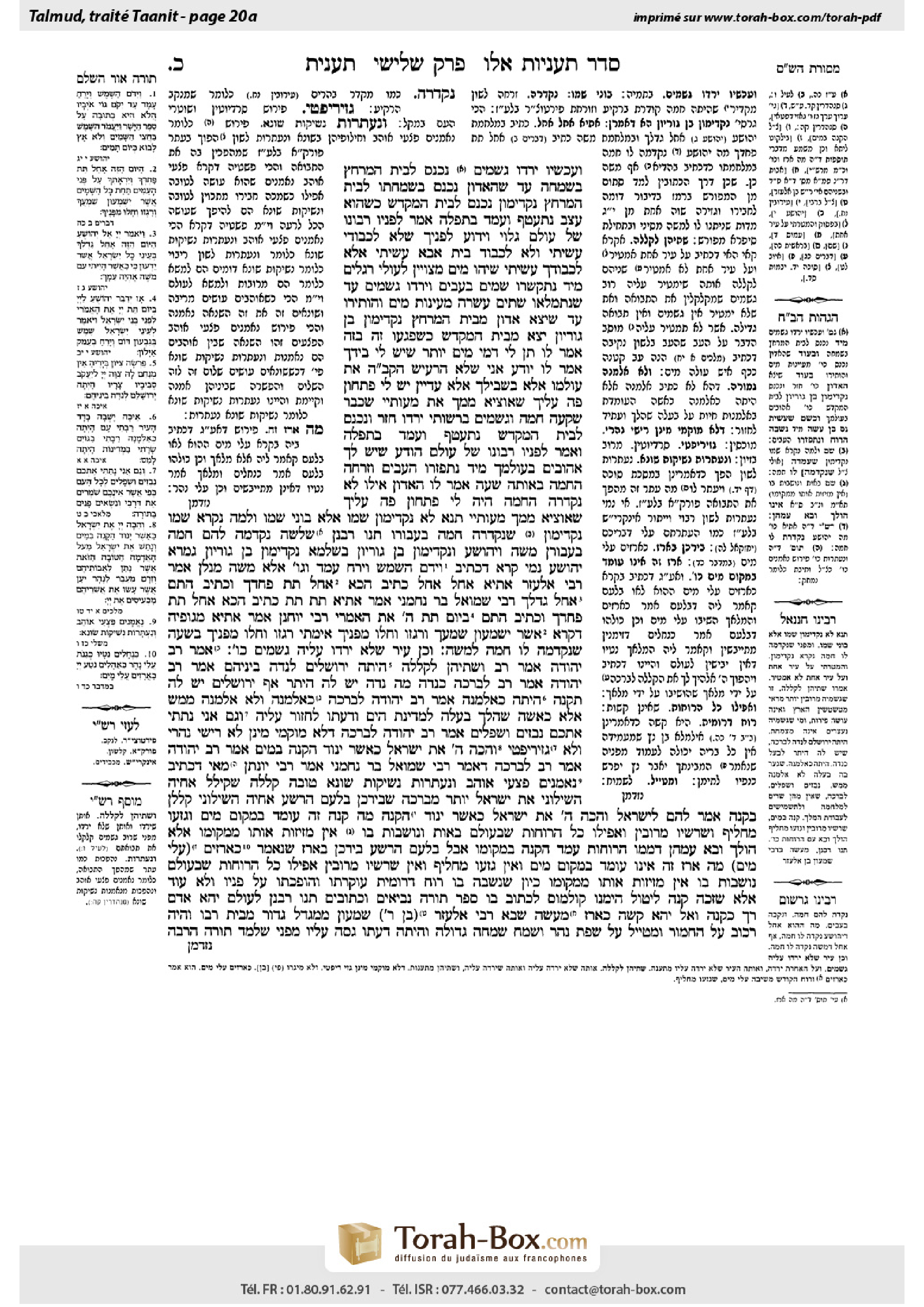
Taanit 20a: Talmud study for Daf Yomi
Daf Yomi is the daily study of one Talmud folio. Explore 37 tractates with scans, Hebrew text, Sefaria English and AI-generated French translations where annotated.
Passage selection and English or AI-generated French translation are available where the scan has annotations. Daf Study is independent of Torah-Box and Sefaria.
Browse Taanit · תענית · All tractatesTaanit 20a text and translations
This page of Taanit includes the Aramaic text, an English translation and an AI-generated French translation, alongside the scan above.
תענית כ׳ א · Aramaic and Hebrew text
וְעַכְשָׁיו יֵרְדוּ גְּשָׁמִים?! נִכְנַס לְבֵית הַמֶּרְחָץ בְּשִׂמְחָה. עַד שֶׁהַהֶגְמוֹן נִכְנַס בְּשִׂמְחָתוֹ לְבֵית הַמֶּרְחָץ, נַקְדִּימוֹן נִכְנַס לְבֵית הַמִּקְדָּשׁ כְּשֶׁהוּא עָצוּב. נִתְעַטֵּף, וְעָמַד בִּתְפִלָּה.
אָמַר לְפָנָיו: רִבּוֹנוֹ שֶׁל עוֹלָם! גָּלוּי וְיָדוּעַ לְפָנֶיךָ שֶׁלֹּא לִכְבוֹדִי עָשִׂיתִי, וְלֹא לִכְבוֹד בֵּית אַבָּא עָשִׂיתִי, אֶלָּא לִכְבוֹדְךָ עָשִׂיתִי, שֶׁיְּהוּ מַיִם מְצוּיִין לְעוֹלֵי רְגָלִים. מִיָּד נִתְקַשְּׁרוּ שָׁמַיִם בְּעָבִים, וְיָרְדוּ גְּשָׁמִים עַד שֶׁנִּתְמַלְּאוּ שְׁתֵּים עֶשְׂרֵה מַעֲיָנוֹת מַיִם וְהוֹתִירוּ.
עַד שֶׁיָּצָא הֶגְמוֹן מִבֵּית הַמֶּרְחָץ, נַקְדִּימוֹן בֶּן גּוּרְיוֹן יָצָא מִבֵּית הַמִּקְדָּשׁ. כְּשֶׁפָּגְעוּ זֶה בָּזֶה, אָמַר לוֹ: תֵּן לִי דְּמֵי מַיִם יוֹתֵר שֶׁיֵּשׁ לִי בְּיָדְךָ! אָמַר לוֹ: יוֹדֵעַ אֲנִי שֶׁלֹּא הִרְעִישׁ הַקָּדוֹשׁ בָּרוּךְ הוּא אֶת עוֹלָמוֹ אֶלָּא בִּשְׁבִילְךָ, אֶלָּא עֲדַיִין יֵשׁ לִי פִּתְחוֹן פֶּה עָלֶיךָ, שֶׁאוֹצִיא מִמְּךָ אֶת מְעוֹתַיי, שֶׁכְּבָר שָׁקְעָה חַמָּה, וּגְשָׁמִים — בִּרְשׁוּתִי יָרְדוּ.
חָזַר וְנִכְנַס לְבֵית הַמִּקְדָּשׁ, נִתְעַטֵּף וְעָמַד בִּתְפִלָּה, וְאָמַר לְפָנָיו: רִבּוֹנוֹ שֶׁל עוֹלָם! הוֹדַע שֶׁיֵּשׁ לְךָ אֲהוּבִים בְּעוֹלָמֶךָ! מִיָּד נִתְפַּזְּרוּ הֶעָבִים וְזָרְחָה הַחַמָּה. בְּאוֹתָהּ שָׁעָה אָמַר לוֹ אוֹתוֹ הֶגְמוֹן: אִילּוּ לֹא נִקְדְּרָה הַחַמָּה, הָיָה לִי פִּתְחוֹן פֶּה עָלֶיךָ שֶׁאוֹצִיא מִמְּךָ מְעוֹתַיי. תָּנָא: לֹא נַקְדִּימוֹן שְׁמוֹ, אֶלָּא בּוּנִי שְׁמוֹ, וְלָמָּה נִקְרָא שְׁמוֹ נַקְדִּימוֹן — שֶׁנִּקְדְּרָה חַמָּה בַּעֲבוּרוֹ.
תָּנוּ רַבָּנַן: שְׁלֹשָׁה נִקְדְּמָה לָהֶם חַמָּה בַּעֲבוּרָן: מֹשֶׁה, וִיהוֹשֻׁעַ, וְנַקְדִּימוֹן בֶּן גּוּרְיוֹן. בִּשְׁלָמָא נַקְדִּימוֹן בֶּן גּוּרְיוֹן — גְּמָרָא. יְהוֹשֻׁעַ — נָמֵי קְרָא, דִּכְתִיב: ״וַיִּדֹּם הַשֶּׁמֶשׁ וְיָרֵחַ עָמָד וְגוֹ׳״. אֶלָּא מֹשֶׁה מְנָלַן?
אָמַר רַבִּי אֶלְעָזָר: אָתְיָא ״אָחֵל״ ״אָחֵל״, כְּתִיב הָכָא: ״אָחֵל תֵּת פַּחְדְּךָ״, וּכְתִיב הָתָם: ״אָחֵל גַּדֶּלְךָ״.
רַבִּי שְׁמוּאֵל בַּר נַחְמָנִי אָמַר: אָתְיָא ״תֵּת״ ״תֵּת״, כְּתִיב הָכָא: ״אָחֵל תֵּת פַּחְדְּךָ״, וּכְתִיב הָתָם: ״בְּיוֹם תֵּת ה׳ אֶת הָאֱמֹרִי״.
רַבִּי יוֹחָנָן אָמַר, אָתְיָא מִגּוּפֵיהּ דִּקְרָא: ״אֲשֶׁר יִשְׁמְעוּן שִׁמְעֲךָ וְרָגְזוּ וְחָלוּ מִפָּנֶיךָ״, אֵימָתַי רָגְזוּ וְחָלוּ מִפָּנֶיךָ — בְּשָׁעָה שֶׁנִּקְדְּמָה לוֹ חַמָּה לְמֹשֶׁה.
וְכֵן עִיר שֶׁלֹּא יָרְדוּ עָלֶיהָ גְּשָׁמִים כּוּ׳. אָמַר רַב יְהוּדָה אָמַר רַב: וּשְׁתֵּיהֶן לִקְלָלָה.
״הָיְתָה יְרוּשָׁלִַים לְנִדָּה בֵּינֵיהֶם״, אָמַר רַב יְהוּדָה אָמַר רַב: לִבְרָכָה, כְּנִדָּה: מָה נִדָּה יֵשׁ לָהּ הֶיתֵּר — אַף יְרוּשָׁלַיִם יֵשׁ לָהּ תַּקָּנָה.
״הָיְתָה כְּאַלְמָנָה״, אָמַר רַב יְהוּדָה, לִבְרָכָה: כְּאַלְמָנָה — וְלֹא אַלְמָנָה מַמָּשׁ, אֶלָּא כְּאִשָּׁה שֶׁהָלַךְ בַּעְלָהּ לִמְדִינַת הַיָּם, וְדַעְתּוֹ לַחֲזוֹר עָלֶיהָ.
״וְגַם אֲנִי נָתַתִּי אֶתְכֶם נִבְזִים וּשְׁפָלִים״, אָמַר רַב יְהוּדָה: לִבְרָכָה, דְּלָא מוֹקְמִי מִינַּן לָא רֵישֵׁי נַהֲרֵי וְלָא גְּזִירִיפָּטֵי.
״וְהִכָּה ה׳ אֶת יִשְׂרָאֵל כַּאֲשֶׁר יָנוּד הַקָּנֶה בַּמַּיִם״, אָמַר רַב יְהוּדָה אָמַר רַב: לִבְרָכָה. דְּאָמַר רַבִּי שְׁמוּאֵל בַּר נַחְמָנִי אָמַר רַבִּי יוֹנָתָן, מַאי דִּכְתִיב: ״נֶאֱמָנִים פִּצְעֵי אוֹהֵב וְנַעְתָּרוֹת נְשִׁיקוֹת שׂוֹנֵא״ — טוֹבָה קְלָלָה שֶׁקִּילֵּל אֲחִיָּה הַשִּׁילוֹנִי אֶת יִשְׂרָאֵל יוֹתֵר מִבְּרָכָה שֶׁבֵּרְכָן בִּלְעָם הָרָשָׁע.
אֲחִיָּה הַשִּׁילוֹנִי קִלְּלָן בְּקָנֶה, אָמַר לָהֶם לְיִשְׂרָאֵל: ״וְהִכָּה ה׳ אֶת יִשְׂרָאֵל כַּאֲשֶׁר יָנוּד הַקָּנֶה״, מָה קָנֶה זֶה עוֹמֵד בִּמְקוֹם מַיִם, וְגִזְעוֹ מַחְלִיף וְשׇׁרָשָׁיו מְרוּבִּין, וַאֲפִילּוּ כׇּל הָרוּחוֹת שֶׁבָּעוֹלָם בָּאוֹת וְנוֹשְׁבוֹת בּוֹ — אֵין מְזִיזוֹת אוֹתוֹ מִמְּקוֹמוֹ, אֶלָּא הוֹלֵךְ וּבָא עִמָּהֶן. דָּמְמוּ הָרוּחוֹת — עָמַד הַקָּנֶה בִּמְקוֹמוֹ.
אֲבָל בִּלְעָם הָרָשָׁע בֵּירְכָן בְּאֶרֶז, שֶׁנֶּאֱמַר: ״כָּאֲרָזִים עֲלֵי מָיִם״, מָה אֶרֶז זֶה אֵינוֹ עוֹמֵד בִּמְקוֹם מַיִם, וְאֵין גִּזְעוֹ מַחְלִיף, וְאֵין שׇׁרָשָׁיו מְרוּבִּין. אֲפִילּוּ כׇּל הָרוּחוֹת שֶׁבָּעוֹלָם נוֹשְׁבוֹת בּוֹ — אֵין מְזִיזוֹת אוֹתוֹ מִמְּקוֹמוֹ. כֵּיוָן שֶׁנָּשְׁבָה בּוֹ רוּחַ דְּרוֹמִית — עוֹקַרְתּוֹ וְהוֹפַכְתּוֹ עַל פָּנָיו. וְלֹא עוֹד אֶלָּא שֶׁזָּכָה קָנֶה לִיטּוֹל הֵימֶנּוּ קוּלְמוֹס לִכְתּוֹב בּוֹ סֵפֶר תּוֹרָה נְבִיאִים וּכְתוּבִים.
תָּנוּ רַבָּנַן: לְעוֹלָם יְהֵא אָדָם רַךְ כְּקָנֶה וְאַל יְהֵא קָשֶׁה כְּאֶרֶז. מַעֲשֶׂה שֶׁבָּא רַבִּי אֶלְעָזָר בְּרַבִּי שִׁמְעוֹן מִמִּגְדַּל גְּדוֹר מִבֵּית רַבּוֹ, וְהָיָה רָכוּב עַל חֲמוֹר וּמְטַיֵּיל עַל שְׂפַת נָהָר, וְשָׂמֵחַ שִׂמְחָה גְּדוֹלָה. וְהָיְתָה דַּעְתּוֹ גַּסָּה עָלָיו מִפְּנֵי שֶׁלָּמַד תּוֹרָה הַרְבֵּה.
Taanit 20a · English translation
and now it will rain? He entered the bathhouse in a state of joy, anticipating the large sum of money he was about to receive. As the master entered the bathhouse in his joy, Nakdimon entered the Temple in a state of sadness. He wrapped himself in his prayer shawl and stood in prayer.
He said before God: Master of the Universe, it is revealed and known before You that I did not act for my own honor, nor did I act for the honor of my father’s house. Rather, I acted for Your honor, so that there should be water for the Festival pilgrims. Immediately the sky became overcast and rain fell until the twelve cisterns were filled with water, and there was even more water, so that they overflowed.
As the master left the bathhouse, Nakdimon ben Guryon left the Temple. When they met one another, Nakdimon said to him: Give me the money you owe me for the extra water you received. The official said to him: I know that the Holy One, Blessed be He, has shaken His world and caused rain to fall only for you. However, I still maintain a claim against you, by which I can legally take my coins from you, as you did not pay me on the agreed date, for the sun had already set, and therefore the rain fell onto my property.
Nakdimon went back and entered the Temple, wrapped himself in his prayer shawl, and stood in prayer. He said before God: Master of the Universe, let it be known that You have beloved ones in Your world. Immediately, the clouds scattered and the sun shined. At that time, the master said to him: If the sun had not broken through the clouds, I would have had a claim against you, by which I could have taken my coins from you. A Sage taught: Nakdimon was not his real name; rather his name was Buni. And why was he called Nakdimon? Because the sun broke through [nikdera] for him.
The Sages taught: With regard to three people, the sun broke through and shone at an irregular time for their sake: Moses, Joshua, and Nakdimon ben Guryon. The Gemara asks: Granted, the case of Nakdimon ben Guryon is known by the aforementioned tradition. The case of Joshua too is derived from a verse, as it is written: “And the sun stood still, and the moon stayed until the people had avenged themselves upon their enemies” (Joshua 10:13). However, from where do we derive that the sun shined in a supernatural way for Moses?
Rabbi Elazar said: It is derived by verbal analogy between “I will begin” and “I will begin.” Here, with regard to Moses, it is written: “This day I will begin to put the dread of you and the fear of you upon the peoples that are under all the whole heaven” (Deuteronomy 2:25). And there, with regard to Joshua, it is written: “On this day I will begin to magnify you in the sight of all Israel, that they may know that just as I was with Moses, so I will be with you” (Joshua 3:7). The repeated use of the phrase “I will begin” indicates that all the miracles performed for Joshua were also performed for Moses.
Rabbi Shmuel bar Naḥmani said: The fact that the sun stood still for Moses is derived by a different verbal analogy, between the terms “put” and “put.” Here, with regard to Moses, it is written: “I will begin to put the dread of you” (Deuteronomy 2:25). And there, with regard to Joshua, is it written: “Then Joshua spoke to the Lord, on the day when the Lord put the Amorites before the children of Israel, and he said in the sight of Israel: Sun, stand still upon Gibeon, and you, moon, in the valley of Aijalon” (Joshua 10:12).
Rabbi Yoḥanan said: This idea is derived from the verse itself, as it says with regard to Moses: “This day I will begin to put the dread of you and the fear of you upon the peoples that are under all the whole heaven, who, when they hear the report of you, shall tremble, and be in anguish due to you” (Deuteronomy 2:25). When did the nations of the world tremble and when were they in anguish due to you? When the sun broke through for Moses.
§ The mishna taught: And likewise, if there is a particular city upon which it did not rain, while the surrounding area did receive rain, this is considered a divine curse, as it is written: “And I will cause it to rain on one city, but on one city I will not cause it to rain, one portion will be rained upon, and the portion upon which it did not rain shall wither” (Amos 4:7). Rav Yehuda said that Rav said: And both of the cities are faced with a curse, as one city suffers from drought while the other is afflicted with destructive storms.
This statement reverses the plain meaning of a verse. The Gemara provides other interpretations that Rav Yehuda attributed to Rav, which also run contrary to the simple meaning of a verse. “Jerusalem among them was a like a menstruating woman” (Lamentations 1:17). Rav Yehuda said that Rav said: Although the simple meaning of this verse is a curse, it can also be understood as a blessing. Jerusalem was like a menstruating woman: Just as a menstruating woman will become permitted to her husband after the conclusion of her days of ritual impurity, so too, Jerusalem will be repaired from its destruction.
Similarly, with regard to the verse: “How she has become like a widow” (Lamentations 1:1), Rav Yehuda said: This too is for a blessing. The verse states that Jerusalem is like a widow, but is not an actual widow. Rather, Jerusalem is like a woman whose husband has gone to a country overseas. Without her husband by her side she is likened to a widow, and yet he intends to return to her.
The same manner of explanation is provided for the verse: “Therefore I have also made you contemptible and base” (Malachi 2:9). Rav Yehuda said: This too can be interpreted as a blessing, as meaning that the nations view us as lowly, but nevertheless, they do not assign us unpleasant jobs. They do not appoint from us either river officials or government officials [geziripatei].
The prophet Ahijah the Shilonite cursed Israel in the following terms: “For the Lord will smite Israel as a reed is shaken in the water” (I Kings 14:15). Rav Yehuda said that Rav said: This too is for a blessing, as Rabbi Shmuel bar Naḥmani said that Rabbi Yonatan said: What is the meaning of that which is written: “Faithful are the wounds of a friend, but the kisses of an enemy are deceitful” (Proverbs 27:6)? The curse with which Ahijah the Shilonite cursed the Jewish people is more effective than the blessing with which Balaam the wicked blessed them.
Rabbi Yoḥanan elaborates: Ahijah the Shilonite cursed the Jewish people by comparing them to a reed: “For the Lord will smite Israel as a reed is shaken in the water.” Although it seems to be a curse, this verse is actually a blessing. Just as this reed stands in a place of water, and its shoots replenish themselves when cut, and its roots are numerous for a plant of its size, and even if all the winds in the world come and blow against it, they cannot move it from its place, rather, it sways with them until the winds subside, and the reed still stands in its place, the same applies to the Jewish people. After all the difficulties that they endure, they will ultimately survive and return home.
However, Balaam the wicked blessed the Jews by comparing them to a cedar, as it is stated: “As cedars beside the waters” (Numbers 24:6). Just as this cedar does not stand in a place of water, and its shoots do not replenish themselves, and its roots are not numerous, Balaam wished that the same should apply to the Jewish people. Furthermore, while it is true that even if all the winds in the world blow against it they will not move it from its place, once the southern wind blows against it, it uproots the cedar and turns it on its face. And not only that, but the reed merited that a quill [kulmos] is taken from it to write with it a Torah scroll, the Prophets, and the Writings. Evidently, the curse comparing Israel to a reed is better than the blessing likening them to a cedar.
The Sages further taught in praise of the reed: A person should always be soft like a reed, and he should not be stiff like a cedar. An incident occurred in which Rabbi Elazar, son of Rabbi Shimon, came from Migdal Gedor, from his rabbi’s house, and he was riding on a donkey and strolling on the bank of the river. And he was very happy, and his head was swollen with pride because he had studied much Torah.
Taanit 20a · Traduction française (IA)
Et maintenant, va-t-il pleuvoir ? Il entra dans les bains dans un état de joie, anticipant la grosse somme d’argent qu’il allait recevoir. Tandis que le notable entrait dans les bains, tout joyeux, Nakdimon entra dans le Temple, accablé de tristesse. Il s’enveloppa dans son châle de prière et se tint en prière.
Il dit devant Dieu : « Maître de l’Univers, il est révélé et connu devant Toi que je n’ai pas agi pour mon propre honneur, ni pour celui de la maison de mon père. J’ai agi pour Ton honneur, afin qu’il y ait de l’eau pour les pèlerins venus pour la fête. » Aussitôt, le ciel se couvrit et la pluie tomba jusqu’à ce que les douze citernes soient remplies d’eau ; il y eut même davantage d’eau, au point qu’elles débordèrent.
Tandis que le notable sortait des bains, Nakdimon ben Guryon sortait du Temple. Lorsqu’ils se rencontrèrent, Nakdimon lui dit : « Donne-moi l’argent que tu me dois pour l’eau supplémentaire que tu as reçue. » Le notable lui dit : « Je sais que le Saint, béni soit-Il, a ébranlé Son monde et fait tomber la pluie uniquement pour toi. Toutefois, j’ai encore une créance légitime contre toi, qui me permet de te réclamer mes pièces : tu ne m’as pas payé à la date convenue, car le soleil s’était déjà couché ; la pluie est donc tombée sur ma propriété. »
Nakdimon retourna au Temple, s’enveloppa dans son châle de prière et se tint en prière. Il dit devant Dieu : « Maître de l’Univers, fais savoir que Tu as des bien-aimés dans Ton monde. » Aussitôt, les nuages se dispersèrent et le soleil brilla. À ce moment-là, le notable lui dit : « Si le soleil n’avait pas percé les nuages, j’aurais eu une créance contre toi qui m’aurait permis de te réclamer mes pièces. » Un Sage enseigna : Nakdimon n’était pas son véritable nom ; il s’appelait Buni. Pourquoi l’appelait-on Nakdimon ? Parce que le soleil avait percé [nikdera] pour lui.
Les Sages enseignèrent : Pour trois personnes, le soleil perça les nuages et brilla à une heure inhabituelle : Moïse, Josué et Nakdimon ben Guryon. La Guemara demande : Le cas de Nakdimon ben Guryon, certes, est connu grâce à la tradition rapportée plus haut. Celui de Josué aussi se déduit d’un verset, comme il est écrit : « Et le soleil s’arrêta, et la lune demeura immobile jusqu’à ce que le peuple se fût vengé de ses ennemis » (Josué 10, 13). Cependant, d’où déduisons-nous que le soleil brilla de manière surnaturelle pour Moïse ?
Rabbi Elazar dit : Cela se déduit par une analogie verbale entre « je commencerai » et « je commencerai ». Ici, au sujet de Moïse, il est écrit : « Aujourd’hui, je commencerai à répandre la terreur et la crainte que tu inspires parmi les peuples sous tout le ciel » (Deutéronome 2, 25). Et là, au sujet de Josué, il est écrit : « En ce jour, je commencerai à t’élever aux yeux de tout Israël, afin qu’ils sachent que, comme j’ai été avec Moïse, je serai avec toi » (Josué 3, 7). La répétition de l’expression « je commencerai » indique que tous les miracles accomplis pour Josué l’ont également été pour Moïse.
Rabbi Shmuel bar Naḥmani dit : Le fait que le soleil se soit arrêté pour Moïse se déduit d’une autre analogie verbale, entre les termes « mettre » et « mettre ». Ici, au sujet de Moïse, il est écrit : « Je commencerai à mettre la terreur que tu inspires » (Deutéronome 2, 25). Et là, au sujet de Josué, il est écrit : « Alors Josué parla au Seigneur, le jour où le Seigneur livra les Amoréens aux enfants d’Israël, et il dit aux yeux d’Israël : “Soleil, arrête-toi sur Gabaon, et toi, lune, dans la vallée d’Ayyalon” » (Josué 10, 12).
Rabbi Yoḥanan dit : Cette idée se déduit du verset lui-même, qui dit au sujet de Moïse : « Aujourd’hui, je commencerai à mettre la terreur et la crainte que tu inspires parmi les peuples sous tout le ciel ; lorsqu’ils entendront parler de toi, ils trembleront et seront dans l’angoisse à cause de toi » (Deutéronome 2, 25). Quand les nations du monde ont-elles tremblé et été dans l’angoisse à cause de toi ? Lorsque le soleil perça les nuages pour Moïse.
§ La Michna enseignait : De même, si une ville particulière ne reçoit pas de pluie alors que les environs en reçoivent, cela est considéré comme une malédiction divine, comme il est écrit : « Je ferai pleuvoir sur une ville, mais sur une autre ville, je ne ferai pas pleuvoir ; une parcelle sera arrosée, tandis que la parcelle qui ne recevra pas de pluie se desséchera » (Amos 4, 7). Rav Yehouda dit au nom de Rav : Les deux villes sont frappées par une malédiction, car l’une souffre de la sécheresse tandis que l’autre est ravagée par de violentes tempêtes.
Cette déclaration inverse le sens littéral d’un verset. La Guemara fournit d’autres interprétations que Rav Yehouda attribua à Rav et qui vont également à l’encontre du sens littéral d’un verset. « Jérusalem est devenue parmi eux comme une femme en état d’impureté menstruelle » (Lamentations 1, 17). Rav Yehouda dit au nom de Rav : Bien que le sens littéral de ce verset soit une malédiction, on peut aussi le comprendre comme une bénédiction. Jérusalem était comme une femme en état d’impureté menstruelle : de même qu’une telle femme redevient permise à son mari à la fin de ses jours d’impureté rituelle, ainsi Jérusalem sera restaurée après sa destruction.
De même, au sujet du verset : « Comme elle est devenue semblable à une veuve » (Lamentations 1, 1), Rav Yehouda dit : Cela aussi est une bénédiction. Le verset dit que Jérusalem est comme une veuve, mais qu’elle n’est pas réellement veuve. Jérusalem est plutôt comme une femme dont le mari est parti dans un pays d’outre-mer. Sans son mari à ses côtés, elle est comparée à une veuve ; pourtant, il a l’intention de revenir auprès d’elle.
La même méthode d’interprétation est appliquée au verset : « C’est pourquoi, moi aussi, je vous ai rendus méprisables et vils » (Malachie 2, 9). Rav Yehouda dit : Cela aussi peut être interprété comme une bénédiction : les nations nous considèrent comme des gens de basse condition, mais elles ne nous confient pourtant pas de tâches dégradantes. Elles ne nous nomment ni responsables des rivières ni fonctionnaires du gouvernement [geziripatei].
Le prophète Aḥiya de Shilo maudit Israël en ces termes : « Car le Seigneur frappera Israël comme un roseau est secoué dans l’eau » (I Rois 14, 15). Rav Yehouda dit au nom de Rav : Cela aussi est une bénédiction, comme Rabbi Shmuel bar Naḥmani dit au nom de Rabbi Yonatan : Que signifie ce qui est écrit : « Les blessures d’un ami sont fidèles, mais les baisers d’un ennemi sont trompeurs » (Proverbes 27, 6) ? La malédiction dont Aḥiya de Shilo maudit le peuple juif est plus efficace que la bénédiction dont Balaam le méchant le bénit.
Rabbi Yoḥanan développe : Aḥiya de Shilo maudit le peuple juif en le comparant à un roseau : « Car le Seigneur frappera Israël comme un roseau est secoué dans l’eau. » Bien que cela semble être une malédiction, ce verset est en réalité une bénédiction. De même que le roseau pousse dans un lieu où il y a de l’eau, que ses pousses se renouvellent lorsqu’on les coupe, que ses racines sont nombreuses pour une plante de sa taille, et que même si tous les vents du monde soufflent contre lui, ils ne peuvent le déplacer de sa place ; il se balance avec eux jusqu’à ce que les vents s’apaisent, et le roseau demeure à sa place. Il en va de même pour le peuple juif. Après toutes les difficultés qu’il endure, il survivra finalement et rentrera chez lui.
Cependant, Balaam le méchant bénit les Juifs en les comparant à un cèdre, comme il est dit : « Comme des cèdres près des eaux » (Nombres 24, 6). De même que ce cèdre ne pousse pas dans un lieu où il y a de l’eau, que ses pousses ne se renouvellent pas et que ses racines ne sont pas nombreuses, Balaam souhaitait qu’il en soit de même pour le peuple juif. De plus, même s’il est vrai que tous les vents du monde peuvent souffler contre lui sans le déplacer de sa place, dès que le vent du sud souffle contre lui, il déracine le cèdre et le renverse. Et ce n’est pas tout : le roseau a mérité qu’on en tire une plume [kulmos] pour écrire un rouleau de Torah, les Prophètes et les Hagiographes. Il apparaît donc que la malédiction comparant Israël à un roseau vaut mieux que la bénédiction le comparant à un cèdre.
Les Sages enseignèrent également, à la louange du roseau : L’homme doit toujours être souple comme un roseau et ne pas être raide comme un cèdre. Un jour, Rabbi Elazar, fils de Rabbi Shimon, revenait de Migdal Gedor, de la maison de son maître. Il chevauchait un âne et se promenait sur la rive du fleuve. Il était très heureux et sa tête enflait d’orgueil, car il avait beaucoup étudié la Torah.
Traduction française générée par IA à partir de l’édition anglaise de Sefaria. Vérifie toujours un passage avec le texte source.
Text from Sefaria: William Davidson Edition - Vocalized Aramaic (CC BY NC); William Davidson Edition - English (CC BY NC).