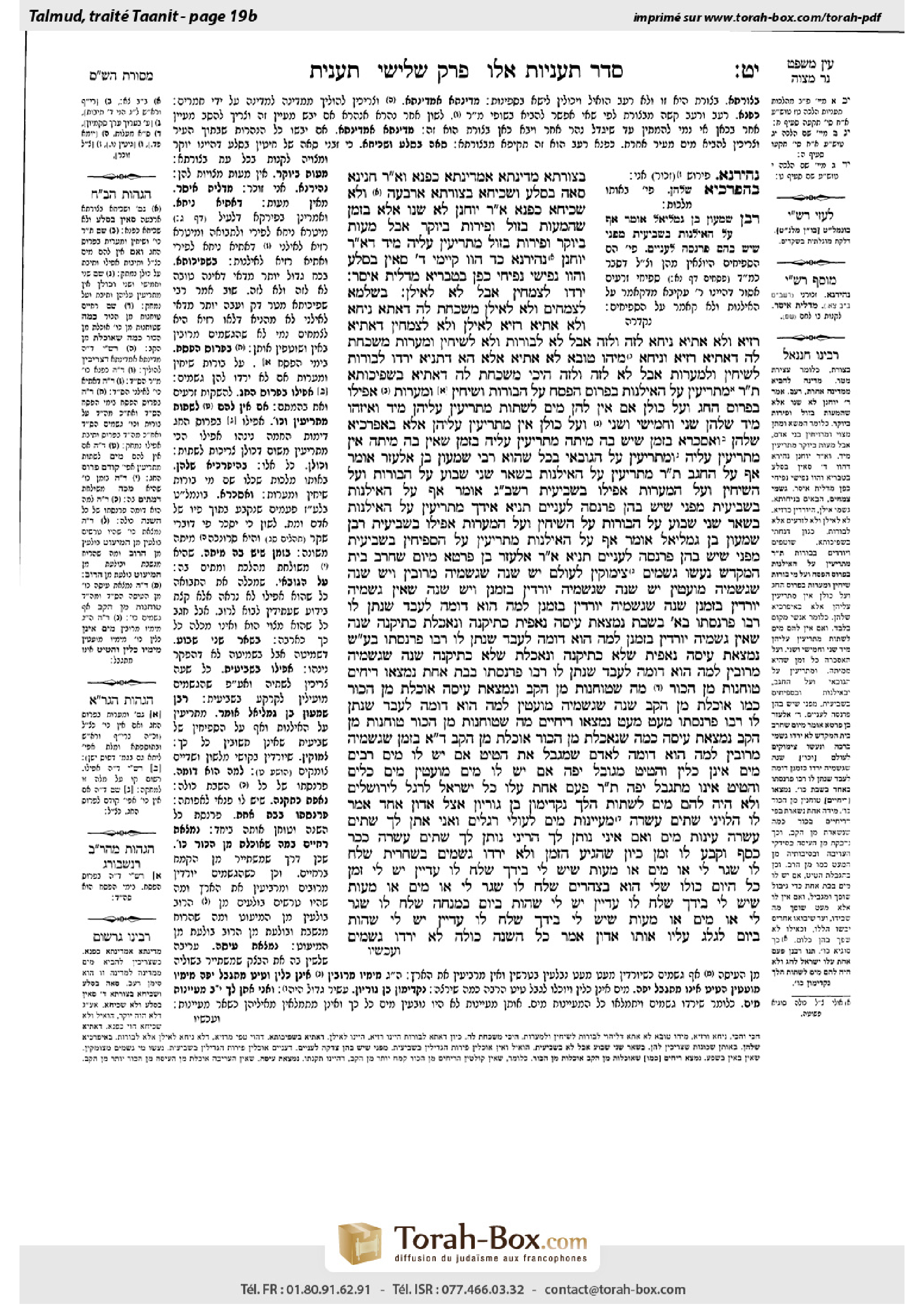
Taanit 19b: Talmud study for Daf Yomi
Daf Yomi is the daily study of one Talmud folio. Explore 37 tractates with scans, Hebrew text, Sefaria English and AI-generated French translations where annotated.
Passage selection and English or AI-generated French translation are available where the scan has annotations. Daf Study is independent of Torah-Box and Sefaria.
Browse Taanit · תענית · All tractatesTaanit 19b text and translations
This page of Taanit includes the Aramaic text, an English translation and an AI-generated French translation, alongside the scan above.
תענית י״ט ב · Aramaic and Hebrew text
בַּצּוּרְתָּא. מְדִינְתָּא אַמְּדִינְתָּא — כַּפְנָא. וְאָמַר רַבִּי חֲנִינָא: סְאָה בְּסֶלַע וּשְׁכִיחָא — בַּצּוּרְתָּא. אַרְבָּעָה וְלָא שְׁכִיחָא — כַּפְנָא.
אָמַר רַבִּי יוֹחָנָן: לֹא שָׁנוּ אֶלָּא בִּזְמַן שֶׁהַמָּעוֹת בְּזוֹל וּפֵירוֹת בְּיוֹקֶר, אֲבָל מָעוֹת בְּיוֹקֶר וּפֵירוֹת בְּזוֹל — מַתְרִיעִין עָלֶיהָ מִיָּד. דְּאָמַר רַבִּי יוֹחָנָן: נְהִירְנָא כַּד הֲווֹ קָיְימִי אַרְבְּעָה סְאִין בְּסֶלַע, וַהֲווֹ נְפִישִׁי נְפִיחֵי כְפַן בִּטְבֶרְיָא מִדְּלֵית אִיסָּר.
יָרְדוּ לַצְּמָחִין אֲבָל לֹא לָאִילָן. בִּשְׁלָמָא לַצְּמָחִים וְלֹא לָאִילָן — מַשְׁכַּחַתְּ לַהּ דַּאֲתָא נִיחָא, וְלָא אֲתָיא רַזְיָא. לָאִילָן וְלֹא לַצְּמָחִין — דַּאֲתָיא רַזְיָא, וְלָא אֲתָיא נִיחָא.
לָזֶה וְלָזֶה אֲבָל לֹא לַבּוֹרוֹת וְלֹא לַשִּׁיחִין וּמְעָרוֹת — מַשְׁכַּחַתְּ לַהּ דַּאֲתָיא רַזְיָא וְנִיחָא, מִיהוּ טוּבָא לָא אֲתָיא. אֶלָּא הָא דְּתַנְיָא: יָרְדוּ לְבוֹרוֹת לַשִּׁיחִין וְלַמְּעָרוֹת אֲבָל לֹא לָזֶה וְלָזֶה, הֵיכִי מַשְׁכַּחַתְּ לַהּ? דַּאֲתָיא בִּשְׁפִיכוּתָא.
תָּנוּ רַבָּנַן: מַתְרִיעִין עַל הָאִילָנוֹת בִּפְרוֹס הַפֶּסַח, עַל הַבּוֹרוֹת וְשִׁיחִין וּמְעָרוֹת בִּפְרוֹס הַחַג. וְאִם אֵין לָהֶן מַיִם לִשְׁתּוֹת — מַתְרִיעִין עֲלֵיהֶן מִיָּד.
וְאֵיזֶהוּ מִיָּד שֶׁלָּהֶן — שֵׁנִי וַחֲמִישִׁי וְשֵׁנִי. וְעַל כּוּלָּן אֵין מַתְרִיעִין עֲלֵיהֶן אֶלָּא בָּאִפַּרְכִיָּא שֶׁלָּהֶן.
וְאַסְכָּרָא, בִּזְמַן שֶׁיֵּשׁ בָּהּ מִיתָה — מַתְרִיעִין עָלֶיהָ. בִּזְמַן שֶׁאֵין בָּהּ מִיתָה — אֵין מַתְרִיעִין עָלֶיהָ. וּמַתְרִיעִין עַל הַגּוֹבַאי בְּכׇל שֶׁהוּא. רַבִּי שִׁמְעוֹן בֶּן אֶלְעָזָר אוֹמֵר: אַף עַל הֶחָגָב.
תָּנוּ רַבָּנַן: מַתְרִיעִין עַל הָאִילָנוֹת בִּשְׁאָר שְׁנֵי שָׁבוּעַ. עַל הַבּוֹרוֹת וְעַל הַשִּׁיחִין וְעַל הַמְּעָרוֹת אֲפִילּוּ בַּשְּׁבִיעִית. רַבָּן שִׁמְעוֹן בֶּן גַּמְלִיאֵל אוֹמֵר: אַף עַל הָאִילָנוֹת בַּשְּׁבִיעִית, מִפְּנֵי שֶׁיֵּשׁ בָּהֶן פַּרְנָסָה לַעֲנִיִּים.
תַּנְיָא אִידַּךְ: מַתְרִיעִין עַל הָאִילָנוֹת בִּשְׁאָר שְׁנֵי שָׁבוּעַ. עַל הַבּוֹרוֹת עַל הַשִּׁיחִין וְעַל הַמְּעָרוֹת אֲפִילּוּ בַּשְּׁבִיעִית. רַבָּן שִׁמְעוֹן בֶּן גַּמְלִיאֵל אוֹמֵר: אַף עַל הָאִילָנוֹת. מַתְרִיעִין עַל הַסְּפִיחִין בַּשְּׁבִיעִית, מִפְּנֵי שֶׁיֵּשׁ בָּהֶן פַּרְנָסָה לָעֲנִיִּים.
תַּנְיָא, אָמַר רַבִּי אֶלְעָזָר בֶּן פַּרְטָא: מִיּוֹם שֶׁחָרַב בֵּית הַמִּקְדָּשׁ נַעֲשׂוּ גְּשָׁמִים צִימּוּקִין לָעוֹלָם. יֵשׁ שָׁנָה שֶׁגְּשָׁמֶיהָ מְרוּבִּין, וְיֵשׁ שָׁנָה שֶׁגְּשָׁמֶיהָ מוּעָטִין. יֵשׁ שָׁנָה שֶׁגְּשָׁמֶיהָ יוֹרְדִין בִּזְמַנָּן, וְיֵשׁ שָׁנָה שֶׁאֵין גְּשָׁמֶיהָ יוֹרְדִין בִּזְמַנָּן.
שָׁנָה שֶׁגְּשָׁמֶיהָ יוֹרְדִין בִּזְמַנָּן לְמָה הוּא דּוֹמֶה — לְעֶבֶד שֶׁנָּתַן לוֹ רַבּוֹ פַּרְנָסָתוֹ בְּאֶחָד בְּשַׁבָּת, נִמְצֵאת עִיסָּה נֶאֱפֵית כְּתִיקְנָהּ, וְנֶאֱכֶלֶת כְּתִיקְנָהּ. שָׁנָה שֶׁאֵין גְּשָׁמֶיהָ יוֹרְדִין בִּזְמַנָּן לְמָה הוּא דּוֹמֶה — לְעֶבֶד שֶׁנָּתַן לוֹ רַבּוֹ פַּרְנָסָתוֹ בְּעֶרֶב שַׁבָּת, נִמְצֵאת עִיסָּה נֶאֱפֵית שֶׁלֹּא כְּתִיקְנָהּ, וְנֶאֱכֶלֶת שֶׁלֹּא כְּתִיקְנָהּ.
שָׁנָה שֶׁגְּשָׁמֶיהָ מְרוּבִּין לְמָה הוּא דּוֹמֶה — לְעֶבֶד שֶׁנָּתַן לוֹ רַבּוֹ פַּרְנָסָתוֹ בְּבַת אַחַת, נִמְצְאוּ רֵיחַיִם טוֹחֲנוֹת מִן הַכּוֹר מַה שֶּׁטּוֹחֲנוֹת מִן הַקַּב, וְנִמְצֵאת עִיסָּה אוֹכֶלֶת מִן הַכּוֹר כְּמוֹ [שֶׁ]אוֹכֶלֶת מִן הַקַּב.
שָׁנָה שֶׁגְּשָׁמֶיהָ מוּעָטִין לְמָה הוּא דּוֹמֶה — לְעֶבֶד שֶׁנָּתַן לוֹ רַבּוֹ פַּרְנָסָתוֹ מְעַט מְעַט, נִמְצְאוּ רֵיחַיִים מַה שֶּׁטּוֹחֲנוֹת מִן הַכּוֹר טוֹחֲנוֹת מִן הַקַּב. נִמְצֵאת עִיסָּה כַּמָּה שֶׁנֶּאֱכֶלֶת מִן הַכּוֹר אוֹכֶלֶת מִן הַקַּב.
דָּבָר אַחֵר: בִּזְמַן שֶׁגְּשָׁמֶיהָ מְרוּבִּין לְמָה הוּא דּוֹמֶה — לְאָדָם שֶׁמְּגַבֵּל אֶת הַטִּיט, אִם יֵשׁ לוֹ מַיִם רַבִּים — מַיִם אֵינָן כָּלִין, וְהַטִּיט מְגוּבָּל יָפֶה. אִם יֵשׁ לוֹ מַיִם מוּעָטִין — מַיִם כָּלִים, וְהַטִּיט אֵינוֹ מִתְגַּבֵּל יָפֶה.
תָּנוּ רַבָּנַן: פַּעַם אַחַת עָלוּ כׇּל יִשְׂרָאֵל לָרֶגֶל לִירוּשָׁלַיִם, וְלֹא הָיָה לָהֶם מַיִם לִשְׁתּוֹת. הָלַךְ נַקְדִּימוֹן בֶּן גּוּרְיוֹן אֵצֶל הֶגְמוֹן אֶחָד, אָמַר לוֹ: הַלְוֵינִי שְׁתֵּים עֶשְׂרֵה מַעֲיָינוֹת מַיִם לְעוֹלֵי רְגָלִים, וַאֲנִי אֶתֵּן לָךְ שְׁתֵּים עֶשְׂרֵה עֵינוֹת מַיִם. וְאִם אֵינִי נוֹתֵן לְךָ — הֲרֵינִי נוֹתֵן לָךְ שְׁתֵּים עֶשְׂרֵה כִּכַּר כֶּסֶף, וְקָבַע לוֹ זְמַן.
כֵּיוָן שֶׁהִגִּיעַ הַזְּמַן וְלֹא יֵרְדוּ גְּשָׁמִים, בַּשַּׁחֲרִית שָׁלַח לוֹ: שַׁגֵּר לִי אוֹ מַיִם אוֹ מָעוֹת שֶׁיֵּשׁ לִי בְּיָדְךָ. שָׁלַח לוֹ: עֲדַיִין יֵשׁ לִי זְמַן, כׇּל הַיּוֹם כּוּלּוֹ שֶׁלִּי הוּא. בַּצָּהֳרַיִים שָׁלַח לוֹ: שַׁגֵּר לִי אוֹ מַיִם אוֹ מָעוֹת שֶׁיֵּשׁ לִי בְּיָדְךָ. שָׁלַח לוֹ: עֲדַיִין יֵשׁ לִי שְׁהוּת בַּיּוֹם. בַּמִּנְחָה שָׁלַח לוֹ: שַׁגֵּר לִי מַיִם אוֹ מָעוֹת שֶׁיֵּשׁ לִי בְּיָדְךָ. שָׁלַח לוֹ: עֲדַיִין יֵשׁ לִי שְׁהוּת בַּיּוֹם. לִגְלֵג עָלָיו אוֹתוֹ הֶגְמוֹן, אָמַר: כׇּל הַשָּׁנָה כּוּלָּהּ לֹא יָרְדוּ גְּשָׁמִים,
Taanit 19b · English translation
this is considered a drought. If produce must be brought from one province to another province, this is considered a famine. And Rabbi Ḥanina said: If a se’a of grain is sold for a sela, but it is available, this is considered a drought. Although prices have risen, there is still grain for those who can afford it. However, if four se’a of grain is sold for a sela, and it is not available, this is considered a famine.
Rabbi Yoḥanan said: They taught this only with regard to a time when money is cheap and everyone has it, and produce is expensive. However, when money is expensive, i.e., unavailable, and produce is cheap, they cry out about it immediately, as this is considered a famine. As Rabbi Yoḥanan said: I remember when four se’a of produce were sold for one sela, and yet there were many swollen by famine in Tiberias, as they did not have even one issar with which to purchase food.
§ The mishna taught: If sufficient rain fell for the vegetation but not enough fell for the trees; if it was enough for the trees but not for the vegetation; or if sufficient rain fell for both this and that, i.e., vegetation and trees, but not enough to fill the cisterns, ditches, and caves with water to last the summer, they cry out about it immediately. The Gemara comments: Granted, with regard to rain that fell in sufficient quantities for the vegetation but not for the trees, this case can be found, e.g., if gentle rain fell but heavy rain did not fall, this is insufficient for the trees. Furthermore, it is possible for enough rain to fall for the trees but it is not effective for the vegetation, if heavy rain fell but gentle rain did not fall.
Likewise, in the case of rain that benefits both this and that, trees and vegetation, but not cisterns, ditches, and caves, you can find this too, if both heavy and gentle rain fell, however, they did not fall in abundance, and therefore the water in the cisterns will not last through the summer. However, that which is taught in a baraita: If sufficient rain fell for cisterns, ditches, and caves, but not for either this or that, i.e., trees or plants, how can you find these circumstances? If the rain is enough to fill cisterns, how could it not be enough for plants and trees? The Gemara answers: Where rain comes in a single downpour, it will fill the cisterns but will provide no benefit to plants and trees.
The Sages taught: They cry out about trees that have not received enough rain, until near Passover, as beyond that time any rain will no longer benefit trees. However, they sound the alarm over cisterns, ditches and caves that have not been filled until before the festival of Sukkot. And at any time, if they have no water to drink, they sound the alarm over them immediately.
And what exactly is the meaning of their use of: Immediately, in these cases? Monday, Thursday, and Monday of the week in which the court became aware of the crisis, but not necessarily on the very day that it became evident. And in all of these cases of interrupted rainfall, they sound the alarm over them only in their district [iparkheya], but not in other areas where rain is falling normally.
And with regard to a plague of diphtheria, when it has the potential to cause death they sound the alarm over it, but when it does not have the potential to cause death they do not sound the alarm over it. And they sound the alarm over the arrival of locusts, for any amount, as it is likely that more locusts are on the way. However, they do not sound the alarm over the arrival of grasshoppers. Rabbi Shimon ben Elazar says: They sound the alarm even over grasshoppers, as they too can cause a great deal of damage if they swarm in large numbers.
The Sages taught in a baraita: They sound the alarm over trees during the other six years of the seven-year Sabbatical cycle, when the earth is tilled, but not during the Sabbatical Year, when one must refrain from working the land. However, for cisterns, ditches, and caves, they sound the alarm even in the Sabbatical Year. Rabban Shimon ben Gamliel says: Even for trees they sound the alarm in the Sabbatical Year, because they serve as sustenance for the poor. Since the poor rely on these trees for their food in the Sabbatical Year, they will lose their means of subsistence if it does not rain.
It is taught in another baraita: They sound the alarm over trees during the other years of the Sabbatical cycle, and for cisterns, ditches and caves they sound the alarm even in the Sabbatical Year. Rabban Shimon ben Gamliel says: Even for trees. Furthermore, they sound the alarm for aftergrowths of crops that have grown of their own accord in the Sabbatical Year, because they serve as sustenance for the poor, as it is permitted to eat aftergrowths.
§ It is taught in a baraita that Rabbi Elazar ben Perata said: Since the day that the Temple was destroyed, rain has been meager, i.e., overall, not enough has fallen in the world. There are years whose rains are abundant, and there are years whose rains are scare. There are years whose rains fall in their proper time, and there are years whose rains do not fall in their proper time.
With regard to a year whose rains fall in their proper time, to what may it be compared? To a servant whose master gave him his weekly portion on Sunday. It is thereby found that his dough is baked properly throughout the week, and it is eaten properly, as he has a sufficient amount. Conversely, with regard to a year whose rains do not fall in their proper time, to what may it be compared? To a servant whose master gave him his portion on Shabbat eve, when there is insufficient time to prepare it fully. It is thereby found that his dough is baked improperly, and it is eaten improperly.
With regard to a year whose rains are abundant, to what may it be compared? To a servant whose master gave him his portion for a long period of time all at once. He performs all of his milling at one time, and it is therefore found that the mill grinds and produces waste from a kor of produce in the same amount as it grinds and produces waste from the much smaller kav of produce. During each milling process, the same amount of flour goes to waste. Consequently, milling a large amount of flour in a single milling process preserves flour. And similarly, it is found that dough is diminished from a kor, as it diminishes from a kav.
In contrast, with regard to a year whose rains are scarce, to what may it be compared? To a servant whose master gave him his portion little by little. It is thereby found that the amount that the mill would have ground from a kor of produce is that which in practice it grinds and produces from each kav. It is likewise found that the dough that would have been diminished from a kor is the same amount that is diminished from a kav. In sum, one retains less dough when given his sustenance little by little.
Alternatively, when its rains are abundant, to what may this year be compared? To a person who kneads clay. If he has a lot of water, his water is not used up and the clay will be well kneaded. If he has only a little water, the water will be used up and the clay will not be well kneaded.
§ The Sages taught: Once all the Jewish people ascended for the pilgrimage Festival to Jerusalem and there was not enough water for them to drink. Nakdimon ben Guryon, one of the wealthy citizens of Jerusalem, went to a certain gentile officer [hegemon] and said to him: Lend me twelve wells of water for the pilgrims, and I will give back to you twelve wells of water. And if I do not give them to you, I will give you twelve talents of silver. And the officer set him a time limit for returning the water.
When the set time arrived and no rain had fallen, in the morning the official sent a message to Nakdimon: Send me either the water or the coins that you owe me. Nakdimon sent a message to him: I still have time, as the entire day is mine. At noontime the official again sent a message to him: Send me either the water or the coins that you owe me. Nakdimon sent a message to him: I still have time left in the day. In the afternoon he sent a message to him: Send me either the water or the coins that you owe me. Nakdimon sent a message to him: I still have time left in the day. That officer ridiculed him, saying: Throughout the entire year rain has not fallen,
Taanit 19b · Traduction française (IA)
cela est considéré comme une sécheresse. Si l’on doit faire venir des produits d’une province à une autre, cela est considéré comme une famine. Rabbi Ḥanina dit également : Si un séa de céréales se vend un sela, mais qu’il y en a de disponible, cela est considéré comme une sécheresse. Bien que les prix aient augmenté, il reste des céréales pour ceux qui peuvent se les procurer. En revanche, si quatre séa de céréales se vendent un sela et qu’il n’y en a pas de disponible, cela est considéré comme une famine.
Rabbi Yoḥanan dit : Cette règle n’a été enseignée que pour une période où l’argent est bon marché et où tout le monde en possède, tandis que les produits sont chers. Mais lorsque l’argent est cher, c’est-à-dire difficile à obtenir, et que les produits sont bon marché, on lance immédiatement des appels à l’aide, car cela est considéré comme une famine. Rabbi Yoḥanan a dit en effet : Je me souviens d’une époque où quatre séa de produits se vendaient un sela, et pourtant beaucoup de gens étaient gonflés par la famine à Tibériade, car ils n’avaient même pas un issar pour acheter de la nourriture.
§ La Michna enseigne : Si la pluie tombée a suffi à la végétation, mais pas aux arbres ; si elle a suffi aux arbres, mais pas à la végétation ; ou si elle a suffi à la fois à l’une et aux autres, c’est-à-dire à la végétation et aux arbres, mais pas à remplir d’eau les citernes, les fossés et les cavernes pour tenir jusqu’à l’été, on lance immédiatement des appels à l’aide. La Guemara fait remarquer : Il est compréhensible que le cas où la pluie tombée a suffi à la végétation, mais pas aux arbres, puisse se présenter, par exemple si une pluie fine est tombée, mais pas une pluie abondante : cela ne suffit pas aux arbres. De plus, il est possible que la pluie ait suffi aux arbres sans être bénéfique à la végétation, si une pluie abondante est tombée, mais pas une pluie fine.
De même, le cas où la pluie a profité à la fois aux arbres et à la végétation, mais pas aux citernes, aux fossés et aux cavernes, peut aussi se présenter si des pluies abondantes et fines sont tombées, mais en quantité insuffisante ; l’eau des citernes ne durera donc pas tout l’été. Mais comment comprendre ce qui est enseigné dans une baraïta : Si la pluie tombée a suffi aux citernes, aux fossés et aux cavernes, mais ni aux arbres ni aux plantes, comment une telle situation peut-elle se présenter ? Si la pluie suffit à remplir les citernes, comment pourrait-elle ne pas suffire aux plantes et aux arbres ? La Guemara répond : Lorsque la pluie tombe en une seule averse, elle remplit les citernes, mais ne profite ni aux plantes ni aux arbres.
Les Sages ont enseigné : On lance des appels à l’aide au sujet des arbres qui n’ont pas reçu assez de pluie jusqu’à l’approche de Pessaḥ, car au-delà de cette période, aucune pluie ne leur sera plus bénéfique. En revanche, on sonne l’alarme au sujet des citernes, des fossés et des cavernes qui ne se sont pas remplis jusqu’avant la fête de Souccot. Et à tout moment, s’ils n’ont pas d’eau à boire, on sonne immédiatement l’alarme à leur sujet.
Que signifie précisément, dans ces cas, l’expression « immédiatement » ? Le lundi, le jeudi et le lundi de la semaine où le tribunal a pris connaissance de la crise, mais pas nécessairement le jour même où celle-ci est devenue manifeste. Dans tous ces cas d’interruption des pluies, on ne sonne l’alarme qu’au sujet de ces phénomènes dans leur district [iparkheya], et non dans les autres régions où la pluie tombe normalement.
Et en ce qui concerne une épidémie de diphtérie, lorsqu’elle est susceptible d’entraîner la mort, on sonne l’alarme à son sujet ; lorsqu’elle n’est pas susceptible d’entraîner la mort, on ne sonne pas l’alarme. On sonne l’alarme à l’arrivée des sauterelles, quelle qu’en soit la quantité, car il est probable que d’autres sauterelles soient en route. En revanche, on ne sonne pas l’alarme à l’arrivée des criquets. Rabbi Shimon ben Elazar dit : On sonne l’alarme même au sujet des criquets, car eux aussi peuvent causer de grands dégâts s’ils arrivent en essaims nombreux.
Les Sages ont enseigné dans une baraïta : On sonne l’alarme au sujet des arbres pendant les six autres années du cycle de sept ans de la Chemita, lorsque la terre est cultivée, mais pas pendant l’année de la Chemita, où l’on doit s’abstenir de travailler la terre. En revanche, au sujet des citernes, des fossés et des cavernes, on sonne l’alarme même pendant l’année de la Chemita. Rabban Shimon ben Gamliel dit : Même au sujet des arbres, on sonne l’alarme pendant l’année de la Chemita, car ils assurent la subsistance des pauvres. Puisque les pauvres comptent sur ces arbres pour se nourrir pendant l’année de la Chemita, ils perdraient leurs moyens de subsistance s’il ne pleuvait pas.
Il est enseigné dans une autre baraïta : On sonne l’alarme au sujet des arbres pendant les autres années du cycle de la Chemita, et au sujet des citernes, des fossés et des cavernes, on sonne l’alarme même pendant l’année de la Chemita. Rabban Shimon ben Gamliel dit : Même au sujet des arbres. De plus, on sonne l’alarme au sujet des repousses spontanées de cultures qui ont poussé pendant l’année de la Chemita, car elles assurent la subsistance des pauvres, puisqu’il est permis de consommer ces repousses.
§ Il est enseigné dans une baraïta que Rabbi Elazar ben Perata a dit : Depuis le jour où le Temple a été détruit, les pluies sont rares, c’est-à-dire qu’en général, il ne tombe pas assez de pluie dans le monde. Certaines années, les pluies sont abondantes, et d’autres années, elles sont rares. Certaines années, les pluies tombent en temps voulu, et d’autres années, elles ne tombent pas en temps voulu.
À quoi peut-on comparer une année où les pluies tombent en temps voulu ? À un serviteur dont le maître lui a donné sa ration hebdomadaire le dimanche. Sa pâte cuit alors correctement tout au long de la semaine et il la mange convenablement, puisqu’il en a une quantité suffisante. En revanche, à quoi peut-on comparer une année où les pluies ne tombent pas en temps voulu ? À un serviteur dont le maître lui a donné sa ration la veille de Chabbat, alors qu’il ne reste pas assez de temps pour la préparer complètement. Sa pâte cuit alors mal et il la mange mal.
À quoi peut-on comparer une année où les pluies sont abondantes ? À un serviteur dont le maître lui a donné d’un seul coup sa ration pour une longue période. Il moud alors toute sa farine en une seule fois ; le moulin moud et produit autant de déchets à partir d’un kor de produits qu’à partir d’un kav, quantité bien moindre. À chaque mouture, la même quantité de farine est perdue. Par conséquent, moudre une grande quantité de farine en une seule fois permet d’en préserver. De même, la pâte perd autant de sa quantité lorsqu’on en pétrit un kor que lorsqu’on en pétrit un kav.
À l’inverse, à quoi peut-on comparer une année où les pluies sont rares ? À un serviteur dont le maître lui donne sa ration peu à peu. Il se trouve alors que la quantité que le moulin aurait moulue à partir d’un kor de produits est celle qu’il moud et dont il produit effectivement des déchets à partir de chaque kav. De même, la quantité de pâte qui aurait été perdue à partir d’un kor est la même que celle qui est perdue à partir d’un kav. En somme, on conserve moins de pâte lorsqu’on reçoit sa subsistance peu à peu.
Autre explication : À quoi peut-on comparer une année où les pluies sont abondantes ? À une personne qui pétrit de l’argile. Si elle a beaucoup d’eau, celle-ci ne s’épuise pas et l’argile sera bien pétrie. Si elle n’a que peu d’eau, celle-ci sera épuisée et l’argile ne sera pas bien pétrie.
§ Les Sages ont enseigné : Une fois, tout le peuple juif monta à Jérusalem pour la fête de pèlerinage, et il n’y avait pas assez d’eau à boire pour eux. Nakdimon ben Guryon, l’un des riches habitants de Jérusalem, se rendit auprès d’un certain officier non juif [hegemon] et lui dit : « Prête-moi douze puits d’eau pour les pèlerins, et je te rendrai douze puits d’eau. Et si je ne te les rends pas, je te donnerai douze talents d’argent. » L’officier lui fixa un délai pour rendre l’eau.
Lorsque le délai fixé arriva et qu’aucune pluie n’était tombée, l’officier envoya un message à Nakdimon le matin : « Envoie-moi soit l’eau, soit les pièces que tu me dois. » Nakdimon lui répondit : « J’ai encore du temps, car toute la journée m’appartient. » À midi, l’officier lui envoya de nouveau un message : « Envoie-moi soit l’eau, soit les pièces que tu me dois. » Nakdimon lui répondit : « Il me reste encore du temps dans la journée. » Dans l’après-midi, l’officier lui envoya un message : « Envoie-moi soit l’eau, soit les pièces que tu me dois. » Nakdimon lui répondit : « Il me reste encore du temps dans la journée. » L’officier se moqua de lui en disant : « Toute l’année, il n’est pas tombé de pluie, »
Traduction française générée par IA à partir de l’édition anglaise de Sefaria. Vérifie toujours un passage avec le texte source.
Text from Sefaria: William Davidson Edition - Vocalized Aramaic (CC BY NC); William Davidson Edition - English (CC BY NC).