Taanit 19a: Talmud study for Daf Yomi
Daf Yomi is the daily study of one Talmud folio. Explore 37 tractates with scans, Hebrew text, Sefaria English and AI-generated French translations where annotated.
Passage selection and English or AI-generated French translation are available where the scan has annotations. Daf Study is independent of Torah-Box and Sefaria.
Browse Taanit · תענית · All tractatesTaanit 19a text and translations
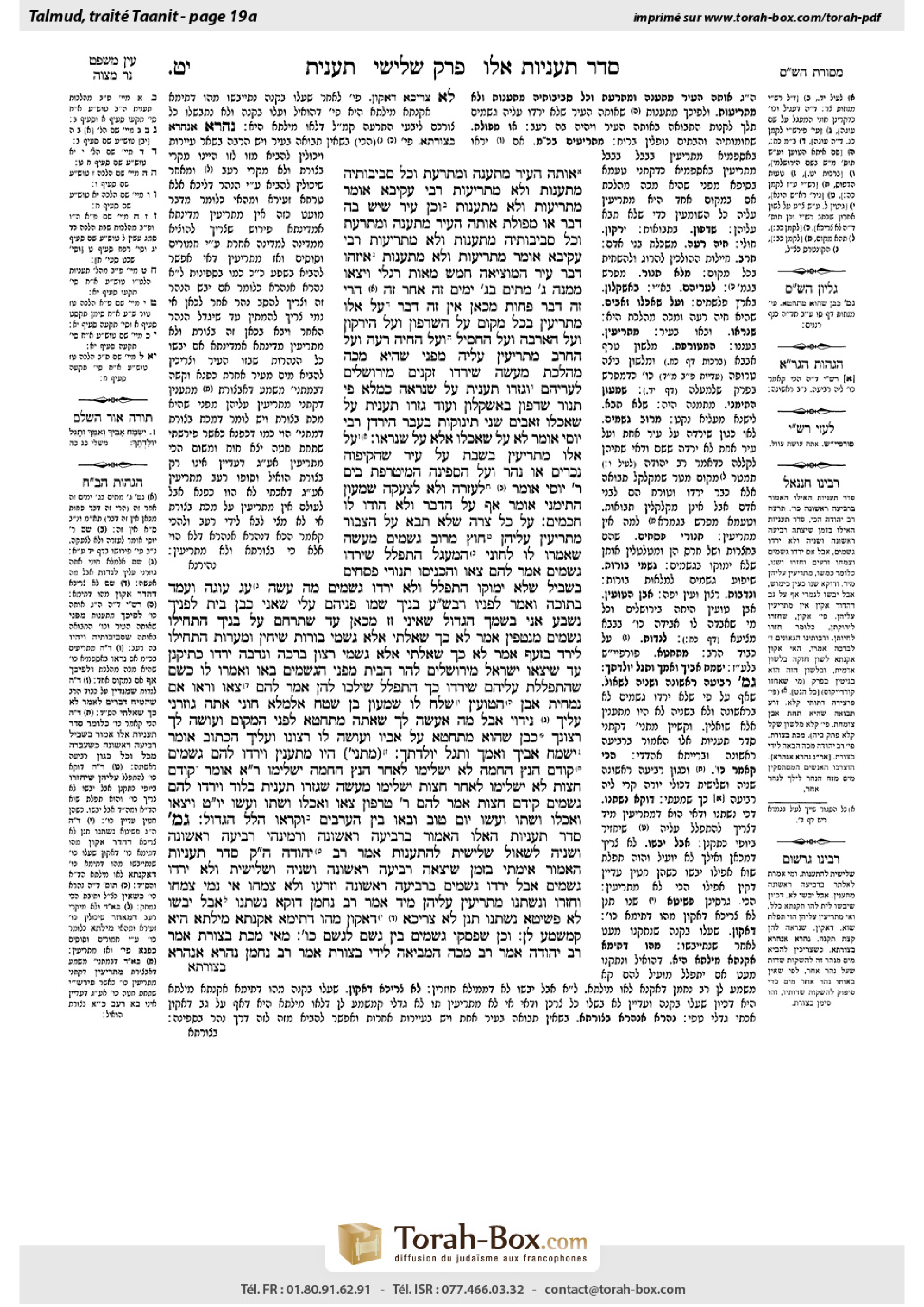
This page of Taanit includes the Aramaic text, an English translation and an AI-generated French translation, alongside the scan above.
תענית י״ט א · Aramaic and Hebrew text
אוֹתָהּ הָעִיר מִתְעַנָּה וּמַתְרַעַת, וְכׇל סְבִיבוֹתֶיהָ מִתְעַנּוֹת וְלֹא מַתְרִיעוֹת. רַבִּי עֲקִיבָא אוֹמֵר: מַתְרִיעוֹת וְלֹא מִתְעַנּוֹת. וְכֵן עִיר שֶׁיֵּשׁ בָּהּ דֶּבֶר אוֹ מַפּוֹלֶת — אוֹתָהּ הָעִיר מִתְעַנָּה וּמַתְרַעַת, וְכׇל סְבִיבוֹתֶיהָ מִתְעַנּוֹת וְלֹא מַתְרִיעוֹת. רַבִּי עֲקִיבָא אוֹמֵר: מַתְרִיעוֹת וְלֹא מִתְעַנּוֹת.
אֵיזֶהוּ דֶּבֶר? עִיר הַמּוֹצִיאָה חֲמֵשׁ מֵאוֹת רַגְלִי, וְיָצְאוּ מִמֶּנָּה שְׁלֹשָׁה מֵתִים בִּשְׁלֹשָׁה יָמִים זֶה אַחַר זֶה — הֲרֵי זֶה דֶּבֶר, פָּחוֹת מִכָּאן — אֵין זֶה דֶּבֶר.
עַל אֵלּוּ מַתְרִיעִין בְּכׇל מָקוֹם: עַל הַשִּׁדָּפוֹן, וְעַל הַיֵּרָקוֹן, וְעַל הָאַרְבֶּה, וְעַל הֶחָסִיל, וְעַל הַחַיָּה רָעָה, וְעַל הַחֶרֶב — מַתְרִיעִין עָלֶיהָ, מִפְּנֵי שֶׁהִיא מַכָּה מְהַלֶּכֶת.
מַעֲשֶׂה שֶׁיָּרְדוּ זְקֵנִים מִירוּשָׁלַיִם לְעָרֵיהֶם, וְגָזְרוּ תַּעֲנִית עַל שֶׁנִּרְאָה כִּמְלֹא פִי תַנּוּר שִׁדָּפוֹן בְּאַשְׁקְלוֹן. וְעוֹד גָּזְרוּ תַּעֲנִית עַל שֶׁאָכְלוּ זְאֵבִים שְׁנֵי תִינוֹקוֹת בְּעֵבֶר הַיַּרְדֵּן. רַבִּי יוֹסֵי אוֹמֵר: לֹא עַל שֶׁאָכְלוּ, אֶלָּא עַל שֶׁנִּרְאוּ.
עַל אֵלּוּ מַתְרִיעִין בְּשַׁבָּת: עַל עִיר שֶׁהִקִּיפוּהָ נׇכְרִים אוֹ נָהָר, וְעַל הַסְּפִינָה הַמִּיטָּרֶפֶת בַּיָּם. רַבִּי יוֹסֵי אוֹמֵר: לְעֶזְרָה וְלֹא לִצְעָקָה. שִׁמְעוֹן הַתִּימְנִי אוֹמֵר: אַף עַל הַדֶּבֶר, וְלֹא הוֹדוּ לוֹ חֲכָמִים.
עַל כׇּל צָרָה שֶׁלֹּא תָּבוֹא עַל הַצִּבּוּר מַתְרִיעִין עֲלֵיהֶן, חוּץ מֵרוֹב גְּשָׁמִים. מַעֲשֶׂה שֶׁאָמְרוּ לוֹ לְחוֹנִי הַמְעַגֵּל, הִתְפַּלֵּל שֶׁיֵּרְדוּ גְּשָׁמִים. אָמַר לָהֶם: צְאוּ וְהַכְנִיסוּ תַּנּוּרֵי פְסָחִים בִּשְׁבִיל שֶׁלֹּא יִמּוֹקוּ. הִתְפַּלֵּל וְלֹא יָרְדוּ גְּשָׁמִים.
מָה עָשָׂה? עָג עוּגָה וְעָמַד בְּתוֹכָהּ, וְאָמַר לְפָנָיו: רִבּוֹנוֹ שֶׁל עוֹלָם! בָּנֶיךָ שָׂמוּ פְּנֵיהֶם עָלַי, שֶׁאֲנִי כְּבֶן בַּיִת לְפָנֶיךָ. נִשְׁבָּע אֲנִי בְּשִׁמְךָ הַגָּדוֹל שֶׁאֵינִי זָז מִכָּאן עַד שֶׁתְּרַחֵם עַל בָּנֶיךָ. הִתְחִילוּ גְּשָׁמִים מְנַטְּפִין. אָמַר: לֹא כָּךְ שָׁאַלְתִּי, אֶלָּא גִּשְׁמֵי בּוֹרוֹת שִׁיחִין וּמְעָרוֹת. הִתְחִילוּ לֵירֵד בְּזַעַף. אָמַר: לֹא כָּךְ שָׁאַלְתִּי, אֶלָּא גִּשְׁמֵי רָצוֹן בְּרָכָה וּנְדָבָה.
יָרְדוּ כְּתִקְנָן, עַד שֶׁיָּצְאוּ יִשְׂרָאֵל מִירוּשָׁלַיִם לְהַר הַבַּיִת מִפְּנֵי הַגְּשָׁמִים. בָּאוּ וְאָמְרוּ לוֹ: כְּשֵׁם שֶׁהִתְפַּלַּלְתָּ עֲלֵיהֶם שֶׁיֵּרְדוּ — כָּךְ הִתְפַּלֵּל שֶׁיֵּלְכוּ לָהֶן. אָמַר לָהֶם: צְאוּ וּרְאוּ אִם נִמְחֵית אֶבֶן הַטּוֹעִין.
שָׁלַח לוֹ שִׁמְעוֹן בֶּן שָׁטַח: אִלְמָלֵא חוֹנִי אַתָּה — גּוֹזְרַנִי עָלֶיךָ נִידּוּי. אֲבָל מָה אֶעֱשֶׂה לְּךָ, שֶׁאַתָּה מִתְחַטֵּא לִפְנֵי הַמָּקוֹם וְעוֹשֶׂה לְךָ רְצוֹנְךָ כְּבֵן שֶׁהוּא מִתְחַטֵּא עַל אָבִיו וְעוֹשֶׂה לוֹ רְצוֹנוֹ, וְעָלֶיךָ הַכָּתוּב אוֹמֵר: ״יִשְׂמַח אָבִיךָ וְאִמֶּךָ וְתָגֵל יוֹלַדְתֶּךָ״.
הָיוּ מִתְעַנִּין וְיָרְדוּ לָהֶם גְּשָׁמִים, קוֹדֶם הָנֵץ הַחַמָּה — לֹא יַשְׁלִימוּ, לְאַחַר הָנֵץ הַחַמָּה — יַשְׁלִימוּ. רַבִּי אֱלִיעֶזֶר אוֹמֵר: קוֹדֶם חֲצוֹת — לֹא יַשְׁלִימוּ, לְאַחַר חֲצוֹת — יַשְׁלִימוּ.
מַעֲשֶׂה שֶׁגָּזְרוּ תַּעֲנִית בְּלוֹד, וְיָרְדוּ לָהֶם גְּשָׁמִים קוֹדֶם חֲצוֹת. אֲמַר לָהֶם רַבִּי טַרְפוֹן: צְאוּ וְאִכְלוּ וּשְׁתוּ וַעֲשׂוּ יוֹם טוֹב, וְיָצְאוּ וְאָכְלוּ וְשָׁתוּ וְעָשׂוּ יוֹם טוֹב, וּבָאוּ בֵּין הָעַרְבַּיִם וְקָרְאוּ הַלֵּל הַגָּדוֹל.
גְּמָ׳ סֵדֶר תַּעֲנִיּוֹת הָאֵלּוּ הָאָמוּר בִּרְבִיעָה רִאשׁוֹנָה. וּרְמִינְהִי: רְבִיעָה רִאשׁוֹנָה וּשְׁנִיָּה לִשְׁאוֹל, שְׁלִישִׁית לְהִתְעַנּוֹת!
אָמַר רַב יְהוּדָה, הָכִי קָאָמַר: סֵדֶר תַּעֲנִיּוֹת הָאָמוּר אֵימָתַי — בִּזְמַן שֶׁיָּצְאָה רְבִיעָה רִאשׁוֹנָה וּשְׁנִיָּה וּשְׁלִישִׁית וְלֹא יָרְדוּ גְּשָׁמִים. אֲבָל יָרְדוּ גְּשָׁמִים בִּרְבִיעָה רִאשׁוֹנָה וְזָרְעוּ וְלֹא צָמְחוּ, אִי נָמֵי צָמְחוּ וְחָזְרוּ וְנִשְׁתַּנּוּ — מַתְרִיעִין עֲלֵיהֶן מִיָּד.
אָמַר רַב נַחְמָן: דַּוְקָא נִשְׁתַּנּוּ, אֲבָל יָבְשׁוּ — לָא. פְּשִׁיטָא, נִשְׁתַּנּוּ תְּנַן! לָא צְרִיכָא, דַּאֲקוּן. מַהוּ דְּתֵימָא: אֲקַנְתָּא מִילְּתָא הִיא, קָמַשְׁמַע לַן.
וְכֵן שֶׁפָּסְקוּ גְּשָׁמִים בֵּין גֶּשֶׁם לְגֶשֶׁם כּוּ׳. מַאי מַכַּת בַּצּוֹרֶת? אָמַר רַב יְהוּדָה אָמַר רַב: מַכָּה הַמְּבִיאָה לִידֵי בַּצּוֹרֶת. אָמַר רַב נַחְמָן: נַהֲרָא אַנַּהֲרָא —
Taanit 19a · English translation
In a case of this kind, that city fasts and cries out by blowing the shofar, and all of its surrounding areas join them in their fast, but they do not cry out. Rabbi Akiva disagrees and says: They cry out but they do not fast. The mishna continues: And likewise, if a city is afflicted by pestilence or collapsing buildings, that city fasts and cries out, and all of its surrounding areas fast but they do not cry out. Rabbi Akiva says: They cry out but they do not fast.
The mishna inquires: What is considered a plague of pestilence? When is a series of deaths treated as a plague? The mishna answers: If a city that sends out five hundred infantrymen, i.e., it has a population of five hundred able-bodied men, and three dead are taken out of it on three consecutive days, this is a plague of pestilence, which requires fasting and crying out. If the death rate is lower than that, this is not pestilence.
For the following calamities they cry out in every place: For blight; for mildew; for locusts; for caterpillars, a type of locust that comes in large swarms and descends upon a certain place; for dangerous beasts that have entered a town; and for the sword, i.e., legions of an invading army. The reason that they cry out about these misfortunes in every place is because these are calamities that spread.
An incident occurred in which Elders descended from Jerusalem to their cities throughout Eretz Yisrael and decreed a fast throughout the land because there was seen in the city of Ashkelon a small amount of blight, enough to fill the mouth of an oven. This fast was observed throughout Eretz Yisrael, as blight spreads quickly. And furthermore, they decreed a fast because wolves had eaten two children in Transjordan. Rabbi Yosei says: This fast was decreed not because they ate the children, but because these wolves were merely seen in an inhabited area.
For the following calamities they cry out even on Shabbat: For a city that is surrounded by gentile troops, or for a place in danger of being flooded by a river that has swelled its banks, or for a ship tossed about at sea. Rabbi Yosei said: One may cry out on Shabbat to summon help, but it may not be sounded for crying out to God. Shimon the Timnite says: One may cry out on Shabbat even for pestilence, but the Rabbis did not agree with him.
§ The mishna adds: In general, they cry out on account of any trouble that should not befall the community, a euphemism for trouble that may befall the community, except for an overabundance of rain. Although too much rain may be disastrous, one does not cry out over it, because rain is a sign of a blessing. The mishna relates: An incident occurred in which the people said to Ḥoni HaMe’aggel: Pray that rain should fall. He said to them: Go out and bring in the clay ovens used to roast the Paschal lambs, so that they will not dissolve in the water, as torrential rains are certain to fall. He prayed, and no rain fell at all.
What did he do? He drew a circle on the ground and stood inside it and said before God: Master of the Universe, Your children have turned their faces toward me, as I am like a member of Your household. Therefore, I take an oath by Your great name that I will not move from here until You have mercy upon Your children and answer their prayers for rain. Rain began to trickle down, but only in small droplets. He said: I did not ask for this, but for rain to fill the cisterns, ditches, and caves with enough water to last the entire year. Rain began to fall furiously. He said: I did not ask for this damaging rain either, but for rain of benevolence, blessing, and generosity.
Subsequently, the rains fell in their standard manner but continued unabated, filling the city with water until all of the Jews exited the residential areas of Jerusalem and went to the Temple Mount due to the rain. They came and said to him: Just as you prayed over the rains that they should fall, so too, pray that they should stop. He said to them: Go out and see if the Claimants’ Stone, a large stone located in the city, upon which proclamations would be posted with regard to lost and found articles, has been washed away. In other words, if the water has not obliterated the Claimants’ Stone, it is not yet appropriate to pray for the rain to cease.
Shimon ben Shetaḥ, the Nasi of the Sanhedrin at the time, relayed to Ḥoni HaMe’aggel: Were you not Ḥoni, I would have decreed that you be ostracized, but what can I do to you? You nag [mitḥatei] God and He does your bidding, like a son who nags his father and his father does his bidding without reprimand. After all, rain fell as you requested. About you, the verse states: “Let your father and your mother be glad, and let her who bore you rejoice” (Proverbs 23:25).
The mishna teaches another halakha with regard to fast days: If they were fasting for rain, and rain fell for them before sunrise, they need not complete their fast until the evening. However, if it fell after sunrise, they must complete their fast. Rabbi Eliezer says: If rain fell before midday, they need not complete their fast; but if it rains after midday, they must complete their fast.
The mishna relates: An incident occurred in which the court decreed a fast in Lod due to a lack of rain, and rain fell for them before midday. Rabbi Tarfon said to the people: Go out, and eat, and drink, and treat this day as a Festival. And they went out, and ate, and drank, and treated the day as a Festival, and in the afternoon they came to the synagogue and recited the great hallel, to thank God for answering their prayers.
GEMARA: The mishna taught: The order of these fasts is stated only when the fast concerns the first rainfall. And the Gemara raises a contradiction between this statement and the following baraita: If the periods of the first and second rainfall pass without rain, this is the time to ask and pray for rain; if the third passes without rain, this is the time to fast.
Rav Yehuda said that this is what the mishna is saying: When does the order of these fasts that is stated apply? When the periods of the first, second, and third rainfall have passed and rain has not fallen. However, if rain fell in the time of the first rainfall, and the people sowed but the plants did not sprout, or, alternatively, if they sprouted a little, but their appearance changed back for the worse, as no rain fell after the first rainfall, they cry out about it immediately.
Rav Naḥman said: This applies specifically if their appearance changed. However, if they dried out entirely, they do not cry out, as this condition cannot be improved. The Gemara asks: It is obvious that this is the case, because in the mishna we learned the word changed. The Gemara answers: No, it is necessary for Rav Naḥman to issue his statement with regard to a case where they produced stalks after they dried out. Lest you say that producing stalks is a matter of significance, as it is a sign of strengthening, and the crops might be saved through prayer, Rav Naḥman therefore teaches us that this is not the case.
The mishna further taught: And likewise, if rain ceased for a period of forty days between one rainfall and another, they cry out about this, because it is a plague of drought. The Gemara asks: What is the meaning of the phrase: A plague of drought? Isn’t this simply a drought? Rav Yehuda said that Rav said: The mishna means that a period of forty days between one rainfall and the next is a plague that may cause a drought. In this regard, Rav Naḥman said: When crops do not grow in one place due to lack of rain and must be imported by means of one river to another river,
Taanit 19a · Traduction française (IA)
Dans un tel cas, cette ville jeûne et pousse des cris en sonnant du chofar, et toutes les localités environnantes se joignent à son jeûne, mais ne poussent pas de cris. Rabbi Akiva est en désaccord et dit : elles poussent des cris, mais ne jeûnent pas. La Michna poursuit : De même, si une ville est frappée par une épidémie ou par l’effondrement de bâtiments, cette ville jeûne et pousse des cris, et toutes les localités environnantes jeûnent, mais ne poussent pas de cris. Rabbi Akiva dit : elles poussent des cris, mais ne jeûnent pas.
La Michna demande : Qu’est-ce qui est considéré comme une épidémie ? À partir de quand une série de décès est-elle considérée comme une épidémie ? La Michna répond : Si une ville qui fournit cinq cents fantassins, c’est-à-dire dont la population compte cinq cents hommes en état de porter les armes, voit trois morts en être emportés pendant trois jours consécutifs, il s’agit d’une épidémie, qui exige de jeûner et de pousser des cris. Si le taux de mortalité est inférieur, il ne s’agit pas d’une épidémie.
Pour les calamités suivantes, on pousse des cris partout : la nielle, le mildiou, les sauterelles, les criquets — une espèce de sauterelle qui arrive en grands essaims et s’abat sur un endroit donné —, les animaux dangereux qui ont pénétré dans une ville, et l’épée, c’est-à-dire les légions d’une armée d’invasion. On pousse des cris partout à propos de ces malheurs parce qu’il s’agit de calamités qui se propagent.
Un événement se produisit : des Anciens descendirent de Jérusalem vers leurs villes dans tout Eretz Israël et décrétèrent un jeûne dans tout le pays, car on avait aperçu dans la ville d’Ashkelon une petite quantité de nielle, suffisante pour remplir la bouche d’un four. Ce jeûne fut observé dans tout Eretz Israël, car la nielle se propage rapidement. De plus, ils décrétèrent un jeûne parce que des loups avaient dévoré deux enfants en Transjordanie. Rabbi Yossei dit : Ce jeûne fut décrété non pas parce qu’ils avaient dévoré les enfants, mais parce que ces loups avaient simplement été aperçus dans une zone habitée.
Pour les calamités suivantes, on pousse des cris même le Chabbat : une ville encerclée par des troupes non juives, un lieu menacé d’inondation par une rivière sortie de son lit, ou un navire ballotté en mer. Rabbi Yossei dit : On peut pousser des cris le Chabbat pour appeler à l’aide, mais on ne doit pas en pousser pour implorer Dieu. Shimon le Timnite dit : On peut pousser des cris le Chabbat même en cas d’épidémie, mais les Sages ne furent pas d’accord avec lui.
§ La Michna ajoute : De manière générale, on pousse des cris à propos de tout malheur qui ne devrait pas s’abattre sur la communauté — expression euphémique pour désigner un malheur qui peut s’abattre sur elle — à l’exception d’un excès de pluie. Bien qu’une pluie trop abondante puisse être désastreuse, on ne pousse pas de cris à ce sujet, car la pluie est un signe de bénédiction. La Michna rapporte : Un événement se produisit : des gens dirent à Ḥoni HaMe’aggel : Prie pour qu’il pleuve. Il leur dit : Sortez et rentrez les fours en argile utilisés pour faire rôtir l’agneau pascal, afin qu’ils ne se dissolvent pas dans l’eau, car des pluies torrentielles vont certainement tomber. Il pria, mais aucune pluie ne tomba.
Que fit-il ? Il traça un cercle sur le sol, se tint à l’intérieur et dit devant Dieu : Maître de l’Univers, Tes enfants se sont tournés vers moi, car je suis comme un membre de Ta maisonnée. C’est pourquoi, je fais le serment par Ton grand nom que je ne bougerai pas d’ici tant que Tu n’auras pas eu pitié de Tes enfants et répondu à leurs prières pour la pluie. La pluie commença à tomber en fines gouttes, mais en trop petite quantité. Il dit : Ce n’est pas ce que j’ai demandé, mais une pluie qui remplisse les citernes, les fossés et les grottes d’une quantité d’eau suffisante pour toute l’année. La pluie se mit alors à tomber avec violence. Il dit : Je n’ai pas non plus demandé cette pluie destructrice, mais une pluie de bienveillance, de bénédiction et de générosité.
Par la suite, les pluies tombèrent de manière habituelle, mais sans s’arrêter, et remplirent la ville d’eau, jusqu’à ce que tous les Juifs quittent les quartiers résidentiels de Jérusalem et se rendent sur le mont du Temple à cause de la pluie. Ils vinrent lui dire : De même que tu as prié pour que les pluies tombent, prie aussi pour qu’elles s’arrêtent. Il leur dit : Sortez et voyez si la Pierre des Réclamations, une grosse pierre située dans la ville sur laquelle on affichait des proclamations concernant les objets perdus et trouvés, a été emportée par les eaux. Autrement dit, si l’eau n’a pas effacé la Pierre des Réclamations, il n’est pas encore approprié de prier pour que la pluie cesse.
Shimon ben Shetaḥ, le nassi du Sanhédrin à l’époque, fit transmettre ce message à Ḥoni HaMe’aggel : Si tu n’étais pas Ḥoni, j’aurais décrété ton exclusion, mais que puis-je te faire ? Tu importunes [mitḥatei] Dieu et Il fait ce que tu demandes, comme un fils qui importune son père et dont le père exauce les demandes sans le réprimander. Après tout, la pluie est tombée comme tu l’avais demandé. À ton sujet, le verset dit : « Que ton père et ta mère se réjouissent, que celle qui t’a enfanté soit dans l’allégresse » (Proverbes 23, 25).
La Michna enseigne une autre halakha concernant les jours de jeûne : s’ils jeûnaient pour la pluie et que la pluie tombait avant le lever du soleil, ils n’avaient pas besoin de poursuivre leur jeûne jusqu’au soir. Toutefois, si elle tombait après le lever du soleil, ils devaient poursuivre leur jeûne. Rabbi Eliezer dit : Si la pluie tombait avant midi, ils n’avaient pas besoin de poursuivre leur jeûne ; mais si elle tombait après midi, ils devaient le poursuivre.
La Michna rapporte : Un événement se produisit : le tribunal décréta un jeûne à Lod en raison du manque de pluie, et la pluie tomba avant midi. Rabbi Tarfon dit aux gens : Sortez, mangez et buvez, et traitez cette journée comme une fête. Ils sortirent, mangèrent, burent et traitèrent la journée comme une fête ; l’après-midi, ils vinrent à la synagogue et récitèrent le grand Hallel pour remercier Dieu d’avoir répondu à leurs prières.
GUEMARA : La Michna a enseigné : L’ordre de ces jeûnes n’est énoncé que lorsque le jeûne concerne la première pluie. La Guemara soulève une contradiction entre cette affirmation et la baraïta suivante : si les périodes de la première et de la deuxième pluie s’écoulent sans pluie, c’est le moment de demander et de prier pour la pluie ; si la troisième période s’écoule sans pluie, c’est le moment de jeûner.
Rav Yehouda dit que voici ce que la Michna veut dire : Quand s’applique l’ordre de ces jeûnes qui y est énoncé ? Lorsque les périodes de la première, de la deuxième et de la troisième pluie se sont écoulées sans qu’il soit tombé de pluie. En revanche, si la pluie est tombée pendant la période de la première pluie et que les gens ont semé, mais que les plantes n’ont pas germé, ou si elles ont un peu germé, mais que leur apparence s’est de nouveau détériorée, faute de pluie après la première pluie, ils poussent immédiatement des cris à ce sujet.
Rav Naḥman dit : Cela s’applique précisément si leur apparence s’est détériorée. En revanche, si elles ont entièrement séché, on ne pousse pas de cris, car cette situation ne peut être améliorée. La Guemara demande : Cela n’est-il pas évident, puisque nous avons appris dans la Michna le mot « détériorée » ? La Guemara répond : Non, la déclaration de Rav Naḥman est nécessaire pour un cas où elles ont produit des tiges après avoir séché. De crainte que tu ne dises que la production de tiges a de l’importance, puisqu’elle est un signe de vigueur, et que les cultures pourraient être sauvées par la prière, Rav Naḥman nous enseigne qu’il n’en est pas ainsi.
La Michna enseignait encore : De même, si la pluie s’interrompt pendant une période de quarante jours entre une pluie et la suivante, on pousse des cris à ce sujet, car il s’agit d’une calamité de sécheresse. La Guemara demande : Que signifie l’expression « calamité de sécheresse » ? N’est-ce pas simplement une sécheresse ? Rav Yehouda dit au nom de Rav : La Michna veut dire qu’une période de quarante jours entre une pluie et la suivante constitue une calamité susceptible de provoquer une sécheresse. À cet égard, Rav Naḥman dit : lorsque les récoltes ne poussent pas en un endroit faute de pluie et doivent être acheminées par un cours d’eau jusqu’à un autre cours d’eau,
Traduction française générée par IA à partir de l’édition anglaise de Sefaria. Vérifie toujours un passage avec le texte source.
Text from Sefaria: William Davidson Edition - Vocalized Aramaic (CC BY NC); William Davidson Edition - English (CC BY NC).