Taanit 18b: Talmud study for Daf Yomi
Daf Yomi is the daily study of one Talmud folio. Explore 37 tractates with scans, Hebrew text, Sefaria English and AI-generated French translations where annotated.
Passage selection and English or AI-generated French translation are available where the scan has annotations. Daf Study is independent of Torah-Box and Sefaria.
Browse Taanit · תענית · All tractatesTaanit 18b text and translations
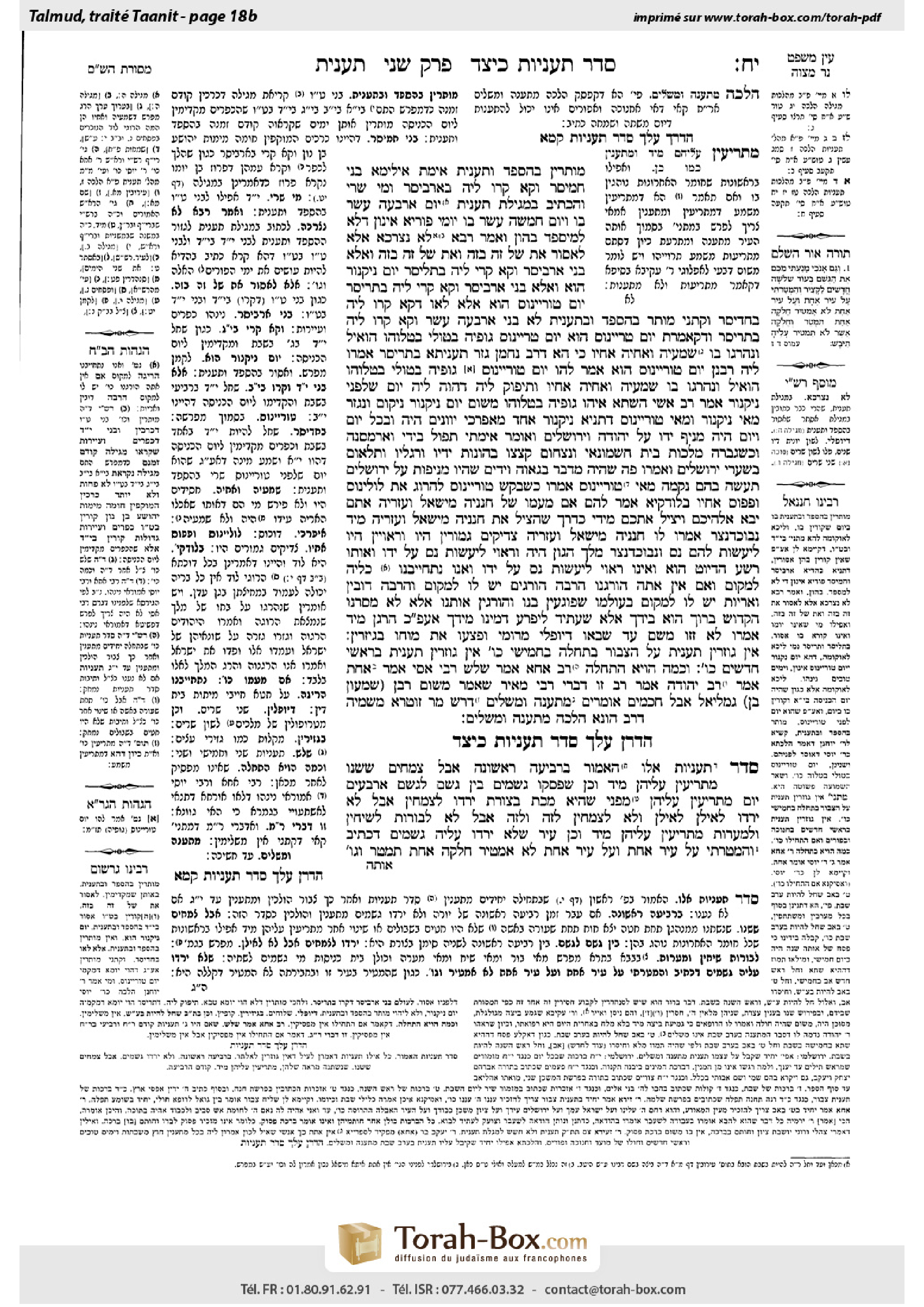
This page of Taanit includes the Aramaic text, an English translation and an AI-generated French translation, alongside the scan above.
תענית י״ח ב · Aramaic and Hebrew text
מוּתָּרִין בְּהֶסְפֵּד וְתַעֲנִית. אֵימַת? אִילֵּימָא בְּנֵי חֲמֵיסַר וְקָא קָרוּ לֵיהּ בְּאַרְבֵּיסַר, וּמִי שְׁרֵי?
וְהָכְתִיב בִּמְגִילַּת תַּעֲנִית: יוֹם אַרְבָּעָה עָשָׂר בּוֹ וְיוֹם חֲמִשָּׁה עָשָׂר בּוֹ, יוֹמֵי פּוּרַיָּא אִינּוּן דְּלָא לְמִיסְפַּד בְּהוֹן. וְאָמַר רָבָא: לֹא נִצְרְכָא, אֶלָּא לֶאֱסוֹר אֶת שֶׁל זֶה בָּזֶה וְאֶת שֶׁל זֶה בָּזֶה.
וְאֶלָּא, בְּנֵי אַרְבֵּיסַר וְקָא קָרֵי לֵיהּ בִּתְלֵיסַר — יוֹם נִיקָנוֹר הוּא! וְאֶלָּא, בְּנֵי אַרְבֵּיסַר וְקָא קָרֵי לֵיהּ בִּתְרֵיסַר — יוֹם טוּרְיָינוֹס הוּא!
אֶלָּא לָאו, דְּקָא קָרוּ לֵיהּ בַּחֲדֵיסַר, וְקָתָנֵי מוּתָּר בְּהֶסְפֵּד וּבְתַעֲנִית!
לָא, בְּנֵי אַרְבָּעָה עָשָׂר, וְקָא קָרוּ לֵיהּ בִּתְרֵיסַר. וּדְקָאָמְרַתְּ יוֹם טֻרְיָינוֹס הוּא — יוֹם טֻרְיָינוֹס גּוּפֵיהּ בַּטּוֹלֵי בַּטְּלוּהּ, הוֹאִיל וְנֶהֶרְגוּ בּוֹ שְׁמַעְיָה וַאֲחִיָּה אֶחָיו. כִּי הָא דְּרַב נַחְמָן גְּזַר תַּעֲנִיתָא בִּתְרֵיסַר, אֲמַרוּ לֵיהּ רַבָּנַן: יוֹם טוּרְיָינוֹס הוּא! אֲמַר לְהוּ: יוֹם טוּרְיָינוֹס גּוּפֵיהּ בַּטּוֹלֵי בַּטְּלוּהּ, הוֹאִיל וְנֶהֶרְגוּ בּוֹ שְׁמַעְיָה וַאֲחִיָּה אָחִיו.
וְתִיפּוֹק לֵיהּ דְּהָוֵה לֵיהּ יוֹם שֶׁלִּפְנֵי נִיקָנוֹר! אָמַר רַב אָשֵׁי: הַשְׁתָּא אִיהוּ גּוּפֵיהּ בַּטְּלוּהּ, מִשּׁוּם יוֹם נִיקָנוֹר נֵיקוּם וְנִגְזֹר?
מַאי נִיקָנוֹר וּמַאי טוּרְיָינוֹס? דְּתַנְיָא: נִיקָנוֹר, אֶחָד מֵאִפַּרְכֵי יְוָונִים הָיָה, וּבְכׇל יוֹם וָיוֹם הָיָה מֵנִיף יָדוֹ עַל יְהוּדָה וִירוּשָׁלַיִם, וְאוֹמֵר: אֵימָתַי תִּפּוֹל בְּיָדִי וְאֶרְמְסֶנָּה. וּכְשֶׁגָּבְרָה מַלְכוּת בֵּית חַשְׁמוֹנַאי וְנִצְּחוּם, קָצְצוּ בְּהוֹנוֹת יָדָיו וְרַגְלָיו וּתְלָאוּם בְּשַׁעֲרֵי יְרוּשָׁלַיִם, וְאָמְרוּ: פֶּה שֶׁהָיָה מְדַבֵּר בְּגַאֲוָה, וְיָדַיִים שֶׁהָיוּ מְנִיפוֹת עַל יְרוּשָׁלַיִם — תֵּעָשֶׂה בָּהֶם נְקָמָה.
מַאי טוּרְיָינוֹס? אָמְרוּ: כְּשֶׁבִּקֵּשׁ טוּרְיָינוֹס לַהֲרוֹג אֶת לוּלְיָנוּס וּפַפּוּס אָחִיו בְּלוּדְקִיָּא, אָמַר לָהֶם: אִם מֵעַמּוֹ שֶׁל חֲנַנְיָה מִישָׁאֵל וַעֲזַרְיָה אַתֶּם — יָבֹא אֱלֹהֵיכֶם וְיַצִּיל אֶתְכֶם מִיָּדִי, כְּדֶרֶךְ שֶׁהִצִּיל אֶת חֲנַנְיָה מִישָׁאֵל וַעֲזַרְיָה מִיַּד נְבוּכַדְנֶצַּר! אָמְרוּ לוֹ: חֲנַנְיָה מִישָׁאֵל וַעֲזַרְיָה צַדִּיקִים גְּמוּרִין הָיוּ, וּרְאוּיִין הָיוּ לֵיעָשׂוֹת לָהֶם נֵס. וּנְבוּכַדְנֶצַּר מֶלֶךְ הָגוּן הָיָה, וְרָאוּי לַעֲשׂוֹת נֵס עַל יָדוֹ.
וְאוֹתוֹ רָשָׁע, הֶדְיוֹט הוּא, וְאֵינוֹ רָאוּי לַעֲשׂוֹת נֵס עַל יָדוֹ. וְאָנוּ נִתְחַיַּיבְנוּ כְּלָיָה לַמָּקוֹם, וְאִם אֵין אַתָּה הוֹרְגֵנוּ — הַרְבֵּה הוֹרְגִים יֵשׁ לוֹ לַמָּקוֹם, וְהַרְבֵּה דּוּבִּין וַאֲרָיוֹת יֵשׁ לוֹ לַמָּקוֹם בְּעוֹלָמוֹ שֶׁפּוֹגְעִין בָּנוּ וְהוֹרְגִין אוֹתָנוּ. אֶלָּא, לֹא מְסָרָנוּ הַקָּדוֹשׁ בָּרוּךְ הוּא בְּיָדְךָ, אֶלָּא שֶׁעָתִיד לִיפָּרַע דָּמֵינוּ מִיָּדֶךָ.
אַף עַל פִּי כֵן הֲרָגָן מִיָּד. אָמְרוּ: לֹא זָזוּ מִשָּׁם, עַד שֶׁבָּאוּ דְּיוֹפָּלֵי מֵרוֹמִי וּפָצְעוּ אֶת מוֹחוֹ בְּגִיזְרִין.
אֵין גּוֹזְרִין תַּעֲנִית עַל הַצִּבּוּר בַּתְּחִלָּה בַּחֲמִישִׁי כּוּ׳, אֵין גּוֹזְרִין תַּעֲנִית בְּרָאשֵׁי חֳדָשִׁים כּוּ׳. וְכַמָּה הָוְיָא הַתְחָלָה? רַב אַחָא אָמַר: שָׁלֹשׁ. רַבִּי אַסִּי אָמַר: אַחַת.
אָמַר רַב יְהוּדָה אָמַר רַב: זוֹ דִּבְרֵי רַבִּי מֵאִיר שֶׁאָמַר מִשּׁוּם רַבָּן גַּמְלִיאֵל, אֲבָל חֲכָמִים אוֹמְרִים: מִתְעַנֶּה וּמַשְׁלִים. דָּרֵשׁ מָר זוּטְרָא מִשְּׁמֵיהּ דְּרַב הוּנָא: הֲלָכָה מִתְעַנֶּה וּמַשְׁלִים.
הֲדַרַן עֲלָךְ סֵדֶר תַּעֲנִיּוֹת כֵּיצַד
סֵדֶר תַּעֲנִיּוֹת אֵלּוּ, הָאָמוּר בִּרְבִיעָה רִאשׁוֹנָה. אֲבָל צְמָחִים שֶׁשָּׁנוּ — מַתְרִיעִין עֲלֵיהֶן מִיָּד. וְכֵן שֶׁפָּסְקוּ גְּשָׁמִים בֵּין גֶּשֶׁם לְגֶשֶׁם אַרְבָּעִים יוֹם — מַתְרִיעִין עֲלֵיהֶן, מִפְּנֵי שֶׁהִיא מַכַּת בַּצּוֹרֶת.
יָרְדוּ לַצְּמָחִין אֲבָל לֹא יָרְדוּ לָאִילָן, לְאִילָן וְלֹא לַצְּמָחִין, לָזֶה וְלָזֶה אֲבָל לֹא לַבּוֹרוֹת לַשִּׁיחִין וְלַמְּעָרוֹת — מַתְרִיעִין עֲלֵיהֶן מִיָּד. וְכֵן עִיר שֶׁלֹּא יָרְדוּ עָלֶיהָ גְּשָׁמִים, דִּכְתִיב: ״וְהִמְטַרְתִּי עַל עִיר אֶחָת וְעַל עִיר אַחַת לֹא אַמְטִיר חֶלְקָה אַחַת תִּמָּטֵר וְגוֹ׳״.
Taanit 18b · English translation
as the Sages decreed that in certain places one may read the Scroll of Esther on the eleventh, twelfth, or thirteenth of Adar, nevertheless, it is permitted to eulogize and fast on these days. The Gemara clarifies: When does this ruling apply? If we say that it applies to those in walled cities, who normally read the scroll on the fifteenth of Adar and yet this year they read it on the fourteenth, a day on which they normally are permitted to fast and eulogize, but this cannot be the case, as are they permitted to fast and eulogize at all on these days?
But isn’t it written in Megillat Ta’anit: The day of the fourteenth of Adar and the day of the fifteenth of Adar are the days of Purim, on which eulogizing is prohibited. And Rava said: Since these days are already mentioned in the Bible (Esther 9:18–19), it is necessary to state this halakha in Megillat Ta’anit only to prohibit those living in these walled cities from fasting and eulogizing on this date, the fourteenth, and those living in these non-walled cities from fasting and eulogizing on this date, the fifteenth.
The Gemara continues its explanation of the difficulty. But rather, the mishna must be referring to those who normally read on the fourteenth of Adar, but who read the Scroll of Esther early, on the thirteenth. However, it is already prohibited to fast on the thirteenth, as it is Nicanor’s Day, which is a commemorative day in its own right. But rather, you will say that the mishna is referring to those residents of cities who normally read on the fourteenth, but who read it early that year, on the twelfth; however, the twelfth of Adar is also a commemorative day, as it is Trajan’s Day.
Rather, isn’t the mishna referring to a case where they read the Scroll of Esther on the eleventh of Adar, and nevertheless that mishna teaches that it is permitted to eulogize and fast on this day, despite the fact that it is the day before Trajan’s Day? The opinion in this unattributed mishna is not in accordance with that of Rabbi Yosei, which means that there is a contradiction between the two statements of Rabbi Yoḥanan.
The Gemara answers: No; the mishna is actually referring to those who normally read on the fourteenth, but who read it that year on the twelfth of Adar. And with regard to that which you said, that it is Trajan’s Day, Trajan’s Day itself was annulled and is no longer celebrated, since Shemaya and his brother Aḥiya were killed on that day. We learn this as in the incident when Rav Naḥman decreed a fast on the twelfth of Adar and the Sages said to him: It is Trajan’s Day. He said to them: Trajan’s Day itself was annulled, since Shemaya and his brother Aḥiya were killed on that day.
The Gemara asks: And let him derive that fasting on the twelfth is prohibited in any case, as it is the day before Nicanor’s Day. Rav Ashi said: Now that with regard to Trajan’s Day itself, they annulled it, will we then arise and issue a decree not to fast on this date due to the following day, Nicanor’s Day?
In relation to the above, the Gemara inquires: What is the origin of Nicanor’s Day and what is the origin of Trajan’s Day? As it is taught in a baraita: Nicanor was one of the generals [iparkhei] in the Greek army, and each and every day he would wave his hand over Judea and Jerusalem and say: When will this city fall into my hands, and I shall trample it? And when the Hasmonean monarchy overcame the Greeks and emerged victorious over them, they killed Nicanor in battle, cut off his thumbs and big toes, and hung them on the gates of Jerusalem, saying: The mouth that spoke with pride, and the hands that waved over Jerusalem, may vengeance be taken against them. This occurred on the thirteenth of Adar.
What is the origin of Trajan’s Day? They said in explanation: When Trajan sought to kill the important leaders Luleyanus and his brother Pappas in Laodicea, he said to them: If you are from the nation of Hananiah, Mishael, and Azariah, let your God come and save you from my hand, just as He saved Hananiah, Mishael, and Azariah from the hand of Nebuchadnezzar. Luleyanus and Pappas said to him: Hananiah, Mishael, and Azariah were full-fledged righteous people, and they were worthy that a miracle should be performed for them, and Nebuchadnezzar was a legitimate king who rose to power through his merit, and it is fitting that a miracle be performed through him.
But this wicked man, Trajan, is a commoner, not a real king, and it is not fitting that a miracle be performed through him. Luleyanus and Pappas continued: And we are not wholly righteous, and have been condemned to destruction by the Omnipresent for our sins. And if you do not kill us, the Omnipresent has many other executioners. And if men do not kill us, the Omnipresent has many bears and lions in His world that can hurt us and kill us. Instead, the Holy One, Blessed be He, placed us into your hands only so that He will avenge our blood in the future.
Even so, Trajan remained unmoved by their response and killed them immediately. It is said that they had not moved from the place of execution when two officials [diyoflei] arrived from Rome with permission to remove Trajan from power, and they split his skull with clubs. This was viewed as an act of divine retribution and was established as a commemorative day.
§ The mishna taught: One may not decree a fast on the community starting on a Thursday, so as not to cause prices to rise. Furthermore, one may not decree a fast on New Moons, on Hanukkah, or on Purim. However, if one began a set of fasts, one does not interrupt the sequence for these days. The Gemara asks: And how many fasts are considered a beginning? Rav Aḥa said: If one fasted three fasts before the festive day. Rabbi Asi said: Even if one fasted one fast before it.
Rav Yehuda said that Rav said: This halakha of the mishna that a fast that occurs on a festival is not observed, is the statement of Rabbi Meir, who said it in the name of Rabban Gamliel. However, the Rabbis say: If a communal fast occurs on one of these days, one must fast and complete the fast until nightfall. Mar Zutra taught in the name of Rav Huna: The practical halakha is in accordance with the opinion of the Rabbis, that one fasts and completes his fast until nightfall.
MISHNA: The order of these fasts of increasing severity, as explained in Chapter One, is stated only in a case when the first rainfall has not materialized. However, if there is vegetation that grew and its appearance changed due to disease, the court does not wait at all; they cry out about it immediately. And likewise, if rain ceased for a period of forty days between one rainfall and another, they cry out about it because it is a plague of drought.
If sufficient rain fell for the vegetation but not enough fell for the trees; or if it was enough for the trees but not for the vegetation; or if sufficient rain fell for both this and that, i.e., vegetation and trees, but not enough to fill the cisterns, ditches, and caves with water to last the summer, they cry out about it immediately. And likewise, if there is a particular city upon which it did not rain, while the surrounding area did receive rain, this is considered a divine curse, as it is written: “And I caused it to rain upon one city, but caused it not to rain upon another city; one piece was rained upon, and the portion upon which it did not rain withered” (Amos 4:7).
Taanit 18b · Traduction française (IA)
Bien que les Sages aient décrété que, dans certains lieux, on peut lire le rouleau d’Esther les 11, 12 ou 13 adar, il est néanmoins permis de prononcer des oraisons funèbres et de jeûner ces jours-là. La Guemara précise : à quel cas cette règle s’applique-t-elle ? Si l’on dit qu’elle concerne les habitants des villes fortifiées, qui lisent normalement le rouleau le 15 adar, mais qui, cette année, le lisent le 14, jour où ils sont normalement autorisés à jeûner et à prononcer des oraisons funèbres, cela ne peut toutefois pas être le cas. En effet, leur est-il jamais permis de jeûner et de prononcer des oraisons funèbres ces jours-là ?
Mais n’est-il pas écrit dans la Meguilat Ta’anit : « Le 14 adar et le 15 adar sont les jours de Pourim, pendant lesquels il est interdit de prononcer des oraisons funèbres » ? Et Rava a dit : puisque ces jours sont déjà mentionnés dans la Bible (Esther 9,18-19), la halakha énoncée dans la Meguilat Ta’anit est nécessaire uniquement pour interdire aux habitants des villes fortifiées de jeûner et de prononcer des oraisons funèbres le 14, et aux habitants des villes non fortifiées de jeûner et de prononcer des oraisons funèbres le 15.
La Guemara poursuit son explication de la difficulté. Mais il faut plutôt dire que la Michna parle de ceux qui lisent normalement le 14 adar, mais qui lisent le rouleau par anticipation, le 13. Or, il est déjà interdit de jeûner le 13, car c’est le jour de Nicanor, qui est en soi un jour commémoratif. Mais il faut plutôt dire que la Michna parle des habitants de villes qui lisent normalement le 14, mais qui, cette année-là, le lisent par anticipation, le 12. Cependant, le 12 adar est également un jour commémoratif, car c’est le jour de Trajan.
La Michna ne parle-t-elle pas plutôt d’un cas où ils lisent le rouleau d’Esther le 11 adar et enseigne néanmoins qu’il est permis de prononcer des oraisons funèbres et de jeûner ce jour-là, bien qu’il précède le jour de Trajan ? L’opinion exprimée dans cette Michna anonyme n’est pas celle de Rabbi Yossei, ce qui signifie qu’il y a une contradiction entre les deux déclarations de Rabbi Yoḥanan.
La Guemara répond : non ; la Michna parle en réalité de ceux qui lisent normalement le 14, mais qui, cette année-là, lisent le rouleau le 12 adar. Quant à ce que tu as dit, à savoir que c’est le jour de Trajan, ce jour même a été annulé et n’est plus célébré, puisque Shemaya et son frère Aḥiya ont été tués ce jour-là. Nous l’apprenons de l’épisode où Rav Naḥman décréta un jeûne le 12 adar et où les Sages lui dirent : « C’est le jour de Trajan. » Il leur répondit : « Le jour de Trajan lui-même a été annulé, puisque Shemaya et son frère Aḥiya ont été tués ce jour-là. »
La Guemara demande : Ne devrait-on pas déduire que le jeûne du 12 est de toute façon interdit, puisqu’il précède le jour de Nicanor ? Rav Ashi a dit : Maintenant que le jour de Trajan lui-même a été annulé, allons-nous donc décréter qu’il est interdit de jeûner à cette date à cause du lendemain, le jour de Nicanor ?
À propos de ce qui précède, la Guemara demande : Quelle est l’origine du jour de Nicanor et quelle est celle du jour de Trajan ? Comme il est enseigné dans une baraïta : Nicanor était l’un des généraux [iparkhei] de l’armée grecque. Chaque jour, il agitait la main au-dessus de la Judée et de Jérusalem et disait : « Quand cette ville tombera-t-elle entre mes mains, pour que je la piétine ? » Lorsque la dynastie hasmonéenne vainquit les Grecs et remporta la victoire sur eux, ils tuèrent Nicanor au combat, lui coupèrent les pouces et les gros orteils, puis les suspendirent aux portes de Jérusalem en disant : « Que vengeance soit faite contre la bouche qui a parlé avec arrogance et les mains qui se sont agitées au-dessus de Jérusalem. » Cela eut lieu le 13 adar.
Quelle est l’origine du jour de Trajan ? On l’explique ainsi : lorsque Trajan voulut tuer les éminents dirigeants Luleyanus et son frère Pappas à Laodicée, il leur dit : « Si vous êtes du peuple de Hananiah, Mishael et Azariah, que votre Dieu vienne vous sauver de mes mains, comme il a sauvé Hananiah, Mishael et Azariah des mains de Nabuchodonosor. » Luleyanus et Pappas lui dirent : « Hananiah, Mishael et Azariah étaient des justes accomplis, dignes qu’un miracle soit accompli pour eux ; et Nabuchodonosor était un roi légitime, qui avait accédé au pouvoir par son mérite, et il convenait qu’un miracle s’accomplisse par son intermédiaire. »
« Mais ce méchant, Trajan, est un homme du peuple, et non un véritable roi ; il ne convient donc pas qu’un miracle s’accomplisse par son intermédiaire. » Luleyanus et Pappas poursuivirent : « Et nous ne sommes pas entièrement justes, et le Maître du monde nous a condamnés à la destruction pour nos péchés. Si tu ne nous tues pas, le Maître du monde a bien d’autres bourreaux. Et si les hommes ne nous tuent pas, le Maître du monde a dans Son monde de nombreux ours et lions capables de nous blesser et de nous tuer. Au contraire, le Saint, béni soit-Il, nous a livrés entre tes mains uniquement afin de venger notre sang à l’avenir. »
Malgré tout, Trajan ne fut pas ému par leur réponse et les tua immédiatement. On raconte qu’ils n’avaient pas encore quitté le lieu de l’exécution lorsque deux envoyés [diyoflei] arrivèrent de Rome, munis de l’autorisation de destituer Trajan, et lui fendirent le crâne à coups de massue. Cela fut considéré comme un acte de rétribution divine et fut institué comme jour commémoratif.
§ La Michna a enseigné : on ne décrète pas de jeûne communautaire commençant un jeudi, afin de ne pas faire monter les prix. De plus, on ne décrète pas de jeûne aux nouvelles lunes, à Hanoucca ni à Pourim. Cependant, si l’on a commencé une série de jeûnes, on ne l’interrompt pas à cause de ces jours. La Guemara demande : combien de jeûnes faut-il pour considérer que la série a commencé ? Rav Aḥa a dit : si l’on a jeûné trois jours avant le jour de fête. Rabbi Asi a dit : même si l’on a jeûné un seul jour avant celui-ci.
Rav Yehouda a dit au nom de Rav : cette halakha de la Michna, selon laquelle on n’observe pas un jeûne qui tombe un jour de fête, est l’opinion de Rabbi Meïr, qui l’a énoncée au nom de Rabban Gamliel. Mais les Sages disent : si un jeûne communautaire tombe l’un de ces jours, il faut jeûner et mener le jeûne à son terme jusqu’à la nuit. Mar Zutra enseignait au nom de Rav Houna : la halakha pratique suit l’opinion des Sages, selon laquelle on jeûne et on mène le jeûne à son terme jusqu’à la nuit.
MICHNA : L’ordre de ces jeûnes de sévérité croissante, comme cela a été expliqué au premier chapitre, ne s’applique que lorsque les premières pluies ne sont pas tombées. Mais si des plantes ont poussé et que leur aspect s’est altéré à cause d’une maladie, le tribunal n’attend pas du tout : il lance immédiatement un appel au jeûne. De même, si la pluie cesse pendant une période de quarante jours entre une pluie et la suivante, on lance un appel au jeûne, car il s’agit d’une calamité de sécheresse.
Si la pluie est suffisante pour les plantes, mais pas pour les arbres ; ou si elle est suffisante pour les arbres, mais pas pour les plantes ; ou si elle est suffisante à la fois pour les unes et les autres, c’est-à-dire les plantes et les arbres, mais pas pour remplir d’eau les citernes, les fossés et les grottes afin de disposer de réserves pour tout l’été, on lance immédiatement un appel au jeûne. De même, s’il y a une ville particulière sur laquelle il n’a pas plu, alors que la région alentour a reçu de la pluie, cela est considéré comme une malédiction divine, comme il est écrit : « J’ai fait pleuvoir sur une ville, mais je n’ai pas fait pleuvoir sur une autre ville ; une parcelle a reçu la pluie, tandis que celle sur laquelle il n’a pas plu s’est desséchée » (Amos 4,7).
Traduction française générée par IA à partir de l’édition anglaise de Sefaria. Vérifie toujours un passage avec le texte source.
Text from Sefaria: William Davidson Edition - Vocalized Aramaic (CC BY NC); William Davidson Edition - English (CC BY NC).