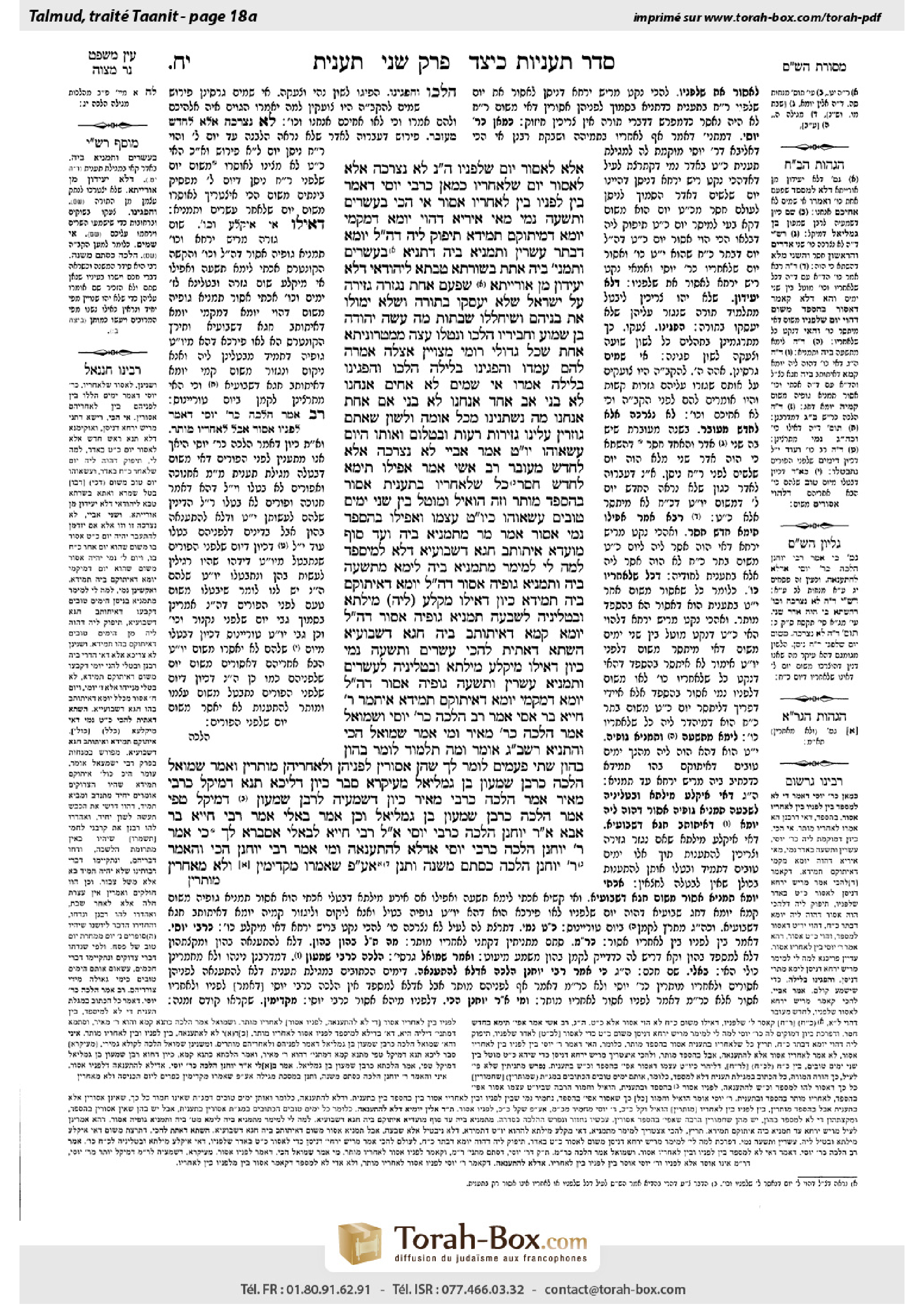
Taanit 18a: Talmud study for Daf Yomi
Daf Yomi is the daily study of one Talmud folio. Explore 37 tractates with scans, Hebrew text, Sefaria English and AI-generated French translations where annotated.
Passage selection and English or AI-generated French translation are available where the scan has annotations. Daf Study is independent of Torah-Box and Sefaria.
Browse Taanit · תענית · All tractatesTaanit 18a text and translations
This page of Taanit includes the Aramaic text, an English translation and an AI-generated French translation, alongside the scan above.
תענית י״ח א · Aramaic and Hebrew text
אֶלָּא לֶאֱסוֹר יוֹם שֶׁלְּפָנָיו, הָכָא נָמֵי — לָא נִצְרְכָה אֶלָּא לֶאֱסוֹר יוֹם שֶׁלְּאַחֲרָיו. כְּמַאן, כְּרַבִּי יוֹסֵי דְּאָמַר: בֵּין לְפָנָיו וּבֵין לְאַחֲרָיו אָסוּר. אִי הָכִי בְּעֶשְׂרִים וְתִשְׁעָה נָמֵי — מַאי אִירְיָא דְּהָוֵי יוֹמָא דְּמִקַּמֵּי יוֹמָא דְּמִיתּוֹקַם תְּמִידָא? תִּיפּוֹק לֵיהּ דְּהָוֵה לֵיהּ יוֹמָא דְּבָתַר עֶשְׂרִין וּתְמָנְיָא בֵּיהּ!
דְּתַנְיָא: בְּעֶשְׂרִים וּתְמָנְיָא בֵּיהּ, אֲתָת בְּשׂוֹרְתָּא טָבְתָּא לִיהוּדָאֵי דְּלָא יְעִידוֹן מִן אוֹרָיְיתָא. שֶׁפַּעַם אַחַת גָּזְרָה מַלְכוּת הָרְשָׁעָה שְׁמָד עַל יִשְׂרָאֵל שֶׁלֹּא יַעַסְקוּ בַּתּוֹרָה, וְשֶׁלֹּא יָמוּלוּ אֶת בְּנֵיהֶם, וְשֶׁיְּחַלְּלוּ שַׁבָּתוֹת. מָה עָשָׂה יְהוּדָה בֶּן שַׁמּוּעַ וַחֲבֵרָיו? הָלְכוּ וְנָטְלוּ עֵצָה מִמַּטְרוֹנִיתָא אַחַת שֶׁכׇּל גְּדוֹלֵי רוֹמִי מְצוּיִין אֶצְלָהּ.
אָמְרָה לָהֶם: עִמְדוּ וְהַפְגִּינוּ בַּלַּיְלָה. הָלְכוּ וְהִפְגִּינוּ בַּלַּיְלָה, אָמְרוּ: אֵי שָׁמַיִם! לֹא אַחִים אֲנַחְנוּ, לֹא בְּנֵי אָב אֶחָד אֲנַחְנוּ, לֹא בְּנֵי אֵם אַחַת אֲנַחְנוּ? מָה נִשְׁתַּנֵּינוּ מִכׇּל אוּמָּה וְלָשׁוֹן שֶׁאַתֶּם גּוֹזְרִין עָלֵינוּ גְּזֵירוֹת רָעוֹת! וּבִטְּלוּם, וְאוֹתוֹ יוֹם עֲשָׂאוּהוּ יוֹם טוֹב.
אָמַר אַבָּיֵי: לֹא נִצְרְכָה אֶלָּא לְחֹדֶשׁ מְעוּבָּר.
רַב אָשֵׁי אָמַר: אֲפִילּוּ תֵּימָא לְחוֹדֶשׁ חָסֵר, כׇּל שֶׁלְּאַחֲרָיו — בְּתַעֲנִית אָסוּר, בְּהֶסְפֵּד מוּתָּר. וְזֶה, הוֹאִיל וּמוּטָל בֵּין שְׁנֵי יָמִים טוֹבִים — עֲשָׂאוּהוּ כְּיוֹם טוֹב עַצְמוֹ, וַאֲפִילּוּ בְּהֶסְפֵּד נָמֵי אָסוּר.
אָמַר מָר: מִתְּמָנְיָא בֵּיהּ וְעַד סוֹף מוֹעֲדָא אִיתּוֹתַב חַגָּא דְשָׁבוּעַיָּא, דְּלָא לְמִיסְפַּד. לְמָה לִי לְמֵימַר מִתְּמָנְיָא בֵּיהּ? לֵימָא מִתִּשְׁעָה בֵּיהּ, וּתְמָנְיָא גּוּפֵיהּ אָסוּר, דְּהָוֵה לֵיהּ יוֹמָא דְּאִיתּוֹקַם בֵּיהּ תְּמִידָא!
כֵּיוָן דְּאִילּוּ מִקְּלַע לֵיהּ מִילְּתָא וּבַטְּלִינֵּיהּ לְשִׁבְעָה — תְּמָנְיָא גּוּפֵיהּ אָסוּר, דְּהָוֵה לֵיהּ יוֹמָא קַמָּא דְּאִיתּוֹתַב בֵּיהּ חַגָּא דְשָׁבוּעַיָּא.
הַשְׁתָּא דְּאָתֵית לְהָכִי, עֶשְׂרִים וְתִשְׁעָה נָמֵי: כֵּיוָן דְּאִילּוּ מִיקְּלַע מִילְּתָא וּבַטְּלִינֵּיהּ לְעֶשְׂרִים וּתְמָנְיָא — עֶשְׂרִין וְתִשְׁעָה גּוּפֵיהּ אָסוּר, דְּהָוֵה לֵיהּ יוֹמָא דְּמִקַּמֵּי יוֹמָא דְּאִיתּוֹקַם תְּמִידָא.
אִיתְּמַר, רַב חִיָּיא בַּר אַסִּי אָמַר רַב: הֲלָכָה כְּרַבִּי יוֹסֵי, וּשְׁמוּאֵל אָמַר: הֲלָכָה כְּרַבִּי מֵאִיר.
וּמִי אָמַר שְׁמוּאֵל הָכִי? וְהָתַנְיָא, רַבָּן שִׁמְעוֹן בֶּן גַּמְלִיאֵל אוֹמֵר: וּמָה תַּלְמוּד לוֹמַר ״בְּהוֹן״ ״בְּהוֹן״ שְׁתֵּי פְעָמִים — לוֹמַר לָךְ שֶׁהֵן אֲסוּרִין, לִפְנֵיהֶן וּלְאַחֲרֵיהֶן מוּתָּרִין. וְאָמַר שְׁמוּאֵל: הֲלָכָה כְּרַבָּן שִׁמְעוֹן בֶּן גַּמְלִיאֵל.
מֵעִיקָּרָא סָבַר: כֵּיוָן דְּלֵיכָּא תַּנָּא דְּמֵיקֵל כְּרַבִּי מֵאִיר, אָמַר הֲלָכָה כְּרַבִּי מֵאִיר. כֵּיוָן דְּשַׁמְעֵיהּ לְרַבָּן שִׁמְעוֹן דְּמֵיקֵל טְפֵי, אָמַר: הֲלָכָה כְּרַבָּן שִׁמְעוֹן בֶּן גַּמְלִיאֵל.
וְכֵן אָמַר בָּאלִי אָמַר רַבִּי חִיָּיא בַּר אַבָּא אָמַר רַבִּי יוֹחָנָן: הֲלָכָה כְּרַבִּי יוֹסֵי. אֲמַר לֵיהּ רַבִּי חִיָּיא לְבָאלִי: אַסְבְּרַהּ לָךְ, כִּי אָמַר רַבִּי יוֹחָנָן הֲלָכָה כְּרַבִּי יוֹסֵי — אַדְּלָא לְהִתְעַנָּאָה.
וּמִי אָמַר רַבִּי יוֹחָנָן הָכִי? וְהָאָמַר רַבִּי יוֹחָנָן: הֲלָכָה כִּסְתַם מִשְׁנָה. וּתְנַן: אַף עַל פִּי שֶׁאָמְרוּ מַקְדִּימִין וְלֹא מְאַחֲרִין,
Taanit 18a · English translation
only to prohibit eulogizing on the day before. Here too, it is necessary to mention Passover only to prohibit eulogizing on the following day. The Gemara asks: In accordance with whose opinion is this ruling? It is in accordance with the opinion of Rabbi Yosei, who said that eulogizing is prohibited both on the day before the date recorded in Megillat Ta’anit and on the following day. The Gemara asks: If so, with regard to the twenty-ninth of Adar too, why state specifically that eulogizing is prohibited then because it is the day before the day on which the daily offering was established? Let him derive this prohibition from the fact that it is the day after the twenty-eighth of Adar.
As it is taught in Megillat Ta’anit: On the twenty-eighth of Adar good tidings came to the Jews, that they would not be restricted from Torah study, and they declared this date a commemorative day. The baraita proceeds to describe the events of this day. As on one occasion the wicked empire, Rome, issued a decree of apostasy against the Jews, that they may not occupy themselves with Torah study, and that they may not circumcise their sons, and that they must desecrate Shabbat. What did Yehuda ben Shammua and his colleagues do? They went and sought the advice of a certain Roman matron [matronita] whose company was kept by all the prominent people of Rome.
She said to them: Arise and cry out [hafginu] at night. They went and cried out at night, saying: O Heaven! Are we not brothers? Are we not children of one father? Are we not the children of one mother? How are we different from any other nation and tongue that you single us out and issue against us evil decrees? Their cries were effective, and the authorities annulled the decrees, and they made that day a commemorative holiday.
§ Since the twenty-eighth of Adar is also a commemorative day, according to the opinion of Rabbi Yosei, it is also prohibited to fast on the following day. The question therefore remains: Why was it necessary to list the New Moon of Nisan, when the day before was already prohibited? Abaye said: It is necessary to include the New Moon of Nisan only for the case of a full, thirty-day month. If the month of Adar is thirty days long, fasting on the thirtieth day would be prohibited only because it is the day preceding the New Moon, not because it follows the twenty-eighth of Adar.
Rav Ashi said: Even if you say that we are dealing with a deficient month, with twenty-nine days, the inclusion of the New Moon of Nisan can still be explained. The reason is that with regard to all days that follow the dates listed in Megillat Ta’anit, fasting is prohibited but eulogizing is permitted. But in this case, since the twenty-ninth of Adar is positioned between two commemorative holidays, the twenty-eighth of Adar and the New Moon of Nisan, the Sages made it like a commemorative holiday in its own right, and it is therefore prohibited even to eulogize on this date.
§ The Master said above, in Megillat Ta’anit: From the eighth of Nisan until the end of the festival of Passover, the festival of Shavuot was restored, and it was decreed not to eulogize during this period. The Gemara asks: Why do I need it to say: From the eighth of Nisan? Let the tanna say: From the ninth of Nisan, and the eighth itself will still be prohibited because, as stated earlier, it is the day on which the daily offering was established.
The Gemara answers: Since if a calamitous event happened and they canceled the seven days commemorating the establishment of the daily offering, the eighth day itself will remain prohibited, as it is the first day on which the festival of Shavuot was restored. Since this date is not merely the last of the series for the daily offering, but it also commemorates the restoration of Shavuot, it is not affected by the cancellation of the previous seven days.
The Gemara notes: Now that you have arrived at this conclusion, the same logic can be applied to the twenty-ninth of Adar as well: Since if a calamitous event happened and they canceled the commemoration of the twenty-eighth of Adar, nevertheless, the twenty-ninth day itself will remain prohibited, as it is the first day on which the daily offering was established.
It was stated that there is a dispute between amora’im: Rav Ḥiyya bar Asi said that Rav said: The halakha is in accordance with the opinion of Rabbi Yosei, that with regard to all the days mentioned in Megillat Ta’anit on which eulogizing is prohibited, it is likewise prohibited to eulogize on the day before and the day after. And Shmuel said: The halakha is in accordance with the opinion of Rabbi Meir, the tanna of the unattributed mishna, who said that although it is prohibited to eulogize on the day before, it is permitted on the day after.
The Gemara asks: And did Shmuel actually say this? But isn’t it taught in a baraita that Rabban Shimon ben Gamliel says: And what is the meaning when Megillat Ta’anit states: On them, on them, twice, in the phrases: Not to eulogize on them, and: Not to fast on them. This phrase is repeated to say to you that fasting and eulogizing on these days themselves is prohibited, but on the days before and on the following days it is permitted. And Shmuel said: The halakha is in accordance with the opinion of Rabban Shimon ben Gamliel. How, then, can it be said that Shmuel ruled in accordance with the opinion of Rabbi Meir?
The Gemara answers: Initially, Shmuel maintained that since there is no other tanna as lenient as Rabbi Meir, he said that the halakha is in accordance with the opinion of Rabbi Meir. When he heard that the opinion of Rabban Shimon ben Gamliel was more lenient, he said that the halakha is in accordance with the opinion of Rabban Shimon ben Gamliel. Shmuel consistently ruled in the most lenient manner possible on this issue.
And similarly, the Sage Bali said that Rabbi Ḥiyya bar Abba said that Rabbi Yoḥanan said: The halakha is in accordance with the opinion of Rabbi Yosei. The Gemara relates that Rabbi Ḥiyya bar Abba said to Bali: I will explain this ruling to you. When Rabbi Yoḥanan said that the halakha is in accordance with the opinion of Rabbi Yosei, he was not referring to all matters. Rather, he spoke specifically with regard to the day before those dates concerning which Megillat Ta’anit said: Fasting is prohibited. However, with regard to those days on which it is prohibited to eulogize, he did not rule in accordance with the opinion of Rabbi Yosei, as Rabbi Yoḥanan maintains that eulogizing on the following day is permitted.
The Gemara asks: And did Rabbi Yoḥanan actually say this? But didn’t Rabbi Yoḥanan say as a principle that the halakha is always in accordance with an unattributed mishna. And we learned in a mishna: Although the Sages said, with regard to reading of the Scroll of Esther, that one may read it earlier but one may not read it later,
Taanit 18a · Traduction française (IA)
seulement pour interdire les oraisons funèbres la veille. Ici aussi, il faut mentionner Pessa’h uniquement pour interdire les oraisons funèbres le lendemain. La Guemara demande : Selon l’opinion de qui cette décision est-elle rendue ? Selon celle de Rabbi Yossei, qui a dit qu’il est interdit de prononcer des oraisons funèbres aussi bien la veille que le lendemain des dates inscrites dans la Meguilat Ta’anit. La Guemara demande : Dans ce cas, concernant également le vingt-neuvième jour d’Adar, pourquoi préciser qu’il est interdit d’y prononcer des oraisons funèbres parce que c’est la veille du jour où le sacrifice quotidien fut institué ? Qu’il déduise cette interdiction du fait que c’est le lendemain du vingt-huitième jour d’Adar.
Comme il est enseigné dans la Meguilat Ta’anit : Le vingt-huitième jour d’Adar, une bonne nouvelle parvint aux Juifs : ils ne seraient plus empêchés d’étudier la Torah, et ils déclarèrent cette date jour commémoratif. La baraïta décrit ensuite les événements de ce jour. En effet, un jour, le cruel empire de Rome promulgua contre les Juifs un décret d’apostasie, leur interdisant de s’adonner à l’étude de la Torah et de circoncire leurs fils, et leur imposant de profaner le Chabbat. Que firent Yehouda ben Shammoua et ses collègues ? Ils allèrent demander conseil à une certaine matrone romaine [matronita], que fréquentaient tous les notables de Rome.
Elle leur dit : Levez-vous et poussez des cris [hafginu] pendant la nuit. Ils allèrent crier pendant la nuit, en disant : Ô Ciel ! Ne sommes-nous pas frères ? Ne sommes-nous pas les enfants d’un même père ? Ne sommes-nous pas les enfants d’une même mère ? En quoi sommes-nous différents de toute autre nation et de toute autre langue, pour que vous nous distinguiez et portiez contre nous de mauvais décrets ? Leurs cris furent efficaces : les autorités annulèrent les décrets et ils firent de ce jour un jour commémoratif.
§ Puisque le vingt-huitième jour d’Adar est lui aussi un jour commémoratif, selon l’opinion de Rabbi Yossei, il est également interdit de jeûner le lendemain. La question demeure donc : pourquoi fallait-il mentionner la néoménie de Nisan, alors que la veille était déjà interdite ? Abayé dit : Il faut inclure la néoménie de Nisan uniquement dans le cas d’un mois complet de trente jours. Si le mois d’Adar compte trente jours, il ne serait interdit de jeûner le trentième jour qu’en raison de la néoménie du lendemain, et non parce qu’il suit le vingt-huitième jour d’Adar.
Rav Ashi dit : Même si tu dis que nous avons affaire à un mois déficient de vingt-neuf jours, on peut encore expliquer pourquoi la néoménie de Nisan est incluse. En effet, pour tous les jours qui suivent les dates mentionnées dans la Meguilat Ta’anit, il est interdit de jeûner, mais il est permis de prononcer des oraisons funèbres. Or, dans ce cas, puisque le vingt-neuvième jour d’Adar se trouve entre deux jours commémoratifs, le vingt-huitième jour d’Adar et la néoménie de Nisan, les Sages l’ont considéré comme un jour commémoratif à part entière ; il est donc même interdit d’y prononcer des oraisons funèbres.
§ Le Maître a dit plus haut, dans la Meguilat Ta’anit : À partir du huitième jour de Nisan et jusqu’à la fin de la fête de Pessa’h, la fête de Chavouot fut rétablie, et il fut décrété qu’il était interdit de prononcer des oraisons funèbres pendant cette période. La Guemara demande : Pourquoi faut-il dire « à partir du huitième jour de Nisan » ? Que le tanna dise « à partir du neuvième jour de Nisan » ; le huitième jour serait malgré tout interdit, car, comme indiqué précédemment, c’est le jour où le sacrifice quotidien fut institué.
La Guemara répond : Car, si un événement calamiteux survenait et qu’ils annulaient les sept jours commémorant l’institution du sacrifice quotidien, le huitième jour lui-même resterait interdit, puisqu’il est le premier jour où la fête de Chavouot fut rétablie. Comme cette date n’est pas seulement la dernière de la série liée au sacrifice quotidien, mais commémore également le rétablissement de Chavouot, elle n’est pas affectée par l’annulation des sept jours précédents.
La Guemara fait remarquer : Maintenant que tu es parvenu à cette conclusion, le même raisonnement peut aussi s’appliquer au vingt-neuvième jour d’Adar : si un événement calamiteux survenait et qu’ils annulaient la commémoration du vingt-huitième jour d’Adar, le vingt-neuvième jour lui-même resterait néanmoins interdit, puisqu’il est le premier jour où le sacrifice quotidien fut institué.
Il fut rapporté qu’il existe un différend entre les amoraïm : Rav Ḥiyya bar Asi dit au nom de Rav : La halakha suit l’opinion de Rabbi Yossei, selon laquelle, pour toutes les dates mentionnées dans la Meguilat Ta’anit où il est interdit de prononcer des oraisons funèbres, il est également interdit d’en prononcer la veille et le lendemain. Et Shmouel dit : La halakha suit l’opinion de Rabbi Meïr, le tanna de la Michna anonyme, qui a dit que, bien qu’il soit interdit de prononcer des oraisons funèbres la veille, cela est permis le lendemain.
La Guemara demande : Shmouel a-t-il vraiment dit cela ? N’est-il pas enseigné dans une baraïta que Rabban Shimon ben Gamliel dit : Que signifie la répétition de l’expression « pour eux » dans la Meguilat Ta’anit, dans les formules « ne pas prononcer d’oraisons funèbres pour eux » et « ne pas jeûner pour eux » ? Cette répétition vient t’enseigner qu’il est interdit de jeûner et de prononcer des oraisons funèbres ces jours-là mêmes, mais que cela est permis les jours précédents et les jours suivants. Et Shmouel a dit : La halakha suit l’opinion de Rabban Shimon ben Gamliel. Comment peut-on alors dire que Shmouel a tranché selon l’opinion de Rabbi Meïr ?
La Guemara répond : Au début, Shmouel estimait que, puisqu’il n’existait aucun autre tanna aussi indulgent que Rabbi Meïr, il avait dit que la halakha suivait l’opinion de Rabbi Meïr. Lorsqu’il apprit que l’opinion de Rabban Shimon ben Gamliel était encore plus indulgente, il dit que la halakha suivait l’opinion de Rabban Shimon ben Gamliel. Sur cette question, Shmouel tranchait systématiquement de la manière la plus indulgente possible.
De même, le sage Bali dit que Rabbi Ḥiyya bar Abba dit au nom de Rabbi Yoḥanan : La halakha suit l’opinion de Rabbi Yossei. La Guemara rapporte que Rabbi Ḥiyya bar Abba dit à Bali : Je vais t’expliquer cette décision. Lorsque Rabbi Yoḥanan a dit que la halakha suivait l’opinion de Rabbi Yossei, il ne faisait pas référence à tous les cas. Il parlait précisément de la veille des dates au sujet desquelles la Meguilat Ta’anit dit qu’il est interdit de jeûner. En revanche, pour les jours où il est interdit de prononcer des oraisons funèbres, il n’a pas tranché selon l’opinion de Rabbi Yossei, car Rabbi Yoḥanan estime qu’il est permis de prononcer des oraisons funèbres le lendemain.
La Guemara demande : Rabbi Yoḥanan a-t-il vraiment dit cela ? Rabbi Yoḥanan n’a-t-il pas posé comme principe que la halakha suit toujours une Michna anonyme ? Or, nous avons appris dans une Michna : Bien que les Sages aient dit, au sujet de la lecture du rouleau d’Esther, qu’on peut le lire par anticipation, mais pas plus tard,
Traduction française générée par IA à partir de l’édition anglaise de Sefaria. Vérifie toujours un passage avec le texte source.
Text from Sefaria: William Davidson Edition - Vocalized Aramaic (CC BY NC); William Davidson Edition - English (CC BY NC).