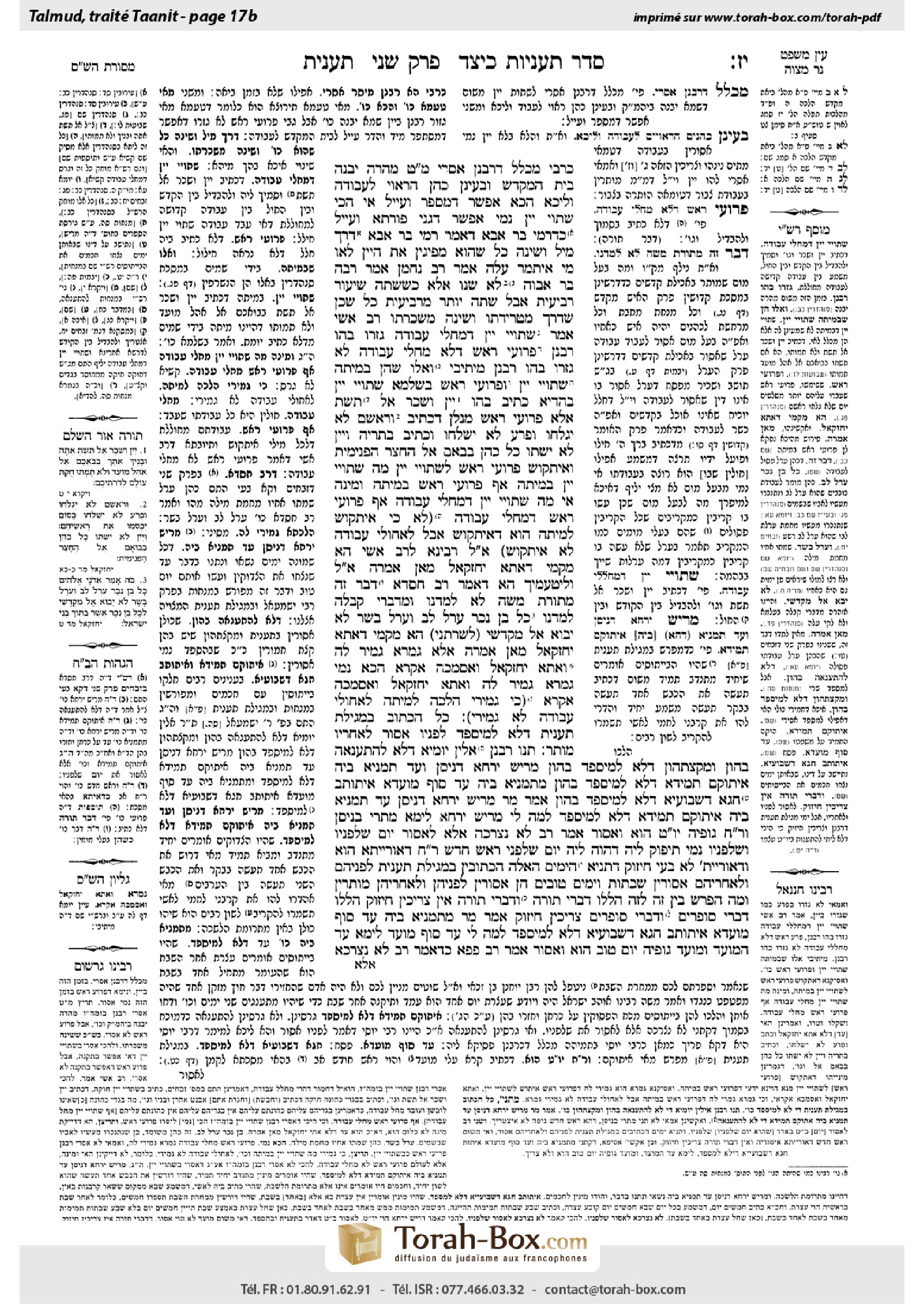
Taanit 17b: Talmud study for Daf Yomi
Daf Yomi is the daily study of one Talmud folio. Explore 37 tractates with scans, Hebrew text, Sefaria English and AI-generated French translations where annotated.
Passage selection and English or AI-generated French translation are available where the scan has annotations. Daf Study is independent of Torah-Box and Sefaria.
Browse Taanit · תענית · All tractatesTaanit 17b text and translations
This page of Taanit includes the Aramaic text, an English translation and an AI-generated French translation, alongside the scan above.
תענית י״ז ב · Aramaic and Hebrew text
כְּרַבִּי, מִכְּלָל דְּרַבָּנַן אָסְרִי! מַאי טַעְמָא: מְהֵרָה יִבָּנֶה בֵּית הַמִּקְדָּשׁ, וּבָעֵינַן כֹּהֵן הָרָאוּי לָעֲבוֹדָה וְלֵיכָּא, הָכָא אֶפְשָׁר דִּמְסַפַּר וְעָיֵיל.
אִי הָכִי, שְׁתוּי יַיִן נָמֵי — אֶפְשָׁר דְּגָנֵי פּוּרְתָּא וְעָיֵיל, כִּדְרָמֵי בַּר אַבָּא. דְּאָמַר רָמֵי בַּר אַבָּא: דֶּרֶךְ מִיל, וְשֵׁינָה כׇּל שֶׁהוּא — מְפִיגִין אֶת הַיַּיִן! לָאו מִי אִיתְּמַר עֲלַהּ, אָמַר רַב נַחְמָן אָמַר רַבָּה בַּר אֲבוּהּ: לֹא שָׁנוּ אֶלָּא בְּשֶׁשָּׁתָה שִׁיעוּר רְבִיעִית, אֲבָל שָׁתָה יוֹתֵר מֵרְבִיעִית — כׇּל שֶׁכֵּן שֶׁדֶּרֶךְ מַטְרִידָתוֹ וְשֵׁינָה מְשַׁכַּרְתּוֹ.
רַב אָשֵׁי אָמַר: שְׁתוּיֵי יַיִן, דְּמַחֲלִי עֲבוֹדָה — גְּזַרוּ בְּהוּ רַבָּנַן. פְּרוּעֵי רֹאשׁ, דְּלָא מַחֲלִי עֲבוֹדָה — לָא גְּזַרוּ בְּהוּ רַבָּנַן.
מֵיתִיבִי, וְאֵלּוּ שֶׁהֵן בְּמִיתָה: שְׁתוּיֵי יַיִן, וּפְרוּעֵי רֹאשׁ. בִּשְׁלָמָא שְׁתוּיֵי יַיִן — בְּהֶדְיָא כְּתִיב בְּהוּ: ״יַיִן וְשֵׁכָר אַל תֵּשְׁתְּ״, אֶלָּא פְּרוּעֵי רֹאשׁ מְנָלַן?
דִּכְתִיב: ״וְרֹאשָׁם לֹא יְגַלֵּחוּ וּפֶרַע לֹא יְשַׁלֵּחוּ״, וּכְתִיב בָּתְרֵיהּ: ״וְיַיִן לֹא יִשְׁתּוּ כׇּל כֹּהֵן בְּבוֹאָם אֶל הֶחָצֵר הַפְּנִימִית״, וְאִיתַּקּוּשׁ פְּרוּעֵי רֹאשׁ לִשְׁתוּיֵי יַיִן: מָה שְׁתוּיֵי יַיִן בְּמִיתָה — אַף פְּרוּעֵי רֹאשׁ בְּמִיתָה.
וּמִינַּהּ: אִי מָה שְׁתוּיֵי יַיִן דְּמַחֲלִי עֲבוֹדָה — אַף פְּרוּעֵי רֹאשׁ דְּמַחֲלִי עֲבוֹדָה! לָא: כִּי אִיתַּקּוּשׁ — לְמִיתָה הוּא דְּאִתַּקּוּשׁ, אֲבָל לְאַחוֹלֵי עֲבוֹדָה — לָא אִתַּקּוּשׁ.
אֲמַר לֵיהּ רָבִינָא לְרַב אָשֵׁי: הָא, מִקַּמֵּי דַּאֲתָא יְחֶזְקֵאל, מַאן אַמְרַהּ? אֲמַר לֵיהּ: וּלְטַעְמָיךְ, הָא דְּאָמַר רַב חִסְדָּא: דָּבָר זֶה מִתּוֹרַת מֹשֶׁה לֹא לָמַדְנוּ, וּמִדִּבְרֵי קַבָּלָה לָמַדְנוּ: ״כׇּל בֶּן נֵכָר עֶרֶל לֵב וְעֶרֶל בָּשָׂר לֹא יָבוֹא אֶל מִקְדָּשִׁי״ — הָא, מִקַּמֵּי דַּאֲתָא יְחֶזְקֵאל, מַאן אַמְרַהּ?
אֶלָּא גְּמָרָא גְּמִירִ[י] לַהּ, וַאֲתָא יְחֶזְקֵאל וְאַסְמְכַהּ אַקְּרָא. הָכָא נָמֵי: גְּמָרָא גְּמִירִ[י] לַהּ, וַאֲתָא יְחֶזְקֵאל וְאַסְמְכַהּ אַקְּרָא, כִּי גְּמִירִי הֲלָכָה — לְמִיתָה, לְאַחוֹלֵי עֲבוֹדָה — לָא גְּמִירִי.
כׇּל הַכָּתוּב בִּמְגִילַּת תַּעֲנִית ״דְּלָא לְמִיסְפַּד״ — לְפָנָיו אָסוּר, לְאַחֲרָיו מוּתָּר. תָּנוּ רַבָּנַן: אִלֵּין יוֹמַיָּא דְּלָא לְהִתְעַנָּאָה בְּהוֹן, וּמִקְצָתְהוֹן דְּלָא לְמִיסְפַּד בְּהוֹן: מֵרֵישׁ יַרְחָא דְנִיסָן וְעַד תְּמָנְיָא בֵּיהּ אִיתּוֹקַם תְּמִידָא, דְּלָא לְמִיסְפַּד בְּהוֹן. מִתְּמָנְיָא בֵּיהּ עַד סוֹף מוֹעֲדָא אִיתּוֹתַב חַגָּא דְשָׁבוּעַיָּא, דְּלָא לְמִיסְפַּד בְּהוֹן.
אָמַר מָר: מֵרֵישׁ יַרְחָא דְנִיסָן עַד תְּמָנְיָא בֵּיהּ אִיתּוֹקַם תְּמִידָא, דְּלָא לְמִיסְפַּד. לְמָה לִי מֵרֵישׁ יַרְחָא? לֵימָא מִתְּרֵי בְּנִיסָן, וְרֹאשׁ חוֹדֶשׁ גּוּפֵיהּ יוֹם טוֹב הוּא וְאָסוּר! אָמַר רַב: לֹא נִצְרְכָה אֶלָּא לֶאֱסוֹר יוֹם שֶׁלְּפָנָיו.
וְשֶׁלְּפָנָיו נָמֵי, תִּיפּוֹק לֵיהּ דְּהָוֵה לֵיהּ יוֹם שֶׁלִּפְנֵי רֹאשׁ חֹדֶשׁ! רֹאשׁ חֹדֶשׁ דְּאוֹרָיְיתָא הוּא, וּדְאוֹרָיְיתָא לָא בָּעֵי חִיזּוּק.
דְּתַנְיָא: הַיָּמִים הָאֵלֶּה הַכְּתוּבִין בִּמְגִילַּת תַּעֲנִית — לִפְנֵיהֶם וּלְאַחֲרֵיהֶם אֲסוּרִין, שַׁבָּתוֹת וְיָמִים טוֹבִים, הֵן — אֲסוּרִין, לִפְנֵיהֶן וּלְאַחֲרֵיהֶן — מוּתָּרִין. וּמָה הֶפְרֵשׁ בֵּין זֶה לָזֶה? הַלָּלוּ — דִּבְרֵי תוֹרָה, וְדִבְרֵי תוֹרָה אֵין צְרִיכִין חִיזּוּק, הַלָּלוּ — דִּבְרֵי סוֹפְרִים, וְדִבְרֵי סוֹפְרִים צְרִיכִין חִיזּוּק.
אָמַר מָר: מִתְּמָנְיָא בֵּיהּ עַד סוֹף מוֹעֲדָא אִיתּוֹתַב חַגָּא דְשָׁבוּעַיָּא, דְּלָא לְמִיסְפַּד. לְמָה לִי עַד סוֹף מוֹעֵד, לֵימָא עַד הַמּוֹעֵד, וּמוֹעֵד גּוּפֵיהּ יוֹם טוֹב הוּא וְאָסוּר! אָמַר רַב פָּפָּא: כִּדְאָמַר רַב — לֹא נִצְרְכָא
Taanit 17b · English translation
It is in accordance with the opinion of Rabbi Yehuda HaNasi. From the fact that Rabbi Yehuda HaNasi permits priests to drink wine, it may be inferred that the Rabbis prohibit it even nowadays. Why, then, isn’t it prohibited for priests to grow their hair as well? The Gemara explains: What is the reason for the prohibition? It is due to the hope: May the Temple be speedily rebuilt, and we will require a priest who is fit for the Temple service, and there will be none available, as they have all imbibed wine. The time that it will take for the effects of the wine to wear off will delay the Temple service considerably. Here, however, with regard to hair, it is possible for a priest to cut his hair and be ready to enter and perform the Temple service with minimal delay.
The Gemara asks: If so, with regard to those who have drunk wine too, it is possible for him to sleep a little and then enter, in accordance with the opinion of Rami bar Abba, as Rami bar Abba said: Walking a distance of a mil, and similarly, sleeping even a minimal amount, will dispel the effect of wine that one has drunk. The Gemara rejects this proof: Wasn’t it stated about this halakha that Rav Naḥman said that Rabba bar Avuh said: They taught this only with regard to one who has drunk the measure of a quarter-log of wine, but with regard to one who has drunk more than a quarter-log, walking this distance will preoccupy and exhaust him all the more, and a small amount of sleep will further intoxicate him. For this reason, it is prohibited for priests to drink wine, lest no suitable priest will be ready for the Temple service.
Rav Ashi said that there is a different way to distinguish between these two halakhot. In the case of those who have drunk wine, who desecrate the Temple service, the Sages issued a decree concerning them, that priests should not drink wine even nowadays. However, with regard to those who have long hair, who do not desecrate the Temple service, the Sages did not issue a decree concerning them.
The Gemara raises an objection from a baraita: And these are the transgressors who are punished by death at the hand of Heaven: Priests who enter the Temple to serve who have drunk wine, and those priests who have long hair while they serve. The Gemara asks: Granted, those who have drunk wine are punished by death, as it is explicitly written: “Drink no wine nor strong drink, neither you nor your sons with you, when you enter the Tent of Meeting, that you should not die” (Leviticus 10:9). However, with regard to those priests who have long hair, from where do we derive that they are punishable by death?
The Gemara answers that this is as it is written: “Neither shall they shave their heads, nor suffer their locks [pera] to grow long” (Ezekiel 44:20), and it is written immediately afterward: “Neither shall any priest drink wine when they enter the inner courtyard” (Ezekiel 44:21). And in this manner the prohibition concerning those who have long hair is juxtaposed with the prohibition concerning those who have drunk wine, to teach the following: Just as those who have drunk wine and perform the Temple service are subject to death, so too, those who have long hair are punishable by death.
The Gemara raises a difficulty: And from this comparison one can also argue as follows: If so, just as those who have drunk wine desecrate the Temple service, so too, those who have long hair desecrate the service. The Gemara rejects this contention: No, when the two cases were juxtaposed, it was with regard to death that they were juxtaposed. However, as for desecrating the Temple service, in this regard they were not juxtaposed. Consequently, Rav Ashi’s distinction concerning the practical application of these two halakhot still applies.
On this issue, Ravina said to Rav Ashi: Before Ezekiel came and stated this halakha, who said it? From where was it derived before Ezekiel that priests may not serve with long hair? This prohibition, which is not mentioned in the Torah, could not have been innovated by Ezekiel, as prophets may not enact new halakhot. Rav Ashi said to him: And according to your reasoning, there is a similar difficulty with that which Rabbi Ḥisda said: This matter, that an uncircumcised priest may not serve in the Temple, we did not learn it from the Torah of Moses, but we learned it from the text of the tradition, i.e., Prophets and Writings: “No stranger, uncircumcised in heart or uncircumcised in flesh, shall enter my Temple” (Ezekiel 44:9). Before Ezekiel came, who said that it is prohibited for an uncircumcised priest to serve?
Rather, you must say that it is learned as a definite tradition, like the rest of the Oral Torah, and Ezekiel came and supported it by means of a verse in his book. He did not, however, teach this halakha anew. Here too, with regard to a priest with long hair, it is learned as a tradition, and Ezekiel came and supported it by a verse. And when they learned this halakha, they learned only that one is punishable by death; however, with regard to desecrating the Temple service, they did not learn this halakha.
§ The mishna teaches: Any day concerning which it is written in Megillat Ta’anit not to eulogize on that day, it is also prohibited to eulogize on the day before, but it is permitted to do so on the following day. The Sages taught in Megillat Ta’anit: These are the days on which fasting is prohibited, and on some of them eulogizing is prohibited as well: From the New Moon of Nisan until the eighth of the month, the proper sacrifice of the daily offering was established, and therefore it was decreed not to eulogize on these dates. From the eighth of Nisan until the end of the festival of Passover, the festival of Shavuot was restored and it was likewise decreed not to eulogize during this period.
The Gemara seeks to clarify these statements by comparing them to the ruling of the mishna. The Master said above: From the New Moon of Nisan until the eighth of the month, the daily offering was established, and therefore it was decreed not to eulogize on these dates. The Gemara asks: Why do I need Megillat Ta’anit to say: From the New Moon? Let it say: From the second of Nisan, as the New Moon is itself a holiday, and it is already prohibited to eulogize on that day. Rav said: It is necessary to mention the New Moon of Nisan only to prohibit eulogizing on the day before, in accordance with the statement in Megillat Ta’anit that fasting on the day before any of the specified commemorative days is also prohibited.
The Gemara asks: And with regard to the day before the New Moon of Nisan as well, one can derive the prohibition against eulogizing on this day from the fact that it is the day before the New Moon. Since it is prohibited to fast on the New Moon, it is likewise prohibited on the day before. The Gemara answers that as the New Moon is by Torah law and a Torah law requires no reinforcement, it is permitted to fast on the previous day.
As it is taught in a baraita: With regard to these days that are written in Megillat Ta’anit, it is prohibited to fast before them and after them. However, concerning Shabbatot and Festivals, fasting on those days is prohibited, but before them and after them fasting is permitted. And what is the difference between this and that? These, Shabbat and Festivals, are statements of Torah, and statements of Torah do not require reinforcement, whereas these days mentioned in Megillat Ta’anit are statements of rabbinic law, and statements of rabbinic law require reinforcement.
§ The Master said above: From the eighth of Nisan until the end of the festival of Passover, the festival of Shavuot was restored and it was decreed not to eulogize. The Gemara asks: Why do I need Megillat Ta’anit to say: Until the end of the Festival? Let it say: Until the Festival, as it is anyway prohibited to eulogize on the festival of Passover. Rav Pappa said that this, too, should be explained as Rav said: It is necessary to mention the first of Nisan
Taanit 17b · Traduction française (IA)
Cela correspond à l’opinion de Rabbi Yehouda HaNassi. Puisque Rabbi Yehouda HaNassi autorise les prêtres à boire du vin, on peut en déduire que les Rabbins l’interdisent même de nos jours. Pourquoi, alors, n’interdisent-ils pas également aux prêtres de laisser pousser leurs cheveux ? La Guemara explique : quelle est la raison de cette interdiction ? Elle tient à l’espoir que le Temple soit bientôt reconstruit et qu’il faille alors un prêtre apte au service du Temple, sans qu’il y en ait aucun de disponible, puisque tous auraient bu du vin. Le temps nécessaire pour que les effets du vin se dissipent retarderait considérablement le service du Temple. En revanche, pour ce qui est des cheveux, le prêtre peut se les couper et être prêt à entrer et à accomplir le service du Temple avec un délai minimal.
La Guemara demande : dans ce cas, ceux qui ont bu du vin pourraient eux aussi dormir un peu, puis entrer, conformément à l’opinion de Rami bar Abba. En effet, Rami bar Abba a dit : parcourir une distance d’un mil et, de même, dormir même un très court moment dissipe les effets du vin que l’on a bu. La Guemara rejette cette preuve : n’a-t-il pas été enseigné à ce propos que Rav Naḥman a dit au nom de Rabba bar Avouha : cela n’a été enseigné que pour celui qui a bu la mesure d’un quart de log de vin ; mais celui qui a bu plus d’un quart de log, parcourir cette distance ne ferait que le distraire et l’épuiser davantage, et un court sommeil l’enivrerait encore plus. C’est pourquoi il est interdit aux prêtres de boire du vin, de peur qu’aucun prêtre apte au service du Temple ne soit disponible.
Rav Ashi dit qu’il existe une autre manière de distinguer ces deux halakhot. Dans le cas de ceux qui ont bu du vin et profanent le service du Temple, les Sages ont édicté un décret leur interdisant de boire du vin, même de nos jours. En revanche, pour ceux qui ont les cheveux longs et ne profanent pas le service du Temple, les Sages n’ont pas édicté de décret.
La Guemara soulève une objection à partir d’une baraïta : voici les transgresseurs qui sont punis de mort par la main du Ciel : les prêtres qui entrent dans le Temple pour y accomplir le service après avoir bu du vin, et les prêtres qui ont les cheveux longs pendant leur service. La Guemara demande : il est compréhensible que ceux qui ont bu du vin soient punis de mort, car il est explicitement écrit : « Ne bois pas de vin ni de boisson forte, ni toi ni tes fils avec toi, lorsque vous entrez dans la Tente d’assignation, afin que vous ne mouriez pas » (Lévitique 10:9). Mais, en ce qui concerne les prêtres qui ont les cheveux longs, d’où déduisons-nous qu’ils sont passibles de mort ?
La Guemara répond que cela est déduit de ce qui est écrit : « Ils ne se raseront pas la tête et ne laisseront pas pousser leurs cheveux [pera] » (Ézéchiel 44:20), puis, immédiatement après : « Aucun prêtre ne boira de vin lorsqu’il entrera dans la cour intérieure » (Ézéchiel 44:21). Ainsi, l’interdiction concernant ceux qui ont les cheveux longs est juxtaposée à celle concernant ceux qui ont bu du vin, pour enseigner ceci : de même que ceux qui ont bu du vin et accomplissent le service du Temple sont passibles de mort, de même ceux qui ont les cheveux longs sont passibles de mort.
La Guemara soulève une difficulté : à partir de cette comparaison, on peut aussi soutenir ceci : si tel est le cas, de même que ceux qui ont bu du vin profanent le service du Temple, ceux qui ont les cheveux longs profanent eux aussi le service. La Guemara rejette cet argument : non, les deux cas ont été juxtaposés en ce qui concerne la mort, mais ils ne l’ont pas été en ce qui concerne la profanation du service du Temple. Par conséquent, la distinction établie par Rav Ashi quant à l’application pratique de ces deux halakhot reste valable.
À ce sujet, Ravina dit à Rav Ashi : avant qu’Ézéchiel ne vienne énoncer cette halakha, qui l’avait formulée ? D’où déduisait-on, avant Ézéchiel, que les prêtres ne peuvent pas officier avec les cheveux longs ? Cette interdiction, qui n’est pas mentionnée dans la Torah, n’a pas pu être instaurée par Ézéchiel, car les prophètes ne peuvent pas édicter de nouvelles halakhot. Rav Ashi lui dit : selon ton raisonnement, une difficulté semblable se pose au sujet de ce que Rabbi Ḥisda a dit : cette règle, selon laquelle un prêtre incirconcis ne peut pas officier dans le Temple, nous ne l’avons pas apprise de la Torah de Moïse, mais du texte de la tradition, c’est-à-dire des Prophètes et des Écrits : « Aucun étranger, incirconcis de cœur ou incirconcis de chair, n’entrera dans mon Temple » (Ézéchiel 44:9). Avant qu’Ézéchiel ne vienne, qui avait dit qu’il est interdit à un prêtre incirconcis d’officier ?
Il faut plutôt dire que cela est appris comme une tradition établie, à l’instar du reste de la Torah orale, et qu’Ézéchiel est venu l’étayer au moyen d’un verset de son livre. Il n’a toutefois pas enseigné cette halakha pour la première fois. Ici aussi, pour ce qui est d’un prêtre aux cheveux longs, cela est appris comme une tradition, et Ézéchiel est venu l’étayer par un verset. Lorsqu’ils ont appris cette halakha, ils ont appris seulement que l’on est passible de mort ; en revanche, ils n’ont pas appris que l’on profane le service du Temple.
§ La Michna enseigne : tout jour au sujet duquel il est écrit dans Meguilat Ta’anit qu’il est interdit de faire un éloge funèbre ce jour-là, il est également interdit d’en faire un la veille, mais il est permis d’en faire un le lendemain. Les Sages ont enseigné dans Meguilat Ta’anit : voici les jours où le jeûne est interdit et, pour certains d’entre eux, les éloges funèbres sont également interdits : de la nouvelle lune de Nissan jusqu’au huit du mois, le sacrifice quotidien régulier fut instauré, et l’on décréta donc qu’il était interdit de faire des éloges funèbres à ces dates. Du huit Nissan jusqu’à la fin de la fête de Pessaḥ, la fête de Chavouot fut rétablie, et l’on décréta également qu’il était interdit de faire des éloges funèbres durant cette période.
La Guemara cherche à clarifier ces propos en les comparant à la décision de la Michna. Le Maître a dit plus haut : de la nouvelle lune de Nissan jusqu’au huit du mois, le sacrifice quotidien fut instauré, et l’on décréta donc qu’il était interdit de faire des éloges funèbres à ces dates. La Guemara demande : pourquoi Meguilat Ta’anit doit-elle préciser « à partir de la nouvelle lune » ? Qu’elle dise : « à partir du deux Nissan », puisque la nouvelle lune est elle-même un jour de fête et qu’il est déjà interdit d’y faire des éloges funèbres. Rav dit : il est nécessaire de mentionner la nouvelle lune de Nissan uniquement pour interdire les éloges funèbres la veille, conformément à l’enseignement de Meguilat Ta’anit selon lequel le jeûne est également interdit la veille de chacun des jours commémoratifs mentionnés.
La Guemara demande : et pour ce qui est de la veille de la nouvelle lune de Nissan, ne peut-on pas également déduire l’interdiction d’y faire des éloges funèbres du fait qu’il s’agit de la veille de la nouvelle lune ? Puisqu’il est interdit de jeûner à la nouvelle lune, il devrait également être interdit de jeûner la veille. La Guemara répond que, puisque la nouvelle lune relève de la Torah et qu’une loi de la Torah n’a pas besoin d’être renforcée, il est permis de jeûner la veille.
Comme il est enseigné dans une baraïta : pour les jours mentionnés dans Meguilat Ta’anit, il est interdit de jeûner avant et après ces jours. En revanche, pour le Chabbat et les fêtes, le jeûne est interdit ces jours-là, mais il est permis de jeûner la veille et le lendemain. Quelle est la différence entre les uns et les autres ? Le Chabbat et les fêtes relèvent de la Torah, et les prescriptions de la Torah n’ont pas besoin d’être renforcées ; tandis que les jours mentionnés dans Meguilat Ta’anit relèvent de la loi rabbinique, et les prescriptions rabbiniques ont besoin d’être renforcées.
§ Le Maître a dit plus haut : du huit Nissan jusqu’à la fin de la fête de Pessaḥ, la fête de Chavouot fut rétablie et l’on décréta qu’il était interdit de faire des éloges funèbres. La Guemara demande : pourquoi Meguilat Ta’anit doit-elle préciser « jusqu’à la fin de la fête » ? Qu’elle dise : « jusqu’à la fête », puisqu’il est de toute façon interdit de faire des éloges funèbres pendant la fête de Pessaḥ. Rav Pappa dit que cela aussi doit s’expliquer comme l’a dit Rav : il est nécessaire de mentionner le premier Nissan
Traduction française générée par IA à partir de l’édition anglaise de Sefaria. Vérifie toujours un passage avec le texte source.
Text from Sefaria: William Davidson Edition - Vocalized Aramaic (CC BY NC); William Davidson Edition - English (CC BY NC).