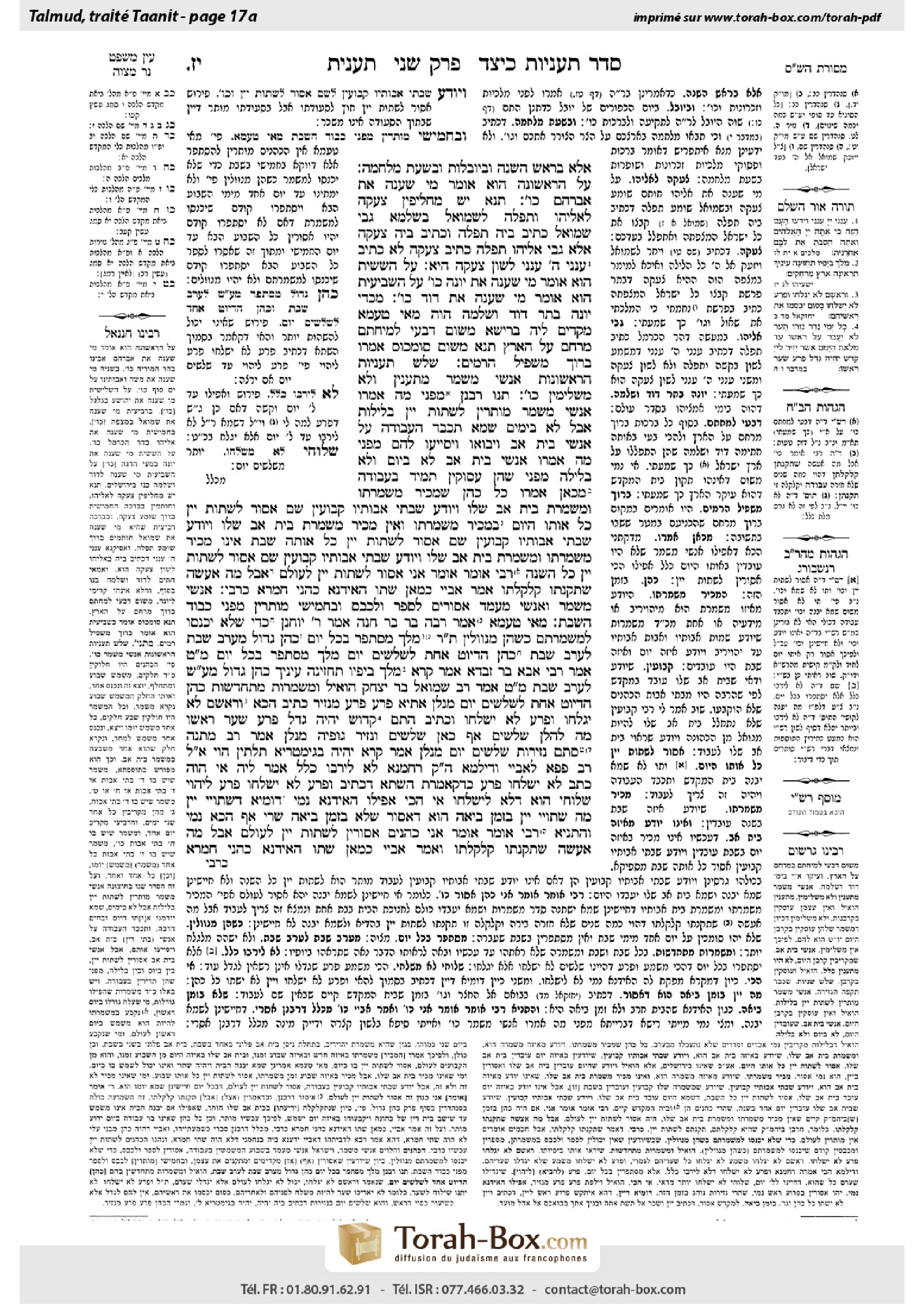
Taanit 17a: Talmud study for Daf Yomi
Daf Yomi is the daily study of one Talmud folio. Explore 37 tractates with scans, Hebrew text, Sefaria English and AI-generated French translations where annotated.
Passage selection and English or AI-generated French translation are available where the scan has annotations. Daf Study is independent of Torah-Box and Sefaria.
Browse Taanit · תענית · All tractatesTaanit 17a text and translations
This page of Taanit includes the Aramaic text, an English translation and an AI-generated French translation, alongside the scan above.
תענית י״ז א · Aramaic and Hebrew text
אֶלָּא בְּרֹאשׁ הַשָּׁנָה, וּבַיּוֹבְלוֹת, וּבִשְׁעַת מִלְחָמָה.
עַל הָרִאשׁוֹנָה הוּא אוֹמֵר: מִי שֶׁעָנָה אֶת אַבְרָהָם כּוּ׳. תָּנָא: יֵשׁ מַחְלִיפִין צְעָקָה לְאֵלִיָּהוּ, וּתְפִלָּה לִשְׁמוּאֵל. בִּשְׁלָמָא גַּבֵּי שְׁמוּאֵל — כְּתִיב בֵּיהּ תְּפִלָּה וּכְתִיב בֵּיהּ צְעָקָה.
אֶלָּא גַּבֵּי אֵלִיָּהוּ — תְּפִלָּה כְּתִיב, צְעָקָה לָא כְּתִיב! ״עֲנֵנִי ה׳ עֲנֵנִי״ לְשׁוֹן צְעָקָה הִיא.
עַל הַשִּׁשִּׁית הוּא אוֹמֵר: מִי שֶׁעָנָה אֶת יוֹנָה כּוּ׳. עַל הַשְּׁבִיעִית הוּא אוֹמֵר: מִי שֶׁעָנָה אֶת דָּוִד כּוּ׳. מִכְּדֵי יוֹנָה בָּתַר דָּוִד וּשְׁלֹמֹה הֲוָה, מַאי טַעְמָא מַקְדֵּים לֵיהּ בְּרֵישָׁא? מִשּׁוּם דְּבָעֵי לְמִיחְתַּם ״מְרַחֵם עַל הָאָרֶץ״. תָּנָא, מִשּׁוּם סוֹמְכוֹס אָמְרוּ: ״בָּרוּךְ מַשְׁפִּיל הָרָמִים״.
שָׁלֹשׁ תַּעֲנִיּוֹת הָרִאשׁוֹנוֹת אַנְשֵׁי מִשְׁמָר מִתְעַנִּין וְלֹא מַשְׁלִימִין כּוּ׳. תָּנוּ רַבָּנַן: מִפְּנֵי מָה אָמְרוּ אַנְשֵׁי מִשְׁמָר מוּתָּרִין לִשְׁתּוֹת יַיִן בַּלֵּילוֹת אֲבָל לֹא בַּיָּמִים — שֶׁמָּא תִּכְבַּד הָעֲבוֹדָה עַל אַנְשֵׁי בֵּית אָב, וְיָבוֹאוּ וִיסַיְּיעוּ לָהֶם.
מִפְּנֵי מָה אָמְרוּ אַנְשֵׁי בֵּית אָב לֹא בַּיּוֹם וְלֹא בַּלַּיְלָה — מִפְּנֵי שֶׁהֵן עֲסוּקִין תָּמִיד בָּעֲבוֹדָה.
מִכָּאן אָמְרוּ: כׇּל כֹּהֵן שֶׁמַּכִּיר מִשְׁמַרְתּוֹ וּמִשְׁמֶרֶת בֵּית אָב שֶׁלּוֹ, וְיוֹדֵעַ שֶׁבָּתֵּי אֲבוֹתָיו קְבוּעִין שָׁם — אָסוּר לִשְׁתּוֹת יַיִן כׇּל אוֹתוֹ הַיּוֹם. בְּמַכִּיר מִשְׁמַרְתּוֹ וְאֵין מַכִּיר מִשְׁמֶרֶת בֵּית אָב שֶׁלּוֹ, וְיוֹדֵעַ שֶׁבָּתֵּי אֲבוֹתָיו קְבוּעִין שָׁם — אָסוּר לִשְׁתּוֹת יַיִן כׇּל אוֹתָהּ שַׁבָּת.
אֵינוֹ מַכִּיר מִשְׁמַרְתּוֹ וּמִשְׁמֶרֶת בֵּית אָב שֶׁלּוֹ, וְיוֹדֵעַ שֶׁבָּתֵּי אֲבוֹתָיו קְבוּעִין שָׁם — אָסוּר לִשְׁתּוֹת יַיִן כׇּל הַשָּׁנָה.
רַבִּי אוֹמֵר, אוֹמֵר אֲנִי: אָסוּר לִשְׁתּוֹת יַיִן לְעוֹלָם, אֲבָל מָה אֶעֱשֶׂה שֶׁתַּקָּנָתוֹ קַלְקָלָתוֹ. אָמַר אַבָּיֵי: כְּמַאן שָׁתוּ הָאִידָּנָא כָּהֲנֵי חַמְרָא — כְּרַבִּי.
אַנְשֵׁי מִשְׁמָר וְאַנְשֵׁי מַעֲמָד אֲסוּרִים לְסַפֵּר וּלְכַבֵּס, וּבַחֲמִישִׁי מוּתָּרִין מִפְּנֵי כְּבוֹד הַשַּׁבָּת. מַאי טַעְמָא? אָמַר רַבָּה בַּר בַּר חָנָה אָמַר רַבִּי יוֹחָנָן: כְּדֵי שֶׁלֹּא יִכָּנְסוּ לְמִשְׁמַרְתָּם כְּשֶׁהֵן מְנֻוּוֹלִין.
תָּנוּ רַבָּנַן: מֶלֶךְ מִסְתַּפֵּר בְּכׇל יוֹם, כֹּהֵן גָּדוֹל — מֵעֶרֶב שַׁבָּת לְעֶרֶב שַׁבָּת, כֹּהֵן הֶדְיוֹט — אַחַת לִשְׁלשִׁים יוֹם. מֶלֶךְ מִסְתַּפֵּר בְּכׇל יוֹם — מַאי טַעְמָא? אָמַר רַבִּי אַבָּא בַּר זַבְדָּא, אָמַר קְרָא: ״מֶלֶךְ בְּיׇפְיוֹ תֶּחֱזֶינָה עֵינֶיךָ״. כֹּהֵן גָּדוֹל מֵעֶרֶב שַׁבָּת לְעֶרֶב שַׁבָּת — מַאי טַעְמָא? אָמַר רַב שְׁמוּאֵל בַּר יִצְחָק: הוֹאִיל וּמִשְׁמָרוֹת מִתְחַדְּשׁוֹת.
כֹּהֵן הֶדְיוֹט אַחַת לִשְׁלשִׁים יוֹם — מְנָלַן? אָתְיָא ״פֶּרַע״ ״פֶּרַע״ מִנָּזִיר, כְּתִיב הָכָא: ״וְרֹאשָׁם לֹא יְגַלֵּחוּ וּפֶרַע לֹא יְשַׁלֵּחוּ״, וּכְתִיב הָתָם: ״קָדֹשׁ יִהְיֶה גַּדֵּל פֶּרַע שְׂעַר רֹאשׁוֹ״, מָה לְהַלָּן שְׁלֹשִׁים — אַף כָּאן שְׁלֹשִׁים.
וְנָזִיר גּוּפֵיהּ מְנָלַן? אָמַר רַב מַתְנָה: סְתַם נְזִירוּת שְׁלֹשִׁים יוֹם. מְנָלַן? אָמַר קְרָא: ״יִהְיֶה״ — בְּגִימַטְרִיָּא תְּלָתִין הָוֵי. אֲמַר לֵיהּ רַב פָּפָּא לְאַבָּיֵי: וְדִלְמָא הָכִי קָאָמַר רַחֲמָנָא: לָא לִירַבּוֹ כְּלָל! אָמַר לֵיהּ: אִי הֲוָה כְּתִב ״לֹא יְשַׁלֵּחוּ פֶּרַע״ — כִּדְקָאָמְרַתְּ, הַשְׁתָּא דִּכְתִיב: ״וּפֶרַע לֹא יְשַׁלֵּחוּ״ — פֶּרַע לֶיהֱוֵי, שַׁלּוֹחֵי הוּא דְּלָא לִישַׁלְּחוּ.
אִי הָכִי, אֲפִילּוּ הָאִידָּנָא נָמֵי! דֻּומְיָא דִּשְׁתוּיֵי יַיִן. מָה שְׁתוּיֵי יַיִן — בִּזְמַן בִּיאָה הוּא דְּאָסוּר, שֶׁלֹּא בִּזְמַן בִּיאָה — שְׁרֵי, אַף הָכָא נָמֵי.
וְהָתַנְיָא, רַבִּי אוֹמֵר: אוֹמֵר אֲנִי כֹּהֲנִים אֲסוּרִים לִשְׁתּוֹת יַיִן לְעוֹלָם, אֲבָל מָה אֶעֱשֶׂה שֶׁתַּקָּנָתוֹ קַלְקָלָתוֹ. וְאָמַר אַבָּיֵי: כְּמַאן שָׁתוּ הָאִידָּנָא כָּהֲנֵי חַמְרָא —
Taanit 17a · English translation
only on Rosh HaShana, and on Yom Kippur of Jubilee Years, and in a time of war.
§ The mishna teaches: For the first blessing he recites: He Who answered Abraham. It was taught in a baraita: Some reverse the order of the conclusion of two blessings, by reciting: Who hears cries, in the fifth blessing, which deals with Elijah, and the conclusion: Who hears prayer, in the blessing of Samuel. The Gemara asks: Granted, with regard to Samuel both options are appropriate, as it is written concerning him: Prayer, and it is likewise written concerning him: Crying. One verse states: “And Samuel said: Gather all of Israel to Mizpah, and I will pray for you to the Lord” (I Samuel 7:5), while another verse states: “And Samuel cried to the Lord for Israel” (I Samuel 7:9).
However, with regard to Elijah, although prayer is written, as it says: “Elijah the prophet came near and said: Lord, the God of Abraham, of Isaac, and of Israel” (I Kings 18:36), which is referring to a prayer, crying is not written. How, then, can one conclude a blessing that deals with Elijah by mentioning crying? The Gemara answers that Elijah’s statement: “Answer me, Lord, answer me” (I Kings 18:37), is an expression of crying, even if the term crying does not itself actually appear.
§ The mishna further teaches: For the sixth he recites: He Who answered Jonah; for the seventh he recites: He Who answered David. The Gemara asks: Since Jonah was after David and Solomon, what is the reason that the tanna mentions Jonah first? The Gemara answers: The reason is due to the fact that he wants to conclude the series with: Blessed are You, Lord, Who has mercy on the Land. Therefore, the last blessing mentions David and Solomon, who were kings of Eretz Yisrael and prayed on its behalf. It was taught in the name of Sumakhos that they said he concludes the final blessing with: Blessed are You, Lord, Who humbles the exalted.
§ The mishna teaches that on the first three fasts, the members of the priestly watch fast but do not complete their fasts until nightfall. The mishna then proceeds to cite other halakhot that deal with the members of the priestly watch and the patrilineal family. The Sages taught: For what reason did they say that the members of the priestly watch are permitted to drink wine at nights but not during the days? They said this lest on a certain day the Temple service becomes burdensome for the members of the patrilineal family, and the members of the priestly watch are called to come and assist them. Therefore, it is prohibited for them to drink wine during the day, when their help might be needed, so that they do not enter the Temple after drinking wine.
The baraita continues to explain the reason for the mishna’s ruling. For what reason did they say that the members of the patrilineal family may not drink wine, neither by day nor by night? Because they are constantly engaged in the Temple service.
From here the Sages stated: Even nowadays, after the destruction of the Temple, with regard to any priest who knows his priestly watch, in which his family served, and the watch of his patrilineal family, and he knows that the family of his forefathers was established as fit for the Temple service there, it is prohibited for him to drink wine that entire day, in the event that the Temple is rebuilt on that day and he will be called to return to the service. In the case of a priest who knows his priestly watch, i.e., the week of the year in which his family served, and does not know the watch of his patrilineal family, the day of the week that his family served, but he knows that the family of his forefathers was established there, it is prohibited for him to drink wine that entire week.
Finally, if he does not know his priestly watch or the watch of his patrilineal family, but he knows that the family of his forefathers was established there, he is prohibited to drink wine that entire year. When the Temple will be rebuilt, his priestly watch might be called upon to serve, and he is unaware of the appointed time for his Temple service.
Rabbi Yehuda HaNasi says: I say that in accordance with this reasoning it is prohibited for any priest to drink wine at any time, even if he knows his priestly watch, as the order of the watches might change when the Temple is rebuilt, or perhaps all the watches will participate in the rededication of Temple. However, what can I do, as his misfortune is his advantage? The unfortunate fact that so many years have passed since the destruction of the Temple means that this decree prohibiting the priests from drinking cannot be sustained. Abaye said: In accordance with whose opinion do priests drink wine nowadays? It is in accordance with the opinion of Rabbi Yehuda HaNasi.
§ The mishna teaches: It is prohibited for both the members of the priestly watch and the members of the non-priestly watch to cut their hair or launder their garments throughout the week, but on Thursday they are permitted to cut their hair and launder their clothes in deference to Shabbat. The Gemara asks: What is the reason for these prohibitions? Rabba bar bar Ḥana said that Rabbi Yoḥanan said: These prohibitions were enacted in order to ensure that the priests will cut their hair and launder their clothes during the week before their service, so that they will not enter their priestly watch when they are unkempt.
The Sages taught: A king cuts his hair every day, a High Priest cuts his hair every Friday, and a common priest once every thirty days. The Gemara clarifies: A king cuts his hair every day. What is the reason for this? Rabbi Abba bar Zavda said that the verse states: “Your eyes shall see the king in his beauty” (Isaiah 33:17), which indicates that a king must always look his best. A High Priest cuts his hair every Friday. The Gemara asks: What is the reason for this? Rav Shmuel bar Yitzḥak said: Since the watches are renewed and changed every Friday, it is fitting for every watch to see the High Priest with his hair perfectly groomed.
§ A common priest cuts his hair once every thirty days. The Gemara asks: From where do we derive this number? It is derived by a verbal analogy from the word pera with regard to priests and pera in connection with a nazirite. It is written here, concerning priests: “Neither shall they shave their heads, nor suffer their locks [pera] to grow long” (Ezekiel 44:20), and it is written there, with regard to a nazirite: “He shall be sacred, he shall let the locks [pera] of the hair of his head grow long” (Numbers 6:5). Just as there, a nazirite who does not specify any other time period cuts his hair after thirty days, so too here, a priest cuts his hair every thirty days.
The Gemara asks: And a nazirite himself, from where do we derive that he may not cut his hair for thirty days? Rav Mattana said: It is a principle that an unspecified naziriteship lasts thirty days. The Gemara inquires: From where do we derive this principle? The Gemara answers that the verse states: “He shall be [yihye] sacred” (Numbers 6:5), and the numerical value [gimatriya] of yihye is thirty. Rav Pappa said to Abaye: But perhaps this is what the Merciful One is saying in the Torah: They should not grow their hair at all, as they must cut it every day. Abaye said to him: If it were written: They shall not grow long their locks, I might have explained as you originally said. Now that it is written: “Nor suffer their locks to grow long,” this indicates that they may have locks, but they may not let them grow long.
The Gemara asks: If it is so that cutting one’s hair is a necessary preparation for the Temple service by Torah law, then even nowadays priests should cut their hair every thirty days as well, in case the Temple is rebuilt and they must resume their service. The Gemara answers: This issue is similar to the prohibition concerning those who have drunk wine. Just as with regard to those who have drunk wine, it is when one enters the Temple that it is prohibited, whereas when one does not enter the Temple it is permitted to drink wine, here the same also applies.
The Gemara questions this conclusion: But isn’t it taught in the aforementioned baraita that Rabbi Yehuda HaNasi says: I say that it is prohibited for all priests to drink wine at any time. However, what can I do, as his misfortune is his advantage? And Abaye said: In accordance with whose opinion do priests drink wine nowadays?
Taanit 17a · Traduction française (IA)
uniquement à Roch Hachana, à Yom Kippour des années jubilaires et en temps de guerre.
§ La Michna enseigne : Pour la première bénédiction, il récite : « Celui qui a répondu à Abraham ». Une baraïta enseigne que certains inversent la conclusion de deux bénédictions : ils récitent « Celui qui entend les cris » dans la cinquième bénédiction, qui concerne Élie, et concluent par « Celui qui entend la prière » dans la bénédiction de Samuel. La Guemara demande : Il est compréhensible que les deux formules conviennent à Samuel, puisqu’on trouve à son sujet aussi bien la prière que les cris. Un verset dit : « Samuel dit : Rassemblez tout Israël à Mitspa, et je prierai l’Éternel pour vous » (I Samuel 7, 5), tandis qu’un autre dit : « Samuel cria à l’Éternel pour Israël » (I Samuel 7, 9).
Cependant, au sujet d’Élie, bien que la prière soit mentionnée, comme il est dit : « Élie le prophète s’approcha et dit : Éternel, Dieu d’Abraham, d’Isaac et d’Israël » (I Rois 18, 36), paroles qui constituent une prière, les cris ne sont pas mentionnés. Comment peut-on donc conclure une bénédiction concernant Élie en évoquant les cris ? La Guemara répond que les paroles d’Élie : « Réponds-moi, Éternel, réponds-moi » (I Rois 18, 37), expriment un cri, même si le terme « cri » n’y figure pas explicitement.
§ La Michna enseigne encore : Pour la sixième bénédiction, il récite : « Celui qui a répondu à Jonas » ; pour la septième, il récite : « Celui qui a répondu à David ». La Guemara demande : Puisque Jonas a vécu après David et Salomon, pourquoi le tanna le mentionne-t-il en premier ? La Guemara répond que c’est parce qu’il veut conclure la série par : « Béni sois-Tu, Éternel, qui prends en pitié le Pays. » C’est pourquoi la dernière bénédiction mentionne David et Salomon, qui furent rois d’Eretz Israël et prièrent en sa faveur. Il fut enseigné au nom de Sumakhos qu’ils concluent la dernière bénédiction ainsi : « Béni sois-Tu, Éternel, qui abaisses les puissants. »
§ La Michna enseigne que, lors des trois premiers jeûnes, les membres de la garde sacerdotale jeûnent, mais ne poursuivent pas leur jeûne jusqu’à la nuit tombée. La Michna cite ensuite d’autres halakhot concernant les membres de la garde sacerdotale et la famille paternelle. Les Sages ont enseigné : Pourquoi ont-ils dit que les membres de la garde sacerdotale peuvent boire du vin la nuit, mais pas le jour ? Ils ont dit cela de crainte qu’un jour le service du Temple ne devienne trop lourd pour les membres de la famille paternelle et que les membres de la garde sacerdotale soient appelés à venir les aider. Il leur est donc interdit de boire du vin pendant la journée, au cas où leur aide serait nécessaire, afin qu’ils ne se présentent pas au Temple après avoir bu du vin.
La baraïta poursuit en expliquant la raison de la décision de la Michna. Pourquoi ont-ils dit que les membres de la famille paternelle ne peuvent boire de vin ni le jour ni la nuit ? Parce qu’ils sont constamment occupés au service du Temple.
C’est de là que les Sages ont déclaré : même de nos jours, après la destruction du Temple, tout prêtre qui connaît sa garde sacerdotale — la période durant laquelle sa famille officiait — ainsi que le jour de la semaine où sa famille paternelle officiait, et qui sait que la famille de ses ancêtres était reconnue comme apte au service du Temple, n’a pas le droit de boire du vin pendant toute cette journée, au cas où le Temple serait reconstruit ce jour-là et où il serait appelé à reprendre le service. Si un prêtre connaît sa garde sacerdotale, c’est-à-dire la semaine de l’année où sa famille officiait, mais ignore le jour de la semaine où sa famille paternelle officiait, tout en sachant que la famille de ses ancêtres était reconnue comme apte au service, il lui est interdit de boire du vin pendant toute cette semaine.
Enfin, s’il ne connaît ni sa garde sacerdotale ni le jour de la semaine où sa famille paternelle officiait, mais sait que la famille de ses ancêtres était reconnue comme apte au service, il lui est interdit de boire du vin pendant toute l’année. Lorsque le Temple sera reconstruit, sa garde sacerdotale pourrait être appelée à officier, alors qu’il ignore le moment fixé pour son service au Temple.
Rabbi Yehouda HaNassi dit : Je soutiens qu’en suivant ce raisonnement, il est interdit à tout prêtre de boire du vin à quelque moment que ce soit, même s’il connaît sa garde sacerdotale, car l’ordre des gardes pourrait changer lors de la reconstruction du Temple, ou peut-être toutes les gardes participeraient-elles à la réinauguration du Temple. Mais que puis-je faire, puisque son malheur tourne à son avantage ? Le fait regrettable que tant d’années se soient écoulées depuis la destruction du Temple signifie que ce décret interdisant aux prêtres de boire ne peut être maintenu. Abayé dit : Selon l’opinion de qui les prêtres boivent-ils du vin de nos jours ? Selon celle de Rabbi Yehouda HaNassi.
§ La Michna enseigne qu’il est interdit aux membres de la garde sacerdotale comme à ceux de la garde non sacerdotale de se couper les cheveux ou de laver leurs vêtements pendant toute la semaine, mais que le jeudi, ils peuvent se couper les cheveux et laver leurs vêtements en l’honneur du Chabbat. La Guemara demande : Quelle est la raison de ces interdictions ? Rabba bar bar Ḥana rapporte au nom de Rabbi Yoḥanan : Ces interdictions furent instituées afin que les prêtres se coupent les cheveux et lavent leurs vêtements pendant la semaine précédant leur service, de sorte qu’ils ne se présentent pas à leur garde sacerdotale en étant négligés.
Les Sages ont enseigné : Un roi se coupe les cheveux chaque jour, un grand prêtre chaque vendredi et un prêtre ordinaire une fois tous les trente jours. La Guemara précise : Un roi se coupe les cheveux chaque jour. Pour quelle raison ? Rabbi Abba bar Zavda dit que le verset déclare : « Tes yeux verront le roi dans sa beauté » (Isaïe 33, 17), ce qui indique qu’un roi doit toujours être à son avantage. Un grand prêtre se coupe les cheveux chaque vendredi. La Guemara demande : Pour quelle raison ? Rav Shmuel bar Yitzḥak dit : Puisque les gardes sont renouvelées et changent chaque vendredi, il convient que chaque garde voie le grand prêtre avec les cheveux parfaitement soignés.
§ Un prêtre ordinaire se coupe les cheveux une fois tous les trente jours. La Guemara demande : D’où déduisons-nous ce nombre ? On le déduit par analogie verbale du mot pera employé à propos des prêtres et du même mot employé à propos du nazir. Il est écrit ici, au sujet des prêtres : « Ils ne se raseront pas la tête et ne laisseront pas pousser leurs mèches [pera] » (Ézéchiel 44, 20), et il est écrit là, au sujet du nazir : « Il sera consacré ; il laissera pousser les mèches [pera] de ses cheveux » (Nombres 6, 5). De même que là, un nazir qui n’a précisé aucune autre durée se coupe les cheveux après trente jours, de même ici, un prêtre se coupe les cheveux tous les trente jours.
La Guemara demande : Et concernant le nazir lui-même, d’où déduisons-nous qu’il ne peut se couper les cheveux pendant trente jours ? Rav Mattana dit : C’est un principe qu’un naziréat non spécifié dure trente jours. La Guemara demande : D’où déduisons-nous ce principe ? La Guemara répond que le verset dit : « Il sera [yihye] consacré » (Nombres 6, 5), et que la valeur numérique [gimatriya] de yihye est trente. Rav Pappa dit à Abayé : Mais peut-être la Torah dit-elle ceci : ils ne doivent pas laisser pousser leurs cheveux du tout, puisqu’ils doivent se les couper chaque jour. Abayé lui dit : Si le texte disait : « Ils ne laisseront pas pousser leurs mèches », j’aurais pu comprendre comme tu l’as proposé. Mais puisqu’il est écrit : « Ils ne laisseront pas leurs mèches pousser longuement », cela indique qu’ils peuvent avoir des mèches, mais ne doivent pas les laisser pousser longuement.
La Guemara demande : Si se couper les cheveux est, selon la Torah, une préparation nécessaire au service du Temple, alors les prêtres devraient aussi se couper les cheveux tous les trente jours de nos jours, au cas où le Temple serait reconstruit et où ils devraient reprendre leur service. La Guemara répond que cette question est semblable à l’interdiction visant ceux qui ont bu du vin. De même que, pour ceux qui ont bu du vin, l’interdiction s’applique lorsqu’ils entrent au Temple, tandis qu’ils peuvent boire du vin s’ils n’y entrent pas, il en va de même ici.
La Guemara remet cette conclusion en question : Mais n’est-il pas enseigné dans la baraïta susmentionnée que Rabbi Yehouda HaNassi dit : « Je soutiens qu’il est interdit à tous les prêtres de boire du vin à quelque moment que ce soit. Mais que puis-je faire, puisque son malheur tourne à son avantage ? » Et Abayé a dit : Selon l’opinion de qui les prêtres boivent-ils du vin de nos jours ?
Traduction française générée par IA à partir de l’édition anglaise de Sefaria. Vérifie toujours un passage avec le texte source.
Text from Sefaria: William Davidson Edition - Vocalized Aramaic (CC BY NC); William Davidson Edition - English (CC BY NC).