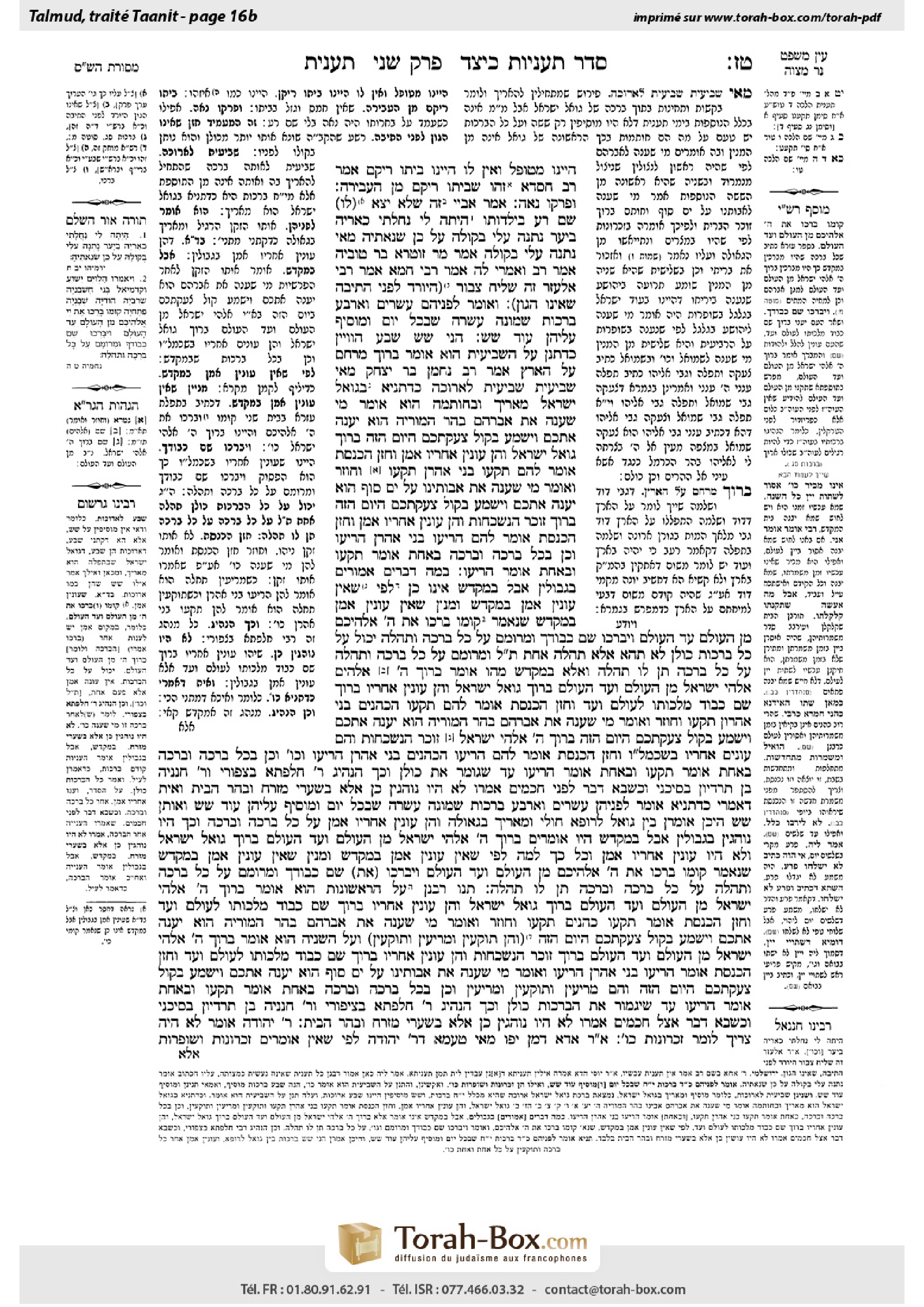
Taanit 16b: Talmud study for Daf Yomi
Daf Yomi is the daily study of one Talmud folio. Explore 37 tractates with scans, Hebrew text, Sefaria English and AI-generated French translations where annotated.
Passage selection and English or AI-generated French translation are available where the scan has annotations. Daf Study is independent of Torah-Box and Sefaria.
Browse Taanit · תענית · All tractatesTaanit 16b text and translations
This page of Taanit includes the Aramaic text, an English translation and an AI-generated French translation, alongside the scan above.
תענית י״ו ב · Aramaic and Hebrew text
הַיְינוּ ״מְטוּפָּל וְאֵין לוֹ״, הַיְינוּ ״בֵּיתוֹ רֵיקָם״? אָמַר רַב חִסְדָּא: זֶהוּ שֶׁבֵּיתוֹ רֵיקָם מִן הָעֲבֵירָה. ״וּפִרְקוֹ נָאֶה״, אָמַר אַבָּיֵי: זֶה שֶׁלֹּא יָצָא עָלָיו שֵׁם רַע בְּיַלְדוּתוֹ.
״הָיְתָה לִּי נַחֲלָתִי כְּאַרְיֵה בַיָּעַר נָתְנָה עָלַי בְּקוֹלָהּ עַל כֵּן שְׂנֵאתִיהָ״, מַאי ״נָתְנָה עָלַי בְּקוֹלָהּ״? אָמַר מָר זוּטְרָא בַּר טוֹבִיָּה אָמַר רַב, וְאָמְרִי לַהּ אָמַר רַבִּי חָמָא אָמַר רַבִּי אֶלְעָזָר: זֶה שְׁלִיחַ צִבּוּר שֶׁאֵינוֹ הָגוּן הַיּוֹרֵד לִפְנֵי הַתֵּיבָה.
וְאוֹמֵר לִפְנֵיהֶם עֶשְׂרִים וְאַרְבַּע בְּרָכוֹת, שְׁמוֹנֶה עֶשְׂרֵה שֶׁבְּכָל יוֹם וּמוֹסִיף עֲלֵיהֶן עוֹד שֵׁשׁ. הָנֵי שֵׁשׁ, שֶׁבַע הָוְויָין! כְּדִתְנַן: עַל הַשְּׁבִיעִית הוּא אוֹמֵר ״בָּרוּךְ מְרַחֵם עַל הָאָרֶץ״! אָמַר רַב נַחְמָן בַּר יִצְחָק: מַאי ״שְׁבִיעִית״ — שְׁבִיעִית לָאֲרוּכָּה.
כִּדְתַנְיָא: בְּ״גוֹאֵל יִשְׂרָאֵל״ מַאֲרִיךְ, וּבְחוֹתָמָהּ הוּא אוֹמֵר: ״מִי שֶׁעָנָה אֶת אַבְרָהָם בְּהַר הַמּוֹרִיָּה, הוּא יַעֲנֶה אֶתְכֶם וְיִשְׁמַע בְּקוֹל צַעֲקַתְכֶם הַיּוֹם הַזֶּה. בָּרוּךְ גּוֹאֵל יִשְׂרָאֵל״, וְהֵן עוֹנִין אַחֲרָיו ״אָמֵן״, וְחַזַּן הַכְּנֶסֶת אוֹמֵר לָהֶם: ״תִּקְעוּ בְּנֵי אַהֲרֹן תִּקְעוּ״.
וְחוֹזֵר וְאוֹמֵר: ״מִי שֶׁעָנָה אֶת אֲבוֹתֵינוּ עַל יַם סוּף, הוּא יַעֲנֶה אֶתְכֶם וְיִשְׁמַע בְּקוֹל צַעֲקַתְכֶם הַיּוֹם הַזֶּה, בָּרוּךְ זוֹכֵר הַנִּשְׁכָּחוֹת״, וְהֵן עוֹנִין אַחֲרָיו ״אָמֵן״, וְחַזַּן הַכְּנֶסֶת אוֹמֵר לָהֶם: ״הָרִיעוּ בְּנֵי אַהֲרֹן הָרִיעוּ״. וְכֵן בְּכׇל בְּרָכָה וּבְרָכָה, בְּאַחַת אוֹמֵר: ״תִּקְעוּ״, וּבְאַחַת אוֹמֵר: ״הָרִיעוּ״.
בַּמֶּה דְּבָרִים אֲמוּרִים — בִּגְבוּלִין, אֲבָל בַּמִּקְדָּשׁ אֵינוֹ כֵּן, לְפִי שֶׁאֵין עוֹנִין ״אָמֵן״ בַּמִּקְדָּשׁ. וּמִנַּיִן שֶׁאֵין עוֹנִין ״אָמֵן״ בַּמִּקְדָּשׁ —
שֶׁנֶּאֱמַר: ״קוּמוּ בָּרְכוּ אֶת ה׳ אֱלֹהֵיכֶם מִן הָעוֹלָם עַד הָעוֹלָם וִיבָרְכוּ שֵׁם כְּבֹדֶךָ וּמְרוֹמַם עַל כׇּל בְּרָכָה וּתְהִלָּה״. יָכוֹל עַל כׇּל בְּרָכוֹת כּוּלָּן לֹא תְּהֵא אֶלָּא תְּהִלָּה אַחַת — תַּלְמוּד לוֹמַר: ״וּמְרוֹמַם עַל כׇּל בְּרָכָה וּתְהִלָּה״ — עַל כׇּל בְּרָכָה תֵּן לוֹ תְּהִלָּה.
וְאֶלָּא בַּמִּקְדָּשׁ מַהוּ אוֹמֵר? ״בָּרוּךְ ה׳ אֱלֹהֵי יִשְׂרָאֵל מִן הָעוֹלָם וְעַד הָעוֹלָם. בָּרוּךְ גּוֹאֵל יִשְׂרָאֵל״. וְהֵן עוֹנִין אַחֲרָיו: ״בָּרוּךְ שֵׁם כְּבוֹד מַלְכוּתוֹ לְעוֹלָם וָעֶד״. וְחַזַּן הַכְּנֶסֶת אוֹמֵר לָהֶם: ״תִּקְעוּ הַכֹּהֲנִים בְּנֵי אַהֲרוֹן תִּקְעוּ״,
וְחוֹזֵר וְאוֹמֵר: ״מִי שֶׁעָנָה אֶת אַבְרָהָם בְּהַר הַמּוֹרִיָּה, הוּא יַעֲנֶה אֶתְכֶם וְיִשְׁמַע בְּקוֹל צַעֲקַתְכֶם הַיּוֹם הַזֶּה. בָּרוּךְ ה׳ אֱלֹהֵי יִשְׂרָאֵל זוֹכֵר הַנִּשְׁכָּחוֹת״, וְהֵם עוֹנִים אַחֲרָיו: ״בָּרוּךְ שֵׁם כְּבוֹד מַלְכוּתוֹ לְעוֹלָם וָעֶד״, וְחַזַּן הַכְּנֶסֶת אוֹמֵר לָהֶם: ״הָרִיעוּ, הַכֹּהֲנִים בְּנֵי אַהֲרֹן, הָרִיעוּ וְכוּ׳״, וְכֵן בְּכׇל בְּרָכָה וּבְרָכָה, בְּאַחַת אוֹמֵר ״תִּקְעוּ״ וּבְאַחַת אוֹמֵר ״הָרִיעוּ״, עַד שֶׁגּוֹמֵר אֶת כּוּלָּן.
וְכָךְ הִנְהִיג רַבִּי חֲלַפְתָּא בְּצִפּוֹרִי, וְרַבִּי חֲנַנְיָה בֶּן תְּרַדְיוֹן בְּסִיכְנִי, וּכְשֶׁבָּא דָּבָר לִפְנֵי חֲכָמִים, אָמְרוּ: לֹא הָיוּ נוֹהֲגִין כֵּן אֶלָּא בְּשַׁעֲרֵי מִזְרָח וּבְהַר הַבַּיִת.
וְאִית דְּאָמְרִי, כִּדְתַנְיָא: אוֹמֵר לִפְנֵיהֶן עֶשְׂרִים וְאַרְבַּע בְּרָכוֹת, שְׁמוֹנֶה עֶשְׂרֵה שֶׁבְּכָל יוֹם, וּמוֹסִיף עֲלֵיהֶן עוֹד שֵׁשׁ. וְאוֹתָן שֵׁשׁ הֵיכָן אוֹמְרָן? בֵּין ״גּוֹאֵל״ לְ״רוֹפֵא חוֹלֵי״, וּמַאֲרִיךְ בַּגְּאוּלָּה, וְהֵן עוֹנִין אַחֲרָיו ״אָמֵן״ עַל כׇּל בְּרָכָה וּבְרָכָה. וְכָךְ הָיוּ נוֹהֲגִין בִּגְבוּלִין.
אֲבָל בַּמִּקְדָּשׁ, הָיוּ אוֹמְרִים: ״בָּרוּךְ ה׳ אֱלֹהֵי יִשְׂרָאֵל מִן הָעוֹלָם וָעֶד הָעוֹלָם. בָּרוּךְ גּוֹאֵל יִשְׂרָאֵל.״ וְלֹא הָיוּ עוֹנִין אַחֲרָיו ״אָמֵן״. וְכׇל כָּךְ לָמָּה? לְפִי שֶׁאֵין עוֹנִין ״אָמֵן״ בַּמִּקְדָּשׁ, וּמִנַּיִן שֶׁאֵין עוֹנִין ״אָמֵן״ בַּמִּקְדָּשׁ, שֶׁנֶּאֱמַר: ״קוּמוּ בָּרְכוּ אֶת ה׳ אֱלֹהֵיכֶם מִן הָעוֹלָם עַד הָעוֹלָם וִיבָרְכוּ שֵׁם כְּבוֹדֶךָ וּמְרוֹמַם עַל כׇּל בְּרָכָה וּתְהִלָּה״ — עַל כׇּל בְּרָכָה וּבְרָכָה תֵּן לוֹ תְּהִלָּה.
תָּנוּ רַבָּנַן: עַל הָרִאשׁוֹנוֹת הוּא אוֹמֵר ״בָּרוּךְ ה׳ אֱלֹהֵי יִשְׂרָאֵל מִן הָעוֹלָם וָעֶד הָעוֹלָם. בָּרוּךְ גּוֹאֵל יִשְׂרָאֵל״. וְהֵן עוֹנִין אַחֲרָיו: ״בָּרוּךְ שֵׁם כְּבוֹד מַלְכוּתוֹ לְעוֹלָם וָעֶד״. וְחַזַּן הַכְּנֶסֶת אוֹמֵר: ״תִּקְעוּ כֹּהֲנִים תִּקְעוּ״. וְחוֹזֵר וְאוֹמֵר: ״מִי שֶׁעָנָה אֶת אַבְרָהָם בְּהַר הַמּוֹרִיָּה, הוּא יַעֲנֶה אֶתְכֶם וְיִשְׁמַע בְּקוֹל צַעֲקַתְכֶם הַיּוֹם הַזֶּה״, וְהֵן תּוֹקְעִין וּמְרִיעִין וְתוֹקְעִין, וְעַל הַשְּׁנִיָּה הוּא אוֹמֵר: ״בָּרוּךְ ה׳ אֱלֹהֵי יִשְׂרָאֵל מִן הָעוֹלָם וָעֶד הָעוֹלָם. בָּרוּךְ זוֹכֵר הַנִּשְׁכָּחוֹת״. וְהֵן עוֹנִין אַחֲרָיו: ״בָּרוּךְ שֵׁם כְּבוֹד מַלְכוּתוֹ לְעוֹלָם וָעֶד״,
וְחַזַּן הַכְּנֶסֶת אוֹמֵר: ״הָרִיעוּ בְּנֵי אַהֲרֹן הָרִיעוּ״. וְאוֹמֵר: ״מִי שֶׁעָנָה אֶת אֲבוֹתֵינוּ עַל יַם סוּף, הוּא יַעֲנֶה אֶתְכֶם וְיִשְׁמַע בְּקוֹל צַעֲקַתְכֶם הַיּוֹם הַזֶּה״, וְהֵם מְרִיעִין וְתוֹקְעִין וּמְרִיעִין, וְכֵן בְּכׇל בְּרָכָה וּבְרָכָה. בְּאַחַת אוֹמֵר ״תִּקְעוּ״, וּבְאַחַת אוֹמֵר ״הָרִיעוּ״, עַד שֶׁיִּגְמוֹר אֶת הַבְּרָכוֹת כּוּלָּן. וְכָךְ הִנְהִיג רַבִּי חֲלַפְתָּא בְּצִיפּוֹרִי וְרַבִּי חֲנַנְיָה בֶּן תְּרַדְיוֹן בְּסִיכְנִי. וּכְשֶׁבָּא דָּבָר אֵצֶל חֲכָמִים, אָמְרוּ: לֹא הָיוּ נוֹהֲגִין כֵּן אֶלָּא בְּשַׁעֲרֵי מִזְרָח וּבְהַר הַבַּיִת.
רַבִּי יְהוּדָה אוֹמֵר: לֹא הָיָה צָרִיךְ לוֹמַר זִכְרוֹנוֹת כּוּ׳. אָמַר רַבִּי אַדָּא דְּמִן יָפוֹ: מַאי טַעְמָא דְּרַבִּי יְהוּדָה — לְפִי שֶׁאֵין אוֹמְרִים זִכְרוֹנוֹת וְשׁוֹפָרוֹת
Taanit 16b · English translation
The Gemara asks a question concerning the explanation of Rabbi Yehuda: One who has dependent children and does not have anything with which to support them is apparently the same as one whose house is empty. Why does Rabbi Yehuda list both descriptions? Rav Ḥisda said: This expression means that his house is empty of transgression. And Rabbi Yehuda further said that the prayer leader must be one whose youth was becoming. In explanation of this phrase, Abaye said: This is one who did not have a bad reputation at any time during his youth.
The Gemara cites a verse in relation to the prayer leader: “My heritage has become to me as a lion in the forest. She has uttered her voice against me; therefore I have hated her” (Jeremiah 12:8). What is the meaning of the phrase: “She has uttered her voice against me”? Mar Zutra bar Toviyya said that Rav said, and some say Rabbi Ḥama said that Rabbi Elazar said: This is an unworthy prayer leader who descends before the ark. When this person calls out to God, He thinks, so to speak: I hate the sound of his prayer.
§ The mishna teaches: And the prayer leader recites twenty-four blessings before them: The eighteen blessings of the everyday Amida prayer, to which he adds another six blessings. The Gemara asks: Are these six blessings? In fact, they are seven, as we learned in a mishna: For the seventh he recites, Blessed are You, Lord, Who has mercy on the Land. Rav Naḥman bar Yitzḥak said: What is the meaning of the seventh blessing? This is referring to the seventh for length, i.e., there were actually six new blessings, but as the prayer leader lengthens the sixth weekday blessing it is considered an additional blessing.
As it is taught in a baraita: In the blessing of: Redeemer of Israel, the prayer leader lengthens the blessing, and for its conclusion he recites: He Who answered Abraham on Mount Moriah, He will answer you and hear the sound of your cry on this day. Blessed are You, Lord, Redeemer of Israel. And the community answers amen after him. And the sexton says to them: Blow a long, unwavering sound, sons of Aaron, blow.
And the prayer leader resumes and recites the second blessing, concluding: He Who answered our forefathers by the Red Sea, He will answer you and hear the sound of your cry on this day. Blessed are You, Lord, Who remembers the forgotten. And the community answers amen after him. And the sexton says to them: Blast a wavering sound, sons of Aaron, blast. And similarly, this is the procedure for each and every additional blessing: After one blessing he says: Blow a long, unwavering sound, and after the next one he says: Blast a wavering sound.
The Gemara asks: In what case is this statement said? This method applies in the outlying areas, i.e., everywhere except in the Temple. However, in the Temple itself this is not the correct procedure, as one does not answer amen in the Temple. Instead, one responds with a long blessing. The Gemara inquires: And from where is it derived that one does not answer amen in the Temple?
The Gemara answers: As it is stated: “Stand up and bless the Lord, your God, from everlasting to everlasting, and let them say: Blessed be Your glorious name, that is exalted above all blessing and praise” (Nehemiah 9:5). One might have thought that for all blessings there should be only one praise, i.e., all blessings are answered with amen. Therefore, the verse states: “That is exalted above all [al kol] blessing and praise,” which indicates that for every [al kol] blessing, you should give it its own praise.
But if so, in the Temple, what would the prayer leader recite? He would conclude the blessing: Blessed be the Lord, God of Israel, from everlasting to everlasting. Blessed are You, Lord, Redeemer of Israel. And instead of amen, they answer after him: Blessed be the name of His glorious kingdom forever and all time. And the sexton says to them: Blow, priests, sons of Aaron, blow.
And the prayer leader resumes and recites the second blessing, concluding: He Who answered Abraham on Mount Moriah, He will answer you and hear the sound of your cry on this day. Blessed be the Lord, God of Israel, Who remembers the forgotten. And the community answers after him: Blessed be the name of His glorious kingdom forever and all time. And the sexton says to them: Blast, priests, sons of Aaron, blast, etc. And similarly, this is the procedure for each and every additional blessing: After one blessing he says: Blow a long, unwavering sound, and after the next one he says: Blast a wavering sound, until he concludes all the blessings.
§ The Gemara relates: And this was the custom Rabbi Ḥalafta established in the city of Tzippori, and Rabbi Ḥananya ben Teradyon in the city of Sikhni. And when this matter came before the Sages, they said: They would act in accordance with this custom only at the Eastern Gate of the Temple and on the Temple Mount, but not outside the Temple.
And some say that they acted as it is taught in a baraita: And he recites twenty-four blessings before them: The eighteen blessings of the everyday Amida prayer, to which he adds another six blessings. And those extra six, where does he recite them? Between the blessings: Redeemer of Israel, and: Healer of the sick. And he lengthens the earlier prayer of redemption, and the congregation answers amen after him, for each and every blessing. And this was the custom in the outlying areas, outside the Temple.
However, in the Temple they would recite: Blessed be the Lord, God of Israel, from everlasting to everlasting. Blessed are You, Lord, Redeemer of Israel, and they would not answer amen after him. And why did the practice differ so much? Because one does not answer amen in the Temple. And from where is it derived that one does not answer amen in the Temple? As it is stated: “Stand up and bless the Lord, your God, from everlasting to everlasting, and let them say: Blessed be Your glorious Name, that is exalted above all blessing and praise” (Nehemiah 9:5). As stated above, this verse indicates that for every blessing, you should give it its own praise.
The Sages taught: In concluding the first blessing he recites: Blessed be the Lord, God of Israel, from everlasting to everlasting. Blessed are You, Lord, Redeemer of Israel, and they would answer after him: Blessed be the name of His glorious kingdom forever and all time. And the sexton says: Blow, priests, blow. And he resumes the blessings and recites: He Who answered Abraham on Mount Moriah, He will answer you and hear the sound of your cry on this day. And they blow a long, unwavering sound, and blast a wavering sound, and blow. And for the second blessing he recites: Blessed be the Lord, God of Israel, from everlasting to everlasting, who remembers the forgotten, and they would answer after him: Blessed be the name of His glorious kingdom forever and all time.
And the sexton says: Blast, sons of Aaron, blast. And he recites: He Who answered our forefathers by the Red Sea, He will answer you and hear the sound of your cry on this day. And they blow, and blast, and blow. And similarly, for each and every blessing: After one he says: Blow, and after the next one he says: Blast, until he concludes all of them. And this was the custom Rabbi Ḥalafta established in Tzippori, and Rabbi Ḥananya ben Teradyon in Sikhni. And when this matter came before the Sages, they said: They would act in accordance with this custom only at the Eastern Gate and on the Temple Mount.
§ The mishna taught: Rabbi Yehuda says: The prayer leader did not need to recite the Remembrances and Shofarot passages. Instead, he recited verses dealing with famine and suffering. Rabbi Adda from Jaffa said: What is Rabbi Yehuda’s reason? Rabbi Yehuda maintains that one recites Remembrances and Shofarot
Taanit 16b · Traduction française (IA)
La Guemara pose une question au sujet de l’explication de Rabbi Yehouda : celui qui a des enfants à charge et rien pour subvenir à leurs besoins semble être dans la même situation que celui dont la maison est vide. Pourquoi Rabbi Yehouda énumère-t-il ces deux descriptions ? Rav Ḥisda dit : cette expression signifie que sa maison est vide de toute transgression. Rabbi Yehouda a également dit que l’officiant doit être quelqu’un dont la jeunesse était honorable. Abayé explique cette expression : il s’agit de quelqu’un qui n’a jamais eu mauvaise réputation durant sa jeunesse.
La Guemara cite un verset à propos de l’officiant : « Mon héritage est devenu pour moi comme un lion dans la forêt. Elle a élevé la voix contre moi ; c’est pourquoi je l’ai haïe » (Jérémie 12, 8). Que signifie l’expression : « Elle a élevé la voix contre moi » ? Mar Zutra bar Toviyya dit au nom de Rav — et certains disent que Rabbi Ḥama a dit au nom de Rabbi Elazar : il s’agit d’un officiant indigne qui se rend devant l’arche. Lorsque cet homme s’adresse à Dieu, Celui-ci pense, pour ainsi dire : « Je déteste le son de sa prière. »
§ La Michna enseigne : l’officiant récite devant eux vingt-quatre bénédictions : les dix-huit bénédictions de la Amida des jours ordinaires, auxquelles il ajoute six autres bénédictions. La Guemara demande : S’agit-il bien de six bénédictions ? En réalité, il y en a sept, comme nous l’avons appris dans une Michna : pour la septième, il récite : « Béni sois-Tu, Seigneur, qui as pitié du Pays. » Rav Naḥman bar Yitzḥak dit : Que signifie « la septième bénédiction » ? Il s’agit de la septième par sa longueur : il y avait en réalité six nouvelles bénédictions, mais l’officiant allonge la sixième bénédiction des jours ordinaires, qui est ainsi considérée comme une bénédiction supplémentaire.
Comme il est enseigné dans une baraïta : dans la bénédiction « Rédempteur d’Israël », l’officiant prolonge la bénédiction et la conclut ainsi : « Celui qui a répondu à Abraham sur le mont Moriah vous répondra et entendra le son de vos cris en ce jour. Béni sois-Tu, Seigneur, Rédempteur d’Israël. » La communauté répond amen après lui. Le bedeau leur dit : « Sonnez longuement, d’un son continu, fils d’Aaron, sonnez. »
L’officiant reprend et récite la deuxième bénédiction, qu’il conclut ainsi : « Celui qui a répondu à nos ancêtres au bord de la mer des Joncs vous répondra et entendra le son de vos cris en ce jour. Béni sois-Tu, Seigneur, qui te souviens de ceux qui sont oubliés. » La communauté répond amen après lui. Le bedeau leur dit : « Sonnez en faisant varier le son, fils d’Aaron, sonnez. » La même procédure s’applique à chacune des bénédictions supplémentaires : après l’une, il dit : « Sonnez longuement, d’un son continu », et après la suivante : « Sonnez en faisant varier le son. »
La Guemara demande : Dans quel cas cette déclaration s’applique-t-elle ? Cette procédure s’applique dans les localités de province, c’est-à-dire partout sauf dans le Temple. Dans le Temple même, toutefois, on ne procède pas ainsi, car on n’y répond pas amen. On répond plutôt par une bénédiction prolongée. La Guemara demande : D’où déduit-on que l’on ne répond pas amen dans le Temple ?
La Guemara répond : car il est dit : « Levez-vous et bénissez le Seigneur, votre Dieu, depuis toujours et à jamais, et qu’ils disent : Béni soit Ton nom glorieux, exalté au-dessus de toute bénédiction et de toute louange » (Néhémie 9, 5). On aurait pu penser qu’à toutes les bénédictions correspond une seule louange, c’est-à-dire qu’on répond amen après toutes les bénédictions. Le verset dit donc : « exalté au-dessus de toute [al kol] bénédiction et de toute louange », ce qui indique que pour chaque [al kol] bénédiction, il faut donner une louange qui lui soit propre.
Mais dans ce cas, que récite l’officiant dans le Temple ? Il conclut la bénédiction ainsi : « Béni soit le Seigneur, Dieu d’Israël, depuis toujours et à jamais. Béni sois-Tu, Seigneur, Rédempteur d’Israël. » Au lieu de répondre amen, ils disent après lui : « Béni soit le nom de Son royaume glorieux pour toujours et à jamais. » Le bedeau leur dit : « Sonnez, prêtres, fils d’Aaron, sonnez. »
L’officiant reprend et récite la deuxième bénédiction, qu’il conclut ainsi : « Celui qui a répondu à Abraham sur le mont Moriah vous répondra et entendra le son de vos cris en ce jour. Béni soit le Seigneur, Dieu d’Israël, qui se souvient de ceux qui sont oubliés. » La communauté dit après lui : « Béni soit le nom de Son royaume glorieux pour toujours et à jamais. » Le bedeau leur dit : « Sonnez, prêtres, fils d’Aaron, sonnez », etc. La même procédure s’applique à chacune des bénédictions supplémentaires : après l’une, il dit : « Sonnez longuement, d’un son continu », et après la suivante : « Sonnez en faisant varier le son », jusqu’à ce qu’il ait conclu toutes les bénédictions.
§ La Guemara rapporte : Rabbi Ḥalafta avait institué cette coutume dans la ville de Tzippori, et Rabbi Ḥananya ben Teradyon dans la ville de Sikhni. Lorsque la question fut soumise aux Sages, ils dirent : cette coutume n’était suivie qu’à la Porte orientale du Temple et sur le mont du Temple, mais pas en dehors du Temple.
Certains disent qu’ils procédaient comme il est enseigné dans une baraïta : l’officiant récite devant eux vingt-quatre bénédictions : les dix-huit bénédictions de la Amida des jours ordinaires, auxquelles il ajoute six autres bénédictions. Où récite-t-il ces six bénédictions supplémentaires ? Entre les bénédictions « Rédempteur d’Israël » et « Guérisseur des malades ». Il prolonge la première prière de rédemption, et l’assemblée répond amen après lui à chacune des bénédictions. Telle était la coutume dans les localités de province, en dehors du Temple.
Dans le Temple, toutefois, ils récitaient : « Béni soit le Seigneur, Dieu d’Israël, depuis toujours et à jamais. Béni sois-Tu, Seigneur, Rédempteur d’Israël », et ils ne répondaient pas amen après lui. Pourquoi la pratique différait-elle tant ? Parce qu’on ne répond pas amen dans le Temple. Et d’où déduit-on que l’on ne répond pas amen dans le Temple ? Car il est dit : « Levez-vous et bénissez le Seigneur, votre Dieu, depuis toujours et à jamais, et qu’ils disent : Béni soit Ton nom glorieux, exalté au-dessus de toute bénédiction et de toute louange » (Néhémie 9, 5). Comme indiqué plus haut, ce verset enseigne que pour chaque bénédiction, il faut donner une louange qui lui soit propre.
Les Sages ont enseigné : en concluant la première bénédiction, l’officiant récite : « Béni soit le Seigneur, Dieu d’Israël, depuis toujours et à jamais. Béni sois-Tu, Seigneur, Rédempteur d’Israël. » Ils répondent après lui : « Béni soit le nom de Son royaume glorieux pour toujours et à jamais. » Le bedeau dit : « Sonnez, prêtres, sonnez. » L’officiant reprend les bénédictions et récite : « Celui qui a répondu à Abraham sur le mont Moriah vous répondra et entendra le son de vos cris en ce jour. » Ils sonnent longuement, d’un son continu, font varier le son, puis sonnent. Pour la deuxième bénédiction, il récite : « Béni soit le Seigneur, Dieu d’Israël, depuis toujours et à jamais, qui se souvient de ceux qui sont oubliés. » Ils répondent après lui : « Béni soit le nom de Son royaume glorieux pour toujours et à jamais. »
Le bedeau dit : « Sonnez, fils d’Aaron, sonnez. » L’officiant récite : « Celui qui a répondu à nos ancêtres au bord de la mer des Joncs vous répondra et entendra le son de vos cris en ce jour. » Ils sonnent, font varier le son, puis sonnent. De même, pour chacune des bénédictions : après l’une, il dit : « Sonnez », et après la suivante : « Faites varier le son », jusqu’à ce qu’il les ait toutes conclues. Rabbi Ḥalafta avait institué cette coutume à Tzippori, et Rabbi Ḥananya ben Teradyon à Sikhni. Lorsque la question fut soumise aux Sages, ils dirent : cette coutume n’était suivie qu’à la Porte orientale et sur le mont du Temple.
§ La Michna enseigne : Rabbi Yehouda dit : l’officiant n’avait pas besoin de réciter les passages des Souvenirs et des Chofarot. À la place, il récitait des versets portant sur la famine et les souffrances. Rabbi Adda de Jaffa dit : Quelle est la raison de Rabbi Yehouda ? Rabbi Yehouda estime que l’on récite les Souvenirs et les Chofarot
Traduction française générée par IA à partir de l’édition anglaise de Sefaria. Vérifie toujours un passage avec le texte source.
Text from Sefaria: William Davidson Edition - Vocalized Aramaic (CC BY NC); William Davidson Edition - English (CC BY NC).