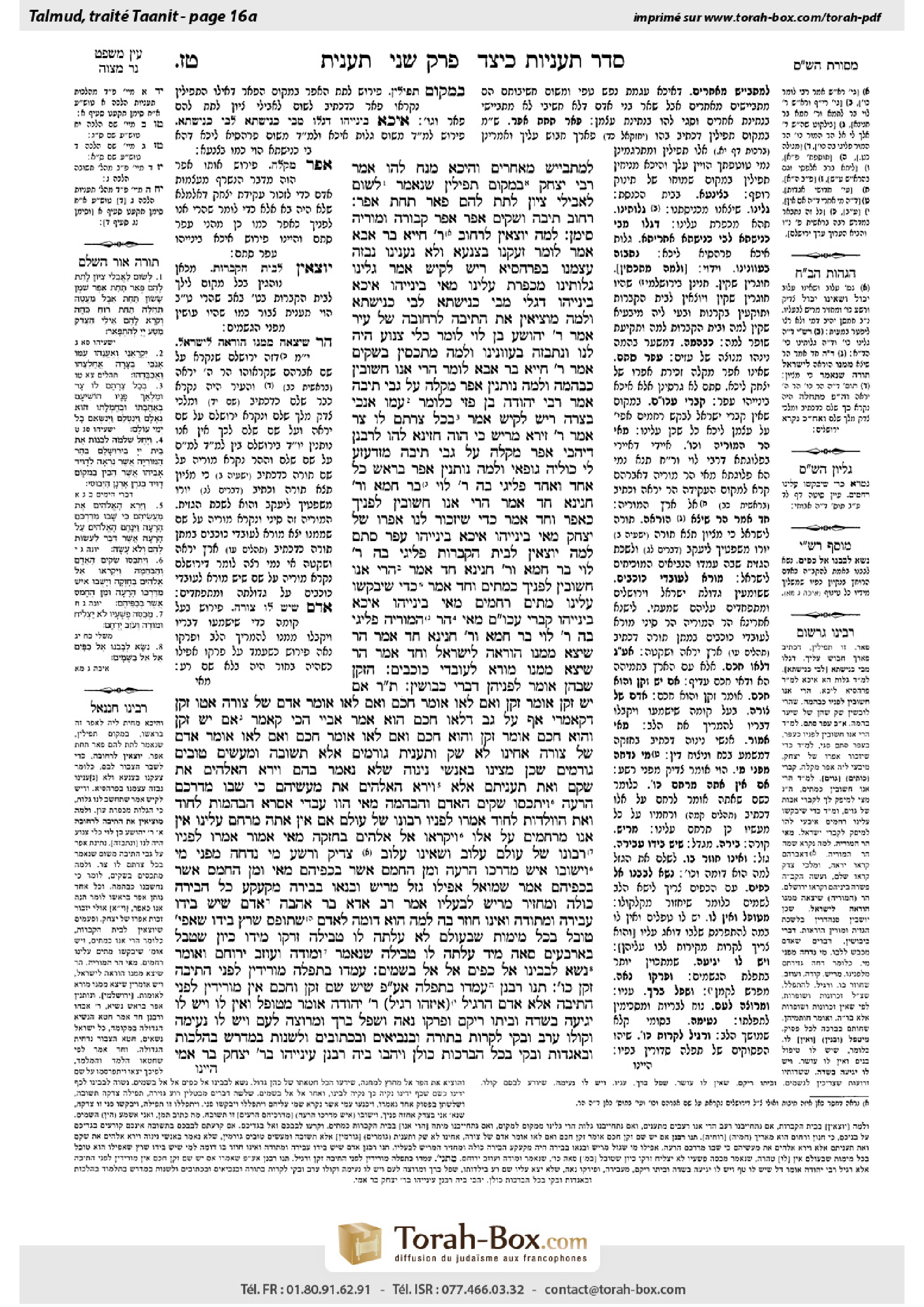
Taanit 16a: Talmud study for Daf Yomi
Daf Yomi is the daily study of one Talmud folio. Explore 37 tractates with scans, Hebrew text, Sefaria English and AI-generated French translations where annotated.
Passage selection and English or AI-generated French translation are available where the scan has annotations. Daf Study is independent of Torah-Box and Sefaria.
Browse Taanit · תענית · All tractatesTaanit 16a text and translations
This page of Taanit includes the Aramaic text, an English translation and an AI-generated French translation, alongside the scan above.
תענית י״ו א · Aramaic and Hebrew text
לְמִתְבַּיֵּישׁ מֵאֲחֵרִים. וְהֵיכָא מַנַּח לְהוּ? אָמַר רַבִּי יִצְחָק: בִּמְקוֹם תְּפִילִּין. שֶׁנֶּאֱמַר: ״לָשׂוּם לַאֲבֵלֵי צִיּוֹן לָתֵת לָהֶם פְּאֵר תַּחַת אֵפֶר״.
רְחוֹב, תֵּיבָה, וְשַׂקִּים, אֵפֶר, אֵפֶר, קְבוּרָה, וּמוֹרִיָּה סִימָן. לָמָּה יוֹצְאִין לָרְחוֹב? רַבִּי חִיָּיא בַּר אַבָּא אָמַר: לוֹמַר — זָעַקְנוּ בְּצִנְעָא וְלֹא נַעֲנֵינוּ, נְבַזֶּה עַצְמֵנוּ בְּפַרְהֶסְיָא.
רֵישׁ לָקִישׁ אָמַר: גָּלִינוּ, גָּלוּתֵינוּ מְכַפֶּרֶת עָלֵינוּ. מַאי בֵּינַיְיהוּ? אִיכָּא בֵּינַיְיהוּ, דְּגָלוּ מִבֵּי כְנִישְׁתָּא לְבֵי כְנִישְׁתָּא.
וְלָמָּה מוֹצִיאִין אֶת הַתֵּיבָה לִרְחוֹבָהּ שֶׁל עִיר? אָמַר רַבִּי יְהוֹשֻׁעַ בֶּן לֵוִי, לוֹמַר: כְּלִי צָנוּעַ הָיָה לָנוּ, וְנִתְבַּזָּה בַּעֲווֹנֵינוּ.
וְלָמָּה מִתְכַּסִּין בְּשַׂקִּים? אָמַר רַבִּי חִיָּיא בַּר אַבָּא: לוֹמַר — הֲרֵי אָנוּ חֲשׁוּבִין כִּבְהֵמָה. וְלָמָּה נוֹתְנִין אֵפֶר מִקְלֶה עַל גַּבֵּי תֵּיבָה? אָמַר רַבִּי יְהוּדָה בֶּן פַּזִּי: כְּלוֹמַר — ״עִמּוֹ אָנֹכִי בְּצָרָה״. רֵישׁ לָקִישׁ אָמַר: ״בְּכׇל צָרָתָם לוֹ צָר״. אָמַר רַבִּי זֵירָא: מֵרֵישׁ כִּי הֲוָה חֲזֵינָא לְהוּ לְרַבָּנַן דְּיָהֲבִי אֵפֶר מִקְלֶה עַל גַּבֵּי תֵּיבָה — מִזְדַּעְזַע לִי כּוּלֵּיהּ גּוּפַאי.
וְלָמָּה נוֹתְנִין אֵפֶר בְּרֹאשׁ כׇּל אֶחָד וְאֶחָד? פְּלִיגִי בַּהּ רַבִּי לֵוִי בַּר חָמָא וְרַבִּי חֲנִינָא. חַד אָמַר: הֲרֵי אָנוּ חֲשׁוּבִין לְפָנֶיךָ כְּאֵפֶר, וְחַד אָמַר: כְּדֵי שֶׁיִּזְכּוֹר לָנוּ אֶפְרוֹ שֶׁל יִצְחָק. מַאי בֵּינַיְיהוּ? אִיכָּא בֵּינַיְיהוּ עָפָר סְתָם.
לָמָּה יוֹצְאִין לְבֵית הַקְּבָרוֹת? פְּלִיגִי בַּהּ רַבִּי לֵוִי בַּר חָמָא וְרַבִּי חֲנִינָא. חַד אָמַר: הֲרֵי אָנוּ חֲשׁוּבִין לְפָנֶיךָ כְּמֵתִים, וְחַד אָמַר: כְּדֵי שֶׁיְּבַקְּשׁוּ עָלֵינוּ מֵתִים רַחֲמִים. מַאי בֵּינַיְיהוּ? אִיכָּא בֵּינַיְיהוּ קִבְרֵי נׇכְרִים.
מַאי הַר הַמּוֹרִיָּה? פְּלִיגִי בַּהּ רַבִּי לֵוִי בַּר חָמָא וְרַבִּי חֲנִינָא. חַד אָמַר: הַר שֶׁיָּצָא מִמֶּנּוּ הוֹרָאָה לְיִשְׂרָאֵל, וְחַד אָמַר: הַר שֶׁיָּצָא מִמֶּנּוּ מוֹרָא לְאוּמּוֹת הָעוֹלָם.
הַזָּקֵן שֶׁבָּהֶן אוֹמֵר לִפְנֵיהֶן דִּבְרֵי כִבּוּשִׁין. תָּנוּ רַבָּנַן: אִם יֵשׁ זָקֵן — אוֹמֵר זָקֵן. וְאִם לָאו — אוֹמֵר חָכָם, וְאִם לָאו — אוֹמֵר אָדָם שֶׁל צוּרָה. אַטּוּ זָקֵן דְּקָאָמְרִי, אַף עַל גַּב דְּלָאו חָכָם הוּא? אָמַר אַבָּיֵי, הָכִי קָאָמַר: אִם יֵשׁ זָקֵן וְהוּא חָכָם — אוֹמֵר זָקֵן וְהוּא חָכָם, וְאִם לָאו — אוֹמֵר חָכָם, וְאִם לָאו — אוֹמֵר אָדָם שֶׁל צוּרָה.
אַחֵינוּ, לֹא שַׂק וְתַעֲנִית גּוֹרְמִים, אֶלָּא תְּשׁוּבָה וּמַעֲשִׂים טוֹבִים גּוֹרְמִים. שֶׁכֵּן מָצִינוּ בְּאַנְשֵׁי נִינְוֵה, שֶׁלֹּא נֶאֱמַר בָּהֶם ״וַיַּרְא הָאֱלֹהִים אֶת שַׂקָּם וְאֶת תַּעֲנִיתָם״, אֶלָּא: ״וַיַּרְא הָאֱלֹהִים אֶת מַעֲשֵׂיהֶם כִּי שָׁבוּ מִדַּרְכָּם הָרָעָה״.
״וְיִתְכַּסּוּ שַׂקִּים הָאָדָם וְהַבְּהֵמָה״, מַאי הֲווֹ עָבְדִי? אָסְרוּ הַבְּהֵמוֹת לְחוּד, וְאֶת הַוְּולָדוֹת לְחוּד. אָמְרוּ לְפָנָיו: רִבּוֹנוֹ שֶׁל עוֹלָם! אִם אֵין אַתָּה מְרַחֵם עָלֵינוּ — אֵין אָנוּ מְרַחֲמִים עַל אֵלּוּ.
״וְיִקְרְאוּ אֶל אֱלֹהִים בְּחׇזְקָה״, מַאי אֲמוּר? אָמְרוּ לְפָנָיו: רִבּוֹנוֹ שֶׁל עוֹלָם! עָלוּב וְשֶׁאֵינוֹ עָלוּב, צַדִּיק וְרָשָׁע — מִי נִדְחֶה מִפְּנֵי מִי?
״וְיָשֻׁבוּ אִישׁ מִדַּרְכּוֹ הָרָעָה וּמִן הֶחָמָס אֲשֶׁר בְּכַפֵּיהֶם״, מַאי ״וּמִן הֶחָמָס אֲשֶׁר בְּכַפֵּיהֶם״? אָמַר שְׁמוּאֵל: אֲפִילּוּ גָּזַל מָרִישׁ וּבְנָאוֹ בְּבִירָה — מְקַעְקֵעַ כׇּל הַבִּירָה כּוּלָּהּ וּמַחְזִיר מָרִישׁ לִבְעָלָיו.
אָמַר רַב אַדָּא בַּר אַהֲבָה: אָדָם שֶׁיֵּשׁ בְּיָדוֹ עֲבֵירָה, וּמִתְוַדֶּה וְאֵינוֹ חוֹזֵר בָּהּ, לְמָה הוּא דּוֹמֶה? לְאָדָם שֶׁתּוֹפֵס שֶׁרֶץ בְּיָדוֹ, שֶׁאֲפִילּוּ טוֹבֵל בְּכׇל מֵימוֹת שֶׁבָּעוֹלָם — לֹא עָלְתָה לוֹ טְבִילָה. זְרָקוֹ מִיָּדוֹ, כֵּיוָן שֶׁטָּבַל בְּאַרְבָּעִים סְאָה — מִיָּד עָלְתָה לוֹ טְבִילָה,
שֶׁנֶּאֱמַר: ״וּמוֹדֶה וְעֹזֵב יְרֻחָם״, וְאוֹמֵר: ״נִשָּׂא לְבָבֵנוּ אֶל כַּפָּיִם אֶל אֵל בַּשָּׁמָיִם״.
עָמְדוּ בִּתְפִלָּה, מוֹרִידִין לִפְנֵי הַתֵּיבָה זָקֵן כּוּ׳. תָּנוּ רַבָּנַן: עָמְדוּ בִּתְפִלָּה, אַף עַל פִּי שֶׁיֵּשׁ שָׁם זָקֵן וְחָכָם — אֵין מוֹרִידִין לִפְנֵי הַתֵּיבָה אֶלָּא אָדָם הָרָגִיל. רַבִּי יְהוּדָה אוֹמֵר: מְטוּפָּל וְאֵין לוֹ, וְיֵשׁ לוֹ יְגִיעָה בַּשָּׂדֶה, וּבֵיתוֹ רֵיקָם,
וּפִרְקוֹ נָאֶה, וּשְׁפַל בֶּרֶךְ, וּמְרוּצֶּה לָעָם, וְיֵשׁ לוֹ נְעִימָה, וְקוֹלוֹ עָרֵב, וּבָקִי לִקְרוֹת בַּתּוֹרָה וּבַנְּבִיאִים וּבַכְּתוּבִים, וְלִשְׁנוֹת בַּמִּדְרָשׁ בַּהֲלָכוֹת וּבָאַגָּדוֹת, וּבָקִי בְּכׇל הַבְּרָכוֹת כּוּלָּן. וִיהַבוּ בֵּיהּ רַבָּנַן עֵינַיְיהוּ בְּרַב יִצְחָק בַּר אַמֵּי.
Taanit 16a · English translation
one who is humiliated by others. Accordingly, ashes are placed on the heads of the leaders of the community by others, to increase the appearance of their suffering. The Gemara asks: And where exactly are the ashes placed upon their heads? Rabbi Yitzḥak said: On the place of the phylacteries of the head, as it is stated: “To appoint to those who mourn in Zion, to give to them an ornament [pe’er] instead of ashes” (Isaiah 61:3). This verse likens the placement of ashes on one’s head to an ornament, and the term pe’er is traditionally interpreted as a reference to phylacteries.
§ The Gemara provides a mnemonic device for the forthcoming statements. Square; ark; and sackcloth; ashes; ashes; cemetery; and Moriah. The Gemara asks: Why do they go out to the square? Rabbi Ḥiyya bar Abba said: This is a symbolic action, as though to say: We cried out in private inside the synagogue and we were not answered. We will therefore disgrace ourselves in public, so that our prayers will be heard.
Reish Lakish said that the move into the square symbolizes exile, as though they are saying: We have been exiled; may our exile atone for us. The Gemara asks: What is the practical difference between these two explanations? The Gemara answers that the practical difference between them is in a case where they are exiled, i.e., they move, from one synagogue to another synagogue. According to the opinion of Reish Lakish, they have exiled themselves, and therefore this ceremony is adequate. Conversely, Rabbi Ḥiyya bar Abba maintains that as the ritual is performed in private, it is insufficient.
The Gemara asks another question concerning the meaning of the ritual. And why do they remove the ark to the city square? Rabbi Yehoshua ben Levi said: This is done as though to say: We had a modest vessel, which was always kept concealed, but it has been publicly exposed due to our transgressions.
The Gemara further asks: And why do they cover themselves in sackcloth? Rabbi Ḥiyya bar Abba said: This is as though to say: We are considered before You like animals, which are likewise covered with hide. And why do they place burnt ashes on top of the ark? Rabbi Yehuda ben Pazi said: This is as though to say in God’s name: “I will be with him in trouble” (Psalms 91:15). Reish Lakish said that the same idea can be derived from a different verse: “In all their affliction, He was afflicted” (Isaiah 63:9). By placing burnt ash on the ark, which is the symbol of the Divine Presence, it is as though God Himself joins the Jews in their pain. Rabbi Zeira said: At first, when I saw the Sages place burnt ashes upon the ark, my entire body trembled from the intensity of the event.
And why do they place ashes upon the head of each and every individual? Rabbi Levi bar Ḥama and Rabbi Ḥanina disagree with regard to this matter. One said that this is as though to say: We are considered like ashes before You. And one said that these ashes are placed in order to remind God of the ashes of our forefather Isaac, on our behalf. The Gemara asks: What is the practical difference between these two explanations? The Gemara answers that the practical difference between them is in a case where one placed ordinary earth upon the heads of the individuals instead of ashes. Although earth does symbolize self-nullification and may be used according to the first explanation, it has no connection to the sacrifice of Isaac, and therefore it does not satisfy the second explanation.
The Gemara further asks: And why do they go out to the cemetery on a fast day? Again, Rabbi Levi bar Ḥama and Rabbi Ḥanina disagree with regard to this matter. One said this is as though to say: We are like the dead before You. And one said that one goes out to the cemetery in order that the deceased will request mercy on our behalf. The Gemara asks: What is the practical difference between them? The Gemara answers that the practical difference between them concerns graves of gentiles. If the purpose of going to graves is to say that they stand before God like the dead, graves of gentiles would suffice. However, if they go to the cemetery for the deceased to ask for mercy on their behalf, they should visit specifically Jewish graves.
§ Apropos disputes between Rabbi Levi bar Ḥama and Rabbi Ḥanina, the Gemara mentions another dispute between them. What is the meaning of the name Mount [Har] Moriah, the Temple Mount? Rabbi Levi bar Ḥama and Rabbi Ḥanina disagree with regard to this matter. One said that the name alludes to the Great Sanhedrin that convened there, as it is the mountain from which instruction [hora’a] went out to the Jewish people. And one said that it is the mountain from which fear [mora] went out to the nations of the world, as this place signifies God’s choice of the Jewish people.
§ The mishna taught: The eldest of the community says to them statements of reproof. The Sages taught in a baraita: If there is an elder, then the elder says the admonition, and if not, a Sage says the admonition. And if not, a person of imposing appearance says it. The Gemara asks: Is that to say that the elder of whom we spoke is preferred to a scholar simply by virtue of his age, even though he is not a scholar? Abaye said that this is what the mishna is saying: If there is an elder, and he is also a scholar, this elder scholar says the admonition. And if not, even a young scholar says the reproof. And if there is no scholar of any kind available, a person of imposing appearance says it.
What does he say? Our brothers, it is not sackcloth and fasting that cause atonement for our sins. Rather, repentance and good deeds will cause our atonement. This is as we find with regard to the people of Nineveh, that it is not stated about them: And God saw their sackcloth and their fasting. Rather, the verse states: “And God saw their deeds, that they had turned from their evil way” (Jonah 3:10).
§ Apropos the repentance of the inhabitants of Nineveh, the Gemara discusses their behavior further. The verse states: “But let them be covered with sackcloth, both man and beast” (Jonah 3:8). What did they do? They confined the female animals alone, and their young alone, in a different place. They then said before God: Master of the Universe, if You do not have mercy on us, we will not have mercy on these animals. Even if we are not worthy of Your mercy, these animals have not sinned.
It is further stated with regard to the people of Nineveh: “And let them cry mightily to God” (Jonah 3:8). The Gemara asks: What did they say that could be described as calling out “mightily”? The Gemara explains that they said before God: Master of the Universe, if there is a dispute between a submissive one and an intractable one, or between a righteous one and a wicked one, who must yield before whom? Certainly the righteous forgives the wicked. Likewise, You must have mercy on us.
The verse states: “And let them turn, every one from his evil way, and from the violence that is in their hands” (Jonah 3:8). What is the meaning of the phrase “and from the violence that is in their hands”? Shmuel said that the king of Nineveh proclaimed: Even if one stole a beam and built it into his building, he must tear down the entire building and return the beam to its owner. Although the Sages decreed that one need only pay financial compensation in a case of this kind, these people wanted to repent completely by removing any remnant of stolen property from their possession.
§ Similarly, Rav Adda bar Ahava said: A person who has a transgression in his hand, and he confesses but does not repent for his sin, to what is he comparable? To a person who holds in his hand a dead creeping animal, which renders one ritually impure by contact. As in this situation, even if he immerses in all the waters of the world, his immersion is ineffective for him, as long as the source of ritual impurity remains in his hand. However, if he has thrown the animal from his hand, once he has immersed in a ritual bath of forty se’a, the immersion is immediately effective for him.
As it is stated: “He who covers his transgressions shall not prosper, but whoever confesses and forsakes them shall obtain mercy” (Proverbs 28:13). That is, confession alone is futile, but one who also abandons his transgressions will receive mercy. And it states elsewhere: “Let us lift up our heart with our hands to God in Heaven” (Lamentations 3:41), which likewise indicates that it is not enough to lift one’s hands in prayer; rather, one must also raise his heart and return to God.
§ The mishna teaches: They stood for prayer, and the congregation appoints an elder. The Sages taught in a baraita: They stood for prayer, and even if there is a man there who is elderly and a scholar, they appoint to descend before the ark as prayer leader only a person who is accustomed to lead in prayer. Who is considered an accustomed prayer leader in this sense? Rabbi Yehuda says: One who has financially dependent children but he does not have the means to support them, and he has no choice but to toil in the field, and whose house is empty, and who will therefore pray for rain with great devotion.
Rabbi Yehuda continues with his depiction of the worthy prayer leader. And his youth was becoming, and he is humble and accepted by the people, as he is likable. And furthermore, he must be familiar with songs and his voice pleasant, and he is expert in reading the Torah, the Prophets, and the Writings, and he knows how to study midrash, halakha, and aggada. And finally, he must be expert in all of the blessings. Clearly, it is hard to find someone with all these qualities. And the Gemara relates that when this worthy person was described, those Sages present turned their eyes toward Rav Yitzḥak bar Ami, who possessed all of these virtues.
Taanit 16a · Traduction française (IA)
celui qui est humilié par autrui. C’est pourquoi d’autres déposent des cendres sur la tête des dirigeants de la communauté, afin de rendre leur souffrance plus manifeste. La Guemara demande : Et où exactement dépose-t-on les cendres sur leur tête ? Rabbi Yitzḥak dit : À l’emplacement des téfilines de la tête, comme il est dit : « Pour donner aux endeuillés de Sion une parure [pe’er] au lieu de cendres » (Isaïe 61, 3). Ce verset assimile le dépôt de cendres sur la tête à une parure, et le terme pe’er est traditionnellement interprété comme une référence aux téfilines.
§ La Guemara propose un moyen mnémotechnique pour les enseignements qui suivent : place publique ; arche ; toile de sac ; cendres ; cendres ; cimetière ; et Moriah. La Guemara demande : Pourquoi sortent-ils sur la place publique ? Rabbi Ḥiyya bar Abba dit : C’est un geste symbolique, comme pour dire : Nous avons crié en privé, à l’intérieur de la synagogue, et nous n’avons pas été exaucés. Nous allons donc nous humilier en public, afin que nos prières soient entendues.
Reish Lakish dit que le déplacement vers la place publique symbolise l’exil, comme s’ils disaient : Nous avons été exilés ; puisse notre exil nous servir d’expiation. La Guemara demande : Quelle est la différence pratique entre ces deux explications ? La Guemara répond que la différence pratique apparaît dans le cas où ils sont exilés, c’est-à-dire lorsqu’ils passent d’une synagogue à une autre. Selon l’avis de Reish Lakish, ils se sont eux-mêmes exilés et cette cérémonie suffit donc. Rabbi Ḥiyya bar Abba, au contraire, estime que, puisque le rite est accompli en privé, il ne suffit pas.
La Guemara pose une autre question sur le sens du rite : Pourquoi sortent-ils l’arche sur la place publique ? Rabbi Yehoshua ben Levi dit : C’est comme pour dire : Nous avions un objet précieux, que l’on gardait toujours caché, mais qui a été exposé publiquement à cause de nos transgressions.
La Guemara demande encore : Pourquoi se couvrent-ils de toile de sac ? Rabbi Ḥiyya bar Abba dit : C’est comme pour dire : À Tes yeux, nous sommes considérés comme des animaux, qui sont eux aussi couverts de leur peau. Et pourquoi déposent-ils des cendres brûlées sur l’arche ? Rabbi Yehuda ben Pazi dit : C’est comme s’ils disaient au nom de Dieu : « Je serai avec lui dans la détresse » (Psaumes 91, 15). Reish Lakish dit que la même idée peut être déduite d’un autre verset : « Dans toutes leurs détresses, Il était lui-même dans la détresse » (Isaïe 63, 9). En déposant des cendres brûlées sur l’arche, symbole de la Présence divine, c’est comme si Dieu Lui-même partageait la douleur des Juifs. Rabbi Zeira dit : Au début, lorsque je voyais les Sages déposer des cendres brûlées sur l’arche, tout mon corps tremblait devant l’intensité de la scène.
Et pourquoi déposent-ils des cendres sur la tête de chacun ? Rabbi Levi bar Ḥama et Rabbi Ḥanina sont en désaccord à ce sujet. L’un dit que c’est comme pour dire : À Tes yeux, nous sommes comme de la cendre. L’autre dit que ces cendres sont déposées afin de rappeler à Dieu, en notre faveur, les cendres de notre ancêtre Isaac. La Guemara demande : Quelle est la différence pratique entre ces deux explications ? La Guemara répond que la différence pratique apparaît dans le cas où l’on dépose de la terre ordinaire sur la tête des personnes au lieu de cendres. Bien que la terre symbolise l’anéantissement de soi et puisse être utilisée selon la première explication, elle n’a aucun lien avec le sacrifice d’Isaac et ne satisfait donc pas à la seconde explication.
La Guemara demande encore : Pourquoi se rendent-ils au cimetière un jour de jeûne ? Là encore, Rabbi Levi bar Ḥama et Rabbi Ḥanina sont en désaccord à ce sujet. L’un dit que c’est comme pour dire : À Tes yeux, nous sommes comme des morts. L’autre dit qu’on se rend au cimetière afin que les défunts implorent la miséricorde en notre faveur. La Guemara demande : Quelle est la différence pratique entre leurs avis ? La Guemara répond que la différence pratique concerne les tombes des non-Juifs. Si l’on se rend aux tombes pour dire que l’on se tient devant Dieu comme des morts, les tombes des non-Juifs conviendraient. Mais si l’on va au cimetière pour que les défunts implorent la miséricorde en notre faveur, il faut se rendre précisément à des tombes juives.
§ À propos des désaccords entre Rabbi Levi bar Ḥama et Rabbi Ḥanina, la Guemara mentionne un autre différend entre eux. Que signifie le nom du mont Moriah [Har], le mont du Temple ? Rabbi Levi bar Ḥama et Rabbi Ḥanina sont en désaccord à ce sujet. L’un dit que ce nom fait allusion au Grand Sanhédrin qui y siégeait, car c’est de cette montagne que l’instruction [hora’a] était transmise au peuple juif. L’autre dit que c’est la montagne d’où la crainte [mora] s’est répandue parmi les nations du monde, car ce lieu témoigne du choix de Dieu en faveur du peuple juif.
§ La Michna enseigne : Le plus âgé de la communauté leur adresse des paroles de réprimande. Les Sages ont enseigné dans une baraïta : S’il y a un ancien, c’est lui qui prononce l’exhortation ; sinon, c’est un Sage qui la prononce. À défaut, une personne à l’apparence imposante la prononce. La Guemara demande : Faut-il comprendre que l’ancien dont nous avons parlé est préféré à un érudit du seul fait de son âge, même s’il n’est pas érudit ? Abaye dit que voici le sens de la Michna : S’il y a un ancien qui est également un Sage, c’est cet ancien Sage qui prononce l’exhortation. Sinon, même un jeune Sage adresse la réprimande. Et si aucun Sage n’est disponible, une personne à l’apparence imposante la prononce.
Que dit-il ? « Nos frères, ce ne sont ni la toile de sac ni le jeûne qui expient nos péchés. Ce sont plutôt le repentir et les bonnes actions qui nous vaudront l’expiation. » On le voit dans le cas des habitants de Ninive : il n’est pas dit à leur sujet : « Dieu vit leur toile de sac et leur jeûne. » Le verset dit plutôt : « Dieu vit leurs actions : ils avaient renoncé à leur mauvaise conduite » (Jonas 3, 10).
§ À propos du repentir des habitants de Ninive, la Guemara examine davantage leur comportement. Le verset dit : « Qu’ils se couvrent de toile de sac, les hommes comme les bêtes » (Jonas 3, 8). Que firent-ils ? Ils enfermèrent les femelles à part et leurs petits séparément, dans un autre endroit. Puis ils dirent devant Dieu : Maître de l’Univers, si Tu n’as pas pitié de nous, nous n’aurons pas pitié de ces animaux. Même si nous ne sommes pas dignes de Ta miséricorde, ces animaux n’ont pas péché.
Il est également dit au sujet des habitants de Ninive : « Qu’ils crient avec force vers Dieu » (Jonas 3, 8). La Guemara demande : Que dirent-ils qui puisse être décrit comme un appel lancé « avec force » ? La Guemara explique qu’ils dirent devant Dieu : Maître de l’Univers, s’il y a un différend entre une personne conciliante et une personne intraitable, ou entre un juste et un méchant, lequel doit céder devant l’autre ? Il est certain que le juste pardonne au méchant. De même, Tu dois avoir pitié de nous.
Le verset dit : « Que chacun se détourne de sa mauvaise conduite et de la violence qui est dans ses mains » (Jonas 3, 8). Que signifie l’expression « et de la violence qui est dans ses mains » ? Shmuel dit que le roi de Ninive proclama : Même si quelqu’un a volé une poutre et l’a incorporée à sa maison, il doit démolir toute la maison et rendre la poutre à son propriétaire. Bien que les Sages aient décrété que, dans un tel cas, il suffit de verser une compensation financière, ces gens voulaient se repentir complètement en éliminant de leur possession toute trace de bien volé.
§ De même, Rav Adda bar Ahava dit : À quoi ressemble une personne qui a commis une transgression et la confesse sans se repentir ? À une personne qui tient dans sa main un animal rampant mort, lequel rend impur par contact. Dans ce cas, même si elle s’immerge dans toutes les eaux du monde, son immersion est inefficace tant que la source d’impureté rituelle reste dans sa main. En revanche, si elle a lâché l’animal, dès qu’elle s’est immergée dans un bain rituel contenant quarante sé’a, l’immersion prend immédiatement effet.
Comme il est dit : « Celui qui dissimule ses transgressions ne réussira pas, mais celui qui les confesse et y renonce obtiendra miséricorde » (Proverbes 28, 13). Autrement dit, la confession seule est vaine, mais celui qui abandonne aussi ses transgressions recevra miséricorde. Et il est dit ailleurs : « Élevons notre cœur avec nos mains vers Dieu dans les Cieux » (Lamentations 3, 41), ce qui indique également qu’il ne suffit pas d’élever les mains dans la prière ; il faut aussi élever son cœur et revenir à Dieu.
§ La Michna enseigne : Ils se tiennent pour la prière, et la communauté désigne un ancien. Les Sages ont enseigné dans une baraïta : Ils se tiennent pour la prière et, même s’il y a là un homme âgé et érudit, ils ne désignent pour s’avancer devant l’arche en tant que responsable de la prière qu’une personne habituée à diriger la prière. Qui est considéré comme un responsable de la prière expérimenté en ce sens ? Rabbi Yehuda dit : Celui qui a des enfants à charge, mais n’a pas les moyens de subvenir à leurs besoins et n’a d’autre choix que de travailler aux champs, et dont la maison est vide ; il priera donc pour la pluie avec une grande ferveur.
Rabbi Yehuda poursuit la description du responsable de la prière digne de ce rôle : sa jeunesse était honorable, il est humble et apprécié du peuple, car il est aimable. En outre, il doit connaître les chants, avoir une voix agréable, être expert dans la lecture de la Torah, des Prophètes et des Écrits, et savoir étudier le midrach, la halakha et l’aggada. Enfin, il doit maîtriser toutes les bénédictions. Il est évidemment difficile de trouver quelqu’un qui réunisse toutes ces qualités. La Guemara rapporte que, lorsqu’on décrivit cet homme digne de ce rôle, les Sages présents tournèrent les yeux vers Rav Yitzḥak bar Ami, qui possédait toutes ces vertus.
Traduction française générée par IA à partir de l’édition anglaise de Sefaria. Vérifie toujours un passage avec le texte source.
Text from Sefaria: William Davidson Edition - Vocalized Aramaic (CC BY NC); William Davidson Edition - English (CC BY NC).