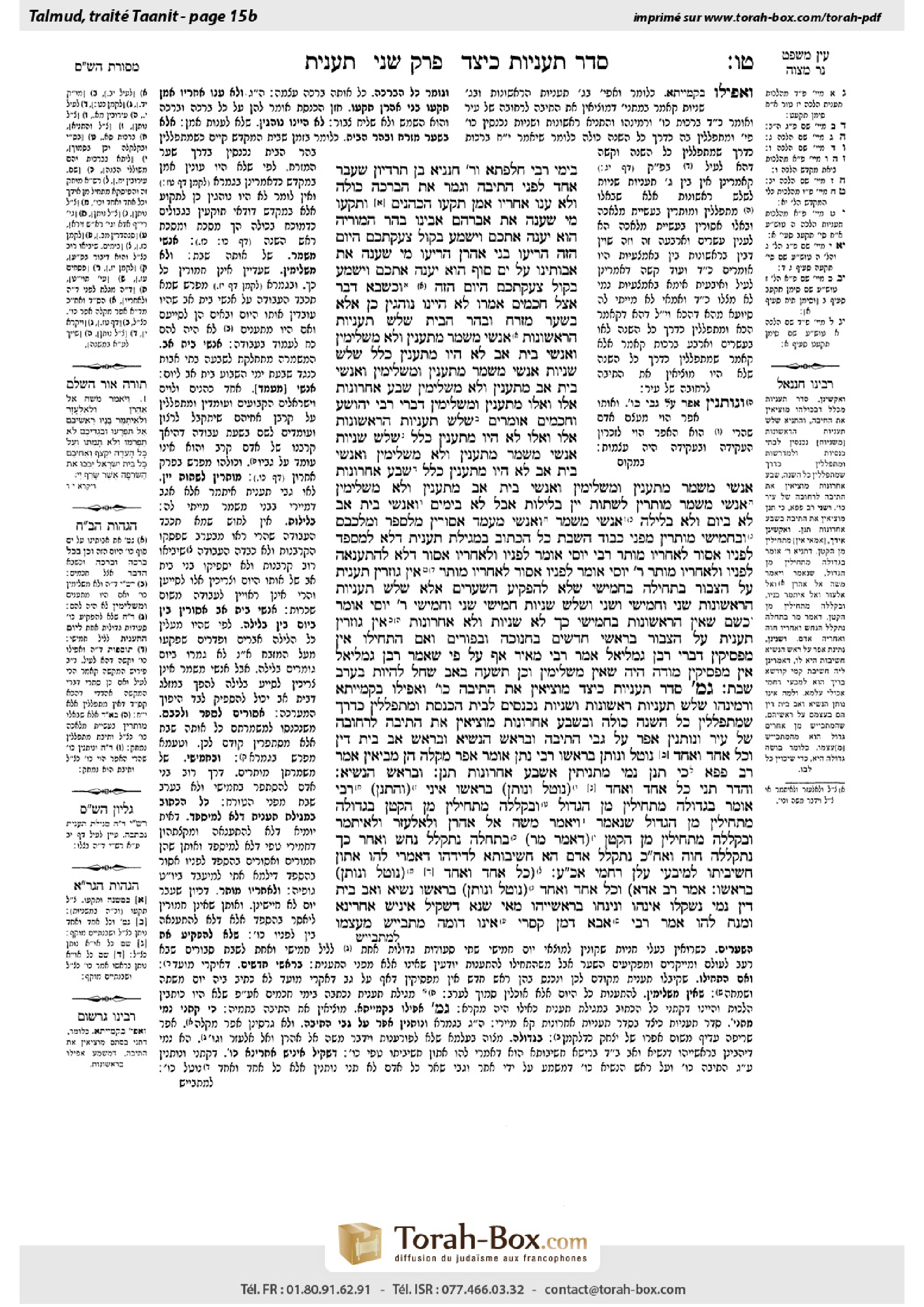
Taanit 15b: Talmud study for Daf Yomi
Daf Yomi is the daily study of one Talmud folio. Explore 37 tractates with scans, Hebrew text, Sefaria English and AI-generated French translations where annotated.
Passage selection and English or AI-generated French translation are available where the scan has annotations. Daf Study is independent of Torah-Box and Sefaria.
Browse Taanit · תענית · All tractatesTaanit 15b text and translations
This page of Taanit includes the Aramaic text, an English translation and an AI-generated French translation, alongside the scan above.
תענית י״ה ב · Aramaic and Hebrew text
בִּימֵי רַבִּי חֲלַפְתָּא וְרַבִּי חֲנַנְיָא בֶּן תְּרַדְיוֹן שֶׁעָבַר אֶחָד לִפְנֵי הַתֵּיבָה וְגָמַר אֶת הַבְּרָכָה כּוּלָּהּ, וְלֹא עָנוּ אַחֲרָיו אָמֵן. תִּקְעוּ הַכֹּהֲנִים תִּקְעוּ! מִי שֶׁעָנָה אֶת אַבְרָהָם אָבִינוּ בְּהַר הַמּוֹרִיָּה, הוּא יַעֲנֶה אֶתְכֶם וְיִשְׁמַע בְּקוֹל צַעֲקַתְכֶם הַיּוֹם הַזֶּה. הָרִיעוּ בְּנֵי אַהֲרֹן הָרִיעוּ! מִי שֶׁעָנָה אֶת אֲבוֹתֵינוּ עַל יַם סוּף, הוּא יַעֲנֶה אֶתְכֶם וְיִשְׁמַע בְּקוֹל צַעֲקַתְכֶם הַיּוֹם הַזֶּה.
וּכְשֶׁבָּא דָּבָר אֵצֶל חֲכָמִים, אָמְרוּ: לֹא הָיִינוּ נוֹהֲגִין כֵּן, אֶלָּא בְּשַׁעַר מִזְרָח וּבְהַר הַבַּיִת.
שָׁלֹשׁ תַּעֲנִיּוֹת הָרִאשׁוֹנוֹת — אַנְשֵׁי מִשְׁמָר מִתְעַנִּין וְלֹא מַשְׁלִימִין, וְאַנְשֵׁי בֵּית אָב לֹא הָיוּ מִתְעַנִּין כְּלָל. שָׁלֹשׁ שְׁנִיּוֹת — אַנְשֵׁי מִשְׁמָר מִתְעַנִּין וּמַשְׁלִימִין, וְאַנְשֵׁי בֵּית אָב מִתְעַנִּין וְלֹא מַשְׁלִימִין. שֶׁבַע אַחֲרוֹנוֹת — אֵלּוּ וָאֵלּוּ מִתְעַנִּין וּמַשְׁלִימִין, דִּבְרֵי רַבִּי יְהוֹשֻׁעַ.
וַחֲכָמִים אוֹמְרִים: שָׁלֹשׁ תַּעֲנִיּוֹת הָרִאשׁוֹנוֹת — אֵלּוּ וָאֵלּוּ לֹא הָיוּ מִתְעַנִּין כְּלָל. שָׁלֹשׁ שְׁנִיּוֹת — אַנְשֵׁי מִשְׁמָר מִתְעַנִּין וְלֹא מַשְׁלִימִין, וְאַנְשֵׁי בֵּית אָב לֹא הָיוּ מִתְעַנִּין כְּלָל, שֶׁבַע אַחֲרוֹנוֹת — אַנְשֵׁי מִשְׁמָר מִתְעַנִּין וּמַשְׁלִימִין, וְאַנְשֵׁי בֵּית אָב מִתְעַנִּין וְלֹא מַשְׁלִימִין.
אַנְשֵׁי מִשְׁמָר — מוּתָּרִין לִשְׁתּוֹת יַיִן בַּלֵּילוֹת, אֲבָל לֹא בַּיָּמִים, וְאַנְשֵׁי בֵּית אָב — לֹא בַּיּוֹם וְלֹא בַּלַּיְלָה. אַנְשֵׁי מִשְׁמָר וְאַנְשֵׁי מַעֲמָד — אֲסוּרִין מִלְּסַפֵּר וּמִלְּכַבֵּס. וּבַחֲמִישִׁי מוּתָּרִין, מִפְּנֵי כְּבוֹד הַשַּׁבָּת.
כׇּל הַכָּתוּב בִּמְגִלַּת תַּעֲנִית ״דְּלָא לְמִסְפַּד״ — לְפָנָיו אָסוּר, לְאַחֲרָיו — מוּתָּר. רַבִּי יוֹסֵי אוֹמֵר: לְפָנָיו וּלְאַחֲרָיו אָסוּר.
״דְּלָא לְהִתְעַנָּאָה״ — לְפָנָיו וּלְאַחֲרָיו מוּתָּר. רַבִּי יוֹסֵי אוֹמֵר: לְפָנָיו אָסוּר, לְאַחֲרָיו מוּתָּר.
אֵין גּוֹזְרִין תַּעֲנִית עַל הַצִּבּוּר בַּתְּחִילָּה בַּחֲמִישִׁי, שֶׁלֹּא לְהַפְקִיעַ הַשְּׁעָרִים. אֶלָּא שָׁלֹשׁ תַּעֲנִיּוֹת הָרִאשׁוֹנוֹת: שֵׁנִי וַחֲמִישִׁי וְשֵׁנִי, וְשָׁלֹשׁ שְׁנִיּוֹת: חֲמִישִׁי שֵׁנִי וַחֲמִישִׁי. רַבִּי יוֹסֵי אוֹמֵר: כְּשֵׁם שֶׁאֵין הָרִאשׁוֹנוֹת בַּחֲמִישִׁי, כָּךְ לֹא שְׁנִיּוֹת וְלֹא אַחֲרוֹנוֹת.
אֵין גּוֹזְרִין תַּעֲנִית עַל הַצִּבּוּר בְּרָאשֵׁי חֳדָשִׁים, בַּחֲנוּכָּה, וּבְפוּרִים. וְאִם הִתְחִילוּ — אֵין מַפְסִיקִין, דִּבְרֵי רַבָּן גַּמְלִיאֵל. אָמַר רַבִּי מֵאִיר: אַף עַל פִּי שֶׁאָמַר רַבָּן גַּמְלִיאֵל אֵין מַפְסִיקִין, מוֹדֶה הָיָה שֶׁאֵין מַשְׁלִימִין. וְכֵן תִּשְׁעָה בְּאָב שֶׁחָל לִהְיוֹת בְּעֶרֶב שַׁבָּת.
גְּמָ׳ סֵדֶר תַּעֲנִיּוֹת כֵּיצַד? מוֹצִיאִין אֶת הַתֵּיבָה כּוּ׳. וַאֲפִילּוּ בְּקַמַּיְיתָא? וּרְמִינְהוּ: שָׁלֹשׁ תַּעֲנִיּוֹת רִאשׁוֹנוֹת וּשְׁנִיּוֹת נִכְנָסִים לְבֵית הַכְּנֶסֶת, וּמִתְפַּלְּלִין כְּדֶרֶךְ שֶׁמִּתְפַּלְּלִין כׇּל הַשָּׁנָה כּוּלָּהּ
וּבְשֶׁבַע אַחֲרוֹנוֹת מוֹצִיאִין אֶת הַתֵּיבָה לִרְחוֹבָהּ שֶׁל עִיר, וְנוֹתְנִין אֵפֶר עַל גַּבֵּי הַתֵּיבָה, וּבְרֹאשׁ הַנָּשִׂיא, וּבְרֹאשׁ אַב בֵּית דִּין, וְכׇל אֶחָד וְאֶחָד נוֹטֵל וְנוֹתֵן בְּרֹאשׁוֹ. רַבִּי נָתָן אוֹמֵר: אֵפֶר מִקְלֶה הֵן מְבִיאִין! אָמַר רַב פָּפָּא: כִּי תְּנַן נָמֵי מַתְנִיתִין — אַשֶּׁבַע אַחֲרוֹנוֹת תְּנַן.
וּבְרֹאשׁ הַנָּשִׂיא, וַהֲדַר תָּנֵי כׇּל אֶחָד וְאֶחָד נוֹתֵן בְּרֹאשׁוֹ. אִינִי?! וְהָתַנְיָא: רַבִּי אוֹמֵר: בִּגְדוּלָּה מַתְחִילִין מִן הַגָּדוֹל, וּבִקְלָלָה מַתְחִילִין מִן הַקָּטָן.
בִּגְדוּלָּה מַתְחִילִין מִן הַגָּדוֹל, שֶׁנֶּאֱמַר: ״וַיֹּאמֶר מֹשֶׁה אֶל אַהֲרֹן וּלְאֶלְעָזָר וּלְאִיתָמָר״. וּבִקְלָלָה מַתְחִילִין מִן הַקָּטָן — שֶׁבַּתְּחִלָּה נִתְקַלֵּל נָחָשׁ, וְאַחַר כָּךְ נִתְקַלְּלָה חַוָּה, וְאַחַר כָּךְ נִתְקַלֵּל אָדָם!
הָא חֲשִׁיבוּתָא לְדִידְהוּ, דְּאָמְרִי לְהוּ: אַתּוּן חֲשִׁיבִיתוּ לְמִיבְעֵי עֲלַן רַחֲמֵי אַכּוּלֵּי עָלְמָא.
כׇּל אֶחָד וְאֶחָד נוֹתֵן בְּרֹאשׁוֹ. נָשִׂיא וְאַב בֵּית דִּין נָמֵי נִשְׁקְלוּ אִינְהוּ וְנַינְּחוּ בְּרֵאשַׁיְיהוּ, מַאי שְׁנָא דְּשָׁקֵיל אִינִישׁ אַחֲרִינָא וּמַנַּח לְהוּ? אָמַר רַבִּי אַבָּא דְּמִן קֵסָרִי: אֵינוֹ דּוֹמֶה מִתְבַּיֵּישׁ מֵעַצְמוֹ
Taanit 15b · English translation
in the days of Rabbi Ḥalafta and Rabbi Ḥananya ben Teradyon, that someone passed before the ark as prayer leader and finished the entire blessing of the fast day, but the congregation did not answer amen after him. Instead, the attendant of the synagogue said: Sound the shofar with a long, unwavering sound, priests, blow the shofar. The prayer leader continued: He Who answered Abraham on Mount Moriah, He will answer you and hear the sound of your cry on this day. Once again, the attendant announced: Blast the shofar, with a wavering sound, sons of Aaron, blast. The prayer leader resumed: He Who answered our forefathers by the Red Sea, He will answer you and hear the sound of your cry on this day, and continued in this way.
And when this matter came before the Sages, and they heard the custom of Rabbi Ḥalafta and Rabbi Ḥananya ben Teradyon, they said: They would act in accordance with this custom only at the Eastern Gate of the Temple and on the Temple Mount. However, this ceremony is never performed outside the Temple.
§ On the first three fasts, the members of the priestly watch, who are in charge of the Temple service that week, fast but do not complete their fast. And the members of the patrilineal family, who perform the Temple service on that particular day, did not fast at all. On the second set of three fast days, the members of the priestly watch fast and complete the fast, and the members of the patrilineal family fast but do not complete their fasts. On the final seven fasts, both groups fast and complete the fasts. This is the statement of Rabbi Yehoshua.
And the Rabbis say: On the first three fasts, the members of both groups do not fast at all. On the second three fast days, the members of the priestly watch fast and do not complete their fast, and the members of the patrilineal family do not fast at all. On the final seven, the members of the priestly watch fast and complete the fast, and the members of the patrilineal family fast but do not complete their fast.
The mishna mentions another difference between the members of the priestly watch and the patrilineal family: The members of the priestly watch were permitted to drink wine during the nights, but not during the days, as they might be called upon to assist in the Temple service, which may not be performed after drinking wine. And the members of the patrilineal family, who performed the Temple service, were not permitted to drink wine, neither at night nor during the day, as their tasks were performed at night as well. It is prohibited for both the members of the priestly watch and the members of the non-priestly watch to cut their hair or launder their garments throughout the week, but on Thursday it is permitted for them to cut their hair and launder their clothes in deference to Shabbat.
§ The mishna returns to the issue of fasting: Any day concerning which it is written in Megillat Ta’anit not to eulogize on that day, it is also prohibited to eulogize on the day before, but it is permitted to do so on the following day. Rabbi Yosei says: It is prohibited to eulogize both on the day before and on the following day.
The mishna continues: With regard to those days concerning which it is written only not to fast, it is permitted to fast on the day before and on the following day. Rabbi Yosei says: Fasting the day before is prohibited, but on the following day it is permitted to fast.
The mishna continues: One may not decree a fast on the community starting on a Thursday, so as not to cause an increase in prices. If the first of a series of fasts is on a Thursday, then on Friday everyone will come to purchase their food for after the fast and for Shabbat, which will allow the storeowners to take advantage of the crowds and raise their prices. Rather, the first set of three fasts is on a Monday, Thursday, and the following Monday, and the second set of three is on a Thursday, Monday, and the following Thursday. Rabbi Yosei says: Just as the first three fasts do not begin on Thursday, so too, neither the second set nor the last set starts on a Thursday. Instead, all the series of fasts begin on a Monday.
The mishna further states: One may not decree a fast on the community on New Moons, on Hanukkah, or on Purim. And if they decreed and began a set of fasts, and only afterward realized that one of the fasts would occur on one of these days, they do not interrupt the sequence. This is the statement of Rabban Gamliel. Rabbi Meir said: Although Rabban Gamliel said that they do not interrupt the sequence, he concedes that on these days, which are days with special observances, they do not complete the fast. And similarly, when the Ninth of Av occurs on Shabbat eve, the fast is not completed and one eats before the start of Shabbat, so as not to enter Shabbat while fasting.
GEMARA: The mishna teaches: What is the order of fast days? They remove the ark. The Gemara asks: And is this ritual performed even on the first set of fasts? And the Gemara raises a contradiction from a baraita: On the first and second sets of three fasts, everyone enters the synagogue and they pray in the manner that they pray throughout the entire year.
The baraita continues: And on the final seven fasts they remove the ark to the main city square and place ashes upon the ark, and on the head of the Nasi, and on the head of the deputy Nasi, and each and every member of the community takes ashes and places them upon his head. Rabbi Natan says: They would bring specifically burnt ashes. This baraita indicates that the full ritual is performed only on the final set of fasts. Rav Pappa said in explanation: When we taught the mishna as well, it was taught only with regard to the final set of seven fasts, not the earlier series of fasts.
§ And the mishna further states that ashes are placed on the head of the Nasi and on the head of the deputy Nasi. And then it teaches that each and every member of the community places ashes upon his head. The Gemara asks: Is that so? Is this the proper order? Isn’t it taught in a baraita that Rabbi Yehuda HaNasi says: With regard to matters of greatness, where it is a mark of honor and distinction to be treated first, one begins with the greatest member of the group, but for any matter involving a curse or dishonor, one begins with the least important member of the group.
The Gemara cites a baraita which provides the sources for this principle. With regard to matters of greatness one begins with the greatest member, as it is stated: “And Moses said to Aaron, and to Elazar and to Itamar, his sons” (Leviticus 10:6). Moses first addresses the most important person, Aaron, and this was a matter of distinction, as the verse continues: “For the anointing oil of the Lord is upon you” (Leviticus 10:7). And for any matter involving a curse, one begins with the least important member of a group, as the serpent was cursed first, and afterward Eve was cursed and afterward Adam was cursed.
Why, then, are the leaders of the community, its most important members, the first to perform these fast day expressions of mourning, which are a response to a curse? The Gemara answers: The reason is that this leadership role in the performance of these acts is considered a distinction and an honor for them, as it is as though the community is saying to them: You are worthy of requesting compassion on behalf of everyone.
§ The mishna teaches: Each and every member of the community places ashes upon his head. The Gemara asks: Let the Nasi and the deputy Nasi also take ashes themselves and place them upon their own heads. What is different with regard to them, that someone else takes the ashes and places them on their heads? Rabbi Abba of Caesarea said: This is done intentionally, as one who humiliates himself, in this case by placing ashes upon his own head, is not similar to
Taanit 15b · Traduction française (IA)
À l’époque de Rabbi Ḥalafta et de Rabbi Ḥananya ben Teradyon, quelqu’un passa devant l’arche en qualité d’officiant et récita toute la bénédiction du jour de jeûne, mais l’assemblée ne répondit pas amen après lui. Au lieu de cela, le bedeau de la synagogue dit : « Sonnez du chofar d’un son long et continu, prêtres, sonnez du chofar. » L’officiant poursuivit : « Celui qui a répondu à Abraham sur le mont Moriah vous répondra et entendra le son de votre cri en ce jour. » De nouveau, le bedeau annonça : « Sonnez du chofar d’un son tremblé, fils d’Aaron, sonnez. » L’officiant reprit : « Celui qui a répondu à nos ancêtres au bord de la mer Rouge vous répondra et entendra le son de votre cri en ce jour », et il continua ainsi.
Lorsque cette question fut portée devant les Sages, qui entendirent parler de la coutume de Rabbi Ḥalafta et de Rabbi Ḥananya ben Teradyon, ils dirent : « Ils ne procédaient selon cette coutume qu’à la Porte orientale du Temple et sur le mont du Temple. » Cependant, cette cérémonie n’est jamais accomplie en dehors du Temple.
§ Lors des trois premiers jeûnes, les membres de la garde sacerdotale, chargés du service du Temple cette semaine-là, jeûnent, mais ne vont pas jusqu’au bout de leur jeûne. Les membres de la famille sacerdotale, qui assurent le service du Temple ce jour-là, ne jeûnaient pas du tout. Lors de la deuxième série de trois jours de jeûne, les membres de la garde sacerdotale jeûnent et vont jusqu’au bout de leur jeûne, tandis que les membres de la famille sacerdotale jeûnent, mais ne vont pas jusqu’au bout. Lors des sept derniers jeûnes, les deux groupes jeûnent et vont jusqu’au bout de leur jeûne. Telle est la déclaration de Rabbi Yehoshua.
Les Rabbins disent : Lors des trois premiers jeûnes, les membres des deux groupes ne jeûnent pas du tout. Lors de la deuxième série de trois jours de jeûne, les membres de la garde sacerdotale jeûnent, mais ne vont pas jusqu’au bout de leur jeûne, tandis que les membres de la famille sacerdotale ne jeûnent pas du tout. Lors des sept derniers jeûnes, les membres de la garde sacerdotale jeûnent et vont jusqu’au bout de leur jeûne, tandis que les membres de la famille sacerdotale jeûnent, mais ne vont pas jusqu’au bout.
La Michna mentionne une autre différence entre les membres de la garde sacerdotale et ceux de la famille sacerdotale : les membres de la garde sacerdotale avaient le droit de boire du vin la nuit, mais pas le jour, car ils pouvaient être appelés à prêter main-forte au service du Temple, qui ne peut être accompli après avoir bu du vin. Quant aux membres de la famille sacerdotale, qui accomplissaient le service du Temple, ils n’avaient pas le droit de boire du vin, ni la nuit ni le jour, car leurs tâches s’effectuaient aussi la nuit. Il est interdit aux membres de la garde sacerdotale comme à ceux de la garde non sacerdotale de se couper les cheveux ou de laver leurs vêtements pendant toute la semaine ; toutefois, le jeudi, ils en ont le droit, par égard pour le Chabbat.
§ La Michna revient à la question des jeûnes : pour tout jour au sujet duquel il est écrit dans la Meguilat Ta’anit qu’il est interdit d’y prononcer une oraison funèbre, il est également interdit d’en prononcer une la veille, mais cela est permis le lendemain. Rabbi Yosei dit : Il est interdit d’en prononcer une aussi bien la veille que le lendemain.
La Michna poursuit : pour les jours au sujet desquels il est seulement écrit qu’il est interdit d’y jeûner, il est permis de jeûner la veille et le lendemain. Rabbi Yosei dit : Il est interdit de jeûner la veille, mais cela est permis le lendemain.
La Michna poursuit : on ne doit pas décréter un jeûne communautaire qui commence un jeudi, afin de ne pas provoquer une hausse des prix. Si le premier jour d’une série de jeûnes tombe un jeudi, tout le monde viendra acheter de quoi manger après le jeûne et pour le Chabbat, le vendredi ; les commerçants pourraient alors profiter de l’affluence pour augmenter leurs prix. La première série de trois jeûnes a donc lieu un lundi, un jeudi, puis le lundi suivant ; la deuxième série de trois a lieu un jeudi, un lundi, puis le jeudi suivant. Rabbi Yosei dit : de même que les trois premiers jeûnes ne commencent pas un jeudi, ni la deuxième série ni la dernière série ne commencent un jeudi. Au contraire, toutes les séries de jeûnes commencent un lundi.
La Michna enseigne également : on ne doit pas décréter de jeûne communautaire à Roch ‘Hodech, à Ḥanoucca ou à Pourim. Si l’on a décrété une série de jeûnes et qu’on l’a commencée, puis qu’on s’aperçoit seulement ensuite que l’un des jeûnes tombe l’un de ces jours, on n’interrompt pas la série. Telle est la déclaration de Rabban Gamliel. Rabbi Meir dit : bien que Rabban Gamliel ait dit qu’on n’interrompt pas la série, il reconnaît que, ces jours comportant des observances particulières, on ne va pas jusqu’au bout du jeûne. De même, lorsque le Neuf Av tombe la veille du Chabbat, on ne va pas jusqu’au bout du jeûne et l’on mange avant le début du Chabbat, afin de ne pas entrer dans le Chabbat en jeûnant.
GUEMARA : La Michna enseigne : Quel est l’ordre des jours de jeûne ? On sort l’arche. La Guemara demande : Accomplit-on ce rituel même lors de la première série de jeûnes ? La Guemara soulève une contradiction à partir d’une baraïta : lors de la première et de la deuxième série de trois jeûnes, tout le monde entre dans la synagogue et prie comme on prie tout au long de l’année.
La baraïta poursuit : lors des sept derniers jeûnes, on sort l’arche sur la place principale de la ville et l’on dépose des cendres sur l’arche, sur la tête du Nassi et sur celle du vice-Nassi ; chaque membre de la communauté prend ensuite des cendres et les dépose sur sa tête. Rabbi Natan dit : On apportait précisément des cendres brûlées. Cette baraïta indique que le rituel complet n’est accompli que lors de la dernière série de jeûnes. Rav Pappa expliqua : lorsque nous avons également enseigné la Michna, nous l’avons enseignée uniquement à propos de la dernière série des sept jeûnes, et non des séries antérieures.
§ La Michna dit également que l’on dépose des cendres sur la tête du Nassi et sur celle du vice-Nassi. Puis elle enseigne que chaque membre de la communauté dépose des cendres sur sa tête. La Guemara demande : Est-ce bien ainsi ? Est-ce l’ordre qui convient ? N’est-il pas enseigné dans une baraïta que Rabbi Yehuda HaNassi dit : pour les marques de grandeur, lorsqu’il est honorable et prestigieux d’être traité en premier, on commence par le membre le plus éminent du groupe ; mais pour toute chose impliquant une malédiction ou un déshonneur, on commence par le membre le moins important du groupe.
La Guemara cite une baraïta qui donne les sources de ce principe. Pour les marques de grandeur, on commence par le membre le plus éminent, comme il est dit : « Moïse dit à Aaron, à Éléazar et à Itamar, ses fils » (Lévitique 10,6). Moïse s’adresse d’abord à la personne la plus éminente, Aaron, et il s’agissait d’une marque de distinction, comme le poursuit le verset : « Car l’huile d’onction du Seigneur est sur vous » (Lévitique 10,7). Pour toute chose impliquant une malédiction, on commence par le membre le moins important du groupe : le serpent fut maudit en premier, puis Ève, et ensuite Adam.
Pourquoi, alors, les dirigeants de la communauté, ses membres les plus éminents, sont-ils les premiers à accomplir ces gestes de deuil propres au jour de jeûne, qui sont une réponse à une malédiction ? La Guemara répond : c’est parce que ce rôle de dirigeant dans l’accomplissement de ces gestes est considéré comme une distinction et un honneur pour eux ; c’est comme si la communauté leur disait : « Vous êtes dignes de demander la compassion au nom de tous. »
§ La Michna enseigne : chaque membre de la communauté dépose des cendres sur sa tête. La Guemara demande : Que le Nassi et le vice-Nassi prennent eux aussi des cendres et les déposent sur leur propre tête. En quoi diffèrent-ils, pour que quelqu’un d’autre prenne les cendres et les dépose sur leur tête ? Rabbi Abba de Césarée dit : cela se fait intentionnellement, car celui qui s’humilie lui-même, en déposant ici des cendres sur sa propre tête, n’est pas semblable à
Traduction française générée par IA à partir de l’édition anglaise de Sefaria. Vérifie toujours un passage avec le texte source.
Text from Sefaria: William Davidson Edition - Vocalized Aramaic (CC BY NC); William Davidson Edition - English (CC BY NC).