Taanit 27b: Talmud study for Daf Yomi
Daf Yomi is the daily study of one Talmud folio. Explore 37 tractates with scans, Hebrew text, Sefaria English and AI-generated French translations where annotated.
Passage selection and English or AI-generated French translation are available where the scan has annotations. Daf Study is independent of Torah-Box and Sefaria.
Browse Taanit · תענית · All tractatesTaanit 27b text and translations
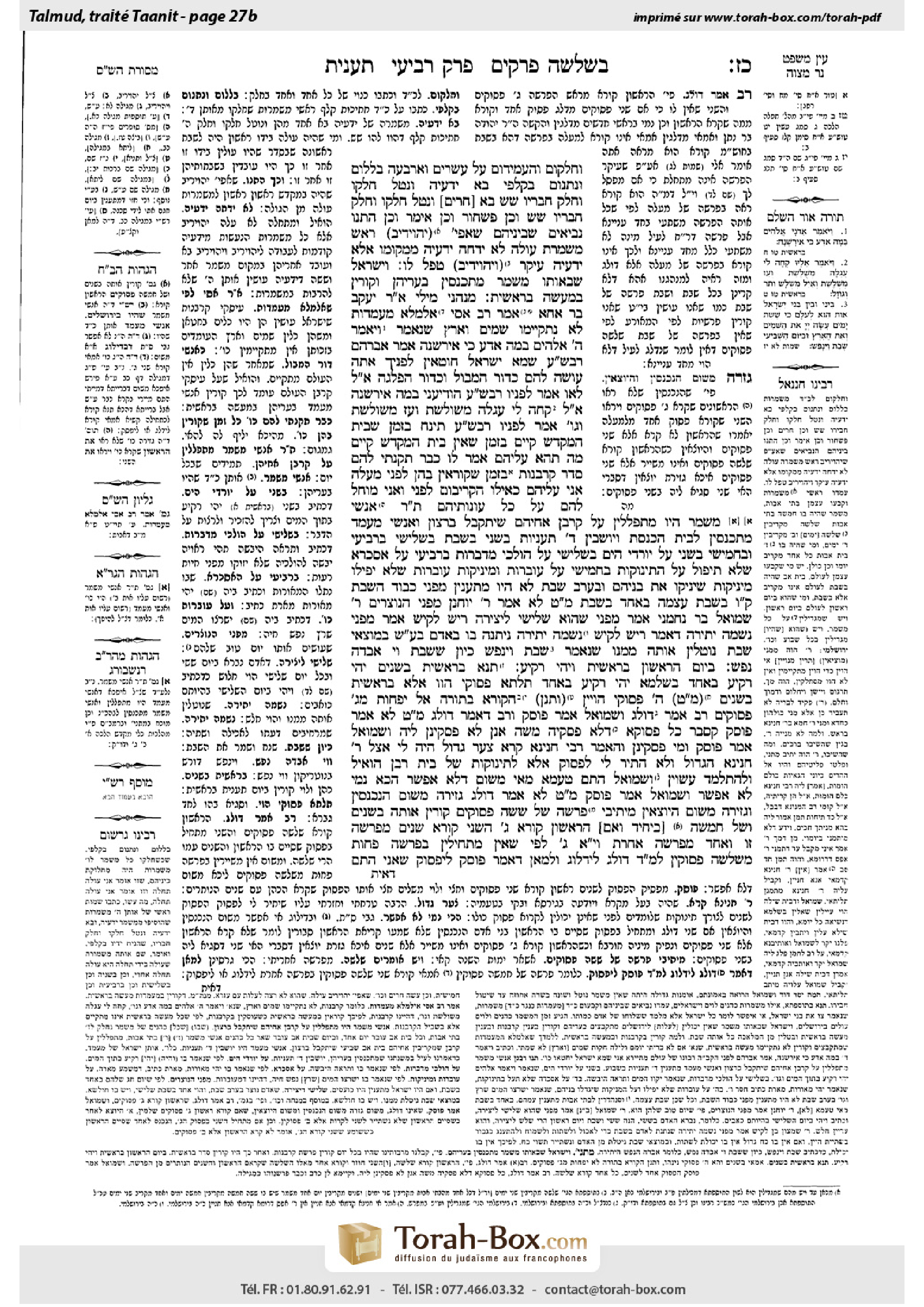
This page of Taanit includes the Aramaic text, an English translation and an AI-generated French translation, alongside the scan above.
תענית כ״ז ב · Aramaic and Hebrew text
וְחִלְּקוּם וְהֶעֱמִידוּם עַל עֶשְׂרִים וְאַרְבָּעָה, בְּלָלוּם וּנְתָנוּם בְּקַלְפִּי. בָּא יְדַעְיָה וְנָטַל חֶלְקוֹ וְחֵלֶק חֲבֵרָיו שֵׁשׁ, בָּא חָרִים וְנָטַל חֶלְקוֹ וְחֵלֶק חֲבֵרָיו שֵׁשׁ, וְכֵן פַּשְׁחוּר, וְכֵן אִימֵּר.
וְכֵן הִתְנוּ נְבִיאִים שֶׁבֵּינֵיהֶם: שֶׁאֲפִילּוּ יְהוֹיָרִיב רֹאשׁ מִשְׁמֶרֶת עוֹלֶה — לֹא יִדָּחֶה יְדַעְיָה מִמְּקוֹמוֹ. אֶלָּא יְדַעְיָה עִיקָּר, וִיהוֹיָרִיב טָפֵל לוֹ.
וְיִשְׂרָאֵל שֶׁבְּאוֹתוֹ מִשְׁמָר מִתְכַּנְּסִין בְּעָרֵיהֶן וְקוֹרִין בְּמַעֲשֵׂה בְרֵאשִׁית. מְנָהָנֵי מִילֵּי? אָמַר רַבִּי יַעֲקֹב בַּר אַחָא אָמַר רַב אַסִּי: אִלְמָלֵא מַעֲמָדוֹת לֹא נִתְקַיְּימוּ שָׁמַיִם וָאָרֶץ, שֶׁנֶּאֱמַר: ״וַיֹּאמֶר ה׳ אֱלֹהִים בַּמָּה אֵדַע כִּי אִירָשֶׁנָּה״,
אָמַר אַבְרָהָם: רִבּוֹנוֹ שֶׁל עוֹלָם! שֶׁמָּא יִשְׂרָאֵל חוֹטְאִין לְפָנֶיךָ, אַתָּה עוֹשֶׂה לָהֶם כְּדוֹר הַמַּבּוּל וּכְדוֹר הַפְּלַגָּה? אֲמַר לֵיהּ: לָאו. אָמַר לְפָנָיו: רִבּוֹנוֹ שֶׁל עוֹלָם! הוֹדִיעֵנִי בַּמֶּה אִירָשֶׁנָּה? אֲמַר לֵיהּ: ״קְחָה לִי עֶגְלָה מְשֻׁלֶּשֶׁת וְעֵז מְשֻׁלֶּשֶׁת וְגוֹ׳״.
אָמַר לְפָנָיו: רִבּוֹנוֹ שֶׁל עוֹלָם! תִּינַח בִּזְמַן שֶׁבֵּית הַמִּקְדָּשׁ קַיָּים. בִּזְמַן שֶׁאֵין בֵּית הַמִּקְדָּשׁ קַיָּים מָה תְּהֵא עֲלֵיהֶם? אָמַר לוֹ: כְּבָר תִּקַּנְתִּי לָהֶם סֵדֶר קׇרְבָּנוֹת, בִּזְמַן שֶׁקּוֹרְאִין בָּהֶן לְפָנַי — מַעֲלֶה אֲנִי עֲלֵיהֶם כְּאִילּוּ הִקְרִיבוּם לְפָנַי וַאֲנִי מוֹחֵל לָהֶם עַל כׇּל עֲוֹנוֹתֵיהֶם.
תָּנוּ רַבָּנַן: אַנְשֵׁי מִשְׁמָר הָיוּ מִתְפַּלְּלִין עַל קׇרְבַּן אֲחֵיהֶם שֶׁיִּתְקַבֵּל בְּרָצוֹן. וְאַנְשֵׁי מַעֲמָד מִתְכַּנְּסִין לְבֵית הַכְּנֶסֶת, וְיוֹשְׁבִין אַרְבַּע תַּעֲנִיּוֹת: בַּשֵּׁנִי בַּשַּׁבָּת, בַּשְּׁלִישִׁי, בָּרְבִיעִי, וּבַחֲמִישִׁי. בַּשֵּׁנִי — עַל יוֹרְדֵי הַיָּם. בַּשְּׁלִישִׁי — עַל הוֹלְכֵי מִדְבָּרוֹת.
בָּרְבִיעִי — עַל אַסְכָּרָא שֶׁלֹּא תִּיפּוֹל עַל הַתִּינוֹקוֹת. בַּחֲמִישִׁי — עַל עוּבָּרוֹת וּמֵינִיקוֹת. עוּבָּרוֹת — שֶׁלֹּא יַפִּילוּ, מֵינִיקוֹת — שֶׁיָּנִיקוּ אֶת בְּנֵיהֶם. וּבָעֶרֶב שַׁבָּת לֹא הָיוּ מִתְעַנִּין מִפְּנֵי כְּבוֹד הַשַּׁבָּת, קַל וָחוֹמֶר בַּשַּׁבָּת עַצְמָהּ.
בְּאֶחָד בְּשַׁבָּת מַאי טַעְמָא לָא? אָמַר רַבִּי יוֹחָנָן: מִפְּנֵי הַנּוֹצְרִים. רַבִּי שְׁמוּאֵל בַּר נַחְמָנִי אָמַר: מִפְּנֵי שֶׁהוּא שְׁלִישִׁי לַיְצִירָה.
רֵישׁ לָקִישׁ אָמַר: מִפְּנֵי נְשָׁמָה יְתֵירָה, דְּאָמַר רֵישׁ לָקִישׁ: נְשָׁמָה יְתֵירָה נִיתְּנָה בּוֹ בָּאָדָם בְּעֶרֶב שַׁבָּת, בְּמוֹצָאֵי שַׁבָּת נוֹטְלִין אוֹתָהּ מִמֶּנּוּ, שֶׁנֶּאֱמַר: ״שָׁבַת וַיִּנָּפַשׁ״. כֵּיוָן שֶׁשָּׁבַת — וַי אָבְדָה נָפֶשׁ.
בַּיּוֹם הָרִאשׁוֹן ״בְּרֵאשִׁית״ וִ״יהִי רָקִיעַ״. תָּנָא: ״בְּרֵאשִׁית״ בִּשְׁנַיִם, ״יְהִי רָקִיעַ״ בְּאֶחָד. בִּשְׁלָמָא ״יְהִי רָקִיעַ״ בְּאֶחָד — תְּלָתָא פְּסוּקֵי הָווּ. אֶלָּא ״בְּרֵאשִׁית״ בִּשְׁנַיִם, מַאי טַעְמָא? חַמְשָׁה פְּסוּקֵי הָוַיִין, וְתַנְיָא: הַקּוֹרֵא בַּתּוֹרָה — אַל יִפְחוֹת מִשְּׁלֹשָׁה פְּסוּקִים!
רַב אָמַר: דּוֹלֵג. וּשְׁמוּאֵל אָמַר: פּוֹסֵק. וְרַב דְּאָמַר דּוֹלֵג, מַאי טַעְמָא לָא אָמַר פּוֹסֵק? קָסָבַר: כׇּל פְּסוּקָא דְּלָא פַּסְקֵיהּ מֹשֶׁה — אֲנַן לָא פָּסְקִינַן לֵיהּ.
וּשְׁמוּאֵל אָמַר פּוֹסֵק, וּמִי פָּסְקִינַן? וְהָאָמַר רַבִּי חֲנִינָא קָרָא: צַעַר גָּדוֹל הָיָה לִי אֵצֶל רַבִּי חֲנִינָא הַגָּדוֹל וְלֹא הִתִּיר לִי לִפְסוֹק אֶלָּא לְתִינוֹקוֹת שֶׁל בֵּית רַבָּן, הוֹאִיל וּלְהִתְלַמֵּד עֲשׂוּיִן. וּשְׁמוּאֵל — הָתָם טַעְמָא מַאי? מִשּׁוּם דְּלָא אֶפְשָׁר. הָכָא נָמֵי לָא אֶפְשָׁר.
וּשְׁמוּאֵל אָמַר פּוֹסֵק, מַאי טַעְמָא לָא אָמַר דּוֹלֵג? גְּזֵירָה מִשּׁוּם הַנִּכְנָסִין וּגְזֵרָה מִשּׁוּם הַיּוֹצְאִין.
מֵיתִיבִי: פָּרָשָׁה שֶׁל שִׁשָּׁה פְּסוּקִים — קוֹרִין אוֹתָהּ בִּשְׁנַיִם, וְשֶׁל חֲמִשָּׁה — בְּיָחִיד. וְאִם הָרִאשׁוֹן קוֹרֵא שְׁלֹשָׁה, הַשֵּׁנִי קוֹרֵא שְׁנַיִם מִפָּרָשָׁה זוֹ וְאֶחָד מִפָּרָשָׁה אַחֶרֶת. וְיֵשׁ אוֹמְרִים: שְׁלֹשָׁה, לְפִי שֶׁאֵין מַתְחִילִין בַּפָּרָשָׁה פָּחוֹת מִשְּׁלֹשָׁה פְּסוּקִין.
לְמַאן דְּאָמַר דּוֹלֵג — לִידְלוֹג, וּלְמַאן דְּאָמַר פּוֹסֵק — לִיפְסוֹק! שָׁאנֵי הָתָם,
Taanit 27b · English translation
and divided them and established them as twenty-four watches. They achieved this by writing the names of these new twenty-four watches on pieces of paper, mixing them up, and putting them in a receptacle [kalfei] from which lots were drawn. A representative from the family of Jedaiah came and drew his portion and the lot of five other watches, for a total of six. Harim came and also drew his portion and the lot of five other watches, a total of six. And likewise Pashhur, and likewise Immer.
And likewise the prophets among them stipulated that even if the descendants of Jehoiarib, who originally headed the priestly watches, ascended to Eretz Yisrael, Jedaiah would not be demoted from its place as the first of the watches. Rather, the watch of Jedaiah would retain precedence, and Jehoiarib would be subordinate to it.
§ The mishna taught: And the Israelites of that priestly watch assembled in their towns and read the act of Creation. The Gemara asks: From where is this matter, that they must read this specific portion, derived? Rabbi Ya’akov bar Aḥa said that Rav Asi said: Were it not for the non-priestly watches and the Temple service, heaven and earth would not continue to exist, as it is stated: “And he said: Lord God, by what shall I know that I shall inherit it?” (Genesis 15:8).
The Gemara explains this verse. Abraham said: Master of the Universe, perhaps the Jews will sin before You. Will You treat them as You did the generation of the flood and the generation of the dispersion, and destroy them? God said to him: No. Abraham said before God: Master of the Universe, tell me, with what shall I inherit it? How can my descendants ensure that You will maintain the world? God said to Abraham: “Take for Me a three-year-old heifer, and a three-year-old goat, and a three-year-old ram, and a turtledove, and a young pigeon” (Genesis 15:9). God was alluding to the offerings, in whose merit the Jewish people, and through them the entire world, will be spared divine punishment.
Abraham said before God: Master of the Universe, this works out well when the Temple is standing, but when the Temple is not standing, what will become of them? God said to him: I have already enacted for them the order of offerings. When they read them before Me, I will ascribe them credit as though they had sacrificed them before Me and I will pardon them for all their transgressions. Since the offerings ensure the continued existence of the Jewish people and the rest of the world, the act of Creation is read in their honor.
§ The Sages taught: The members of the priestly watch would pray for the offerings of their brothers, the daily offering, that it should be accepted with favor. And meanwhile, the members of the non-priestly watch remained in their towns and would assemble in the synagogue and observe four fasts: On Monday of that week, on Tuesday, on Wednesday, and on Thursday. On Monday they would fast for seafarers, that they should be rescued from danger, as the sea was created on Monday. On Tuesday they would fast for those who walk in the desert, as the dry land was created on Tuesday.
On Wednesday they would fast over croup, that it should not befall the children, as on the fourth day the bodies of light [me’orot] were created, a textual allusion to curses [me’erot]. On Thursday they would fast for pregnant women and nursing women, as living beings were first created on this day. For pregnant women they would fast that they should not miscarry, while for nursing women they would fast that they should be able to nurse their children properly. And on Shabbat eve they would not fast, in deference to Shabbat, and a fortiori they would not fast on Shabbat itself.
The Gemara asks: What is the reason that they would not fast on Sunday? Rabbi Yoḥanan said: Due to the Christians, as Sunday is their day of rest, and they would claim that even the Jews ascribe significance to their special day. Rabbi Shmuel bar Naḥmani said: Because it is the third day after the creation of man, who was created on Friday, and the third day of recovery from a wound or sickness, in this case one’s very creation, is considered the most painful.
Reish Lakish said: They would not fast on Sunday due to the added soul, as Reish Lakish said: An added soul is given to man on Shabbat eve, and at the conclusion of Shabbat it is removed it from him, as it is stated: “He ceased from work and rested [vayinafash]” (Exodus 31:17), which he expounds as follows: Since one has rested and Shabbat has passed, woe for the soul [vai nefesh] that is lost, the added soul that each individual relinquishes. Consequently, one is still weak from this loss on Sunday.
The mishna taught that on Sunday they would read the portions starting with: “In the beginning” (Genesis 1:1–5) and “Let there be a firmament” (Genesis 1:6–8). It is taught in a baraita: The section: “In the beginning” is read by two people, while “Let there be a firmament” is read by one. The Gemara asks: Granted, the passage “Let there be a firmament” is read by one individual, as it is three verses long, and one who is called to the Torah reads at least three verses. However, what is the reason that the section “In the beginning” is read by two individuals? It is five verses long, and it is taught in a mishna (Megilla 22a): One who reads from the Torah may not read fewer than three verses. How, then, are five verses read by two individuals?
The Gemara cites two answers. Rav said: The first reader reads the first three verses, and the second reader repeats the last verse read by the first, and continues with the final two verses. And Shmuel said: They split the middle verse into two, so that each of the pair reads half of it. The Gemara asks: And with regard to Rav, who said that one repeats, what is the reason that he did not say they should split a verse? The Gemara answers that Rav maintains that with regard to any verse that was not divided by Moses, we do not divide it.
And Shmuel said that one splits the middle verse into two. The Gemara asks: And may one split a single verse? But didn’t Rabbi Ḥanina Kara, the Bible expert, who taught the Bible to schoolchildren, say: I had great trouble with Rabbi Ḥanina the Great when I asked him this question, and he permitted me to split long verses into two only for the benefit of schoolchildren, since it is performed to help them learn. And Shmuel can respond that what is the reason there, in the case of schoolchildren, that it is permitted to split verses? Because it is not possible to proceed in any other way. Here too, it is not possible for two people to read five verses other than by splitting one of them into two.
The Gemara questions this last conclusion. And Shmuel said that one splits the middle verse into two. What is the reason that he did not say that he repeats one of the verses, in accordance with the opinion of Rav? The Gemara explains: It is a rabbinic decree due to those who enter the synagogue in the middle of the reading, and a decree due to those who leave in the middle. If someone entered or exited in the middle of the reading and heard three full verses, he might think that one of the readers had read fewer than three full verses, which might lead him to conclude that it is permitted to read fewer than three verses.
The Gemara raises an objection from a baraita: A chapter consisting of six verses may be read by two individuals, and a chapter of five verses must be read by one. And if the first individual reads three verses from the five-verse chapter, the second one reads the last two verses of that chapter and one more from another chapter. And some say that three verses are read from the next chapter, as one may not begin to read a chapter for fewer than three verses.
The Gemara explains the objection: According to the one who said that they repeat the middle verse, let the second reader repeat a verse here as well. And according to the one who said that they split a verse, here too, let them split it. Apparently, the baraita contradicts the opinions of both Rav and Shmuel. The Gemara answers: It is different there,
Taanit 27b · Traduction française (IA)
et les répartirent en vingt-quatre équipes. Ils procédèrent en inscrivant les noms de ces vingt-quatre nouvelles équipes sur des bouts de papier, en les mélangeant et en les plaçant dans un récipient [kalfei] d’où l’on tirait au sort. Un représentant de la famille de Yedaïa vint tirer au sort sa part et celle de cinq autres équipes, soit six au total. Harim vint à son tour tirer au sort sa part et celle de cinq autres équipes, soit six au total. Il en fut de même pour Pashhour et pour Immer.
De même, les prophètes parmi eux stipulèrent que, même si les descendants de Yehoyariv, qui dirigeaient à l’origine les équipes sacerdotales, montaient en terre d’Israël, Yedaïa ne serait pas délogée de sa place de première équipe. L’équipe de Yedaïa conserverait plutôt la préséance, et Yehoyariv lui serait subordonnée.
§ La Michna enseigne : Les Israélites appartenant à cette équipe sacerdotale se rassemblaient dans leurs villes et lisaient le récit de la Création. La Guemara demande : D’où sait-on qu’ils doivent lire précisément ce passage ? Rabbi Ya’akov bar Aḥa a dit au nom de Rav Asi : Sans les équipes non sacerdotales et le service du Temple, le ciel et la terre ne continueraient pas d’exister, comme il est dit : « Et il dit : Seigneur Dieu, à quoi connaîtrai-je que j’en hériterai ? » (Genèse 15, 8).
La Guemara explique ce verset. Abraham dit : Maître de l’univers, peut-être les Juifs pécheront-ils devant Toi. Les traiteras-Tu comme Tu as traité la génération du Déluge et celle de la dispersion, et les détruiras-Tu ? Dieu lui dit : Non. Abraham dit devant Dieu : Maître de l’univers, dis-moi, par quoi en hériterai-je ? Comment mes descendants pourront-ils faire en sorte que Tu maintiennes le monde ? Dieu dit à Abraham : « Prends pour Moi une génisse de trois ans, une chèvre de trois ans, un bélier de trois ans, une tourterelle et un jeune pigeon » (Genèse 15, 9). Dieu faisait allusion aux sacrifices, par le mérite desquels le peuple juif, et à travers lui le monde entier, serait épargné du châtiment divin.
Abraham dit devant Dieu : Maître de l’univers, cela convient lorsque le Temple est debout, mais quand il ne l’est pas, que leur arrivera-t-il ? Dieu lui dit : J’ai déjà institué pour eux l’ordre des sacrifices. Lorsqu’ils les liront devant Moi, Je le leur compterai comme s’ils les avaient offerts devant Moi et Je leur pardonnerai toutes leurs transgressions. Puisque les sacrifices assurent la pérennité du peuple juif et du reste du monde, le récit de la Création est lu en leur honneur.
§ Les Sages enseignent : Les membres de l’équipe sacerdotale priaient pour que les sacrifices de leurs frères, l’offrande quotidienne, soient agréés. Pendant ce temps, les membres de l’équipe non sacerdotale restaient dans leurs villes, se rassemblaient à la synagogue et observaient quatre jeûnes : le lundi de cette semaine, le mardi, le mercredi et le jeudi. Le lundi, ils jeûnaient pour les marins, afin qu’ils soient sauvés du danger, car la mer fut créée le lundi. Le mardi, ils jeûnaient pour ceux qui cheminent dans le désert, car la terre ferme fut créée le mardi.
Le mercredi, ils jeûnaient contre le croup, afin qu’il ne frappe pas les enfants, car le quatrième jour furent créés les luminaires [me’orot], ce qui évoque textuellement les malédictions [me’erot]. Le jeudi, ils jeûnaient pour les femmes enceintes et les femmes qui allaitent, car les êtres vivants furent créés pour la première fois ce jour-là. Pour les femmes enceintes, ils jeûnaient afin qu’elles ne fassent pas de fausse couche ; pour les femmes qui allaitent, afin qu’elles puissent nourrir correctement leurs enfants. Ils ne jeûnaient pas la veille de Chabbat, par égard pour Chabbat, et à plus forte raison ne jeûnaient-ils pas le Chabbat même.
La Guemara demande : Pourquoi ne jeûnaient-ils pas le dimanche ? Rabbi Yoḥanan a dit : À cause des chrétiens, car le dimanche est leur jour de repos et ils auraient prétendu que les Juifs aussi accordent de l’importance à leur jour particulier. Rabbi Shmuel bar Naḥmani a dit : Parce que c’est le troisième jour après la création de l’homme, qui fut créé le vendredi, et que le troisième jour de convalescence après une blessure ou une maladie — ici, sa création même — est considéré comme le plus douloureux.
Reish Lakish a dit : Ils ne jeûnaient pas le dimanche à cause de l’âme supplémentaire. En effet, Reish Lakish a dit : Une âme supplémentaire est accordée à l’homme la veille de Chabbat, et elle lui est retirée à la fin de Chabbat, comme il est dit : « Il cessa son ouvrage et se reposa [vayinafash] » (Exode 31, 17), ce qu’il interprète ainsi : Puisqu’on s’est reposé et que Chabbat est passé, malheur à l’âme [vai nefesh] qui s’en est allée, l’âme supplémentaire à laquelle chacun renonce. Par conséquent, on est encore affaibli par cette perte le dimanche.
La Michna enseigne que le dimanche, on lisait les passages commençant par : « Au commencement » (Genèse 1, 1-5) et « Qu’il y ait une étendue » (Genèse 1, 6-8). Une baraïta enseigne : Le passage « Au commencement » est lu par deux personnes, tandis que « Qu’il y ait une étendue » est lu par une seule. La Guemara demande : Il est compréhensible que le passage « Qu’il y ait une étendue » soit lu par une seule personne, puisqu’il compte trois versets et que celui qui est appelé à lire la Torah en lit au moins trois. Mais pourquoi le passage « Au commencement » est-il lu par deux personnes ? Il compte cinq versets, et une Michna enseigne (Meguila 22a) : Celui qui lit dans la Torah ne peut lire moins de trois versets. Comment, dès lors, deux personnes peuvent-elles lire cinq versets ?
La Guemara rapporte deux réponses. Rav a dit : Le premier lecteur lit les trois premiers versets, et le second répète le dernier verset lu par le premier, puis poursuit avec les deux derniers versets. Shmuel a dit : Ils partagent en deux le verset du milieu, de sorte que chacun des deux en lit la moitié. La Guemara demande : Quant à Rav, qui dit qu’on répète, pourquoi ne dit-il pas qu’il faut partager un verset ? La Guemara répond que Rav estime qu’on ne partage pas un verset qui n’a pas été divisé par Moïse.
Shmuel a dit qu’on partage en deux le verset du milieu. La Guemara demande : Peut-on partager un seul verset ? Rabbi Ḥanina Kara, l’expert de la Bible qui enseignait la Bible aux enfants, n’a-t-il pas dit : J’ai eu beaucoup de mal avec Rabbi Ḥanina le Grand lorsque je lui ai posé cette question, et il ne m’a autorisé à partager en deux de longs versets que pour aider les enfants, puisque cela se fait pour faciliter leur apprentissage. Shmuel pourrait répondre : Pourquoi, dans le cas des enfants, est-il permis de partager les versets ? Parce qu’il n’est pas possible de procéder autrement. Ici aussi, il est impossible que deux personnes lisent cinq versets sans en partager un en deux.
La Guemara met en question cette dernière conclusion. Shmuel a dit qu’on partage en deux le verset du milieu. Pourquoi n’a-t-il pas dit qu’on répète l’un des versets, conformément à l’avis de Rav ? La Guemara explique : C’est à cause d’un décret rabbinique concernant ceux qui entrent dans la synagogue au milieu de la lecture, et d’un autre décret concernant ceux qui la quittent au milieu. Si quelqu’un entrait ou sortait pendant la lecture et entendait trois versets complets, il pourrait penser que l’un des lecteurs en a lu moins de trois complets, et en conclure qu’il est permis de lire moins de trois versets.
La Guemara soulève une objection à partir d’une baraïta : Un chapitre de six versets peut être lu par deux personnes, tandis qu’un chapitre de cinq versets doit être lu par une seule. Si le premier lecteur lit trois versets du chapitre de cinq versets, le second lit les deux derniers versets de ce chapitre, puis un verset supplémentaire d’un autre chapitre. Certains disent qu’on lit trois versets du chapitre suivant, car on ne peut commencer la lecture d’un chapitre par moins de trois versets.
La Guemara explique l’objection : Selon celui qui dit qu’on répète le verset du milieu, que le second lecteur répète lui aussi un verset ici. Et selon celui qui dit qu’on partage un verset, qu’on le partage ici aussi. Il semble donc que la baraïta contredise les avis de Rav et de Shmuel. La Guemara répond : Le cas présenté là est différent,
Traduction française générée par IA à partir de l’édition anglaise de Sefaria. Vérifie toujours un passage avec le texte source.
Text from Sefaria: William Davidson Edition - Vocalized Aramaic (CC BY NC); William Davidson Edition - English (CC BY NC).