Taanit 28a: Talmud study for Daf Yomi
Daf Yomi is the daily study of one Talmud folio. Explore 37 tractates with scans, Hebrew text, Sefaria English and AI-generated French translations where annotated.
Passage selection and English or AI-generated French translation are available where the scan has annotations. Daf Study is independent of Torah-Box and Sefaria.
Browse Taanit · תענית · All tractatesTaanit 28a text and translations
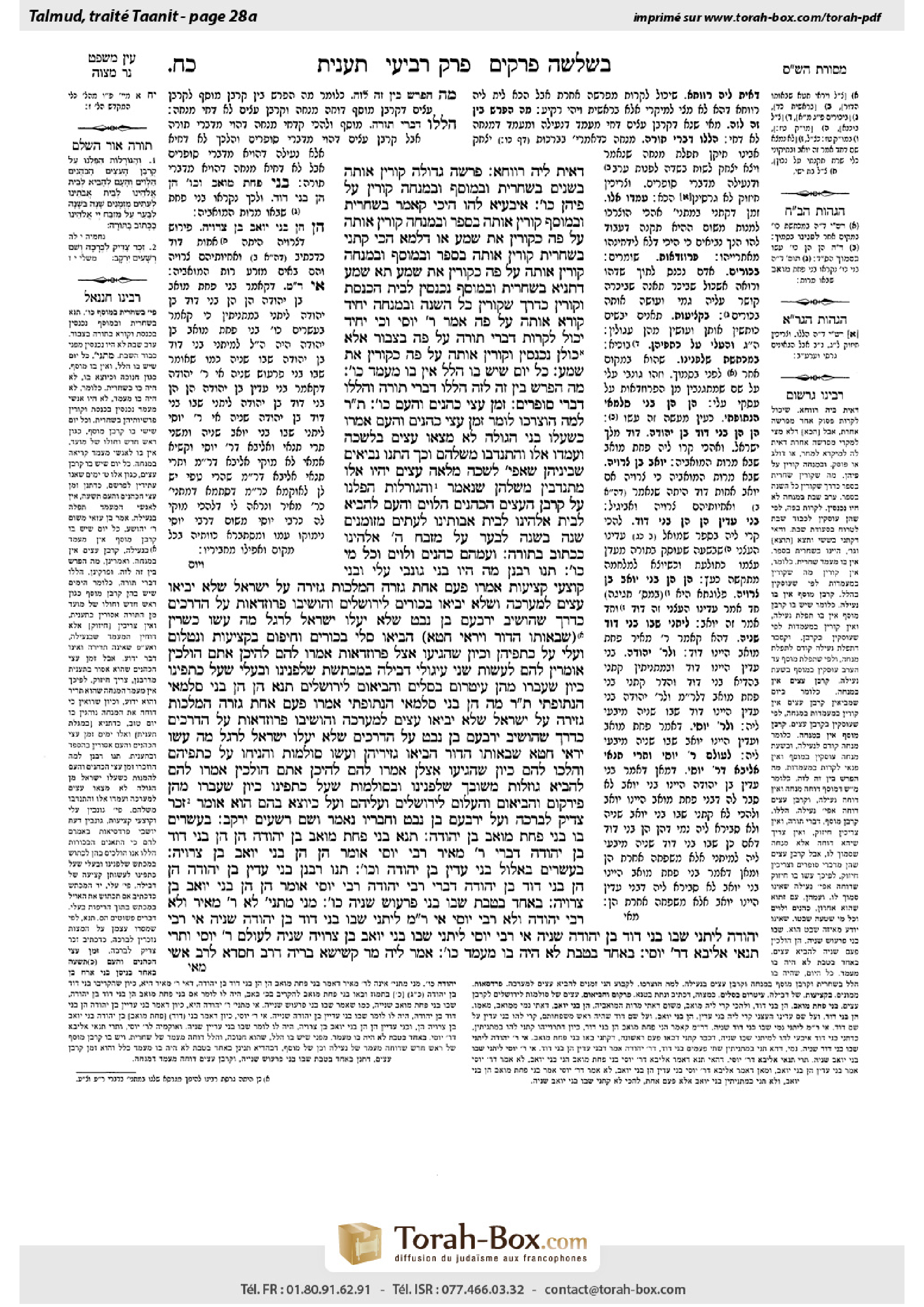
This page of Taanit includes the Aramaic text, an English translation and an AI-generated French translation, alongside the scan above.
תענית כ״ח א · Aramaic and Hebrew text
דְּאִית לֵיהּ רַוְוחָא.
פָּרָשָׁה גְּדוֹלָה קוֹרִין אוֹתָהּ בִּשְׁנַיִם בַּשַּׁחֲרִית וּבַמּוּסָף. וּבַמִּנְחָה קוֹרִין עַל פִּיהֶן כּוּ׳. אִיבַּעְיָא לְהוּ: הֵיכִי קָאָמַר? בַּשַּׁחֲרִית וּבַמּוּסָף קוֹרִין אוֹתָהּ בַּסֵּפֶר, וּבַמִּנְחָה קוֹרִין אוֹתָהּ עַל פֶּה כְּקוֹרִין אֶת שְׁמַע, אוֹ דִלְמָא הָכִי קָתָנֵי: בַּשַּׁחֲרִית קוֹרִין אוֹתָהּ בַּסֵּפֶר, וּבַמּוּסָף וּבַמִּנְחָה קוֹרִין אוֹתָהּ עַל פֶּה כְּקוֹרִין אֶת שְׁמַע?
תָּא שְׁמַע, דְּתַנְיָא: בַּשַּׁחֲרִית וּבַמּוּסָף נִכְנָסִין לְבֵית הַכְּנֶסֶת וְקוֹרִין כְּדֶרֶךְ שֶׁקּוֹרִין כׇּל הַשָּׁנָה, וּבַמִּנְחָה יָחִיד קוֹרֵא אוֹתָהּ עַל פֶּה. אֲמַר רַבִּי יוֹסֵי: וְכִי יָחִיד יָכוֹל לִקְרוֹת דִּבְרֵי תוֹרָה עַל פֶּה בְּצִיבּוּר? אֶלָּא כּוּלָּן נִכְנָסִין וְקוֹרִין אוֹתָהּ עַל פֶּה כְּקוֹרִין אֶת שְׁמַע.
כׇּל יוֹם שֶׁיֵּשׁ בּוֹ הַלֵּל אֵין בּוֹ מַעֲמָד כּוּ׳. מָה הֶפְרֵשׁ בֵּין זֶה לָזֶה? הַלָּלוּ דִּבְרֵי תוֹרָה, וְהַלָּלוּ דִּבְרֵי סוֹפְרִים.
זְמַן עֲצֵי כֹהֲנִים וְהָעָם כּוּ׳. תָּנוּ רַבָּנַן: לָמָּה הוּצְרְכוּ לוֹמַר זְמַן עֲצֵי כֹהֲנִים וְהָעָם? אָמְרוּ: כְּשֶׁעָלוּ בְּנֵי הַגּוֹלָה לֹא מָצְאוּ עֵצִים בַּלִּשְׁכָּה, וְעָמְדוּ אֵלּוּ וְהִתְנַדְּבוּ מִשֶּׁלָּהֶם.
וְכָךְ הִתְנוּ נְבִיאִים שֶׁבֵּינֵיהֶן: שֶׁאֲפִילּוּ לִשְׁכָּה מְלֵאָה עֵצִים יִהְיוּ אֵלּוּ מִתְנַדְּבִין מִשֶּׁלָּהֶן, שֶׁנֶּאֱמַר: ״וְהַגּוֹרָלוֹת הִפַּלְנוּ עַל קֻרְבַּן הָעֵצִים הַכֹּהֲנִים הַלְוִיִּם וְהָעָם לְהָבִיא לְבֵית אֱלֹהֵינוּ לְבֵית אֲבוֹתֵינוּ לְעִתִּים מְזֻמָּנִים שָׁנָה בְשָׁנָה לְבַעֵר עַל מִזְבַּח ה׳ אֱלֹהֵינוּ כַּכָּתוּב בַּתּוֹרָה״.
וְעִמָּהֶם כֹּהֲנִים וּלְוִיִּם וְכׇל מִי כּוּ׳. תָּנוּ רַבָּנַן: מָה הָיוּ בְּנֵי גּוֹנְבֵי עֱלִי וּבְנֵי קוֹצְעֵי קְצִיעוֹת?
אָמְרוּ: פַּעַם אַחַת גָּזְרָה מַלְכוּת הָרְשָׁעָה שְׁמָד עַל יִשְׂרָאֵל שֶׁלֹּא יָבִיאוּ עֵצִים לַמַּעֲרָכָה, וְשֶׁלֹּא יָבִיאוּ בִּכּוּרִים לִירוּשָׁלַיִם, וְהוֹשִׁיבוּ פְּרוֹזְדָאוֹת עַל הַדְּרָכִים כְּדֶרֶךְ שֶׁהוֹשִׁיב יָרׇבְעָם בֶּן נְבָט, שֶׁלֹּא יַעֲלוּ יִשְׂרָאֵל לָרֶגֶל.
מָה עָשׂוּ כְּשֵׁרִין וְיִרְאֵי חֵטְא שֶׁבְּאוֹתוֹ הַדּוֹר? הֵבִיאוּ סַלֵּי בִכּוּרִים וְחִיפּוּם בִּקְצִיעוֹת וּנְטָלוּם, וֶעֱלִי עַל כִּתְפֵיהֶן. וְכֵיוָן שֶׁהִגִּיעוּ אֵצֶל פְּרוֹזְדָאוֹת, אָמְרוּ לָהֶם: לְהֵיכָן אַתֶּם הוֹלְכִין? אוֹמְרִין לָהֶם: לַעֲשׂוֹת שְׁנֵי עִגּוּלֵי דְבֵילָה בַּמַּכְתֶּשֶׁת שֶׁלְּפָנֵינוּ, וּבָעֱלִי שֶׁעַל כְּתֵפֵינוּ. כֵּיוָן שֶׁעָבְרוּ מֵהֶן — עִיטְּרוּם בְּסַלִּים, וֶהֱבִיאוּם לִירוּשָׁלַיִם.
תָּנָא: הֵן הֵן בְּנֵי סַלְמַאי הַנְּתוֹפָתִי. תָּנוּ רַבָּנַן: מָה הֵן בְּנֵי סַלְמַאי הַנְּתוֹפָתִי? אָמְרוּ: פַּעַם אַחַת גָּזְרָה מַלְכוּת הָרְשָׁעָה שְׁמָד עַל יִשְׂרָאֵל שֶׁלֹּא יָבִיאוּ עֵצִים לַמַּעֲרָכָה, וְהוֹשִׁיבוּ פְּרוֹזְדָאוֹת עַל הַדְּרָכִים כְּדֶרֶךְ שֶׁהוֹשִׁיב יָרׇבְעָם בֶּן נְבָט עַל הַדְּרָכִים, שֶׁלֹּא יַעֲלוּ יִשְׂרָאֵל לָרֶגֶל.
מָה עָשׂוּ יִרְאֵי חֵטְא שֶׁבְּאוֹתוֹ הַדּוֹר? הֵבִיאוּ גְּזִירֵיהֶן וְעָשׂוּ סוּלָּמוֹת, וְהִנִּיחוּ עַל כִּתְפֵיהֶם וְהָלְכוּ לָהֶם. כֵּיוָן שֶׁהִגִּיעוּ אֶצְלָן, אָמְרוּ לָהֶם: לְהֵיכָן אַתֶּם הוֹלְכִין? אָמְרוּ לָהֶם: לְהָבִיא גּוֹזָלוֹת מִשּׁוֹבָךְ שֶׁלְּפָנֵינוּ וּבַסּוּלָּמוֹת שֶׁעַל כְּתֵפֵינוּ. כֵּיוָן שֶׁעָבְרוּ מֵהֶן פֵּירְקוּם וֶהֱבִיאוּם וְהֶעֱלוּם לִירוּשָׁלַיִם.
וַעֲלֵיהֶם וְעַל כַּיּוֹצֵא בָּהֶם הוּא אוֹמֵר: ״זֵכֶר צַדִּיק לִבְרָכָה״, וְעַל יָרׇבְעָם בֶּן נְבָט וַחֲבֵרָיו נֶאֱמַר: ״וְשֵׁם רְשָׁעִים יִרְקָב״.
בְּעֶשְׂרִים בּוֹ בְּנֵי פַּחַת מוֹאָב בֶּן יְהוּדָה. תָּנָא: בְּנֵי פַּחַת מוֹאָב בֶּן יְהוּדָה — הֵן הֵן בְּנֵי דָוִד בֶּן יְהוּדָה, דִּבְרֵי רַבִּי מֵאִיר. רַבִּי יוֹסֵי אוֹמֵר: הֵן הֵן בְּנֵי יוֹאָב בֶּן צְרוּיָה.
בְּעֶשְׂרִים בֶּאֱלוּל בְּנֵי עָדִין בֶּן יְהוּדָה וְכוּ׳. תָּנוּ רַבָּנַן: בְּנֵי עָדִין בֶּן יְהוּדָה — הֵן הֵן בְּנֵי דָוִד בֶּן יְהוּדָה, דִּבְרֵי רַבִּי יְהוּדָה. רַבִּי יוֹסֵי אוֹמֵר: הֵן הֵן בְּנֵי יוֹאָב בֶּן צְרוּיָה.
בְּאֶחָד בְּטֵבֵת שָׁבוּ בְּנֵי פַרְעוֹשׁ שְׁנִיָּה כּוּ׳. מַנִּי מַתְנִיתִין? לָא רַבִּי מֵאִיר, וְלָא רַבִּי יְהוּדָה, וְלָא רַבִּי יוֹסֵי. אִי רַבִּי מֵאִיר, לִיתְנֵי: שָׁבוּ בְּנֵי דָוִד בֶּן יְהוּדָה שְׁנִיָּה!
אִי רַבִּי יְהוּדָה, לִיתְנֵי: שָׁבוּ בְּנֵי דָוִד בֶּן יְהוּדָה שְׁנִיָּה! אִי רַבִּי יוֹסֵי, לִיתְנֵי: שָׁבוּ בְּנֵי יוֹאָב בֶּן צְרוּיָה שְׁנִיָּה!
לְעוֹלָם רַבִּי יוֹסֵי, וּתְרֵי תַנָּאֵי אַלִּיבָּא דְּרַבִּי יוֹסֵי.
בְּאֶחָד בְּטֵבֵת לֹא הָיָה בּוֹ מַעֲמָד כּוּ׳. אֲמַר לֵיהּ מָר קַשִּׁישָׁא בְּרֵיהּ דְּרַב חִסְדָּא לְרַב אָשֵׁי:
Taanit 28a · English translation
as the second reader has space, i.e., he has the option to read from the ensuing paragraph.
§ The mishna taught: A long passage is read by two people, and they read from the Torah in the morning prayer and in the additional prayer. And in the afternoon prayer they read the daily portion by heart, just as one recites Shema. A dilemma was raised before the Sages: With regard to what case is the tanna speaking? Does he mean that in the morning prayer and in the additional prayer they read the portion from a Torah scroll, but in the afternoon prayer each individual reads by heart, just as one recites Shema? Or perhaps this is what is taught: In the morning prayer they read it from a Torah scroll, but in the additional prayer and in the afternoon prayer they read it by heart, just as one recites Shema.
The Gemara suggests: Come and hear, as it is taught in a baraita: In the morning prayer and in the additional prayer they would enter the synagogue and read from the Torah in the manner that they read all year. But in the afternoon prayer, a single individual would read the portion for that day by heart. Rabbi Yosei said: But can an individual read matters of Torah by heart in the presence of the community? Rather, they all enter and read that day’s portion together, just as one recites Shema. This baraita clearly indicates that they would read by heart only in the afternoon service.
The mishna taught: On any day that has the recitation of hallel, but on which the additional offering was not sacrificed, it has no reading of the Torah by the non-priestly watch in the morning service. On days that have both hallel and an additional offering, there was no reading in the afternoon prayer. When a wood offering was brought, there was no reading in the closing prayer. The Gemara asks: What is the difference between this and that, a day on which an additional offering is sacrificed and a day on which a wood offering is brought? The Gemara explains: These days, on which an additional offering is brought, apply by Torah law, but these days, on which a wood offering is brought, apply by rabbinic law, and therefore it overrides only the closing prayer.
The mishna continues with a list of the times for the wood offering of priests and the people. The Sages taught: Why was it necessary to state the times for the wood offering of priests and the people? They said in response that this is what happened: When the people of the exile ascended to Jerusalem in the beginning of the Second Temple period, they did not find enough wood in the Temple chamber for the needs of the altar. And these families arose and donated from their own wood to the Temple.
And the prophets among them stipulated as follows, that even if the entire chamber were full of wood, the descendants of these families would donate wood from their own property on these specific days, as it is stated: “And we cast lots, the priests, the Levites and the people, for the wood offering, to bring it into the house of our God, according to our fathers’ houses, at appointed times year by year, to burn upon the altar of the Lord our God, as it is written in the Torah” (Nehemiah 10:35). Although these donations were not always necessary, it was established that all generations would observe these days.
The mishna further taught that on the fifteenth of Av, wood was brought by the descendants of Zattu ben Yehuda, and with this group were other priests and Levites, and anyone who erred with regard to his tribe, i.e., Israelites who did not know which tribe they were from, and the descendants of those who deceived the authorities with a pestle, and the descendants of those who packed dried figs. The Sages taught: Who were the descendants of those who deceived the authorities with a pestle and the descendants of those who packed dried figs?
They said in explanation: Once, the evil kingdom of Greece issued a decree of apostasy against the Jews, that they may not bring wood for the arrangement of the altar and that they may not bring first fruits to Jerusalem. And they placed guards [prozda’ot] on the roads, in the manner that Jeroboam, son of Nevat, placed guards, so that the Jews could not ascend for the pilgrim Festival.
What did the worthy and sin-fearing individuals of that generation do? They brought baskets of first fruits, and covered them with dried figs, and took them with a pestle on their shoulders. And when they reached the guards, the guards said to them: Where are you going? They said to them: We are going to prepare two round cakes of pressed figs with the mortar that is down the road before us and with the pestle that we are carrying on our shoulders. As soon as they passed the guards, they decorated the baskets of first fruits and brought them to Jerusalem.
A Sage taught: This was something that was performed in a similar manner by the descendants of Salmai of Netophat. The Gemara explains this comment by quoting a baraita. The Sages taught: Who are the descendants of Salmai of Netophat? They said in explanation: Once, the evil kingdom of Greece issued a decree of apostasy against the Jews, that they may not bring wood for the arrangement of the altar. And they placed guards on the roads, in the manner that Jeroboam, son of Nevat, placed guards, so that the Jews could not ascend for the pilgrim Festival.
What did the sin-fearing individuals of that generation do? They brought their pieces of wood and prepared ladders [sulamot], and they placed the ladders on their shoulders and went off to Jerusalem. When they reached the guards, the guards said to them: Where are you going? They said to them: We are going to bring down doves from the dovecote that is located down the road before us and with these ladders that are on our shoulders. As soon as they had passed the guards, they dismantled the ladders and took them up to Jerusalem. The name Salmai alludes to the Hebrew word for ladder, sulam.
And about these families who provided these donations and others like them, the verse says: “The memory of the righteous shall be for a blessing” (Proverbs 10:7), as they are remembered for the good throughout the generations. And about Jeroboam, son of Nevat, and his ilk, it is stated: “But the name of the wicked shall rot” (Proverbs 10:7).
§ The mishna taught: On the twentieth of Av, the wood offering was brought by the descendants of Pahath Moab ben Yehuda. A tanna taught: The descendants of Pahath Moab ben Yehuda are the descendants of David ben Yehuda. He is called Moab because Ruth the Moabite was the grandmother of David’s father, Yishai. This is the statement of Rabbi Meir. Rabbi Yosei says: These are the descendants of Joab, son of Zeruiah, whose mother was the daughter of Yishai and therefore also descended from Ruth.
The mishna further taught: On the twentieth of Elul, the descendants of Adin ben Yehuda brought their wood offering. The Sages taught: The descendants of Adin ben Yehuda are the descendants of David ben Yehuda, who was called Adin. This is the statement of Rabbi Yehuda. Rabbi Yosei says: These are the descendants of Joab, son of Zeruiah.
The mishna taught: On the first of Tevet, the descendants of Parosh returned to bring wood for a second time. The Gemara asks: Who is the author of this opinion of the mishna? It is not the opinion of Rabbi Meir, nor that of Rabbi Yehuda, nor that of Rabbi Yosei. The Gemara elaborates: If it represents the opinion of Rabbi Meir, let him teach, with regard to the twentieth of Av, that the descendants of David ben Yehuda returned for a second time. According to Rabbi Meir, the descendants of Pahath Moab are the descendants of David, and consequently they would return for a second time on that date.
The Gemara continues: If it represents the opinion of Rabbi Yehuda, let him teach that the descendants of David ben Yehuda returned for a second time on a different date, the twentieth of Elul, as he contends that the descendants of Adin ben Yehuda are the descendants of David. And if the mishna represents the opinion of Rabbi Yosei, let him teach that the descendants of Joab, son of Zeruiah, returned for a second time, as he maintains that the descendants of Pahath Moab and the descendants of Adin ben Yehuda are both the descendants of Joab.
The Gemara answers: Actually, the mishna represents the opinion of Rabbi Yosei, and there are two tanna’im whose opinion is in accordance with the opinion of Rabbi Yosei. One tanna maintains that only the descendants of Pahath Moab are the descendants of Joab, while the other claims that only the descendants of Adin ben Yehuda are the descendants of Joab. According to both opinions, neither group was repeated a second time, and therefore the mishna does not pose a difficulty to either of them.
§ The mishna taught that on the first of Tevet there was no non-priestly watch at all, as there was an additional offering, hallel, and a wood offering. Mar Kashisha, son of Rav Ḥisda, said to Rav Ashi:
Taanit 28a · Traduction française (IA)
car le second lecteur a de la latitude, c’est-à-dire qu’il peut lire le passage suivant.
§ La Michna a enseigné : Un long passage est lu par deux personnes, et l’on lit dans la Torah lors de la prière du matin et de la prière additionnelle. Lors de la prière de l’après-midi, on récite la portion du jour par cœur, comme on récite le Chéma. Les Sages soulevèrent une question : De quel cas parle le tanna ? Veut-il dire que, lors de la prière du matin et de la prière additionnelle, on lit le passage dans un rouleau de la Torah, tandis que, lors de la prière de l’après-midi, chacun le récite par cœur, comme on récite le Chéma ? Ou bien enseigne-t-il peut-être ceci : lors de la prière du matin, on lit le passage dans un rouleau de la Torah, mais, lors de la prière additionnelle et de la prière de l’après-midi, on le récite par cœur, comme on récite le Chéma ?
La Guemara propose : « Viens et entends », car il est enseigné dans une baraïta : Lors de la prière du matin et de la prière additionnelle, ils entraient dans la synagogue et lisaient dans la Torah comme ils le faisaient toute l’année. Mais, lors de la prière de l’après-midi, un seul individu récitait par cœur la portion du jour. Rabbi Yossi dit : « Un individu peut-il réciter des paroles de Torah par cœur en présence de l’assemblée ? » Il faut plutôt dire qu’ils entraient tous et récitaient ensemble la portion du jour, comme on récite le Chéma. Cette baraïta indique clairement qu’ils récitaient par cœur uniquement lors de la prière de l’après-midi.
La Michna a enseigné : Tout jour où l’on récite le Hallel, mais où le sacrifice additionnel n’est pas offert, il n’y a pas de lecture de la Torah par la garde non sacerdotale lors de la prière du matin. Les jours où il y a à la fois le Hallel et un sacrifice additionnel, il n’y avait pas de lecture lors de la prière de l’après-midi. Lorsqu’une offrande de bois était apportée, il n’y avait pas de lecture lors de la prière de clôture. La Guemara demande : Quelle est la différence entre ces cas, c’est-à-dire entre un jour où un sacrifice additionnel est offert et un jour où une offrande de bois est apportée ? La Guemara explique : Les jours où un sacrifice additionnel est offert sont institués par la Torah, tandis que ceux où une offrande de bois est apportée sont institués par les Sages ; cette offrande ne supprime donc que la lecture de la prière de clôture.
La Michna poursuit en énumérant les dates auxquelles les prêtres et le peuple apportaient l’offrande de bois. Les Sages enseignèrent : Pourquoi fallait-il préciser les dates de l’offrande de bois des prêtres et du peuple ? Ils répondirent que voici ce qui s’était passé : Lorsque les exilés montèrent à Jérusalem au début de la période du Second Temple, ils ne trouvèrent pas assez de bois dans la chambre du Temple pour les besoins de l’autel. Ces familles se levèrent alors et firent don au Temple de leur propre bois.
Les prophètes parmi eux stipulèrent ce qui suit : même si la chambre était entièrement remplie de bois, les descendants de ces familles apporteraient, à ces dates précises, du bois provenant de leurs propres biens, comme il est dit : « Nous tirâmes au sort, les prêtres, les Lévites et le peuple, pour l’offrande de bois, afin de l’apporter dans la maison de notre Dieu, selon nos maisons paternelles, aux dates fixées, année après année, pour le brûler sur l’autel de l’Éternel notre Dieu, comme cela est écrit dans la Torah » (Néhémie 10:35). Bien que ces dons ne fussent pas toujours nécessaires, il fut établi que toutes les générations observeraient ces dates.
La Michna enseigna également que, le quinze Av, les descendants de Zattu ben Yehuda apportaient le bois ; d’autres prêtres et Lévites se joignaient à eux, ainsi que quiconque s’était trompé au sujet de sa tribu, c’est-à-dire les Israélites qui ne savaient pas de quelle tribu ils étaient issus, les descendants de ceux qui avaient trompé les autorités avec un pilon et les descendants de ceux qui avaient emballé des figues sèches. Les Sages enseignèrent : Qui étaient les descendants de ceux qui avaient trompé les autorités avec un pilon et les descendants de ceux qui avaient emballé des figues sèches ?
Ils expliquèrent : Un jour, le royaume malfaisant de Grèce promulgua contre les Juifs un décret d’apostasie leur interdisant d’apporter du bois pour l’agencement de l’autel et d’apporter les prémices à Jérusalem. Des gardes [prozda’ot] furent postés sur les routes, comme l’avait fait Jéroboam, fils de Nevat, afin d’empêcher les Juifs de monter pour la fête de pèlerinage.
Que firent les hommes dignes et craignant le péché de cette génération ? Ils apportèrent des paniers de prémices, les recouvrirent de figues sèches et les transportèrent sur leurs épaules à l’aide d’un pilon. Lorsqu’ils arrivèrent auprès des gardes, ceux-ci leur demandèrent : « Où allez-vous ? » Ils leur répondirent : « Nous allons préparer deux galettes rondes de figues pressées avec le mortier qui se trouve plus loin, devant nous, et avec le pilon que nous portons sur nos épaules. » Dès qu’ils eurent dépassé les gardes, ils décorèrent les paniers de prémices et les apportèrent à Jérusalem.
Un Sage enseigna : Les descendants de Salmai de Netophat firent de même. La Guemara éclaire cette remarque en citant une baraïta. Les Sages enseignèrent : Qui sont les descendants de Salmai de Netophat ? Ils expliquèrent : Un jour, le royaume malfaisant de Grèce promulgua contre les Juifs un décret d’apostasie leur interdisant d’apporter du bois pour l’agencement de l’autel. Des gardes furent postés sur les routes, comme l’avait fait Jéroboam, fils de Nevat, afin d’empêcher les Juifs de monter pour la fête de pèlerinage.
Que firent les hommes craignant le péché de cette génération ? Ils apportèrent leurs morceaux de bois et préparèrent des échelles [sulamot]. Ils les placèrent sur leurs épaules et partirent pour Jérusalem. Lorsqu’ils arrivèrent auprès des gardes, ceux-ci leur demandèrent : « Où allez-vous ? » Ils leur répondirent : « Nous allons faire descendre des colombes du colombier qui se trouve plus loin, devant nous, à l’aide de ces échelles que nous portons sur nos épaules. » Dès qu’ils eurent dépassé les gardes, ils démontèrent les échelles et les emportèrent à Jérusalem. Le nom Salmai fait allusion au mot hébreu désignant une échelle, sulam.
Au sujet de ces familles qui firent ces dons, ainsi que d’autres semblables, le verset dit : « La mémoire du juste est une bénédiction » (Proverbes 10:7), car elles sont évoquées en bien au fil des générations. Et au sujet de Jéroboam, fils de Nevat, et de ses semblables, il est dit : « Mais le nom des méchants pourrira » (Proverbes 10:7).
§ La Michna a enseigné : Le vingt Av, l’offrande de bois était apportée par les descendants de Pahath Moab ben Yehuda. Un tanna enseigna : Les descendants de Pahath Moab ben Yehuda sont les descendants de David ben Yehuda. Il est appelé Moab parce que Ruth la Moabite était la grand-mère de Yichaï, le père de David. Telle est l’opinion de Rabbi Meïr. Rabbi Yossi dit : Il s’agit des descendants de Yoav, fils de Tserouya, dont la mère était la fille de Yichaï et descendait donc elle aussi de Ruth.
La Michna enseigna également que, le vingt Eloul, les descendants d’Adin ben Yehuda apportaient leur offrande de bois. Les Sages enseignèrent : Les descendants d’Adin ben Yehuda sont les descendants de David ben Yehuda, qui était appelé Adin. Telle est l’opinion de Rabbi Yehuda. Rabbi Yossi dit : Il s’agit des descendants de Yoav, fils de Tserouya.
La Michna enseigna : Le premier Tevet, les descendants de Parosh revinrent apporter du bois une seconde fois. La Guemara demande : De qui est cette opinion de la Michna ? Ce n’est ni celle de Rabbi Meïr, ni celle de Rabbi Yehuda, ni celle de Rabbi Yossi. La Guemara précise : S’il s’agissait de l’opinion de Rabbi Meïr, qu’il enseigne que, le vingt Av, les descendants de David ben Yehuda revinrent une seconde fois. Selon Rabbi Meïr, les descendants de Pahath Moab sont les descendants de David et, par conséquent, ils seraient revenus une seconde fois à cette date.
La Guemara poursuit : S’il s’agissait de l’opinion de Rabbi Yehuda, qu’il enseigne que les descendants de David ben Yehuda revinrent une seconde fois à une autre date, le vingt Eloul, puisqu’il soutient que les descendants d’Adin ben Yehuda sont les descendants de David. Et si la Michna exprimait l’opinion de Rabbi Yossi, qu’elle enseigne que les descendants de Yoav, fils de Tserouya, revinrent une seconde fois, puisqu’il soutient que les descendants de Pahath Moab et ceux d’Adin ben Yehuda sont tous deux les descendants de Yoav.
La Guemara répond : En réalité, la Michna exprime l’opinion de Rabbi Yossi, et deux tannaïm partagent cette opinion. Selon l’un, seuls les descendants de Pahath Moab sont les descendants de Yoav ; selon l’autre, seuls les descendants d’Adin ben Yehuda sont les descendants de Yoav. D’après ces deux opinions, aucun des deux groupes ne revient une seconde fois ; la Michna ne pose donc de difficulté ni à l’une ni à l’autre.
§ La Michna enseigna que, le premier Tevet, il n’y avait aucune garde non sacerdotale, car il y avait un sacrifice additionnel, le Hallel et une offrande de bois. Mar Kashisha, fils de Rav Ḥisda, dit à Rav Ashi :
Traduction française générée par IA à partir de l’édition anglaise de Sefaria. Vérifie toujours un passage avec le texte source.
Text from Sefaria: William Davidson Edition - Vocalized Aramaic (CC BY NC); William Davidson Edition - English (CC BY NC).