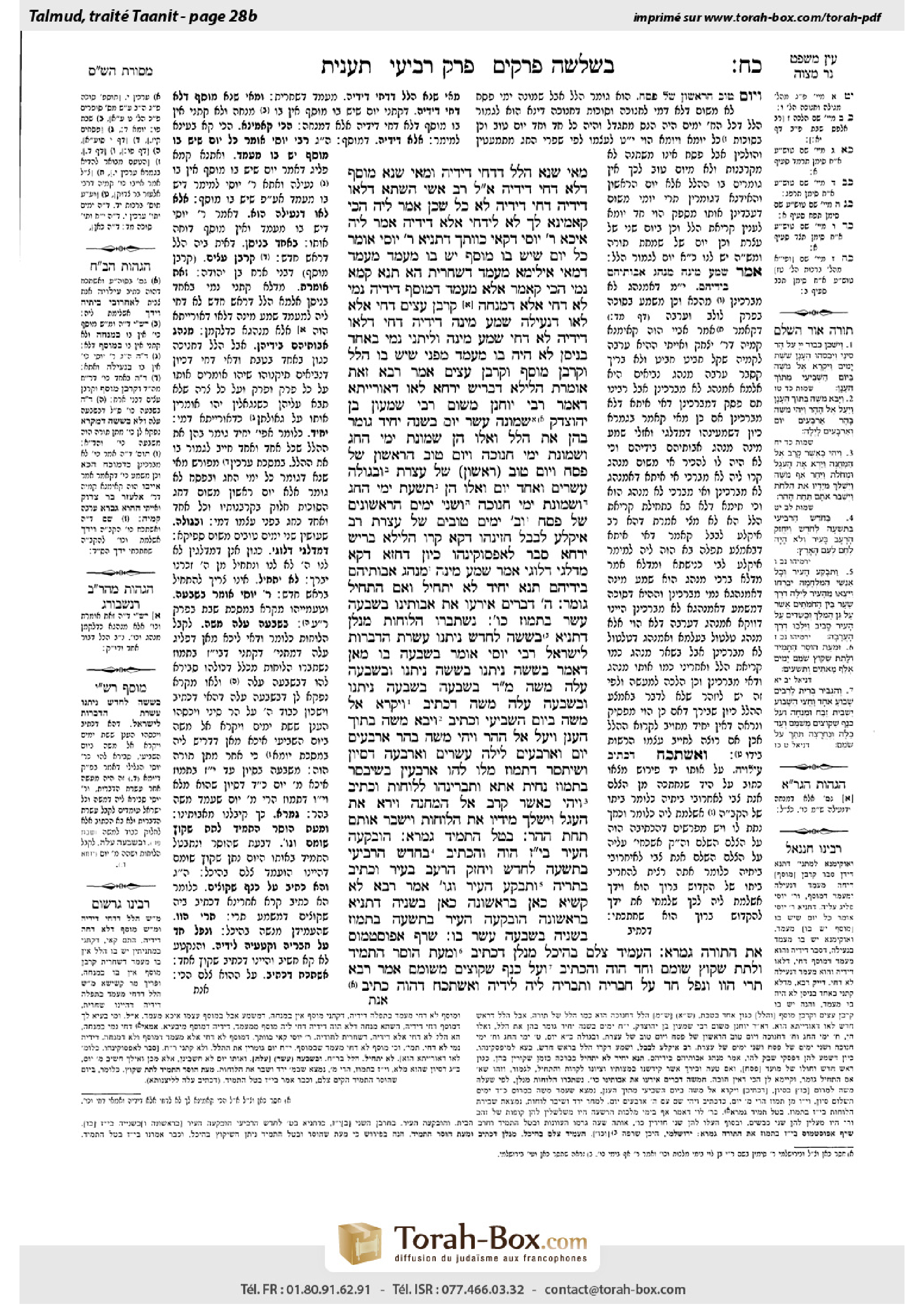
Taanit 28b: Talmud study for Daf Yomi
Daf Yomi is the daily study of one Talmud folio. Explore 37 tractates with scans, Hebrew text, Sefaria English and AI-generated French translations where annotated.
Passage selection and English or AI-generated French translation are available where the scan has annotations. Daf Study is independent of Torah-Box and Sefaria.
Browse Taanit · תענית · All tractatesTaanit 28b text and translations
This page of Taanit includes the Aramaic text, an English translation and an AI-generated French translation, alongside the scan above.
תענית כ״ח ב · Aramaic and Hebrew text
מַאי שְׁנָא הַלֵּל דְּדָחֵי דִּידֵיהּ, וּמַאי שְׁנָא מוּסָף דְּלָא דָּחֵי דִּידֵיהּ?
אֲמַר לֵיהּ רַב אָשֵׁי: הַשְׁתָּא דְּלָאו דִּידֵיהּ דָּחֵי — דִּידֵיהּ לָא כׇּל שֶׁכֵּן? אֲמַר לֵיהּ, הָכִי קָאָמֵינָא לָךְ: לָא לִידְחֵי אֶלָּא דִּידֵיהּ!
אֲמַר לֵיהּ: אִיכָּא רַבִּי יוֹסֵי דְּקָאֵי כְּווֹתָךְ. דְּתַנְיָא, רַבִּי יוֹסֵי אוֹמֵר: כׇּל יוֹם שֶׁיֵּשׁ בּוֹ מוּסָף יֵשׁ בּוֹ מַעֲמָד. מַעֲמָד דְּמַאי? אִילֵימָא מַעֲמָד דְּשַׁחֲרִית, הָא תַּנָּא קַמָּא נָמֵי הָכִי קָאָמַר! אֶלָּא מַעֲמָד דְּמוּסָף — דִּידֵיהּ נָמֵי לָא דָּחֵי?!
אֶלָּא דְּמִנְחָה — קׇרְבַּן עֵצִים דָּחֵי! אֶלָּא לָאו, דִּנְעִילָה. שְׁמַע מִינַּהּ: דִּידֵיהּ דָּחֵי, דְּלָאו דִּידֵיהּ — לָא דָּחֵי. שְׁמַע מִינַּהּ.
וְלִיתְנֵי נָמֵי: בְּאֶחָד בְּנִיסָן לֹא הָיָה בּוֹ מַעֲמָד מִפְּנֵי שֶׁיֵּשׁ בּוֹ הַלֵּל וְקׇרְבַּן מוּסַף וְקׇרְבַּן עֵצִים! אָמַר רָבָא: זֹאת אוֹמֶרֶת הַלֵּילָא דִּבְרֵישׁ יַרְחָא לָאו דְּאוֹרָיְיתָא.
דְּאָמַר רַבִּי יוֹחָנָן מִשּׁוּם רַבִּי שִׁמְעוֹן בֶּן יְהוֹצָדָק: שְׁמוֹנָה עָשָׂר יוֹם בַּשָּׁנָה יָחִיד גּוֹמֵר בָּהֶן אֶת הַהַלֵּל, וְאֵלּוּ הֵן: שְׁמוֹנַת יְמֵי הֶחָג, וּשְׁמוֹנַת יְמֵי חֲנוּכָּה, וְיוֹם טוֹב הָרִאשׁוֹן שֶׁל פֶּסַח, וְיוֹם טוֹב שֶׁל עֲצֶרֶת. וּבַגּוֹלָה, עֶשְׂרִים וְאֶחָד יוֹם, וְאֵלּוּ הֵן: תִּשְׁעַת יְמֵי הַחַג, וּשְׁמוֹנַת יְמֵי חֲנוּכָּה, וּשְׁנֵי יָמִים הָרִאשׁוֹנִים שֶׁל פֶּסַח, וּשְׁנֵי יָמִים טוֹבִים שֶׁל עֲצֶרֶת.
רַב אִיקְּלַע לְבָבֶל, חֲזָנְהוּ דְּקָא קָרוּ הַלֵּילָא בְּרֵישׁ יַרְחָא, סְבַר לְאַפְסוֹקִינְהוּ. כֵּיוָן דַּחֲזָא דְּקָא מְדַלְּגִי דַּלּוֹגֵי, אֲמַר: שְׁמַע מִינַּהּ מִנְהַג אֲבוֹתֵיהֶם בִּידֵיהֶם. תָּנָא: יָחִיד לֹא יַתְחִיל, וְאִם הִתְחִיל גּוֹמֵר.
חֲמִשָּׁה דְּבָרִים אֵירְעוּ אֶת אֲבוֹתֵינוּ בְּשִׁבְעָה עָשָׂר בְּתַמּוּז וְכוּ׳. נִשְׁתַּבְּרוּ הַלּוּחוֹת, מְנָלַן? דְּתַנְיָא: בְּשִׁשָּׁה לַחֹדֶשׁ נִיתְּנוּ עֲשֶׂרֶת הַדִּבְּרוֹת לְיִשְׂרָאֵל, רַבִּי יוֹסֵי אוֹמֵר: בְּשִׁבְעָה בּוֹ. מַאן דְּאָמַר בְּשִׁשָּׁה נִיתְּנוּ — בְּשִׁשָּׁה נִיתְּנוּ, וּבְשִׁבְעָה עָלָה מֹשֶׁה.
מַאן דְּאָמַר בְּשִׁבְעָה — בְּשִׁבְעָה נִיתְּנוּ, וּבְשִׁבְעָה עָלָה מֹשֶׁה, דִּכְתִיב: ״וַיִּקְרָא אֶל מֹשֶׁה בַּיּוֹם הַשְּׁבִיעִי״, וּכְתִיב: ״וַיָּבֹא מֹשֶׁה בְּתוֹךְ הֶעָנָן וַיַּעַל אֶל הָהָר וַיְהִי מֹשֶׁה בָּהָר אַרְבָּעִים יוֹם וְאַרְבָּעִים לָיְלָה״. עֶשְׂרִים וְאַרְבְּעָה דְּסִיוָן, וְשִׁיתְּסַר דְּתַמּוּז, מְלוֹ לְהוּ אַרְבְּעִין.
בְּשִׁיבְסַר בְּתַמּוּז נְחֵית, אֲתָא וְתַבְרִינְהוּ לְלוּחוֹת, וּכְתִיב: ״וַיְהִי כַּאֲשֶׁר קָרַב אֶל הַמַּחֲנֶה וַיַּרְא אֶת הָעֵגֶל וַיַּשְׁלֵךְ מִיָּדָיו אֶת הַלֻּחוֹת וַיְשַׁבֵּר אֹתָם תַּחַת הָהָר״.
בָּטַל הַתָּמִיד — גְּמָרָא.
הוּבְקְעָה הָעִיר. בְּשִׁבְעָה עָשָׂר? וְהָכְתִיב: ״בַּחֹדֶשׁ הָרְבִיעִי בְּתִשְׁעָה לַחֹדֶשׁ וַיֶּחֱזַק הָרָעָב בָּעִיר״, וּכְתִיב בָּתְרֵיהּ: ״וַתִּבָּקַע הָעִיר וְגוֹ׳״!
אָמַר רָבָא, לָא קַשְׁיָא: כָּאן — בָּרִאשׁוֹנָה, כָּאן — בַּשְּׁנִיָּה. דְּתַנְיָא: בָּרִאשׁוֹנָה הוּבְקְעָה הָעִיר בְּתִשְׁעָה בְּתַמּוּז, בַּשְּׁנִיָּה בְּשִׁבְעָה עָשָׂר בּוֹ.
שָׂרַף אַפּוֹסְטְמוֹס אֶת הַתּוֹרָה — גְּמָרָא.
הֶעֱמִיד צֶלֶם בַּהֵיכׇל, מְנָלַן? דִּכְתִיב: ״וּמֵעֵת הוּסַר הַתָּמִיד וְלָתֵת שִׁקּוּץ שֹׁמֵם״.
וְחַד הֲוָה? וְהָכְתִיב: ״וְעַל כְּנַף שִׁקּוּצִים מְשֹׁמֵם״! אָמַר רָבָא: תְּרֵי הֲווֹ, וּנְפַל חַד עַל חַבְרֵיהּ וְתַבְרֵיהּ (לֵיהּ) לִידֵיהּ, וְאִשְׁתְּכַח דַּהֲוָה כְּתִיב:
Taanit 28b · English translation
What is different about hallel that it overrides its own watch, i.e., the watch in the morning service, when hallel is recited; and what is different about the additional offering, that it does not override its own watch, of the morning service, but it does override the watch of the afternoon service and the closing prayer?
Rav Ashi said to him: Now, as the additional offering overrides the watch of the afternoon service, which is not its own, is it not all the more so that it should take precedence over its own watch? Rav Ḥisda said to Rav Ashi: I meant the opposite, as this is what I am saying to you: It should not take precedence over another watch, that of the closing prayer; rather, let it override only its own watch, the one performed in the additional service.
Rav Ashi said to him: There is Rabbi Yosei, who holds in accordance with your opinion, as it is taught in a baraita that Rabbi Yosei says: On any day on which there is an additional offering, there is a non-priestly watch. The Gemara clarifies: To which non-priestly watch is he referring? If we say that Rabbi Yosei means the non-priestly watch of the morning prayer, but the first tanna also said this. Rather, Rabbi Yosei must mean the non-priestly watch of the additional prayer. However, this too is problematic; is it possible that the additional offering does not override even its own watch, during the additional service itself?
Rather, Rabbi Yosei must be referring to the watch of the afternoon prayer. However, this is also puzzling, for if the wood offering overrides the watch of the afternoon service, the additional offering should certainly take precedence over it. Rather, is it not the case that Rabbi Yosei is speaking of the watch in the closing prayer? One can learn from this that the additional offering overrides its own watch, but it does not override a watch that is not its own. The Gemara concludes: Indeed, learn from this that this is the case.
The Gemara asks: And let the mishna also teach: On the first of Nisan there was no non-priestly watch because it is a day on which hallel is recited, and it is the New Moon, on which an additional offering is sacrificed, and there was also a wood offering. Rava said: That is to say that the hallel recited on a New Moon is not required by Torah law but is a custom.
As Rabbi Yoḥanan said in the name of Rabbi Shimon ben Yehotzadak: On eighteen days a year, the individual completes the full hallel. And they are: The eight days of the festival of Sukkot, including the Eighth Day of Assembly; the eight days of Hanukkah; the first Festival day of Passover; and the Festival day of Assembly, i.e., Shavuot. And in the Diaspora, where a second day is added to each Festival due to uncertainty over the correct date, there are twenty-one days, and they are: The nine days of the festival of Sukkot, including the last day, known as the Celebration of the Torah, the eight days of Hanukkah, the first two days of Passover, and the two Festival days of Assembly.
On this topic, the Gemara relates: Rav happened to come to Babylonia, where he saw that they were reciting hallel on a New Moon. Unfamiliar with this practice, he thought to stop them, as he assumed that they were reciting hallel unnecessarily. Once he saw that they were omitting portions, he said: I can learn from this that they are maintaining the custom of their forefathers, i.e., they know that it is a custom, not an obligation. It is taught in a baraita: An individual should not begin reciting hallel on a New Moon, but if he has begun he should complete it.
§ The mishna taught: Five calamitous matters occurred to our forefathers on the seventeenth of Tammuz, one of which was that the tablets were broken. The Gemara asks: From where do we derive that the tablets were broken on this day? As it is taught in a baraita: On the sixth of the month of Sivan the Ten Commandments were given to the Jewish people. Rabbi Yosei says: It was on the seventh of that month. The Gemara comments: According to the one who said that they were given on the sixth of Sivan, they were given on the sixth, and on the seventh Moses ascended to Mount Sinai.
According to the one who said that the Ten Commandments were given on the seventh of Sivan, they were given on the seventh, and on the seventh Moses ascended to Mount Sinai, as it is written: “And He called to Moses on the seventh day out of the midst of the cloud” (Exodus 24:16), and it is written: “And Moses entered into the midst of the cloud, and he went up into the mount, and Moses was on the mount forty days and forty nights” (Exodus 24:18). The calculation is as follows: There were twenty-four days remaining in Sivan, plus the first sixteen days of Tammuz, which comes to forty days.
On the seventeenth of Tammuz, Moses descended, came, observed the people worshipping the Golden Calf, and broke the tablets. And it is written: “And it came to pass, as soon as he came near to the camp, that he saw the calf and the dancing, and Moses’ anger burned, and he cast the tablets out of his hands, and broke them beneath the mount” (Exodus 32:19). This shows that the tablets were shattered on the seventeenth of Tammuz.
§ The mishna taught that on the seventeenth of Tammuz the daily offering was nullified. The Gemara explains: It is a tradition that this occurred on that date.
The mishna further taught that on the seventeenth of Tammuz the city walls of Jerusalem were breached. The Gemara asks: Was this tragedy something that occurred on the seventeenth of Tammuz? But isn’t it written: “In the fourth month, on the ninth of the month, the famine was severe in the city” (Jeremiah 52:6), and it is written immediately afterward: “Then a breach was made in the city” (Jeremiah 52:7), which clearly indicates that the city was breached on the ninth.
Rava said: This is not difficult, as here the verse is referring to the First Temple, whereas there, in the mishna, it describes the destruction of the Second Temple, as it is taught in a baraita: Upon the destruction of the First Temple, the city walls were breached on the ninth of Tammuz; and at the destruction of the Second Temple they were breached on the seventeenth of Tammuz.
The mishna further taught that on the seventeenth of Tammuz Apostemos publicly burned a Torah scroll. The Gemara explains: This, too, is a tradition.
The mishna also stated that on the seventeenth of Tammuz Manasseh placed an idol in the Sanctuary. The Gemara asks: From where do we derive that this occurred on the seventeenth of Tammuz? As it is written: “And from the time that the daily offering shall be taken away and the abomination that causes appallment is set up” (Daniel 12:11), which indicates that an idol was placed in the Temple on the very day that the daily offering was suspended.
The Gemara asks: And was there only one idol placed there? But isn’t it written: “And upon the wing of detestable things shall be that which causes appallment” (Daniel 9:27)? The plural, “detestable things,” indicates the presence of at least two idols. Rava said: There were initially two idols, but one fell upon the other and broke its hand. Since only one idol was whole, the mishna mentions only that one. Rava continues: And an inscription was found on the broken idol that read:
Taanit 28b · Traduction française (IA)
En quoi le hallel diffère-t-il, puisqu’il suspend sa propre garde, c’est-à-dire celle de l’office du matin, où l’on récite le hallel ? Et en quoi l’offrande supplémentaire diffère-t-elle, puisqu’elle ne suspend pas sa propre garde, celle de l’office du matin, mais suspend la garde de l’office de l’après-midi et celle de la prière de clôture ?
Rav Ashi lui dit : Puisque l’offrande supplémentaire suspend la garde de l’office de l’après-midi, qui n’est pas la sienne, ne devrait-elle pas, à plus forte raison, avoir priorité sur sa propre garde ? Rav Ḥisda dit à Rav Ashi : Je voulais dire le contraire ; voici ce que je te dis : elle ne devrait pas avoir priorité sur une autre garde, celle de la prière de clôture ; qu’elle suspende plutôt uniquement sa propre garde, celle de l’office supplémentaire.
Rav Ashi lui dit : Rabbi Yosei partage ton avis, comme l’enseigne une baraïta : Rabbi Yosei dit : Tout jour où il y a une offrande supplémentaire, il y a une garde non sacerdotale. La Guemara précise : De quelle garde non sacerdotale parle-t-il ? Si l’on dit qu’il s’agit de la garde de l’office du matin, le premier tanna a lui aussi dit cela. Rabbi Yosei doit donc parler de la garde de l’office supplémentaire. Mais cela pose également problème : est-il possible que l’offrande supplémentaire ne suspende même pas sa propre garde, pendant l’office supplémentaire lui-même ?
Rabbi Yosei doit donc parler de la garde de l’office de l’après-midi. Mais cela aussi est étonnant : si l’offrande de bois suspend la garde de l’office de l’après-midi, l’offrande supplémentaire devrait certainement avoir priorité sur elle. N’est-ce donc pas plutôt de la garde de la prière de clôture que parle Rabbi Yosei ? On peut en déduire que l’offrande supplémentaire suspend sa propre garde, mais pas une garde qui n’est pas la sienne. La Guemara conclut : En effet, déduis-en que c’est bien le cas.
La Guemara demande : Que la Michna enseigne aussi que, le premier Nissan, il n’y avait pas de garde non sacerdotale, car c’est un jour où l’on récite le hallel, le jour de la néoménie où l’on offre une offrande supplémentaire, et où il y avait également une offrande de bois. Rava dit : Cela signifie que le hallel récité à la néoménie n’est pas une obligation prescrite par la Torah, mais une coutume.
Car Rabbi Yoḥanan a dit au nom de Rabbi Shimon ben Yehotzadak : Dix-huit jours par an, un particulier récite le hallel complet. Ce sont : les huit jours de la fête de Soukkot, y compris le huitième jour de l’Assemblée ; les huit jours de Hanoucca ; le premier jour de fête de Pessaḥ ; et le jour de fête de l’Assemblée, c’est-à-dire Chavouot. En diaspora, où un deuxième jour est ajouté à chaque fête en raison de l’incertitude quant à la date exacte, il y a vingt et un jours : les neuf jours de la fête de Soukkot, y compris le dernier jour, appelé Sim’hat Torah ; les huit jours de Hanoucca ; les deux premiers jours de Pessaḥ ; et les deux jours de fête de l’Assemblée.
À ce sujet, la Guemara rapporte : Rav arriva par hasard en Babylonie, où il vit que l’on récitait le hallel à la néoménie. Ne connaissant pas cette pratique, il pensa les arrêter, car il supposait qu’ils récitaient le hallel sans nécessité. Lorsqu’il vit qu’ils en omettaient des passages, il dit : J’en déduis qu’ils suivent la coutume de leurs ancêtres, c’est-à-dire qu’ils savent qu’il s’agit d’une coutume et non d’une obligation. Une baraïta enseigne : Un particulier ne doit pas commencer à réciter le hallel à la néoménie, mais, s’il a commencé, il doit le terminer.
§ La Michna a enseigné que cinq calamités frappèrent nos ancêtres le dix-sept Tammouz, dont la brisure des Tables. La Guemara demande : D’où savons-nous que les Tables furent brisées ce jour-là ? Une baraïta enseigne en effet : Le six Sivan, les Dix Commandements furent donnés au peuple juif. Rabbi Yosei dit : C’était le sept de ce mois. La Guemara commente : Selon celui qui dit qu’ils furent donnés le six Sivan, ils furent donnés le six, et Moïse monta au mont Sinaï le sept.
Selon celui qui dit que les Dix Commandements furent donnés le sept Sivan, ils furent donnés le sept, et Moïse monta au mont Sinaï le sept, comme il est écrit : « Il appela Moïse le septième jour du milieu de la nuée » (Exode 24:16), et il est écrit : « Moïse entra au milieu de la nuée, monta sur la montagne, et Moïse demeura sur la montagne quarante jours et quarante nuits » (Exode 24:18). Le calcul est le suivant : il restait vingt-quatre jours en Sivan, auxquels s’ajoutèrent les seize premiers jours de Tammouz, soit quarante jours.
Le dix-sept Tammouz, Moïse descendit, arriva, vit le peuple adorer le Veau d’or et brisa les Tables. Il est écrit : « Dès qu’il se fut approché du camp, il vit le veau et les danses ; la colère de Moïse s’enflamma, il jeta les Tables de ses mains et les brisa au pied de la montagne » (Exode 32:19). Cela montre que les Tables furent brisées le dix-sept Tammouz.
§ La Michna a enseigné que, le dix-sept Tammouz, l’offrande quotidienne fut supprimée. La Guemara explique : La tradition veut que cela se soit produit à cette date.
La Michna a également enseigné que, le dix-sept Tammouz, les murailles de Jérusalem furent percées. La Guemara demande : Cette tragédie eut-elle lieu le dix-sept Tammouz ? N’est-il pas écrit : « Le quatrième mois, le neuvième jour du mois, la famine était intense dans la ville » (Jérémie 52:6), puis immédiatement après : « Alors une brèche fut faite dans la ville » (Jérémie 52:7), ce qui indique clairement que la ville fut percée le neuf ?
Rava dit : Il n’y a pas de difficulté, car le verset évoque ici le Premier Temple, tandis que la Michna, là, décrit la destruction du Second Temple. Une baraïta enseigne en effet : Lors de la destruction du Premier Temple, les murailles de la ville furent percées le neuf Tammouz ; lors de la destruction du Second Temple, elles furent percées le dix-sept Tammouz.
La Michna a également enseigné que, le dix-sept Tammouz, Apostemos brûla publiquement un rouleau de Torah. La Guemara explique : Cela aussi relève de la tradition.
La Michna a également indiqué que, le dix-sept Tammouz, Manassé plaça une idole dans le Sanctuaire. La Guemara demande : D’où savons-nous que cela se produisit le dix-sept Tammouz ? Il est écrit : « Depuis le moment où l’offrande quotidienne sera supprimée et où sera dressée l’abomination qui cause l’épouvante » (Daniel 12:11), ce qui indique qu’une idole fut placée dans le Temple le jour même où l’offrande quotidienne fut supprimée.
La Guemara demande : N’y eut-il qu’une seule idole placée là ? N’est-il pas écrit : « Sur l’aile des choses abominables se trouvera celle qui cause l’épouvante » (Daniel 9:27) ? Le pluriel « choses abominables » indique la présence d’au moins deux idoles. Rava dit : Au départ, il y avait deux idoles, mais l’une tomba sur l’autre et lui brisa la main. Comme une seule idole était intacte, la Michna ne mentionne que celle-là. Rava poursuit : On trouva sur l’idole brisée une inscription qui disait :
Traduction française générée par IA à partir de l’édition anglaise de Sefaria. Vérifie toujours un passage avec le texte source.
Text from Sefaria: William Davidson Edition - Vocalized Aramaic (CC BY NC); William Davidson Edition - English (CC BY NC).